change time VOLKSWAGEN T-ROC 2021 Owner´s Manual
[x] Cancel search | Manufacturer: VOLKSWAGEN, Model Year: 2021, Model line: T-ROC, Model: VOLKSWAGEN T-ROC 2021Pages: 502, PDF Size: 9.42 MB
Page 247 of 502

Volkswagen recommends that Front Assist and also the distance and advance warnings are switched
on at all times. Exceptions ⇒ Limits of Front Assist .
Switching on and off
Switch Front Assist on and off in the vehicle settings of the Infotainment system ⇒ Vehicle settings
menu .
Or: switch Front Assist on and off in the instrument cluster menus ⇒ Instrument cluster menus .
If you switch off Front Assist, the advance warning and distance warning will also be switched off.
The yellow indicator lamp lights up in the instrument cluster display. .
Setting the distance and advance warnings
Switch on Front Assist.
Switch the desired function on and off in the vehicle settings of the Infotainment system ⇒ Vehicle
settings menu .
Depending on the vehicle equipment, you can also set the warning time for the advance warning.
Some settings can be stored in the user accounts of the personalisation function and therefore
change automatically when the user account changes ⇒ Personalisation .
Troubleshooting
First read and observe the introductoryinformation and safety warnings⇒Introduction
Front Assist is not available, the radar sensor does not have sufficient visibility.
The radar sensor is dirty. Clean the radar sensor ⇒ Vehicle care .
The visibility of the radar sensor is impaired due to the weather conditions, e.g. snow, or due to
detergent deposits or coatings. Clean the radar sensor ⇒ Vehicle care .
The visibility of the radar sensor is impaired by add-on parts, the trim frames of number plate
holders or stickers. Keep the area around the radar sensor free.
The radar sensor has been displaced or damaged, e.g. due to damage to the front of the vehicle.
Check whether damage is visible ⇒ Repairs and technical modifications .
Structural modifications have been made to the front of the vehicle.
The genuine Volkswagen badge is not used.
If the problem persists, switch off Front Assist and go to a qualified workshop.
Front Assist does not function as expected or is triggered unnecessarily several times.
The radar sensor is dirty. Clean the radar sensor ⇒ Vehicle care .
The system limits are not met ⇒ Limits of Front Assist .
Page 255 of 502
Spot Monitor tempt you into taking any safety risks when driving. Careless or unintentional use of
the Blind Spot Monitor can cause accidents and serious injuries. The system is not a substitute for
the full concentration of the driver.
Adapt your speed and distance from the vehicles ahead to suit visibility, weather, road and traffic
conditions.
Your hands should always be on the steering wheel so that you can steer at any time.
Pay attention to the indicator lamps in the exterior mirrors and in the instrument cluster display and
respond according to the commands.
Always pay close attention to the surroundings of the vehicle.
Never use the Blind Spot Monitor if the radar sensors are dirty, covered or damaged. These
conditions can impair the proper functioning of the system.
It may be hard to see the indicator lamp in the exterior mirror in direct sunlight.
Some settings can be saved in the user accounts of the personalisation function and can therefore
change automatically when the user account is changed ⇒ Personalisation .
Driving with the Blind Spot Monitor
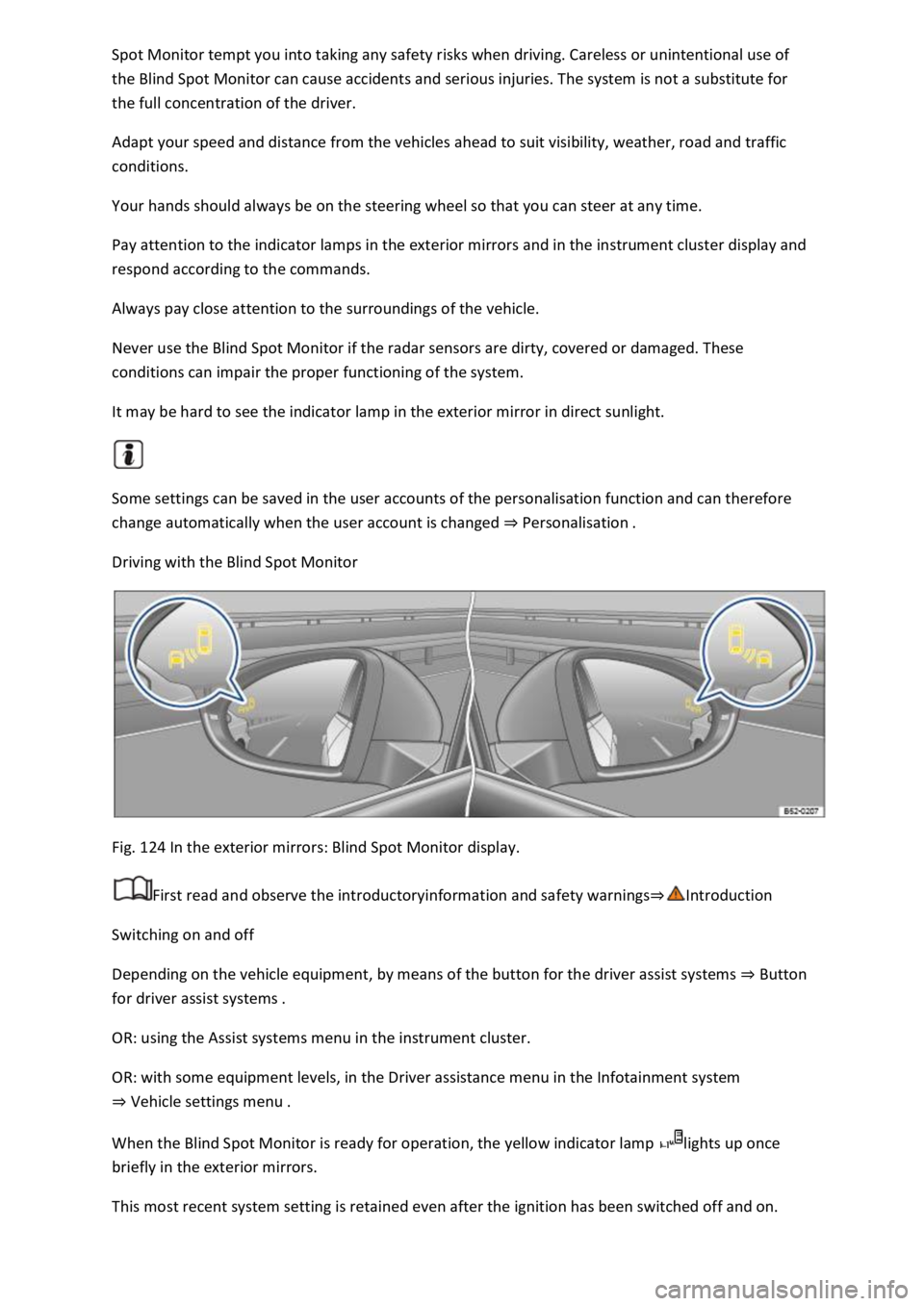
Fig. 124 In the exterior mirrors: Blind Spot Monitor display.
First read and observe the introductoryinformation and safety warnings⇒Introduction
Switching on and off
Depending on the vehicle equipment, by means of the button for the driver assist systems ⇒ Button
for driver assist systems .
OR: using the Assist systems menu in the instrument cluster.
OR: with some equipment levels, in the Driver assistance menu in the Infotainment system
⇒ Vehicle settings menu .
When the Blind Spot Monitor is ready for operation, the yellow indicator lamp lights up once
briefly in the exterior mirrors.
This most recent system setting is retained even after the ignition has been switched off and on.
Page 341 of 502
Do not touch the glass part of the bulb with unprotected fingers. When switched on, the heat of the
bulb would cause the remaining fingerprint to evaporate and be deposited on the reflector. This will
impair the light output of the headlight.
After changing a bulb, check to ensure that the bulb is working properly. If the bulb is not working
properly, the bulb may not have been inserted properly, may have failed again, or the connector
may have been fitted incorrectly.
Any time you change a bulb at the front of the vehicle, the headlight settings should be checked by a
qualified workshop.
WARNING
Ignoring any of the items on this important safety checklist can lead to accidents and severe injuries.
NOTICE
Always take care when removing or fitting lights to prevent damage to the paintwork or to other
vehicle parts.
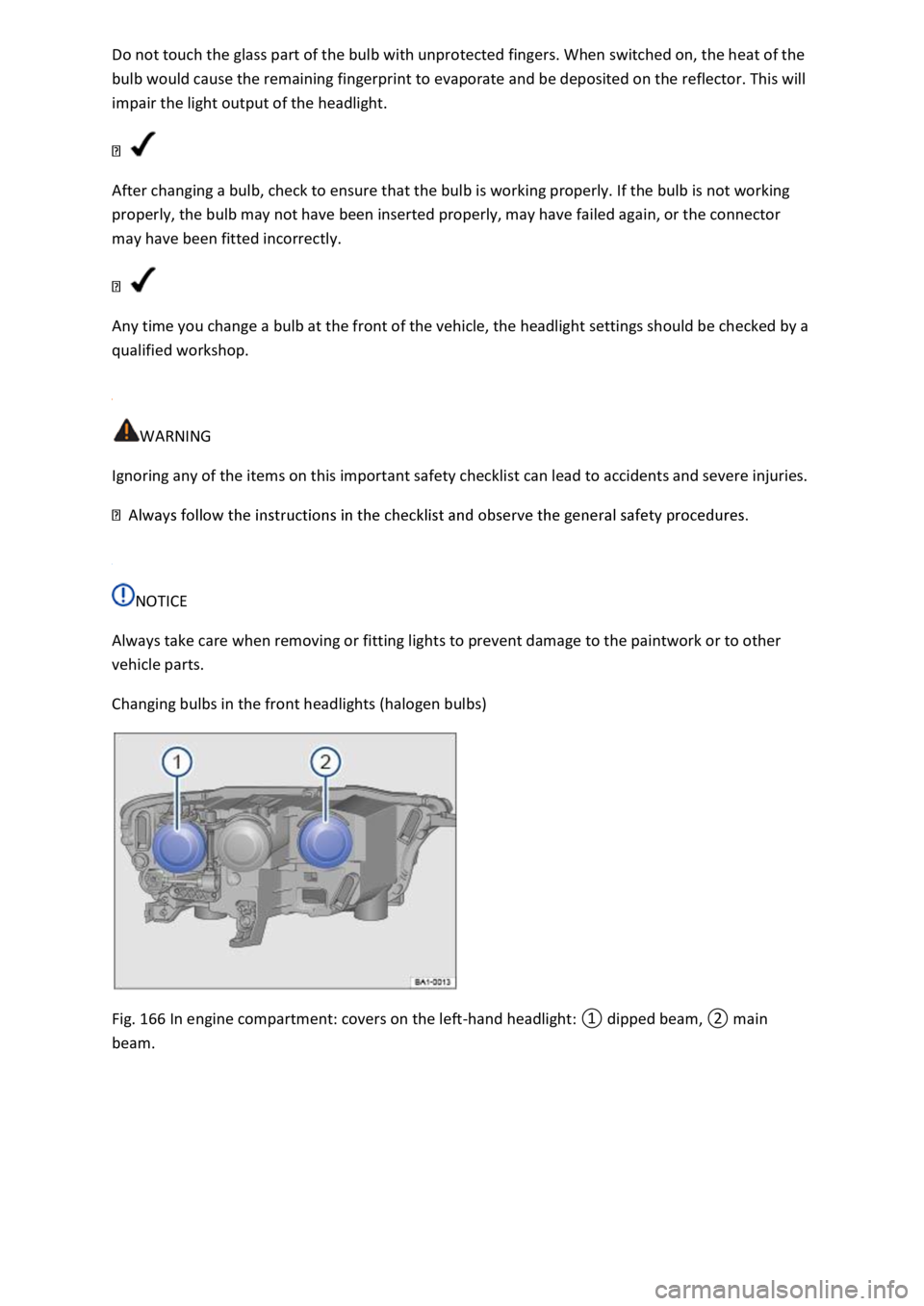
Changing bulbs in the front headlights (halogen bulbs)
Fig. 166 In engine compartment: covers on the left-hand headlight: ① dipped beam, ② main
beam.
Page 372 of 502

Service identification
You can check whether your vehicle is equipped for the Flexible Service QI6 (Longlife) or Fixed
Service QI1, QI2, QI3, QI4, QI7 (dependent on time or mileage) in the vehicle data ⇒ Technical data
or on the inside cover of this owner's manual.
Permitted engine oil standards
Petrol engineswith particulate filter1)
Flexible ServiceVW 508 00 or alternatively VW 504 002)Fixed ServiceVW 502 00
Petrol engineswithout particulate filter
Flexible ServiceVW 508 00 or alternatively VW 504 00Fixed ServiceVW 502 00
Diesel engineswith particulate filter1)
Flexible ServiceVW 507 00Fixed ServiceVW 507 00
Diesel engineswithout particulate filter
Flexible ServiceVW 507 00Fixed ServiceVW 505 01
Volkswagen recommends engine oils.
NOTICE
additives is not covered by the warranty.
Using other engine oils can cause engine damage.
d engine oils are not
available. To avoid damaging the engine, a maximum quantity of 0.5 litres of the following engine oil
may be used only once until the next oil change:
SN (API SM).
ards ACEA C3 or API CJ-4.
1) Check with a qualified workshop if you are unsure whether your vehicle is equipped with a
particulate filter. Volkswagen recommends using a Volkswagen dealership for this purpose.
2) Using VW 504 00 instead of VW 508 00 may cause the vehicle's emissions values to increase
slightly.
Changing engine oil
First read and observe the introductoryinformation and safety warnings⇒Introduction
Page 373 of 502

The engine oil must be changed on a regular basis. Always observe the service intervals applicable to
your vehicle ⇒ Service .
The engine oil and filter change should be carried out by a qualified workshop due to the special
tools and knowledge required, this also applies to the disposal of used oil. Volkswagen recommends
using a Volkswagen dealership for this purpose.
More details on the service intervals can be found in the chapter on service ⇒ Service .
Additives in the engine oil can cause new engine oil to discolour quickly. This is normal and does not
mean that the engine oil should be changed more frequently.
WARNING
If, in exceptional cases, you have to carry out an oil change yourself, please observe the following:
al when removing the oil drain plug with your fingers to help prevent oil
from running down your arm.
engine filling quantity.
l in empty food containers, bottles or any other non-original containers as
people finding these containers may not know that they contain engine oil.
Before changing the engine oil, first find out where old oil can be disposed of properly near you.
Used oil must be disposed of in accordance with regulations governing the protection of the
environment. Never dispose of used oil in locations such as gardens, woods, sewerage systems, on
streets and roads, or in rivers and waterways.
Engine oil consumption
First read and observe the introductoryinformation and safety warnings⇒Introduction
Engine oil consumption can vary from engine to engine and can change during the service life of an
engine.
The vehicle may consume up to 1.0 litre of engine oil per 2,000 km, depending on your driving style
and the conditions in which the car is used. In new vehicles, consumption may be higher for the first
5,000 km. The engine oil level must therefore be checked at regular intervals, preferably each time
the vehicle is refuelled and before long journeys.
Page 383 of 502

Brake fluid that is compliant with VW standard 501 14 is available from Volkswagen dealerships.
If this brake fluid is not available and it is necessary to use another high-quality brake fluid instead,
brake fluid that is compliant with DIN ISO 4925 CLASS 4 or US standard FMVSS 116 DOT 4 can be
used.
Not all brake fluids that are compliant with DIN ISO 4925 CLASS 4 or US standard FMVSS 116 DOT 4
have the same chemical composition. Some of these brake fluids may contain chemicals that can
damage or destroy brake system components over time.
Volkswagen therefore recommends the use of brake fluid that is compliant with VW standard 501 14
to ensure sustained proper operation of the brake system.
Brake fluid that is compliant with VW standard 501 14 fulfils the requirements of DIN ISO 4925
CLASS 4 or US standard FMVSS 116 DOT 4.
Brake fluid level
The brake fluid level must always be between the MIN and MAX marking on the brake fluid reservoir
or above the MIN marking ⇒ .
The brake fluid level cannot be checked accurately in all models as engine components may partially
conceal the fluid level in the brake fluid reservoir. If the brake fluid level cannot be read exactly,
please go to a qualified workshop.
The brake fluid level drops slightly during vehicle operation as the brake pads wear and the brakes
are automatically adjusted.
Brake fluid level
The indicator lamp lights up red.
Brake fluid level is too low.
Do not drive on! Check the brake fluid level.
If the brake fluid level is too low, inform a qualified workshop. Have the brake system checked.
Changing the brake fluid
The brake fluid should be changed by a qualified workshop. Volkswagen recommends using a
Volkswagen dealership for this purpose. Only brake fluid that conforms with the required
specification should be used.
WARNING
Brake failure or reduced braking efficiency can be caused by the brake fluid level being too low or by
brake fluid that is too old or unsuitable.
Page 386 of 502
-volt vehicle battery. Discharged 12-volt vehicle batteries can already freeze
at temperatures of around 0°C (+32°F). Frozen 12-volt vehicle batteries must be renewed
immediately.
NOTICE
Do not expose the 12-volt vehicle battery to direct daylight for an extended time.
NOTICE
Protect the 12-volt vehicle battery against frost if the vehicle is left standing for extended periods.
-volt vehicle battery can freeze and be destroyed as a result.
When you start the engine after the 12-volt battery has been totally discharged or after jump
starting, you may find that system settings (time, date, personal convenience settings and
programming) have been changed or deleted. Check and correct the settings as necessary once the
12-volt vehicle battery has been sufficiently charged.
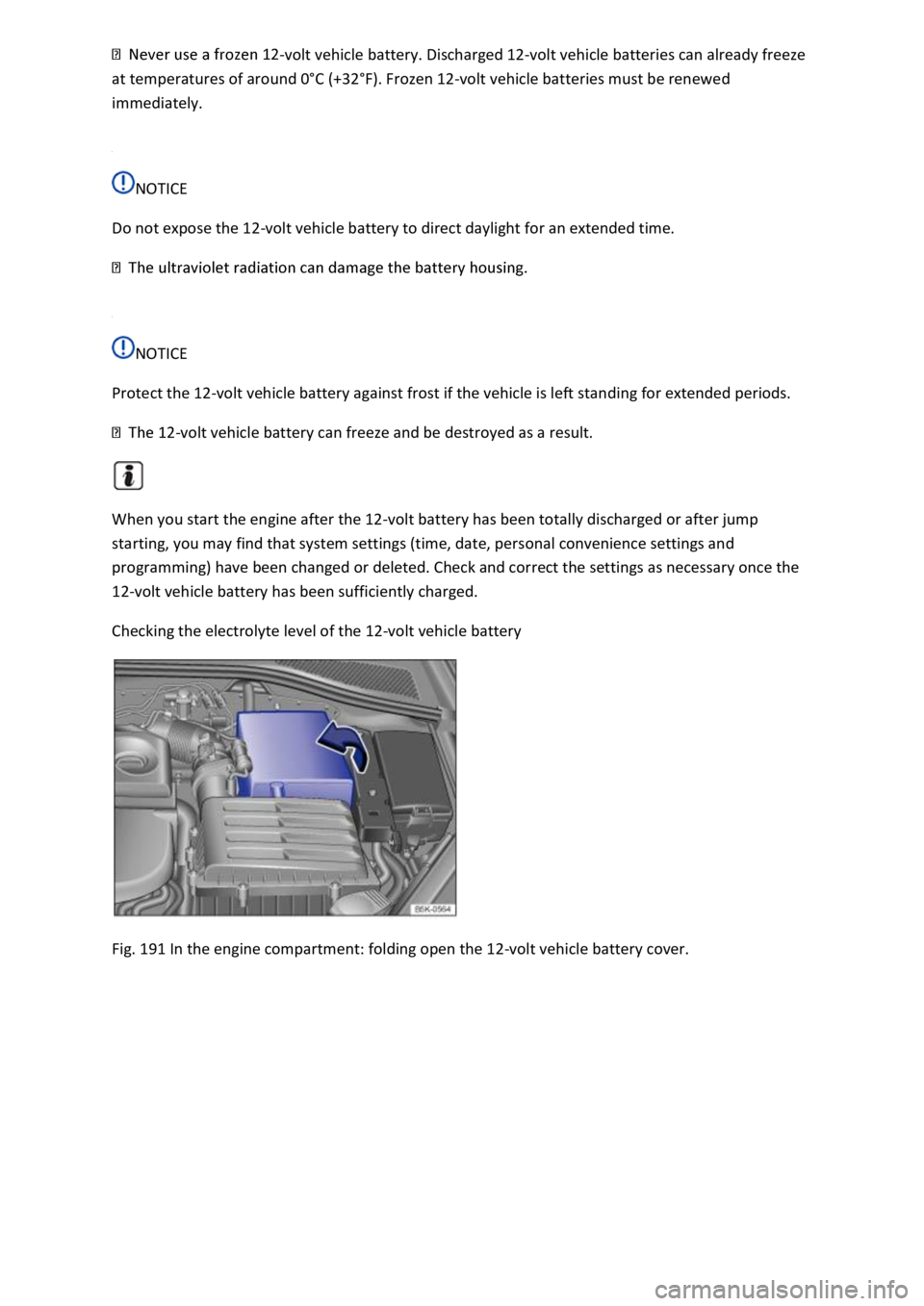
Checking the electrolyte level of the 12-volt vehicle battery
Fig. 191 In the engine compartment: folding open the 12-volt vehicle battery cover.
Page 392 of 502

⇒ Tyre
pressure . If the tyre pressure is too low, it is possible that the tyre temperature will increase to such
an extent that the tread peels off and the tyre bursts.
⇒ Tyre pressure .
eck the tyre pressure regularly when the tyres are cold. If necessary, adjust the tyre pressure in
the cold tyre to the recommended tyre pressure for the tyres installed on your vehicle ⇒ Tyre
pressure .
amage.
If the tyre pressure is too low, this will increase fuel consumption and tyre wear.
When new tyres are driven at high speeds for the first time, they can expand slightly and trigger a
one-off pressure warning.
Old tyres should be replaced only by tyres that have been approved by Volkswagen for the vehicle
type.
Do not rely solely on the tyre monitoring system. Check your tyres regularly to ensure that they are
properly inflated and have no signs of damage, such as punctures, cuts, cracks, and blisters. Remove
any objects that become embedded in the tyre tread but have not penetrated into the body of the
tyre itself.
Tyre Pressure Loss Indicator
First read and observe the introductoryinformation and safety warnings⇒Introduction
Functional description
The Tyre Pressure Loss Indicator uses data from the ABS sensors and other functions to compare the
speed of rotation and the rolling circumference of the individual wheels.
The rolling circumference can change:
Page 397 of 502

The tyres and wheel rims approved by Volkswagen have been carefully selected.
Rotating wheels
Regularly rotating the wheels as shown in the illustration ⇒ Fig. 193 is recommended to help ensure
that tyres wear evenly. All the tyres will then last for about the same time.
Volkswagen recommends having the wheels changed by a qualified workshop.
Avoiding damage to the wheel rims and tyres
⇒ Tyre lettering and
tyre type .
worn tyres must be replaced immediately ⇒ Tyre damage .
fluid ⇒ .
Tyres that are older than 6 years
Tyres age through physical and chemical processes that can impair their function. Tyres that have
been stored unused for an extended period of time age more quickly than tyres that are used all the
time.
Volkswagen recommends replacing tyres that are older than 6 years with new tyres. This also applies
to tyres which appear to still be in good condition and whose tread depth has not yet reached the
minimum value stipulated by legislation ⇒ .
Winter and all-year tyres also largely lose their effectiveness through ageing – regardless of the
remaining tread depth.
The age of each tyre can be determined using the manufacturing date ⇒ Tyre lettering and tyre
type .
Storing tyres
es mounted on the
wheel rim vertically.
should be stored vertically (standing on the tread).
New tyres
with new tyres as the tyres have to be run in. Tyres
that have not been run in have reduced grip ⇒ and braking efficiency ⇒ .
Page 398 of 502

Replacing tyres
lace tyres at least on an axle-by-axle basis ⇒ .
type.
-approved tyres.
Re-synchronising the Tyre Pressure Loss Indicator
The Tyre Pressure Loss Indicator must be re-synchronised each time one or more wheels is changed.
This also applies if the wheels have been swapped, e.g. from the front to the rear ⇒ Tyre monitoring
system .
WARNING
Aggressive liquids and other substances can cause visible and invisible damage to the tyres, which
can cause the tyre to burst.
from the tyres.
WARNING
Even if they have not been used, old tyres can suddenly lose pressure or burst, especially at high
speeds, and thus cause accidents and serious injuries.
ith
extra care at all times.
WARNING
New tyres must be run in as they initially have reduced grip and braking efficiency.
km in order to prevent accidents and serious injury.
WARNING
Wheels must have the necessary clearance. If the wheels do not have the necessary clearance, the
tyre could rub on parts of the running gear, vehicle body and the brake lines. This can lead to a fault
in the brake system and to tread separation and thus to a tyre bursting.
and must not rub on any vehicle body parts.