warning VOLKSWAGEN T-ROC 2021 Owner´s Manual
[x] Cancel search | Manufacturer: VOLKSWAGEN, Model Year: 2021, Model line: T-ROC, Model: VOLKSWAGEN T-ROC 2021Pages: 502, PDF Size: 9.42 MB
Page 43 of 502
its operating temperature. The needle may move further in a clockwise direction under high engine
loads and at high outside temperatures. This is no cause for concern unless the indicator lamp
in the instrument cluster display is lit up or flashing ⇒ Engine oil .
Adapting the display areas to the driving situation
Choose the three possible instruments corresponding to your individual driving style and the driving
situation.
WARNING
Accidents and injuries can occur if the driver is distracted. Operating the Infotainment system can
distract you from the road.
Always drive carefully and responsibly.
NOTICE
When starting from cold, avoid high engine speeds, driving at full throttle and over-loading the
engine.
Due to the principle of performance determination used in the vehicle, the physical accuracy of the
displayed values is not guaranteed.
Lap timer
First read and observe the introductoryinformation and safety warnings⇒Introduction
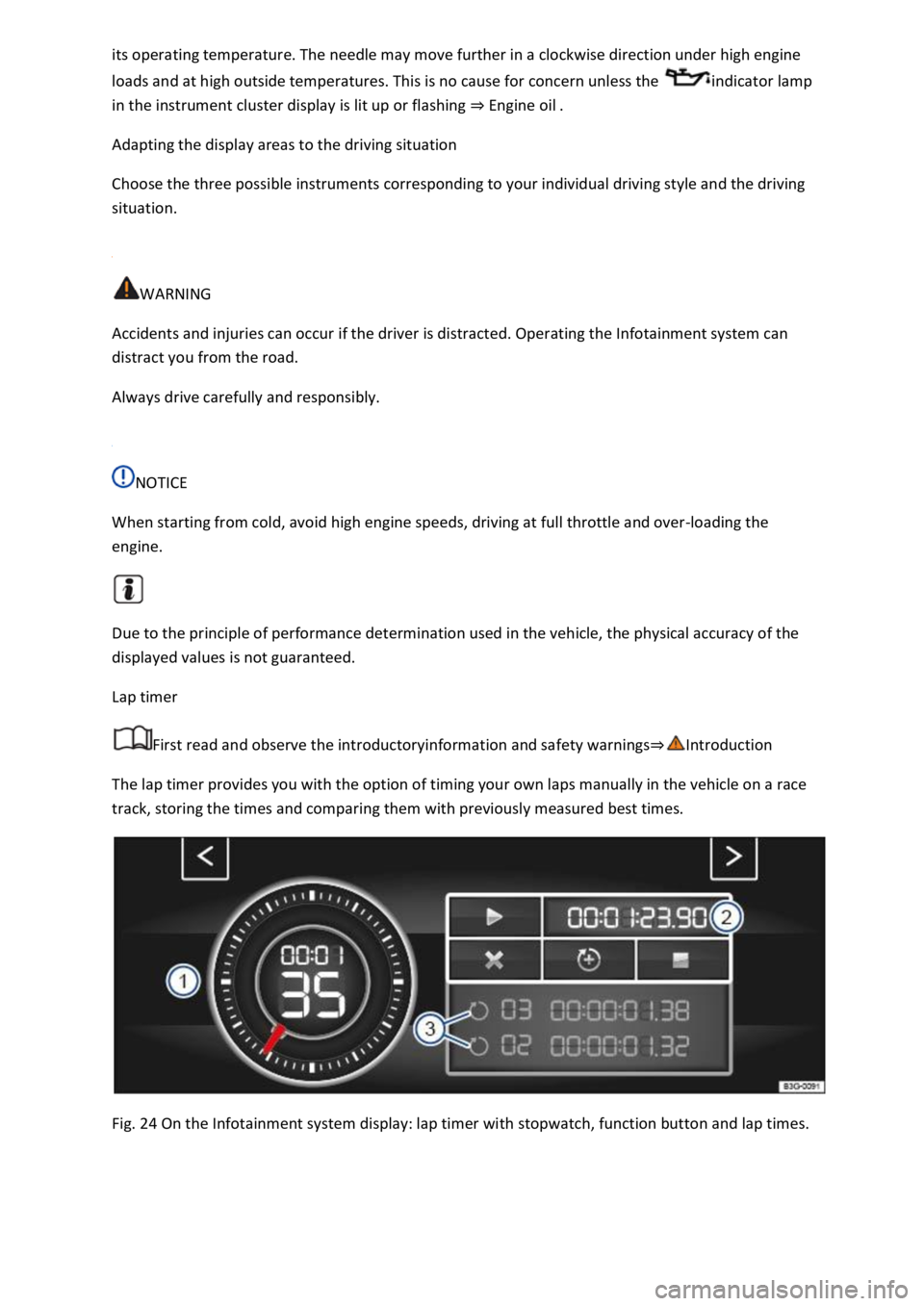
The lap timer provides you with the option of timing your own laps manually in the vehicle on a race
track, storing the times and comparing them with previously measured best times.
Fig. 24 On the Infotainment system display: lap timer with stopwatch, function button and lap times.
Page 45 of 502
Opening the lap timer
Press the MENU button or function button, depending on the version of the Infotainment system.
Touch the Vehicle function button.
Touch the Selection function button.
Touch the Sport function button. The performance monitor is displayed.
Touch one of the arrow buttons ⇒ Fig. 23 ② in the performance monitor to change to the lap
timer.
You can change between the lap timer and performance monitor at any time using the arrow
buttons ⇒ Fig. 23 ② and ⇒ Fig. 24 .
Measuring lap times
The stopwatch measures the lap time in two areas:
The red needle and the numerical value in the centre show the running time in seconds. The smaller
display in the inner area shows minutes and hours.
The display on the right side shows the current lap time with an accuracy of 1/100 seconds. There is
no difference between the stopwatch and lap times if there are not yet any laps with split times
stored in the lap timer.
WARNING
Avoid operating the lap timer when the vehicle is in motion if possible.
Make lap timer settings and access statistics only when the vehicle is stationary.
When the vehicle is in motion, use the lap timer only in driving situations which are easy to control.
Personalisation
First read and observe the introductoryinformation and safety warnings⇒Introduction
The personalisation function allows personalised vehicle settings, such as air conditioning system,
instrument cluster or lighting settings, to be saved in a user account. Four user accounts are
available. Users are identified by the vehicle keys upon unlocking the vehicle. A user account is
assigned to each vehicle key.
Changes to the settings will be assigned to the active user account and saved upon locking the
vehicle or changing the user account.
Welcome and user account selection
When personalisation is activated, the name of the current user account appears on the instrument
cluster display for approximately ten seconds after you switch on the ignition.
During this time, you can select a user account using the buttons on the wiper lever or multifunction
steering wheel ⇒ Infotainment system controls and displays .
Page 50 of 502
Vehicle lighting Lights necessary for traffic safety:
Turn signals
Side lights, dipped beam headlights and main beam headlights
Tail light clusters
Brake lights
Rear fog light
Number plate light
Information on changing bulbs ⇒ Changing bulbs .
DANGER
Please observe important safety information about the front passenger front airbag ⇒ Fitting and
using child seats .
WARNING
Driving under the influence of alcohol, drugs, medication or narcotics could cause accidents and fatal
injuries.
Alcohol, drugs, medication and narcotics can severely impair senses, reaction times and driving
safety. This could cause you to lose control of the vehicle.
WARNING
Always observe current traffic regulations and speed limits, and think ahead when driving. The
correct interpretation of the driving situation can make the difference between reaching your
destination safely and having an accident with serious injuries.
NOTICE
Volkswagen is not responsible for any vehicle damage caused by low-quality fuel, inadequate
servicing work or non-availability of Genuine Parts.
Observe the instructions and information for vehicles with an N1 approval ⇒ Information about
vehicles with N1 approval (light commercial vehicle) .
Page 51 of 502
Servicing the vehicle is not only about vehicle maintenance – it also ensures that your vehicle
remains roadworthy and in perfect working order. You should therefore have your vehicle serviced
according to the Volkswagen guidelines. Some work may have to be carried out before the date of
the next service if the vehicle is subjected to severe operating conditions. Severe operating
conditions are, for example, regular stop-and-go driving or driving in areas with high levels of dust.
Further information can be obtained from your Volkswagen dealership or qualified workshop.
Sitting position
Introduction
This chapter contains information on the followingsubjects:
⇒ Dangers of assuming an incorrect sitting position
⇒ Correct sitting position
Number of seats
The vehicle has a total of five seats: two at the front and three at the rear.
Each seat is equipped with a seat belt.
WARNING
Assuming an incorrect sitting position in the vehicle can increase the risk of severe or fatal injuries
during a sudden driving or braking manoeuvre in the event of a collision or accident or if the airbags
are triggered.
All vehicle occupants must assume a correct sitting position before setting off and maintain this
position throughout the trip. This also applies for the fastening of seat belts.
The number of vehicle occupants must never exceed the number of seats with seat belts in the
vehicle.
Always secure children in the vehicle in an authorised child restraint system which is suitable for
their height and weight ⇒ Safe transport of children and ⇒ Airbag system .
Always keep your feet in the footwell while the vehicle is in motion. Never place your feet on the
seat or dash panel, for example, and never ride with your feet out of the window. The airbag and
seat belt can otherwise not provide optimal protection and can actually increase the risk of injury
during an accident.
Dangers of assuming an incorrect sitting position
First read and observe the introductoryinformation and safety warnings⇒Introduction
If the seat belts are not worn or are worn incorrectly, the risk of severe or fatal injuries increases.
Seat belts can provide optimal protection only if seat belt routing is correct. An incorrect sitting
position considerably impairs the level of protection provided by a seat belt. This could lead to
severe or even fatal injuries. The risk of severe or fatal injuries is especially increased when a
Page 52 of 502

deploying airbag strikes a vehicle occupant who has assumed an incorrect sitting position. The driver
is responsible for all occupants transported in the vehicle, especially children.
The following list contains examples of sitting positions that can be dangerous for all vehicle
occupants.
Whenever the vehicle is in motion:
Never stand in the vehicle.
Never stand on the seats.
Never kneel on the seats.
Never tilt the backrest too far to the rear.
Never lean against the dash panel.
Never lie on the seats in the passenger compartment and on the rear bench seat.
Never sit on the front edge of a seat.
Never sit sideways.
Never lean out of a window.
Never put your feet out of a window.
Never put your feet on the dash panel.
Never place your feet on the seat cushion or seat backrest.
Never travel in a footwell.
Never sit on the armrests.
Never travel on a seat without wearing the seat belt.
Never travel in the luggage compartment.
WARNING
Every incorrect sitting position in the vehicle increases the risk of severe or fatal injuries in the event
of an accident or sudden driving or braking manoeuvre.
All vehicle occupants must maintain a correct sitting position and wear their seat belt properly while
the vehicle is in motion.
Sitting in an incorrect position, not fastening the seat belt, or not leaving adequate space between
the occupants and the airbags could inflict critical or fatal injuries, especially if the airbags deploy
and strike an occupant who has assumed an incorrect sitting position.
Correct sitting position
Page 53 of 502
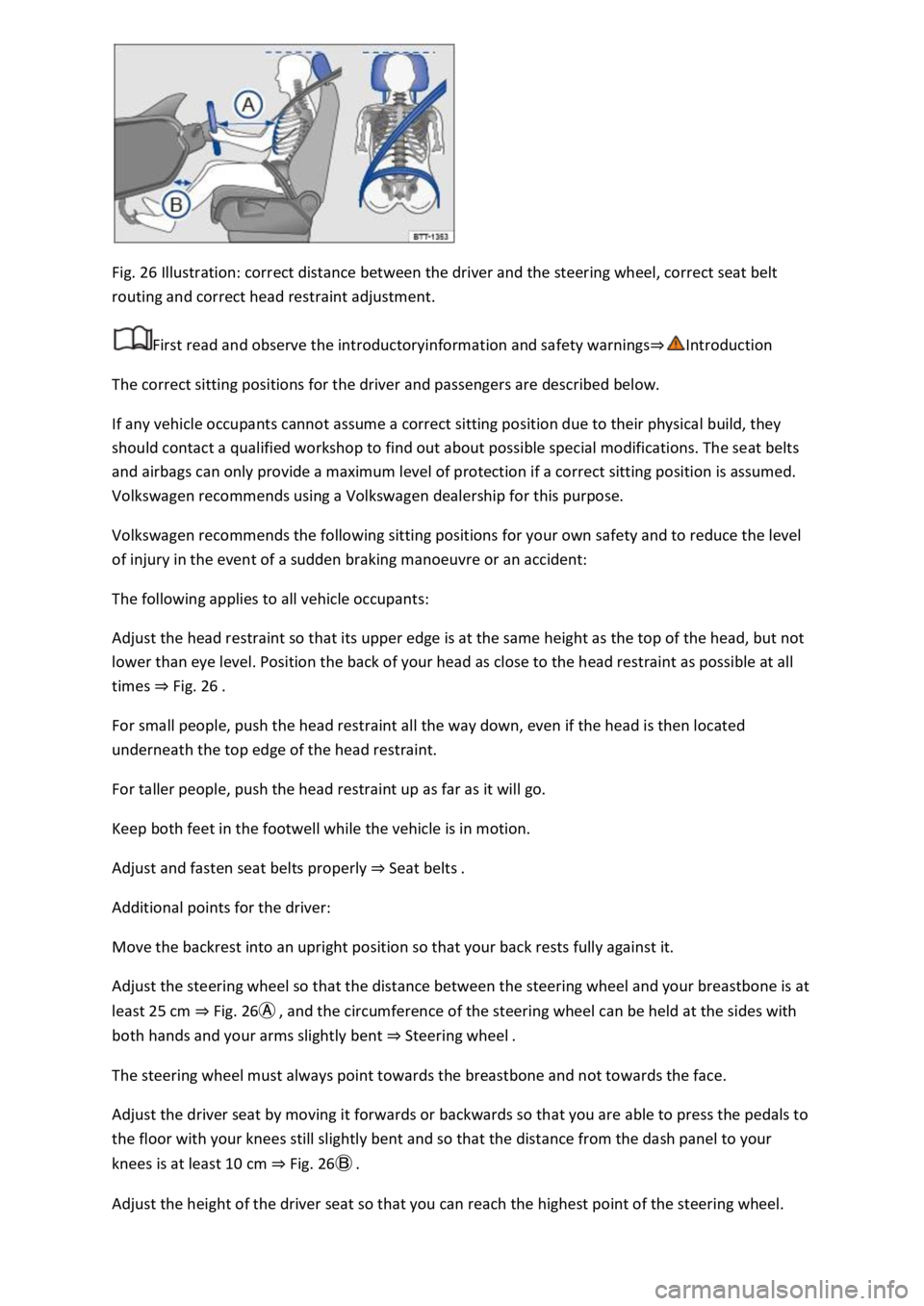
Fig. 26 Illustration: correct distance between the driver and the steering wheel, correct seat belt
routing and correct head restraint adjustment.
First read and observe the introductoryinformation and safety warnings⇒Introduction
The correct sitting positions for the driver and passengers are described below.
If any vehicle occupants cannot assume a correct sitting position due to their physical build, they
should contact a qualified workshop to find out about possible special modifications. The seat belts
and airbags can only provide a maximum level of protection if a correct sitting position is assumed.
Volkswagen recommends using a Volkswagen dealership for this purpose.
Volkswagen recommends the following sitting positions for your own safety and to reduce the level
of injury in the event of a sudden braking manoeuvre or an accident:
The following applies to all vehicle occupants:
Adjust the head restraint so that its upper edge is at the same height as the top of the head, but not
lower than eye level. Position the back of your head as close to the head restraint as possible at all
times ⇒ Fig. 26 .
For small people, push the head restraint all the way down, even if the head is then located
underneath the top edge of the head restraint.
For taller people, push the head restraint up as far as it will go.
Keep both feet in the footwell while the vehicle is in motion.
Adjust and fasten seat belts properly ⇒ Seat belts .
Additional points for the driver:
Move the backrest into an upright position so that your back rests fully against it.
Adjust the steering wheel so that the distance between the steering wheel and your breastbone is at
least 25 cm ⇒ Fig. 26Ⓐ , and the circumference of the steering wheel can be held at the sides with
both hands and your arms slightly bent ⇒ Steering wheel .
The steering wheel must always point towards the breastbone and not towards the face.
Adjust the driver seat by moving it forwards or backwards so that you are able to press the pedals to
the floor with your knees still slightly bent and so that the distance from the dash panel to your
knees is at least 10 cm ⇒ Fig. 26Ⓑ .
Adjust the height of the driver seat so that you can reach the highest point of the steering wheel.
Page 54 of 502
Always leave both feet in the footwell in order to maintain control over the vehicle at all times.
Additional points for the front passenger:
Move the backrest into an upright position so that your back rests fully against it.
Push the front passenger seat as far back as possible so that the airbag can provide maximum
protection if it is deployed.
Seat belts
Introduction
This chapter contains information on the followingsubjects:
⇒ Warning lamp
⇒ Frontal collisions and the laws of physics
⇒ What happens to vehicle occupants who have not fastened their seat belts
⇒ Seat belt protection
⇒ Using seat belts
⇒ Fastening and unfastening seat belts
⇒ Seat belt routing
⇒ Seat belt height adjuster
⇒ Belt retractor, belt tensioner, belt tension limiter
⇒ Service and disposal of belt tensioners
⇒ Proactive occupant protection system
Regularly check the condition of all seat belts. If the belt webbing, belt connections, belt retractor or
seat belt buckle become damaged, the seat belt in question should be replaced immediately by a
qualified workshop ⇒ . The qualified workshop must use the correct spare parts which are
compatible with the vehicle, equipment level and model year. Volkswagen recommends using a
Volkswagen dealership for this purpose.
WARNING
Incorrectly fastened or unfastened seat belts increase the risk of severe or fatal injuries. Seat belts
will only offer the optimum level of protection when they are fastened and used properly.
Seat belts are the most effective means of reducing the risk of serious and fatal injuries in the event
of an accident. Seat belts must always be fastened properly when the vehicle is in motion to protect
the driver and all vehicle occupants.
Page 55 of 502
Before every trip, each vehicle occupant must adopt the correct sitting position, correctly fasten the
seat belt belonging to their seat and keep it fastened properly throughout the trip. This applies to all
vehicle occupants and also in urban traffic.
While the vehicle is in motion, secure all children travelling in the vehicle in a restraint system
suitable for their weight and height. They must also wear correctly fastened seat belts ⇒ Safe
transport of children .
Drive off only when all passengers have correctly fastened their seat belts.
Never insert the latch plate into a buckle which does not belong to the corresponding seat and
always ensure it engages properly. Using a buckle which does not belong to the seat you are
occupying reduces the level of protection and can lead to severe injuries.
Never let any foreign bodies or liquids get into the slots for the belt buckles. This could prevent the
belt buckle and seat belt from working properly.
Never unfasten the seat belt while the vehicle is in motion.
Never allow more than one person to share the same seat belt.
Never travel when children or babies are being carried on somebody's lap and fastened with the
same belt.
Never travel wearing loose, bulky clothing (such as an overcoat over a jacket). This could prevent the
seat belts from fitting and functioning properly.
WARNING
Damaged seat belts are very dangerous and could cause severe or fatal injuries.
Never damage the belt by trapping it in the door or in the seat mechanism.
If the belt webbing or any other part of the seat belt becomes damaged, the seat belts may tear
during an accident or sudden braking manoeuvre.
Have damaged seat belts immediately replaced by new seat belts that have been approved by
Volkswagen for the vehicle. Seat belts subjected to stress and stretched during an accident must be
replaced by a qualified workshop. Renewal may be necessary even if there is no apparent damage.
The belt anchorage should also be checked.
Never try to repair, modify or remove the seat belts yourself. All repairs to the seat belts, belt
retractors and buckles must be carried out by a qualified workshop.
Warning lamp
Page 56 of 502
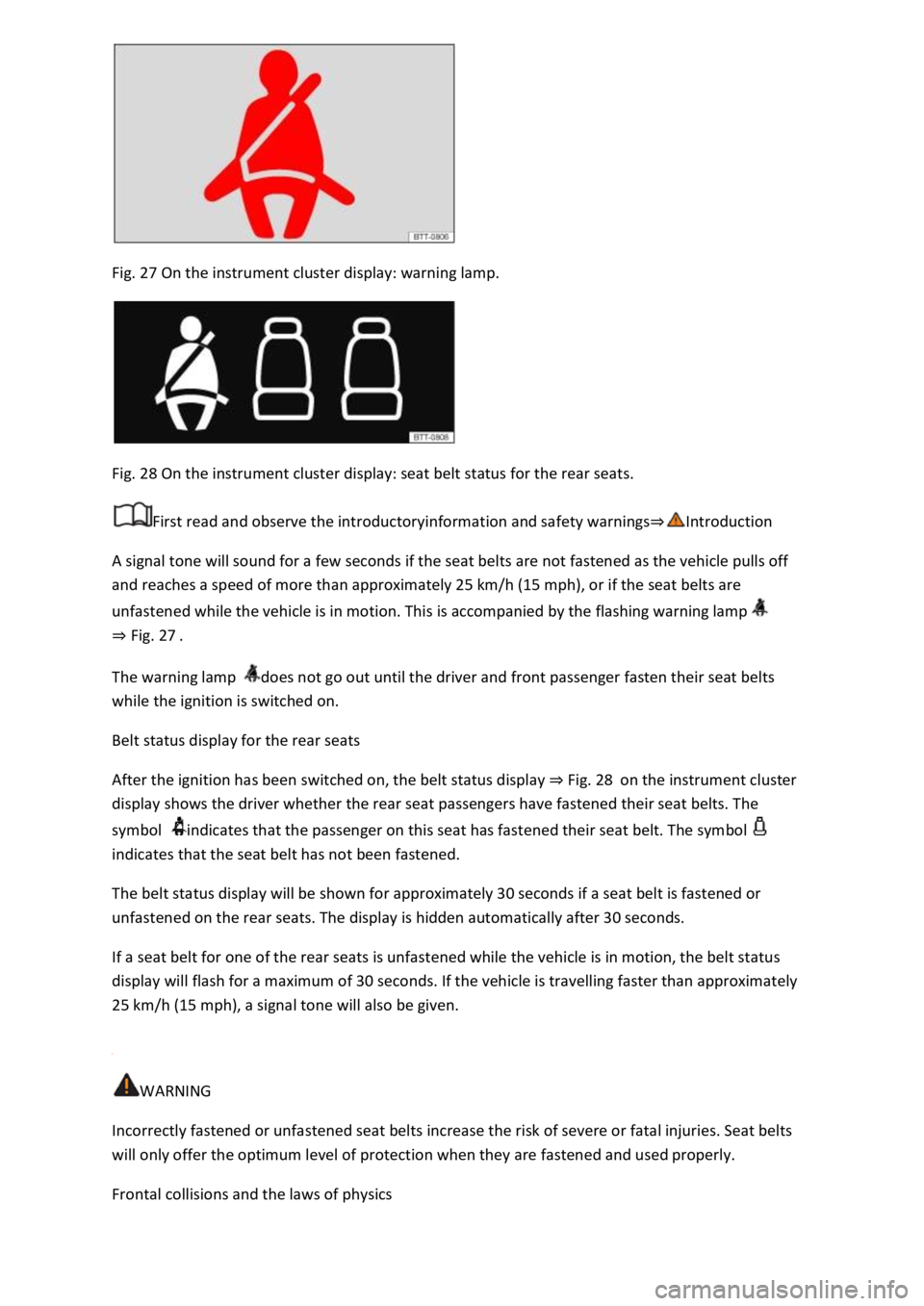
Fig. 27 On the instrument cluster display: warning lamp.
Fig. 28 On the instrument cluster display: seat belt status for the rear seats.
First read and observe the introductoryinformation and safety warnings⇒Introduction
A signal tone will sound for a few seconds if the seat belts are not fastened as the vehicle pulls off
and reaches a speed of more than approximately 25 km/h (15 mph), or if the seat belts are
unfastened while the vehicle is in motion. This is accompanied by the flashing warning lamp
⇒ Fig. 27 .
The warning lamp does not go out until the driver and front passenger fasten their seat belts
while the ignition is switched on.
Belt status display for the rear seats
After the ignition has been switched on, the belt status display ⇒ Fig. 28 on the instrument cluster
display shows the driver whether the rear seat passengers have fastened their seat belts. The
symbol indicates that the passenger on this seat has fastened their seat belt. The symbol
indicates that the seat belt has not been fastened.
The belt status display will be shown for approximately 30 seconds if a seat belt is fastened or
unfastened on the rear seats. The display is hidden automatically after 30 seconds.
If a seat belt for one of the rear seats is unfastened while the vehicle is in motion, the belt status
display will flash for a maximum of 30 seconds. If the vehicle is travelling faster than approximately
25 km/h (15 mph), a signal tone will also be given.
WARNING
Incorrectly fastened or unfastened seat belts increase the risk of severe or fatal injuries. Seat belts
will only offer the optimum level of protection when they are fastened and used properly.
Frontal collisions and the laws of physics
Page 57 of 502
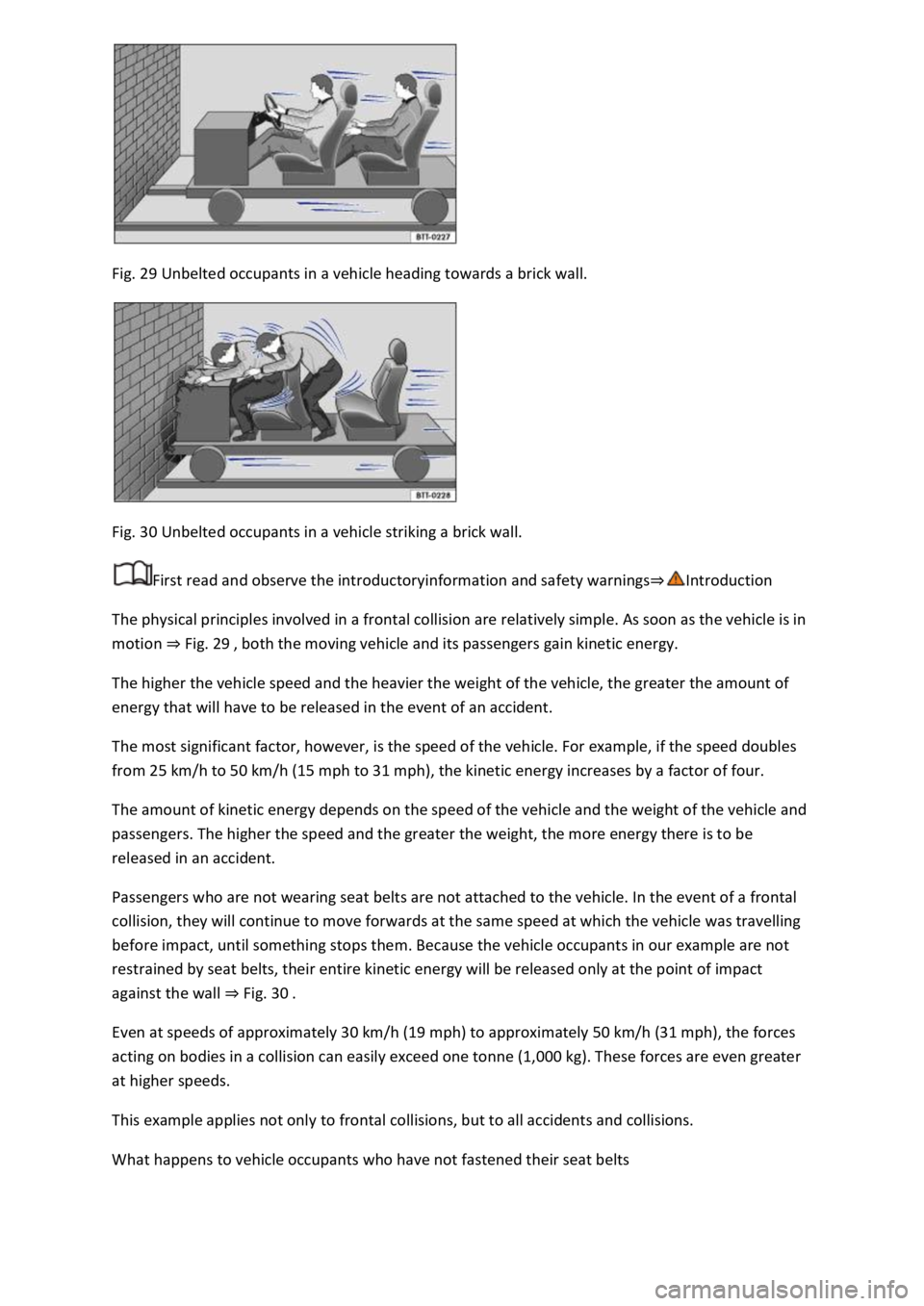
Fig. 29 Unbelted occupants in a vehicle heading towards a brick wall.
Fig. 30 Unbelted occupants in a vehicle striking a brick wall.
First read and observe the introductoryinformation and safety warnings⇒Introduction
The physical principles involved in a frontal collision are relatively simple. As soon as the vehicle is in
motion ⇒ Fig. 29 , both the moving vehicle and its passengers gain kinetic energy.
The higher the vehicle speed and the heavier the weight of the vehicle, the greater the amount of
energy that will have to be released in the event of an accident.
The most significant factor, however, is the speed of the vehicle. For example, if the speed doubles
from 25 km/h to 50 km/h (15 mph to 31 mph), the kinetic energy increases by a factor of four.
The amount of kinetic energy depends on the speed of the vehicle and the weight of the vehicle and
passengers. The higher the speed and the greater the weight, the more energy there is to be
released in an accident.
Passengers who are not wearing seat belts are not attached to the vehicle. In the event of a frontal
collision, they will continue to move forwards at the same speed at which the vehicle was travelling
before impact, until something stops them. Because the vehicle occupants in our example are not
restrained by seat belts, their entire kinetic energy will be released only at the point of impact
against the wall ⇒ Fig. 30 .
Even at speeds of approximately 30 km/h (19 mph) to approximately 50 km/h (31 mph), the forces
acting on bodies in a collision can easily exceed one tonne (1,000 kg). These forces are even greater
at higher speeds.
This example applies not only to frontal collisions, but to all accidents and collisions.
What happens to vehicle occupants who have not fastened their seat belts