warning VOLKSWAGEN T-ROC 2021 Owner´s Manual
[x] Cancel search | Manufacturer: VOLKSWAGEN, Model Year: 2021, Model line: T-ROC, Model: VOLKSWAGEN T-ROC 2021Pages: 502, PDF Size: 9.42 MB
Page 68 of 502

WARNING
Never rely on the airbag system exclusively for your protection.
The airbag has merely a supportive function for your protection, even if it is triggered.
The airbag system offers the best level of protection and reduces the risk of injury when seat belts
are properly worn ⇒ Seat belts .
Before every trip, each vehicle occupant must adopt the correct sitting position, correctly fasten the
seat belt belonging to their seat and keep it fastened properly throughout the trip. This applies to all
vehicle occupants and also in urban traffic.
WARNING
The risk of injury increases if there are any objects located between the vehicle occupants and the
deployment area of the airbag when it is triggered. This will impinge on the deployment zone of the
airbag or the items will be flung against the body.
Never hold any objects in your hands or on your lap while the vehicle is in motion.
Never transport any objects on the front passenger seat. The objects could enter into the
deployment zone of the airbag during sudden braking or driving manoeuvres and then be flung
dangerously through the vehicle interior if the airbag is activated.
Vehicle occupants sitting on the front seats and rear outer seats must never carry any people, pets
or objects in the deployment zone between themselves and the airbags. Make sure that children and
passengers also keep to this rule.
WARNING
The airbag system can be triggered only once. The system will have to be replaced if the airbags have
been triggered.
Airbags that have been triggered, and any affected system parts, must immediately be replaced with
new parts that are approved by Volkswagen for the vehicle.
Repairs and modifications to your vehicle should be carried out only by a qualified workshop.
Qualified workshops have the necessary tools, diagnostic equipment, repair information and
qualified personnel.
Never use recycled airbag components or components that have been taken from end-of-life
vehicles in your vehicle.
Never alter any components of the airbag system.
WARNING
Page 69 of 502
Fine dust particles or steam may be released when the airbags trigger. This is normal and does not
mean there is a fire in the vehicle.
The fine dust can cause irritation to the skin and eye membranes as well as cause breathing
difficulties, particularly for those people suffering from asthma or other respiratory health problems.
In order to reduce breathing difficulties, get out of the vehicle or open the windows or doors in
order to breathe fresh air.
If you should come into contact with the dust, you should wash your hands and face with a mild
soap and water before eating.
Do not rub the dust into your eyes or into open wounds.
If dust has entered your eyes, rinse them with water.
WARNING
Cleaning agents that contain solvents cause the surface of the airbag modules to become porous. In
an accident that triggers the airbag, loose plastic parts can cause serious injury.
Never clean the dash panel or the airbag covers with cleaning agents that contain solvents.
Types of front passenger front airbag system
First read and observe the introductoryinformation and safety warnings⇒Introduction
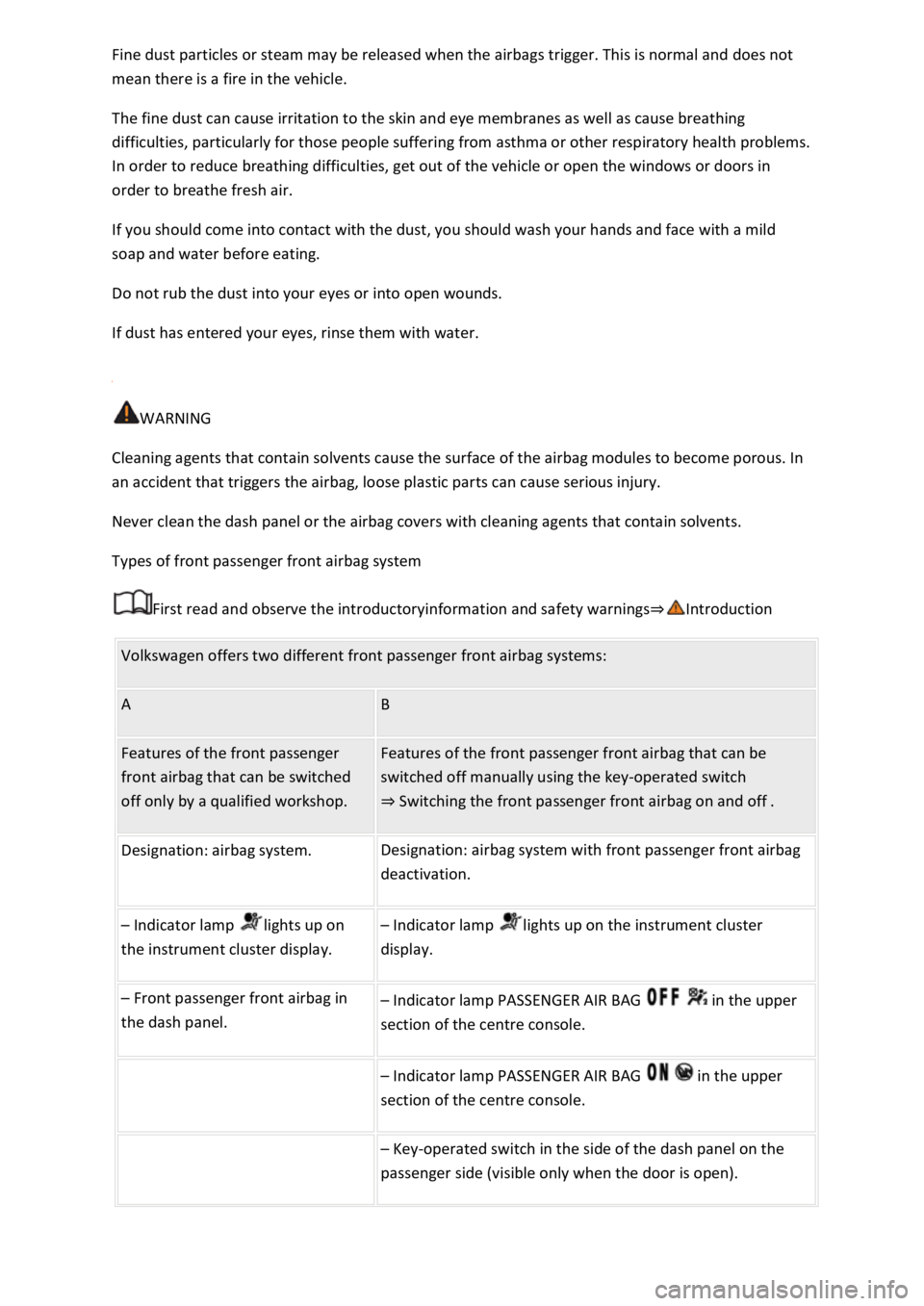
Volkswagen offers two different front passenger front airbag systems:
A B
Features of the front passenger
front airbag that can be switched
off only by a qualified workshop.
Features of the front passenger front airbag that can be
switched off manually using the key-operated switch
⇒ Switching the front passenger front airbag on and off .
Designation: airbag system. Designation: airbag system with front passenger front airbag
deactivation.
– Indicator lamp lights up on
the instrument cluster display.
– Indicator lamp lights up on the instrument cluster
display.
– Front passenger front airbag in
the dash panel.
– Indicator lamp PASSENGER AIR BAG in the upper
section of the centre console.
– Indicator lamp PASSENGER AIR BAG in the upper
section of the centre console.
– Key-operated switch in the side of the dash panel on the
passenger side (visible only when the door is open).
Page 70 of 502
Volkswagen offers two different front passenger front airbag systems:
A B
Features of the front passenger
front airbag that can be switched
off only by a qualified workshop.
Features of the front passenger front airbag that can be
switched off manually using the key-operated switch
⇒ Switching the front passenger front airbag on and off .
– Front passenger front airbag in the dash panel.
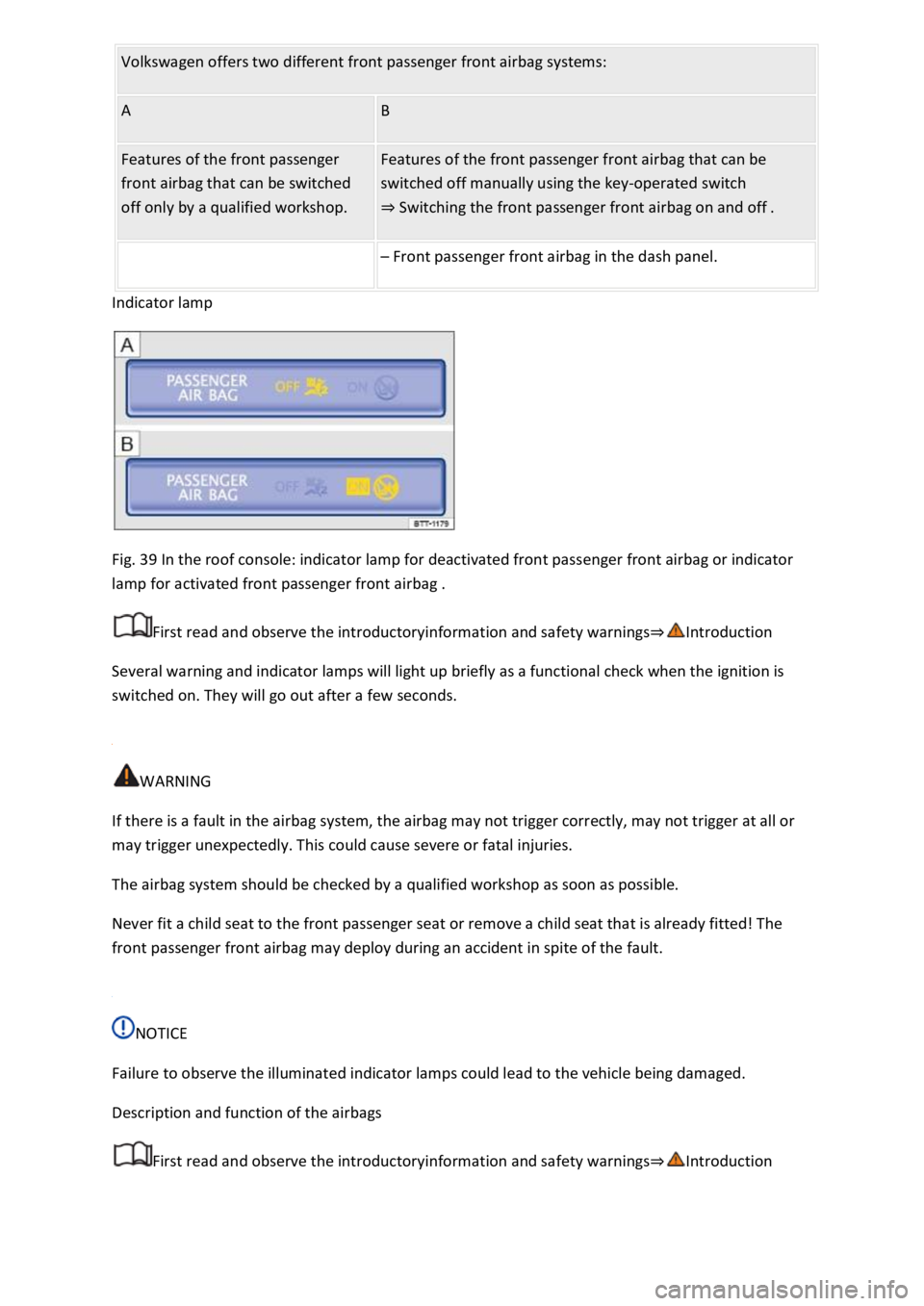
Indicator lamp
Fig. 39 In the roof console: indicator lamp for deactivated front passenger front airbag or indicator
lamp for activated front passenger front airbag .
First read and observe the introductoryinformation and safety warnings⇒Introduction
Several warning and indicator lamps will light up briefly as a functional check when the ignition is
switched on. They will go out after a few seconds.
WARNING
If there is a fault in the airbag system, the airbag may not trigger correctly, may not trigger at all or
may trigger unexpectedly. This could cause severe or fatal injuries.
The airbag system should be checked by a qualified workshop as soon as possible.
Never fit a child seat to the front passenger seat or remove a child seat that is already fitted! The
front passenger front airbag may deploy during an accident in spite of the fault.
NOTICE
Failure to observe the illuminated indicator lamps could lead to the vehicle being damaged.
Description and function of the airbags
First read and observe the introductoryinformation and safety warnings⇒Introduction
Page 72 of 502
Front airbags
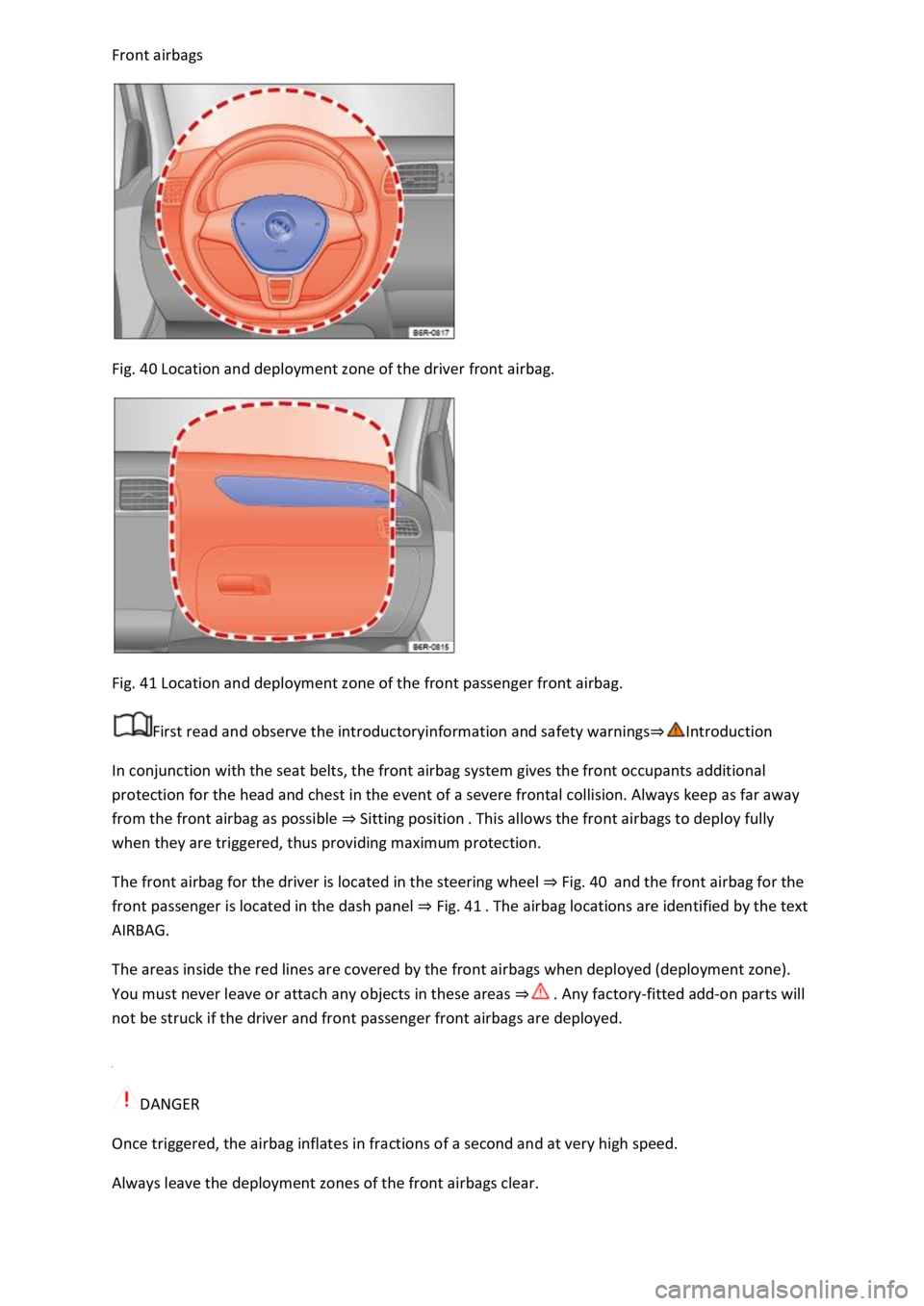
Fig. 40 Location and deployment zone of the driver front airbag.
Fig. 41 Location and deployment zone of the front passenger front airbag.
First read and observe the introductoryinformation and safety warnings⇒Introduction
In conjunction with the seat belts, the front airbag system gives the front occupants additional
protection for the head and chest in the event of a severe frontal collision. Always keep as far away
from the front airbag as possible ⇒ Sitting position . This allows the front airbags to deploy fully
when they are triggered, thus providing maximum protection.
The front airbag for the driver is located in the steering wheel ⇒ Fig. 40 and the front airbag for the
front passenger is located in the dash panel ⇒ Fig. 41 . The airbag locations are identified by the text
AIRBAG.
The areas inside the red lines are covered by the front airbags when deployed (deployment zone).
You must never leave or attach any objects in these areas ⇒ . Any factory-fitted add-on parts will
not be struck if the driver and front passenger front airbags are deployed.
DANGER
Once triggered, the airbag inflates in fractions of a second and at very high speed.
Always leave the deployment zones of the front airbags clear.
Page 73 of 502
Never attach any objects, such as drink or telephone holders, to the covers of the airbags or
anywhere in the airbag deployment zone.
No other people, animals or objects may be carried between the occupants of the front seats and
the airbag deployment zone. Make sure that children and passengers also keep to this rule.
Do not attach any objects, e.g. mobile navigation devices, to the windscreen above the front airbag
on the front passenger side.
Do not cover or stick anything on the steering wheel hub or the soft plastic surface of the airbag unit
on the front passenger side, and do not obstruct or modify them in any way.
WARNING
The front airbags are deployed in front of the steering wheel ⇒ Fig. 40 and dash panel⇒ Fig. 41 .
When driving, always hold the steering wheel with both hands on the outside of the rim at the 9
o'clock and 3 o'clock positions.
Adjust the driver seat so that there is at least 25 cm between your breastbone and the hub of the
steering wheel. Contact a qualified workshop if your physical build makes this impracticable.
Adjust the front passenger seat so that the distance between the front passenger and the dash panel
is as large as possible.
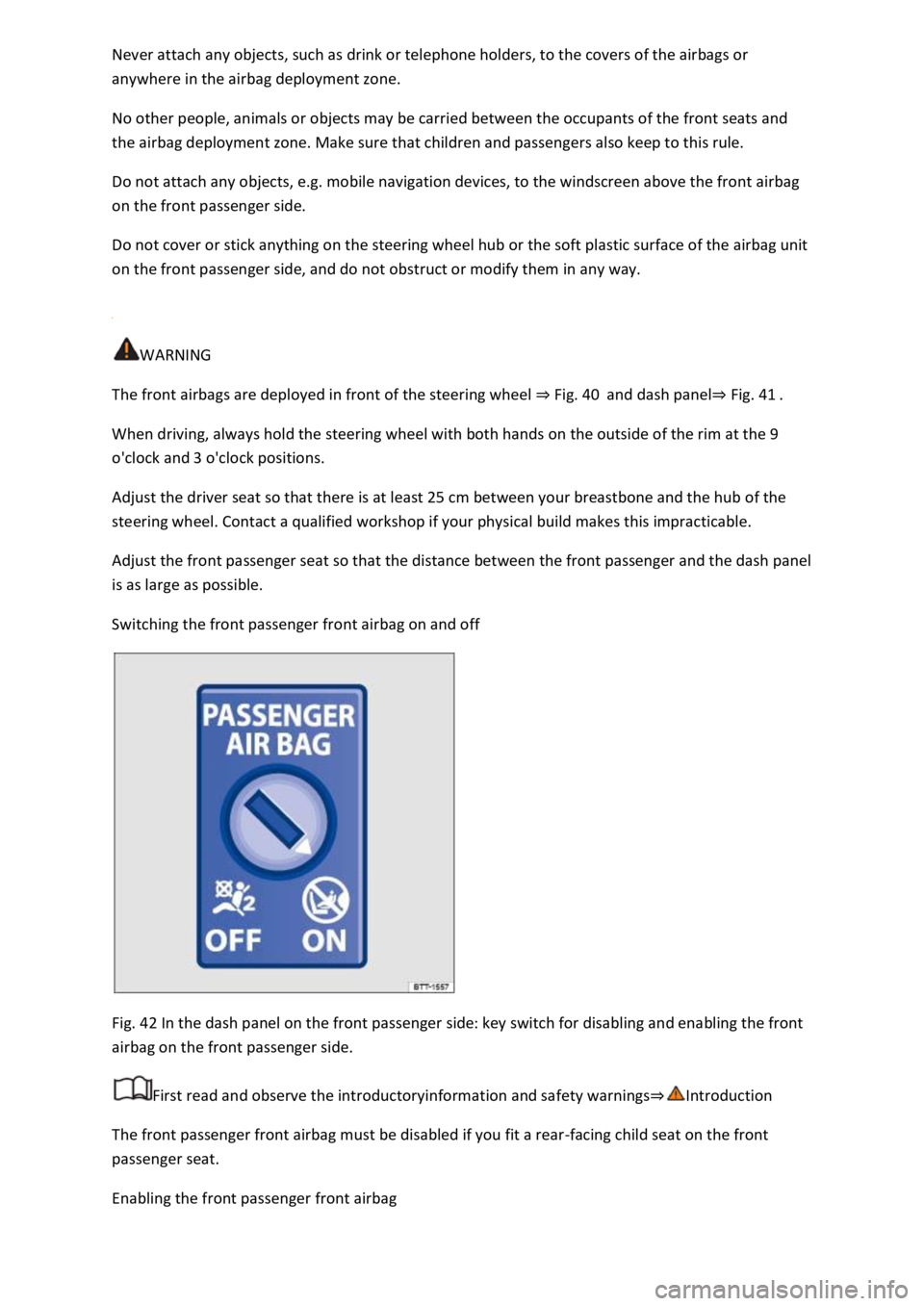
Switching the front passenger front airbag on and off
Fig. 42 In the dash panel on the front passenger side: key switch for disabling and enabling the front
airbag on the front passenger side.
First read and observe the introductoryinformation and safety warnings⇒Introduction
The front passenger front airbag must be disabled if you fit a rear-facing child seat on the front
passenger seat.
Enabling the front passenger front airbag
Page 75 of 502

WARNING
The front passenger front airbag should be switched off only in exceptional circumstances.
To prevent damage to the airbag system, switch the front passenger front airbag on and off only
when the ignition is switched off.
It is the driver's responsibility to ensure that the key-operated switch is set to the correct position.
Switch off the front passenger front airbag only if in exceptional circumstances a child seat is fitted
on the front passenger seat.
Switch the front passenger front airbag back on again as soon as the child seat on the front
passenger seat is no longer being used.
WARNING
Do not leave the vehicle key in the key switch while driving.
Strong vibrations may cause the vehicle key to turn in the key switch, which could cause the front
passenger front airbag to be activated.
Untimely inflation of the front passenger front airbag could lead to serious or fatal injuries.
NOTICE
If the key bit is not inserted far enough, the key switch could be damaged when the key is turned.
NOTICE
Do not leave the vehicle key in the key switch, as this could result in damage to the interior door
trim, dash panel, key switch or vehicle key when the front passenger door is closed.
Safe transport of children
Introduction
This chapter contains information on the followingsubjects:
⇒ Types of child seat
⇒ Fitting and using child seats
⇒ Securing systems
⇒ Securing a child seat with ISOFIX
⇒ Securing child seats with a seat belt
Page 76 of 502

Using child seats can reduce the risk of injury to the child if there is an accident. Always use child
seats when driving with children.
Note the following:
Child seats are classified into groups depending on the size, age and weight of child for which they
are designed.
Various securing systems are used to secure child seats in the vehicle.
For safety reasons, child seats must always be fitted to the rear seats ⇒ Fitting and using child seats .
Volkswagen recommends child seats from the Volkswagen range of accessories. These child seats
have been developed and approved for use in Volkswagen vehicles.
WARNING
If children are not secured or are inadequately secured, they are at greater risk of serious or even
fatal injury. Please note the following:
Children who are either under twelve years of age or less than 150 cm tall must not be carried in the
vehicle if they are not secured in a suitable child seat while the vehicle is in motion. Regulations in
some countries may differ and must be complied with.
Always secure children in the vehicle in a suitable child seat. The seat used must be appropriate to
the child's height, weight and age.
Never fasten more than one child into one child seat.
Under no circumstances should children or babies be held in a passenger's or drivers lap while
driving.
Never leave a child unsupervised in a child seat.
Never allow a child to be carried in a vehicle without being properly secured, and never allow a child
to stand up or to kneel on a seat, or to sit incorrectly while the car is in motion. This is particularly
important for children carried on the front passenger seat. In an accident, children may sustain
serious injuries to themselves and others.
The child seat can provide maximum protection only if the seat belt is routed correctly around it.
Always ensure that the seat belt is routed as specified in the instructions provided by the child seat
manufacturer. If the seat belt is routed incorrectly, injuries may occur even in a minor accident.
After an accident, it is vital to replace any child seats that were in use during the accident, as they
could have sustained non-visible damage.
Types of child seat
Page 77 of 502
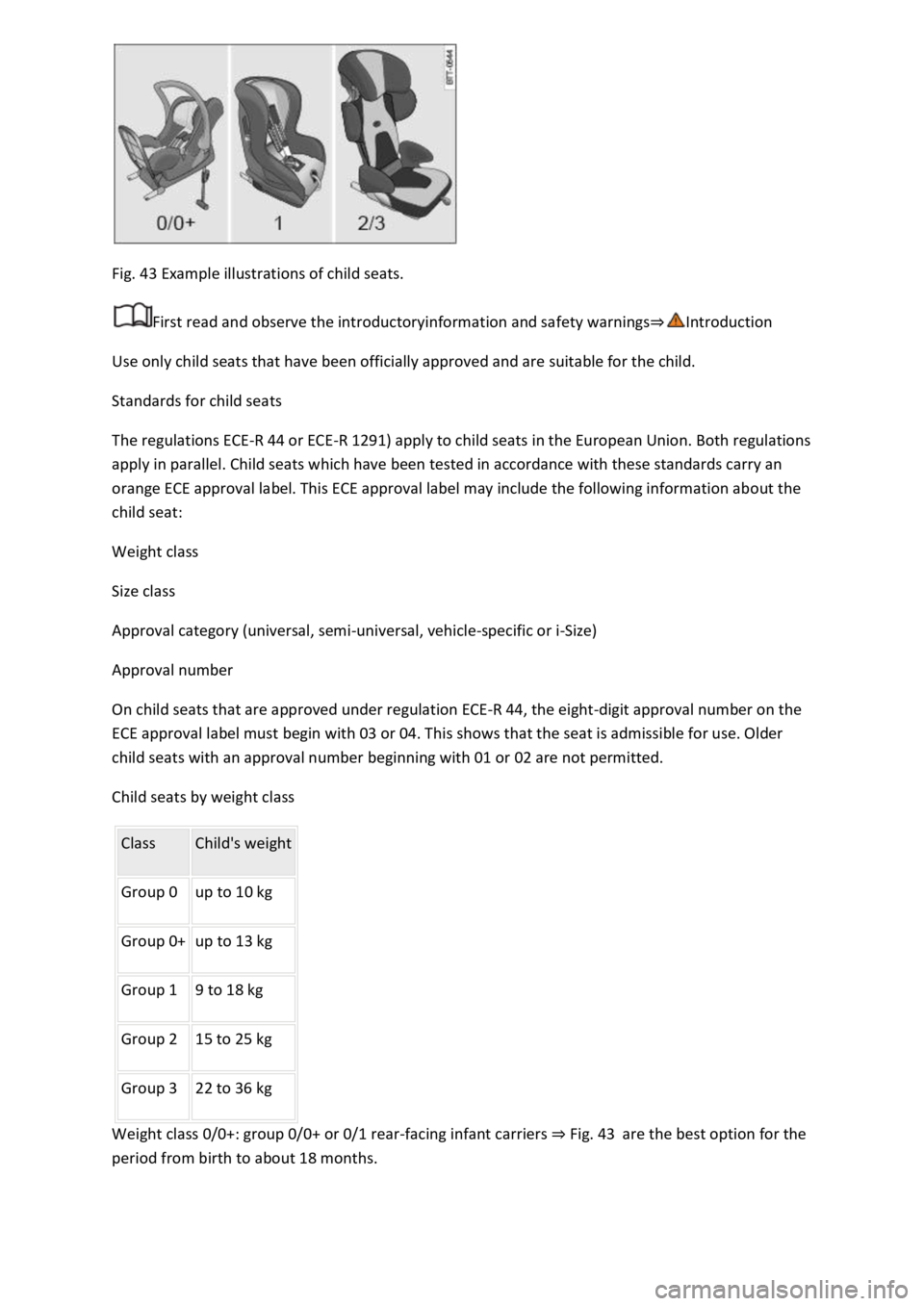
Fig. 43 Example illustrations of child seats.
First read and observe the introductoryinformation and safety warnings⇒Introduction
Use only child seats that have been officially approved and are suitable for the child.
Standards for child seats
The regulations ECE-R 44 or ECE-R 1291) apply to child seats in the European Union. Both regulations
apply in parallel. Child seats which have been tested in accordance with these standards carry an
orange ECE approval label. This ECE approval label may include the following information about the
child seat:
Weight class
Size class
Approval category (universal, semi-universal, vehicle-specific or i-Size)
Approval number
On child seats that are approved under regulation ECE-R 44, the eight-digit approval number on the
ECE approval label must begin with 03 or 04. This shows that the seat is admissible for use. Older
child seats with an approval number beginning with 01 or 02 are not permitted.
Child seats by weight class
Class Child's weight
Group 0 up to 10 kg
Group 0+ up to 13 kg
Group 1 9 to 18 kg
Group 2 15 to 25 kg
Group 3 22 to 36 kg
Weight class 0/0+: group 0/0+ or 0/1 rear-facing infant carriers ⇒ Fig. 43 are the best option for the
period from birth to about 18 months.
Page 79 of 502
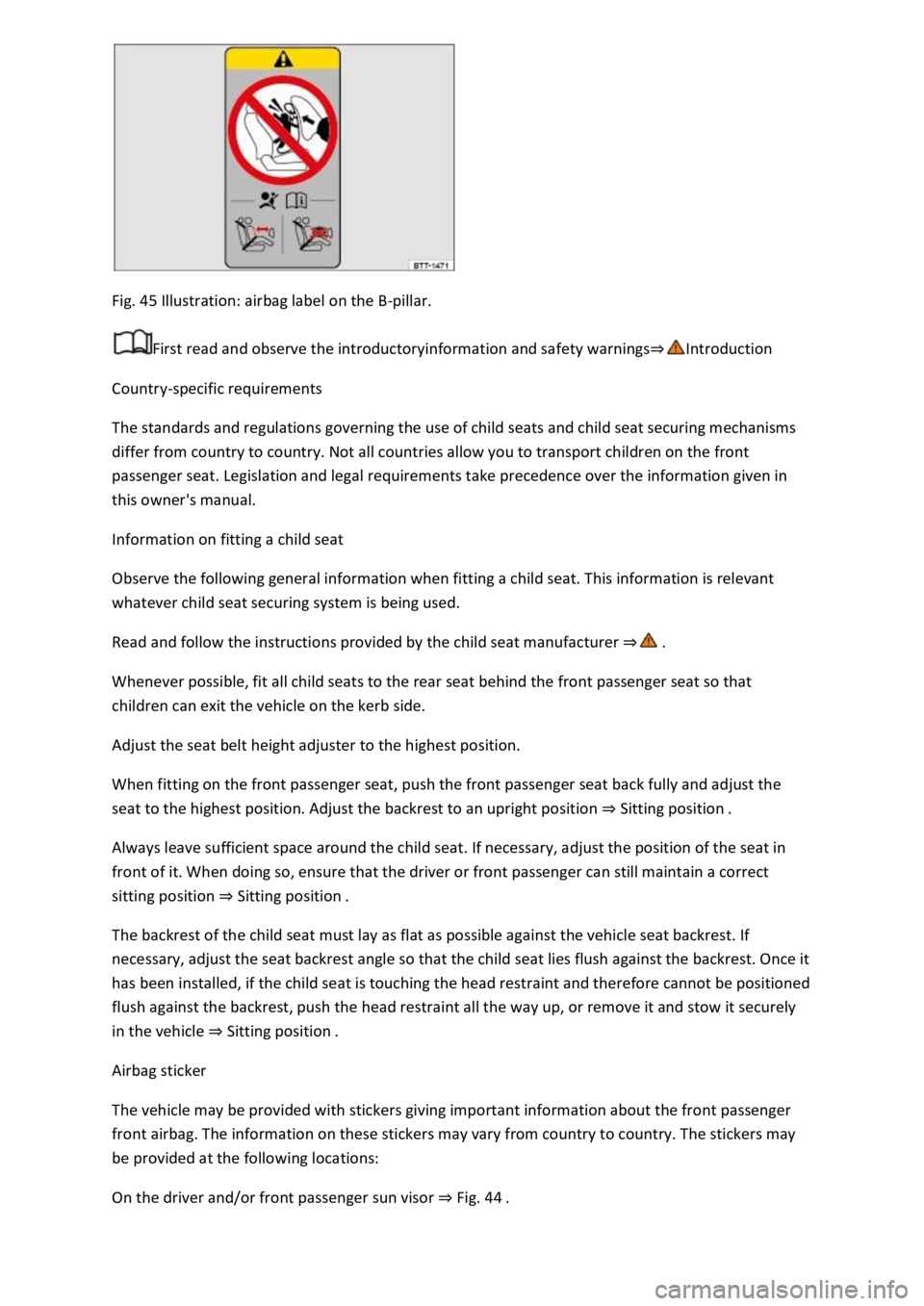
Fig. 45 Illustration: airbag label on the B-pillar.
First read and observe the introductoryinformation and safety warnings⇒Introduction
Country-specific requirements
The standards and regulations governing the use of child seats and child seat securing mechanisms
differ from country to country. Not all countries allow you to transport children on the front
passenger seat. Legislation and legal requirements take precedence over the information given in
this owner's manual.
Information on fitting a child seat
Observe the following general information when fitting a child seat. This information is relevant
whatever child seat securing system is being used.
Read and follow the instructions provided by the child seat manufacturer ⇒ .
Whenever possible, fit all child seats to the rear seat behind the front passenger seat so that
children can exit the vehicle on the kerb side.
Adjust the seat belt height adjuster to the highest position.
When fitting on the front passenger seat, push the front passenger seat back fully and adjust the
seat to the highest position. Adjust the backrest to an upright position ⇒ Sitting position .
Always leave sufficient space around the child seat. If necessary, adjust the position of the seat in
front of it. When doing so, ensure that the driver or front passenger can still maintain a correct
sitting position ⇒ Sitting position .
The backrest of the child seat must lay as flat as possible against the vehicle seat backrest. If
necessary, adjust the seat backrest angle so that the child seat lies flush against the backrest. Once it
has been installed, if the child seat is touching the head restraint and therefore cannot be positioned
flush against the backrest, push the head restraint all the way up, or remove it and stow it securely
in the vehicle ⇒ Sitting position .
Airbag sticker
The vehicle may be provided with stickers giving important information about the front passenger
front airbag. The information on these stickers may vary from country to country. The stickers may
be provided at the following locations:
On the driver and/or front passenger sun visor ⇒ Fig. 44 .
Page 80 of 502
On the B-pillar on the front passenger side ⇒ Fig. 45 .
It is essential to note the warning information shown on these stickers before installing a rear-facing
child seat ⇒ .
Risks involved in carrying children on the front passenger seat
If you are using a rear-facing child seat, the front passenger front airbag can cause critical or
potentially fatal injuries when it inflates ⇒ .
Rear-facing child seats may be used on the front passenger seat only if the front passenger front
airbag has been deactivated. A deactivated front passenger front airbag is indicated by the
continuously lit PASSENGER AIR BAG indicator lamp in the driver's field of vision.
PASSENGER AIR BAG indicator lamp ⇒ Indicator lamp .
If using a front-facing child seat, do not deactivate the front passenger front airbag. When fitting the
child seat, ensure that it is as far away as possible from the front passenger front airbag. The front
passenger front airbag can cause severe injuries when it inflates ⇒ .
Some child seats are not suitable for use on the front passenger seat. The child seat must be
specially approved by the manufacturer for use on the front passenger seat in vehicles with front
and side airbags. Volkswagen dealerships keep an up-to-date list of approved child seats.
DANGER
If you use a rear-facing child seat on the front passenger seat, the child in it is at increased risk of
sustaining critical or fatal injuries in the event of an accident.
Deactivate the front passenger front airbag. If the front passenger front airbag cannot be
deactivated, no rear-facing child seat may be used.
Move the front passenger seat as far back as possible and adjust to its highest position to create the
largest possible distance between the child seat and the front passenger front airbag.
Move the backrest to the upright position.
Adjust the seat belt height adjuster to the highest position.
Use only child seats that have been approved by the child seat manufacturer for use on a front
passenger seat with front and side airbags.
WARNING
There is a risk of injury if child seats are installed incorrectly.
Always read and follow the installation instructions and warning information provided by the child
seat manufacturer.
WARNING