Table VOLKSWAGEN T-ROC 2021 Owner´s Manual
[x] Cancel search | Manufacturer: VOLKSWAGEN, Model Year: 2021, Model line: T-ROC, Model: VOLKSWAGEN T-ROC 2021Pages: 502, PDF Size: 9.42 MB
Page 349 of 502
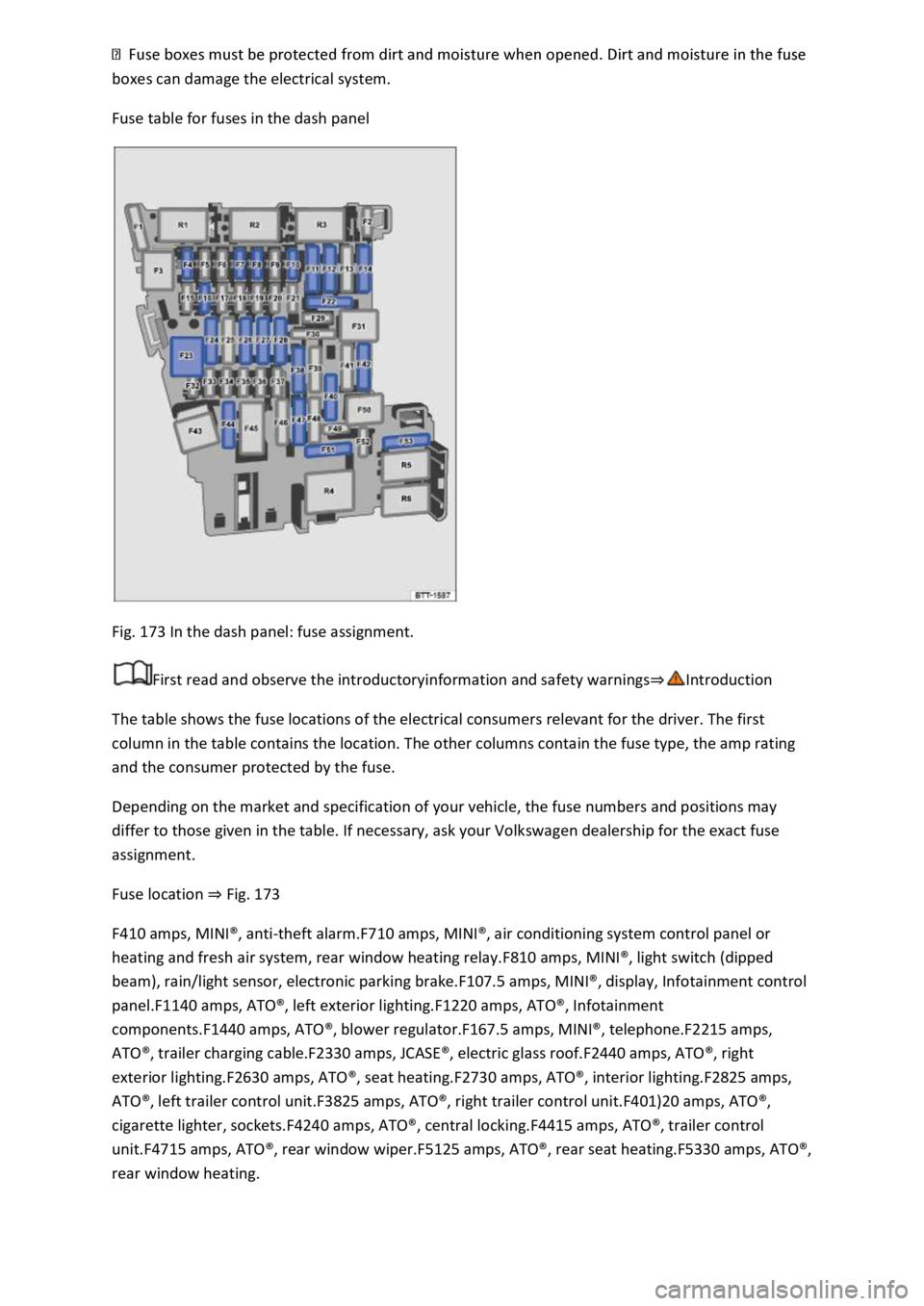
boxes can damage the electrical system.
Fuse table for fuses in the dash panel
Fig. 173 In the dash panel: fuse assignment.
First read and observe the introductoryinformation and safety warnings⇒Introduction
The table shows the fuse locations of the electrical consumers relevant for the driver. The first
column in the table contains the location. The other columns contain the fuse type, the amp rating
and the consumer protected by the fuse.
Depending on the market and specification of your vehicle, the fuse numbers and positions may
differ to those given in the table. If necessary, ask your Volkswagen dealership for the exact fuse
assignment.
Fuse location ⇒ Fig. 173
F410 amps, MINI®, anti-theft alarm.F710 amps, MINI®, air conditioning system control panel or
heating and fresh air system, rear window heating relay.F810 amps, MINI®, light switch (dipped
beam), rain/light sensor, electronic parking brake.F107.5 amps, MINI®, display, Infotainment control
panel.F1140 amps, ATO®, left exterior lighting.F1220 amps, ATO®, Infotainment
components.F1440 amps, ATO®, blower regulator.F167.5 amps, MINI®, telephone.F2215 amps,
ATO®, trailer charging cable.F2330 amps, JCASE®, electric glass roof.F2440 amps, ATO®, right
exterior lighting.F2630 amps, ATO®, seat heating.F2730 amps, ATO®, interior lighting.F2825 amps,
ATO®, left trailer control unit.F3825 amps, ATO®, right trailer control unit.F401)20 amps, ATO®,
cigarette lighter, sockets.F4240 amps, ATO®, central locking.F4415 amps, ATO®, trailer control
unit.F4715 amps, ATO®, rear window wiper.F5125 amps, ATO®, rear seat heating.F5330 amps, ATO®,
rear window heating.
Page 350 of 502
1) Note installation position. Factory-fitted fuse location as shown in illustration ⇒ Fig. 173 .
Fuse tables for fuses in the engine compartment
First read and observe the introductoryinformation and safety warnings⇒Introduction
The table shows the fuse locations of the electrical consumers relevant for the driver. The first
column in the table contains the location. The other columns contain the fuse type, the amp rating
and the consumer protected by the fuse.
Depending on the market and specification of your vehicle, the fuse numbers and positions may
differ to those given in the table. If necessary, ask your Volkswagen dealership for the exact fuse
assignment.
F65 amps, ATO®, brake light sensor.F1440 amps, JCASE®, windscreen heating.F1515 amps, ATO®,
horn.F1930 amps, ATO®, front wipers.F3720 amps, ATO®, auxiliary heater.
Changing a blown fuse
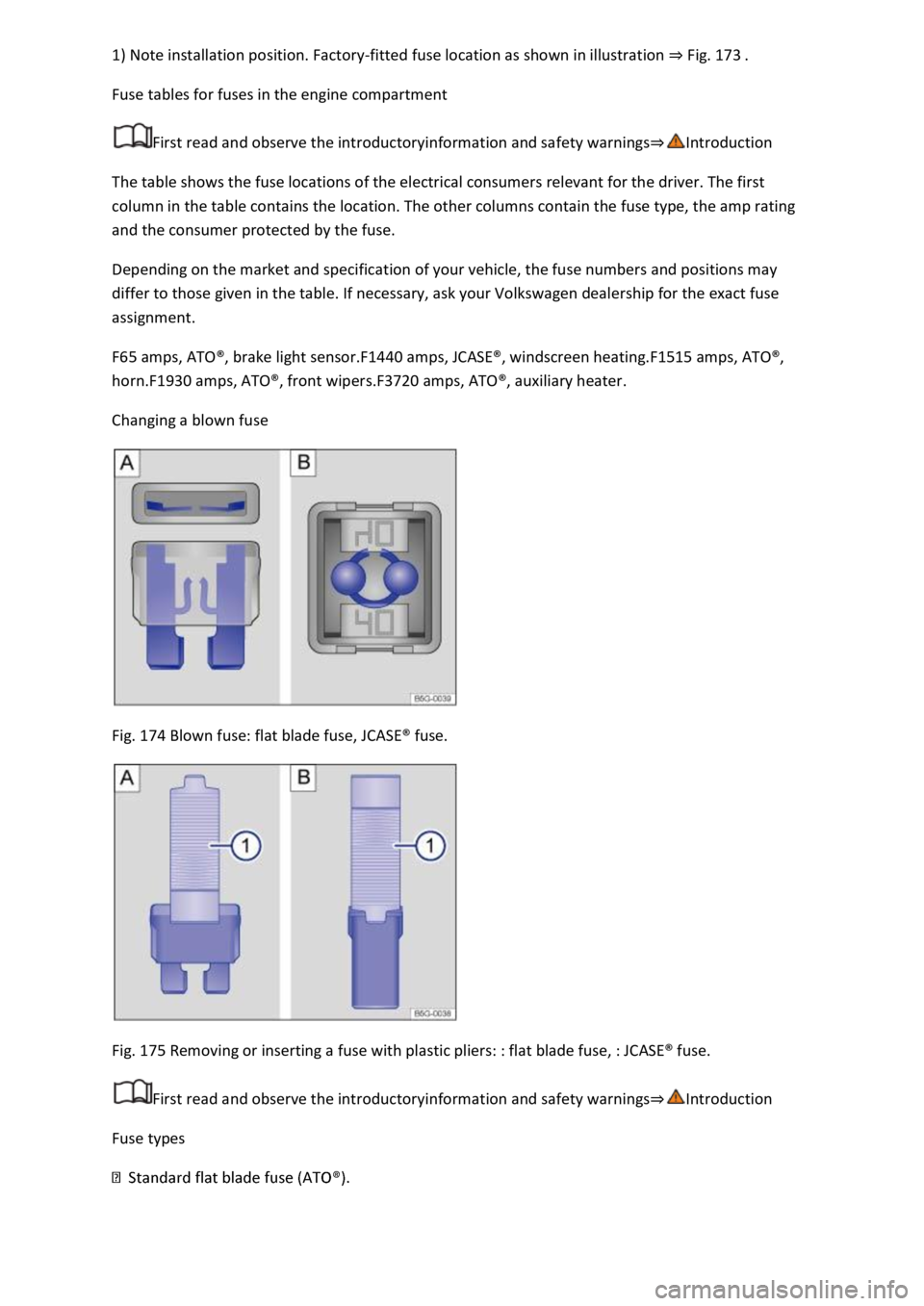
Fig. 174 Blown fuse: flat blade fuse, JCASE® fuse.
Fig. 175 Removing or inserting a fuse with plastic pliers: : flat blade fuse, : JCASE® fuse.
First read and observe the introductoryinformation and safety warnings⇒Introduction
Fuse types
Page 352 of 502
Introduction
This chapter contains information on the followingsubjects:
⇒ Jump lead connection point (earth connection)
⇒ Jump starting the vehicle
If the engine fails to start because the 12-volt vehicle battery is flat, the discharged battery can be
connected to the 12-volt battery of another vehicle to start the engine.
Suitable jump leads are needed for jump starting.
2 for vehicles with petrol engines.
WARNING
Using the jump leads incorrectly or performing the jump start procedure incorrectly can cause the
12-volt vehicle battery to explode, which can lead to severe injuries. Please note the following in
order to reduce the risk of the 12-volt vehicle battery exploding:
-volt vehicle battery and the electrical system can cause serious chemical burns,
fire or electric shocks. Always read the warnings and safety information before carrying out any kind
of work on the 12-volt vehicle battery ⇒ 12-volt vehicle battery .
volts) and approximately
the same capacity (see label on battery) as the flat 12-volt vehicle battery.
-volt vehicle battery. Discharged 12-volt vehicle batteries can
already freeze at temperatures of around 0°C (+32°F).
-volt vehicle battery should be replaced if it is or has ever been frozen.
-volt vehicle battery is jump started.
Always keep fire, sparks, naked flames and lit cigarettes away from the 12-volt vehicle battery.
Never use a mobile telephone when the jump leads are being connected or disconnected.
compartment.
rectly.
NOTICE
Please note the following in order to avoid considerable damage to the vehicle electrical system:
Page 354 of 502
Suitable earth connection: preferably the jump lead connection point (earth connection), a
solid metal part which is securely bolted onto the cylinder block, or the cylinder block itself.
The discharged 12-volt vehicle battery must be properly connected to the vehicle's electrical system.
The vehicles must not touch. Otherwise electricity could flow as soon as the positive terminals are
connected.
Ensure that the battery clamps have good metal-to-metal contact with the battery terminals.
If the engine does not start immediately, switch off the starter after about 10 seconds and try again
after about a minute.
If the engine still does not start, seek expert assistance.
Attaching the jump leads
The jump leads should be connected only in the order A – B – C – D⇒ Fig. 177 .
The black jump lead should never be connected to the negative terminal (–) on the 12-volt vehicle
battery. Connecting the lead to the negative terminal can cause incorrect condition evaluation of the
12-volt vehicle battery in the vehicle electronics.
⇒ Starting the engine .
-volt vehicle battery in the engine compartment, if a cover is installed
⇒ 12-volt vehicle battery .
discharged 12-volt vehicle battery ⇒ Fig. 177 ① ⇒ .
providing assistance ⇒ Fig. 177 ②.
⇒ Fig. 177 ③ preferably to a suitable jump start
connection point (earth connection) or otherwise to a solid metal part that is securely bolted onto
the cylinder block, or to the cylinder block itself of the vehicle providing assistance.
-volt battery, connect the other end of the black jump lead
⇒ Fig. 177 ③ preferably to the jump lead connection point (earth connection), or otherwise to a
solid metal part that is securely bolted onto the cylinder block, or to the cylinder block itself ⇒ .
s in such a way that they cannot come into contact with any moving parts in the
engine compartment.
Starting the engine
2-volt vehicle battery and wait two or three
minutes until the engine is running smoothly.
Removing the jump leads
Page 360 of 502
Comply with the notes on towing ⇒ Notes on tow-starting and towing .
Fitting the rear towing eye
⇒ Vehicle toolkit .
area of the cover ⇒ Fig. 178 in the direction of the arrow to release the cover.
⇒ Fig. 179 and tighten as far as it will go ⇒ .
Use a suitable object to screw the towing eye fully and securely into the mounting.
clockwise.
-clockwise.
compartment.
NOTICE
urely into the mounting. Otherwise, the
towing eye can be torn out of the mounting when the vehicle is being tow-started or towed.
-fitted towing bracket must be towed only using tow bars that are specially
designed for fitting to a ball coupling. If you use an unsuitable tow bar, the ball coupling and the
vehicle could be damaged. You should use a tow rope instead.
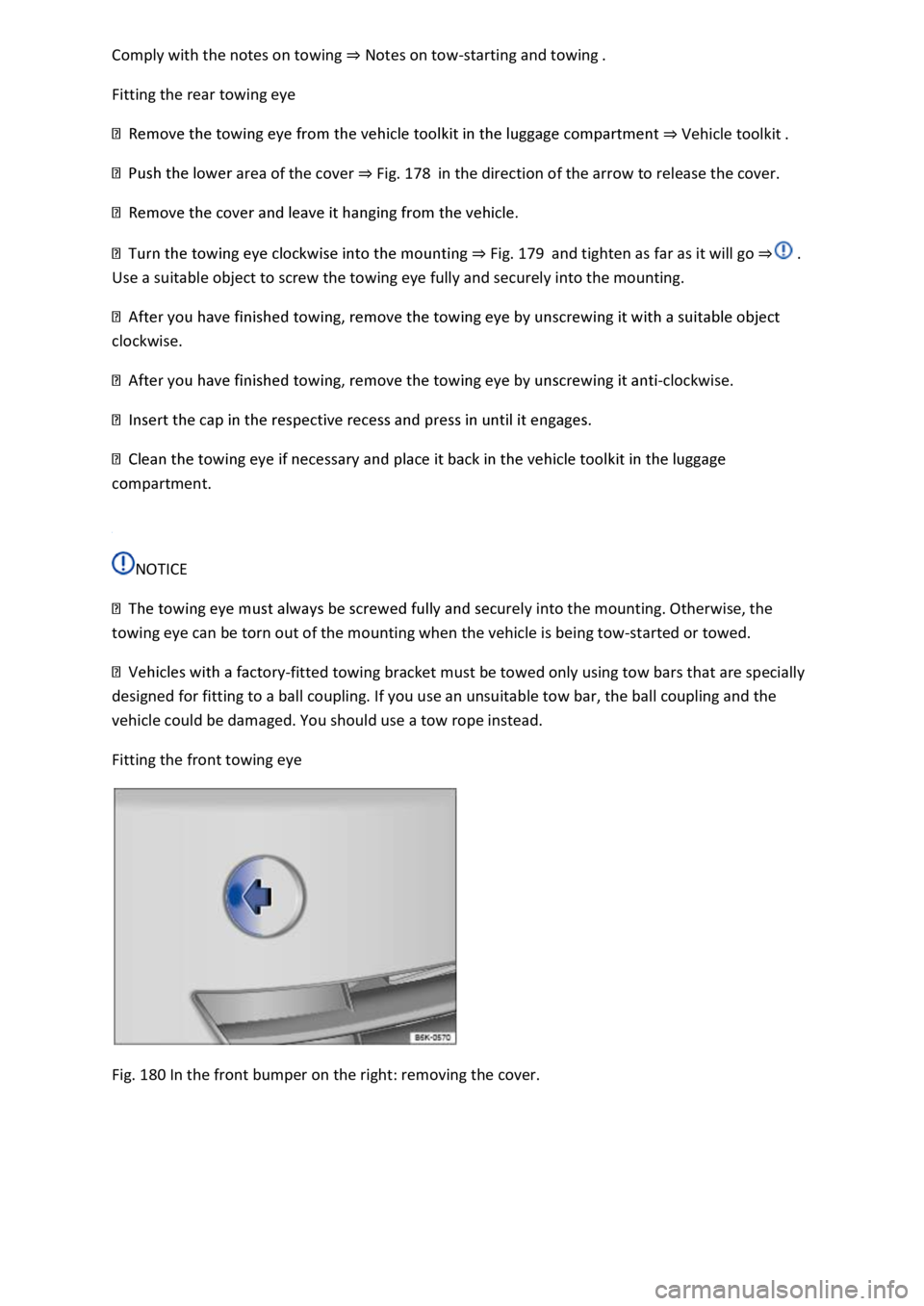
Fitting the front towing eye
Fig. 180 In the front bumper on the right: removing the cover.
Page 361 of 502
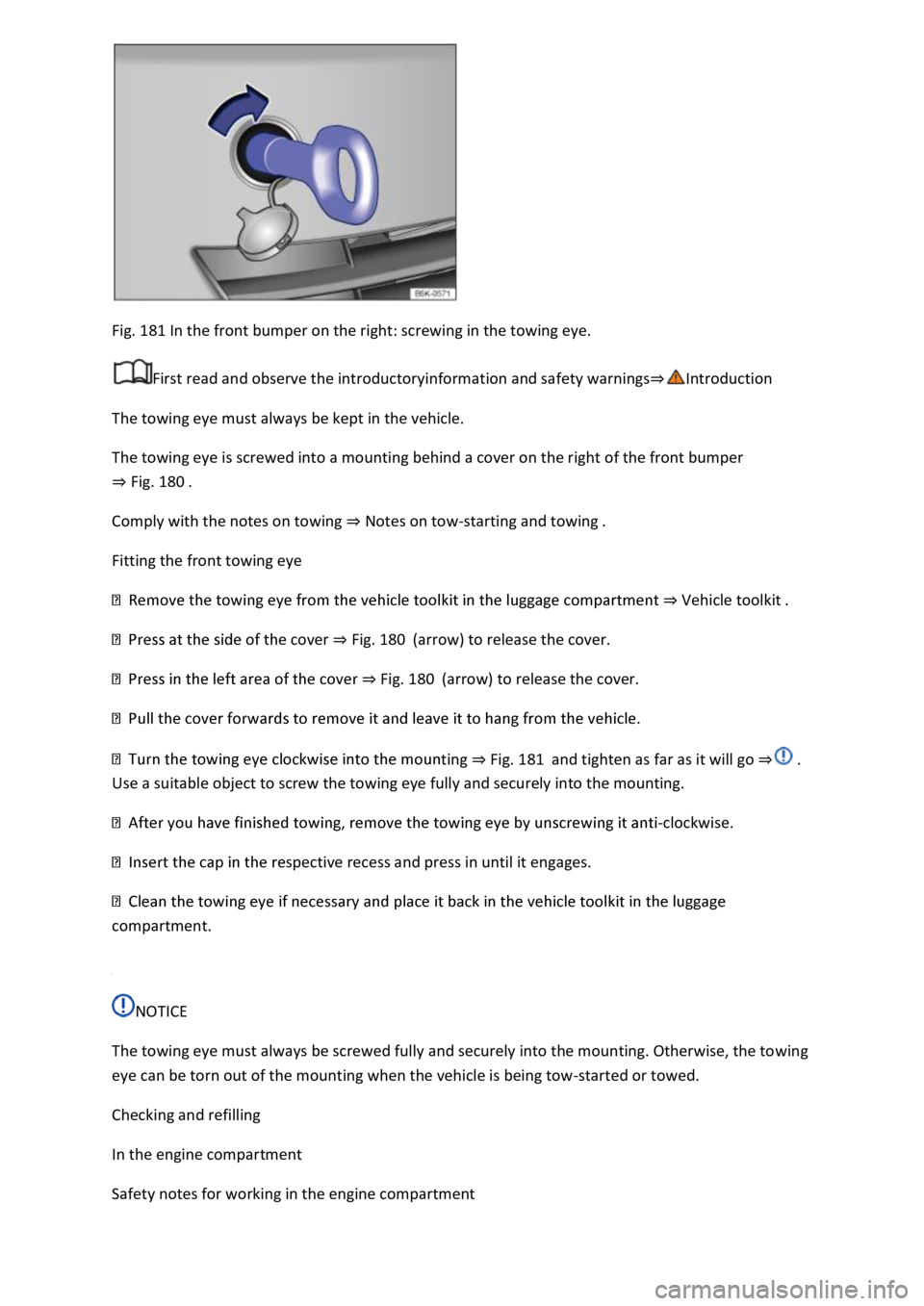
Fig. 181 In the front bumper on the right: screwing in the towing eye.
First read and observe the introductoryinformation and safety warnings⇒Introduction
The towing eye must always be kept in the vehicle.
The towing eye is screwed into a mounting behind a cover on the right of the front bumper
⇒ Fig. 180 .
Comply with the notes on towing ⇒ Notes on tow-starting and towing .
Fitting the front towing eye
⇒ Vehicle toolkit .
e cover ⇒ Fig. 180 (arrow) to release the cover.
⇒ Fig. 180 (arrow) to release the cover.
ting ⇒ Fig. 181 and tighten as far as it will go ⇒ .
Use a suitable object to screw the towing eye fully and securely into the mounting.
-clockwise.
spective recess and press in until it engages.
compartment.
NOTICE
The towing eye must always be screwed fully and securely into the mounting. Otherwise, the towing
eye can be torn out of the mounting when the vehicle is being tow-started or towed.
Checking and refilling
In the engine compartment
Safety notes for working in the engine compartment
Page 362 of 502

The engine compartment of a motor vehicle is a hazardous area. Do not work on the engine and in
the engine compartment unless you are familiar with the task, aware of the general safety
procedures and have the correct equipment, service fluids and suitable tools. Serious injuries can be
caused by carrying out work incorrectly ⇒ . The work should be carried out by a qualified
workshop if you are uncertain. Volkswagen recommends using a Volkswagen dealership for this
purpose.
Always park the vehicle on a level and stable surface before carrying out any work in the engine
compartment.
WARNING
Unintentional vehicle movements during service work can cause serious injury.
underneath the vehicle while the wheels are on the ground, the vehicle must be on a level surface,
the wheels chocked, and the vehicle key removed from the ignition lock as required.
vehicle. The vehicle jack is not sufficient for this task and can fail, which can lead to serious injuries.
WARNING
The engine compartment of any motor vehicle is a dangerous area. Serious injuries can be sustained
here.
st care and attention must be paid when carrying out any work and you must follow the
general safety rules. Never take any risks.
carry it out. If you are uncertain of what to do, the work should be carried out by a qualified
workshop. Serious injuries can result from work that has not been carried out properly.
steam or hot coolant can cause serious burns. Always wait until you can no longer see or hear steam
or coolant coming from the engine compartment.
urn the skin.
P or move the gear
lever to the neutral position.
and remove the vehicle key from the ignition lock.
Page 364 of 502

Additional insulating materials such as blankets in the engine compartment could disrupt the
operation of the engine, start fires and lead to severe injuries.
WARNING
Service fluids and some materials in the engine compartment are highly flammable and can cause
fires and serious injuries!
ty of the engine compartment.
injuries.
tem or the electrical
system:
-volt vehicle battery. Ensure that the vehicle is unlocked when the 12-
volt vehicle battery is disconnected as otherwise the anti-theft alarm will be activated.
of heating systems, water heaters or any other open flames.
NOTICE
When filling or changing service fluids, please ensure that the correct service fluids are filled through
the correct openings. The use of incorrect service fluids could result in serious malfunctions and
engine damage.
Service fluids that leak from the vehicle are harmful to the environment. For this reason, you should
regularly check the ground underneath your vehicle. If there are spots of oil or other fluids on the
ground, the vehicle should be inspected by a qualified workshop. Any spilt service fluids must be
disposed of properly.
Preparing the vehicle for working in the engine compartment
Checklist
The following steps should always be carried out in the specified order before working in the engine
compartment ⇒ :
Park the vehicle on a level and stable surface.
Page 368 of 502
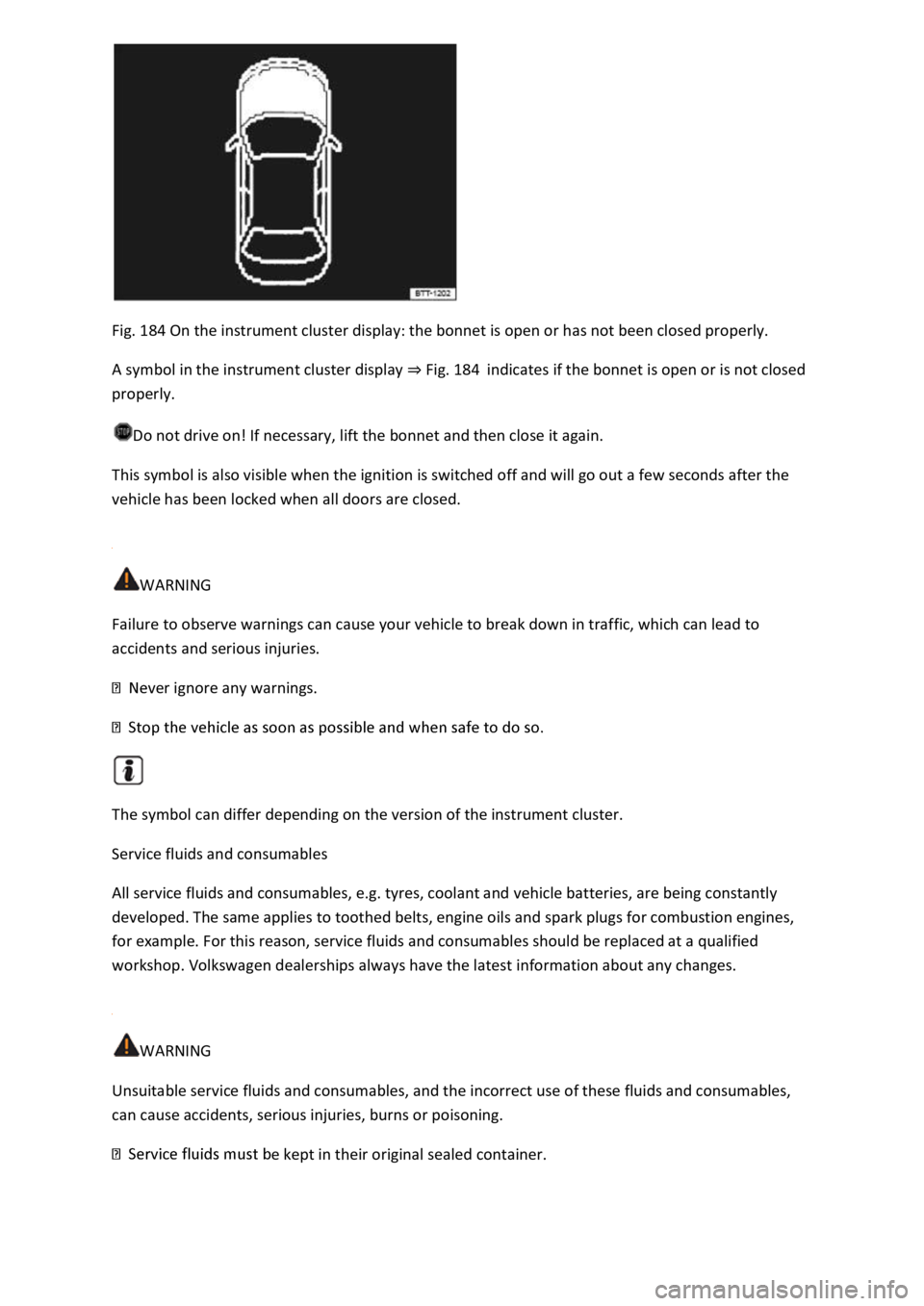
Fig. 184 On the instrument cluster display: the bonnet is open or has not been closed properly.
A symbol in the instrument cluster display ⇒ Fig. 184 indicates if the bonnet is open or is not closed
properly.
Do not drive on! If necessary, lift the bonnet and then close it again.
This symbol is also visible when the ignition is switched off and will go out a few seconds after the
vehicle has been locked when all doors are closed.
WARNING
Failure to observe warnings can cause your vehicle to break down in traffic, which can lead to
accidents and serious injuries.
ver ignore any warnings.
The symbol can differ depending on the version of the instrument cluster.
Service fluids and consumables
All service fluids and consumables, e.g. tyres, coolant and vehicle batteries, are being constantly
developed. The same applies to toothed belts, engine oils and spark plugs for combustion engines,
for example. For this reason, service fluids and consumables should be replaced at a qualified
workshop. Volkswagen dealerships always have the latest information about any changes.
WARNING
Unsuitable service fluids and consumables, and the incorrect use of these fluids and consumables,
can cause accidents, serious injuries, burns or poisoning.
e kept in their original sealed container.
Page 369 of 502
-original containers as
people finding these containers could drink them.
es.
-ventilated
area.
r or other volatile fluids for vehicle care.
These substances are toxic and highly flammable. They could cause fires and explosions.
NOTICE
this can result in serious malfunctions and engine damage.
-on parts in front of the air intake reduce the cooling effect of the
coolant. The engine may overheat at high ambient temperatures and high engine loads.
Leaking service fluids can pollute the environment. Spilt service fluids must be collected in suitable
containers and disposed of properly and with respect for the environment.
Washer fluid
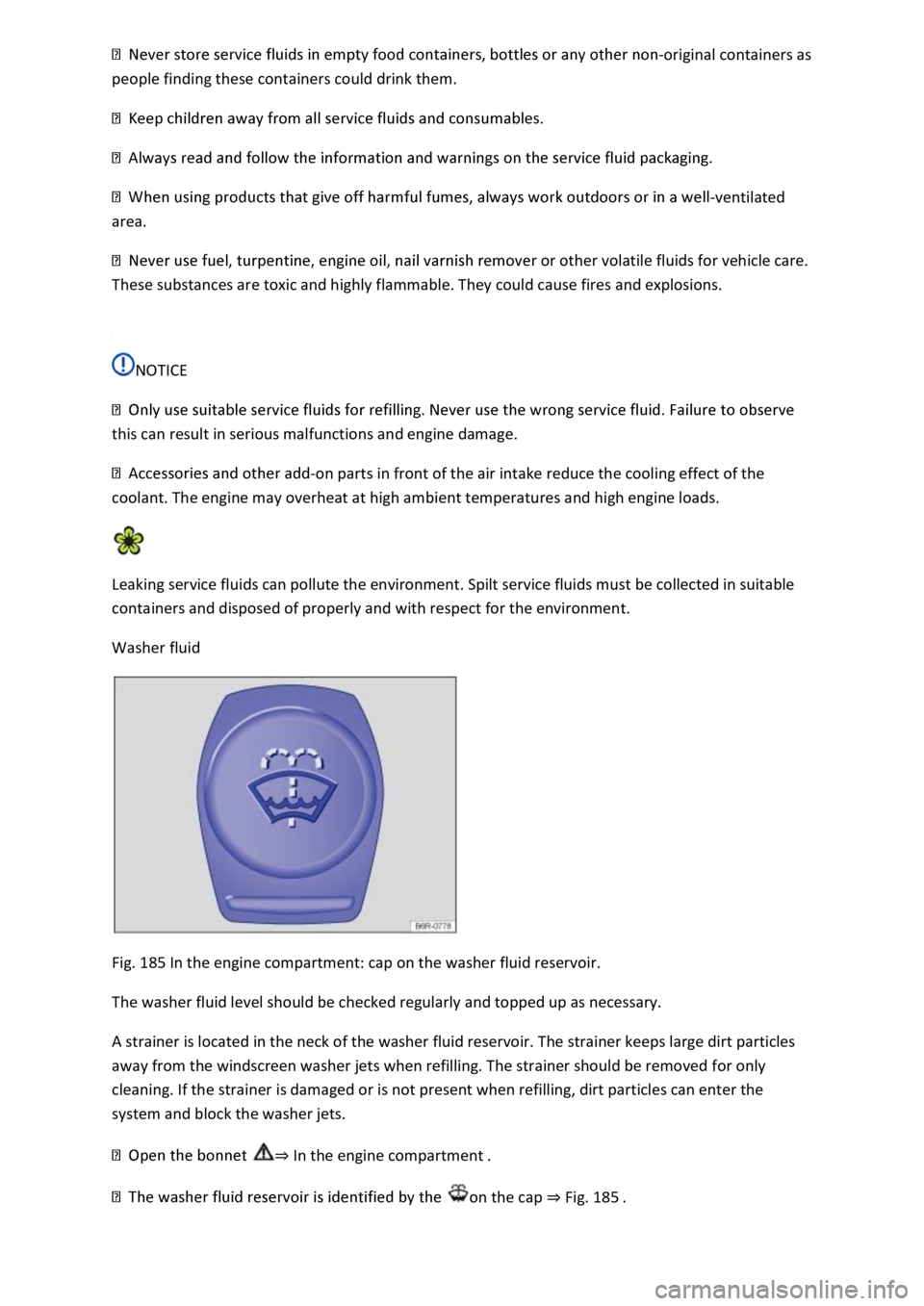
Fig. 185 In the engine compartment: cap on the washer fluid reservoir.
The washer fluid level should be checked regularly and topped up as necessary.
A strainer is located in the neck of the washer fluid reservoir. The strainer keeps large dirt particles
away from the windscreen washer jets when refilling. The strainer should be removed for only
cleaning. If the strainer is damaged or is not present when refilling, dirt particles can enter the
system and block the washer jets.
⇒ In the engine compartment .
on the cap ⇒ Fig. 185 .