service VOLKSWAGEN T-ROC 2021 Owner´s Manual
[x] Cancel search | Manufacturer: VOLKSWAGEN, Model Year: 2021, Model line: T-ROC, Model: VOLKSWAGEN T-ROC 2021Pages: 502, PDF Size: 9.42 MB
Page 453 of 502

e.g. temperature, rain.
As well as performing the actual control functions, these data are also used to detect and rectify
faults and help Volkswagen to improve vehicle functions. The majority of these data are temporary
and are only processed within the vehicle itself. Only a very small amount of data is stored in the
event memories or possibly on the vehicle key.
Reading out the vehicle's event memory
There is a diagnostic interface in the vehicle interior for reading out the event memories (on-board
diagnosis) ⇒ .
If you have service work performed on your vehicle, the technical data can be read out of the vehicle
together with the vehicle identification number by service employees, e.g. workshops, or third
parties such as breakdown services. Service work includes, for example, repairs, maintenance,
warranty work or quality assurance measures. The service workshop or third party collects,
processes and uses the data. The data document the vehicle's technical status, help in
troubleshooting and in improving quality and may be sent to Volkswagen in some cases.
Furthermore, the manufacturer is subject to legal product safety requirements. To make sure it
complies with these requirements, the manufacturer requires technical data from the vehicles.
Event memories in the vehicle can be reset by a service workshop as part of repair or service work.
The event memory should be read out and reset only by a qualified workshop. Additional
information on the stored data is available from the qualified workshop.
After a fault has been rectified, the information in the memory relating to the fault is deleted. Other
memory content is overwritten on an ongoing basis.
Event data recorder
This vehicle is equipped with an event data recorder. The main task of an event data recorder is to
record data in particular accident scenarios or accident-like situations, e.g. in the event of airbags
being triggered or a collision with an obstacle on the road. These data help in analysis of how a
vehicle system behaved in these situations. The event data recorder records data relating to driving
dynamics and the restraint system for a short period of 10 seconds or less. This information includes,
for example:
of the driver and front passenger were fastened.
These data help to obtain a better understanding of the circumstances in the situations where
accidents and injuries have occurred.
Data from driver assist systems are also recorded. In addition to information about whether the
systems were switched on or off, available only to a restricted extent or inactive, it is also possible to
determine whether these functions steered, accelerated or braked the vehicle in the above-
described situations. Depending on the vehicle equipment, these systems include the following:
Page 454 of 502

Assist).
Park Distance Control.
The data of the event data recorder are recorded only if a particular accident-like situation occurs.
No recordings occur under normal driving conditions. Audio or video data from the vehicle interior
or vehicle surroundings are not stored. Personal data such as name, gender, age or accident location
are also not recorded at any time. However, third parties such as law enforcement agencies can use
corresponding means to link the content of the event data recorder with other sources of data and
thus establish a reference to persons as part of an accident investigation.
Special equipment, access to the legally prescribed diagnostic interface (on-board diagnosis) and
switched-on ignition are required in order to read data out of the event data recorder.
Volkswagen will not access, read out or process data from the event data recorder unless the vehicle
owner (or lessee in the case of leasing) grants their permission. Exceptions to this are contractual or
legal provisions.
Due to its legal product monitoring obligations, Volkswagen is entitled to use the data for field
monitoring and also for research purposes and quality improvements. For research purposes,
Volkswagen makes the data available to third parties in anonymous form, in other words without
any reference to the individual vehicle, vehicle owner or lessee.
Reprogramming control units
All data for the control of components are stored in the control units. Some convenience functions,
such as convenience turn signal, single door unlocking and displays, can be reprogrammed using
special workshop equipment. If the convenience functions are reprogrammed, the specifications and
descriptions in this owner's manual will no longer match the original functions. Volkswagen
recommends having any reprogramming entered into the digital service schedule by a Volkswagen
dealership or qualified workshop.
Information about possible reprogramming can be obtained from the Volkswagen dealership.
Convenience and Infotainment functions
Depending on the equipment selected, you can store your own data in the vehicle's Infotainment
functions. This includes, for example:
data for use with a hands-free system or navigation system.
These data can be stored locally in the vehicle or located on a device that you have connected to the
vehicle, e.g. mobile device, USB stick or MP3 player. If these data are stored in the vehicle, you can
Page 455 of 502

delete them at any time. These data are transmitted to third parties only at your request, in
particular in relation to the use of online services and in accordance with your personal settings.
You can store convenience settings (personalisation) in the vehicle and change them at any time.
Depending on the equipment in the vehicle, this includes, for example:
ning system settings.
Integration of mobile devices
If your vehicle contains the necessary equipment, you can connect your mobile device or any other
mobile end device to your vehicle so that you can control this device via the controls integrated in
the vehicle when the corresponding functions are available. For example, images and sounds from
the mobile device can be output through the Infotainment system. At the same time, certain
information is sent to your mobile device. This includes location data and further general vehicle
information, depending on the type of integration. For more details, refer to the information about
display of apps in the Infotainment system.
This enables selected apps on the mobile device to be used in the vehicle, e.g. navigation or music
player. The mobile device and vehicle do not interact in any other ways than those described here,
in particular the device does not actively access vehicle data. The type of further data processing
depends on the app provider. The settings that you can make here depend on the app in question
and the operating system of your mobile device.
Third-party providers
If your vehicle is equipped with a connection to a mobile network, your vehicle will be able to
exchange data with other systems. The vehicle can be connected to a mobile network using a
transmitter and receiver unit in the vehicle or using your own mobile device. This mobile network
connection enables you to use online functions. This includes online services and apps provided by
Volkswagen or other third-party providers.
Manufacturer services
In the case of Volkswagen online services, Volkswagen describes the respective functions in a
suitable place, e.g. in a separate service description or on an Internet page, and the associated
privacy information is provided. Personal data may be used to perform online services. For this, data
are exchanged over a secure connection, e.g. using the designated IT systems of the manufacturer.
Any collection, processing and use of personal data that goes beyond the provision of the service
takes place exclusively according to legal regulations, contractual agreements or the necessary
permission.
You can activate and deactivate the services and functions, some of which charge a fee, and, in some
cases, also disable the vehicle's entire data connection. This does not apply to any functions and
services required by law, e.g. emergency call systems.
Third-party services
If you are able to use online services provided by a party other than the manufacturer, these services
are the sole responsibility of the provider in question and are subject to this provider's privacy policy
Page 456 of 502

and terms and conditions of use. Volkswagen has no influence over the content exchanged in these
services.
Please refer to the provider in question for information about the type, scope and purpose of the
collection and use of personal data related to third-party services.
WARNING
Incorrect use of the diagnostic interface can cause malfunctions, which can result in accidents and
serious injuries.
Volkswagen recommends using a Volkswagen dealership for this purpose.
Please note the further information on Volkswagen Car-Net services ⇒ Mobile online services .
Information stickers and plates
Stickers and plates showing important information for vehicle operation are factory-fitted in the
engine compartment and on certain vehicle parts.
ers or
plates with the same information must be applied properly to the new parts by the qualified
workshop.
Safety certificate
There is a safety certificate on the door pillar of the driver door which states that all necessary safety
standards and specifications from the transport safety authorities of the particular country were met
at the time of production. The month and year of production and the vehicle identification number
may also be listed. Observe notes in the owner's manual.
WARNING
Handling the vehicle incorrectly will increase the risk of accident and injuries.
NOTICE
Handling the vehicle incorrectly could lead to the vehicle becoming damaged.
Page 457 of 502

Carry out servicing work in accordance with the specifications.
Fluids in the air conditioning system
Refrigerant in the air conditioning system
The sticker in the engine compartment provides information about the type and quantity of the
refrigerant used in the vehicle's air conditioning system. The sticker is located in the front part of the
engine compartment close to the refrigerant filler neck.
Symbol and description:
Warning: the air conditioning system must be serviced only by qualified personnel.Type of
refrigerant.Type of lubricating oil.See workshop information (available only for Volkswagen
dealerships).The air conditioning system must be serviced only by qualified personnel.
Flammable refrigerant.Ensure correct disposal of all components and never install components
removed from end-of-life vehicles or recycled components in the vehicle.
Lubricating oil in the air conditioning system
The air conditioning system contains up to 210 ml of lubricating oil. The exact specification and
information about the lubricating oil quantity in the air conditioning system are available from the
following website:
https://erwin.volkswagen.de
WARNING
The air conditioning system must be serviced only by qualified personnel in order to ensure safe
handling of the system.
NOTICE
-of-life
vehicles or from recycling sources.
-of-
life vehicles or from recycling sources.
Radio reception and aerials
The aerials for radio reception can be installed at various locations in the vehicle:
side windows.
Page 466 of 502

Vehicle
equipm
ent
Device name
according to
declaration of
conformity
s er &
Slave
LRR4
R
MRR
e14F
CR
MRR
evo1
4F
MRR
1Plus
MRR
1Rea
r
R3TR
RS4
Car-Net
Securit
y &
Service
TUV
M02I
U-E
Car-Net
e-
Remot
e
HT-6 HT-
6d
HT-
6e
Central
control
unit
BC-
Mod
ule
BCM PQ26
ROW
(502N1xFOx
)
BCM
evo
BCM
2
BCM
2R
BR11 RXI-
35-
433-
DC
5WK
5025
4
Infotain
ment
system
A109 A486 / A449
/ A493 / 183
A473
/ A47
6 /
A475
/ A7
54
A580
/ A2
70
Page 482 of 502

Radio
equipment
a)
Frequ
ency
band
Max. tr
ansmit
power
Security &
Service
00
(880.2
–
959.8
MHz)
(2.002
W)
GSM 1
800
(1,710
.2–
1,879.
8
MHz)
30 dBm
(1.002
W)
UMTS
B1
(1,920
–
2,170
MHz)
24 dBm
(0.25
W)
UMTS
B8
(880–
960
MHz)
GPS
(1,575
.42
MHz)
24 dBm
(0.25
W)
Applies to: Arteon, e-Golf,
Golf, Golf GTE,
Golf Estate,
Passat, Passat
GTE, Passat
Estate, Passat
Estate GTE,
Tiguan.
Car-Net e-
Remote
GSM 8
50
(824–
849
33 dBm
Page 486 of 502

a) In certain European countries, the activation of or permission to use radio technology may be
restricted, not possible, or possible only when additional requirements have been fulfilled.
Technical data
Notes on technical data
Unless otherwise indicated or separately listed, the technical data apply to the basic model. The
values may differ if additional equipment is fitted, for different model versions and for special
vehicles and in the case of country-specific vehicle specifications. All data in the official vehicle
documents take precedence over these data.
Engine
The vehicle data sticker and the official vehicle documents show which engine is installed in your
vehicle.
Weight
The values for the kerb weight in the following tables apply for the road-ready vehicle with driver
(75 kg), service fluids including fuel tank carrying 90% of its capacity and, where applicable, tools and
spare tyre ⇒ . Additional equipment and retrofitted accessories increase the stated kerb weight
and reduce the maximum permitted load accordingly.
The load comprises the weights of the following:
system
Performance figures
In certain vehicles with heavy duty running gear, the engine could be governed to provide a
maximum speed of 210 km/h.
The performance figures were measured without equipment which may negatively influence
performance, such as a roof carrier or mudflaps.
Gross combination weight
The specified gross combination weights are applicable only for altitudes up to 1,000 m above sea
level. The maximum gross combination weight must be reduced by approximately 10% for every
further started 1,000 m in altitude.
Notes on the tables
Gearbox abbreviations: MG = manual gearbox, AG = automatic gearbox, DSG® = DSG® dual clutch
gearbox. MG6 = 6-speed manual gearbox.
WARNING
Page 488 of 502

Fig. 214 Vehicle identification number.
Vehicle data sticker
The vehicle data sticker ⇒ Fig. 213 is located on the cover of the owner's manual and under the
rear luggage compartment trim on the luggage compartment wall. It contains the following data:
Vehicle identification number (chassis number)
Vehicle type, engine power, gearbox type
Engine and gearbox codes, paint number, interior equipment. In the example, the engine code
is CPTA ⇒ Fig. 213 .
Additional equipment, PR numbers
Type plate
The type plate ⇒ Fig. 213 can be seen on the lower part of the door pillar when the driver door is
open. Vehicles for certain export countries do not have a type plate.
The type plate contains the following data:
Approval
Gross vehicle weight rating
Gross combination weight rating (vehicle plus trailer)
Gross front axle weight rating
Gross rear axle weight rating
Vehicle identification number (VIN)
The vehicle identification number can be read from outside the vehicle through a viewer in the
windscreen ⇒ Fig. 214 (arrow). The viewer is located in the lower corner of the windscreen. The
vehicle identification number is also stamped on the right-hand water drainage channel. The water
drainage channel is located between the suspension turret and wing. Open the bonnet to gain
access to the vehicle identification number ⇒ In the engine compartment .
The vehicle identification number can be displayed in the Infotainment system using the button
and the and Service function buttons ⇒ Infotainment system controls and displays .
Vehicle data
Page 490 of 502
Gross combination weight rating (vehicle plus trailer)
Gross front axle weight rating
Gross rear axle weight rating
Vehicle identification number (VIN)
The vehicle identification number can be read from outside the vehicle through a viewer in the
windscreen ⇒ Fig. 216 (arrow). The viewer is located in the lower corner of the windscreen. The
vehicle identification number is also stamped on the right-hand water drainage channel. The water
drainage channel is located between the suspension turret and wing. Open the bonnet to gain
access to the vehicle identification number ⇒ In the engine compartment .
The vehicle identification number can be displayed in the Infotainment system using the button
and the and Service function buttons ⇒ Infotainment system controls and displays .
Dimensions
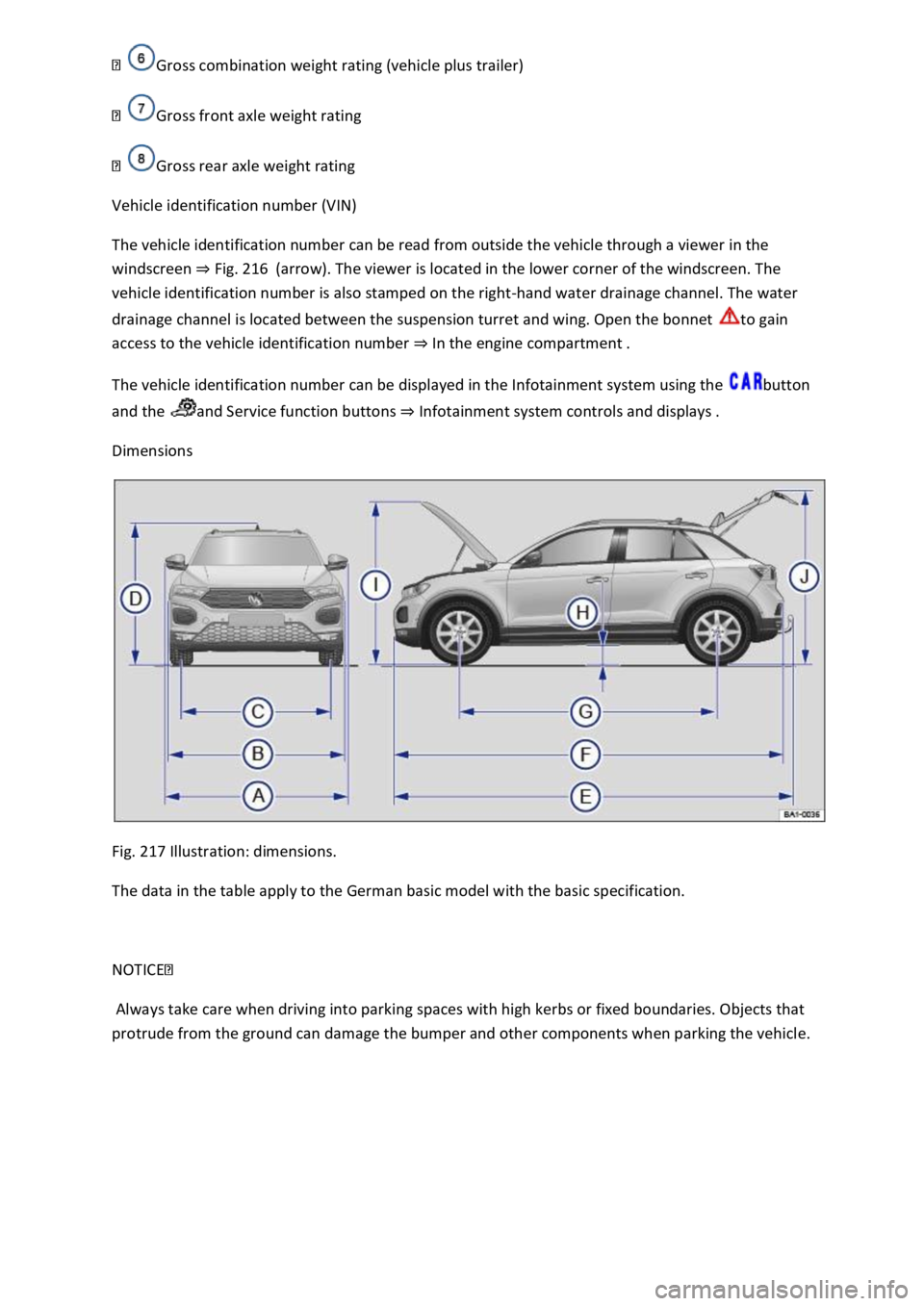
Fig. 217 Illustration: dimensions.
The data in the table apply to the German basic model with the basic specification.
NOTICE
Always take care when driving into parking spaces with high kerbs or fixed boundaries. Objects that
protrude from the ground can damage the bumper and other components when parking the vehicle.