lock VOLKSWAGEN TIGUAN 2017 Owner´s Manual
[x] Cancel search | Manufacturer: VOLKSWAGEN, Model Year: 2017, Model line: TIGUAN, Model: VOLKSWAGEN TIGUAN 2017Pages: 341, PDF Size: 9.14 MB
Page 310 of 341
Crank the jack further until the wheel is just clear of the ground.
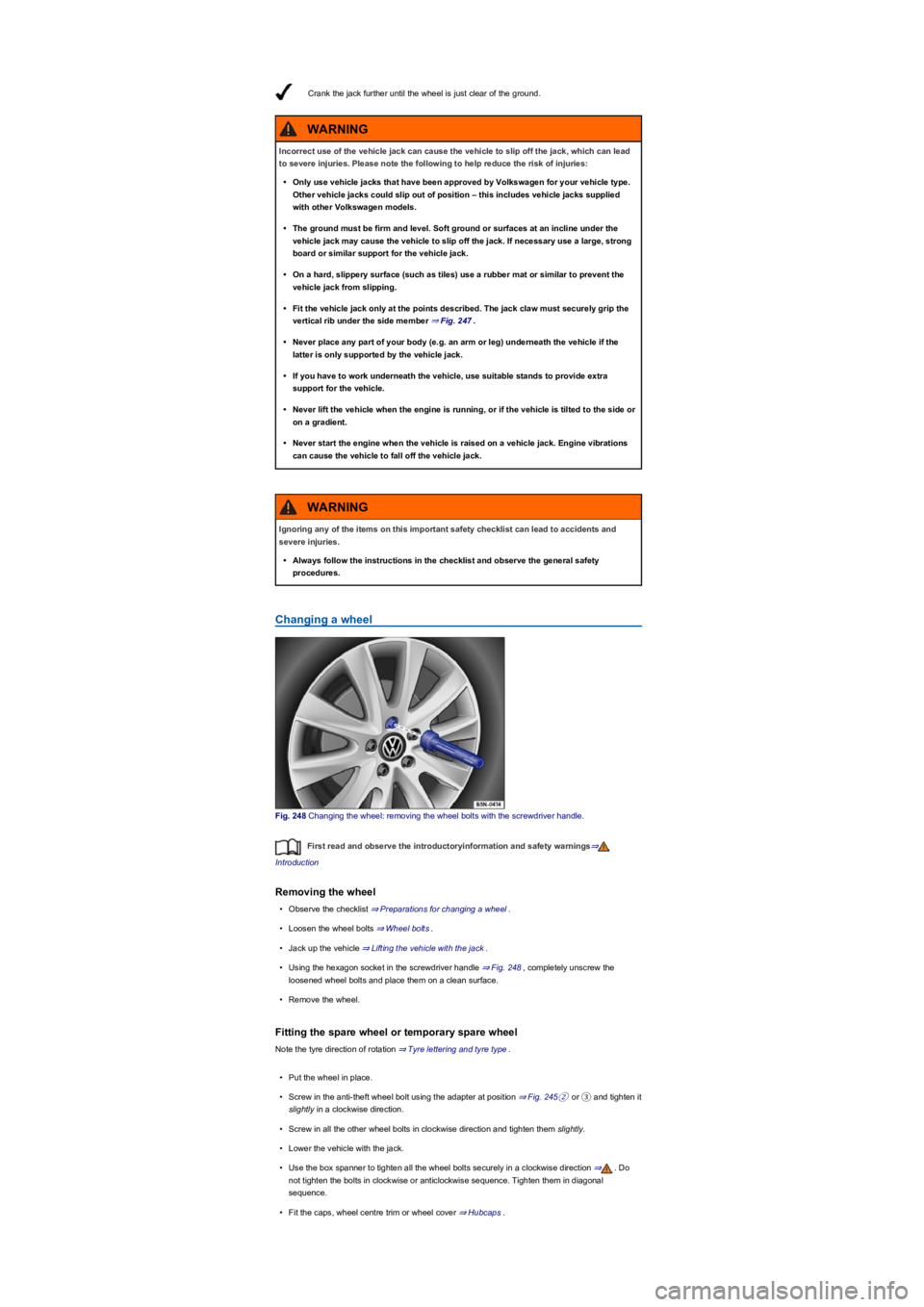
Changing a wheel
Fig. 248 Changing the wheel: removing the wheel bolts with the screwdriver handle.
First read and observe the introductoryinformation and safety warnings⇒
Introduction
Removing the wheel
•Observe the checklist ⇒ Preparations for changing a wheel.
•Loosen the wheel bolts ⇒ Wheel bolts.
•Jack up the vehicle ⇒ Lifting the vehicle with the jack.
•Using the hexagon socket in the screwdriver handle ⇒ Fig. 248, completely unscrew the
loosened wheel bolts and place them on a clean surface.
•Remove the wheel.
Fitting the spare wheel or temporary spare wheel
Note the tyre direction of rotation ⇒ Tyre lettering and tyre type.
•Put the wheel in place.
•Screw in the anti-theft wheel bolt using the adapter at position ⇒ Fig. 245② or ③ and tighten it
slightly in a clockwise direction.
•Screw in all the other wheel bolts in clockwise direction and tighten them slightly.
•Lower the vehicle with the jack.
•Use the box spanner to tighten all the wheel bolts securely in a clockwise direction ⇒. Do
not tighten the bolts in clockwise or anticlockwise sequence. Tighten them in diagonal
sequence.
•Fit the caps, wheel centre trim or wheel cover ⇒ Hubcaps.
Incorrect use of the vehicle jack can cause the vehicle to slip off the jack, which can lead
to severe injuries. Please note the following to help reduce the risk of injuries:
•Only use vehicle jacks that have been approved by Volkswagen for your vehicle type.
Other vehicle jacks could slip out of position – this includes vehicle jacks supplied
with other Volkswagen models.
•The ground must be firm and level. Soft ground or surfaces at an incline under the
vehicle jack may cause the vehicle to slip off the jack. If necessary use a large, strong
board or similar support for the vehicle jack.
•On a hard, slippery surface (such as tiles) use a rubber mat or similar to prevent the
vehicle jack from slipping.
•Fit the vehicle jack only at the points described. The jack claw must securely grip the
vertical rib under the side member ⇒ Fig. 247.
•Never place any part of your body (e.g. an arm or leg) underneath the vehicle if the
latter is only supported by the vehicle jack.
•If you have to work underneath the vehicle, use suitable stands to provide extra
support for the vehicle.
•Never lift the vehicle when the engine is running, or if the vehicle is tilted to the side or
on a gradient.
•Never start the engine when the vehicle is raised on a vehicle jack. Engine vibrations
can cause the vehicle to fall off the vehicle jack.
WARNING
Ignoring any of the items on this important safety checklist can lead to accidents and
severe injuries.
•Always follow the instructions in the checklist and observe the general safety
procedures.
WARNING
Page 313 of 341
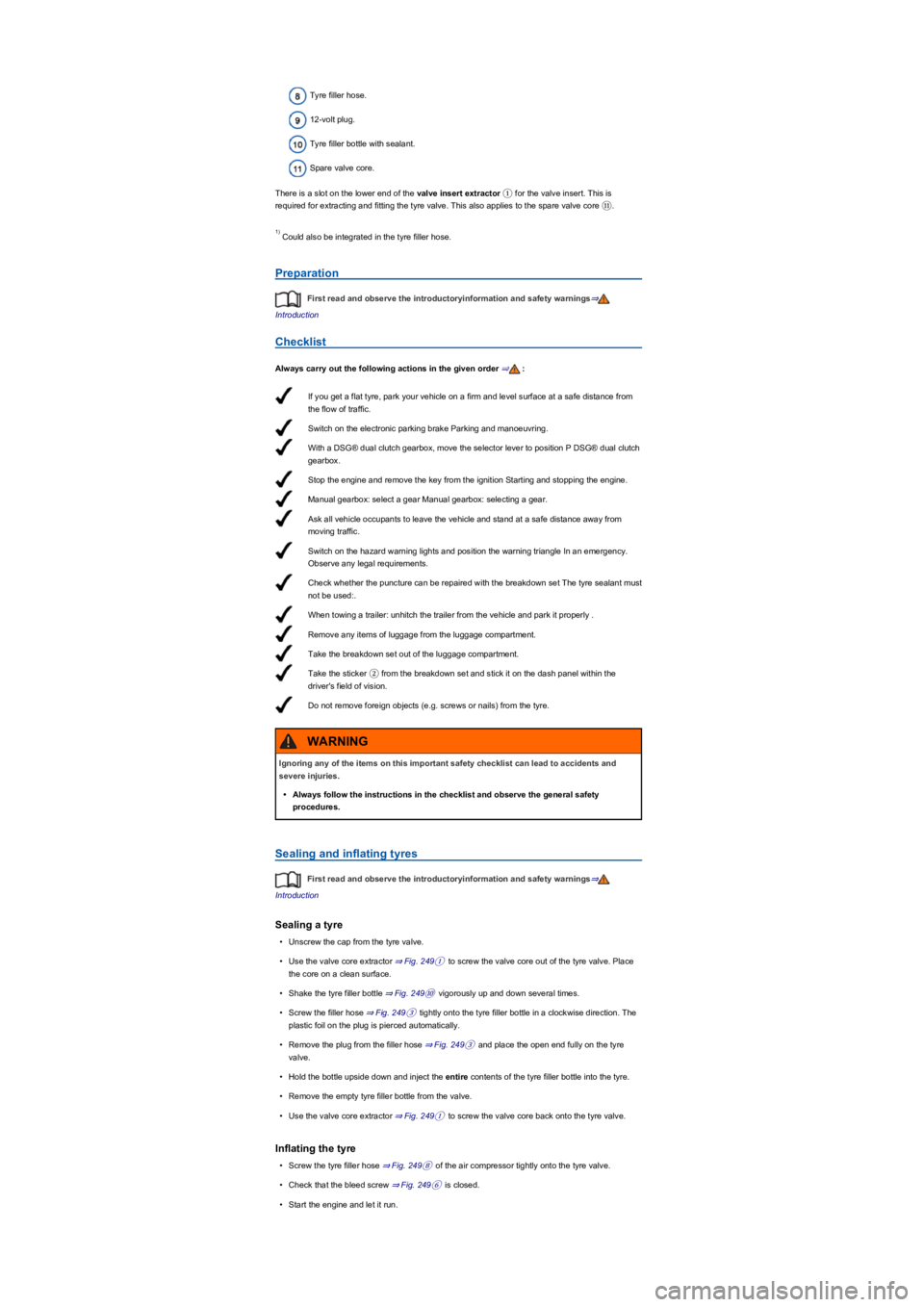
If you get a flat tyre, park your vehicle on a firm and level surface at a safe distance from
the flow of traffic.
Switch on the electronic parking brake Parking and manoeuvring.
With a DSG® dual clutch gearbox, move the selector lever to position P DSG® dual clutch
gearbox.
Stop the engine and remove the key from the ignition Starting and stopping the engine.
Manual gearbox: select a gear Manual gearbox: selecting a gear.
Ask all vehicle occupants to leave the vehicle and stand at a safe distance away from
moving traffic.
Switch on the hazard warning lights and position the warning triangle In an emergency.
Observe any legal requirements.
Check whether the puncture can be repaired with the breakdown set The tyre sealant must
not be used:.
When towing a trailer: unhitch the trailer from the vehicle and park it properly .
Remove any items of luggage from the luggage compartment.
Take the breakdown set out of the luggage compartment.
Take the sticker ② from the breakdown set and stick it on the dash panel within the
driver's field of vision.
Do not remove foreign objects (e.g. screws or nails) from the tyre.
Tyre filler hose.
12-volt plug.
Tyre filler bottle with sealant.
Spare valve core.
There is a slot on the lower end of the valve insert extractor① for the valve insert. This is
required for extracting and fitting the tyre valve. This also applies to the spare valve core ⑪.
Could also be integrated in the tyre filler hose.
Preparation
First read and observe the introductoryinformation and safety warnings⇒
Introduction
Checklist
Always carry out the following actions in the given order ⇒:
Sealing and inflating tyres
First read and observe the introductoryinformation and safety warnings⇒
Introduction
Sealing a tyre
•Unscrew the cap from the tyre valve.
•Use the valve core extractor ⇒ Fig. 249① to screw the valve core out of the tyre valve. Place
the core on a clean surface.
•Shake the tyre filler bottle ⇒ Fig. 249⑩ vigorously up and down several times.
•Screw the filler hose ⇒ Fig. 249③ tightly onto the tyre filler bottle in a clockwise direction. The
plastic foil on the plug is pierced automatically.
•Remove the plug from the filler hose ⇒ Fig. 249③ and place the open end fully on the tyre
valve.
•Hold the bottle upside down and inject the entire contents of the tyre filler bottle into the tyre.
•Remove the empty tyre filler bottle from the valve.
•Use the valve core extractor ⇒ Fig. 249① to screw the valve core back onto the tyre valve.
Inflating the tyre
•Screw the tyre filler hose ⇒ Fig. 249⑧ of the air compressor tightly onto the tyre valve.
•Check that the bleed screw ⇒ Fig. 249⑥ is closed.
•Start the engine and let it run.
1)
Ignoring any of the items on this important safety checklist can lead to accidents and
severe injuries.
•Always follow the instructions in the checklist and observe the general safety
procedures.
WARNING
Page 319 of 341
Suitable accessories are available from your Volkswagen dealership. Follow the usage
instructions on the packaging.
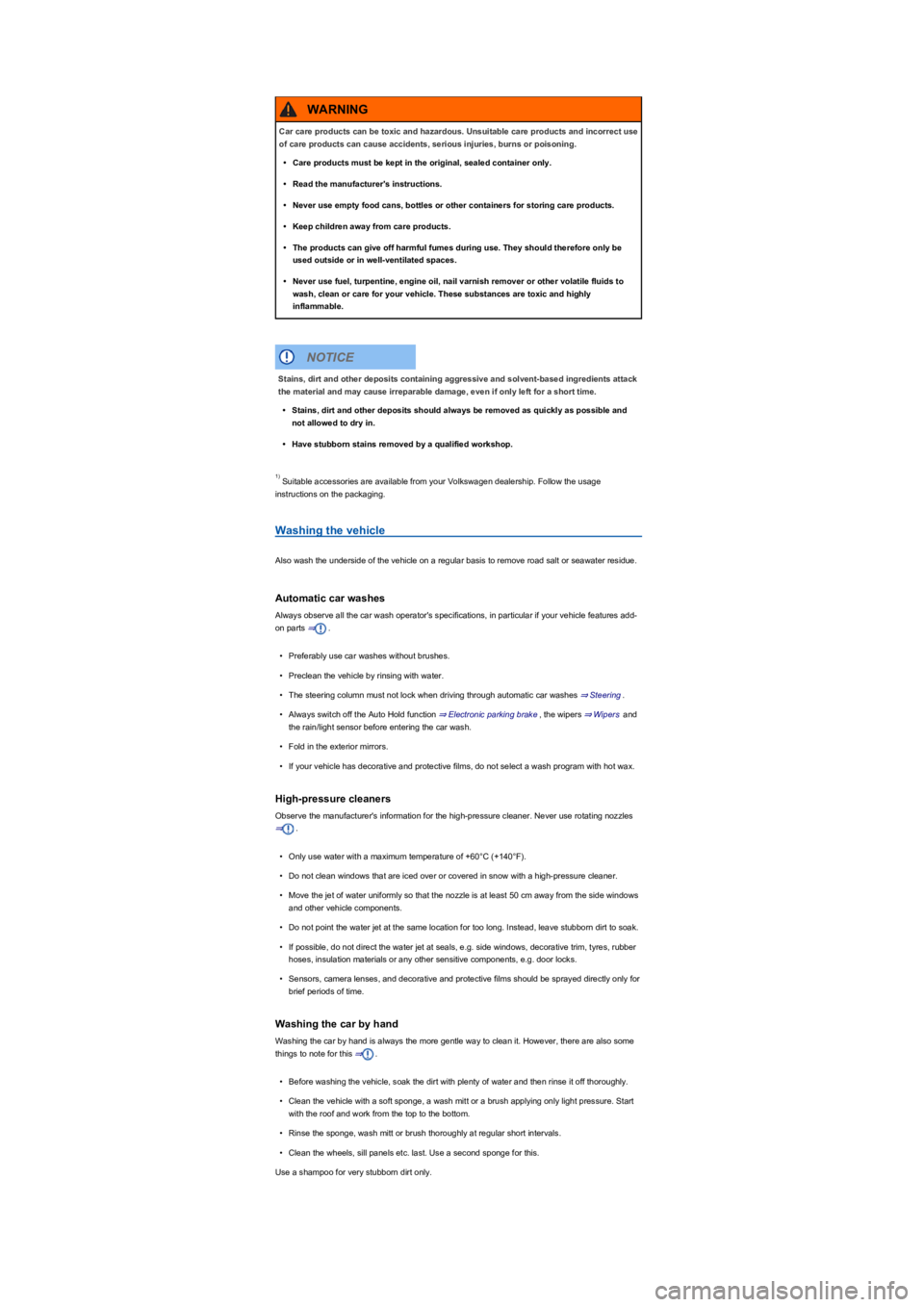
Washing the vehicle
Also wash the underside of the vehicle on a regular basis to remove road salt or seawater residue.
Automatic car washes
Always observe all the car wash operator's specifications, in particular if your vehicle features add-
on parts ⇒.
•Preferably use car washes without brushes.
•Preclean the vehicle by rinsing with water.
•The steering column must not lock when driving through automatic car washes ⇒ Steering.
•Always switch off the Auto Hold function ⇒ Electronic parking brake, the wipers ⇒ Wipers and
the rain/light sensor before entering the car wash.
•Fold in the exterior mirrors.
•If your vehicle has decorative and protective films, do not select a wash program with hot wax.
High-pressure cleaners
Observe the manufacturer's information for the high-pressure cleaner. Never use rotating nozzles
⇒.
•Only use water with a maximum temperature of +60°C (+140°F).
•Do not clean windows that are iced over or covered in snow with a high-pressure cleaner.
•Move the jet of water uniformly so that the nozzle is at least 50 cm away from the side windows
and other vehicle components.
•Do not point the water jet at the same location for too long. Instead, leave stubborn dirt to soak.
•If possible, do not direct the water jet at seals, e.g. side windows, decorative trim, tyres, rubber
hoses, insulation materials or any other sensitive components, e.g. door locks.
•Sensors, camera lenses, and decorative and protective films should be sprayed directly only for
brief periods of time.
Washing the car by hand
Washing the car by hand is always the more gentle way to clean it. However, there are also some
things to note for this ⇒.
•Before washing the vehicle, soak the dirt with plenty of water and then rinse it off thoroughly.
•Clean the vehicle with a soft sponge, a wash mitt or a brush applying only light pressure. Start
with the roof and work from the top to the bottom.
•Rinse the sponge, wash mitt or brush thoroughly at regular short intervals.
•Clean the wheels, sill panels etc. last. Use a second sponge for this.
Use a shampoo for very stubborn dirt only.
Car care products can be toxic and hazardous. Unsuitable care products and incorrect use
of care products can cause accidents, serious injuries, burns or poisoning.
•Care products must be kept in the original, sealed container only.
•Read the manufacturer's instructions.
•Never use empty food cans, bottles or other containers for storing care products.
•Keep children away from care products.
•The products can give off harmful fumes during use. They should therefore only be
used outside or in well-ventilated spaces.
•Never use fuel, turpentine, engine oil, nail varnish remover or other volatile fluids to
wash, clean or care for your vehicle. These substances are toxic and highly
inflammable.
WARNING
Stains, dirt and other deposits containing aggressive and solvent-based ingredients attack
the material and may cause irreparable damage, even if only left for a short time.
•Stains, dirt and other deposits should always be removed as quickly as possible and
not allowed to dry in.
•Have stubborn stains removed by a qualified workshop.
NOTICE
1)
Page 320 of 341
Waxing
Waxing protects the paintwork. At the latest when water no longer clearly forms small drops and
runs off the paintwork when the vehicle is clean, you should re-wax the vehicle with a good wax
solution.
Even if a preservative wax is applied regularly in the automatic car wash, Volkswagen recommends
protecting the vehicle paintwork at least twice a year using Volkswagen Genuine hard wax (-
000 096 317 -).
Polishing
Polishing is only necessary if the paint has lost its shine, and the gloss cannot be brought back by
applying wax.
Wash the vehicle only in specially provided wash bays This prevents waste water
contaminated with oil, grease or fuel from entering the sewerage system.
Caring for and cleaning the vehicle exterior
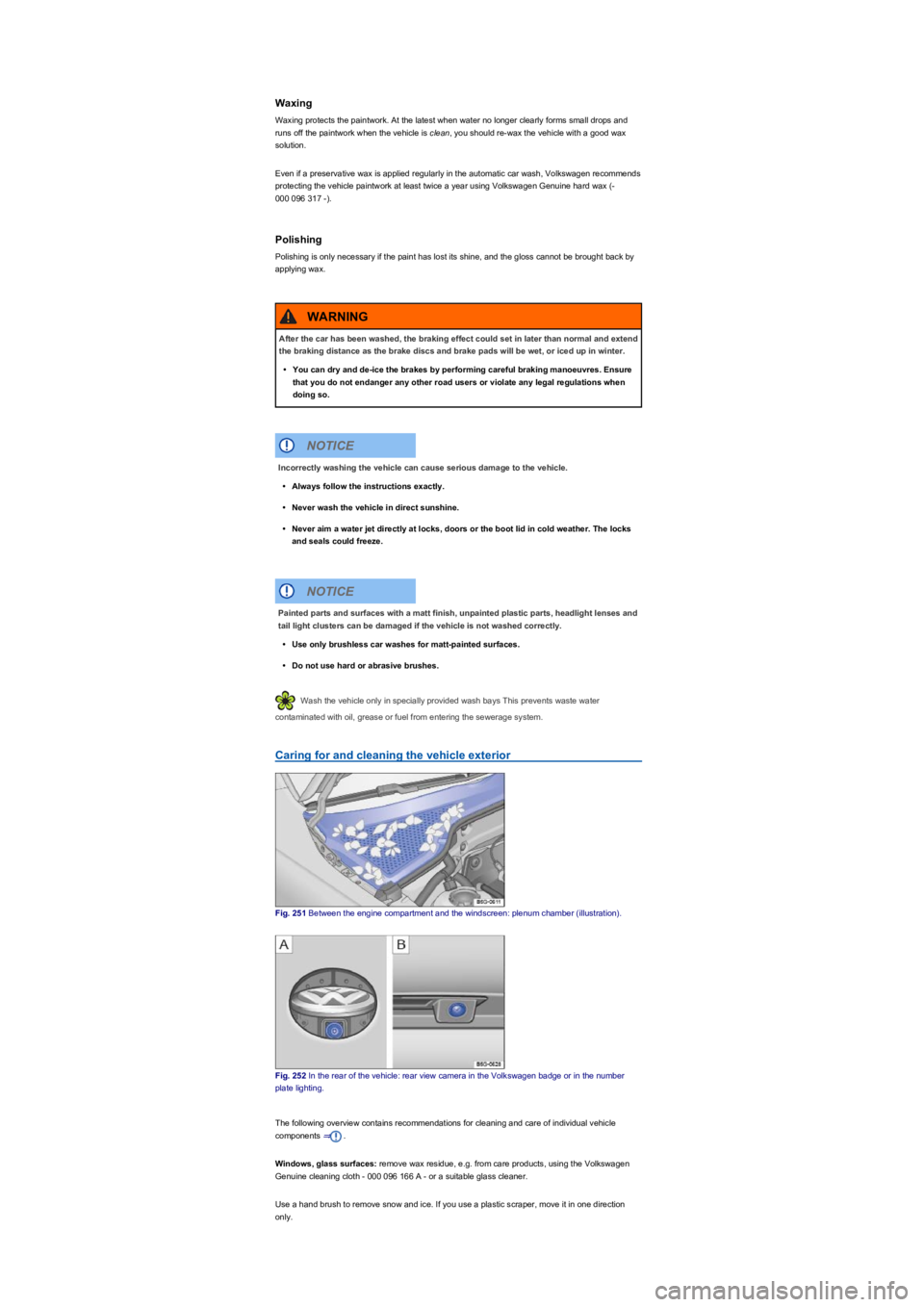
Fig. 251 Between the engine compartment and the windscreen: plenum chamber (illustration).
Fig. 252 In the rear of the vehicle: rear view camera in the Volkswagen badge or in the number
plate lighting.
The following overview contains recommendations for cleaning and care of individual vehicle
components ⇒.
Windows, glass surfaces: remove wax residue, e.g. from care products, using the Volkswagen
Genuine cleaning cloth - 000 096 166 A - or a suitable glass cleaner.
Use a hand brush to remove snow and ice. If you use a plastic scraper, move it in one direction
only.
After the car has been washed, the braking effect could set in later than normal and extend
the braking distance as the brake discs and brake pads will be wet, or iced up in winter.
•You can dry and de-ice the brakes by performing careful braking manoeuvres. Ensure
that you do not endanger any other road users or violate any legal regulations when
doing so.
WARNING
Incorrectly washing the vehicle can cause serious damage to the vehicle.
•Always follow the instructions exactly.
•Never wash the vehicle in direct sunshine.
•Never aim a water jet directly at locks, doors or the boot lid in cold weather. The locks
and seals could freeze.
NOTICE
Painted parts and surfaces with a matt finish, unpainted plastic parts, headlight lenses and
tail light clusters can be damaged if the vehicle is not washed correctly.
•Use only brushless car washes for matt-painted surfaces.
•Do not use hard or abrasive brushes.
NOTICE
Page 321 of 341
Use the Volkswagen Genuine de-icing agent (- 000 096 322 -) to remove ice.
Wiper blades:⇒ Wiper blades.
Paintwork: always treat surfaces carefully in order to prevent damage to the paint coat. Use a
clean, soft cloth and a mild soap solution or cleaning clay to remove any light dirt immediately, e.g.
deposits, insect residue, or cosmetics.
Repair minor paint damage with a touch-up pen. Refer to the vehicle data sticker for the paint code
⇒ Technical data. Consult a qualified workshop in the event of damage to surfaces with matt paint.
•Overflowing fuel or service fluids: clean immediately.
•Flash rust deposits: moisten deposits with a soap solution. Then remove any deposits with
cleaning clay.
•Corrosion: have removed by a qualified workshop.
•Water no longer forms beads on clean paint: preserve paintwork at least twice a year using
Volkswagen Genuine hard wax (- 000 096 317 -).
•No gloss in spite of preservation/paint unattractive: treat the vehicle with suitable polish after
cleaning to remove dirt and dust.
Plenum chamber, engine compartment: remove leaves and other loose objects with a vacuum
cleaner or by hand ⇒ Fig. 251⇒. Cleaning of the engine compartment should always be
performed by a qualified workshop ⇒.
Water that has entered the plenum chamber via a manual process (e.g. from a high-pressure
cleaner) can cause considerable damage to the vehicle.
Sensors, camera lenses: clean the area in front of the sensors or camera with a soft cloth and
solvent-free cleaning agent. Observe the installation locations ⇒ Vehicle overviews.
•Switch on the ignition.
•Move the selector lever to position R.
•Clean the camera lens.
Clean sensitive surfaces on the rain/light sensor and the camera window on the windscreen in the
same way as windows and glass surfaces (depending on vehicle equipment).
Remove snow with a brush. Do not use warm or hot water.
Use the Volkswagen Genuine de-icing agent (- 000 096 322 -) to remove ice.
Decorative films, protective films: remove soiling in the same way as for paint. Always use
Volkswagen Genuine plastic cleaner (- 000 096 314 -) for matt decorative films.
Treat the vehicle with liquid hard wax every three months after washing and removing dust. Only
use clean, soft microfibre clothes to apply it. Do not use hot wax, also not in car washes!
•Stubborn dirt: remove carefully using white spirits, and then rinse using warm water.
Trim parts, trim strips, exhaust pipes made of chrome, aluminium or stainless steel: clean
only in a dust-free environment using a clean, soft cloth and a mild soap solution.
Chrome parts can be protected using Volkswagen Genuine hard wax (- 000 096 317 -).
Anodised surfaces: do not use chrome cleaning products.
Headlights, tail light clusters: use a soft sponge soaked with a mild soap solution. Do not use
any cleaning agents that contain alcohol or solvents.
•Stubborn dirt: remove with Volkswagen Genuine chrome and aluminium care product (-
000 096 319 D -).
Wheels: remove dirt and gritting salt deposits with plenty of water.
Alloy wheels: treat dirty aluminium wheels with Volkswagen Genuine wheel cleaner (- 000 096 304
-). Volkswagen recommends treating the wheel rims with Volkswagen Genuine hard wax (-
000 096 317 -) every three months.
•Damage protective paint coating: repair immediately with a touch-up pen. Go to a qualified
workshop if necessary.
•Brake dust: use Volkswagen Genuine wheel rim cleaner (- 000 096 304 -).
Door lock cylinders: Volkswagen recommends using Volkswagen Genuine de-icing agent (-
000 096 322 -) for de-icing. Do not use door lock de-icers containing substances that dissolve
grease.
1)
1)
1)
Page 322 of 341
The durability and colourfastness of decorative and protective films can be affected by
environmental influences such as direct sunlight, moisture, air pollution, stone impact etc.
Decorative films may show signs of wear or ageing after about one to three years, protective films
after about two to three years. In very warm environments, decorative films may fade slightly after
one year and protective films after two.
Mild soap solution: a maximum of two tablespoons of neutral soap diluted in one litre of water.
Vehicle interior care and cleaning
The following overview contains recommendations for cleaning and care of individual vehicle
components ⇒.
Windows: clean with a glass cleaner, then wipe dry with a clean chamois leather or with a lint-free
cloth.
Textiles, microfibre cloth, artificial leather: remove any dirt with Volkswagen Genuine interior
cleaning agent (- 000 096 301 -). Never treat materials with leather care agents, solvents, wax
polish, shoe cream, stain removers or similar substances.
•Dirt particles adhering to surfaces: remove with a vacuum cleaner on a regular basis so that the
material is not permanently damaged by abrasion.
•Grease stains, e.g. oil: use Volkswagen Genuine interior cleaning agent (- 000 096 301 -). Dab
off dissolved grease and colour particles with an absorbent cloth and then treat with water if
necessary.
•Special soiling, e.g. ballpoint pen, nail varnish: use Volkswagen Genuine interior cleaning agent
(- 000 096 301 -) and then treat afterwards with a mild soap solution if necessary.
Natural leather: remove fresh soiling with a cotton cloth and mild soap solution. Do not allow
fluids to seep into the seams.
Treat any dried spots with Volkswagen Genuine leather cleaner (- 000 096 323 -).
Regularly and each time after having finished cleaning, apply care cream with light protection and
impregnating properties. Use a special coloured leather cream if necessary. If the vehicle is parked
outdoors for long periods, you should cover the leather to protect it from direct sunlight.
Never treat leather with solvents, wax polish, shoe cream, stain removers or similar.
•Grease-based soiling, e.g. oil: remove fresh stains with an absorbent cloth.
•Special soiling, e.g. ballpoint pen, nail varnish and dried stains: treat with Volkswagen Genuine
leather cleaner (- 000 096 323 -).
Plastic parts: use a soft, moist cloth.
Remove stubborn stains with a soft cloth and a mild soap solution. If necessary, use a solvent-free
plastic cleaning agent, e.g. Volkswagen Genuine plastic cleaner (- 000 096 314 -).
Trim parts, trim strips made of chrome, aluminium or stainless steel: clean in a dust-free
environment using a clean, soft cloth and a mild soap solution.
Anodised surfaces: do not use chrome cleaning products.
Controls: remove coarse dirt and other dirt that is difficult to reach using a soft brush. Then use a
clean, soft cloth and a mild soap solution. Do not allow liquids to come into contact with control
elements.
The engine compartment of any motor vehicle is a hazardous area. All work in the engine
compartment carries the risk of injury, scalding, accidents and fire.
•Before carrying out any work, ensure that you are familiar with the requisite
procedures and general safety regulations ⇒ In the engine compartment.
•Volkswagen recommends having the work carried out by a qualified workshop.
WARNING
Incorrect cleaning and care may cause vehicle damage.
•Always heed the instructions precisely.
•Do not use any excessively harsh, abrasive cleaning products.
NOTICE
The drains of the plenum chamber may become blocked by leaves and dirt. Water that
does not drain away can enter the vehicle interior.
•Have the area under the perforated cover cleaned by a qualified workshop.
NOTICE
1)
1)
1)
1)
1)
1)
Page 329 of 341
Special equipment, access to the legally prescribed diagnostic interface (on-board diagnostics) and
switched-on ignition are required in order to read data out of the event data recorder.
Volkswagen will not access, read out or process data from the event data recorder unless the
vehicle owner (or lessee in the case of leasing) grants their permission. Exceptions to this are
contractual or legal provisions.
Due to its legal product monitoring obligations, Volkswagen is entitled to use the data for field
monitoring and also for research purposes and quality improvements. For research purposes,
Volkswagen makes the data available to third parties in anonymous form, in other words without
any reference to the individual vehicle, vehicle owner or lessee.
Reprogramming control units
All data for the control of components are stored in the control units. Some convenience functions,
such as lane change flash, single door unlocking and displays, can be reprogrammed using special
workshop equipment. If the convenience functions are reprogrammed, the descriptions in your
vehicle wallet will no longer match the original functions. Volkswagen recommends having any
reprogramming entered into the digital service schedule by a Volkswagen dealership or qualified
workshop.
Information about possible reprogramming can be obtained from the Volkswagen dealership.
Convenience and Infotainment functions
Depending on the equipment selected, you can store your own data in the vehicle's Infotainment
functions. This includes, for example:
•Media files for playing music, films or photos in the Infotainment system.
•Address book data for use with a hands-free system or navigation system.
•Entered navigation destinations.
•Data on the use of online services.
These data can be stored locally in the vehicle or located on a device that you have connected to
the vehicle, e.g. mobile device, USB stick or MP3 player. If these data are stored in the vehicle, you
can delete them at any time. These data are transmitted to third parties only at your request, in
particular in relation to the use of online services and in accordance with your personal settings.
You can store convenience settings (personalisation) in the vehicle and change them at any time.
Depending on the equipment in the vehicle, this includes, for example:
•Seat position settings.
•Running gear and air conditioning system settings.
•Personalised settings such as mirror adjustment or background lighting.
Integration of mobile devices
If your vehicle contains the necessary equipment, you can connect your mobile device or any other
mobile end device to your vehicle so that you can control this device via the controls integrated in
the vehicle when the corresponding functions are available. For example, images and sounds from
the mobile device can be output through the Infotainment system. At the same time, certain
information is sent to your mobile device. This includes location data and further general vehicle
information, depending on the type of integration. For more details, refer to the information about
display of apps in the Infotainment system ⇒ Mobile online services.
This enables selected apps on the mobile device to be used in the vehicle, e.g. navigation or music
player. The mobile device and vehicle do not interact in any other ways than those described here,
in particular the device does not actively access vehicle data. The type of further data processing
depends on the app provider. The settings that you can make here depend on the app in question
and the operating system on your mobile device.
Third party providers
If your vehicle is equipped with a connection to a mobile network, your vehicle will be able to
exchange data with other systems. The vehicle can be connected to a mobile network using a
transmitter and receiver unit in the vehicle or using your own mobile device. This mobile network
connection enables you to use online functions. This includes online services and apps provided by
Volkswagen or other third-party providers.
Manufacturer services
In the case of online services provided by Volkswagen, the respective functions are described by
Volkswagen in a suitable location, e.g. in a separate service description or on a website ⇒ Mobile
online services along with the relevant data protection policies. Personal data may be required to
provide online services. For this, data are exchanged over a secure connection, e.g. using the
designated IT systems of the manufacturer. Any collection, processing and use of personal data
that goes beyond the provision of the service takes place exclusively according to legal regulations,
contractual agreements or the necessary permission.
You can activate and deactivate the services and functions, some of which are subject to a fee, and
in some cases also disable the vehicle's entire data connection. This does not apply to any
functions and services required by law, e.g. emergency call systems.
Page 332 of 341
Information in accordance with the EU Chemicals Regulation
REACH
In accordance with the European regulations on chemicals, known as REACH, Volkswagen would
like to inform you about the substances that may be found in your vehicle.
You can access this information online using your vehicle identification number ⇒ Technical data:
https://reachinfo.volkswagen.com
Declaration of conformity
The individual manufacturer declares herewith that the following products conform, at the time of
vehicle production, with the basic requirements and other relevant laws and regulations, including
FCC Part 15.19, FCC Part 15.21 and RSS-Gen Issue 1:
Radio-based equipment
•Electronic immobiliser.
•Vehicle key.
•Keyless Access locking and starting system.
•Adaptive Cruise Control (ACC).
•Area monitoring system (Front Assist) including City Emergency Brake.
•Lane change system (Side Assist)
•Remote control for the auxiliary heater ⇒ Auxiliary heater and ventilation.
•Trailer manoeuvring system (Trailer Assist) ⇒ Trailer Assist
Electrical equipment
•12-volt socket.
•230-volt Euro socket, 115-volt socket, 100-volt socket.
Recycling and scrapping end-of-life vehicles
Recycling end-of-life vehicles
Volkswagen has already made provision for you to recycle your vehicle in an environmentally
responsible manner. The recycling system operating in many European countries will take back
your vehicle at the end of its useful life. Once the vehicle has been recycled, a certificate of
destruction will be issued to show that the vehicle has been disposed of correctly.
End-of-life vehicles are recycled free of charge, provided that national legislation is complied with.
Further information on the recycling of end-of-life vehicles can be found at a Volkswagen
dealership.
Scrapping
The relevant safety requirements must be observed when the vehicle or components of the airbag
and the belt tensioners are scrapped. Qualified workshops are familiar with these requirements.
Information about vehicles with N1 approval (light commercial
vehicle)
Please observe the following information for vehicles used to transport goods with a maximum
permitted weight of up to 3.5 t (N1 approval in Europe):
Variants and number of seats
N1 vehicles based on a Volkswagen passenger car models are available in different versions. The
number of seats may be restricted to two or four.
Vehicles with two seats: there is no floor covering in the rear of the vehicle interior because there is
no rear bench seat ⇒.
Vehicles with four seats: the centre seat on the rear bench seat cannot be used⇒.
Safe transport of children
Like in vehicles with passenger car approval (M1), approved child restraint systems can be used on
the seats ⇒ Safe transport of children.
Towing a trailer
If the vehicle is approved for towing a trailer, observe any local regulations for driving with a trailer
and using a towing bracket.
Page 340 of 341
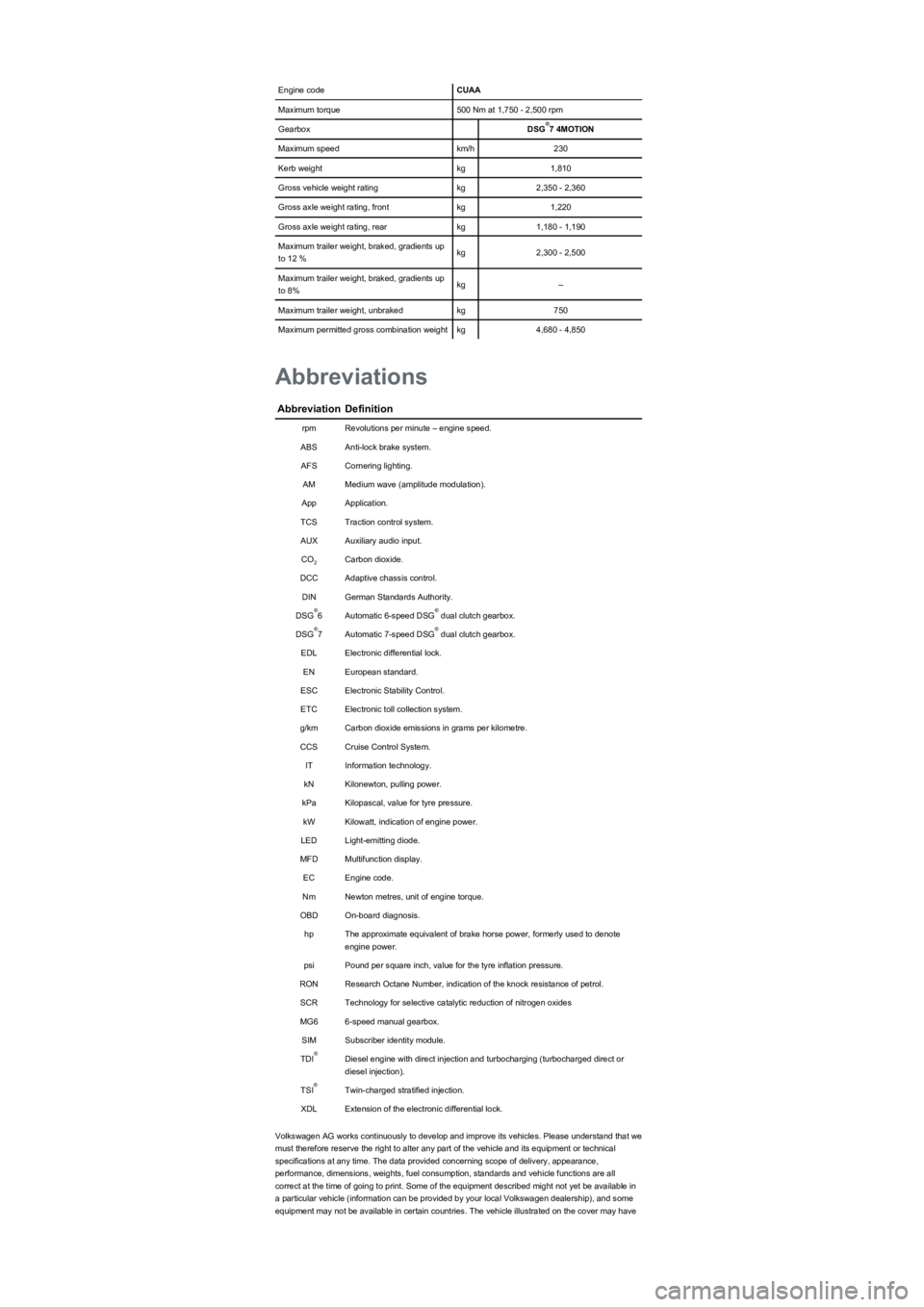
Engine codeCUAA
Maximum torque500 Nm at 1,750 - 2,500 rpm
GearboxDSG7 4MOTION
Maximum speedkm/h230
Kerb weightkg1,810
Gross vehicle weight ratingkg2,350 - 2,360
Gross axle weight rating, frontkg1,220
Gross axle weight rating, rearkg1,180 - 1,190
Maximum trailer weight, braked, gradients up
to 12 %kg2,300 - 2,500
Maximum trailer weight, braked, gradients up
to 8%kg–
Maximum trailer weight, unbrakedkg750
Maximum permitted gross combination weightkg4,680 - 4,850
AbbreviationDefinition
rpmRevolutions per minute – engine speed.
ABSAnti-lock brake system.
AFSCornering lighting.
AMMedium wave (amplitude modulation).
AppApplication.
TCSTraction control system.
AUXAuxiliary audio input.
COCarbon dioxide.
DCCAdaptive chassis control.
DINGerman Standards Authority.
DSG6Automatic 6-speed DSG dual clutch gearbox.
DSG7Automatic 7-speed DSG dual clutch gearbox.
EDLElectronic differential lock.
ENEuropean standard.
ESCElectronic Stability Control.
ETCElectronic toll collection system.
g/kmCarbon dioxide emissions in grams per kilometre.
CCSCruise Control System.
ITInformation technology.
kNKilonewton, pulling power.
kPaKilopascal, value for tyre pressure.
kWKilowatt, indication of engine power.
LEDLight-emitting diode.
MFDMultifunction display.
ECEngine code.
NmNewton metres, unit of engine torque.
OBDOn-board diagnosis.
hpThe approximate equivalent of brake horse power, formerly used to denote
engine power.
psiPound per square inch, value for the tyre inflation pressure.
RONResearch Octane Number, indication of the knock resistance of petrol.
SCRTechnology for selective catalytic reduction of nitrogen oxides
MG66-speed manual gearbox.
SIMSubscriber identity module.
TDIDiesel engine with direct injection and turbocharging (turbocharged direct or
diesel injection).
TSITwin-charged stratified injection.
XDLExtension of the electronic differential lock.
Volkswagen AG works continuously to develop and improve its vehicles. Please understand that we
must therefore reserve the right to alter any part of the vehicle and its equipment or technical
specifications at any time. The data provided concerning scope of delivery, appearance,
performance, dimensions, weights, fuel consumption, standards and vehicle functions are all
correct at the time of going to print. Some of the equipment described might not yet be available in
a particular vehicle (information can be provided by your local Volkswagen dealership), and some
equipment may not be available in certain countries. The vehicle illustrated on the cover may have
®
Abbreviations
2
®®
®®
®
®