brake light VOLKSWAGEN TIGUAN 2017 Owner´s Manual
[x] Cancel search | Manufacturer: VOLKSWAGEN, Model Year: 2017, Model line: TIGUAN, Model: VOLKSWAGEN TIGUAN 2017Pages: 341, PDF Size: 9.14 MB
Page 151 of 341
•After manual release, carefully press the cover onto the centre console while ensuring that the
electrical wires are positioned correctly.
Emergency programme
There is a fault in the system if all the displays on the instrument cluster for the selector lever
positions have a light background. The DSG dual clutch gearbox is running in an emergency
programme. The vehicle can still be driven in the emergency programme, but only at reduced
speed and not in all gears.
In vehicles with a DSG dual clutch gearbox, you may no longer be able to select reverse gear.
In all cases you should have the DSG dual clutch gearbox checked by a qualified workshop
immediately.
Overheating of the DSG dual clutch gearbox
The DSG dual clutch gearbox can become too hot, for example, if the vehicle pulls off
frequently, drives at crawling speed for long periods, or in stop-and-go traffic. Overheating is
indicated by the warning lamp and in some cases by a text message in the instrument cluster
display. A signal tone may also be given. Stop the vehicle and allow the gearbox to cool down ⇒
.
The vehicle does not move forwards or backwards even though a position
has been selected
If the vehicle will not move in the required direction, the system may have selected the position
incorrectly. Depress the brake pedal and reselect the position.
If the vehicle still does not move in the required direction, there is a system fault. Seek expert
assistance and have the system checked.
Downhill speed control
If the vehicle is being held on the Auto Hold function, the green indicator lamp lights up.
Switch off Auto Hold if necessary ⇒ Auto Hold function.
The Hill Descent Control system in vehicles with a DSG dual clutch gearbox helps when braking
and travelling downhill ⇒. This system uses the braking power of the engine, rather than the
brakes directly.
The DSG dual clutch gearbox selects the best gear for the circumstances, depending on the
steepness of the hill and the current speed. The selector lever must be in position D/S. The downhill
speed control is not active in Tiptronic mode.
As the downhill speed control system can shift down only as far as third gear, it may be necessary
to activate the Tiptronic mode when driving down particularly steep inclines. When in Tiptronic
mode, select second or first gear manually in order to make use of the braking effect of the engine
and to relieve the load on the brakes.
The start/stop system is automatically deactivated as long as downhill speed control is active.
Activating downhill speed control automatically:
•If the downhill gradient is greater than approximately 6%.
•AND: if the selector lever is in position D/S.
®
®
®
®
®
Never move the selector lever out of the position P if the electronic parking brake is not
switched on. Otherwise the vehicle could move unexpectedly if it is stopped on an incline,
which could lead to accidents and serious injuries.
WARNING
The DSG dual clutch gearbox will become damaged if the vehicle is allowed to roll for a
long period of time or at a high speed (for example while being towed) with the selector
lever in position N and the engine switched off.
NOTICE
®
•If the display indicates that the gearbox is overheating for the first time, the vehicle will
have to be parked safely or driven faster than 20 km/h (12 mph).
•If the text message and signal tone are repeated every ten seconds, the vehicle must be
parked safely immediately and the engine switched off. Allow the gearbox to cool down.
•In order to prevent damage to the gearbox, you should not drive on until the acoustic
warning stops. You should not pull away or drive the vehicle at very low speeds while
the gearbox is overheated.
NOTICE
®
®
Page 152 of 341
•In addition, if the cruise control system or Adaptive Cruise Control (ACC) is switched off:
if the vehicle speed is less than approximately 80 km/h (50 mph) or the brake pedal is
depressed.
•In addition, if the cruise control system or Adaptive Cruise Control (ACC) is active: if the
stored speed is exceeded.
Deactivating downhill speed control automatically:
•If the downhill gradient becomes less steep.
•OR: if the gearbox shifts up a gear because the engine speed is higher than approximately
4,500 rpm.
•Or in addition if the cruise control system or Adaptive Cruise Control (ACC) is active: if
the stored speed can be maintained.
Hill Descent Control
When Hill Descent Control is active, the indicator lamp lights up white.
When Hill Descent Control is not active, the indicator lamp lights up grey. The system is
switched on, but is not regulating.
The Hill Descent Control system automatically brakes all four wheels to limit the speed when driving
forwards and reversing on steep downhill gradients. The wheels will not lock as the anti-lock brake
system remains active. In vehicles with a manual gearbox, Hill Descent Control adjusts the target
speed so that the engine speed does not drop below the idling speed.
If you enter a downhill slope travelling at a speed under 30 km/h (18 mph), the vehicle speed will be
limited to a speed between min. 2 km/h (1 mph) and max. 30 km/h (18 mph). The driver can use the
accelerator pedal and the brakes to alter the speed in this range. The control speed will be set
again as soon as the driver takes their foot off the accelerator or brake pedal.
However, this can work only if the tyres have sufficient grip on the road. Hill Descent Control
cannot work on an icy or slippery slope, for example.
Hill Descent Control is automatically activated if the following conditions are met:
•The engine is running.
•The Off-road driving profile is selected ⇒ Driving profile selection and 4MOTION Active
Control.
•The speed is under 30 km/h (18 mph) (the function display is visible on the instrument
cluster display).
•The downhill gradient is at least 10 %.
•You do not brake or accelerate.
The Hill Descent Control function will be deactivated when the downhill gradient is less than 5 %.
The intelligent downhill speed control technology cannot overcome the laws of physics,
and functions only within the limits of the system. Never allow the extra convenience
afforded by pull-away assist systems to tempt you into taking any risks when driving.
•Unintentional vehicle movements can cause serious injury.
•The downhill speed control cannot replace the full concentration of the driver.
•Always adapt your speed and driving style to suit visibility, weather, road and traffic
conditions.
•Downhill speed control cannot hold the vehicle in all hill start situations or brake it
sufficiently on all slopes going downhill (e.g. if the ground is slippery or icy).
WARNING
Always be prepared to brake the vehicle. Accidents and injuries could occur if this is not
ensured.
•The downhill speed control is only a support function and may not be able to brake the
vehicle sufficiently in all situations when driving downhill.
•The vehicle may become faster despite the downhill speed control being in operation.
WARNING
Page 153 of 341
Steering
Information on steering
The steering should be locked every time you leave the vehicle to make it more difficult for the
vehicle to be stolen.
Steering
The power steering is not hydraulic. It is an electromechanical system. The advantage of this
steering system is that no hydraulic hoses, hydraulic oil, pumps, filter or other parts are required.
The electromechanical system reduces fuel consumption. A hydraulic system requires constant oil
pressure in the system, whereas an electromechanical steering system only needs an energy
supply while steering.
In vehicles with driving profile selection, the selected driving profile can affect the behaviour of the
power steering ⇒ Driving profile selection and 4MOTION Active Control.
Electronic steering column lock in vehicles with starter button
The steering column will be locked if the driver door is opened and the ignition is switched off. For
this, the vehicle should be stationary and, if necessary, the gear selector lever should be in position
P.
If the ignition is not switched off until after the driver door is opened, the electronic steering column
will only be locked when the vehicle is locked using the vehicle key or the sensor in the door
handle.
Mechanical steering column lock (steering lock) in vehicles with an
ignition lock
The steering column is locked if the vehicle key is removed from the ignition lock when the vehicle
is stationary. Turn the steering wheel slightly until the steering lock clicks into place.
Insert the vehicle key into the ignition lock to unlock the steering lock. Turn the steering wheel
slightly to take the load off the steering lock mechanism. Hold the steering wheel in this position and
turn the ignition on.
Electromechanical steering
The power steering provided by the electromechanical steering system automatically adjusts to the
vehicle speed, steering wheel torque and steering wheel angle. The electromechanical steering
only functions when the engine is running.
You will need considerably more strength than normal to steer the vehicle if the power steering is
reduced or has failed completely.
Counter steering assistance
Counter steering assistance provides the driver with power steering in critical driving situations.
Additional steering power helps the driver when counter steering ⇒.
The intelligent Hill Descent Control technology cannot overcome the laws of physics, and
functions only within the limits of the system. Never allow the extra convenience afforded
by pull-away assist systems to tempt you into taking any risks when driving.
•Unintentional vehicle movements can cause serious injury.
•The Hill Descent Control cannot replace the full concentration of the driver.
•Always adapt your speed and driving style to suit visibility, weather, road and traffic
conditions.
•A Hill Descent Control System may not be able to always hold the vehicle on uphill
gradients or brake it sufficiently on all slopes going downhill (e.g. if the ground is
slippery or icy).
WARNING
Always be prepared to brake the vehicle. Accidents and injuries could occur if this is not
ensured.
•The Hill Descent Control system is only a support function and may not be able to
brake the vehicle sufficiently in all situations when driving downhill.
•The vehicle may accelerate despite the Hill Descent Control system.
WARNING
Page 156 of 341
•Proactive occupant protection system
In vehicles with a DSG dual clutch gearbox, the system automatically changes to gear
position S when the Sport driving profile is selected. The system automatically switches to gear
position D when the Eco driving profile is selected. Since coasting is active in the Eco driving
profile, the gearbox programme E is additionally displayed on the instrument cluster display.
The driver can adjust certain vehicle functions irrespective of the selected driving profile. For
example, the driver can switch to gear position S when the Eco driving profile is selected.
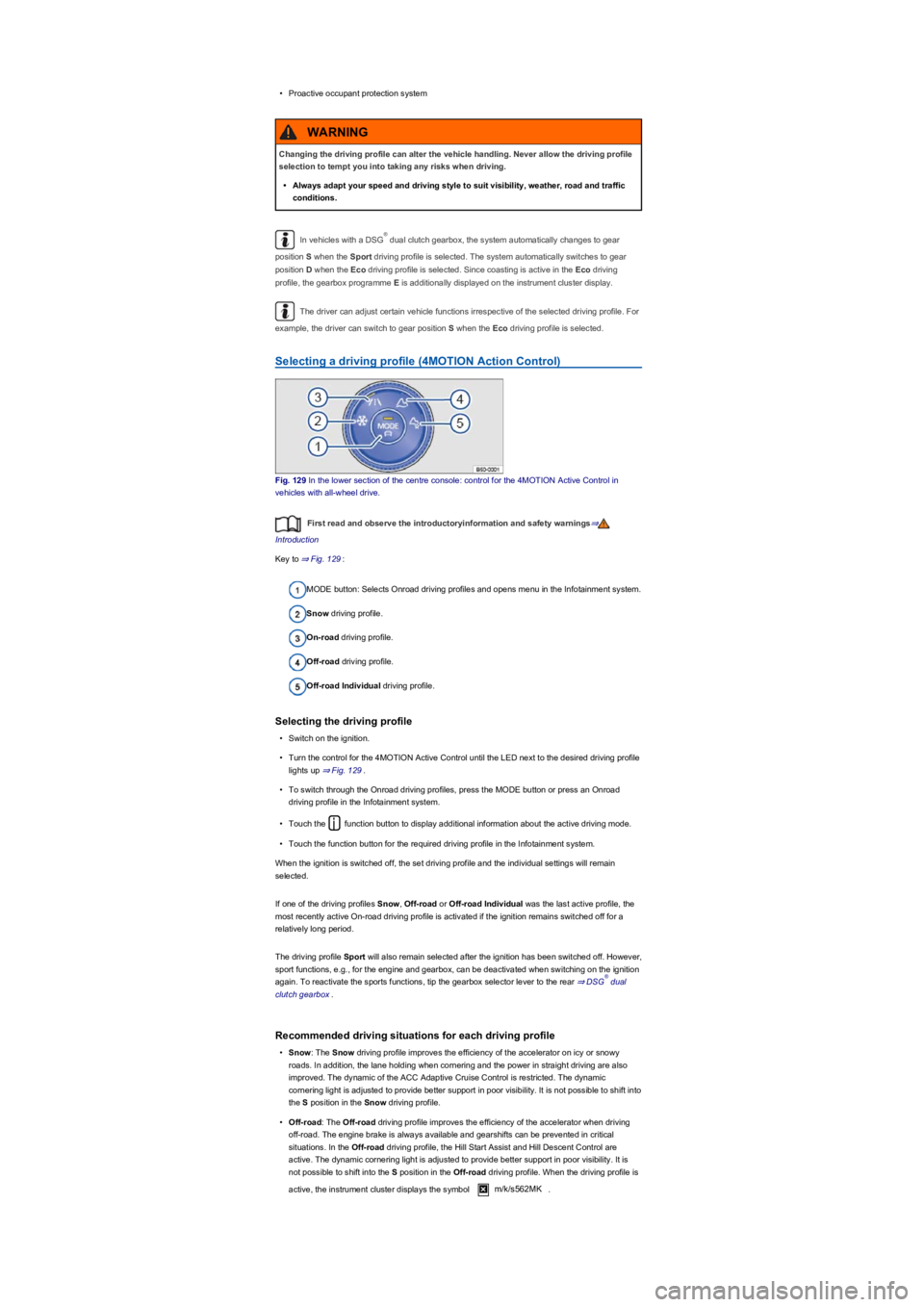
Selecting a driving profile (4MOTION Action Control)
Fig. 129 In the lower section of the centre console: control for the 4MOTION Active Control in
vehicles with all-wheel drive.
First read and observe the introductoryinformation and safety warnings⇒
Introduction
Key to ⇒ Fig. 129:
MODE button: Selects Onroad driving profiles and opens menu in the Infotainment system.
Snow driving profile.
On-road driving profile.
Off-road driving profile.
Off-road Individual driving profile.
Selecting the driving profile
•Switch on the ignition.
•Turn the control for the 4MOTION Active Control until the LED next to the desired driving profile
lights up ⇒ Fig. 129.
•To switch through the Onroad driving profiles, press the MODE button or press an Onroad
driving profile in the Infotainment system.
•Touch the function button to display additional information about the active driving mode.
•Touch the function button for the required driving profile in the Infotainment system.
When the ignition is switched off, the set driving profile and the individual settings will remain
selected.
If one of the driving profiles Snow, Off-road or Off-road Individual was the last active profile, the
most recently active On-road driving profile is activated if the ignition remains switched off for a
relatively long period.
The driving profile Sport will also remain selected after the ignition has been switched off. However,
sport functions, e.g., for the engine and gearbox, can be deactivated when switching on the ignition
again. To reactivate the sports functions, tip the gearbox selector lever to the rear ⇒ DSG dual
clutch gearbox.
Recommended driving situations for each driving profile
•Snow: The Snow driving profile improves the efficiency of the accelerator on icy or snowy
roads. In addition, the lane holding when cornering and the power in straight driving are also
improved. The dynamic of the ACC Adaptive Cruise Control is restricted. The dynamic
cornering light is adjusted to provide better support in poor visibility. It is not possible to shift into
the S position in the Snow driving profile.
•Off-road: The Off-road driving profile improves the efficiency of the accelerator when driving
off-road. The engine brake is always available and gearshifts can be prevented in critical
situations. In the Off-road driving profile, the Hill Start Assist and Hill Descent Control are
active. The dynamic cornering light is adjusted to provide better support in poor visibility. It is
not possible to shift into the S position in the Off-road driving profile. When the driving profile is
active, the instrument cluster displays the symbol m/k/s562MK.
Changing the driving profile can alter the vehicle handling. Never allow the driving profile
selection to tempt you into taking any risks when driving.
•Always adapt your speed and driving style to suit visibility, weather, road and traffic
conditions.
WARNING
®
®
Page 164 of 341
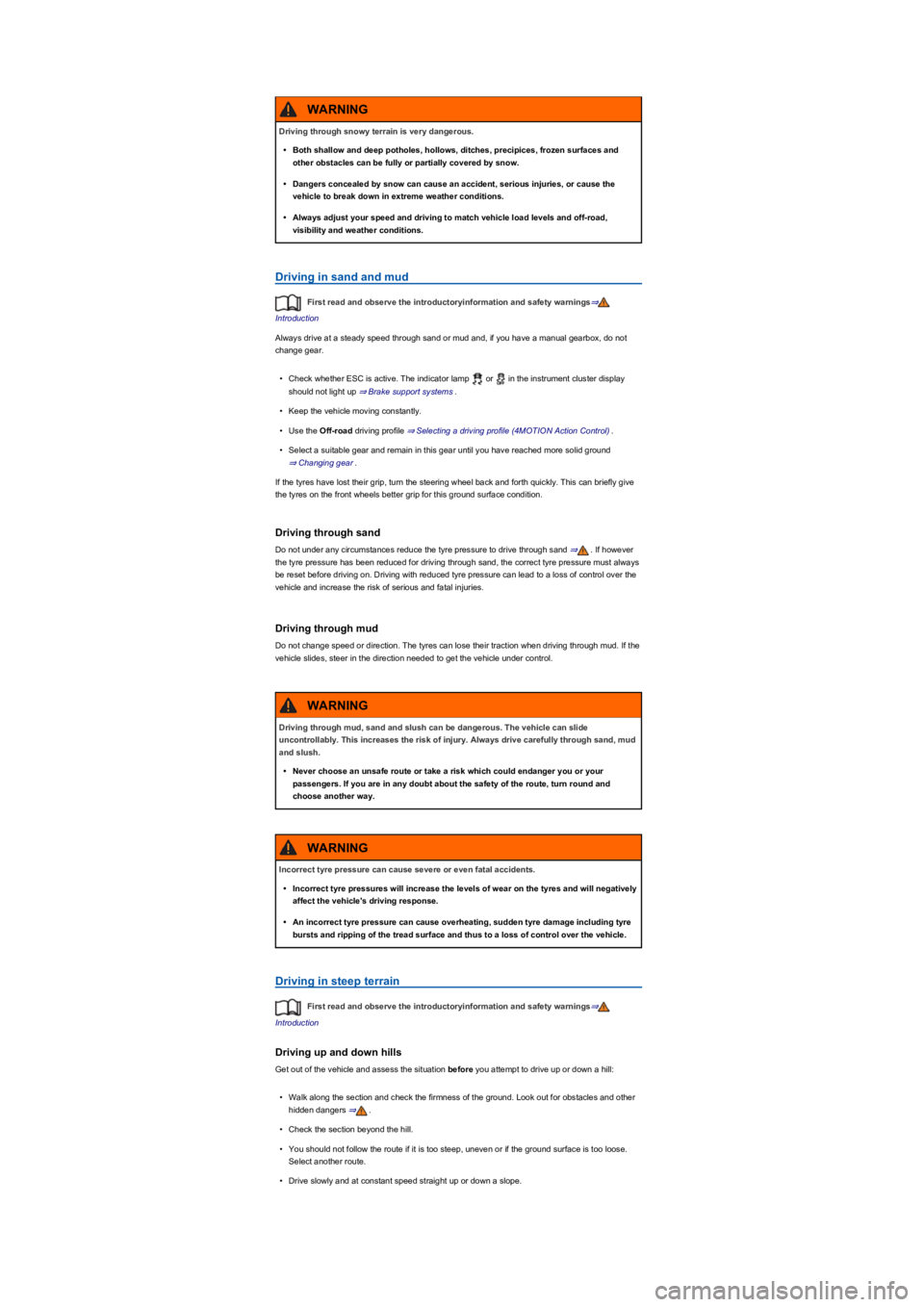
Driving in sand and mud
First read and observe the introductoryinformation and safety warnings⇒
Introduction
Always drive at a steady speed through sand or mud and, if you have a manual gearbox, do not
change gear.
•Check whether ESC is active. The indicator lamp or in the instrument cluster display
should not light up ⇒ Brake support systems.
•Keep the vehicle moving constantly.
•Use the Off-road driving profile ⇒ Selecting a driving profile (4MOTION Action Control).
•Select a suitable gear and remain in this gear until you have reached more solid ground
⇒ Changing gear.
If the tyres have lost their grip, turn the steering wheel back and forth quickly. This can briefly give
the tyres on the front wheels better grip for this ground surface condition.
Driving through sand
Do not under any circumstances reduce the tyre pressure to drive through sand ⇒. If however
the tyre pressure has been reduced for driving through sand, the correct tyre pressure must always
be reset before driving on. Driving with reduced tyre pressure can lead to a loss of control over the
vehicle and increase the risk of serious and fatal injuries.
Driving through mud
Do not change speed or direction. The tyres can lose their traction when driving through mud. If the
vehicle slides, steer in the direction needed to get the vehicle under control.
Driving in steep terrain
First read and observe the introductoryinformation and safety warnings⇒
Introduction
Driving up and down hills
Get out of the vehicle and assess the situation before you attempt to drive up or down a hill:
•Walk along the section and check the firmness of the ground. Look out for obstacles and other
hidden dangers ⇒.
•Check the section beyond the hill.
•You should not follow the route if it is too steep, uneven or if the ground surface is too loose.
Select another route.
•Drive slowly and at constant speed straight up or down a slope.
Driving through snowy terrain is very dangerous.
•Both shallow and deep potholes, hollows, ditches, precipices, frozen surfaces and
other obstacles can be fully or partially covered by snow.
•Dangers concealed by snow can cause an accident, serious injuries, or cause the
vehicle to break down in extreme weather conditions.
•Always adjust your speed and driving to match vehicle load levels and off-road,
visibility and weather conditions.
WARNING
Driving through mud, sand and slush can be dangerous. The vehicle can slide
uncontrollably. This increases the risk of injury. Always drive carefully through sand, mud
and slush.
•Never choose an unsafe route or take a risk which could endanger you or your
passengers. If you are in any doubt about the safety of the route, turn round and
choose another way.
WARNING
Incorrect tyre pressure can cause severe or even fatal accidents.
•Incorrect tyre pressures will increase the levels of wear on the tyres and will negatively
affect the vehicle's driving response.
•An incorrect tyre pressure can cause overheating, sudden tyre damage including tyre
bursts and ripping of the tread surface and thus to a loss of control over the vehicle.
WARNING
Page 167 of 341
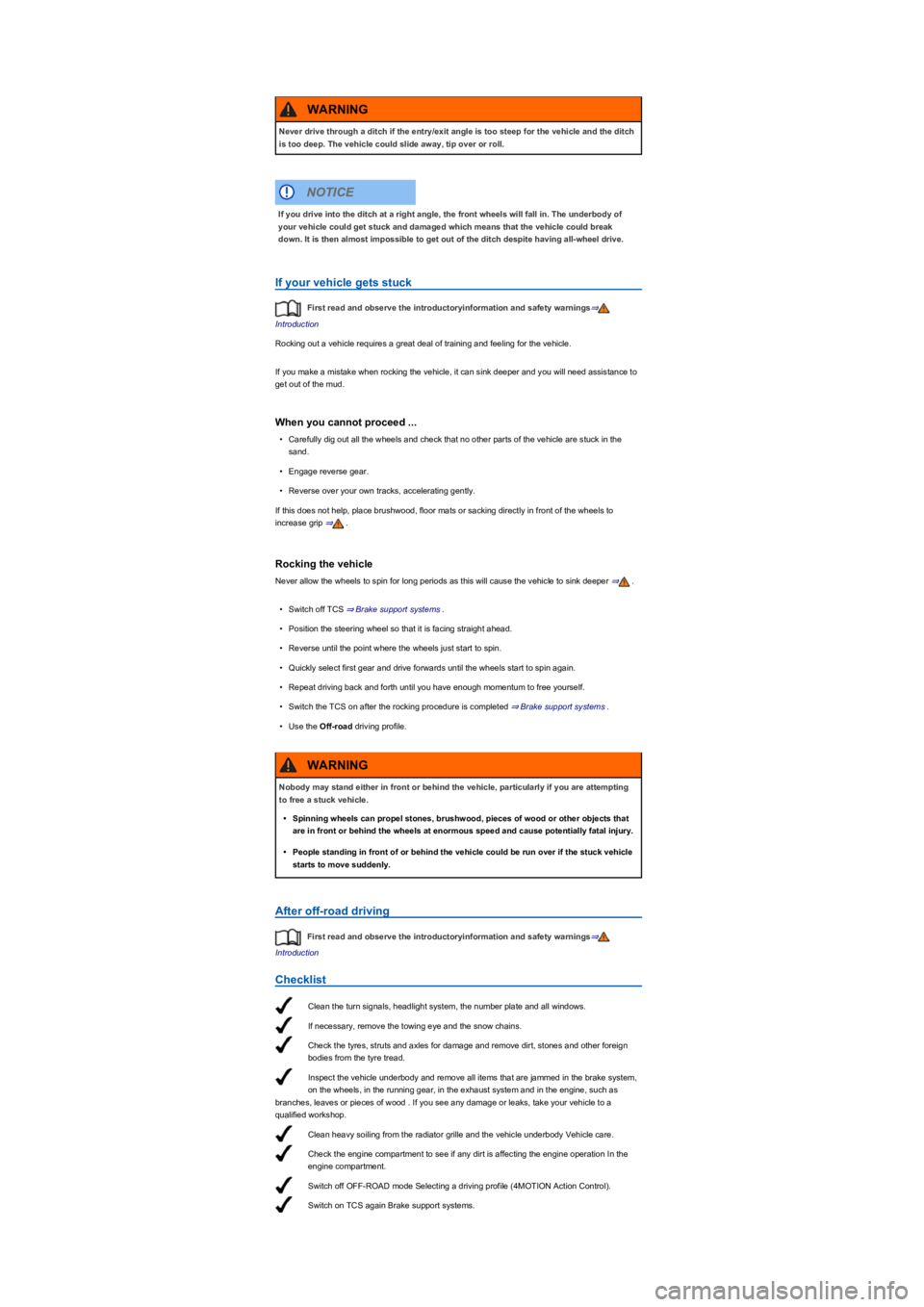
Clean the turn signals, headlight system, the number plate and all windows.
If necessary, remove the towing eye and the snow chains.
Check the tyres, struts and axles for damage and remove dirt, stones and other foreign
bodies from the tyre tread.
Inspect the vehicle underbody and remove all items that are jammed in the brake system,
on the wheels, in the running gear, in the exhaust system and in the engine, such as
branches, leaves or pieces of wood . If you see any damage or leaks, take your vehicle to a
qualified workshop.
Clean heavy soiling from the radiator grille and the vehicle underbody Vehicle care.
Check the engine compartment to see if any dirt is affecting the engine operation In the
engine compartment.
Switch off OFF-ROAD mode Selecting a driving profile (4MOTION Action Control).
Switch on TCS again Brake support systems.
If your vehicle gets stuck
First read and observe the introductoryinformation and safety warnings⇒
Introduction
Rocking out a vehicle requires a great deal of training and feeling for the vehicle.
If you make a mistake when rocking the vehicle, it can sink deeper and you will need assistance to
get out of the mud.
When you cannot proceed ...
•Carefully dig out all the wheels and check that no other parts of the vehicle are stuck in the
sand.
•Engage reverse gear.
•Reverse over your own tracks, accelerating gently.
If this does not help, place brushwood, floor mats or sacking directly in front of the wheels to
increase grip ⇒.
Rocking the vehicle
Never allow the wheels to spin for long periods as this will cause the vehicle to sink deeper ⇒.
•Switch off TCS ⇒ Brake support systems.
•Position the steering wheel so that it is facing straight ahead.
•Reverse until the point where the wheels just start to spin.
•Quickly select first gear and drive forwards until the wheels start to spin again.
•Repeat driving back and forth until you have enough momentum to free yourself.
•Switch the TCS on after the rocking procedure is completed ⇒ Brake support systems.
•Use the Off-road driving profile.
After off-road driving
First read and observe the introductoryinformation and safety warnings⇒
Introduction
Checklist
Never drive through a ditch if the entry/exit angle is too steep for the vehicle and the ditch
is too deep. The vehicle could slide away, tip over or roll.
WARNING
If you drive into the ditch at a right angle, the front wheels will fall in. The underbody of
your vehicle could get stuck and damaged which means that the vehicle could break
down. It is then almost impossible to get out of the ditch despite having all-wheel drive.
NOTICE
Nobody may stand either in front or behind the vehicle, particularly if you are attempting
to free a stuck vehicle.
•Spinning wheels can propel stones, brushwood, pieces of wood or other objects that
are in front or behind the wheels at enormous speed and cause potentially fatal injury.
•People standing in front of or behind the vehicle could be run over if the stuck vehicle
starts to move suddenly.
WARNING
Page 169 of 341
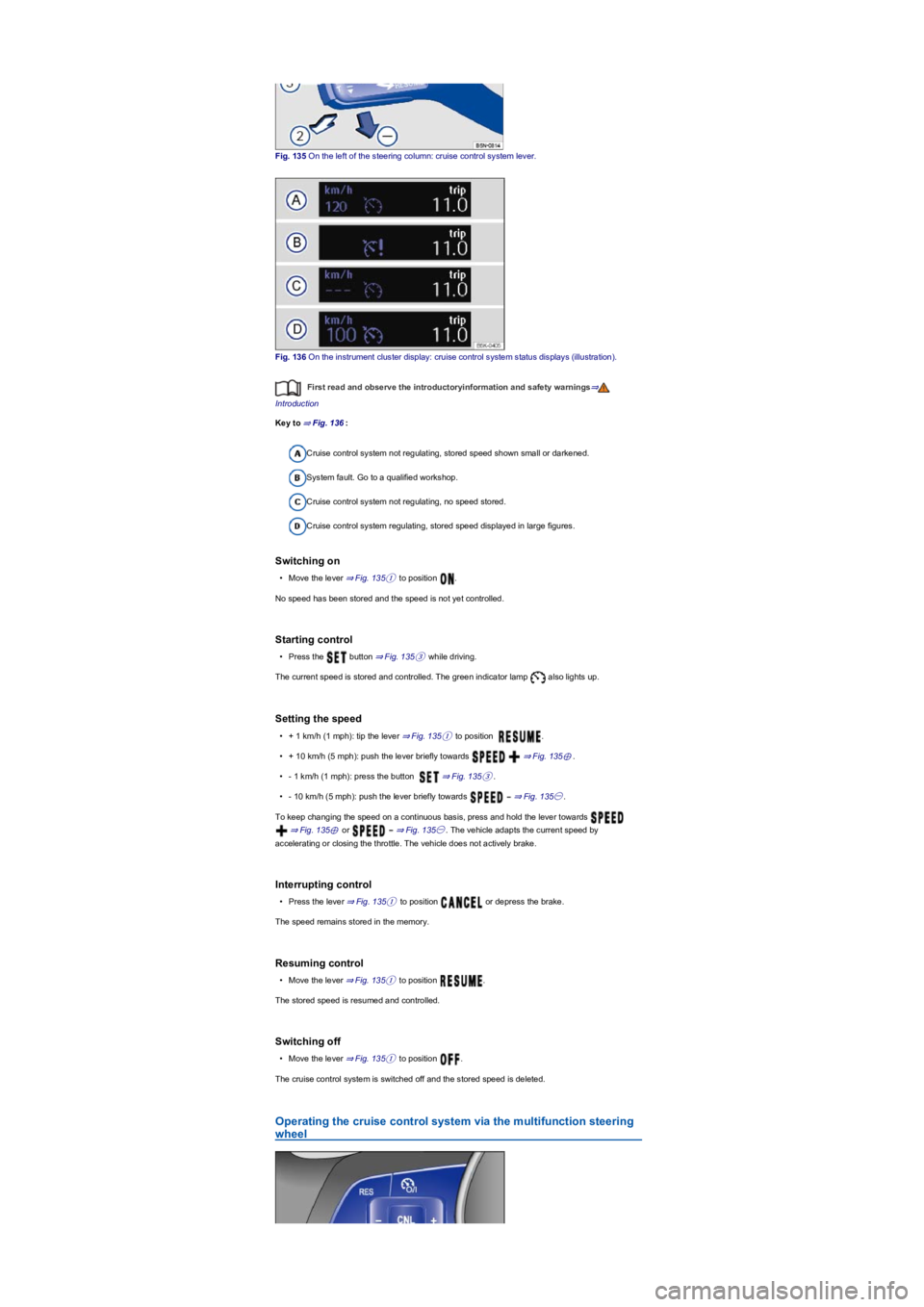
Fig. 135 On the left of the steering column: cruise control system lever.
Fig. 136 On the instrument cluster display: cruise control system status displays (illustration).
First read and observe the introductoryinformation and safety warnings⇒
Introduction
Key to ⇒ Fig. 136:
Cruise control system not regulating, stored speed shown small or darkened.
System fault. Go to a qualified workshop.
Cruise control system not regulating, no speed stored.
Cruise control system regulating, stored speed displayed in large figures.
Switching on
•Move the lever ⇒ Fig. 135① to position .
No speed has been stored and the speed is not yet controlled.
Starting control
•Press the button ⇒ Fig. 135③ while driving.
The current speed is stored and controlled. The green indicator lamp also lights up.
Setting the speed
•+ 1 km/h (1 mph): tip the lever ⇒ Fig. 135① to position .
•+ 10 km/h (5 mph): push the lever briefly towards ⇒ Fig. 135⊕.
•- 1 km/h (1 mph): press the button ⇒ Fig. 135③.
•- 10 km/h (5 mph): push the lever briefly towards ⇒ Fig. 135㊀.
To keep changing the speed on a continuous basis, press and hold the lever towards
⇒ Fig. 135⊕ or ⇒ Fig. 135㊀. The vehicle adapts the current speed by
accelerating or closing the throttle. The vehicle does not actively brake.
Interrupting control
•Press the lever ⇒ Fig. 135① to position or depress the brake.
The speed remains stored in the memory.
Resuming control
•Move the lever ⇒ Fig. 135① to position .
The stored speed is resumed and controlled.
Switching off
•Move the lever ⇒ Fig. 135① to position .
The cruise control system is switched off and the stored speed is deleted.
Operating the cruise control system via the multifunction steering
wheel
Page 173 of 341
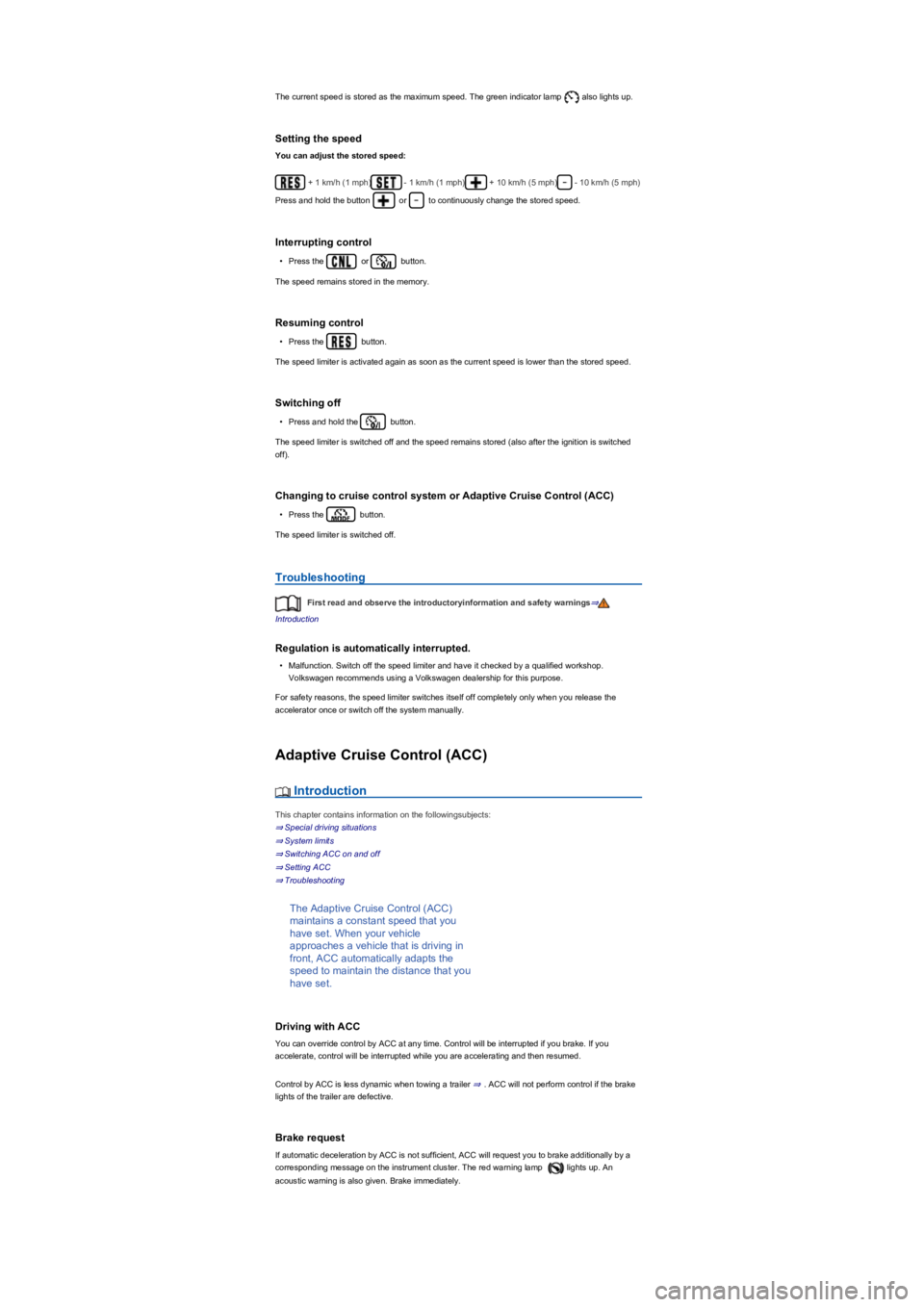
The current speed is stored as the maximum speed. The green indicator lamp also lights up.
Setting the speed
You can adjust the stored speed:
+ 1 km/h (1 mph)- 1 km/h (1 mph)+ 10 km/h (5 mph)- 10 km/h (5 mph)
Press and hold the button or to continuously change the stored speed.
Interrupting control
•Press the or button.
The speed remains stored in the memory.
Resuming control
•Press the button.
The speed limiter is activated again as soon as the current speed is lower than the stored speed.
Switching off
•Press and hold the button.
The speed limiter is switched off and the speed remains stored (also after the ignition is switched
off).
Changing to cruise control system or Adaptive Cruise Control (ACC)
•Press the button.
The speed limiter is switched off.
Troubleshooting
First read and observe the introductoryinformation and safety warnings⇒
Introduction
Regulation is automatically interrupted.
•Malfunction. Switch off the speed limiter and have it checked by a qualified workshop.
Volkswagen recommends using a Volkswagen dealership for this purpose.
For safety reasons, the speed limiter switches itself off completely only when you release the
accelerator once or switch off the system manually.
Adaptive Cruise Control (ACC)
Introduction
This chapter contains information on the followingsubjects:
⇒ Special driving situations
⇒ System limits
⇒ Switching ACC on and off
⇒ Setting ACC
⇒ Troubleshooting
The Adaptive Cruise Control (ACC)
maintains a constant speed that you
have set. When your vehicle
approaches a vehicle that is driving in
front, ACC automatically adapts the
speed to maintain the distance that you
have set.
Driving with ACC
You can override control by ACC at any time. Control will be interrupted if you brake. If you
accelerate, control will be interrupted while you are accelerating and then resumed.
Control by ACC is less dynamic when towing a trailer ⇒. ACC will not perform control if the brake
lights of the trailer are defective.
Brake request
If automatic deceleration by ACC is not sufficient, ACC will request you to brake additionally by a
corresponding message on the instrument cluster. The red warning lamp lights up. An
acoustic warning is also given. Brake immediately.
Page 176 of 341
If a stationary vehicle is hidden behind a vehicle that has been detected by the adaptive cruise
control and this vehicle turns off the road or changes lane, the ACC will not react to the stationary
vehicle ⇒ Fig. 144.
Bends
The radar sensor always measures straight ahead. For this reason, vehicles may be incorrectly
detected or vehicles driving ahead not detected in tight bends ⇒ Fig. 143.
Vehicles outside the sensor range
•Vehicles that are driving outside the sensor range in close proximity to your vehicle, e.g.
motorbikes ⇒ Fig. 143.
•Vehicles that change into your lane directly in front of your vehicle ⇒ Fig. 144.
•Vehicles with bodies or attachments that project beyond the vehicle.
Switching ACC on and off
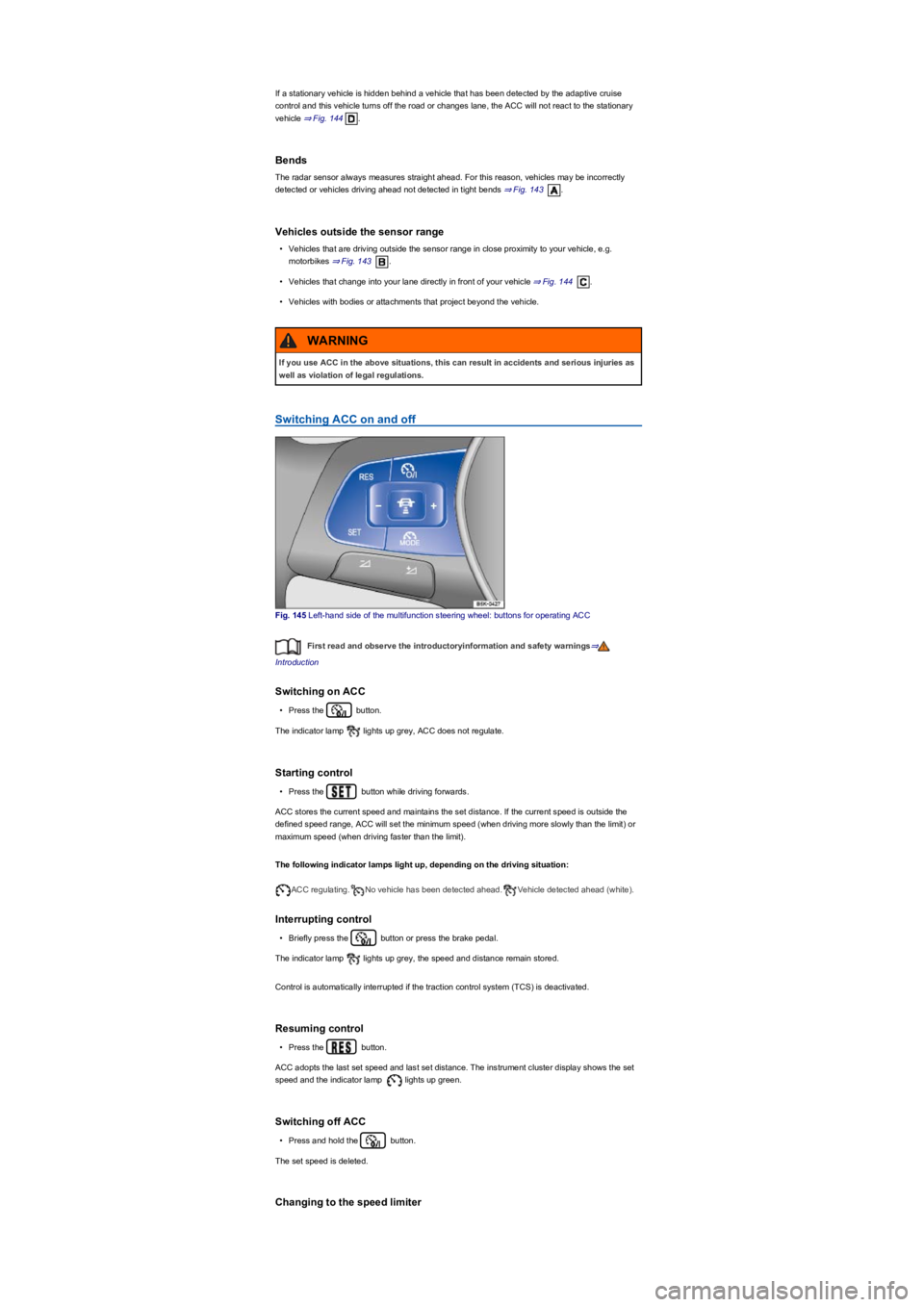
Fig. 145 Left-hand side of the multifunction steering wheel: buttons for operating ACC
First read and observe the introductoryinformation and safety warnings⇒
Introduction
Switching on ACC
•Press the button.
The indicator lamp lights up grey, ACC does not regulate.
Starting control
•Press the button while driving forwards.
ACC stores the current speed and maintains the set distance. If the current speed is outside the
defined speed range, ACC will set the minimum speed (when driving more slowly than the limit) or
maximum speed (when driving faster than the limit).
The following indicator lamps light up, depending on the driving situation:
ACC regulating.No vehicle has been detected ahead.Vehicle detected ahead (white).
Interrupting control
•Briefly press the button or press the brake pedal.
The indicator lamp lights up grey, the speed and distance remain stored.
Control is automatically interrupted if the traction control system (TCS) is deactivated.
Resuming control
•Press the button.
ACC adopts the last set speed and last set distance. The instrument cluster display shows the set
speed and the indicator lamp lights up green.
Switching off ACC
•Press and hold the button.
The set speed is deleted.
Changing to the speed limiter
If you use ACC in the above situations, this can result in accidents and serious injuries as
well as violation of legal regulations.
WARNING
Page 177 of 341
•Press the button.
ACC is switched off.
Setting ACC
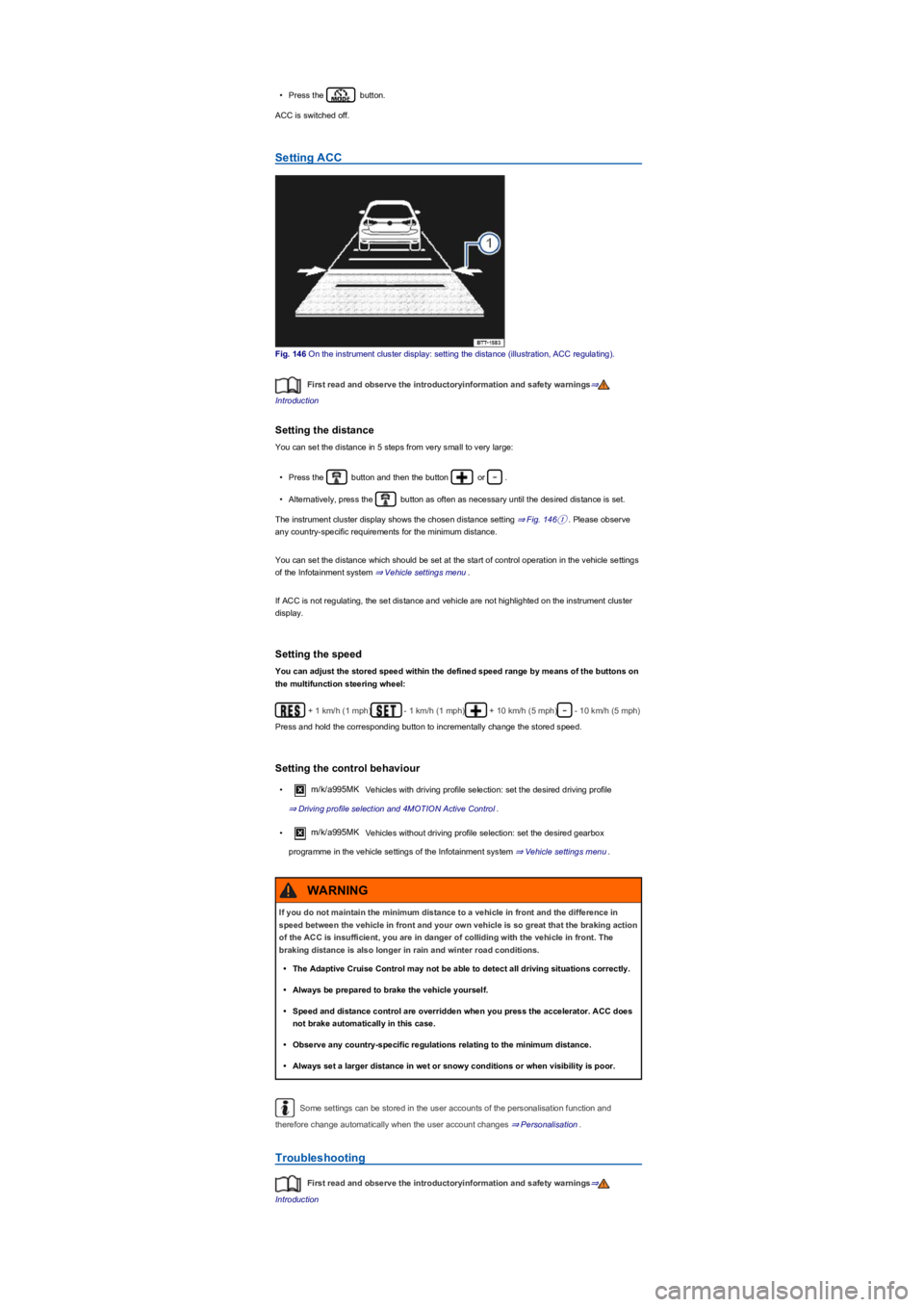
Fig. 146 On the instrument cluster display: setting the distance (illustration, ACC regulating).
First read and observe the introductoryinformation and safety warnings⇒
Introduction
Setting the distance
You can set the distance in 5 steps from very small to very large:
•Press the button and then the button or .
•Alternatively, press the button as often as necessary until the desired distance is set.
The instrument cluster display shows the chosen distance setting ⇒ Fig. 146①. Please observe
any country-specific requirements for the minimum distance.
You can set the distance which should be set at the start of control operation in the vehicle settings
of the Infotainment system ⇒ Vehicle settings menu.
If ACC is not regulating, the set distance and vehicle are not highlighted on the instrument cluster
display.
Setting the speed
You can adjust the stored speed within the defined speed range by means of the buttons on
the multifunction steering wheel:
+ 1 km/h (1 mph)- 1 km/h (1 mph)+ 10 km/h (5 mph)- 10 km/h (5 mph)
Press and hold the corresponding button to incrementally change the stored speed.
Setting the control behaviour
•m/k/a995MK Vehicles with driving profile selection: set the desired driving profile
⇒ Driving profile selection and 4MOTION Active Control.
•m/k/a995MK Vehicles without driving profile selection: set the desired gearbox
programme in the vehicle settings of the Infotainment system ⇒ Vehicle settings menu.
Some settings can be stored in the user accounts of the personalisation function and
therefore change automatically when the user account changes ⇒ Personalisation.
Troubleshooting
First read and observe the introductoryinformation and safety warnings⇒
Introduction
If you do not maintain the minimum distance to a vehicle in front and the difference in
speed between the vehicle in front and your own vehicle is so great that the braking action
of the ACC is insufficient, you are in danger of colliding with the vehicle in front. The
braking distance is also longer in rain and winter road conditions.
•The Adaptive Cruise Control may not be able to detect all driving situations correctly.
•Always be prepared to brake the vehicle yourself.
•Speed and distance control are overridden when you press the accelerator. ACC does
not brake automatically in this case.
•Observe any country-specific regulations relating to the minimum distance.
•Always set a larger distance in wet or snowy conditions or when visibility is poor.
WARNING