mirror VOLKSWAGEN TIGUAN 2017 Owner´s Manual
[x] Cancel search | Manufacturer: VOLKSWAGEN, Model Year: 2017, Model line: TIGUAN, Model: VOLKSWAGEN TIGUAN 2017Pages: 341, PDF Size: 9.14 MB
Page 258 of 341
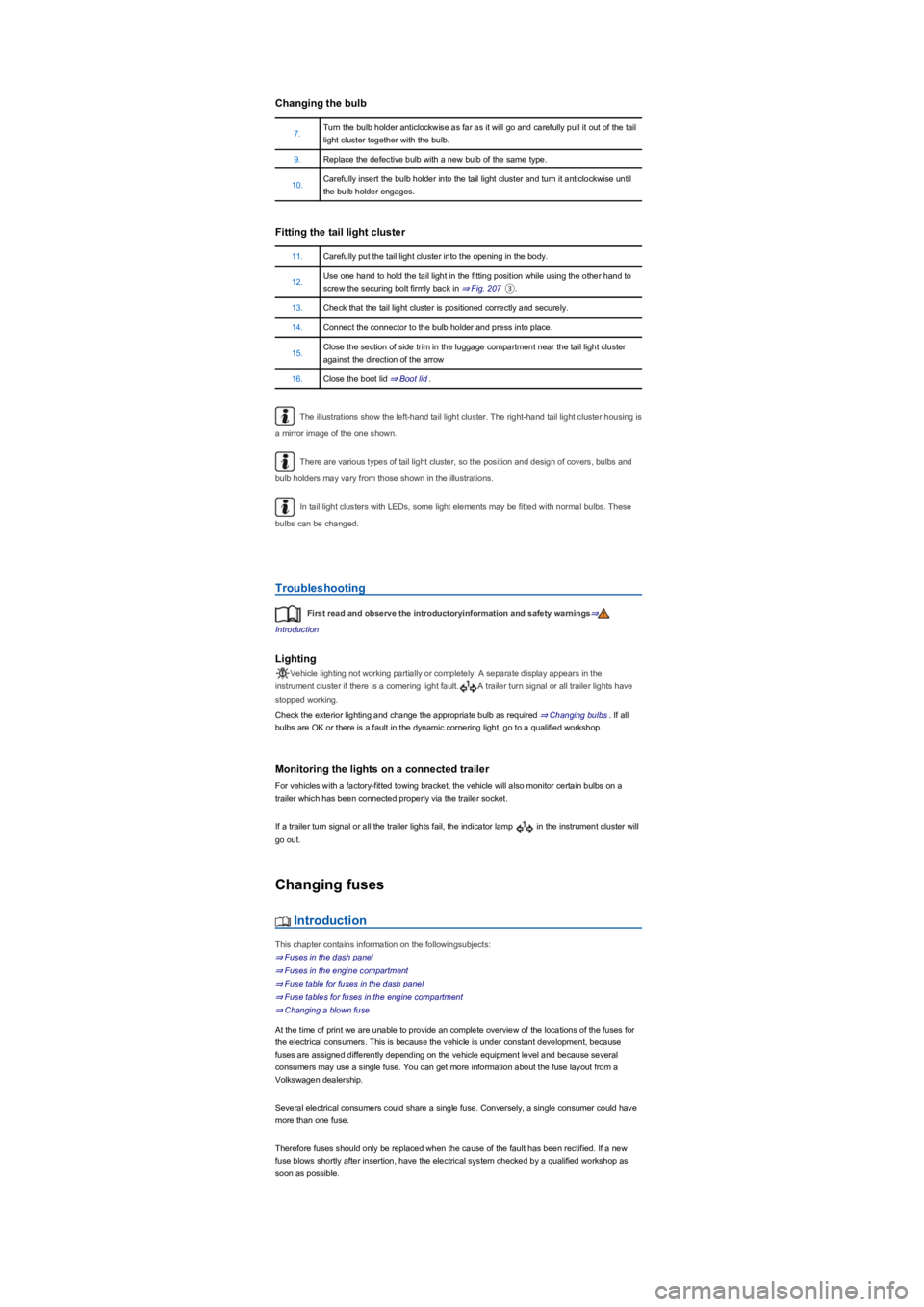
Changing the bulb
7.Turn the bulb holder anticlockwise as far as it will go and carefully pull it out of the tail
light cluster together with the bulb.
9.Replace the defective bulb with a new bulb of the same type.
10.Carefully insert the bulb holder into the tail light cluster and turn it anticlockwise until
the bulb holder engages.
Fitting the tail light cluster
11.Carefully put the tail light cluster into the opening in the body.
12.Use one hand to hold the tail light in the fitting position while using the other hand to
screw the securing bolt firmly back in ⇒ Fig. 207③.
13.Check that the tail light cluster is positioned correctly and securely.
14.Connect the connector to the bulb holder and press into place.
15.Close the section of side trim in the luggage compartment near the tail light cluster
against the direction of the arrow
16.Close the boot lid ⇒ Boot lid.
The illustrations show the left-hand tail light cluster. The right-hand tail light cluster housing is
a mirror image of the one shown.
There are various types of tail light cluster, so the position and design of covers, bulbs and
bulb holders may vary from those shown in the illustrations.
In tail light clusters with LEDs, some light elements may be fitted with normal bulbs. These
bulbs can be changed.
Troubleshooting
First read and observe the introductoryinformation and safety warnings⇒
Introduction
Lighting
Vehicle lighting not working partially or completely. A separate display appears in the
instrument cluster if there is a cornering light fault.A trailer turn signal or all trailer lights have
stopped working.
Check the exterior lighting and change the appropriate bulb as required ⇒ Changing bulbs. If all
bulbs are OK or there is a fault in the dynamic cornering light, go to a qualified workshop.
Monitoring the lights on a connected trailer
For vehicles with a factory-fitted towing bracket, the vehicle will also monitor certain bulbs on a
trailer which has been connected properly via the trailer socket.
If a trailer turn signal or all the trailer lights fail, the indicator lamp in the instrument cluster will
go out.
Changing fuses
Introduction
This chapter contains information on the followingsubjects:
⇒ Fuses in the dash panel
⇒ Fuses in the engine compartment
⇒ Fuse table for fuses in the dash panel
⇒ Fuse tables for fuses in the engine compartment
⇒ Changing a blown fuse
At the time of print we are unable to provide an complete overview of the locations of the fuses for
the electrical consumers. This is because the vehicle is under constant development, because
fuses are assigned differently depending on the vehicle equipment level and because several
consumers may use a single fuse. You can get more information about the fuse layout from a
Volkswagen dealership.
Several electrical consumers could share a single fuse. Conversely, a single consumer could have
more than one fuse.
Therefore fuses should only be replaced when the cause of the fault has been rectified. If a new
fuse blows shortly after insertion, have the electrical system checked by a qualified workshop as
soon as possible.
Page 319 of 341
Suitable accessories are available from your Volkswagen dealership. Follow the usage
instructions on the packaging.
Washing the vehicle
Also wash the underside of the vehicle on a regular basis to remove road salt or seawater residue.
Automatic car washes
Always observe all the car wash operator's specifications, in particular if your vehicle features add-
on parts ⇒.
•Preferably use car washes without brushes.
•Preclean the vehicle by rinsing with water.
•The steering column must not lock when driving through automatic car washes ⇒ Steering.
•Always switch off the Auto Hold function ⇒ Electronic parking brake, the wipers ⇒ Wipers and
the rain/light sensor before entering the car wash.
•Fold in the exterior mirrors.
•If your vehicle has decorative and protective films, do not select a wash program with hot wax.
High-pressure cleaners
Observe the manufacturer's information for the high-pressure cleaner. Never use rotating nozzles
⇒.
•Only use water with a maximum temperature of +60°C (+140°F).
•Do not clean windows that are iced over or covered in snow with a high-pressure cleaner.
•Move the jet of water uniformly so that the nozzle is at least 50 cm away from the side windows
and other vehicle components.
•Do not point the water jet at the same location for too long. Instead, leave stubborn dirt to soak.
•If possible, do not direct the water jet at seals, e.g. side windows, decorative trim, tyres, rubber
hoses, insulation materials or any other sensitive components, e.g. door locks.
•Sensors, camera lenses, and decorative and protective films should be sprayed directly only for
brief periods of time.
Washing the car by hand
Washing the car by hand is always the more gentle way to clean it. However, there are also some
things to note for this ⇒.
•Before washing the vehicle, soak the dirt with plenty of water and then rinse it off thoroughly.
•Clean the vehicle with a soft sponge, a wash mitt or a brush applying only light pressure. Start
with the roof and work from the top to the bottom.
•Rinse the sponge, wash mitt or brush thoroughly at regular short intervals.
•Clean the wheels, sill panels etc. last. Use a second sponge for this.
Use a shampoo for very stubborn dirt only.
Car care products can be toxic and hazardous. Unsuitable care products and incorrect use
of care products can cause accidents, serious injuries, burns or poisoning.
•Care products must be kept in the original, sealed container only.
•Read the manufacturer's instructions.
•Never use empty food cans, bottles or other containers for storing care products.
•Keep children away from care products.
•The products can give off harmful fumes during use. They should therefore only be
used outside or in well-ventilated spaces.
•Never use fuel, turpentine, engine oil, nail varnish remover or other volatile fluids to
wash, clean or care for your vehicle. These substances are toxic and highly
inflammable.
WARNING
Stains, dirt and other deposits containing aggressive and solvent-based ingredients attack
the material and may cause irreparable damage, even if only left for a short time.
•Stains, dirt and other deposits should always be removed as quickly as possible and
not allowed to dry in.
•Have stubborn stains removed by a qualified workshop.
NOTICE
1)
Page 324 of 341
authorization symbol). These devices include cruise control systems or an electronically controlled
suspension.
Any additional electrical components fitted that do not serve to control the vehicle itself must
bear the mark (manufacturer conformity declaration in the European Union). Such devices
include refrigerator boxes, laptops and ventilator fans.
Repairs and technical modifications
Repairs and technical modifications must always be carried out according to Volkswagen
specifications⇒.
Unauthorised modifications to the electronic components or software in the vehicle may cause
malfunctions. As the electronic components are linked together in networks, these faults may
indirectly affect the working of other systems. This can seriously impair safety, lead to excessive
wear of components, and also invalidate the type approval for the vehicle.
The Volkswagen dealership cannot be held liable for any damage caused by technical
modifications and/or work performed incorrectly.
The Volkswagen dealership is not responsible for damage caused by technical modifications and/or
work performed incorrectly. Such damage is not covered by the Volkswagen guarantee.
Volkswagen recommends that all repairs and technical modifications be performed by an
authorised Volkswagen workshop using Volkswagen Genuine Parts.
Volkswagen repair information
Volkswagen Service information and official Volkswagen repair information can be purchased for a
fee.
Customers in Europe, Asia, Australia, Africa, Central and South America: please contact a
Volkswagen dealership or qualified workshop or register on the online portal erWin (electronic
repair and workshop information):
https://erwin.volkswagen.de
erWin is available in numerous languages.
Vehicles with special auxiliary equipment or body parts
The manufacturer of these components must ensure that these parts (fittings) adhere to the
stipulated environmental laws and regulations, particularly the EU directive 2000/53/EC concerning
end-of-life vehicles and EU directive 2003/11/EC concerning the restriction on the marketing and
use of certain dangerous substances and preparations.
The vehicle owner should keep all assembly documentation for these auxiliary fittings, and pass it
on to any scrapping company later engaged. This is to facilitate environmentally responsible
disposal for all vehicles, including refitted vehicles.
Windscreen repairs
To function properly, some items of equipment require an electrical or electronic module, which is
located on the inside of the windscreen near the interior mirror. If the windscreen has been
damaged in the viewing field of the electrical or electronic module, e.g. by stone impact, the
windscreen must be replaced. Repairing the crack can lead to malfunctions or functional faults in
the equipment.
After changing the windscreen, the camera and sensors must be set up and calibrated by a
qualified workshop.
Impairment or damage to sensors and cameras
Incorrect repairs, retrofit structural modifications to the vehicle, e.g. lowering the body, add-on parts
on the vehicle or trailer ⇒ Trailer towing, or changes to the trim may lead to the sensors or
cameras being disrupted or damaged. This can also be caused by collisions, e.g. when parking.
Failure to observe this may impair important functions (driver assist systems) and damage the
vehicle.
The area in front of and around the sensors and cameras must not be covered by stickers,
additional headlights, trim frames for number plates or similar.
Incorrectly performed repairs or modifications to your vehicle can impair the effectiveness
of the airbags, cause malfunctions, accidents and fatal injury.
•Never secure or mount objects such as drink holders or telephone holders either on or
next to the airbag covers or within the deployment zones of the airbag modules.
•Objects either on or next to the airbag module covers or are in the deployment zone of
the airbags can cause serious or even fatal injuries should the airbags be activated.
WARNING
®
Page 329 of 341
Special equipment, access to the legally prescribed diagnostic interface (on-board diagnostics) and
switched-on ignition are required in order to read data out of the event data recorder.
Volkswagen will not access, read out or process data from the event data recorder unless the
vehicle owner (or lessee in the case of leasing) grants their permission. Exceptions to this are
contractual or legal provisions.
Due to its legal product monitoring obligations, Volkswagen is entitled to use the data for field
monitoring and also for research purposes and quality improvements. For research purposes,
Volkswagen makes the data available to third parties in anonymous form, in other words without
any reference to the individual vehicle, vehicle owner or lessee.
Reprogramming control units
All data for the control of components are stored in the control units. Some convenience functions,
such as lane change flash, single door unlocking and displays, can be reprogrammed using special
workshop equipment. If the convenience functions are reprogrammed, the descriptions in your
vehicle wallet will no longer match the original functions. Volkswagen recommends having any
reprogramming entered into the digital service schedule by a Volkswagen dealership or qualified
workshop.
Information about possible reprogramming can be obtained from the Volkswagen dealership.
Convenience and Infotainment functions
Depending on the equipment selected, you can store your own data in the vehicle's Infotainment
functions. This includes, for example:
•Media files for playing music, films or photos in the Infotainment system.
•Address book data for use with a hands-free system or navigation system.
•Entered navigation destinations.
•Data on the use of online services.
These data can be stored locally in the vehicle or located on a device that you have connected to
the vehicle, e.g. mobile device, USB stick or MP3 player. If these data are stored in the vehicle, you
can delete them at any time. These data are transmitted to third parties only at your request, in
particular in relation to the use of online services and in accordance with your personal settings.
You can store convenience settings (personalisation) in the vehicle and change them at any time.
Depending on the equipment in the vehicle, this includes, for example:
•Seat position settings.
•Running gear and air conditioning system settings.
•Personalised settings such as mirror adjustment or background lighting.
Integration of mobile devices
If your vehicle contains the necessary equipment, you can connect your mobile device or any other
mobile end device to your vehicle so that you can control this device via the controls integrated in
the vehicle when the corresponding functions are available. For example, images and sounds from
the mobile device can be output through the Infotainment system. At the same time, certain
information is sent to your mobile device. This includes location data and further general vehicle
information, depending on the type of integration. For more details, refer to the information about
display of apps in the Infotainment system ⇒ Mobile online services.
This enables selected apps on the mobile device to be used in the vehicle, e.g. navigation or music
player. The mobile device and vehicle do not interact in any other ways than those described here,
in particular the device does not actively access vehicle data. The type of further data processing
depends on the app provider. The settings that you can make here depend on the app in question
and the operating system on your mobile device.
Third party providers
If your vehicle is equipped with a connection to a mobile network, your vehicle will be able to
exchange data with other systems. The vehicle can be connected to a mobile network using a
transmitter and receiver unit in the vehicle or using your own mobile device. This mobile network
connection enables you to use online functions. This includes online services and apps provided by
Volkswagen or other third-party providers.
Manufacturer services
In the case of online services provided by Volkswagen, the respective functions are described by
Volkswagen in a suitable location, e.g. in a separate service description or on a website ⇒ Mobile
online services along with the relevant data protection policies. Personal data may be required to
provide online services. For this, data are exchanged over a secure connection, e.g. using the
designated IT systems of the manufacturer. Any collection, processing and use of personal data
that goes beyond the provision of the service takes place exclusively according to legal regulations,
contractual agreements or the necessary permission.
You can activate and deactivate the services and functions, some of which are subject to a fee, and
in some cases also disable the vehicle's entire data connection. This does not apply to any
functions and services required by law, e.g. emergency call systems.
Page 335 of 341
Engine and gearbox code, paint number, interior equipment. In the example, the engine
code is CPTA ⇒ Fig. 253.
Optional extras, PR numbers.
Type plate
The type plate ⇒ Fig. 253 can be seen on the lower part of the door pillar when the door is
open. Vehicles for certain export countries do not have a type plate.
The type plate contains the following data:
Permit
Gross vehicle weight rating
Gross combination weight rating (vehicle plus trailer ⇒ Trailer towing)
Gross axle weight rating, front
Gross axle weight rating, rear
Vehicle identification number
The vehicle identification number can be read from outside the vehicle through a viewer in the
windscreen ⇒ Fig. 254 (arrow). The viewer is located in the lower corner of the windscreen. The
vehicle identification number is also stamped on the right-hand water drainage channel. The water
drainage channel is located between the suspension turret and wing. Open the bonnet ⇒ In the
engine compartment to gain access to the vehicle identification number.
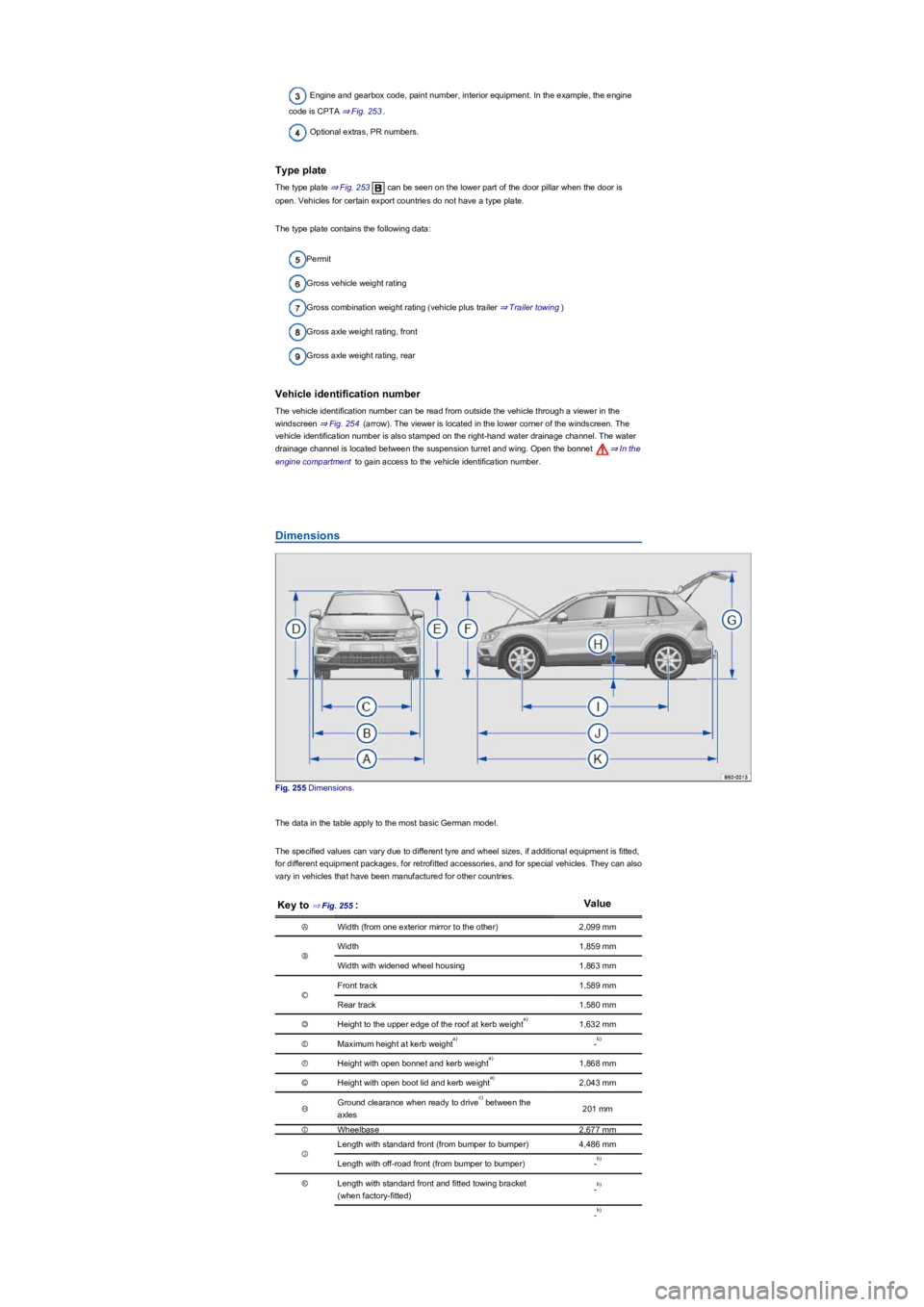
Dimensions
Fig. 255 Dimensions.
The data in the table apply to the most basic German model.
The specified values can vary due to different tyre and wheel sizes, if additional equipment is fitted,
for different equipment packages, for retrofitted accessories, and for special vehicles. They can also
vary in vehicles that have been manufactured for other countries.
Key to ⇒ Fig. 255:Value
ⒶWidth (from one exterior mirror to the other)2,099 mm
Ⓑ
Width1,859 mm
Width with widened wheel housing1,863 mm
Ⓒ
Front track1,589 mm
Rear track1,580 mm
ⒹHeight to the upper edge of the roof at kerb weight1,632 mm
ⒺMaximum height at kerb weight-
ⒻHeight with open bonnet and kerb weight1,868 mm
ⒼHeight with open boot lid and kerb weight2,043 mm
ⒽGround clearance when ready to drive between the
axles201 mm
ⒾWheelbase2,677 mm
Ⓙ
Length with standard front (from bumper to bumper)4,486 mm
Length with off-road front (from bumper to bumper)-
ⓀLength with standard front and fitted towing bracket
(when factory-fitted)-
-
a)
a)b)
a)
a)
c)
b)
b)
b)