STARTING VOLKSWAGEN TIGUAN 2017 Owner´s Manual
[x] Cancel search | Manufacturer: VOLKSWAGEN, Model Year: 2017, Model line: TIGUAN, Model: VOLKSWAGEN TIGUAN 2017Pages: 341, PDF Size: 9.14 MB
Page 254 of 341
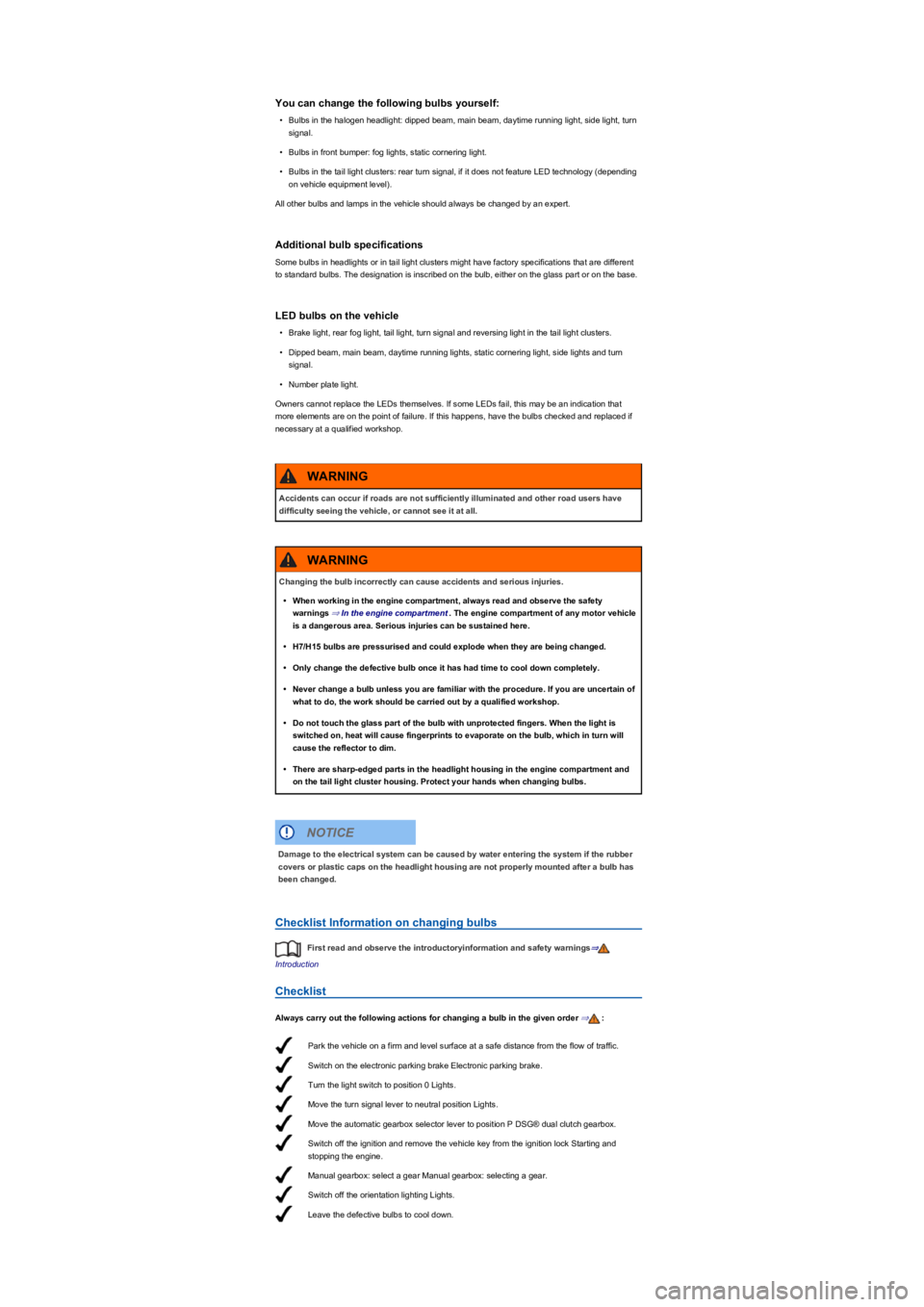
Park the vehicle on a firm and level surface at a safe distance from the flow of traffic.
Switch on the electronic parking brake Electronic parking brake.
Turn the light switch to position 0 Lights.
Move the turn signal lever to neutral position Lights.
Move the automatic gearbox selector lever to position P DSG® dual clutch gearbox.
Switch off the ignition and remove the vehicle key from the ignition lock Starting and
stopping the engine.
Manual gearbox: select a gear Manual gearbox: selecting a gear.
Switch off the orientation lighting Lights.
Leave the defective bulbs to cool down.
You can change the following bulbs yourself:
•Bulbs in the halogen headlight: dipped beam, main beam, daytime running light, side light, turn
signal.
•Bulbs in front bumper: fog lights, static cornering light.
•Bulbs in the tail light clusters: rear turn signal, if it does not feature LED technology (depending
on vehicle equipment level).
All other bulbs and lamps in the vehicle should always be changed by an expert.
Additional bulb specifications
Some bulbs in headlights or in tail light clusters might have factory specifications that are different
to standard bulbs. The designation is inscribed on the bulb, either on the glass part or on the base.
LED bulbs on the vehicle
•Brake light, rear fog light, tail light, turn signal and reversing light in the tail light clusters.
•Dipped beam, main beam, daytime running lights, static cornering light, side lights and turn
signal.
•Number plate light.
Owners cannot replace the LEDs themselves. If some LEDs fail, this may be an indication that
more elements are on the point of failure. If this happens, have the bulbs checked and replaced if
necessary at a qualified workshop.
Checklist Information on changing bulbs
First read and observe the introductoryinformation and safety warnings⇒
Introduction
Checklist
Always carry out the following actions for changing a bulb in the given order ⇒:
Accidents can occur if roads are not sufficiently illuminated and other road users have
difficulty seeing the vehicle, or cannot see it at all.
WARNING
Changing the bulb incorrectly can cause accidents and serious injuries.
•When working in the engine compartment, always read and observe the safety
warnings ⇒ In the engine compartment. The engine compartment of any motor vehicle
is a dangerous area. Serious injuries can be sustained here.
•H7/H15 bulbs are pressurised and could explode when they are being changed.
•Only change the defective bulb once it has had time to cool down completely.
•Never change a bulb unless you are familiar with the procedure. If you are uncertain of
what to do, the work should be carried out by a qualified workshop.
•Do not touch the glass part of the bulb with unprotected fingers. When the light is
switched on, heat will cause fingerprints to evaporate on the bulb, which in turn will
cause the reflector to dim.
•There are sharp-edged parts in the headlight housing in the engine compartment and
on the tail light cluster housing. Protect your hands when changing bulbs.
WARNING
Damage to the electrical system can be caused by water entering the system if the rubber
covers or plastic caps on the headlight housing are not properly mounted after a bulb has
been changed.
NOTICE
Page 263 of 341
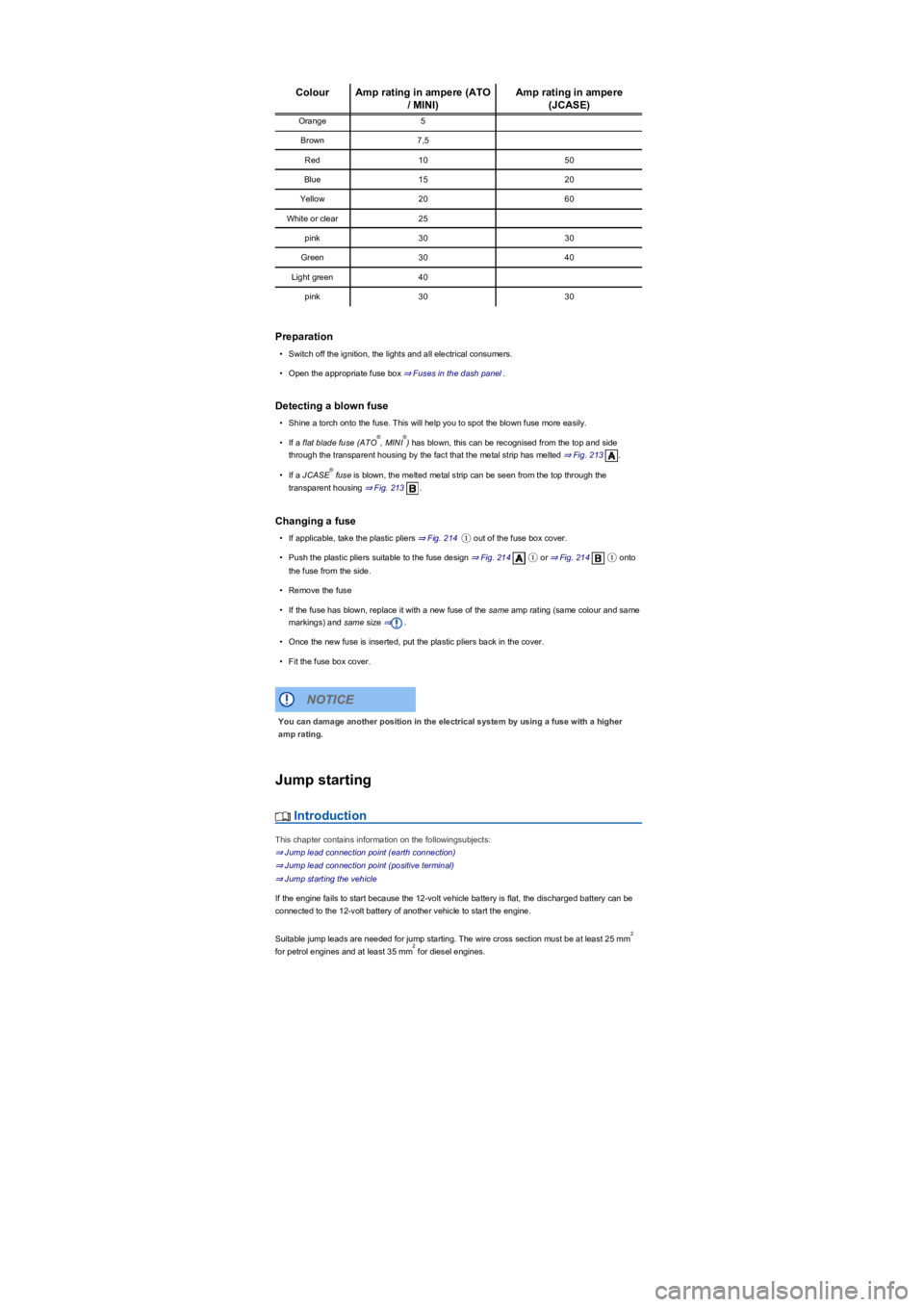
ColourAmp rating in ampere (ATO
/ MINI)
Amp rating in ampere
(JCASE)
Orange5
Brown7,5
Red1050
Blue1520
Yellow2060
White or clear25
pink3030
Green3040
Light green40
pink3030
Preparation
•Switch off the ignition, the lights and all electrical consumers.
•Open the appropriate fuse box ⇒ Fuses in the dash panel.
Detecting a blown fuse
•Shine a torch onto the fuse. This will help you to spot the blown fuse more easily.
•If a flat blade fuse (ATO, MINI) has blown, this can be recognised from the top and side
through the transparent housing by the fact that the metal strip has melted ⇒ Fig. 213.
•If a JCASE fuse is blown, the melted metal strip can be seen from the top through the
transparent housing ⇒ Fig. 213.
Changing a fuse
•If applicable, take the plastic pliers ⇒ Fig. 214① out of the fuse box cover.
•Push the plastic pliers suitable to the fuse design ⇒ Fig. 214① or ⇒ Fig. 214① onto
the fuse from the side.
•Remove the fuse
•If the fuse has blown, replace it with a new fuse of the same amp rating (same colour and same
markings) and same size ⇒.
•Once the new fuse is inserted, put the plastic pliers back in the cover.
•Fit the fuse box cover.
Jump starting
Introduction
This chapter contains information on the followingsubjects:
⇒ Jump lead connection point (earth connection)
⇒ Jump lead connection point (positive terminal)
⇒ Jump starting the vehicle
If the engine fails to start because the 12-volt vehicle battery is flat, the discharged battery can be
connected to the 12-volt battery of another vehicle to start the engine.
Suitable jump leads are needed for jump starting. The wire cross section must be at least 25 mm
for petrol engines and at least 35 mm for diesel engines.
®®
®
You can damage another position in the electrical system by using a fuse with a higher
amp rating.
NOTICE
2
2
Page 265 of 341
First read and observe the introductoryinformation and safety warnings⇒
Introduction
In vehicles with a 12-volt vehicle battery in the luggage compartment, there is a jump lead
connection point (positive terminal) ⇒ Fig. 216⊕ under a cover in the engine compartment for
connecting the red jump lead.
The vehicle can be jump-started or be used to jump-start another vehicle only via this jump lead
connection point.
Jump starting the vehicle
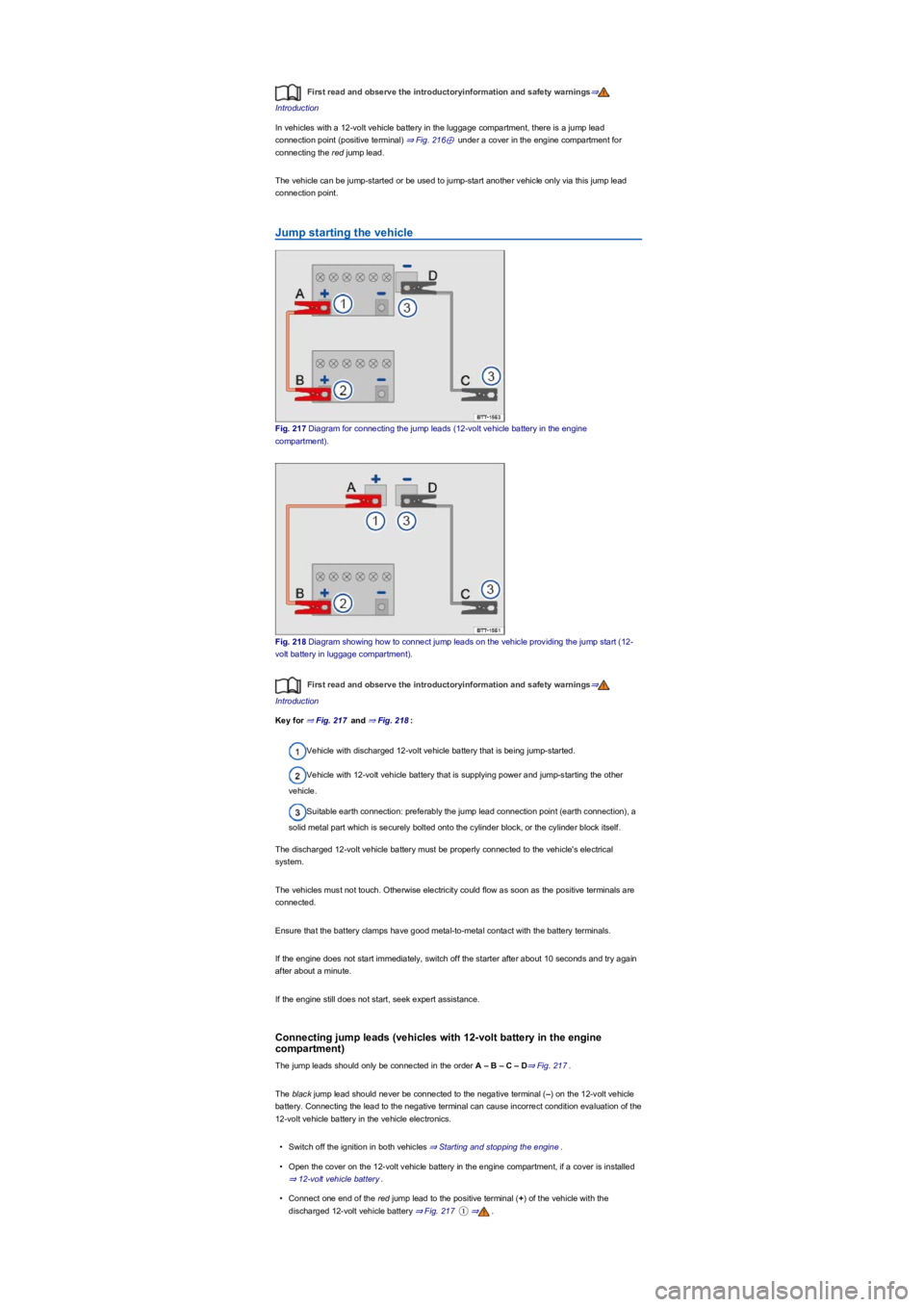
Fig. 217 Diagram for connecting the jump leads (12-volt vehicle battery in the engine
compartment).
Fig. 218 Diagram showing how to connect jump leads on the vehicle providing the jump start (12-
volt battery in luggage compartment).
First read and observe the introductoryinformation and safety warnings⇒
Introduction
Key for ⇒ Fig. 217 and ⇒ Fig. 218:
Vehicle with discharged 12-volt vehicle battery that is being jump-started.
Vehicle with 12-volt vehicle battery that is supplying power and jump-starting the other
vehicle.
Suitable earth connection: preferably the jump lead connection point (earth connection), a
solid metal part which is securely bolted onto the cylinder block, or the cylinder block itself.
The discharged 12-volt vehicle battery must be properly connected to the vehicle's electrical
system.
The vehicles must not touch. Otherwise electricity could flow as soon as the positive terminals are
connected.
Ensure that the battery clamps have good metal-to-metal contact with the battery terminals.
If the engine does not start immediately, switch off the starter after about 10 seconds and try again
after about a minute.
If the engine still does not start, seek expert assistance.
Connecting jump leads (vehicles with 12-volt battery in the engine
compartment)
The jump leads should only be connected in the order A – B – C – D⇒ Fig. 217.
The black jump lead should never be connected to the negative terminal (–) on the 12-volt vehicle
battery. Connecting the lead to the negative terminal can cause incorrect condition evaluation of the
12-volt vehicle battery in the vehicle electronics.
•Switch off the ignition in both vehicles ⇒ Starting and stopping the engine.
•Open the cover on the 12-volt vehicle battery in the engine compartment, if a cover is installed
⇒ 12-volt vehicle battery.
•Connect one end of the red jump lead to the positive terminal (+) of the vehicle with the
discharged 12-volt vehicle battery ⇒ Fig. 217①⇒.
Page 266 of 341
•Connect the other end of the red jump lead to the positive terminal (+) of the vehicle battery
providing assistance ⇒ Fig. 217②.
•On the vehicle with the flat 12-volt battery, connect the other end of the black jump lead
⇒ Fig. 217③ preferably to the jump lead connection point (earth connection), or otherwise to a
solid metal part that is securely bolted onto the cylinder block, or to the cylinder block itself ⇒
.
•Position the leads in such a way that they cannot come into contact with any moving parts in the
engine compartment.
Connecting jump leads (vehicles with 12-volt battery in the luggage
compartment)
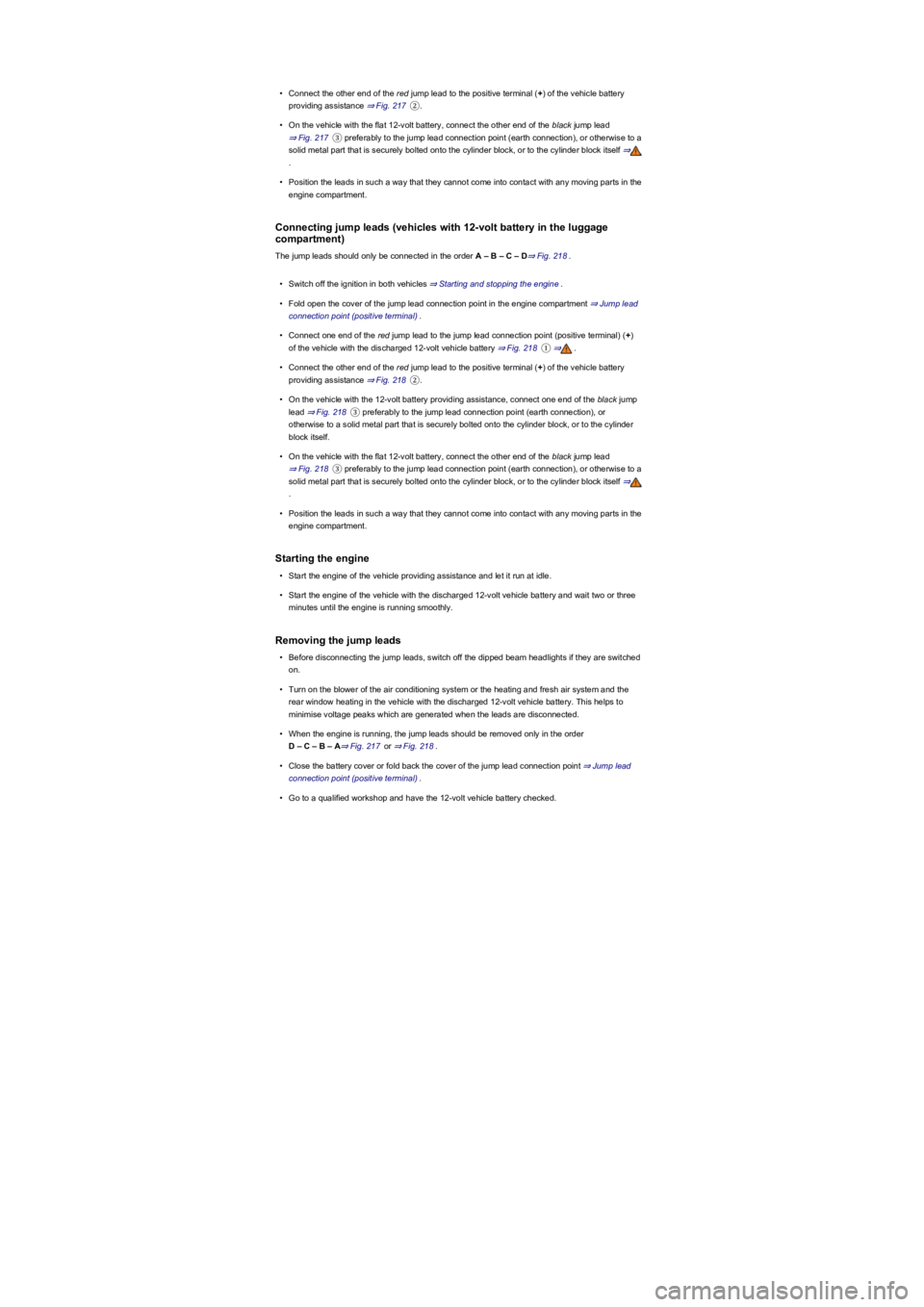
The jump leads should only be connected in the order A – B – C – D⇒ Fig. 218.
•Switch off the ignition in both vehicles ⇒ Starting and stopping the engine.
•Fold open the cover of the jump lead connection point in the engine compartment ⇒ Jump lead
connection point (positive terminal).
•Connect one end of the red jump lead to the jump lead connection point (positive terminal) (+)
of the vehicle with the discharged 12-volt vehicle battery ⇒ Fig. 218①⇒.
•Connect the other end of the red jump lead to the positive terminal (+) of the vehicle battery
providing assistance ⇒ Fig. 218②.
•On the vehicle with the 12-volt battery providing assistance, connect one end of the black jump
lead ⇒ Fig. 218③ preferably to the jump lead connection point (earth connection), or
otherwise to a solid metal part that is securely bolted onto the cylinder block, or to the cylinder
block itself.
•On the vehicle with the flat 12-volt battery, connect the other end of the black jump lead
⇒ Fig. 218③ preferably to the jump lead connection point (earth connection), or otherwise to a
solid metal part that is securely bolted onto the cylinder block, or to the cylinder block itself ⇒
.
•Position the leads in such a way that they cannot come into contact with any moving parts in the
engine compartment.
Starting the engine
•Start the engine of the vehicle providing assistance and let it run at idle.
•Start the engine of the vehicle with the discharged 12-volt vehicle battery and wait two or three
minutes until the engine is running smoothly.
Removing the jump leads
•Before disconnecting the jump leads, switch off the dipped beam headlights if they are switched
on.
•Turn on the blower of the air conditioning system or the heating and fresh air system and the
rear window heating in the vehicle with the discharged 12-volt vehicle battery. This helps to
minimise voltage peaks which are generated when the leads are disconnected.
•When the engine is running, the jump leads should be removed only in the order
D – C – B – A⇒ Fig. 217 or ⇒ Fig. 218.
•Close the battery cover or fold back the cover of the jump lead connection point ⇒ Jump lead
connection point (positive terminal).
•Go to a qualified workshop and have the 12-volt vehicle battery checked.
Page 267 of 341
Tow-starting or towing
Introduction
This chapter contains information on the followingsubjects:
⇒ Notes on tow-starting and towing
⇒ Fitting the rear towing eye
⇒ Fitting the front towing eye
⇒ Fitting the front towing eye (R-Line)
⇒ Driving notes when towing
Tow-starting is where a vehicle is started from it being set in motion by a vehicle that is hitched up
to it.
Towing is where a vehicle that cannot be driven is pulled away with the aid of another vehicle.
Observe any legal requirements when towing or tow-starting.
For technical reasons, vehicles with a discharged 12-volt battery must not be towed.⇒ Jump
starting
Vehicles with Keyless Access must only be towed with the ignition switched on.
Towing a vehicle when the engine is switched off and the ignition is switched on discharges the 12-
volt vehicle battery. Depending on the charge level of the 12-volt vehicle battery, the drop in voltage
can be large enough after just a few minutes that electrical consumers in the vehicle will no longer
function, e.g. the hazard warning lights.
Jump starting the vehicle incorrectly can cause the 12-volt vehicle battery to explode,
which can lead to serious injuries. Please observe the following in order to reduce the risk
of the 12-volt vehicle battery exploding:
•All work on the 12-volt vehicle battery and the electrical system can cause serious
chemical burns, fire or electric shocks. Always read the warnings and safety
information before carrying out any kind of work on the 12-volt vehicle battery ⇒ 12-
volt vehicle battery.
•Always wear suitable eye protection and gloves and never lean over the 12-volt vehicle
battery.
•Attach the connector cables in the correct order – the positive cable first, followed by
the negative.
•Never connect the negative cable to parts of the fuel system or to the brake lines.
•The non-insulated parts of the battery clamps must not be allowed to touch. The jump
lead attached to the positive terminal on the 12-volt vehicle battery must not touch
electrically conductive parts of the vehicle.
•m/k/a995MK Vehicles with battery in the engine compartment: check the battery
window on the 12-volt vehicle battery. Use a torch for this if necessary. If the display is
light yellow or colourless, do not jump start the vehicle. Seek expert assistance.
•Avoid electrostatic discharge in the vicinity of the 12-volt vehicle battery. The explosive
gas emitted from the 12-volt vehicle battery could be ignited by sparks.
•Do not carry out jump starting if the 12-volt vehicle battery is damaged or if it is or has
ever been frozen.
WARNING
Once the vehicle has been successfully jump-started, go to a qualified workshop and have
the 12-volt vehicle battery checked.
NOTICE
Page 268 of 341
Notes on tow-starting and towing
First read and observe the introductoryinformation and safety warnings⇒
Introduction
Tow rope, tow bar
It is easier and safer to tow a vehicle with a tow bar. Only use a tow rope if you do not have a tow
bar.
The tow rope should be slightly elastic to reduce the strain on both vehicles. It is advisable to use a
tow rope made of synthetic fibre or similarly elastic material.
Only attach the tow rope or tow bar to the specially provided towing eyes or to the towing bracket.
Vehicles with a factory-fitted towing bracket must only use tow bars that are specially designed
to fit a ball head ⇒ Trailer towing.
Tow-starting
Vehicles should not be tow-started wherever possible. Instead have the vehicle jump-started
⇒ Jump starting or collected by a recovery vehicle.
However, if the vehicle still has to be tow-started:
•Engage second or third gear.
•Keep the clutch pressed down.
•Switch on the ignition and the hazard warning lights.
•Once both vehicles are in motion, release the clutch.
•As soon as the engine starts, press the clutch and put the gear into neutral. This helps to
prevent driving into the towing vehicle.
When should your vehicle not be towed?
•The vehicle gearbox is damaged or does not contain any lubricant.
•The 12-volt vehicle battery is discharged. The steering system is still locked and the electronic
parking brake and electronic steering column lock, if applied, cannot be released.
•The distance to be towed is further than 50 km.
Never tow a vehicle that has no power supply.
•Never remove the vehicle key from the ignition or switch off the ignition using the
starter button during towing. This could cause the mechanical steering column lock
(steering lock) or the electronic steering column lock to engage suddenly. You will no
longer be able to steer the vehicle. This can lead to a loss of control of the vehicle,
accidents and serious injuries.
•If the power supply to the towed vehicle is disconnected, stop towing immediately and
seek expert assistance.
WARNING
If a vehicle is being towed, the vehicle handling and braking effect will change
significantly. Please note the following in order to reduce the risk of an accident or serious
injuries:
•Notes for the driver of the towed vehicle:
- You will need to depress the brake pedal more vigorously than normal as the
brake servo is not working. Always be careful not to drive into the vehicle that is
pulling your vehicle.
- You will need to turn the steering wheel more vigorously as the power-assisted
steering function is not working.
•Notes for the driver of the towing vehicle
- Accelerate carefully and gently.
- Avoid sudden braking and driving manoeuvres.
- Brake earlier than normal by pressing lightly on the brake pedal.
WARNING
•Remove and install the cover and the towing eye carefully so as to avoid damage to the
vehicle, e.g. the paintwork.
•Unburnt fuel can enter the catalytic converter and damage it while the vehicle is being
towed.
NOTICE
Page 269 of 341
•The steering function or the operating clearance of the wheels cannot be ensured after an
accident.
If your own vehicle has to be towed:
•Switch on the ignition.
•Select the neutral position or move the selector lever to N⇒ DSG dual clutch gearbox.
•Do not allow the vehicle to be towed at speeds faster than 50 km/h (30 mph).
•Do not allow the vehicle to be towed further than 50 km.
•Vehicles with a DSG dual clutch gearbox may only be towed by the breakdown truck with the
front wheels raised.
Towing vehicles with four-wheel drive (4MOTION)
Vehicles with four-wheel drive (4MOTION) may be towed with a tow bar or tow rope. If the vehicle
is towed with the rear or front axle raised, the engine must be switched off otherwise the drive train
could be damaged.
Please comply with the following when towing another vehicle:
•Comply with legal regulations.
•Comply with the information on towing contained in the owner's manual for the other vehicle.
The vehicle can only be towed when the electronic parking brake is switched off and, if
applicable, when the electronic steering column lock is released. If the power supply fails or if there
are faults in the electrical system, you may need to use jump leads to start the engine to release the
electronic parking brake and the electronic steering column lock.
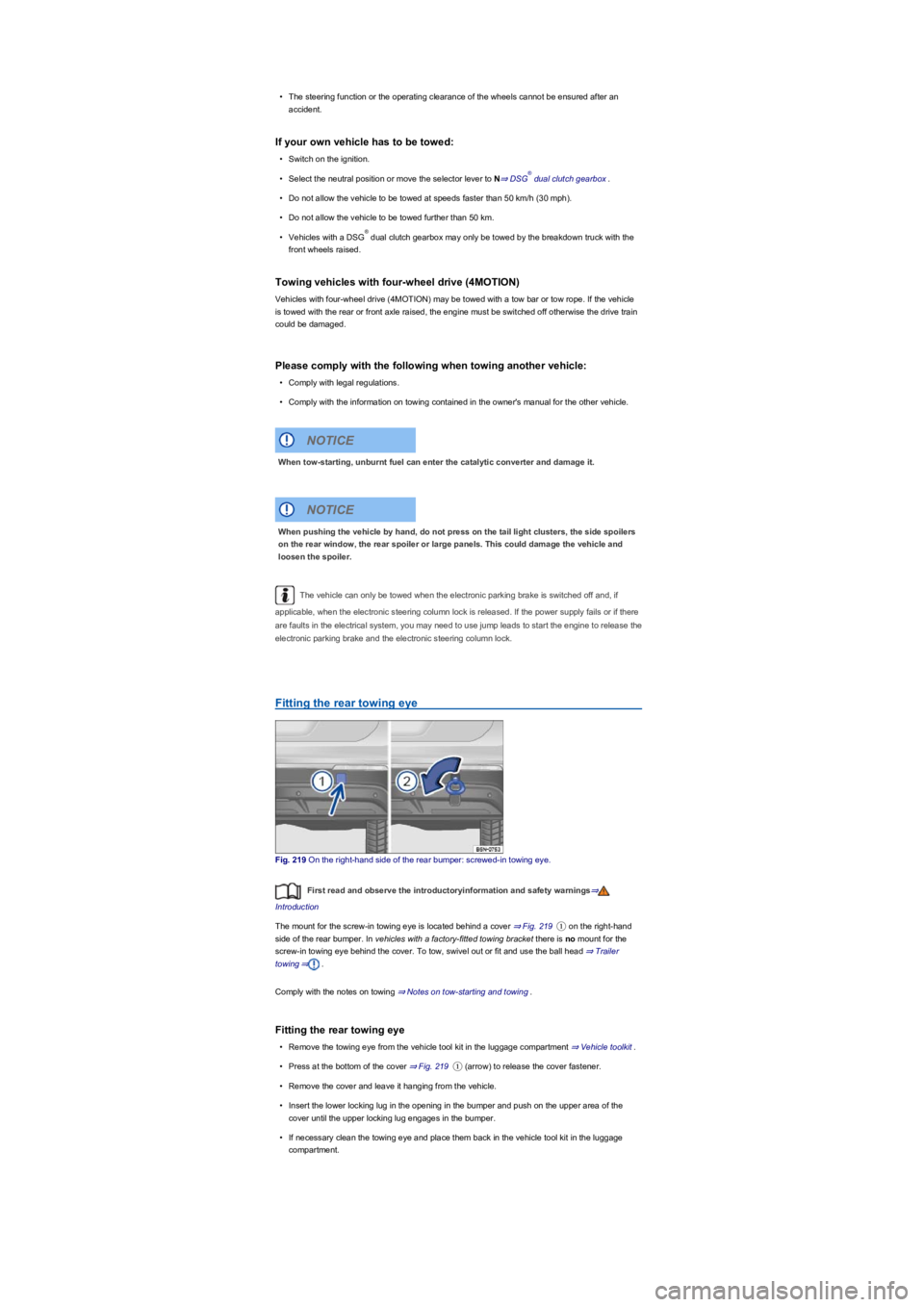
Fitting the rear towing eye
Fig. 219 On the right-hand side of the rear bumper: screwed-in towing eye.
First read and observe the introductoryinformation and safety warnings⇒
Introduction
The mount for the screw-in towing eye is located behind a cover ⇒ Fig. 219① on the right-hand
side of the rear bumper. In vehicles with a factory-fitted towing bracket there is no mount for the
screw-in towing eye behind the cover. To tow, swivel out or fit and use the ball head ⇒ Trailer
towing⇒.
Comply with the notes on towing ⇒ Notes on tow-starting and towing.
Fitting the rear towing eye
•Remove the towing eye from the vehicle tool kit in the luggage compartment ⇒ Vehicle toolkit.
•Press at the bottom of the cover ⇒ Fig. 219① (arrow) to release the cover fastener.
•Remove the cover and leave it hanging from the vehicle.
•Insert the lower locking lug in the opening in the bumper and push on the upper area of the
cover until the upper locking lug engages in the bumper.
•If necessary clean the towing eye and place them back in the vehicle tool kit in the luggage
compartment.
®
®
When tow-starting, unburnt fuel can enter the catalytic converter and damage it.
NOTICE
When pushing the vehicle by hand, do not press on the tail light clusters, the side spoilers
on the rear window, the rear spoiler or large panels. This could damage the vehicle and
loosen the spoiler.
NOTICE
Page 270 of 341
Fitting the front towing eye
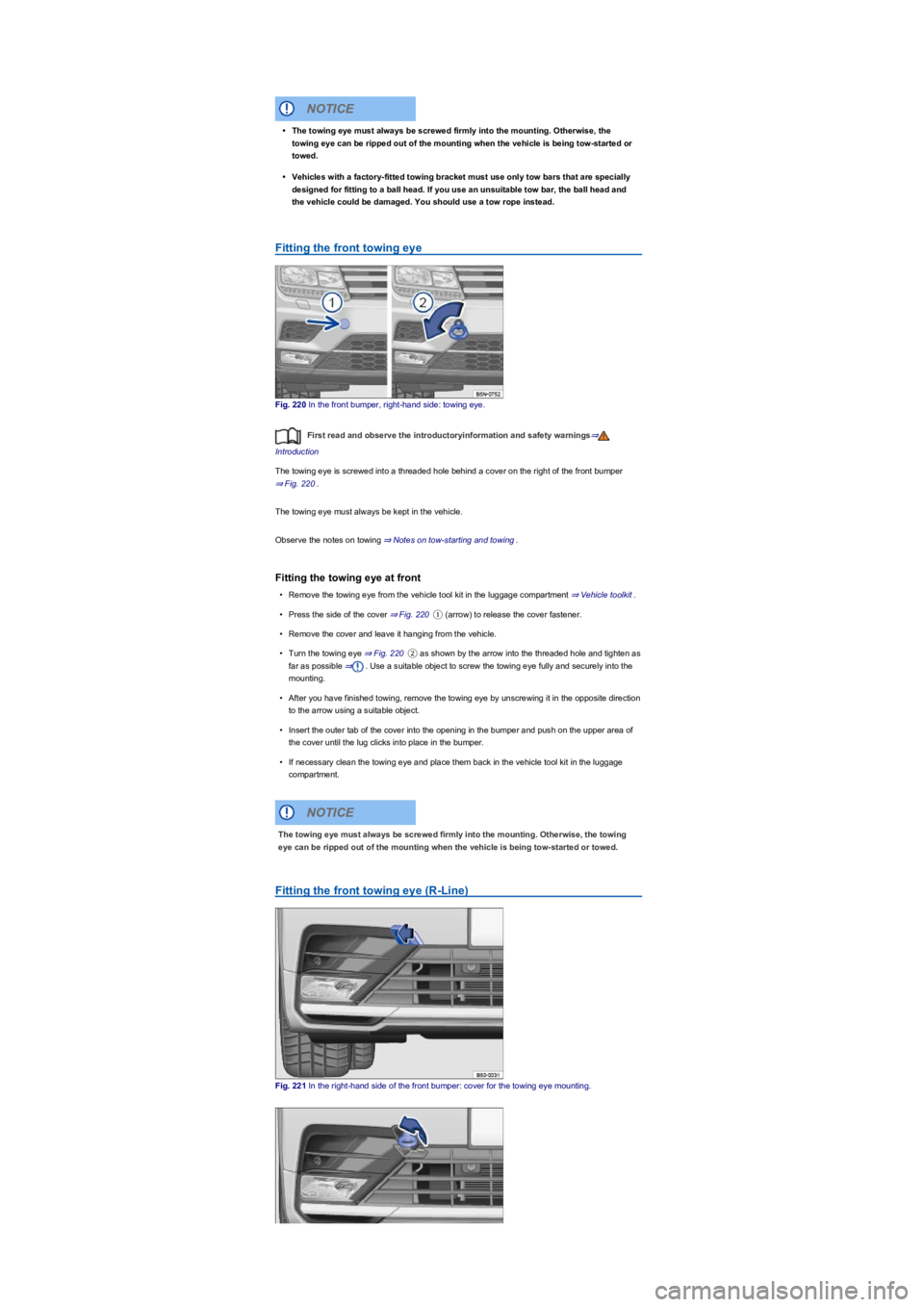
Fig. 220 In the front bumper, right-hand side: towing eye.
First read and observe the introductoryinformation and safety warnings⇒
Introduction
The towing eye is screwed into a threaded hole behind a cover on the right of the front bumper
⇒ Fig. 220.
The towing eye must always be kept in the vehicle.
Observe the notes on towing ⇒ Notes on tow-starting and towing.
Fitting the towing eye at front
•Remove the towing eye from the vehicle tool kit in the luggage compartment ⇒ Vehicle toolkit.
•Press the side of the cover ⇒ Fig. 220① (arrow) to release the cover fastener.
•Remove the cover and leave it hanging from the vehicle.
•Turn the towing eye ⇒ Fig. 220② as shown by the arrow into the threaded hole and tighten as
far as possible ⇒. Use a suitable object to screw the towing eye fully and securely into the
mounting.
•After you have finished towing, remove the towing eye by unscrewing it in the opposite direction
to the arrow using a suitable object.
•Insert the outer tab of the cover into the opening in the bumper and push on the upper area of
the cover until the lug clicks into place in the bumper.
•If necessary clean the towing eye and place them back in the vehicle tool kit in the luggage
compartment.
Fitting the front towing eye (R-Line)
Fig. 221 In the right-hand side of the front bumper: cover for the towing eye mounting.
•The towing eye must always be screwed firmly into the mounting. Otherwise, the
towing eye can be ripped out of the mounting when the vehicle is being tow-started or
towed.
•Vehicles with a factory-fitted towing bracket must use only tow bars that are specially
designed for fitting to a ball head. If you use an unsuitable tow bar, the ball head and
the vehicle could be damaged. You should use a tow rope instead.
NOTICE
The towing eye must always be screwed firmly into the mounting. Otherwise, the towing
eye can be ripped out of the mounting when the vehicle is being tow-started or towed.
NOTICE
Page 271 of 341
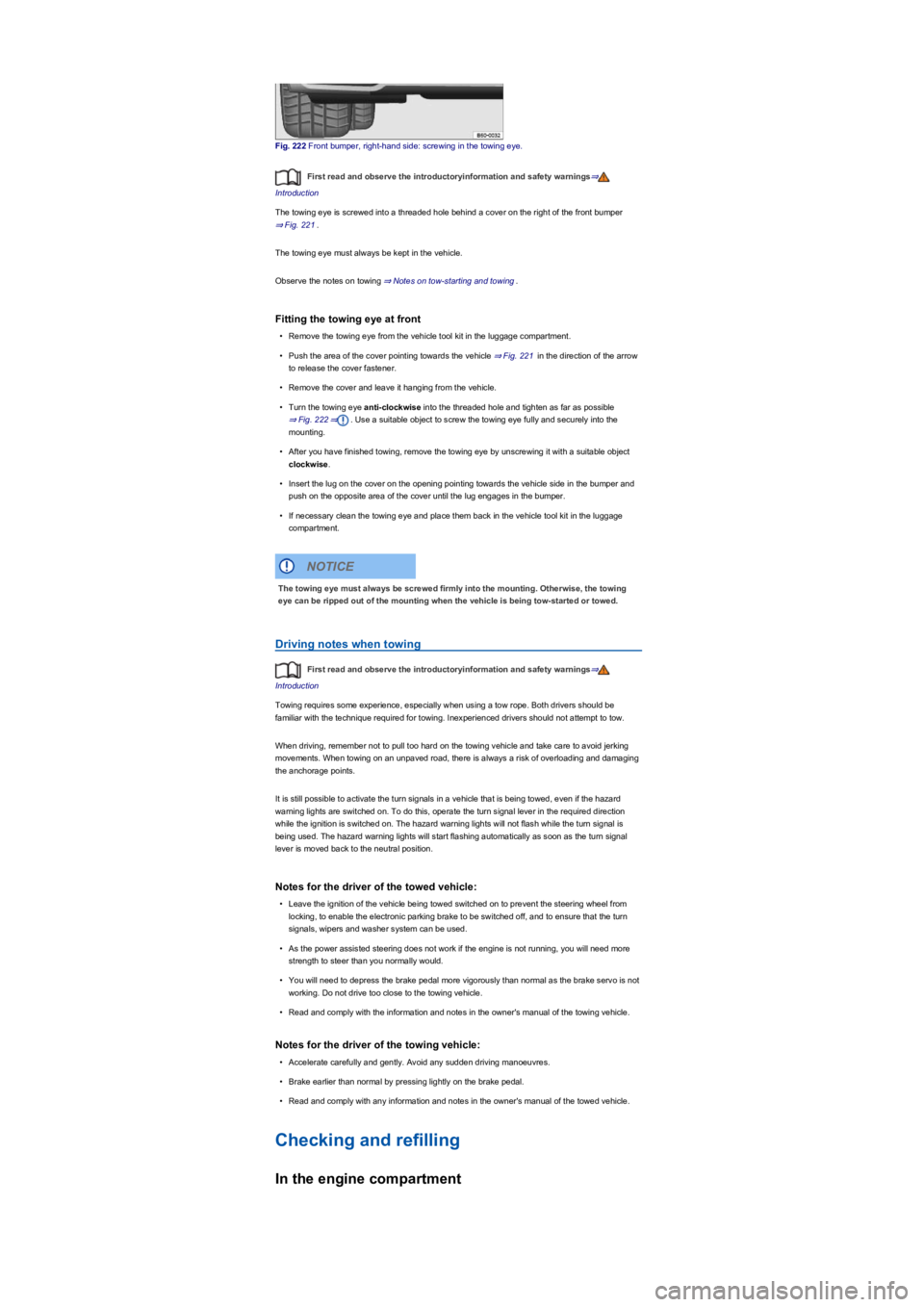
Fig. 222 Front bumper, right-hand side: screwing in the towing eye.
First read and observe the introductoryinformation and safety warnings⇒
Introduction
The towing eye is screwed into a threaded hole behind a cover on the right of the front bumper
⇒ Fig. 221.
The towing eye must always be kept in the vehicle.
Observe the notes on towing ⇒ Notes on tow-starting and towing.
Fitting the towing eye at front
•Remove the towing eye from the vehicle tool kit in the luggage compartment.
•Push the area of the cover pointing towards the vehicle ⇒ Fig. 221 in the direction of the arrow
to release the cover fastener.
•Remove the cover and leave it hanging from the vehicle.
•Turn the towing eye anti-clockwise into the threaded hole and tighten as far as possible
⇒ Fig. 222⇒. Use a suitable object to screw the towing eye fully and securely into the
mounting.
•After you have finished towing, remove the towing eye by unscrewing it with a suitable object
clockwise.
•Insert the lug on the cover on the opening pointing towards the vehicle side in the bumper and
push on the opposite area of the cover until the lug engages in the bumper.
•If necessary clean the towing eye and place them back in the vehicle tool kit in the luggage
compartment.
Driving notes when towing
First read and observe the introductoryinformation and safety warnings⇒
Introduction
Towing requires some experience, especially when using a tow rope. Both drivers should be
familiar with the technique required for towing. Inexperienced drivers should not attempt to tow.
When driving, remember not to pull too hard on the towing vehicle and take care to avoid jerking
movements. When towing on an unpaved road, there is always a risk of overloading and damaging
the anchorage points.
It is still possible to activate the turn signals in a vehicle that is being towed, even if the hazard
warning lights are switched on. To do this, operate the turn signal lever in the required direction
while the ignition is switched on. The hazard warning lights will not flash while the turn signal is
being used. The hazard warning lights will start flashing automatically as soon as the turn signal
lever is moved back to the neutral position.
Notes for the driver of the towed vehicle:
•Leave the ignition of the vehicle being towed switched on to prevent the steering wheel from
locking, to enable the electronic parking brake to be switched off, and to ensure that the turn
signals, wipers and washer system can be used.
•As the power assisted steering does not work if the engine is not running, you will need more
strength to steer than you normally would.
•You will need to depress the brake pedal more vigorously than normal as the brake servo is not
working. Do not drive too close to the towing vehicle.
•Read and comply with the information and notes in the owner's manual of the towing vehicle.
Notes for the driver of the towing vehicle:
•Accelerate carefully and gently. Avoid any sudden driving manoeuvres.
•Brake earlier than normal by pressing lightly on the brake pedal.
•Read and comply with any information and notes in the owner's manual of the towed vehicle.
Checking and refilling
In the engine compartment
The towing eye must always be screwed firmly into the mounting. Otherwise, the towing
eye can be ripped out of the mounting when the vehicle is being tow-started or towed.
NOTICE
Page 273 of 341
Park the vehicle on a level and stable surface.
Depress and hold the brake pedal until you have switched off the ignition.
Switch on the electronic parking brake Electronic parking brake.
Select the neutral position Manual gearbox: selecting a gear or move the selector lever to
position P DSG® dual clutch gearbox.
Switch off the ignition and remove the vehicle key from the ignition lock Starting and
stopping the engine.
Service fluids leaks are harmful to the environment. So you should regularly check the
ground underneath your vehicle. If there are spots of oil or other service fluids on the ground, the
vehicle should be inspected by a qualified workshop. Any spilt service fluids must be disposed of
properly.
Preparing the vehicle for working in the engine compartment
Checklist
The following steps should always be carried out in the specified order before working in
the engine compartment ⇒:
There are rotating components in the engine compartment that can cause serious injury.
•Never place your hand near these components or in the radiator fan. Touching the
rotary blades can result in serious injuries. The fan is temperature-controlled and can
start automatically, even if the ignition has been switched off and the vehicle key has
been removed from the ignition lock.
•If any work has to be performed when the engine is started or with the engine running,
there is an additional, potentially fatal, safety risk from the rotating parts, such as the
poly V-belts, alternator, radiator fan etc., and from the high-voltage ignition system.
Always be particularly careful.
- Always ensure that no body parts, jewellery, ties, loose items of clothing or long
hair can be caught up in rotating engine components. Before starting work,
remove any jewellery and ties, tie up long hair and pull clothes in tightly to avoid
them getting caught in the engine compartment.
- Always take due care and attention when depressing the accelerator. The vehicle
could move, even if the electronic parking brake is applied.
•Always ensure you have not left any objects, such as cleaning cloths and tools, in the
engine compartment. Any forgotten items can cause malfunctions, engine damage and
fires.
WARNING
Additional insulating materials such as covers in the engine compartment could disrupt
the operation of the engine, start fires and lead to severe injuries.
•Never cover the engine with any insulating materials.
WARNING
Service fluids and some materials in the engine compartment are highly flammable and
can cause fires and serious injuries!
•Never smoke in the vicinity of the engine compartment.
•Never work near naked flames or sparks.
•Never spill fluids onto the engine. They could ignite on hot engine components and
hence cause injuries.
•Please note the following when carrying out any work on the fuel system or the
electrical system:
- Always disconnect the 12-volt vehicle battery. Ensure that the vehicle is
unlocked when the 12-volt vehicle battery is disconnected as otherwise the anti-
theft alarm will be activated.
- Never work in the direct proximity of heating systems, water heaters or any other
open flames.
•Always have a fully functional and tested fire extinguisher to hand.
WARNING
When topping up or changing service fluids, ensure that you pour the correct service
fluids into the correct openings. The use of incorrect service fluids could result in serious
malfunctions and engine damage.
NOTICE