Mode VOLKSWAGEN TIGUAN 2017 Owner´s Manual
[x] Cancel search | Manufacturer: VOLKSWAGEN, Model Year: 2017, Model line: TIGUAN, Model: VOLKSWAGEN TIGUAN 2017Pages: 341, PDF Size: 9.14 MB
Page 307 of 341
If your vehicle has a flat tyre, park the vehicle on a firm and level surface at a safe distance
from moving traffic.
Switch on the electronic parking brake Parking and manoeuvring.
With a DSG® dual clutch gearbox, move the selector lever to position P DSG® dual clutch
gearbox.
Stop the engine and remove the key from the ignition Starting and stopping the engine.
Manual gearbox: select a gear Manual gearbox: selecting a gear.
First read and observe the introductoryinformation and safety warnings⇒
Introduction
The caps protect the wheel bolts and should be placed fully back in position after changing the
wheel.
Removing and fitting the caps
•Removing: take the wire hook from the vehicle tool kit ⇒ Vehicle toolkit.
•Insert the wire hook through the opening in the cap ⇒ Fig. 243 and pull off in the direction of
the arrow.
•Fitting: press the caps on the bolts as far as they will go.
The anti-theft wheel bolt has a separate cap. It only fits onto the anti-theft wheel bolts and not
onto conventional wheel bolts.
Changing a wheel
Introduction
This chapter contains information on the followingsubjects:
⇒ Preparations for changing a wheel
⇒ Wheel bolts
⇒ Lifting the vehicle with the jack
⇒ Changing a wheel
⇒ After changing a wheel
Some models are delivered from the factory without a jack or box spanner. If this is the case, the
wheel should be changed by a qualified workshop.
The vehicle jack supplied with the vehicle is only designed for changing a wheel when one vehicle
tyre is damaged and has to be replaced. If both tyres on one side of the vehicle, both tyres on one
axle, or all tyres are damaged, seek expert assistance.
Preparations for changing a wheel
First read and observe the introductoryinformation and safety warnings⇒
Introduction
Checklist
The following actions must always be carried out in the given order in preparation for
changing the wheel ⇒:
Changing a wheel can be dangerous, especially when carried out at the side of a road.
Please note the following steps in order to reduce the risk of serious injuries:
•Stop the vehicle as soon as it is possible and safe to do so. Park the vehicle at a safe
distance from moving traffic in order to carry out the wheel change.
•All passengers and children in particular must be at a safe distance and away from
your area of work during the wheel change.
•Switch on the hazard warning lights to warn other road users.
•Check that the surface the vehicle is parked on is level and firm. If necessary use a
large, strong board or similar support for the vehicle jack.
•Only change the wheel yourself if you feel confident carrying out the procedure. If not,
seek expert assistance.
•Always use suitable and undamaged tools to change the wheel.
•Always switch off the engine, switch on the electronic parking brake and move the
selector lever to the position P or select a gear on a manual gearbox in order to reduce
the risk of unintended vehicle movement.
•The wheel bolt tightening torque should be checked with a torque wrench immediately
after changing a wheel.
•In the case of vehicles with a Tyre Pressure Loss Indicator, the system must be re-
synchronised immediately after new tyres are fitted ⇒ Tyre monitoring systems.
WARNING
Page 310 of 341
Crank the jack further until the wheel is just clear of the ground.
Changing a wheel
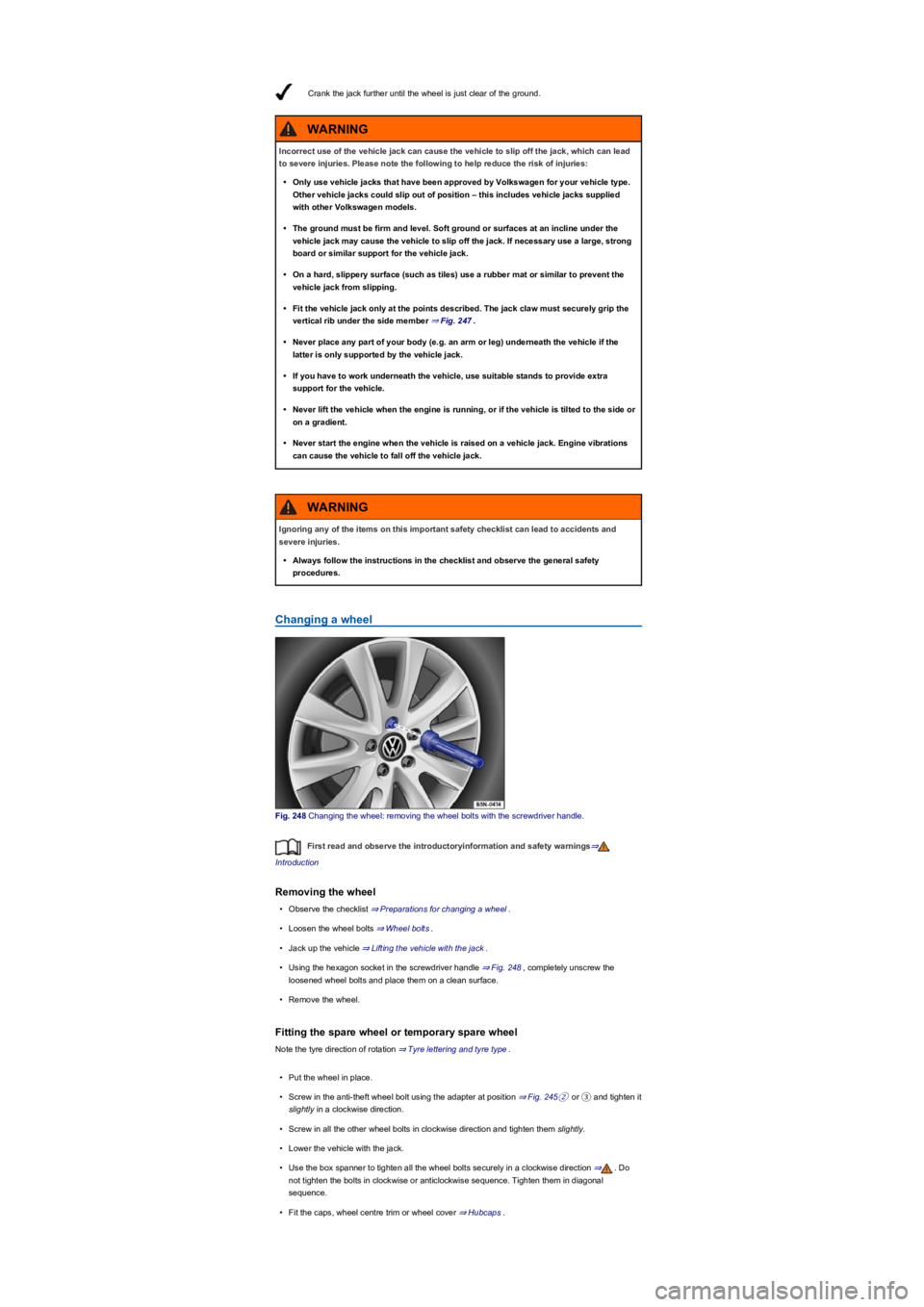
Fig. 248 Changing the wheel: removing the wheel bolts with the screwdriver handle.
First read and observe the introductoryinformation and safety warnings⇒
Introduction
Removing the wheel
•Observe the checklist ⇒ Preparations for changing a wheel.
•Loosen the wheel bolts ⇒ Wheel bolts.
•Jack up the vehicle ⇒ Lifting the vehicle with the jack.
•Using the hexagon socket in the screwdriver handle ⇒ Fig. 248, completely unscrew the
loosened wheel bolts and place them on a clean surface.
•Remove the wheel.
Fitting the spare wheel or temporary spare wheel
Note the tyre direction of rotation ⇒ Tyre lettering and tyre type.
•Put the wheel in place.
•Screw in the anti-theft wheel bolt using the adapter at position ⇒ Fig. 245② or ③ and tighten it
slightly in a clockwise direction.
•Screw in all the other wheel bolts in clockwise direction and tighten them slightly.
•Lower the vehicle with the jack.
•Use the box spanner to tighten all the wheel bolts securely in a clockwise direction ⇒. Do
not tighten the bolts in clockwise or anticlockwise sequence. Tighten them in diagonal
sequence.
•Fit the caps, wheel centre trim or wheel cover ⇒ Hubcaps.
Incorrect use of the vehicle jack can cause the vehicle to slip off the jack, which can lead
to severe injuries. Please note the following to help reduce the risk of injuries:
•Only use vehicle jacks that have been approved by Volkswagen for your vehicle type.
Other vehicle jacks could slip out of position – this includes vehicle jacks supplied
with other Volkswagen models.
•The ground must be firm and level. Soft ground or surfaces at an incline under the
vehicle jack may cause the vehicle to slip off the jack. If necessary use a large, strong
board or similar support for the vehicle jack.
•On a hard, slippery surface (such as tiles) use a rubber mat or similar to prevent the
vehicle jack from slipping.
•Fit the vehicle jack only at the points described. The jack claw must securely grip the
vertical rib under the side member ⇒ Fig. 247.
•Never place any part of your body (e.g. an arm or leg) underneath the vehicle if the
latter is only supported by the vehicle jack.
•If you have to work underneath the vehicle, use suitable stands to provide extra
support for the vehicle.
•Never lift the vehicle when the engine is running, or if the vehicle is tilted to the side or
on a gradient.
•Never start the engine when the vehicle is raised on a vehicle jack. Engine vibrations
can cause the vehicle to fall off the vehicle jack.
WARNING
Ignoring any of the items on this important safety checklist can lead to accidents and
severe injuries.
•Always follow the instructions in the checklist and observe the general safety
procedures.
WARNING
Page 332 of 341
Information in accordance with the EU Chemicals Regulation
REACH
In accordance with the European regulations on chemicals, known as REACH, Volkswagen would
like to inform you about the substances that may be found in your vehicle.
You can access this information online using your vehicle identification number ⇒ Technical data:
https://reachinfo.volkswagen.com
Declaration of conformity
The individual manufacturer declares herewith that the following products conform, at the time of
vehicle production, with the basic requirements and other relevant laws and regulations, including
FCC Part 15.19, FCC Part 15.21 and RSS-Gen Issue 1:
Radio-based equipment
•Electronic immobiliser.
•Vehicle key.
•Keyless Access locking and starting system.
•Adaptive Cruise Control (ACC).
•Area monitoring system (Front Assist) including City Emergency Brake.
•Lane change system (Side Assist)
•Remote control for the auxiliary heater ⇒ Auxiliary heater and ventilation.
•Trailer manoeuvring system (Trailer Assist) ⇒ Trailer Assist
Electrical equipment
•12-volt socket.
•230-volt Euro socket, 115-volt socket, 100-volt socket.
Recycling and scrapping end-of-life vehicles
Recycling end-of-life vehicles
Volkswagen has already made provision for you to recycle your vehicle in an environmentally
responsible manner. The recycling system operating in many European countries will take back
your vehicle at the end of its useful life. Once the vehicle has been recycled, a certificate of
destruction will be issued to show that the vehicle has been disposed of correctly.
End-of-life vehicles are recycled free of charge, provided that national legislation is complied with.
Further information on the recycling of end-of-life vehicles can be found at a Volkswagen
dealership.
Scrapping
The relevant safety requirements must be observed when the vehicle or components of the airbag
and the belt tensioners are scrapped. Qualified workshops are familiar with these requirements.
Information about vehicles with N1 approval (light commercial
vehicle)
Please observe the following information for vehicles used to transport goods with a maximum
permitted weight of up to 3.5 t (N1 approval in Europe):
Variants and number of seats
N1 vehicles based on a Volkswagen passenger car models are available in different versions. The
number of seats may be restricted to two or four.
Vehicles with two seats: there is no floor covering in the rear of the vehicle interior because there is
no rear bench seat ⇒.
Vehicles with four seats: the centre seat on the rear bench seat cannot be used⇒.
Safe transport of children
Like in vehicles with passenger car approval (M1), approved child restraint systems can be used on
the seats ⇒ Safe transport of children.
Towing a trailer
If the vehicle is approved for towing a trailer, observe any local regulations for driving with a trailer
and using a towing bracket.
Page 333 of 341
If the vehicle exceeds the permitted gross weight or axle load for the rear axle, a speed of 80 km/h
must not be exceeded when towing a trailer. This also applies to countries where higher speeds are
permitted. Always obey speed limits. In some areas speed limits for vehicles towing trailers are
lower than for vehicles without trailers.
Any permitted excess loads for the vehicle are entered in the vehicle documents. If no permitted
excess load is entered, the permitted driving speed limit is 100 km/h taking into account country-
specific legislation.
Technical data
Refer to the vehicle documents for the technical data.
Technical data
Information on technical data
Unless otherwise indicated or listed separately, the technical data for the basic model apply.
Optional equipment, different vehicle equipment, special vehicles and country-specific vehicle
equipment levels can result in different values. All data in the official vehicle documents take
precedence over these data.
Observe the instructions and information relating to vehicles with N1 approval ⇒ Information about
vehicles with N1 approval (light commercial vehicle).
Engine
The vehicle data sticker or the vehicle registration documents show which engine is installed in your
vehicle.
Weight
The values for the kerb weight in the following tables apply to the road-ready vehicle with driver
(75 kg), service fluids including fuel tank carrying 90% of its capacity and, if applicable, tool kit and
spare tyre ⇒. Additional equipment and retrofitted accessories increase the kerb weight stated
and reduce the maximum permitted load accordingly.
The load comprises the weights of the following:
•Vehicle occupants
•All luggage
•Roof load including the mounts or roof bars and the load carrier system
•Drawbar load when towing a trailer ⇒ Trailer towing.
Performance figures
For reasons of vehicle registration and vehicle taxation, the power output and performance of some
engines may vary in some countries from the information given in this booklet.
In certain vehicles with heavy duty suspension, the engine could be governed to provide a
maximum speed of 210 km/h.
Danger of injuries and electric shock from exposed cables.
•Have the luggage compartment completed at the latest after delivery so that the cables
in the rear area of the vehicle are covered during use of the vehicle.
WARNING
Danger of serious injury due to incorrect transport of persons.
•Never transport a person or child in the middle of the rear bench seat.
•The lack of restraint systems such as seat belt and head restraint can result in serious
or fatal injury in the event of an accident.
WARNING
Danger of serious and fatal injury.
•Do not transport people in the luggage compartment.
•Observe the safety instructions and information on the luggage compartment and
transporting items ⇒ Transporting.
WARNING
Page 335 of 341
Engine and gearbox code, paint number, interior equipment. In the example, the engine
code is CPTA ⇒ Fig. 253.
Optional extras, PR numbers.
Type plate
The type plate ⇒ Fig. 253 can be seen on the lower part of the door pillar when the door is
open. Vehicles for certain export countries do not have a type plate.
The type plate contains the following data:
Permit
Gross vehicle weight rating
Gross combination weight rating (vehicle plus trailer ⇒ Trailer towing)
Gross axle weight rating, front
Gross axle weight rating, rear
Vehicle identification number
The vehicle identification number can be read from outside the vehicle through a viewer in the
windscreen ⇒ Fig. 254 (arrow). The viewer is located in the lower corner of the windscreen. The
vehicle identification number is also stamped on the right-hand water drainage channel. The water
drainage channel is located between the suspension turret and wing. Open the bonnet ⇒ In the
engine compartment to gain access to the vehicle identification number.
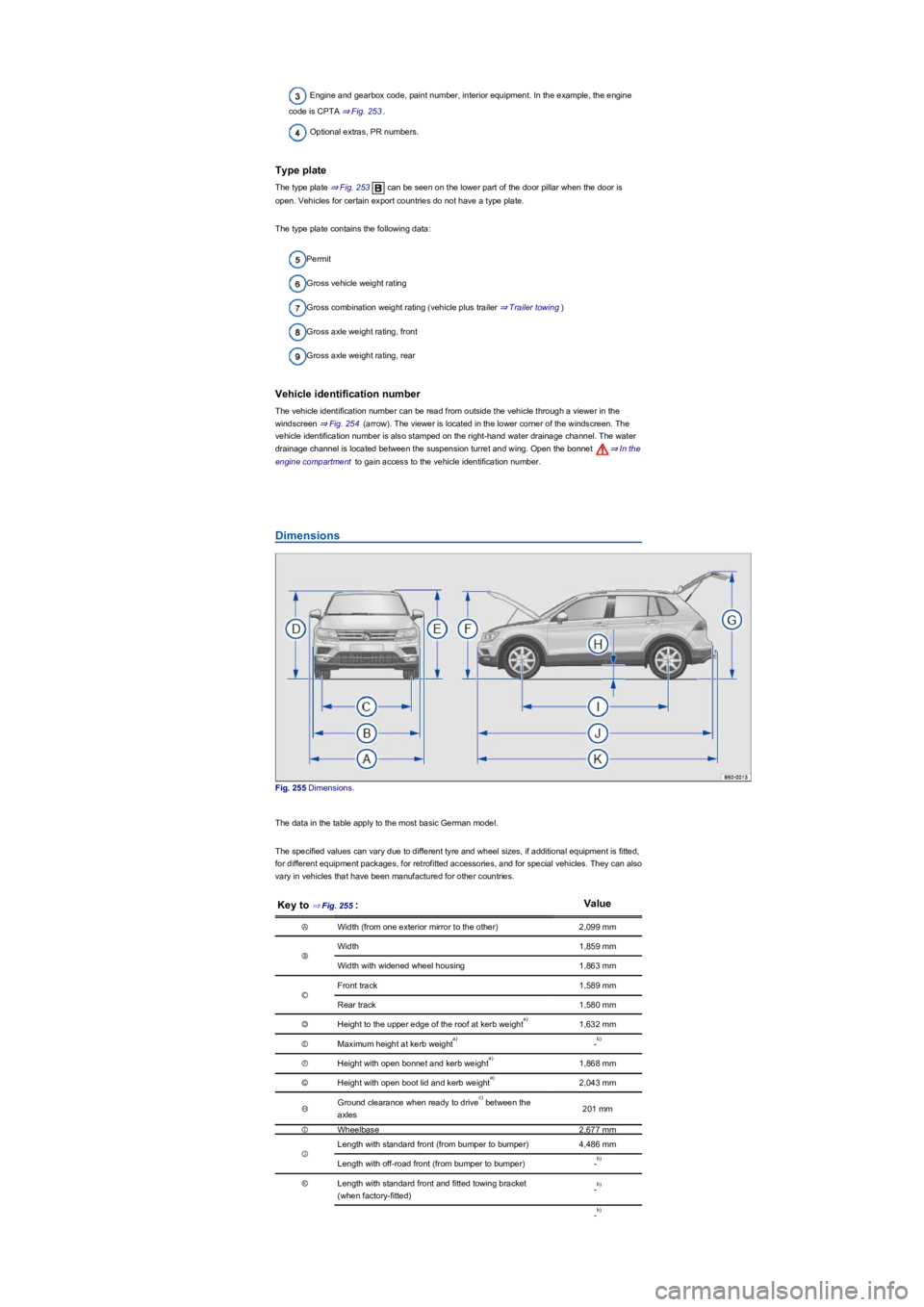
Dimensions
Fig. 255 Dimensions.
The data in the table apply to the most basic German model.
The specified values can vary due to different tyre and wheel sizes, if additional equipment is fitted,
for different equipment packages, for retrofitted accessories, and for special vehicles. They can also
vary in vehicles that have been manufactured for other countries.
Key to ⇒ Fig. 255:Value
ⒶWidth (from one exterior mirror to the other)2,099 mm
Ⓑ
Width1,859 mm
Width with widened wheel housing1,863 mm
Ⓒ
Front track1,589 mm
Rear track1,580 mm
ⒹHeight to the upper edge of the roof at kerb weight1,632 mm
ⒺMaximum height at kerb weight-
ⒻHeight with open bonnet and kerb weight1,868 mm
ⒼHeight with open boot lid and kerb weight2,043 mm
ⒽGround clearance when ready to drive between the
axles201 mm
ⒾWheelbase2,677 mm
Ⓙ
Length with standard front (from bumper to bumper)4,486 mm
Length with off-road front (from bumper to bumper)-
ⓀLength with standard front and fitted towing bracket
(when factory-fitted)-
-
a)
a)b)
a)
a)
c)
b)
b)
b)