gearbox VOLKSWAGEN TIGUAN 2017 Owner´s Manual
[x] Cancel search | Manufacturer: VOLKSWAGEN, Model Year: 2017, Model line: TIGUAN, Model: VOLKSWAGEN TIGUAN 2017Pages: 341, PDF Size: 9.14 MB
Page 307 of 341
If your vehicle has a flat tyre, park the vehicle on a firm and level surface at a safe distance
from moving traffic.
Switch on the electronic parking brake Parking and manoeuvring.
With a DSG® dual clutch gearbox, move the selector lever to position P DSG® dual clutch
gearbox.
Stop the engine and remove the key from the ignition Starting and stopping the engine.
Manual gearbox: select a gear Manual gearbox: selecting a gear.
First read and observe the introductoryinformation and safety warnings⇒
Introduction
The caps protect the wheel bolts and should be placed fully back in position after changing the
wheel.
Removing and fitting the caps
•Removing: take the wire hook from the vehicle tool kit ⇒ Vehicle toolkit.
•Insert the wire hook through the opening in the cap ⇒ Fig. 243 and pull off in the direction of
the arrow.
•Fitting: press the caps on the bolts as far as they will go.
The anti-theft wheel bolt has a separate cap. It only fits onto the anti-theft wheel bolts and not
onto conventional wheel bolts.
Changing a wheel
Introduction
This chapter contains information on the followingsubjects:
⇒ Preparations for changing a wheel
⇒ Wheel bolts
⇒ Lifting the vehicle with the jack
⇒ Changing a wheel
⇒ After changing a wheel
Some models are delivered from the factory without a jack or box spanner. If this is the case, the
wheel should be changed by a qualified workshop.
The vehicle jack supplied with the vehicle is only designed for changing a wheel when one vehicle
tyre is damaged and has to be replaced. If both tyres on one side of the vehicle, both tyres on one
axle, or all tyres are damaged, seek expert assistance.
Preparations for changing a wheel
First read and observe the introductoryinformation and safety warnings⇒
Introduction
Checklist
The following actions must always be carried out in the given order in preparation for
changing the wheel ⇒:
Changing a wheel can be dangerous, especially when carried out at the side of a road.
Please note the following steps in order to reduce the risk of serious injuries:
•Stop the vehicle as soon as it is possible and safe to do so. Park the vehicle at a safe
distance from moving traffic in order to carry out the wheel change.
•All passengers and children in particular must be at a safe distance and away from
your area of work during the wheel change.
•Switch on the hazard warning lights to warn other road users.
•Check that the surface the vehicle is parked on is level and firm. If necessary use a
large, strong board or similar support for the vehicle jack.
•Only change the wheel yourself if you feel confident carrying out the procedure. If not,
seek expert assistance.
•Always use suitable and undamaged tools to change the wheel.
•Always switch off the engine, switch on the electronic parking brake and move the
selector lever to the position P or select a gear on a manual gearbox in order to reduce
the risk of unintended vehicle movement.
•The wheel bolt tightening torque should be checked with a torque wrench immediately
after changing a wheel.
•In the case of vehicles with a Tyre Pressure Loss Indicator, the system must be re-
synchronised immediately after new tyres are fitted ⇒ Tyre monitoring systems.
WARNING
Page 309 of 341
Find a firm and level surface suitable for lifting the vehicle.
Stop the engine, with a manual gearbox select a gear or with a DSG® dual clutch gearbox
move the selector lever to position P DSG® dual clutch gearbox and switch on the
electronic parking brake Parking and manoeuvring.
Chock both wheels on the opposite side of the vehicle using the collapsible chocks or
other suitable objects.
Loosen the wheel bolts Wheel bolts.
Find the jacking point under the vehicle which is closest to the wheel that is being
changed.
Insert the hand crank into the opening on the jack (depending on equipment).
Crank up the jack until it just fits under the jacking point of the vehicle.
Ensure that the entire surface of the foot of the jack is resting securely on the ground, and
that the foot of the jack is positioned fully underneath the point of application and .
Position the jack and simultaneously continue to crank the claw up until it is in position
around the vertical rib underneath the vehicle .
The tightening torque should be checked with a properly functioning torque wrench immediately
after changing a wheel.
Lifting the vehicle with the jack
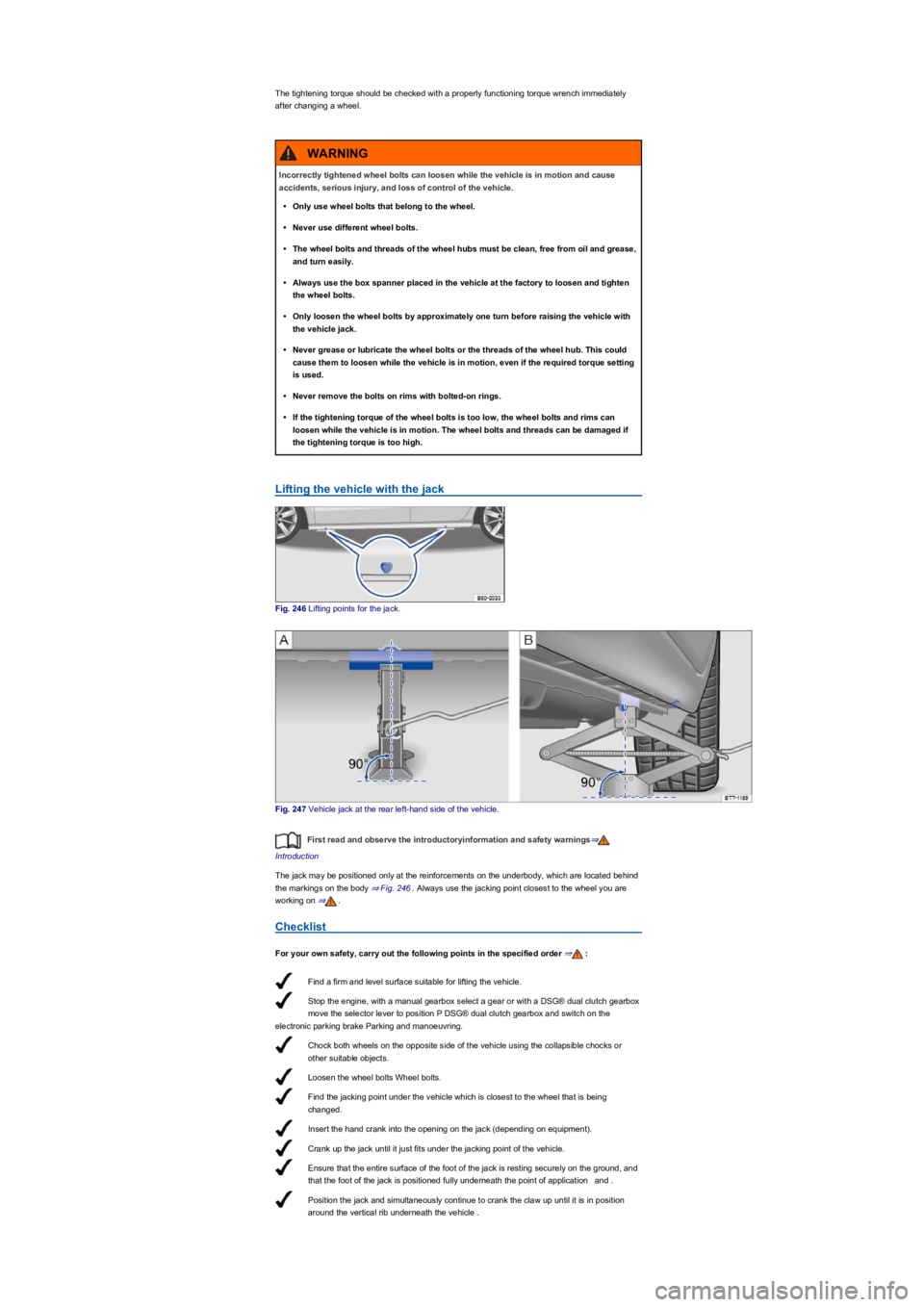
Fig. 246 Lifting points for the jack.
Fig. 247 Vehicle jack at the rear left-hand side of the vehicle.
First read and observe the introductoryinformation and safety warnings⇒
Introduction
The jack may be positioned only at the reinforcements on the underbody, which are located behind
the markings on the body ⇒ Fig. 246. Always use the jacking point closest to the wheel you are
working on ⇒.
Checklist
For your own safety, carry out the following points in the specified order ⇒:
Incorrectly tightened wheel bolts can loosen while the vehicle is in motion and cause
accidents, serious injury, and loss of control of the vehicle.
•Only use wheel bolts that belong to the wheel.
•Never use different wheel bolts.
•The wheel bolts and threads of the wheel hubs must be clean, free from oil and grease,
and turn easily.
•Always use the box spanner placed in the vehicle at the factory to loosen and tighten
the wheel bolts.
•Only loosen the wheel bolts by approximately one turn before raising the vehicle with
the vehicle jack.
•Never grease or lubricate the wheel bolts or the threads of the wheel hub. This could
cause them to loosen while the vehicle is in motion, even if the required torque setting
is used.
•Never remove the bolts on rims with bolted-on rings.
•If the tightening torque of the wheel bolts is too low, the wheel bolts and rims can
loosen while the vehicle is in motion. The wheel bolts and threads can be damaged if
the tightening torque is too high.
WARNING
Page 312 of 341
Dispose of used or out-of-date sealant in accordance with legal requirements.
You can get a new tyre filler bottle from a Volkswagen dealership.
Observe the separate instructions from the manufacturer of the breakdown set.
Contents of the breakdown set
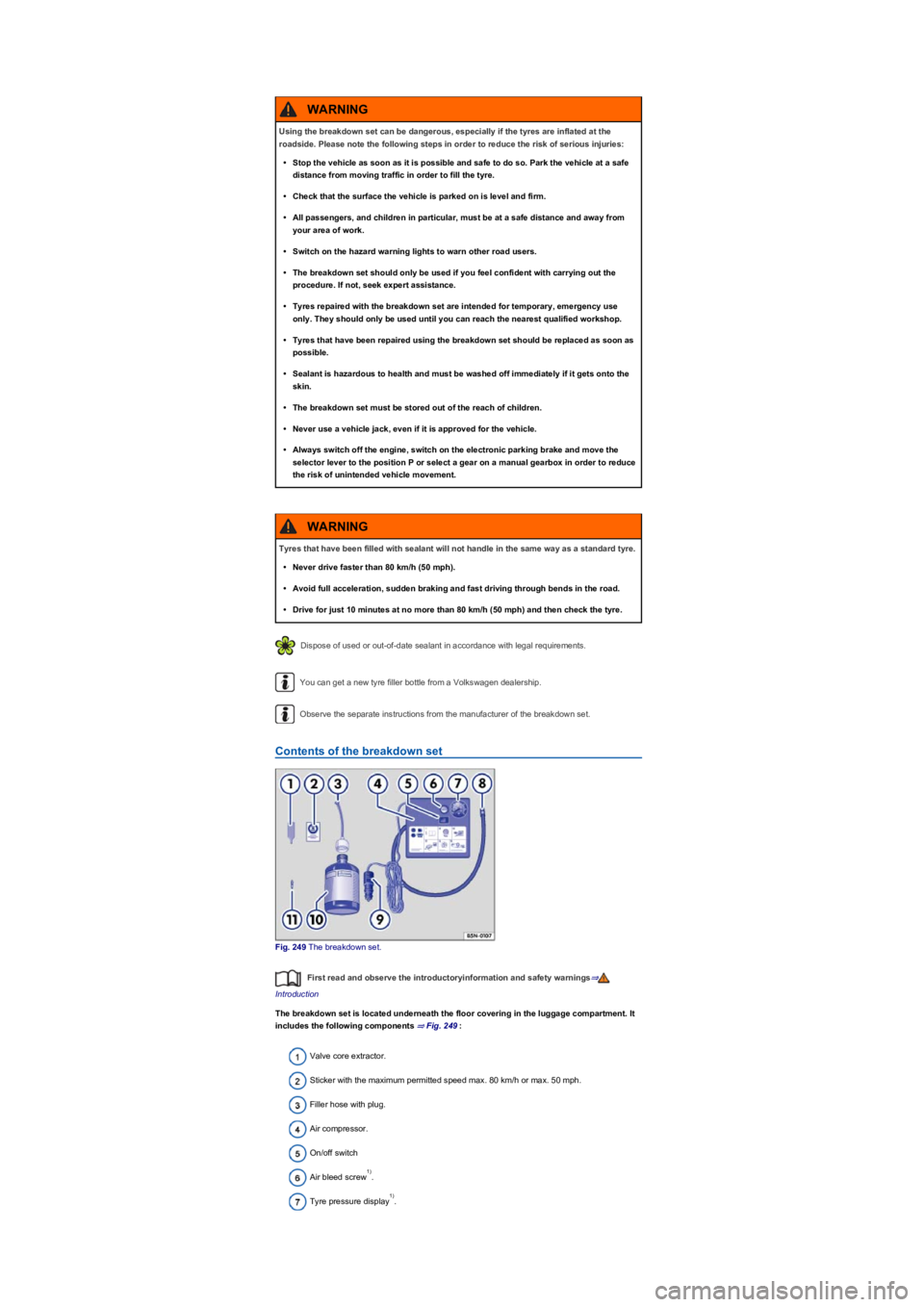
Fig. 249 The breakdown set.
First read and observe the introductoryinformation and safety warnings⇒
Introduction
The breakdown set is located underneath the floor covering in the luggage compartment. It
includes the following components ⇒ Fig. 249:
Valve core extractor.
Sticker with the maximum permitted speed max. 80 km/h or max. 50 mph.
Filler hose with plug.
Air compressor.
On/off switch
Air bleed screw.
Tyre pressure display.
Using the breakdown set can be dangerous, especially if the tyres are inflated at the
roadside. Please note the following steps in order to reduce the risk of serious injuries:
•Stop the vehicle as soon as it is possible and safe to do so. Park the vehicle at a safe
distance from moving traffic in order to fill the tyre.
•Check that the surface the vehicle is parked on is level and firm.
•All passengers, and children in particular, must be at a safe distance and away from
your area of work.
•Switch on the hazard warning lights to warn other road users.
•The breakdown set should only be used if you feel confident with carrying out the
procedure. If not, seek expert assistance.
•Tyres repaired with the breakdown set are intended for temporary, emergency use
only. They should only be used until you can reach the nearest qualified workshop.
•Tyres that have been repaired using the breakdown set should be replaced as soon as
possible.
•Sealant is hazardous to health and must be washed off immediately if it gets onto the
skin.
•The breakdown set must be stored out of the reach of children.
•Never use a vehicle jack, even if it is approved for the vehicle.
•Always switch off the engine, switch on the electronic parking brake and move the
selector lever to the position P or select a gear on a manual gearbox in order to reduce
the risk of unintended vehicle movement.
WARNING
Tyres that have been filled with sealant will not handle in the same way as a standard tyre.
•Never drive faster than 80 km/h (50 mph).
•Avoid full acceleration, sudden braking and fast driving through bends in the road.
•Drive for just 10 minutes at no more than 80 km/h (50 mph) and then check the tyre.
WARNING
1)
1)
Page 313 of 341
If you get a flat tyre, park your vehicle on a firm and level surface at a safe distance from
the flow of traffic.
Switch on the electronic parking brake Parking and manoeuvring.
With a DSG® dual clutch gearbox, move the selector lever to position P DSG® dual clutch
gearbox.
Stop the engine and remove the key from the ignition Starting and stopping the engine.
Manual gearbox: select a gear Manual gearbox: selecting a gear.
Ask all vehicle occupants to leave the vehicle and stand at a safe distance away from
moving traffic.
Switch on the hazard warning lights and position the warning triangle In an emergency.
Observe any legal requirements.
Check whether the puncture can be repaired with the breakdown set The tyre sealant must
not be used:.
When towing a trailer: unhitch the trailer from the vehicle and park it properly .
Remove any items of luggage from the luggage compartment.
Take the breakdown set out of the luggage compartment.
Take the sticker ② from the breakdown set and stick it on the dash panel within the
driver's field of vision.
Do not remove foreign objects (e.g. screws or nails) from the tyre.
Tyre filler hose.
12-volt plug.
Tyre filler bottle with sealant.
Spare valve core.
There is a slot on the lower end of the valve insert extractor① for the valve insert. This is
required for extracting and fitting the tyre valve. This also applies to the spare valve core ⑪.
Could also be integrated in the tyre filler hose.
Preparation
First read and observe the introductoryinformation and safety warnings⇒
Introduction
Checklist
Always carry out the following actions in the given order ⇒:
Sealing and inflating tyres
First read and observe the introductoryinformation and safety warnings⇒
Introduction
Sealing a tyre
•Unscrew the cap from the tyre valve.
•Use the valve core extractor ⇒ Fig. 249① to screw the valve core out of the tyre valve. Place
the core on a clean surface.
•Shake the tyre filler bottle ⇒ Fig. 249⑩ vigorously up and down several times.
•Screw the filler hose ⇒ Fig. 249③ tightly onto the tyre filler bottle in a clockwise direction. The
plastic foil on the plug is pierced automatically.
•Remove the plug from the filler hose ⇒ Fig. 249③ and place the open end fully on the tyre
valve.
•Hold the bottle upside down and inject the entire contents of the tyre filler bottle into the tyre.
•Remove the empty tyre filler bottle from the valve.
•Use the valve core extractor ⇒ Fig. 249① to screw the valve core back onto the tyre valve.
Inflating the tyre
•Screw the tyre filler hose ⇒ Fig. 249⑧ of the air compressor tightly onto the tyre valve.
•Check that the bleed screw ⇒ Fig. 249⑥ is closed.
•Start the engine and let it run.
1)
Ignoring any of the items on this important safety checklist can lead to accidents and
severe injuries.
•Always follow the instructions in the checklist and observe the general safety
procedures.
WARNING
Page 317 of 341
Scope of service
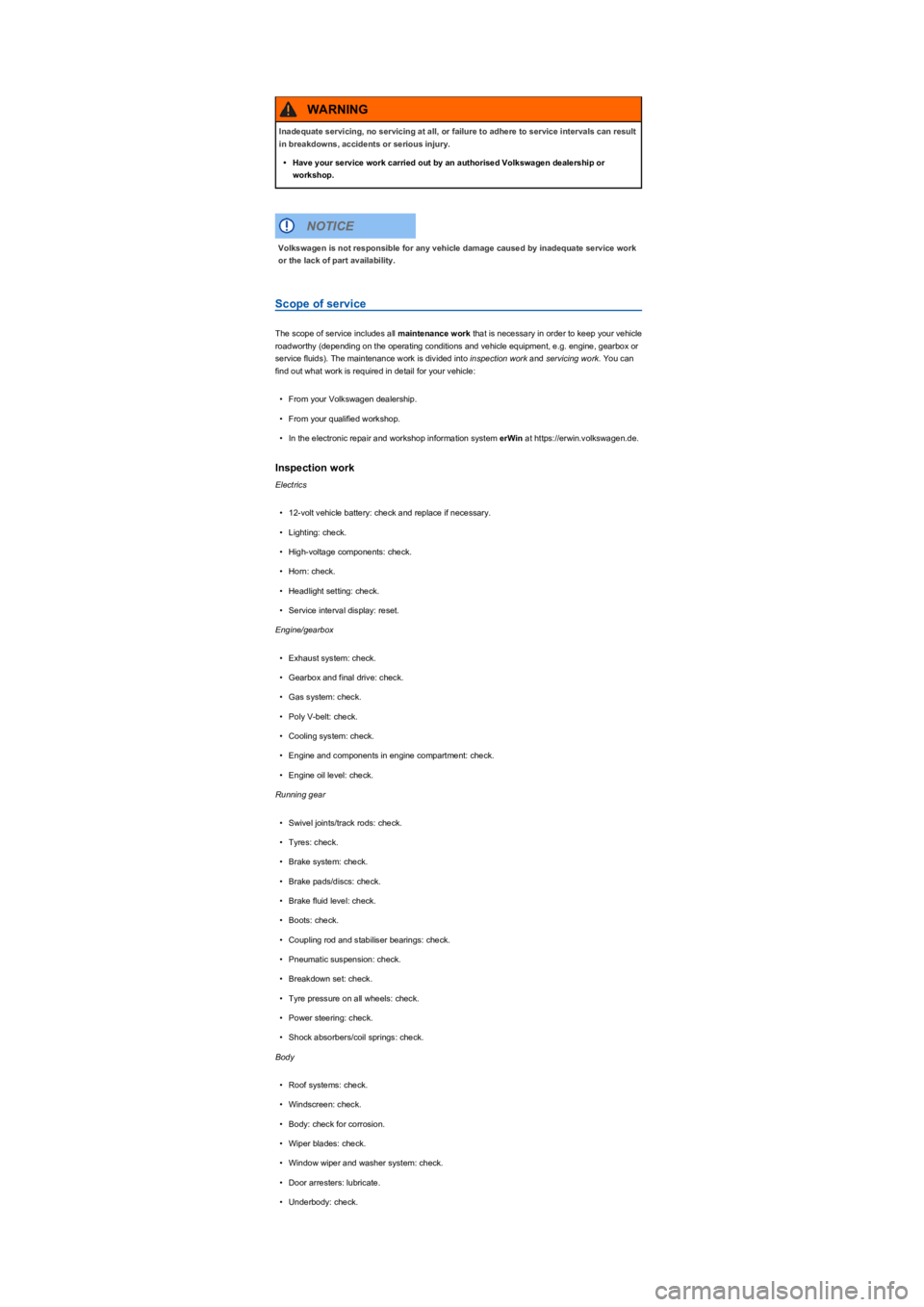
The scope of service includes all maintenance work that is necessary in order to keep your vehicle
roadworthy (depending on the operating conditions and vehicle equipment, e.g. engine, gearbox or
service fluids). The maintenance work is divided into inspection work and servicing work. You can
find out what work is required in detail for your vehicle:
•From your Volkswagen dealership.
•From your qualified workshop.
•In the electronic repair and workshop information system erWin at https://erwin.volkswagen.de.
Inspection work
Electrics
•12-volt vehicle battery: check and replace if necessary.
•Lighting: check.
•High-voltage components: check.
•Horn: check.
•Headlight setting: check.
•Service interval display: reset.
Engine/gearbox
•Exhaust system: check.
•Gearbox and final drive: check.
•Gas system: check.
•Poly V-belt: check.
•Cooling system: check.
•Engine and components in engine compartment: check.
•Engine oil level: check.
Running gear
•Swivel joints/track rods: check.
•Tyres: check.
•Brake system: check.
•Brake pads/discs: check.
•Brake fluid level: check.
•Boots: check.
•Coupling rod and stabiliser bearings: check.
•Pneumatic suspension: check.
•Breakdown set: check.
•Tyre pressure on all wheels: check.
•Power steering: check.
•Shock absorbers/coil springs: check.
Body
•Roof systems: check.
•Windscreen: check.
•Body: check for corrosion.
•Wiper blades: check.
•Window wiper and washer system: check.
•Door arresters: lubricate.
•Underbody: check.
Inadequate servicing, no servicing at all, or failure to adhere to service intervals can result
in breakdowns, accidents or serious injury.
•Have your service work carried out by an authorised Volkswagen dealership or
workshop.
WARNING
Volkswagen is not responsible for any vehicle damage caused by inadequate service work
or the lack of part availability.
NOTICE
Page 318 of 341
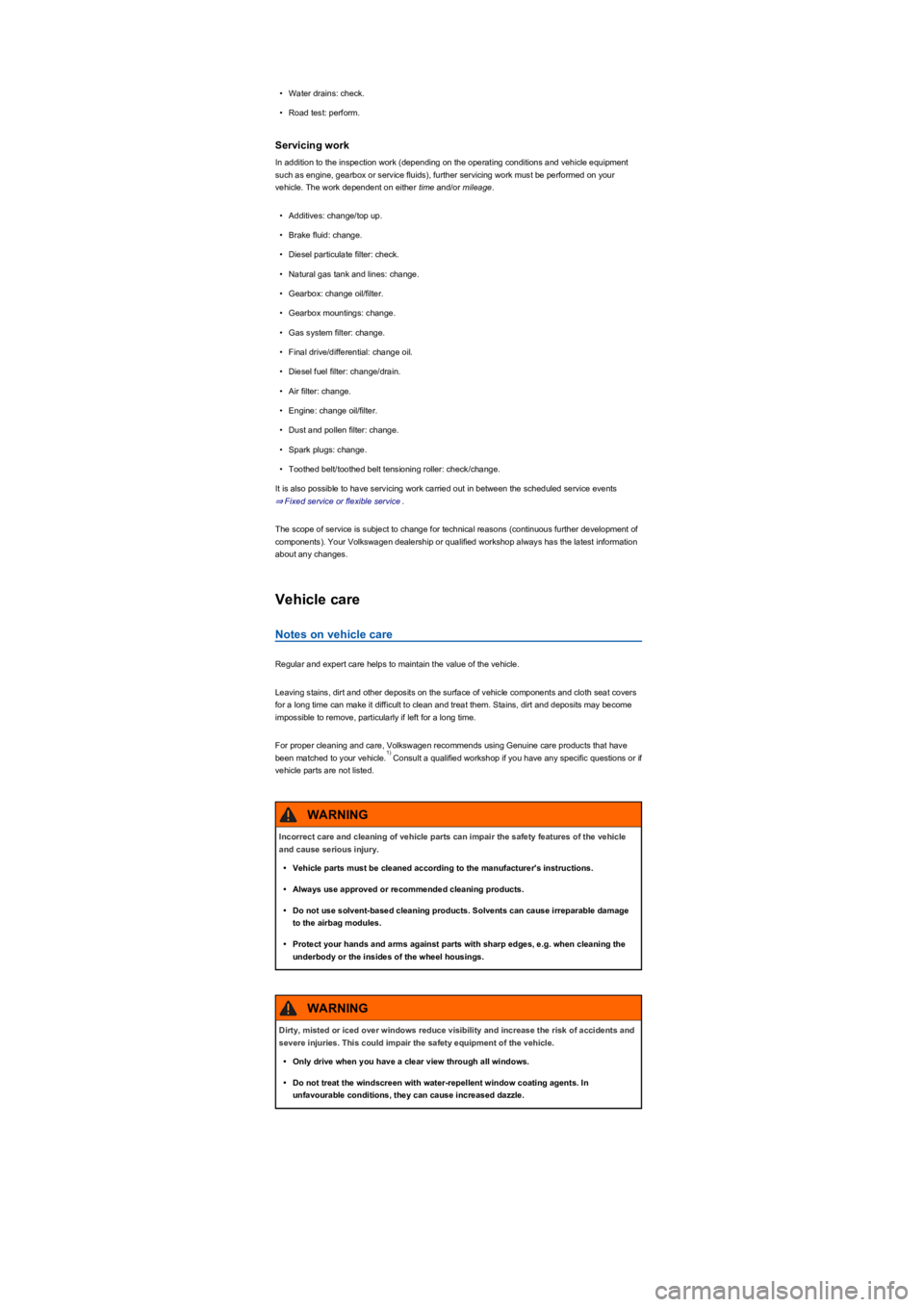
•Water drains: check.
•Road test: perform.
Servicing work
In addition to the inspection work (depending on the operating conditions and vehicle equipment
such as engine, gearbox or service fluids), further servicing work must be performed on your
vehicle. The work dependent on either time and/or mileage.
•Additives: change/top up.
•Brake fluid: change.
•Diesel particulate filter: check.
•Natural gas tank and lines: change.
•Gearbox: change oil/filter.
•Gearbox mountings: change.
•Gas system filter: change.
•Final drive/differential: change oil.
•Diesel fuel filter: change/drain.
•Air filter: change.
•Engine: change oil/filter.
•Dust and pollen filter: change.
•Spark plugs: change.
•Toothed belt/toothed belt tensioning roller: check/change.
It is also possible to have servicing work carried out in between the scheduled service events
⇒ Fixed service or flexible service.
The scope of service is subject to change for technical reasons (continuous further development of
components). Your Volkswagen dealership or qualified workshop always has the latest information
about any changes.
Vehicle care
Notes on vehicle care
Regular and expert care helps to maintain the value of the vehicle.
Leaving stains, dirt and other deposits on the surface of vehicle components and cloth seat covers
for a long time can make it difficult to clean and treat them. Stains, dirt and deposits may become
impossible to remove, particularly if left for a long time.
For proper cleaning and care, Volkswagen recommends using Genuine care products that have
been matched to your vehicle. Consult a qualified workshop if you have any specific questions or if
vehicle parts are not listed.
1)
Incorrect care and cleaning of vehicle parts can impair the safety features of the vehicle
and cause serious injury.
•Vehicle parts must be cleaned according to the manufacturer's instructions.
•Always use approved or recommended cleaning products.
•Do not use solvent-based cleaning products. Solvents can cause irreparable damage
to the airbag modules.
•Protect your hands and arms against parts with sharp edges, e.g. when cleaning the
underbody or the insides of the wheel housings.
WARNING
Dirty, misted or iced over windows reduce visibility and increase the risk of accidents and
severe injuries. This could impair the safety equipment of the vehicle.
•Only drive when you have a clear view through all windows.
•Do not treat the windscreen with water-repellent window coating agents. In
unfavourable conditions, they can cause increased dazzle.
WARNING
Page 334 of 341
When the performance figures were measured, the vehicle was not fitted with any equipment that
could reduce performance, e.g. a roof carrier or mud flaps.
Gross combination weight rating
The gross combination weight ratings listed are only applicable for altitudes up to 1,000 m above
sea level. The maximum weight of the car and trailer must be reduced by approximately 10% for
every further 1,000 m in altitude.
Explanation of tables
Gearbox abbreviations: MG = manual gearbox, DSG = dual clutch gearbox DSG. MG6 = 6-speed
manual gearbox.
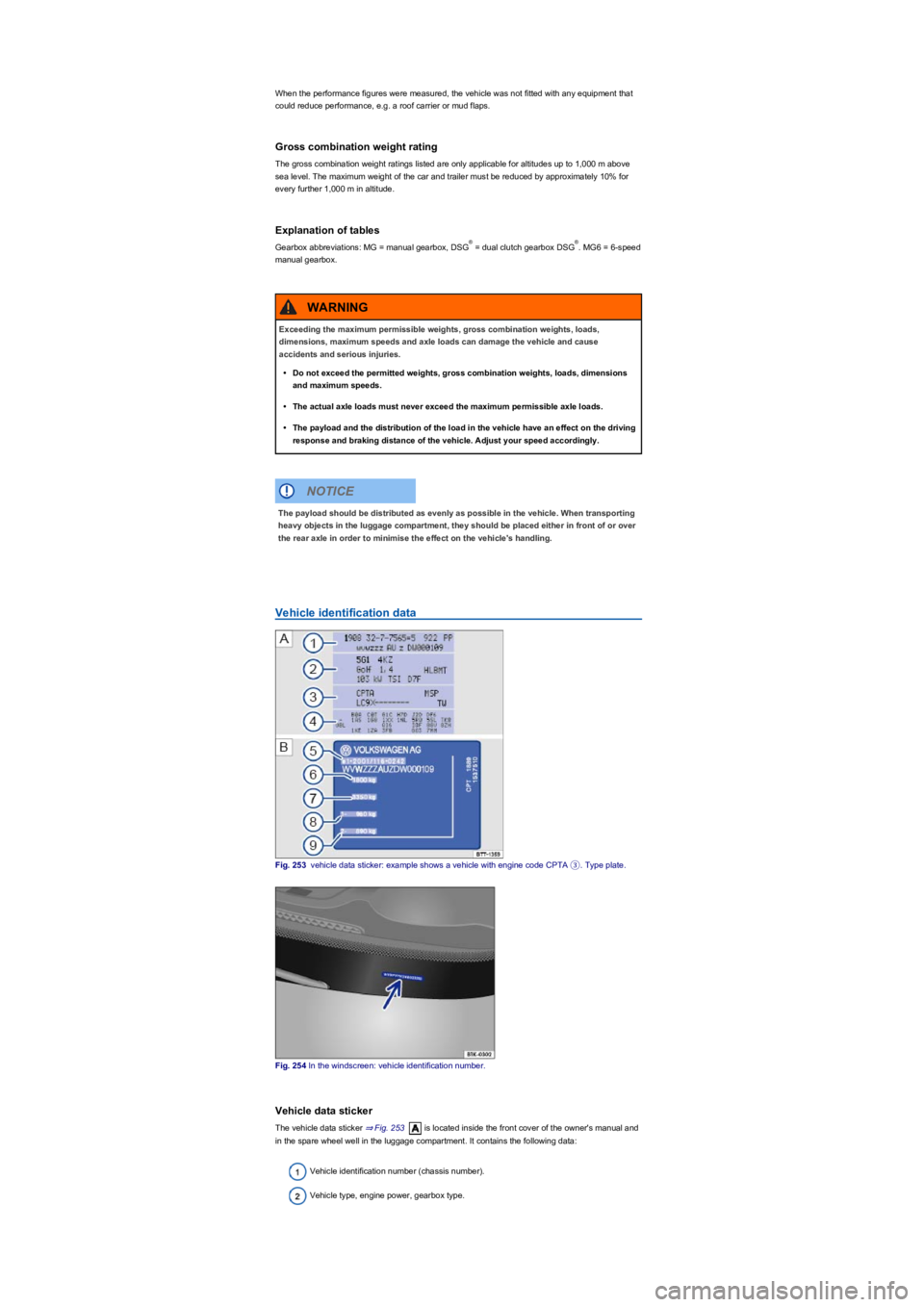
Vehicle identification data
Fig. 253 vehicle data sticker: example shows a vehicle with engine code CPTA ③. Type plate.
Fig. 254 In the windscreen: vehicle identification number.
Vehicle data sticker
The vehicle data sticker ⇒ Fig. 253 is located inside the front cover of the owner's manual and
in the spare wheel well in the luggage compartment. It contains the following data:
Vehicle identification number (chassis number).
Vehicle type, engine power, gearbox type.
®®
Exceeding the maximum permissible weights, gross combination weights, loads,
dimensions, maximum speeds and axle loads can damage the vehicle and cause
accidents and serious injuries.
•Do not exceed the permitted weights, gross combination weights, loads, dimensions
and maximum speeds.
•The actual axle loads must never exceed the maximum permissible axle loads.
•The payload and the distribution of the load in the vehicle have an effect on the driving
response and braking distance of the vehicle. Adjust your speed accordingly.
WARNING
The payload should be distributed as evenly as possible in the vehicle. When transporting
heavy objects in the luggage compartment, they should be placed either in front of or over
the rear axle in order to minimise the effect on the vehicle's handling.
NOTICE
Page 335 of 341
Engine and gearbox code, paint number, interior equipment. In the example, the engine
code is CPTA ⇒ Fig. 253.
Optional extras, PR numbers.
Type plate
The type plate ⇒ Fig. 253 can be seen on the lower part of the door pillar when the door is
open. Vehicles for certain export countries do not have a type plate.
The type plate contains the following data:
Permit
Gross vehicle weight rating
Gross combination weight rating (vehicle plus trailer ⇒ Trailer towing)
Gross axle weight rating, front
Gross axle weight rating, rear
Vehicle identification number
The vehicle identification number can be read from outside the vehicle through a viewer in the
windscreen ⇒ Fig. 254 (arrow). The viewer is located in the lower corner of the windscreen. The
vehicle identification number is also stamped on the right-hand water drainage channel. The water
drainage channel is located between the suspension turret and wing. Open the bonnet ⇒ In the
engine compartment to gain access to the vehicle identification number.
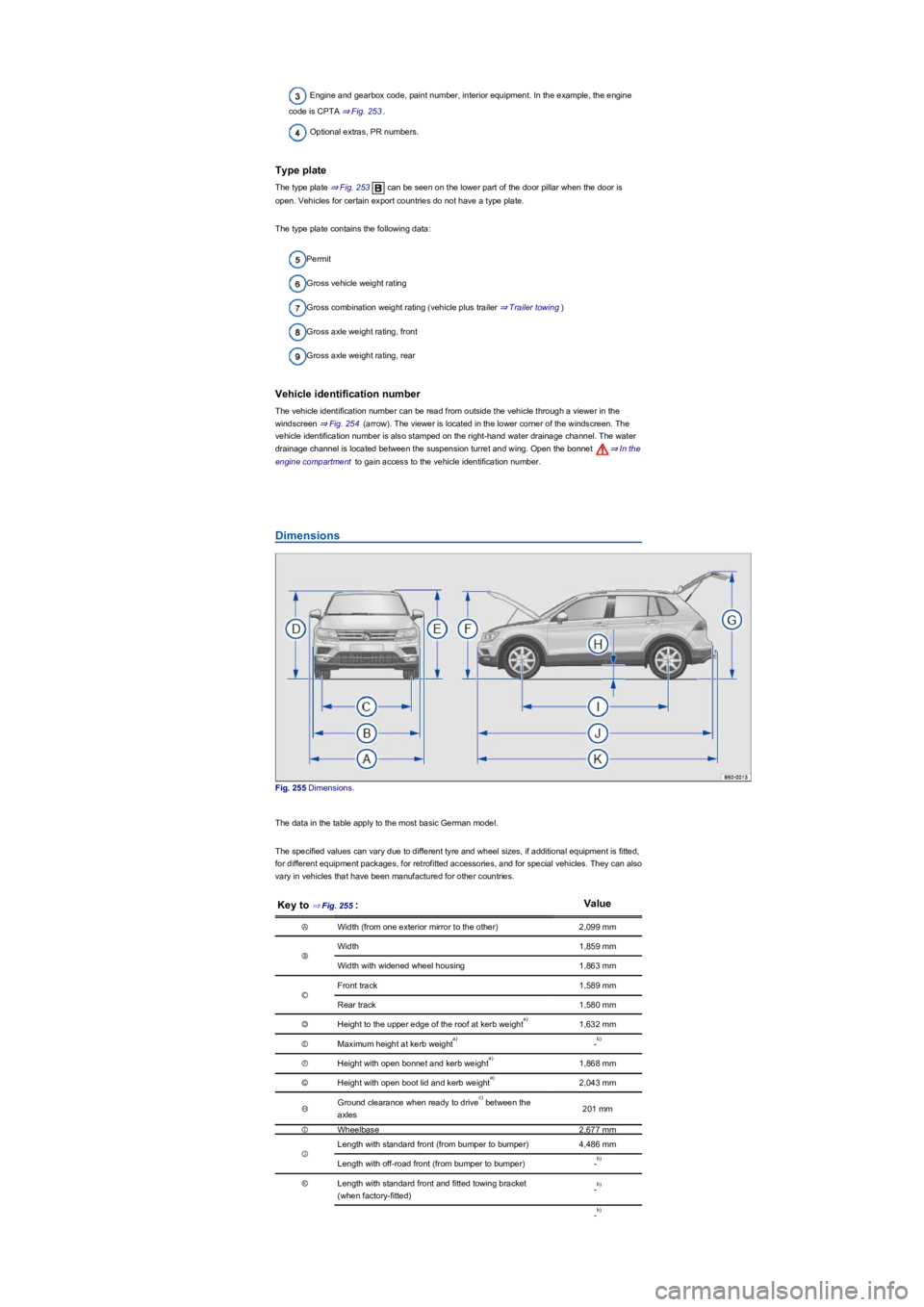
Dimensions
Fig. 255 Dimensions.
The data in the table apply to the most basic German model.
The specified values can vary due to different tyre and wheel sizes, if additional equipment is fitted,
for different equipment packages, for retrofitted accessories, and for special vehicles. They can also
vary in vehicles that have been manufactured for other countries.
Key to ⇒ Fig. 255:Value
ⒶWidth (from one exterior mirror to the other)2,099 mm
Ⓑ
Width1,859 mm
Width with widened wheel housing1,863 mm
Ⓒ
Front track1,589 mm
Rear track1,580 mm
ⒹHeight to the upper edge of the roof at kerb weight1,632 mm
ⒺMaximum height at kerb weight-
ⒻHeight with open bonnet and kerb weight1,868 mm
ⒼHeight with open boot lid and kerb weight2,043 mm
ⒽGround clearance when ready to drive between the
axles201 mm
ⒾWheelbase2,677 mm
Ⓙ
Length with standard front (from bumper to bumper)4,486 mm
Length with off-road front (from bumper to bumper)-
ⓀLength with standard front and fitted towing bracket
(when factory-fitted)-
-
a)
a)b)
a)
a)
c)
b)
b)
b)
Page 336 of 341
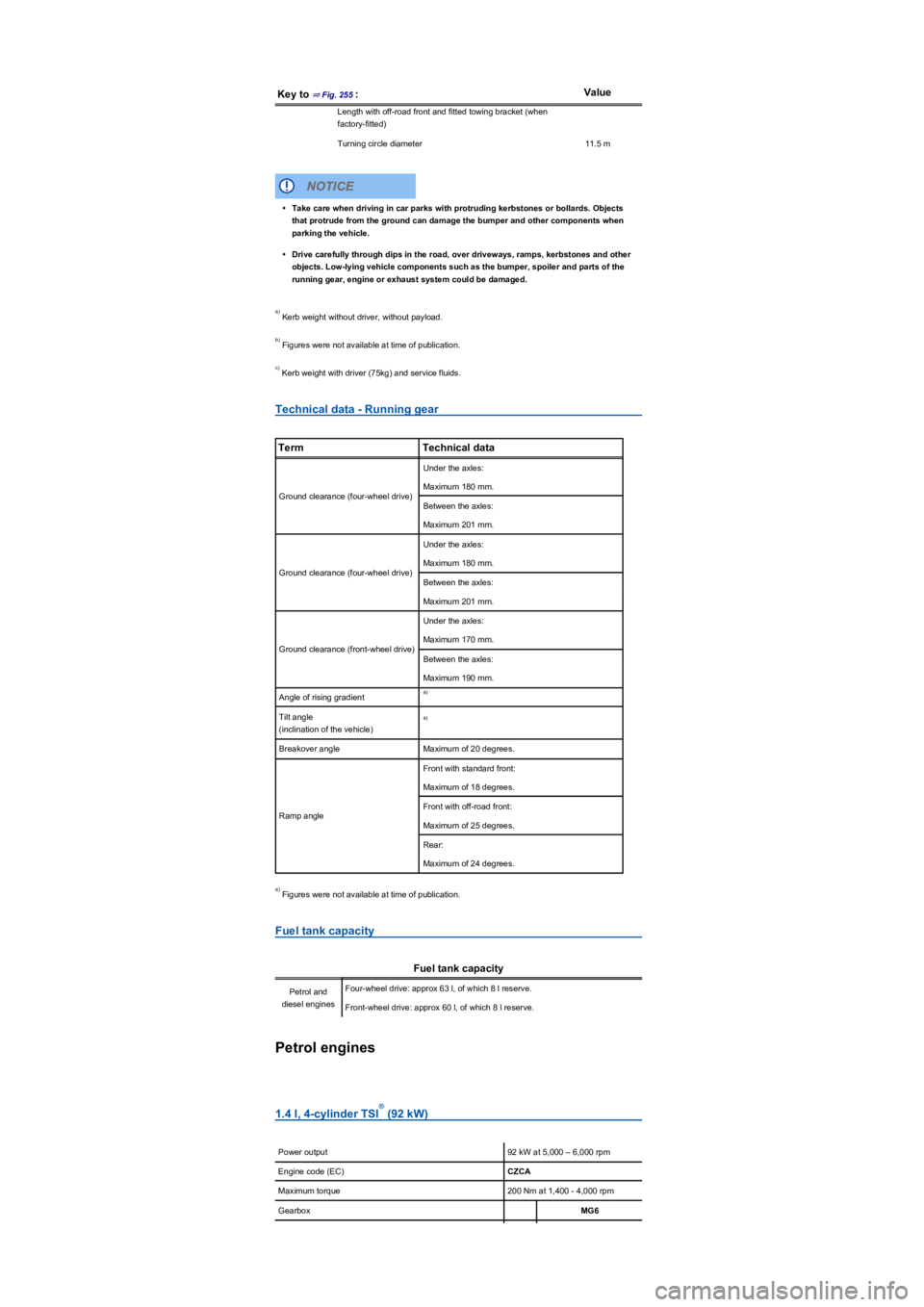
Key to ⇒ Fig. 255:Value
Length with off-road front and fitted towing bracket (when
factory-fitted)
Turning circle diameter11.5 m
Kerb weight without driver, without payload.
Figures were not available at time of publication.
Kerb weight with driver (75kg) and service fluids.
Technical data - Running gear
TermTechnical data
Ground clearance (four-wheel drive)
Under the axles:
Maximum 180 mm.
Between the axles:
Maximum 201 mm.
Ground clearance (four-wheel drive)
Under the axles:
Maximum 180 mm.
Between the axles:
Maximum 201 mm.
Ground clearance (front-wheel drive)
Under the axles:
Maximum 170 mm.
Between the axles:
Maximum 190 mm.
Angle of rising gradient
Tilt angle
(inclination of the vehicle)
Breakover angleMaximum of 20 degrees.
Ramp angle
Front with standard front:
Maximum of 18 degrees.
Front with off-road front:
Maximum of 25 degrees.
Rear:
Maximum of 24 degrees.
Figures were not available at time of publication.
Fuel tank capacity
Fuel tank capacity
Petrol and
diesel engines
Four-wheel drive: approx 63 l, of which 8 l reserve.
Front-wheel drive: approx 60 l, of which 8 l reserve.
Petrol engines
1.4 l, 4-cylinder TSI (92 kW)
Power output92 kW at 5,000 – 6,000 rpm
Engine code (EC)CZCA
Maximum torque200 Nm at 1,400 - 4,000 rpm
GearboxMG6
•Take care when driving in car parks with protruding kerbstones or bollards. Objects
that protrude from the ground can damage the bumper and other components when
parking the vehicle.
•Drive carefully through dips in the road, over driveways, ramps, kerbstones and other
objects. Low-lying vehicle components such as the bumper, spoiler and parts of the
running gear, engine or exhaust system could be damaged.
NOTICE
a)
b)
c)
a)
a)
a)
®
Page 337 of 341
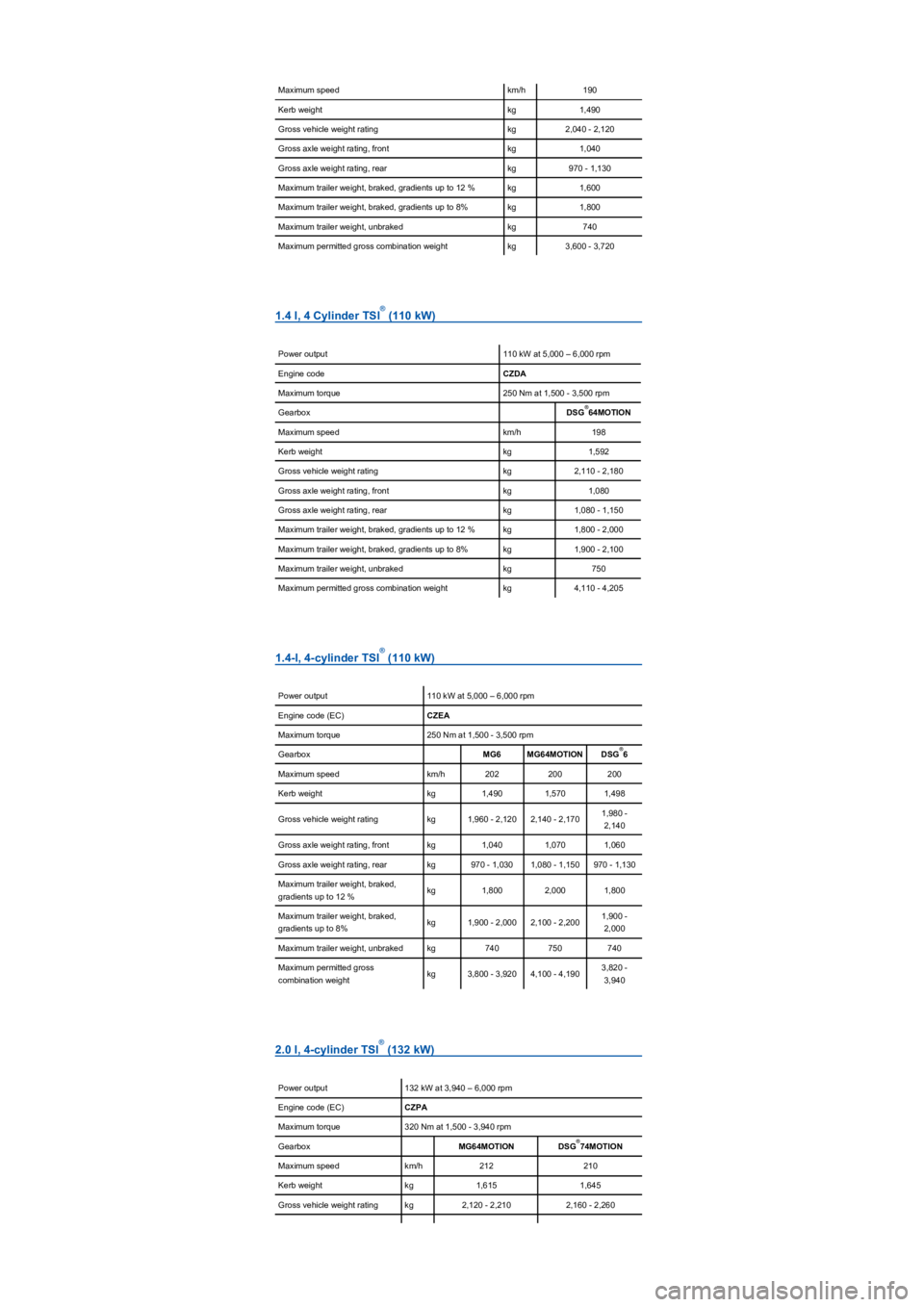
Maximum speedkm/h190
Kerb weightkg1,490
Gross vehicle weight ratingkg2,040 - 2,120
Gross axle weight rating, frontkg1,040
Gross axle weight rating, rearkg970 - 1,130
Maximum trailer weight, braked, gradients up to 12 %kg1,600
Maximum trailer weight, braked, gradients up to 8%kg1,800
Maximum trailer weight, unbrakedkg740
Maximum permitted gross combination weightkg3,600 - 3,720
1.4 l, 4 Cylinder TSI (110 kW)
Power output110 kW at 5,000 – 6,000 rpm
Engine codeCZDA
Maximum torque250 Nm at 1,500 - 3,500 rpm
GearboxDSG64MOTION
Maximum speedkm/h198
Kerb weightkg1,592
Gross vehicle weight ratingkg2,110 - 2,180
Gross axle weight rating, frontkg1,080
Gross axle weight rating, rearkg1,080 - 1,150
Maximum trailer weight, braked, gradients up to 12 %kg1,800 - 2,000
Maximum trailer weight, braked, gradients up to 8%kg1,900 - 2,100
Maximum trailer weight, unbrakedkg750
Maximum permitted gross combination weightkg4,110 - 4,205
1.4-l, 4-cylinder TSI (110 kW)
Power output110 kW at 5,000 – 6,000 rpm
Engine code (EC)CZEA
Maximum torque250 Nm at 1,500 - 3,500 rpm
GearboxMG6MG64MOTIONDSG6
Maximum speedkm/h202200200
Kerb weightkg1,4901,5701,498
Gross vehicle weight ratingkg1,960 - 2,1202,140 - 2,1701,980 -
2,140
Gross axle weight rating, frontkg1,0401,0701,060
Gross axle weight rating, rearkg970 - 1,0301,080 - 1,150970 - 1,130
Maximum trailer weight, braked,
gradients up to 12 %kg1,8002,0001,800
Maximum trailer weight, braked,
gradients up to 8%kg1,900 - 2,0002,100 - 2,2001,900 -
2,000
Maximum trailer weight, unbrakedkg740750740
Maximum permitted gross
combination weightkg3,800 - 3,9204,100 - 4,1903,820 -
3,940
2.0 l, 4-cylinder TSI (132 kW)
Power output132 kW at 3,940 – 6,000 rpm
Engine code (EC)CZPA
Maximum torque320 Nm at 1,500 - 3,940 rpm
GearboxMG64MOTIONDSG74MOTION
Maximum speedkm/h212210
Kerb weightkg1,6151,645
Gross vehicle weight ratingkg2,120 - 2,2102,160 - 2,260
®
®
®
®
®
®