ECU VOLKSWAGEN TIGUAN 2017 Owner´s Manual
[x] Cancel search | Manufacturer: VOLKSWAGEN, Model Year: 2017, Model line: TIGUAN, Model: VOLKSWAGEN TIGUAN 2017Pages: 341, PDF Size: 9.14 MB
Page 280 of 341
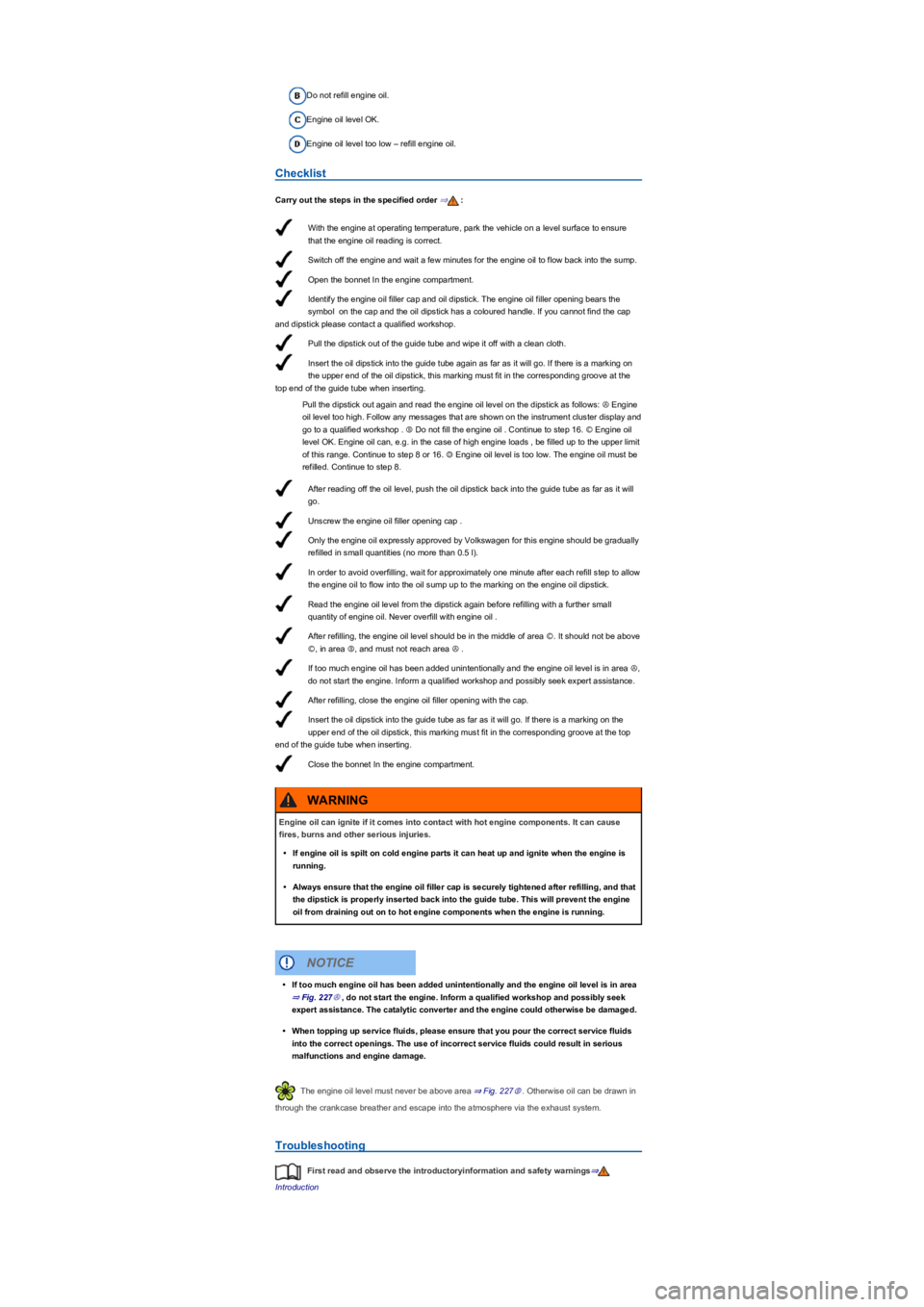
With the engine at operating temperature, park the vehicle on a level surface to ensure
that the engine oil reading is correct.
Switch off the engine and wait a few minutes for the engine oil to flow back into the sump.
Open the bonnet In the engine compartment.
Identify the engine oil filler cap and oil dipstick. The engine oil filler opening bears the
symbol on the cap and the oil dipstick has a coloured handle. If you cannot find the cap
and dipstick please contact a qualified workshop.
Pull the dipstick out of the guide tube and wipe it off with a clean cloth.
Insert the oil dipstick into the guide tube again as far as it will go. If there is a marking on
the upper end of the oil dipstick, this marking must fit in the corresponding groove at the
top end of the guide tube when inserting.
After reading off the oil level, push the oil dipstick back into the guide tube as far as it will
go.
Unscrew the engine oil filler opening cap .
Only the engine oil expressly approved by Volkswagen for this engine should be gradually
refilled in small quantities (no more than 0.5 l).
In order to avoid overfilling, wait for approximately one minute after each refill step to allow
the engine oil to flow into the oil sump up to the marking on the engine oil dipstick.
Read the engine oil level from the dipstick again before refilling with a further small
quantity of engine oil. Never overfill with engine oil .
After refilling, the engine oil level should be in the middle of area Ⓒ. It should not be above
Ⓒ, in area Ⓑ, and must not reach area Ⓐ .
If too much engine oil has been added unintentionally and the engine oil level is in area Ⓐ,
do not start the engine. Inform a qualified workshop and possibly seek expert assistance.
After refilling, close the engine oil filler opening with the cap.
Insert the oil dipstick into the guide tube as far as it will go. If there is a marking on the
upper end of the oil dipstick, this marking must fit in the corresponding groove at the top
end of the guide tube when inserting.
Close the bonnet In the engine compartment.
Do not refill engine oil.
Engine oil level OK.
Engine oil level too low – refill engine oil.
Checklist
Carry out the steps in the specified order ⇒:
Pull the dipstick out again and read the engine oil level on the dipstick as follows: Ⓐ Engine
oil level too high. Follow any messages that are shown on the instrument cluster display and
go to a qualified workshop . Ⓑ Do not fill the engine oil . Continue to step 16. Ⓒ Engine oil
level OK. Engine oil can, e.g. in the case of high engine loads , be filled up to the upper limit
of this range. Continue to step 8 or 16. Ⓓ Engine oil level is too low. The engine oil must be
refilled. Continue to step 8.
The engine oil level must never be above area ⇒ Fig. 227Ⓑ. Otherwise oil can be drawn in
through the crankcase breather and escape into the atmosphere via the exhaust system.
Troubleshooting
First read and observe the introductoryinformation and safety warnings⇒
Introduction
Engine oil can ignite if it comes into contact with hot engine components. It can cause
fires, burns and other serious injuries.
•If engine oil is spilt on cold engine parts it can heat up and ignite when the engine is
running.
•Always ensure that the engine oil filler cap is securely tightened after refilling, and that
the dipstick is properly inserted back into the guide tube. This will prevent the engine
oil from draining out on to hot engine components when the engine is running.
WARNING
•If too much engine oil has been added unintentionally and the engine oil level is in area
⇒ Fig. 227Ⓐ, do not start the engine. Inform a qualified workshop and possibly seek
expert assistance. The catalytic converter and the engine could otherwise be damaged.
•When topping up service fluids, please ensure that you pour the correct service fluids
into the correct openings. The use of incorrect service fluids could result in serious
malfunctions and engine damage.
NOTICE
Page 289 of 341
Dispose of the 12-volt vehicle battery in accordance with the regulations. 12-volt vehicle
batteries may contain toxic substances such as sulphuric acid and lead.
Electrolyte can pollute the environment. Clean up any service fluid leakages and dispose of
them properly.
Troubleshooting
First read and observe the introductoryinformation and safety warnings⇒
Introduction
12-volt vehicle battery
Fault in the alternator. Go to a qualified workshop. Have the electrical system checked. Switch
off any electrical consumers that are not required. The 12-volt vehicle battery will not be charged by
the alternator while the vehicle is in motion. The start/stop system cannot start the engine.
⇒ Start/stop system
Wheels and tyres
Tyre monitoring systems
Introduction
This chapter contains information on the followingsubjects:
⇒ Types of tyre monitoring systems
⇒ Tyre Pressure Loss Indicator
⇒ Tyre Pressure Monitoring System
⇒ Troubleshooting for the Tyre Pressure Loss Indicator
⇒ Troubleshooting for the Tyre Pressure Monitoring System
The tyre monitoring system warns the
driver when the tyre pressures get too
low.
Incorrectly securing the battery and using incorrect 12-volt vehicle batteries can cause
short circuits, fire and serious injuries.
•Always use maintenance-free and leak-proof 12-volt vehicle batteries that have the
same properties, specifications and dimensions as the factory-fitted 12-volt vehicle
battery.
•In vehicles with the 12-volt vehicle battery in the luggage compartment, ensure that the
breather hose is connected properly to the 12-volt vehicle battery. Make sure that no
open gas discharge openings are located in the area around the positive battery
terminal. If there is an open breather opening in this area, it must be closed off with a
sealing plug. The breather hose must be connected to the open breather opening in the
area of the negative terminal.
WARNING
A highly explosive mixture of gases is given off when the 12-volt vehicle battery is being
charged.
•12-volt vehicle batteries should only be charged in well-ventilated spaces.
•Never charge a 12-volt vehicle battery that is frozen or that has thawed. Discharged 12-
volt vehicle batteries can already freeze at temperatures of around 0°C (+32°F).
•The 12-volt vehicle battery must be replaced if it has ever been frozen.
•Incorrectly connected cables can cause a short circuit. First connect the positive cable
and then the negative cable.
WARNING
•Never connect or disconnect 12-volt vehicle batteries if the ignition is switched on or
the engine is running. Never use a 12-volt vehicle battery that does not correspond with
the vehicle's specifications. This can damage the electrical system or electronic
components, which can cause electrical faults.
•Never connect equipment that supplies electric power, such as solar panels or a
battery charger, to the 12-volt socket or to the cigarette lighter to charge the 12-volt
vehicle battery. This can damage the vehicle electrical system.
NOTICE
Page 292 of 341
There may be differences between readings on the pressure gauge when filling the tyres and the
values determined by the Tyre Pressure Monitoring System. The Tyre Pressure Monitoring System
is more precise.
Selecting target pressures for partial or full vehicle load
The driver must select the appropriate target pressure depending on the vehicle load level.
•Switch on the ignition.
•Press the button or function button, depending on version ⇒ Vehicle settings menu.
•Touch the Vehicle status function button.
•Touch the Settings function button.
•Select the Tyres menu option.
•Select the load level.
Selecting the tyre type
While the dimensions of the tyres are changed, it may be necessary to adjust the target pressure
for the new tyres. If no adjustment is necessary, the selection menu will not be available.
•Switch on the ignition.
•Press the button or function button, depending on version ⇒ Vehicle settings menu.
•Touch the Vehicle status function button.
•Touch the Settings function button.
•Select the Tyres menu option.
•Select the appropriate tyre size.
If the tyre sizes are fitted that do not correspond to the factory-specified sizes, the corresponding
target tyre pressures can be entered by a Volkswagen dealer.
Spare wheel or temporary spare wheel
The tyre pressure of the spare wheel or the temporary spare wheel in the luggage compartment is
not monitored.
Depends on the vehicle.
Troubleshooting for the Tyre Pressure Loss Indicator
First read and observe the introductoryinformation and safety warnings⇒
Introduction
Lit up
•Do not drive on!
•Check and adjust all tyre pressures ⇒ Tyre pressure.
•The damaged tyre should be replaced.
•Re-synchronise the Tyre Pressure Loss Indicator ⇒ Tyre Pressure Loss Indicator.
•If the problem persists, seek expert assistance.
Flashes
•Do not drive on!
•Switch the ignition off and then back on again.
•Re-synchronise the Tyre Pressure Loss Indicator ⇒ Tyre Pressure Loss Indicator.
•If the problem persists, seek expert assistance.
•The pressure sensors are secured to special aluminium valves that are screwed rigidly
in place. When inflating the tyres and checking the pressure, do not bend the valves
into position.
•Missing valve caps could lead to damage to the valve and the sensors. Always make
sure that all valve caps are fully screwed on. Do not use metal valve caps.
•Do not use convenience valve caps as they do not form a proper seal. This can cause
damage to the sensors.
NOTICE
1)
Page 300 of 341
Tyre damage
First read and observe the introductoryinformation and safety warnings⇒
Introduction
Damage to tyres and wheel rims is often hidden ⇒.
•If you suspect that a wheel is damaged, stop the vehicle as soon as it is safe to do so.
•Check the tyres and rims for damage.
•If a tyre is damaged, do not drive on. Seek expert assistance.
•If there is no visible damage, drive slowly and cautiously to the next qualified workshop in order
to have the vehicle checked.
Foreign bodies in the tyre
•Leave the foreign body in the tyre if it has entered the inner tyre. Foreign bodies that are stuck
between the tyre tread blocks can be removed.
•Replace the damaged wheel ⇒ Changing a wheel or seal the tyre with the breakdown set and
inflate it ⇒ Breakdown set. Seek professional assistance for this if necessary.
•Check and adjust the tyre pressure.
•Go to a qualified workshop. Volkswagen recommends using a Volkswagen dealership for this
purpose.
Tyre wear
Fast cornering, heavy acceleration and hard braking all increase tyre wear.
Wheel imbalance may develop when the vehicle is driven; you will notice this by nervous steering
response. Unbalanced wheels will affect the level of tyre wear. In this case the wheels should be
balanced again.
Incorrect wheel alignment causes excessive tyre wear, impairing the safety of the vehicle. The
wheel alignment should be checked by a qualified workshop if tyres show excessive wear.
Spare wheel or temporary spare wheel
Fig. 239 In the luggage compartment: handwheel for securing the spare wheel.
First read and observe the introductoryinformation and safety warnings⇒
Introduction
Worn tyres are a safety risk and can lead to a loss of control of the vehicle and cause
serious injury.
•Tyres must be replaced at the latest when the tread is worn down to the tread wear
indicators.
•Worn tyres have considerably less grip, particularly on wet roads, which can cause the
vehicle to glide along the road surface (aquaplaning).
•Worn tyres reduce the possibility of controlling the vehicle well in normal and difficult
driving situations and increase braking distance and the risk of skidding.
WARNING
If you notice unusual vibration or the car pulling to one side while the vehicle is in motion,
this may indicate that one of the tyres is damaged.
•Reduce speed immediately and park the vehicle without obstructing traffic.
•Check the tyres and rims for damage.
•Never drive on if wheels or tyres are damaged. Seek expert assistance instead.
•If there is no visible damage, drive slowly and cautiously to the next qualified
workshop in order to have the vehicle checked.
WARNING
Page 301 of 341
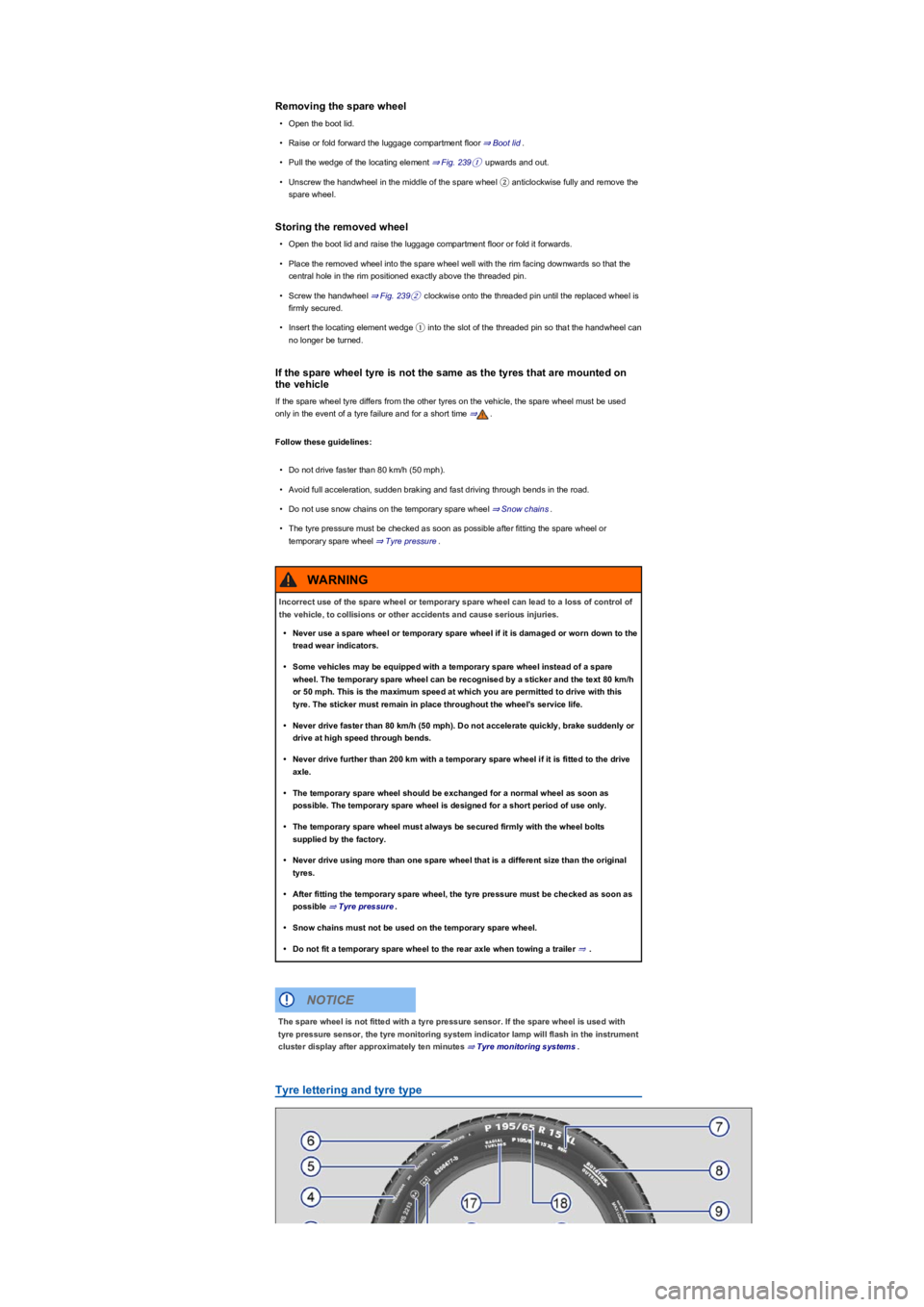
Removing the spare wheel
•Open the boot lid.
•Raise or fold forward the luggage compartment floor ⇒ Boot lid.
•Pull the wedge of the locating element ⇒ Fig. 239① upwards and out.
•Unscrew the handwheel in the middle of the spare wheel ② anticlockwise fully and remove the
spare wheel.
Storing the removed wheel
•Open the boot lid and raise the luggage compartment floor or fold it forwards.
•Place the removed wheel into the spare wheel well with the rim facing downwards so that the
central hole in the rim positioned exactly above the threaded pin.
•Screw the handwheel ⇒ Fig. 239② clockwise onto the threaded pin until the replaced wheel is
firmly secured.
•Insert the locating element wedge ① into the slot of the threaded pin so that the handwheel can
no longer be turned.
If the spare wheel tyre is not the same as the tyres that are mounted on
the vehicle
If the spare wheel tyre differs from the other tyres on the vehicle, the spare wheel must be used
only in the event of a tyre failure and for a short time ⇒.
Follow these guidelines:
•Do not drive faster than 80 km/h (50 mph).
•Avoid full acceleration, sudden braking and fast driving through bends in the road.
•Do not use snow chains on the temporary spare wheel ⇒ Snow chains.
•The tyre pressure must be checked as soon as possible after fitting the spare wheel or
temporary spare wheel ⇒ Tyre pressure.
Tyre lettering and tyre type
Incorrect use of the spare wheel or temporary spare wheel can lead to a loss of control of
the vehicle, to collisions or other accidents and cause serious injuries.
•Never use a spare wheel or temporary spare wheel if it is damaged or worn down to the
tread wear indicators.
•Some vehicles may be equipped with a temporary spare wheel instead of a spare
wheel. The temporary spare wheel can be recognised by a sticker and the text 80 km/h
or 50 mph. This is the maximum speed at which you are permitted to drive with this
tyre. The sticker must remain in place throughout the wheel's service life.
•Never drive faster than 80 km/h (50 mph). Do not accelerate quickly, brake suddenly or
drive at high speed through bends.
•Never drive further than 200 km with a temporary spare wheel if it is fitted to the drive
axle.
•The temporary spare wheel should be exchanged for a normal wheel as soon as
possible. The temporary spare wheel is designed for a short period of use only.
•The temporary spare wheel must always be secured firmly with the wheel bolts
supplied by the factory.
•Never drive using more than one spare wheel that is a different size than the original
tyres.
•After fitting the temporary spare wheel, the tyre pressure must be checked as soon as
possible ⇒ Tyre pressure.
•Snow chains must not be used on the temporary spare wheel.
•Do not fit a temporary spare wheel to the rear axle when towing a trailer ⇒.
WARNING
The spare wheel is not fitted with a tyre pressure sensor. If the spare wheel is used with
tyre pressure sensor, the tyre monitoring system indicator lamp will flash in the instrument
cluster display after approximately ten minutes ⇒ Tyre monitoring systems.
NOTICE
Page 306 of 341
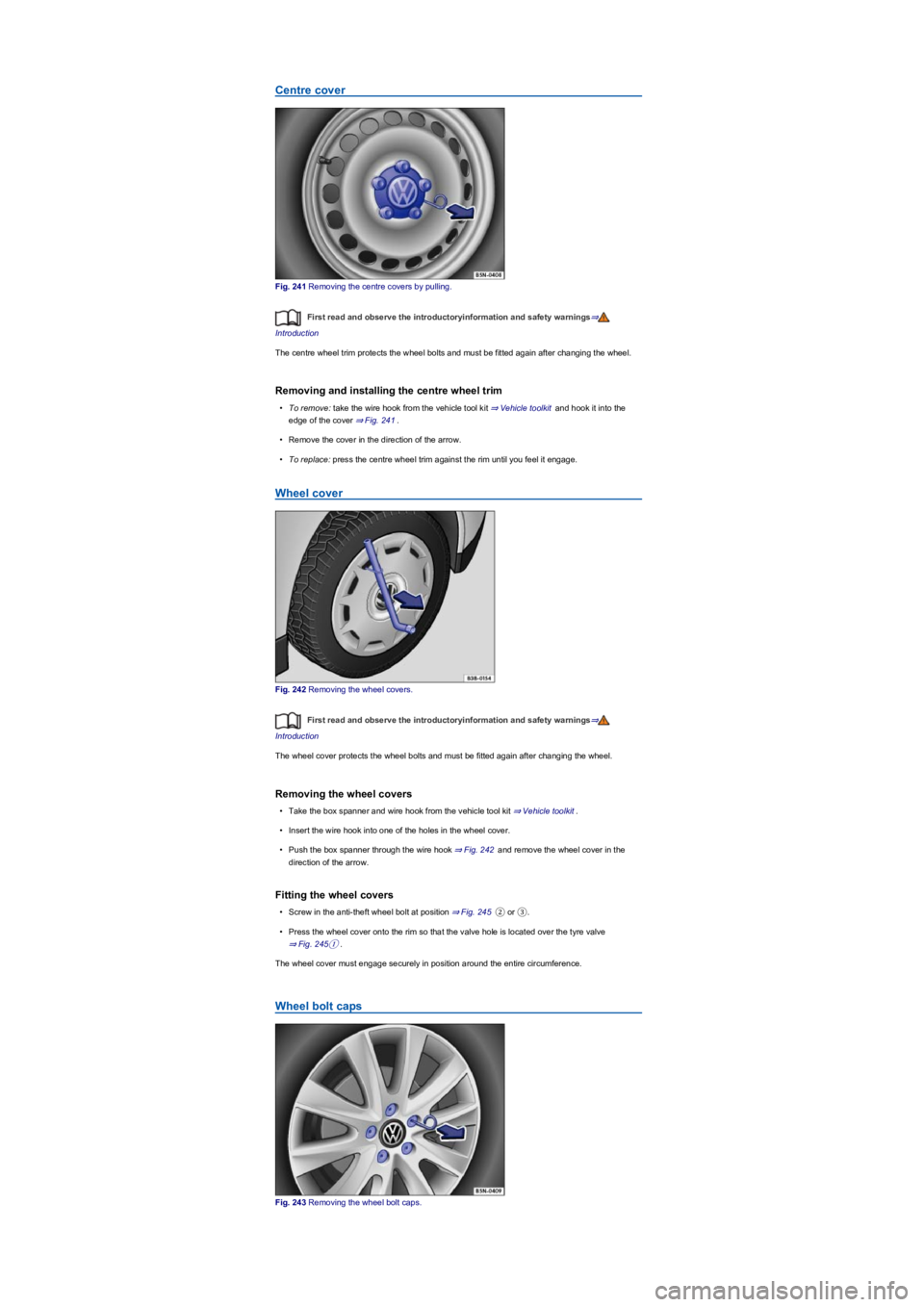
Centre cover
Fig. 241 Removing the centre covers by pulling.
First read and observe the introductoryinformation and safety warnings⇒
Introduction
The centre wheel trim protects the wheel bolts and must be fitted again after changing the wheel.
Removing and installing the centre wheel trim
•To remove: take the wire hook from the vehicle tool kit ⇒ Vehicle toolkit and hook it into the
edge of the cover ⇒ Fig. 241.
•Remove the cover in the direction of the arrow.
•To replace: press the centre wheel trim against the rim until you feel it engage.
Wheel cover
Fig. 242 Removing the wheel covers.
First read and observe the introductoryinformation and safety warnings⇒
Introduction
The wheel cover protects the wheel bolts and must be fitted again after changing the wheel.
Removing the wheel covers
•Take the box spanner and wire hook from the vehicle tool kit ⇒ Vehicle toolkit.
•Insert the wire hook into one of the holes in the wheel cover.
•Push the box spanner through the wire hook ⇒ Fig. 242 and remove the wheel cover in the
direction of the arrow.
Fitting the wheel covers
•Screw in the anti-theft wheel bolt at position ⇒ Fig. 245② or ③.
•Press the wheel cover onto the rim so that the valve hole is located over the tyre valve
⇒ Fig. 245①.
The wheel cover must engage securely in position around the entire circumference.
Wheel bolt caps
Fig. 243 Removing the wheel bolt caps.
Page 309 of 341
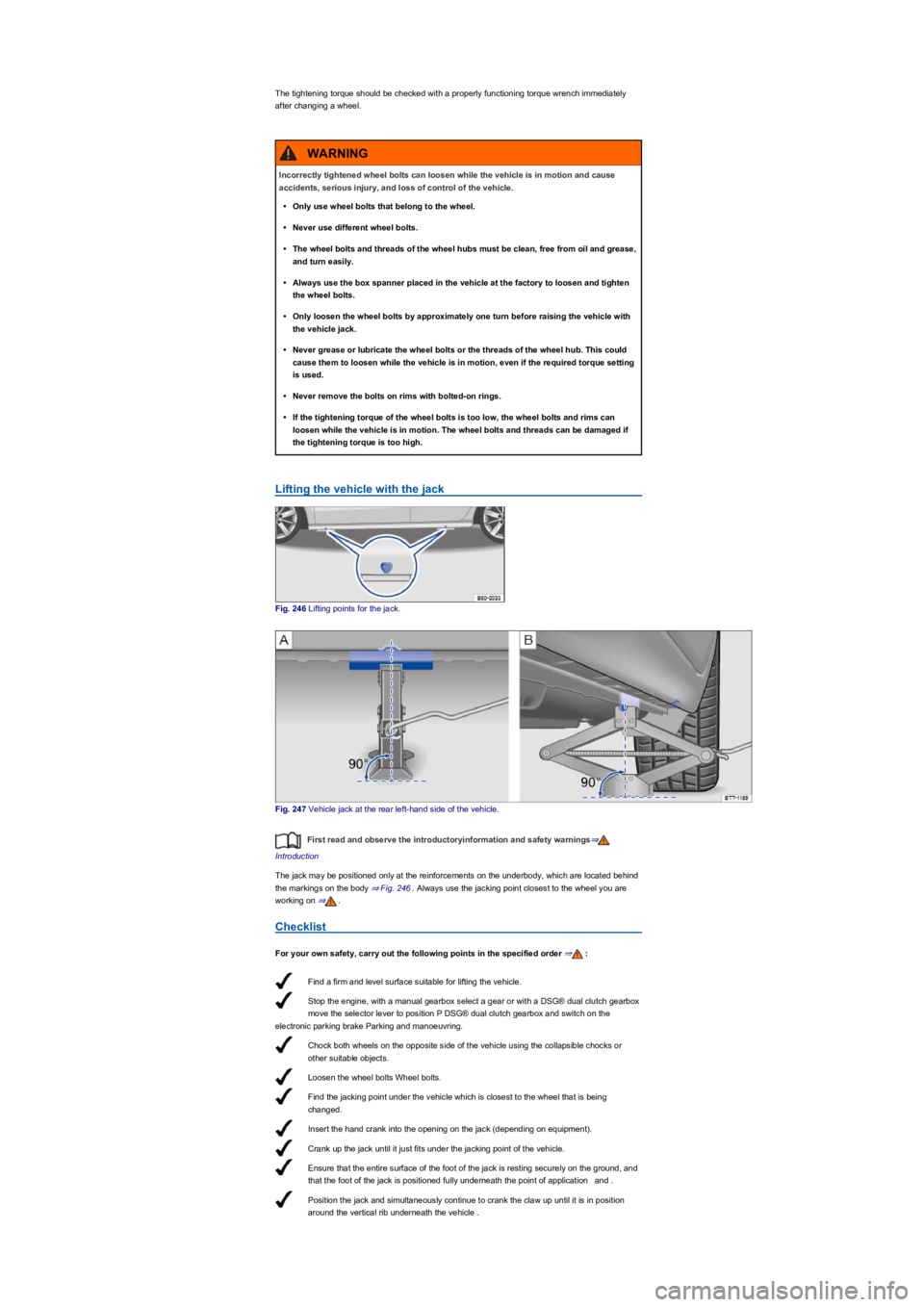
Find a firm and level surface suitable for lifting the vehicle.
Stop the engine, with a manual gearbox select a gear or with a DSG® dual clutch gearbox
move the selector lever to position P DSG® dual clutch gearbox and switch on the
electronic parking brake Parking and manoeuvring.
Chock both wheels on the opposite side of the vehicle using the collapsible chocks or
other suitable objects.
Loosen the wheel bolts Wheel bolts.
Find the jacking point under the vehicle which is closest to the wheel that is being
changed.
Insert the hand crank into the opening on the jack (depending on equipment).
Crank up the jack until it just fits under the jacking point of the vehicle.
Ensure that the entire surface of the foot of the jack is resting securely on the ground, and
that the foot of the jack is positioned fully underneath the point of application and .
Position the jack and simultaneously continue to crank the claw up until it is in position
around the vertical rib underneath the vehicle .
The tightening torque should be checked with a properly functioning torque wrench immediately
after changing a wheel.
Lifting the vehicle with the jack
Fig. 246 Lifting points for the jack.
Fig. 247 Vehicle jack at the rear left-hand side of the vehicle.
First read and observe the introductoryinformation and safety warnings⇒
Introduction
The jack may be positioned only at the reinforcements on the underbody, which are located behind
the markings on the body ⇒ Fig. 246. Always use the jacking point closest to the wheel you are
working on ⇒.
Checklist
For your own safety, carry out the following points in the specified order ⇒:
Incorrectly tightened wheel bolts can loosen while the vehicle is in motion and cause
accidents, serious injury, and loss of control of the vehicle.
•Only use wheel bolts that belong to the wheel.
•Never use different wheel bolts.
•The wheel bolts and threads of the wheel hubs must be clean, free from oil and grease,
and turn easily.
•Always use the box spanner placed in the vehicle at the factory to loosen and tighten
the wheel bolts.
•Only loosen the wheel bolts by approximately one turn before raising the vehicle with
the vehicle jack.
•Never grease or lubricate the wheel bolts or the threads of the wheel hub. This could
cause them to loosen while the vehicle is in motion, even if the required torque setting
is used.
•Never remove the bolts on rims with bolted-on rings.
•If the tightening torque of the wheel bolts is too low, the wheel bolts and rims can
loosen while the vehicle is in motion. The wheel bolts and threads can be damaged if
the tightening torque is too high.
WARNING
Page 310 of 341
Crank the jack further until the wheel is just clear of the ground.
Changing a wheel
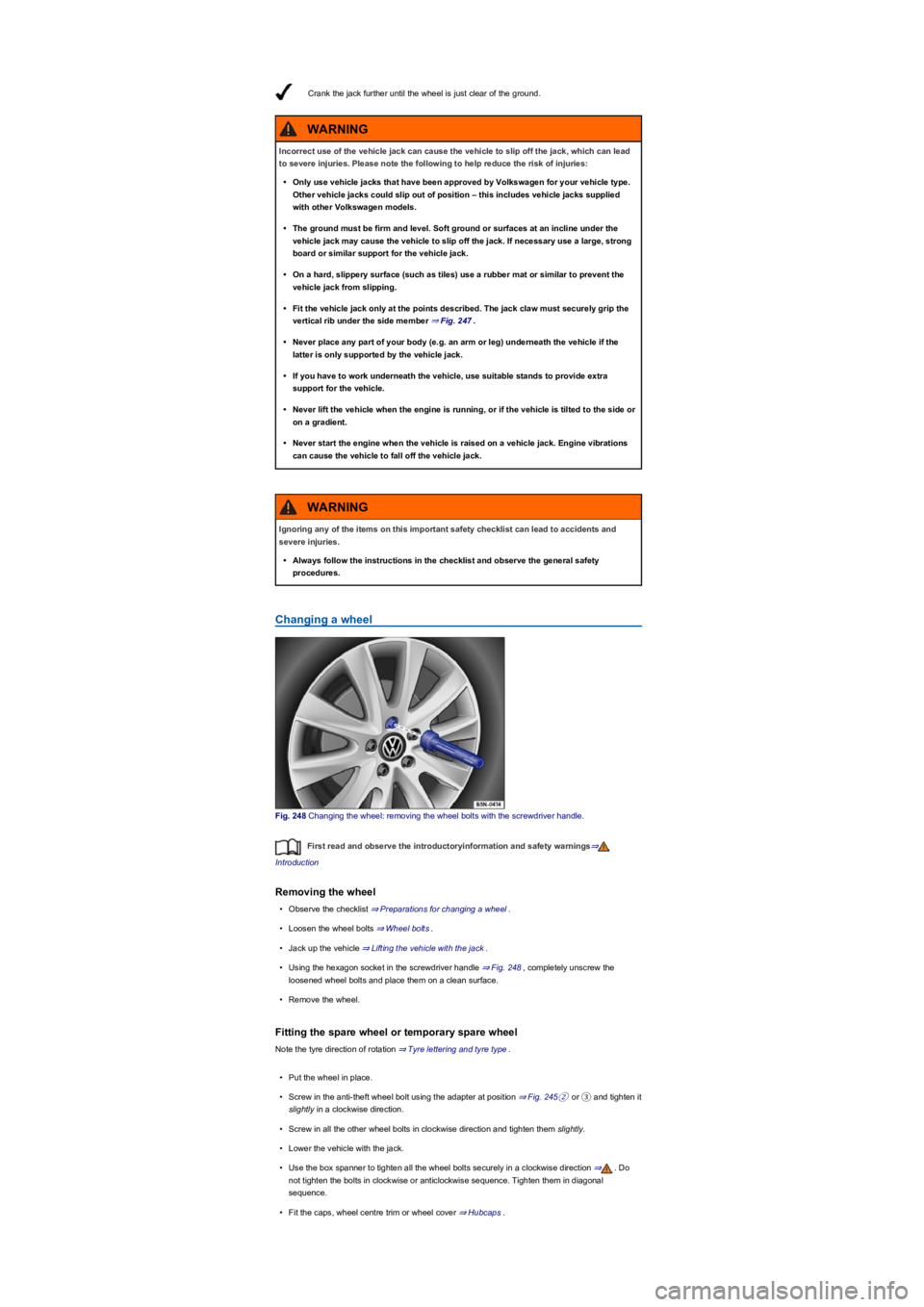
Fig. 248 Changing the wheel: removing the wheel bolts with the screwdriver handle.
First read and observe the introductoryinformation and safety warnings⇒
Introduction
Removing the wheel
•Observe the checklist ⇒ Preparations for changing a wheel.
•Loosen the wheel bolts ⇒ Wheel bolts.
•Jack up the vehicle ⇒ Lifting the vehicle with the jack.
•Using the hexagon socket in the screwdriver handle ⇒ Fig. 248, completely unscrew the
loosened wheel bolts and place them on a clean surface.
•Remove the wheel.
Fitting the spare wheel or temporary spare wheel
Note the tyre direction of rotation ⇒ Tyre lettering and tyre type.
•Put the wheel in place.
•Screw in the anti-theft wheel bolt using the adapter at position ⇒ Fig. 245② or ③ and tighten it
slightly in a clockwise direction.
•Screw in all the other wheel bolts in clockwise direction and tighten them slightly.
•Lower the vehicle with the jack.
•Use the box spanner to tighten all the wheel bolts securely in a clockwise direction ⇒. Do
not tighten the bolts in clockwise or anticlockwise sequence. Tighten them in diagonal
sequence.
•Fit the caps, wheel centre trim or wheel cover ⇒ Hubcaps.
Incorrect use of the vehicle jack can cause the vehicle to slip off the jack, which can lead
to severe injuries. Please note the following to help reduce the risk of injuries:
•Only use vehicle jacks that have been approved by Volkswagen for your vehicle type.
Other vehicle jacks could slip out of position – this includes vehicle jacks supplied
with other Volkswagen models.
•The ground must be firm and level. Soft ground or surfaces at an incline under the
vehicle jack may cause the vehicle to slip off the jack. If necessary use a large, strong
board or similar support for the vehicle jack.
•On a hard, slippery surface (such as tiles) use a rubber mat or similar to prevent the
vehicle jack from slipping.
•Fit the vehicle jack only at the points described. The jack claw must securely grip the
vertical rib under the side member ⇒ Fig. 247.
•Never place any part of your body (e.g. an arm or leg) underneath the vehicle if the
latter is only supported by the vehicle jack.
•If you have to work underneath the vehicle, use suitable stands to provide extra
support for the vehicle.
•Never lift the vehicle when the engine is running, or if the vehicle is tilted to the side or
on a gradient.
•Never start the engine when the vehicle is raised on a vehicle jack. Engine vibrations
can cause the vehicle to fall off the vehicle jack.
WARNING
Ignoring any of the items on this important safety checklist can lead to accidents and
severe injuries.
•Always follow the instructions in the checklist and observe the general safety
procedures.
WARNING
Page 311 of 341
After changing a wheel
First read and observe the introductoryinformation and safety warnings⇒
Introduction
•Clean the tools from the vehicle tool kit and place them back in the foam rubber holder in the
luggage compartment ⇒ Vehicle toolkit.
•Stow the changed wheel securely in the luggage compartment.
•Have the tightening torque of the wheel bolts checked immediately ⇒ Tightening torque for the
wheel bolts.
•The damaged wheel should be replaced as soon as possible.
In vehicles with a Tyre Pressure Loss Indicator, the system has to re-synchronise after
wheels are changed ⇒ Tyre monitoring systems.
Breakdown set
Introduction
This chapter contains information on the followingsubjects:
⇒ Contents of the breakdown set
⇒ Preparation
⇒ Sealing and inflating tyres
⇒ Test after driving for 10 minutes
The breakdown set can be used to temporarily and reliably seal any tyre damage caused by foreign
bodies or punctures (up to approx. 4 mm in diameter). Do not remove foreign objects (e.g.
screws or nails) from the tyre!
Once the sealant has been added to the tyre, the tyre pressure must be checked and adjusted
again after approximately ten minutes of driving.
Seek expert assistance if more than one of the vehicle's tyres is damaged. The breakdown set is
designed to fill only one tyre.
Use the breakdown set only when the vehicle has been safely parked and if you are familiar with
the work and safety precautions needed. Seek expert assistance if this is not the case.
The tyre sealant must not be used:
•If the rim is damaged.
•If the outside temperature is below -20°C (-4°F).
•If there are cuts or punctures in the tyre that are larger than 4 mm.
•If the vehicle was driven with very low tyre pressure or a flat tyre.
•If the use-by date on the tyre filler bottle has expired.
•In conjunction with AirStop tyres. You can tell if your vehicle is equipped with AirStop tyres if
there is the word Seal on the outside of the tyres.
Incorrect torque or incorrect use of wheel bolts can lead to a loss of control of the vehicle,
cause accidents and serious injuries.
•Always keep all wheel bolts and threads in the wheel hubs clean and free from oil and
grease. The wheel bolts must be easy to turn and be tightened to the specified torque.
•The hexagonal socket in the screwdriver handle should only be used for turning wheel
bolts, not use for loosening or tightening them.
WARNING
®®
Page 324 of 341
authorization symbol). These devices include cruise control systems or an electronically controlled
suspension.
Any additional electrical components fitted that do not serve to control the vehicle itself must
bear the mark (manufacturer conformity declaration in the European Union). Such devices
include refrigerator boxes, laptops and ventilator fans.
Repairs and technical modifications
Repairs and technical modifications must always be carried out according to Volkswagen
specifications⇒.
Unauthorised modifications to the electronic components or software in the vehicle may cause
malfunctions. As the electronic components are linked together in networks, these faults may
indirectly affect the working of other systems. This can seriously impair safety, lead to excessive
wear of components, and also invalidate the type approval for the vehicle.
The Volkswagen dealership cannot be held liable for any damage caused by technical
modifications and/or work performed incorrectly.
The Volkswagen dealership is not responsible for damage caused by technical modifications and/or
work performed incorrectly. Such damage is not covered by the Volkswagen guarantee.
Volkswagen recommends that all repairs and technical modifications be performed by an
authorised Volkswagen workshop using Volkswagen Genuine Parts.
Volkswagen repair information
Volkswagen Service information and official Volkswagen repair information can be purchased for a
fee.
Customers in Europe, Asia, Australia, Africa, Central and South America: please contact a
Volkswagen dealership or qualified workshop or register on the online portal erWin (electronic
repair and workshop information):
https://erwin.volkswagen.de
erWin is available in numerous languages.
Vehicles with special auxiliary equipment or body parts
The manufacturer of these components must ensure that these parts (fittings) adhere to the
stipulated environmental laws and regulations, particularly the EU directive 2000/53/EC concerning
end-of-life vehicles and EU directive 2003/11/EC concerning the restriction on the marketing and
use of certain dangerous substances and preparations.
The vehicle owner should keep all assembly documentation for these auxiliary fittings, and pass it
on to any scrapping company later engaged. This is to facilitate environmentally responsible
disposal for all vehicles, including refitted vehicles.
Windscreen repairs
To function properly, some items of equipment require an electrical or electronic module, which is
located on the inside of the windscreen near the interior mirror. If the windscreen has been
damaged in the viewing field of the electrical or electronic module, e.g. by stone impact, the
windscreen must be replaced. Repairing the crack can lead to malfunctions or functional faults in
the equipment.
After changing the windscreen, the camera and sensors must be set up and calibrated by a
qualified workshop.
Impairment or damage to sensors and cameras
Incorrect repairs, retrofit structural modifications to the vehicle, e.g. lowering the body, add-on parts
on the vehicle or trailer ⇒ Trailer towing, or changes to the trim may lead to the sensors or
cameras being disrupted or damaged. This can also be caused by collisions, e.g. when parking.
Failure to observe this may impair important functions (driver assist systems) and damage the
vehicle.
The area in front of and around the sensors and cameras must not be covered by stickers,
additional headlights, trim frames for number plates or similar.
Incorrectly performed repairs or modifications to your vehicle can impair the effectiveness
of the airbags, cause malfunctions, accidents and fatal injury.
•Never secure or mount objects such as drink holders or telephone holders either on or
next to the airbag covers or within the deployment zones of the airbag modules.
•Objects either on or next to the airbag module covers or are in the deployment zone of
the airbags can cause serious or even fatal injuries should the airbags be activated.
WARNING
®