ECU VOLKSWAGEN TIGUAN 2017 Owner´s Manual
[x] Cancel search | Manufacturer: VOLKSWAGEN, Model Year: 2017, Model line: TIGUAN, Model: VOLKSWAGEN TIGUAN 2017Pages: 341, PDF Size: 9.14 MB
Page 92 of 341
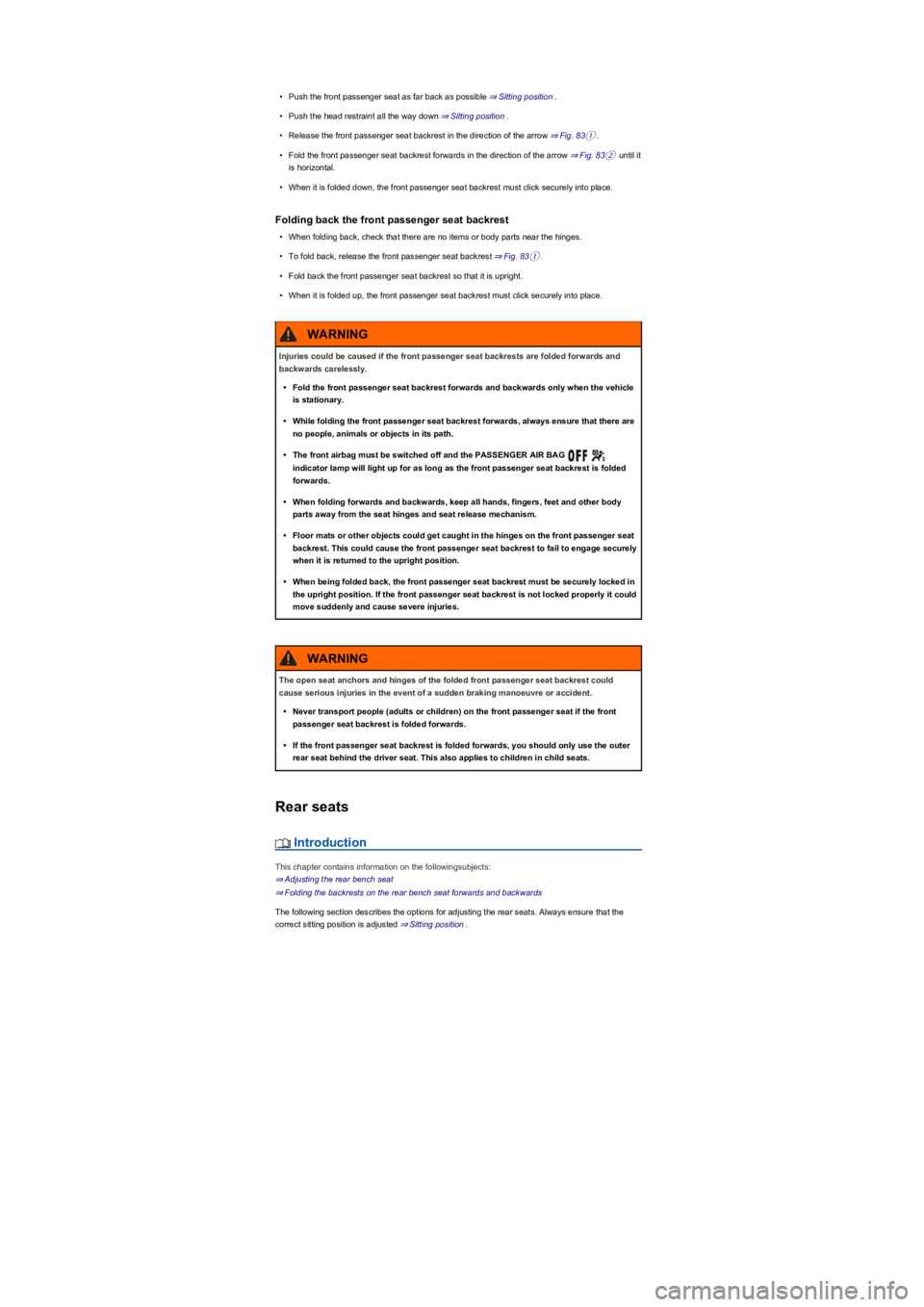
•Push the front passenger seat as far back as possible ⇒ Sitting position.
•Push the head restraint all the way down ⇒ Sitting position.
•Release the front passenger seat backrest in the direction of the arrow ⇒ Fig. 83①.
•Fold the front passenger seat backrest forwards in the direction of the arrow ⇒ Fig. 83② until it
is horizontal.
•When it is folded down, the front passenger seat backrest must click securely into place.
Folding back the front passenger seat backrest
•When folding back, check that there are no items or body parts near the hinges.
•To fold back, release the front passenger seat backrest ⇒ Fig. 83①.
•Fold back the front passenger seat backrest so that it is upright.
•When it is folded up, the front passenger seat backrest must click securely into place.
Rear seats
Introduction
This chapter contains information on the followingsubjects:
⇒ Adjusting the rear bench seat
⇒ Folding the backrests on the rear bench seat forwards and backwards
The following section describes the options for adjusting the rear seats. Always ensure that the
correct sitting position is adjusted ⇒ Sitting position.
Injuries could be caused if the front passenger seat backrests are folded forwards and
backwards carelessly.
•Fold the front passenger seat backrest forwards and backwards only when the vehicle
is stationary.
•While folding the front passenger seat backrest forwards, always ensure that there are
no people, animals or objects in its path.
•The front airbag must be switched off and the PASSENGER AIR BAG
indicator lamp will light up for as long as the front passenger seat backrest is folded
forwards.
•When folding forwards and backwards, keep all hands, fingers, feet and other body
parts away from the seat hinges and seat release mechanism.
•Floor mats or other objects could get caught in the hinges on the front passenger seat
backrest. This could cause the front passenger seat backrest to fail to engage securely
when it is returned to the upright position.
•When being folded back, the front passenger seat backrest must be securely locked in
the upright position. If the front passenger seat backrest is not locked properly it could
move suddenly and cause severe injuries.
WARNING
The open seat anchors and hinges of the folded front passenger seat backrest could
cause serious injuries in the event of a sudden braking manoeuvre or accident.
•Never transport people (adults or children) on the front passenger seat if the front
passenger seat backrest is folded forwards.
•If the front passenger seat backrest is folded forwards, you should only use the outer
rear seat behind the driver seat. This also applies to children in child seats.
WARNING
Page 94 of 341
•Adjust the rear seat backrest to the required position with your hand against the spring pressure
⇒ Fig. 85②.
•Release the loop and engage the rear seat backrest in position by moving it forwards or
backwards gently.
Folding the backrests on the rear bench seat forwards and
backwards
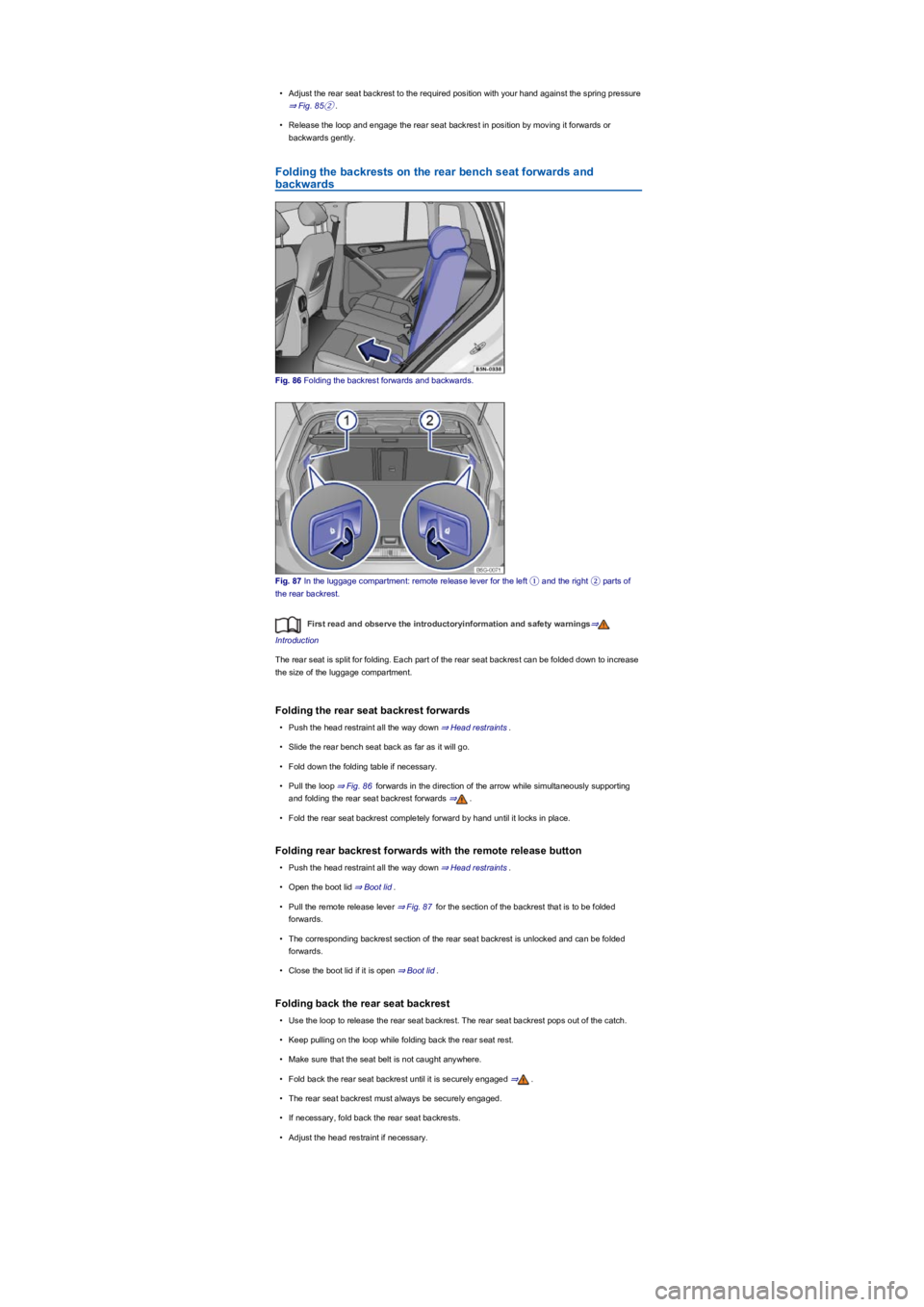
Fig. 86 Folding the backrest forwards and backwards.
Fig. 87 In the luggage compartment: remote release lever for the left ① and the right ② parts of
the rear backrest.
First read and observe the introductoryinformation and safety warnings⇒
Introduction
The rear seat is split for folding. Each part of the rear seat backrest can be folded down to increase
the size of the luggage compartment.
Folding the rear seat backrest forwards
•Push the head restraint all the way down ⇒ Head restraints.
•Slide the rear bench seat back as far as it will go.
•Fold down the folding table if necessary.
•Pull the loop ⇒ Fig. 86 forwards in the direction of the arrow while simultaneously supporting
and folding the rear seat backrest forwards ⇒.
•Fold the rear seat backrest completely forward by hand until it locks in place.
Folding rear backrest forwards with the remote release button
•Push the head restraint all the way down ⇒ Head restraints.
•Open the boot lid ⇒ Boot lid.
•Pull the remote release lever ⇒ Fig. 87 for the section of the backrest that is to be folded
forwards.
•The corresponding backrest section of the rear seat backrest is unlocked and can be folded
forwards.
•Close the boot lid if it is open ⇒ Boot lid.
Folding back the rear seat backrest
•Use the loop to release the rear seat backrest. The rear seat backrest pops out of the catch.
•Keep pulling on the loop while folding back the rear seat rest.
•Make sure that the seat belt is not caught anywhere.
•Fold back the rear seat backrest until it is securely engaged ⇒.
•The rear seat backrest must always be securely engaged.
•If necessary, fold back the rear seat backrests.
•Adjust the head restraint if necessary.
Page 95 of 341
Head restraints
Introduction
This chapter contains information on the followingsubjects:
⇒ Adjusting the head restraints
⇒ Removing and fitting head restraints
The following section describes the options for adjusting and removing the head restraints. Always
ensure that the correct sitting position is adjusted ⇒ Sitting position.
Every seat is fitted with a head restraint. The centre head restraint at the rear is designed solely for
use with the centre rear bench seat. Therefore you should not install the head restraint in any of the
other positions.
Correct head restraint setting
Adjust the head restraint so that its upper edge is at the same height as the top of the head, but not
lower than eye level. Position the back of your head as close to the head restraint as possible.
In vehicles with head restraints that can be adjusted in the longitudinal direction, push the head
restraints on the front seats as close as possible to the back of your head.
Head restraint setting for shorter people
Push the head restraint all the way down, even if the head is then underneath the top edge of the
head restraint. There may be a small gap between the head restraint and backrest in the lowest
position.
Head restraint setting for taller people
Push the head restraint up as far as it will go.
Injuries can be caused if the rear backrests are folded forwards and backwards carelessly.
•While folding the rear backrest, always make sure that no people, animals or items are
in the path.
•Never fold the rear seat backrest forwards or backwards while the vehicle is in motion.
•Ensure that the seat belt is not trapped or damaged when folding back the rear seat
backrest.
•Always keep hands, fingers, feet or other body parts away from the seat area when
folding the rear seat backrest forwards and backwards.
•Ensure that the rear seat backrest engages securely, otherwise the seat belts for the
rear seats will not work properly. This applies to the centre seat of the rear bench seat
in particular. If a seat is occupied and the rear seat backrest has not engaged securely
into place, the seat occupant and rear seat backrest may move forwards in the event of
a sudden braking or driving manoeuvre or during accidents.
•Passengers (adults and children) must not use seats if the backrest is folded forwards
or is not clicked securely into place.
WARNING
Damage to the vehicle or to other objects could be caused if the rear bench seat backrest
is folded forwards and backwards in an uncontrolled way or without taking appropriate
care.
•Before folding the rear seat backrests forwards, always adjust the front seats so that
the rear head restraints or rear seat backrest cushions do not rub against the front
seats.
•Before folding down the rear seat backrest, always ensure that there are no objects
located in its path.
NOTICE
Page 96 of 341
Adjusting the head restraints
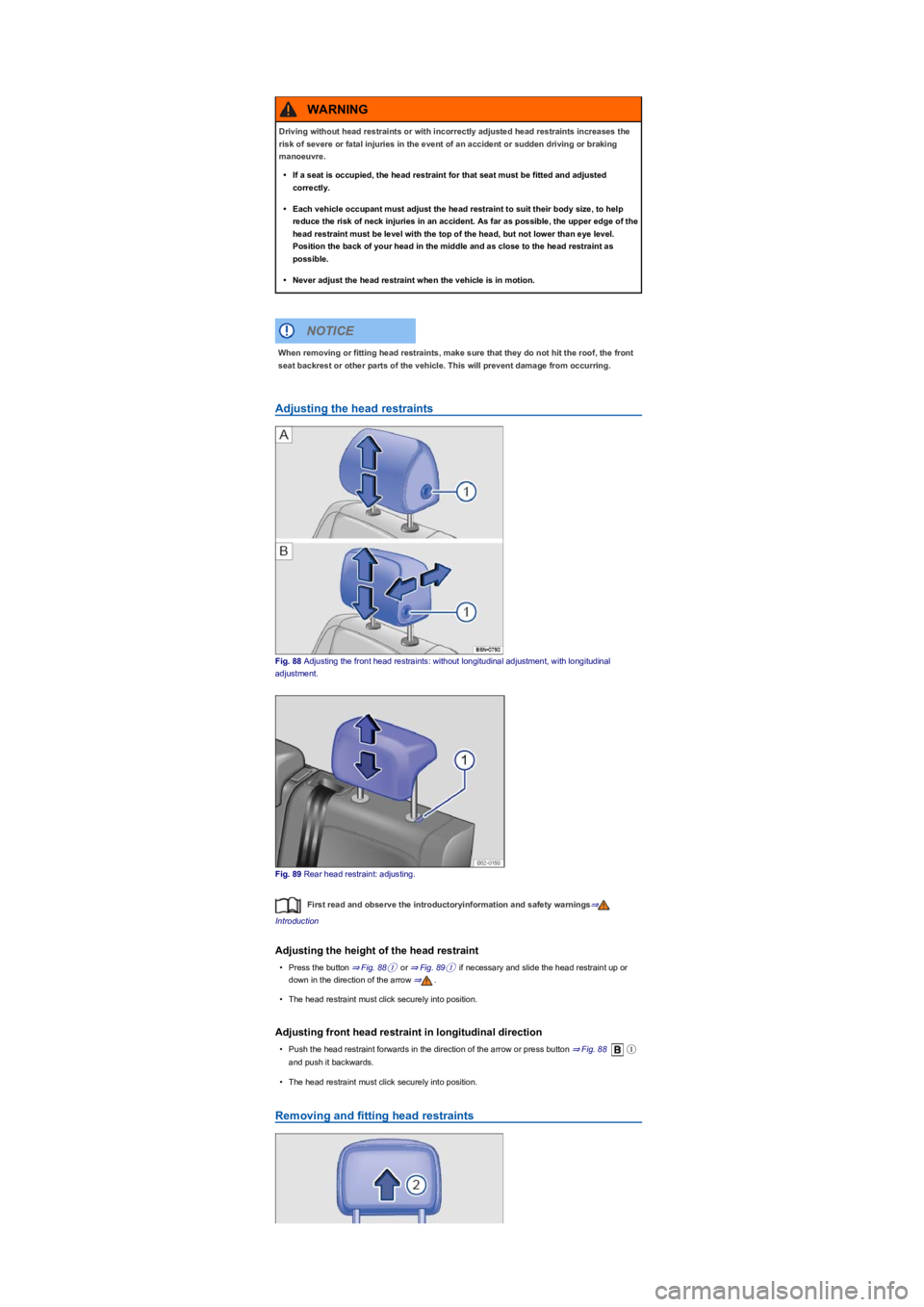
Fig. 88 Adjusting the front head restraints: without longitudinal adjustment, with longitudinal
adjustment.
Fig. 89 Rear head restraint: adjusting.
First read and observe the introductoryinformation and safety warnings⇒
Introduction
Adjusting the height of the head restraint
•Press the button ⇒ Fig. 88① or ⇒ Fig. 89① if necessary and slide the head restraint up or
down in the direction of the arrow ⇒.
•The head restraint must click securely into position.
Adjusting front head restraint in longitudinal direction
•Push the head restraint forwards in the direction of the arrow or press button ⇒ Fig. 88①
and push it backwards.
•The head restraint must click securely into position.
Removing and fitting head restraints
Driving without head restraints or with incorrectly adjusted head restraints increases the
risk of severe or fatal injuries in the event of an accident or sudden driving or braking
manoeuvre.
•If a seat is occupied, the head restraint for that seat must be fitted and adjusted
correctly.
•Each vehicle occupant must adjust the head restraint to suit their body size, to help
reduce the risk of neck injuries in an accident. As far as possible, the upper edge of the
head restraint must be level with the top of the head, but not lower than eye level.
Position the back of your head in the middle and as close to the head restraint as
possible.
•Never adjust the head restraint when the vehicle is in motion.
WARNING
When removing or fitting head restraints, make sure that they do not hit the roof, the front
seat backrest or other parts of the vehicle. This will prevent damage from occurring.
NOTICE
Page 97 of 341
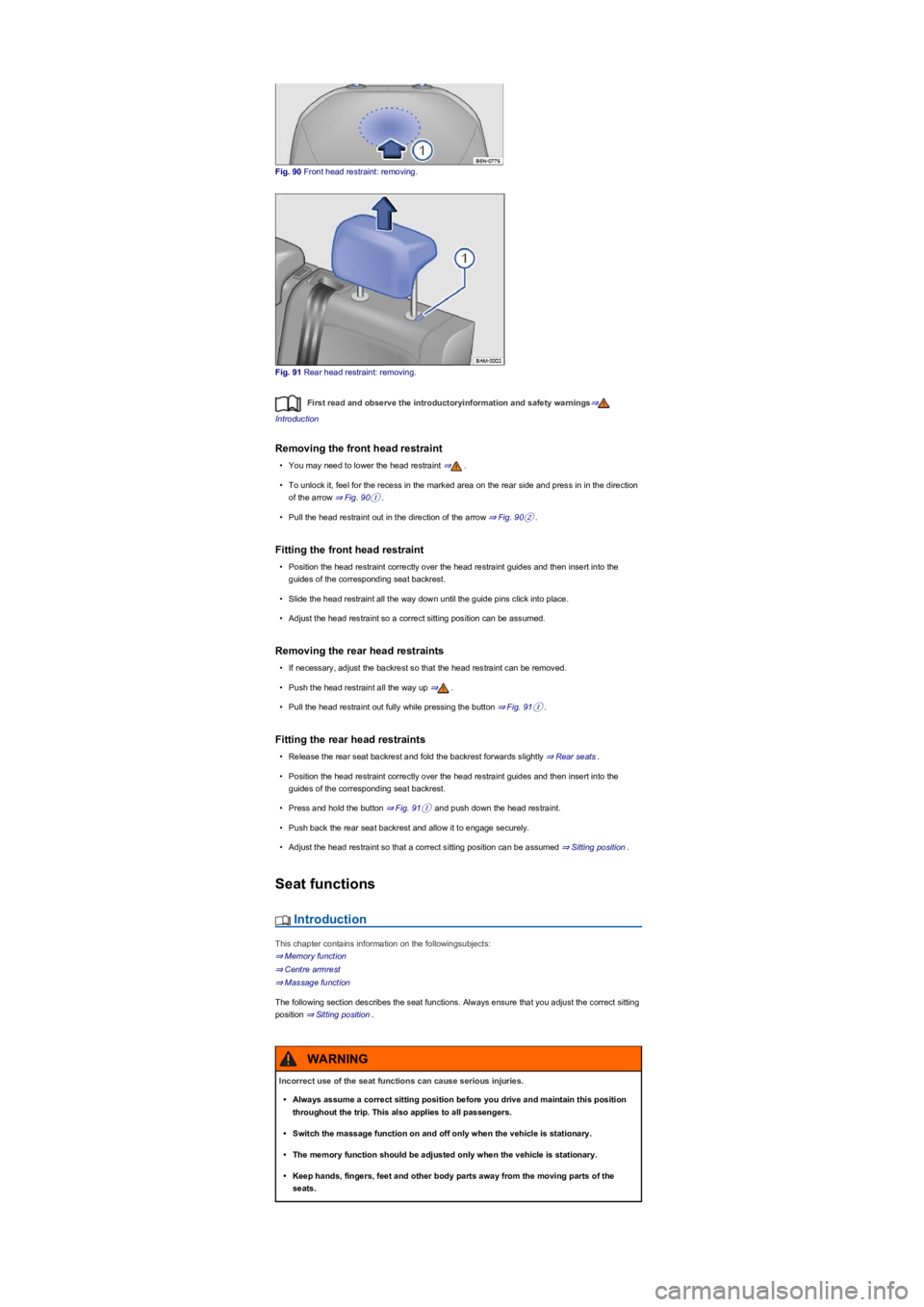
Fig. 90 Front head restraint: removing.
Fig. 91 Rear head restraint: removing.
First read and observe the introductoryinformation and safety warnings⇒
Introduction
Removing the front head restraint
•You may need to lower the head restraint ⇒.
•To unlock it, feel for the recess in the marked area on the rear side and press in in the direction
of the arrow ⇒ Fig. 90①.
•Pull the head restraint out in the direction of the arrow ⇒ Fig. 90②.
Fitting the front head restraint
•Position the head restraint correctly over the head restraint guides and then insert into the
guides of the corresponding seat backrest.
•Slide the head restraint all the way down until the guide pins click into place.
•Adjust the head restraint so a correct sitting position can be assumed.
Removing the rear head restraints
•If necessary, adjust the backrest so that the head restraint can be removed.
•Push the head restraint all the way up ⇒.
•Pull the head restraint out fully while pressing the button ⇒ Fig. 91①.
Fitting the rear head restraints
•Release the rear seat backrest and fold the backrest forwards slightly ⇒ Rear seats.
•Position the head restraint correctly over the head restraint guides and then insert into the
guides of the corresponding seat backrest.
•Press and hold the button ⇒ Fig. 91① and push down the head restraint.
•Push back the rear seat backrest and allow it to engage securely.
•Adjust the head restraint so that a correct sitting position can be assumed ⇒ Sitting position.
Seat functions
Introduction
This chapter contains information on the followingsubjects:
⇒ Memory function
⇒ Centre armrest
⇒ Massage function
The following section describes the seat functions. Always ensure that you adjust the correct sitting
position ⇒ Sitting position.
Incorrect use of the seat functions can cause serious injuries.
•Always assume a correct sitting position before you drive and maintain this position
throughout the trip. This also applies to all passengers.
•Switch the massage function on and off only when the vehicle is stationary.
•The memory function should be adjusted only when the vehicle is stationary.
•Keep hands, fingers, feet and other body parts away from the moving parts of the
seats.
WARNING
Page 105 of 341
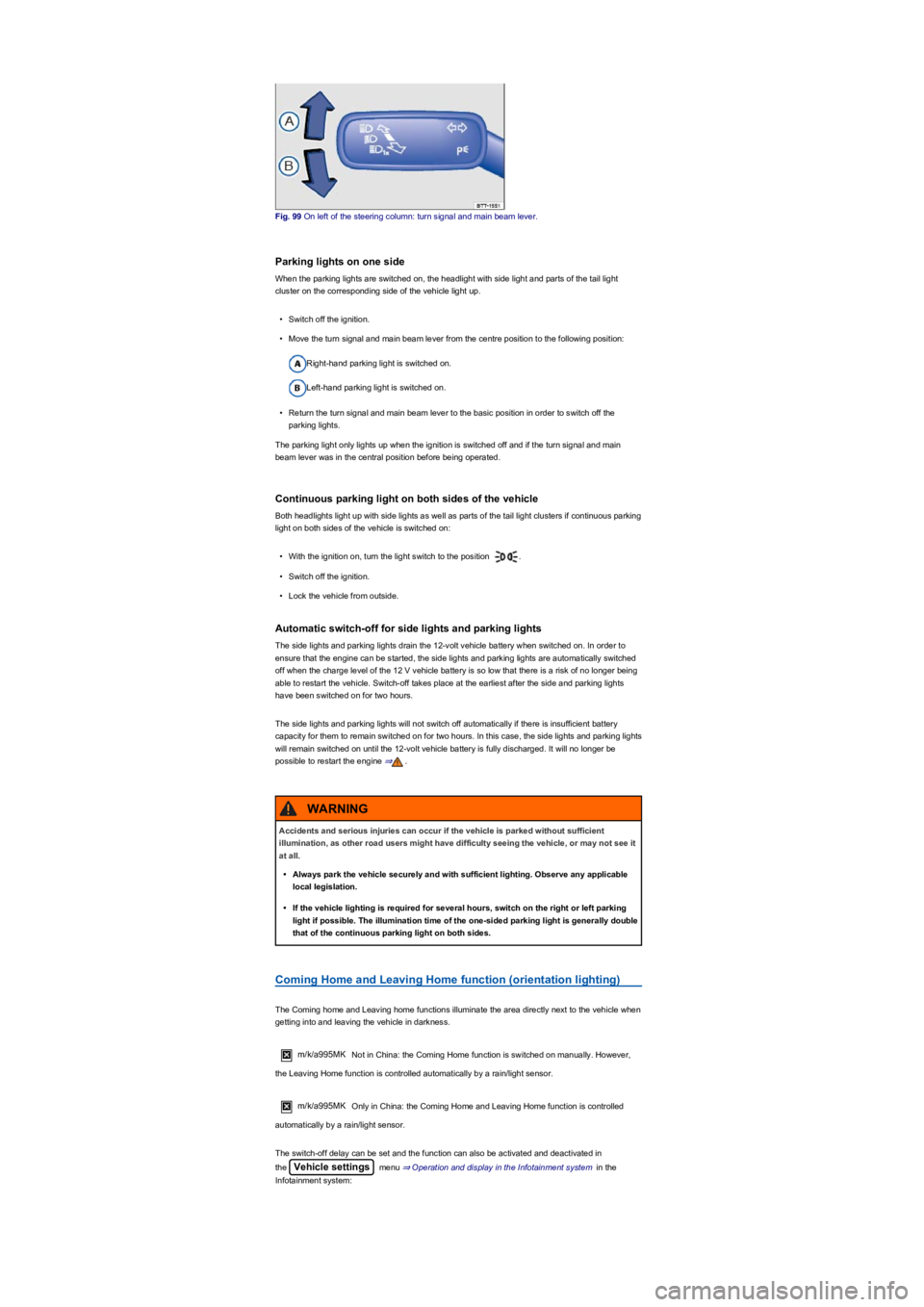
Fig. 99 On left of the steering column: turn signal and main beam lever.
Parking lights on one side
When the parking lights are switched on, the headlight with side light and parts of the tail light
cluster on the corresponding side of the vehicle light up.
•Switch off the ignition.
•Move the turn signal and main beam lever from the centre position to the following position:
Right-hand parking light is switched on.
Left-hand parking light is switched on.
•Return the turn signal and main beam lever to the basic position in order to switch off the
parking lights.
The parking light only lights up when the ignition is switched off and if the turn signal and main
beam lever was in the central position before being operated.
Continuous parking light on both sides of the vehicle
Both headlights light up with side lights as well as parts of the tail light clusters if continuous parking
light on both sides of the vehicle is switched on:
•With the ignition on, turn the light switch to the position .
•Switch off the ignition.
•Lock the vehicle from outside.
Automatic switch-off for side lights and parking lights
The side lights and parking lights drain the 12-volt vehicle battery when switched on. In order to
ensure that the engine can be started, the side lights and parking lights are automatically switched
off when the charge level of the 12 V vehicle battery is so low that there is a risk of no longer being
able to restart the vehicle. Switch-off takes place at the earliest after the side and parking lights
have been switched on for two hours.
The side lights and parking lights will not switch off automatically if there is insufficient battery
capacity for them to remain switched on for two hours. In this case, the side lights and parking lights
will remain switched on until the 12-volt vehicle battery is fully discharged. It will no longer be
possible to restart the engine ⇒.
Coming Home and Leaving Home function (orientation lighting)
The Coming home and Leaving home functions illuminate the area directly next to the vehicle when
getting into and leaving the vehicle in darkness.
m/k/a995MK Not in China: the Coming Home function is switched on manually. However,
the Leaving Home function is controlled automatically by a rain/light sensor.
m/k/a995MK Only in China: the Coming Home and Leaving Home function is controlled
automatically by a rain/light sensor.
The switch-off delay can be set and the function can also be activated and deactivated in
the Vehicle settings menu ⇒ Operation and display in the Infotainment system in the
Infotainment system:
Accidents and serious injuries can occur if the vehicle is parked without sufficient
illumination, as other road users might have difficulty seeing the vehicle, or may not see it
at all.
•Always park the vehicle securely and with sufficient lighting. Observe any applicable
local legislation.
•If the vehicle lighting is required for several hours, switch on the right or left parking
light if possible. The illumination time of the one-sided parking light is generally double
that of the continuous parking light on both sides.
WARNING
Page 128 of 341
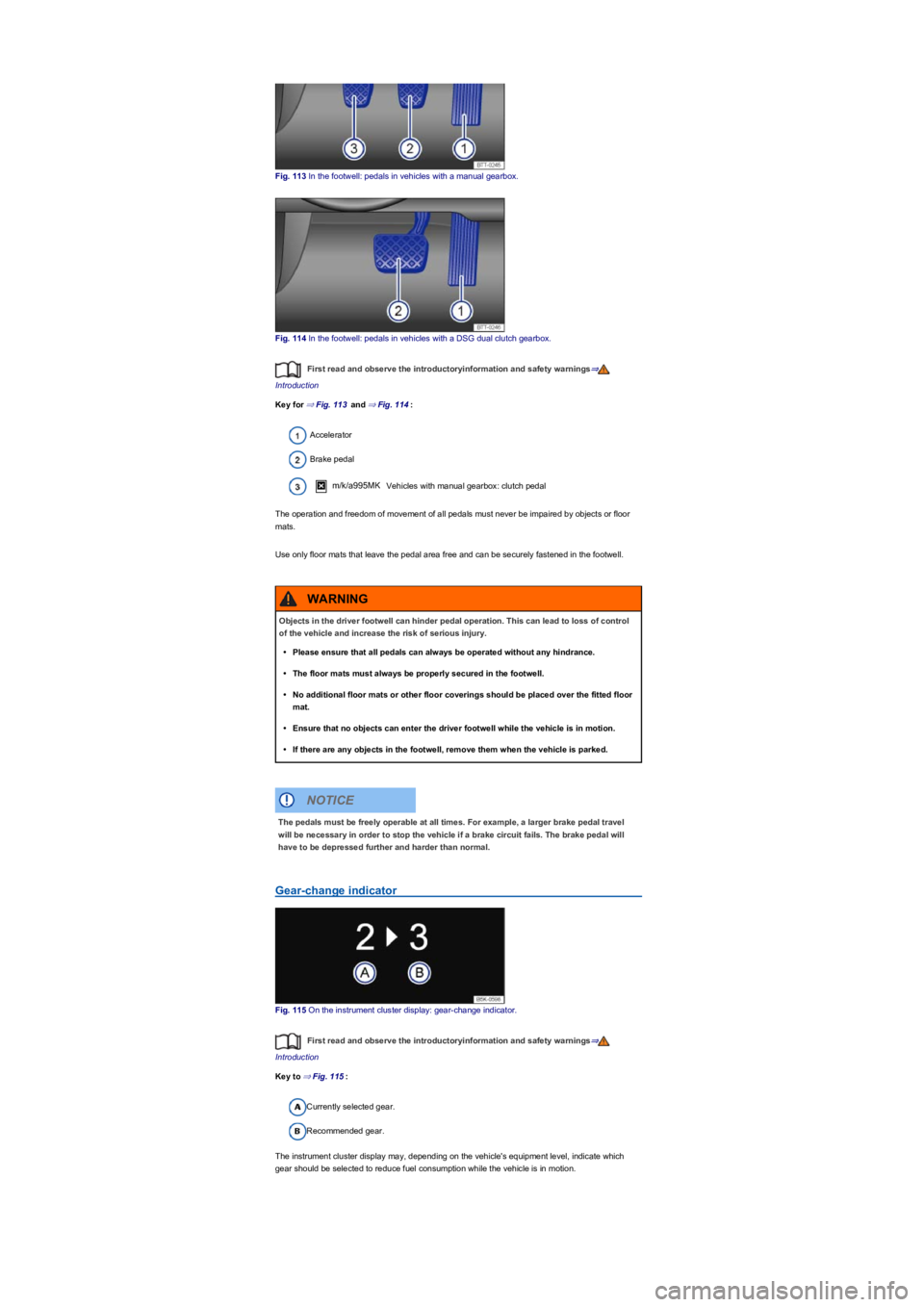
Fig. 113 In the footwell: pedals in vehicles with a manual gearbox.
Fig. 114 In the footwell: pedals in vehicles with a DSG dual clutch gearbox.
First read and observe the introductoryinformation and safety warnings⇒
Introduction
Key for ⇒ Fig. 113 and ⇒ Fig. 114:
Accelerator
Brake pedal
m/k/a995MK Vehicles with manual gearbox: clutch pedal
The operation and freedom of movement of all pedals must never be impaired by objects or floor
mats.
Use only floor mats that leave the pedal area free and can be securely fastened in the footwell.
Gear-change indicator
Fig. 115 On the instrument cluster display: gear-change indicator.
First read and observe the introductoryinformation and safety warnings⇒
Introduction
Key to ⇒ Fig. 115:
Currently selected gear.
Recommended gear.
The instrument cluster display may, depending on the vehicle's equipment level, indicate which
gear should be selected to reduce fuel consumption while the vehicle is in motion.
Objects in the driver footwell can hinder pedal operation. This can lead to loss of control
of the vehicle and increase the risk of serious injury.
•Please ensure that all pedals can always be operated without any hindrance.
•The floor mats must always be properly secured in the footwell.
•No additional floor mats or other floor coverings should be placed over the fitted floor
mat.
•Ensure that no objects can enter the driver footwell while the vehicle is in motion.
•If there are any objects in the footwell, remove them when the vehicle is parked.
WARNING
The pedals must be freely operable at all times. For example, a larger brake pedal travel
will be necessary in order to stop the vehicle if a brake circuit fails. The brake pedal will
have to be depressed further and harder than normal.
NOTICE
Page 133 of 341
If the front brake pads are tested, the rear brake pads should be tested at the same time.
Regularly check the thickness of the brake pads through the openings in the rims or from the
underside of the vehicle. If necessary, remove the wheels to carry out a comprehensive check.
Volkswagen recommends using a Volkswagen dealership for this purpose.
Driving with a loaded vehicle
First read and observe the introductoryinformation and safety warnings⇒
Introduction
For good vehicle handling when driving a loaded vehicle, please observe the following:
•Stow all items of luggage securely ⇒ Stowing luggage and loads.
•Accelerate particularly cautiously and carefully.
•Avoid sudden braking and driving manoeuvres.
•Brake earlier than in normal driving.
•If applicable, observe the information concerning the roof carrier ⇒ Roof carrier.
•If applicable, observe the information about driving with a trailer ⇒ Trailer towing.
Driving with an open boot lid
First read and observe the introductoryinformation and safety warnings⇒
Introduction
Driving with an open boot lid is particularly dangerous. All objects and the open boot lid must be
secured properly. Take the appropriate measures to reduce the amount of poisonous exhaust
fumes that could enter into the vehicle.
Wet brakes or brakes coated with ice or road salt react more slowly and require longer
braking distances.
•Carefully apply the brakes to test them.
•Always dry brakes and clean off any coating of ice and salt with a few cautious
applications of the brake when visibility, weather, road and traffic conditions permit.
WARNING
Driving without the brake servo can considerably increase the braking distance and thus
cause accidents and serious injuries.
•Never switch the engine or ignition off while the vehicle is in motion.
•If the brake servo does not function or the vehicle is being towed, the brake pedal will
have to be depressed more forcefully as the braking distance will be increased due to
the lack of assistance for the brake system.
WARNING
Moving loads can severely impair the vehicle's stability and driving safety which could
cause accidents and severe injuries.
•Secure objects properly to prevent them from sliding.
•Use suitable straps when securing heavy objects.
•Engage the rear seat backrests and the adjustable rear bench seat securely.
WARNING
Page 134 of 341
Driving through water on roads
First read and observe the introductoryinformation and safety warnings⇒
Introduction
Please follow these rules to help prevent damage to your vehicle when driving through water, for
example if the road is flooded:
•Check the depth of the water before driving through it. The water level must be no higher than
the lower edge of the vehicle body ⇒.
•Do not drive faster than walking speed.
•Never stop the vehicle, reverse or switch off the engine while in water.
•Oncoming vehicles will create waves that could increase the water level for your vehicle to such
an extent that it is not safe to drive through the water.
•Always deactivate the start/stop system manually when driving through water ⇒ Start/stop
system .
Driving with an unlocked or open boot lid can cause serious injuries.
•Always drive with the boot lid closed.
•Always stow all items in the luggage compartment securely. Loose objects can fall out
of the luggage compartment and injure other road users.
•Always drive carefully and ensure that you think ahead.
•Avoid any abrupt or sudden driving and braking manoeuvres as this could cause the
open boot lid to move unpredictably.
•Any objects protruding from the luggage compartment must be marked to ensure that
they are visible to other road users. Comply with legal regulations.
•If items protrude out of the luggage compartment, never use the boot lid to wedge
them into place or hold them in position.
•If you drive with the boot lid open, you must remove any racks and luggage from the
boot lid.
WARNING
Poisonous exhaust fumes could enter the vehicle interior if the boot lid is open. This could
result in loss of consciousness, carbon monoxide poisoning, serious injury and
accidents.
•You should always drive with the boot lid closed in order to prevent poisonous gases
from entering the vehicle.
•If exceptional circumstances require you to drive with an open boot lid, you must do
the following to reduce the amount of poisonous exhaust fumes that could enter into
the vehicle:
- Close all windows and the glass roof.
- Switch off the air recirculation mode of the heating and fresh air system or
switch off the air conditioning system.
- Open all vents in the dash panel.
- Switch the blowers for the heating and fresh air system, or for the air
conditioning system, to the highest setting.
WARNING
The vehicle height, and possibly the length, are different when the boot lid is open.
NOTICE
Page 149 of 341
If the accelerator pedal is depressed fully, the gearbox will automatically shift to a lower gear,
depending on the speed and engine revs. This will make use of the full vehicle acceleration.
The gearbox does not shift up to the next gear until the engine reaches the maximum engine speed
for the gear.
When the Eco driving profile is selected in vehicles with driving profile selection ⇒ Driving profile
selection and 4MOTION Active Control and the accelerator is depressed fully beyond the pressure
point, the engine output is automatically regulated to ensure maximum vehicle acceleration.
Launch Control Programme
The Launch Control programme gives the vehicle maximum acceleration from a standing start in
vehicles with a DSG dual clutch gearbox.
•Switch off TCS ⇒ Brake support systems.
•Depress and hold the brake pedal with your left foot.
•In selector lever position D/S, select position S. Alternatively, select the Tiptronic position or in
vehicles with driving profile selection select the Sport driving profile ⇒ Driving profile selection
and 4MOTION Active Control.
•With your right foot, depress the accelerator until the engines speed reaches approximately
3,200 rpm.
•Take your left foot off the brake ⇒. The vehicle will start with maximum acceleration.
•Switch the TCS back on after acceleration.
Troubleshooting
®
Rapid acceleration can cause loss of traction and skidding, particularly on slippery roads.
This can cause you to lose control of the vehicle, which can lead to accidents and serious
injuries.
•Always adjust your driving style in accordance with the flow of traffic.
•Only use kickdown or fast acceleration if visibility, weather, road and traffic conditions
permit, and other road users are not put at risk due to the acceleration and the driving
style.
•Please note that the driven wheels could start to spin and the vehicle could skid if the
traction control system (TCS) is switched off, especially if the road is slippery.
•Switch the traction control system (TCS) back on after acceleration.
•Only use the launch control programme, if the road and traffic conditions allow for it.
•You should never endanger other road users through the acceleration of your vehicle
or through your driving style.
WARNING
Never ride the brake pedal. Do not overuse the brake pedal. Constant braking will cause
the brakes to overheat. This can considerably reduce the brake effect, increase the
braking distance and, in certain circumstances, cause the brake system to fail completely.
WARNING
•If you stop the vehicle on an incline, do not attempt to stop it from rolling back by
depressing the accelerator while a position is still selected. The dual clutch gearbox
DSG could overheat and be damaged.
•Never allow the vehicle to roll in position N, particularly if the ignition is switched off.
The DSG dual clutch gearbox will not be lubricated and could be damaged.
•m/k/a995MK Vehicles with Launch Control Programme: accelerating with the
Launch Control programme places heavy strain on all vehicle components. This can
lead to higher rates of wear.
NOTICE
®
®
•Never let the brakes rub by applying light pressure to the brake when it is not
necessary to brake. This will increase levels of wear.
•Before driving down a long, steep gradient, reduce your speed and select a suitable
recuperation level. This will make use of the electric drive braking effect and relieve the
load on the brakes. The brakes could otherwise overheat and possibly fail. The brakes
should only be used to slow or stop the vehicle.
NOTICE