REST VOLKSWAGEN TIGUAN 2017 Owner´s Manual
[x] Cancel search | Manufacturer: VOLKSWAGEN, Model Year: 2017, Model line: TIGUAN, Model: VOLKSWAGEN TIGUAN 2017Pages: 341, PDF Size: 9.14 MB
Page 216 of 341
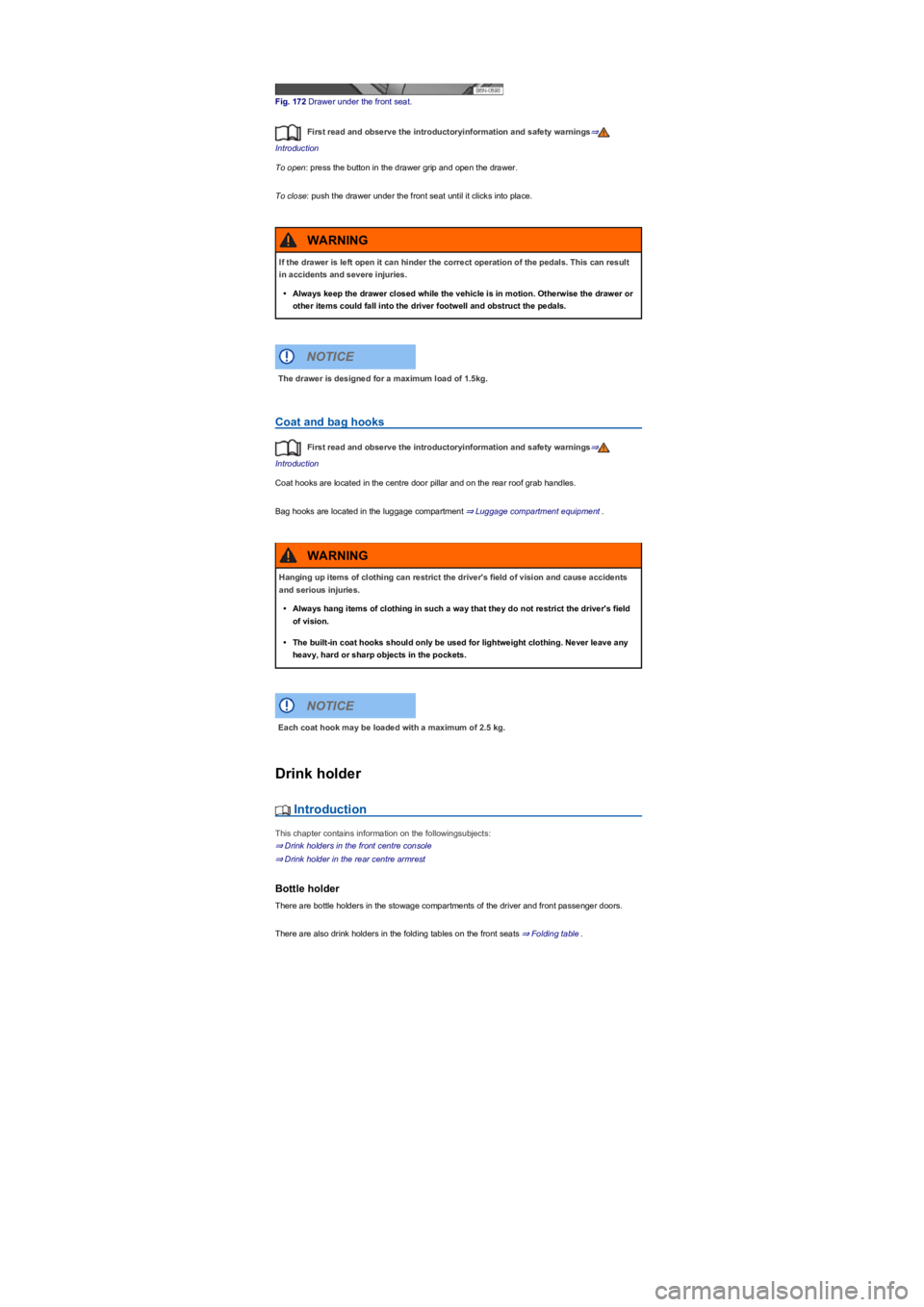
Fig. 172 Drawer under the front seat.
First read and observe the introductoryinformation and safety warnings⇒
Introduction
To open: press the button in the drawer grip and open the drawer.
To close: push the drawer under the front seat until it clicks into place.
Coat and bag hooks
First read and observe the introductoryinformation and safety warnings⇒
Introduction
Coat hooks are located in the centre door pillar and on the rear roof grab handles.
Bag hooks are located in the luggage compartment ⇒ Luggage compartment equipment.
Drink holder
Introduction
This chapter contains information on the followingsubjects:
⇒ Drink holders in the front centre console
⇒ Drink holder in the rear centre armrest
Bottle holder
There are bottle holders in the stowage compartments of the driver and front passenger doors.
There are also drink holders in the folding tables on the front seats ⇒ Folding table.
If the drawer is left open it can hinder the correct operation of the pedals. This can result
in accidents and severe injuries.
•Always keep the drawer closed while the vehicle is in motion. Otherwise the drawer or
other items could fall into the driver footwell and obstruct the pedals.
WARNING
The drawer is designed for a maximum load of 1.5kg.
NOTICE
Hanging up items of clothing can restrict the driver's field of vision and cause accidents
and serious injuries.
•Always hang items of clothing in such a way that they do not restrict the driver's field
of vision.
•The built-in coat hooks should only be used for lightweight clothing. Never leave any
heavy, hard or sharp objects in the pockets.
WARNING
Each coat hook may be loaded with a maximum of 2.5 kg.
NOTICE
Page 217 of 341
The inserts for the drink holders can be removed for cleaning purposes.
Drink holders in the front centre console
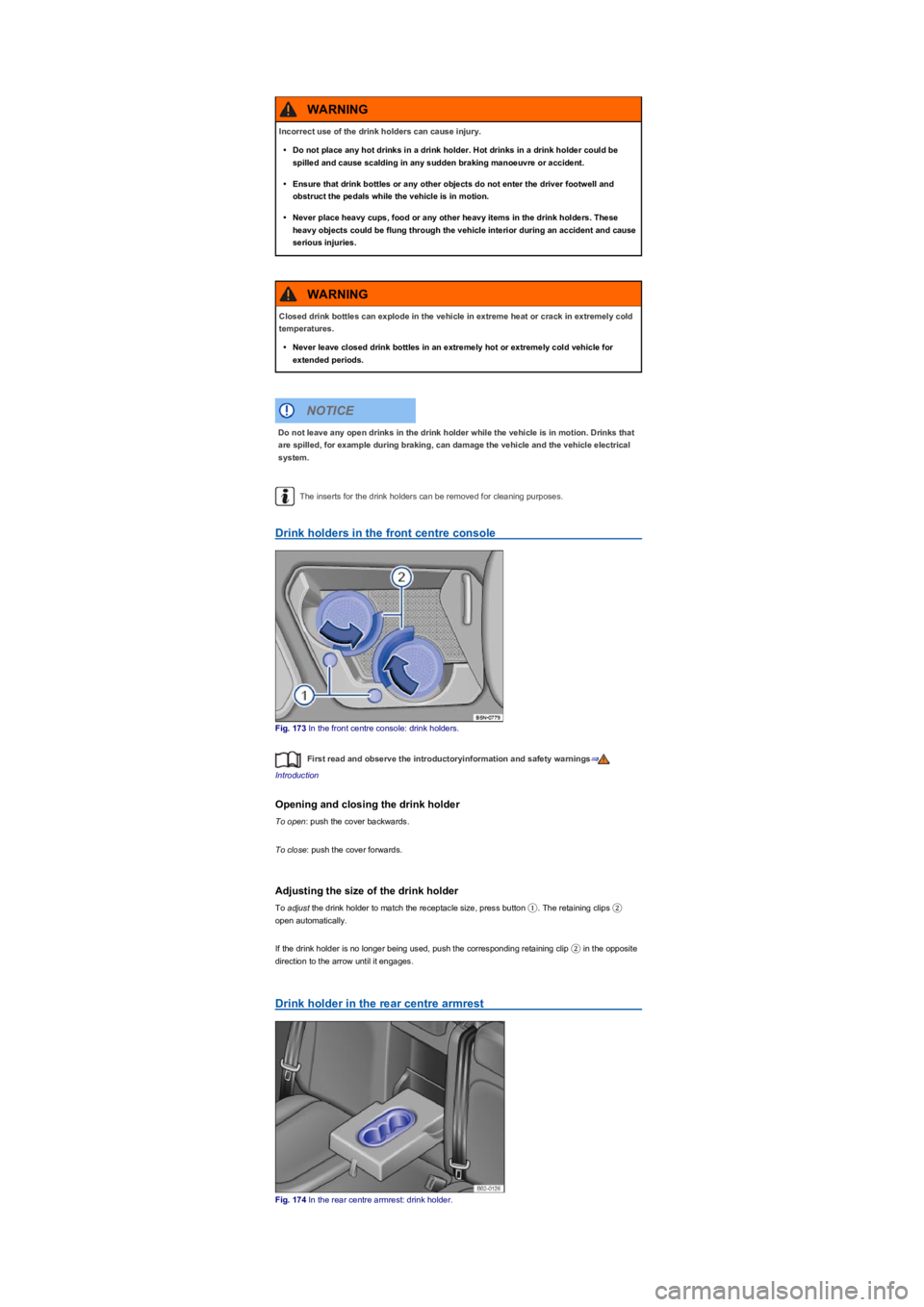
Fig. 173 In the front centre console: drink holders.
First read and observe the introductoryinformation and safety warnings⇒
Introduction
Opening and closing the drink holder
To open: push the cover backwards.
To close: push the cover forwards.
Adjusting the size of the drink holder
To adjust the drink holder to match the receptacle size, press button ①. The retaining clips ②
open automatically.
If the drink holder is no longer being used, push the corresponding retaining clip ② in the opposite
direction to the arrow until it engages.
Drink holder in the rear centre armrest
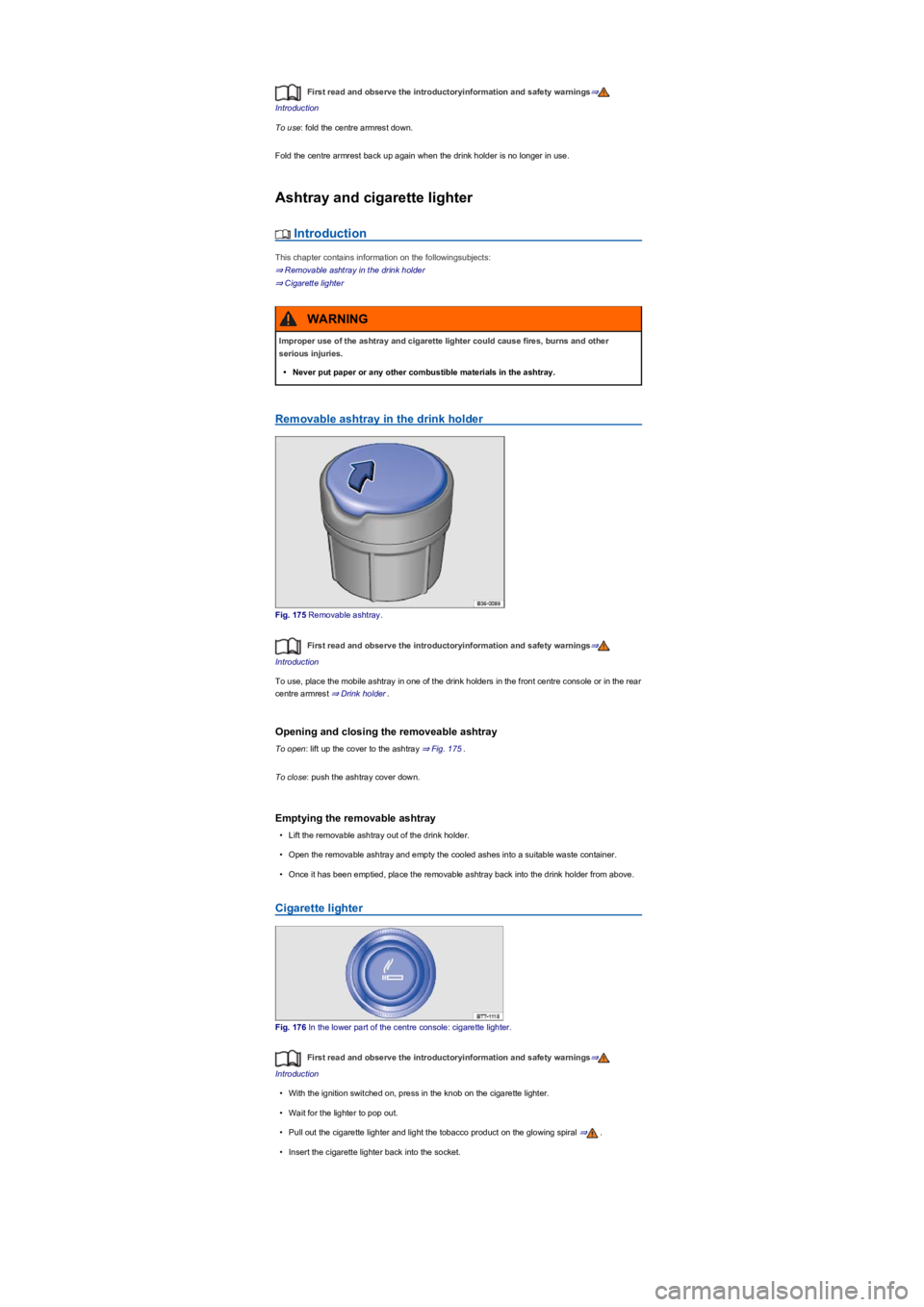
Fig. 174 In the rear centre armrest: drink holder.
Incorrect use of the drink holders can cause injury.
•Do not place any hot drinks in a drink holder. Hot drinks in a drink holder could be
spilled and cause scalding in any sudden braking manoeuvre or accident.
•Ensure that drink bottles or any other objects do not enter the driver footwell and
obstruct the pedals while the vehicle is in motion.
•Never place heavy cups, food or any other heavy items in the drink holders. These
heavy objects could be flung through the vehicle interior during an accident and cause
serious injuries.
WARNING
Closed drink bottles can explode in the vehicle in extreme heat or crack in extremely cold
temperatures.
•Never leave closed drink bottles in an extremely hot or extremely cold vehicle for
extended periods.
WARNING
Do not leave any open drinks in the drink holder while the vehicle is in motion. Drinks that
are spilled, for example during braking, can damage the vehicle and the vehicle electrical
system.
NOTICE
Page 218 of 341
First read and observe the introductoryinformation and safety warnings⇒
Introduction
To use: fold the centre armrest down.
Fold the centre armrest back up again when the drink holder is no longer in use.
Ashtray and cigarette lighter
Introduction
This chapter contains information on the followingsubjects:
⇒ Removable ashtray in the drink holder
⇒ Cigarette lighter
Removable ashtray in the drink holder
Fig. 175 Removable ashtray.
First read and observe the introductoryinformation and safety warnings⇒
Introduction
To use, place the mobile ashtray in one of the drink holders in the front centre console or in the rear
centre armrest ⇒ Drink holder.
Opening and closing the removeable ashtray
To open: lift up the cover to the ashtray ⇒ Fig. 175.
To close: push the ashtray cover down.
Emptying the removable ashtray
•Lift the removable ashtray out of the drink holder.
•Open the removable ashtray and empty the cooled ashes into a suitable waste container.
•Once it has been emptied, place the removable ashtray back into the drink holder from above.
Cigarette lighter
Fig. 176 In the lower part of the centre console: cigarette lighter.
First read and observe the introductoryinformation and safety warnings⇒
Introduction
•With the ignition switched on, press in the knob on the cigarette lighter.
•Wait for the lighter to pop out.
•Pull out the cigarette lighter and light the tobacco product on the glowing spiral ⇒.
•Insert the cigarette lighter back into the socket.
Improper use of the ashtray and cigarette lighter could cause fires, burns and other
serious injuries.
•Never put paper or any other combustible materials in the ashtray.
WARNING
Page 219 of 341
The cigarette lighter socket can also be used as a 12-volt socket ⇒ Electrical sockets.
Electrical sockets
Introduction
This chapter contains information on the followingsubjects:
⇒ Sockets in the vehicle
Electrical equipment can be connected to the sockets in the vehicle.
The electrical devices must be in good condition. Do not use faulty devices.
The 12-volt socket will work only when the ignition is switched on.
Using electrical consumers with the engine switched off and the ignition switched on will
drain the 12-volt battery.
Unshielded devices can cause interference in the Infotainment system and vehicle
electronics.
Sockets in the vehicle
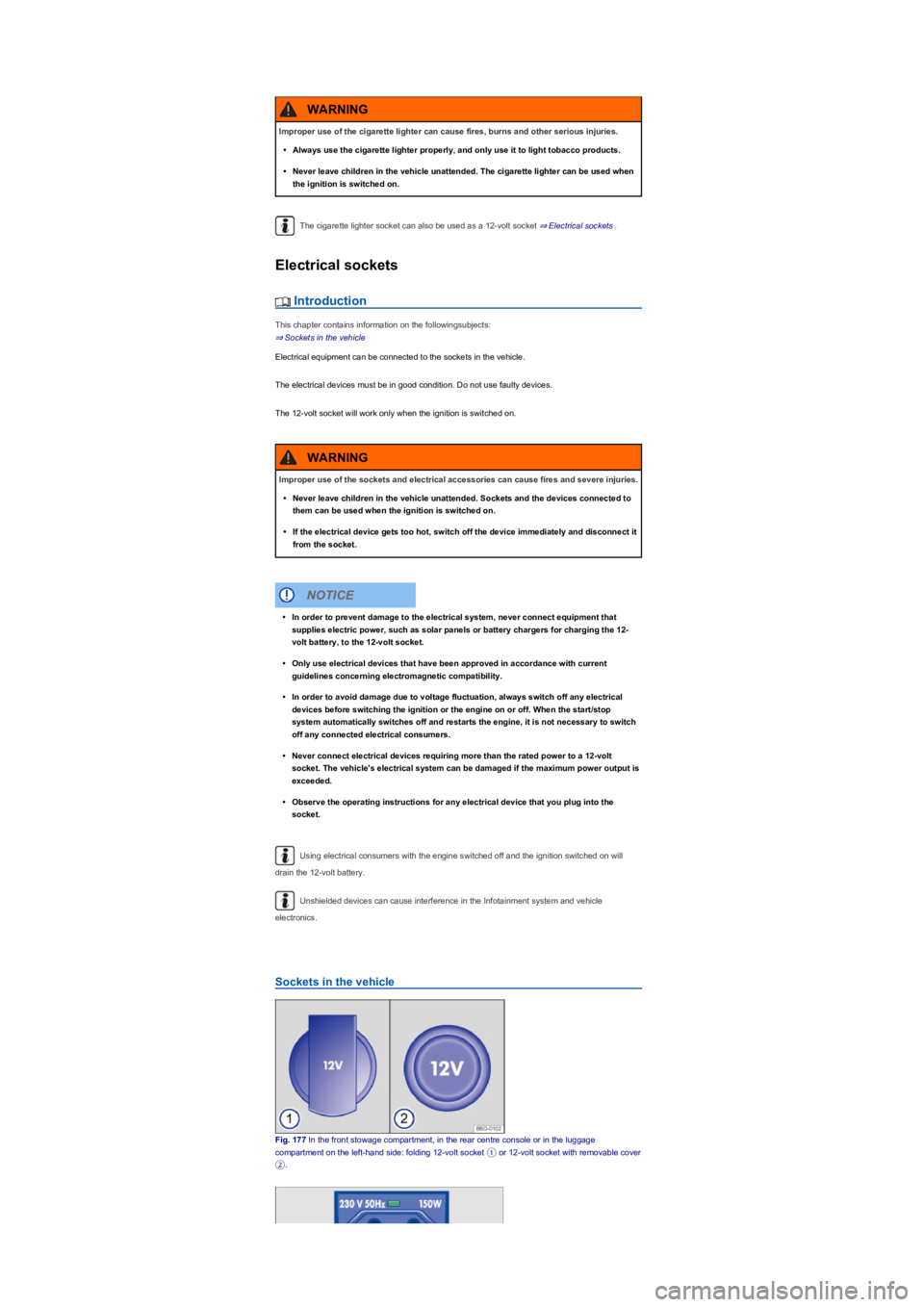
Fig. 177 In the front stowage compartment, in the rear centre console or in the luggage
compartment on the left-hand side: folding 12-volt socket ① or 12-volt socket with removable cover
②.
Improper use of the cigarette lighter can cause fires, burns and other serious injuries.
•Always use the cigarette lighter properly, and only use it to light tobacco products.
•Never leave children in the vehicle unattended. The cigarette lighter can be used when
the ignition is switched on.
WARNING
Improper use of the sockets and electrical accessories can cause fires and severe injuries.
•Never leave children in the vehicle unattended. Sockets and the devices connected to
them can be used when the ignition is switched on.
•If the electrical device gets too hot, switch off the device immediately and disconnect it
from the socket.
WARNING
•In order to prevent damage to the electrical system, never connect equipment that
supplies electric power, such as solar panels or battery chargers for charging the 12-
volt battery, to the 12-volt socket.
•Only use electrical devices that have been approved in accordance with current
guidelines concerning electromagnetic compatibility.
•In order to avoid damage due to voltage fluctuation, always switch off any electrical
devices before switching the ignition or the engine on or off. When the start/stop
system automatically switches off and restarts the engine, it is not necessary to switch
off any connected electrical consumers.
•Never connect electrical devices requiring more than the rated power to a 12-volt
socket. The vehicle's electrical system can be damaged if the maximum power output is
exceeded.
•Observe the operating instructions for any electrical device that you plug into the
socket.
NOTICE
Page 224 of 341
Volkswagen Car-Net services can be subject to regional restrictions. Availability also depends on
the mobile network coverage in each country.
Exchanging your system
If the factory-fitted Infotainment system or control unit is damaged or must be exchanged in a
vehicle with Volkswagen Car-Net services installed, go to a qualified workshop. This may require
registering or activating again.
Registration for user account on Car-Net portal
If you wish to use the Volkswagen Car-Net e-Remote, Guide & Inform or Security & Service
services in a Car-Net-compatible vehicle, you must create a user account at
www.volkswagen.com/car-net and activate Volkswagen Car-Net.
Service description
The portfolios for the e-Remote, Guide & Inform and Security & Service services are all explained in
a separate service description. This service descriptions and additional important information about
all services and Car-Net-capable vehicles are available online at www.volkswagen.com/car-net and
on the Car-Net portal once a user account has been set up.
All service descriptions are updated at irregular intervals and are available on the Car-Net portal.
Always use the latest edition of the relevant service description.
Volkswagen Car-Net services is a system based on a mobile network. If a fault arises
despite the fact that all requirements have been fulfilled, please try using the services again at a
later time.
The use of Volkswagen Car-Net and the necessary mobile network connection may be
subject to a fee. Due to the potentially high volume of data in use, Volkswagen recommends using
a mobile phone tariff which includes a data flat rate. For more information contact your mobile
telephone provider.
Data transfer via the factory-fitted SIM card reader (if possible).
Apps
First read and observe the introductoryinformation and safety warnings⇒
Introduction
•The Volkswagen Car-Net app that executes Volkswagen Car-Net services in the vehicle and
that can provide information.
•Volkswagen App-Connect allows content from Volkswagen apps and third party apps on mobile
devices to be shown on the Infotainment system screen.
There may be problems with compatibility with third party apps.
Applications, their use and the necessary mobile network connection may be subject to charges.
A wide range of applications may be available and they can be vehicle-specific and country-specific
⇒. Content, range and provider of applications can vary. Some applications also depend on
availability of services offered by third parties.
We are unable to guarantee that the available apps can be run on all mobile devices and all
operating systems.
Applications offered by Volkswagen can be changed, set, deactivated, reactivated and expanded
without prior notice.
Transporting
Stowing luggage and loads
Cargo and luggage can be transported in the vehicle, on a trailer ⇒ Technical requirements and on
the roof ⇒ Roof carrier. Always observe the legal regulations.
Stowing luggage safely in the vehicle
•Always distribute any loads in the vehicle as evenly as possible.
•Always stow luggage and heavy objects in the luggage compartment ⇒.
•Place heavy objects as far forward in the luggage compartment as possible.
•Observe gross axle weight ratings and the gross vehicle weight rating ⇒ Information on
technical data.
•Secure luggage in the luggage compartment to the fastening rings using suitable fixing and
securing straps ⇒ Luggage compartment equipment.
•Also stow small objects safely.
1)
Page 225 of 341
•If necessary, fold back the rear seat backrest and allow it to engage securely.
•If necessary, adjust the headlight range ⇒ Headlights.
•Adjust the tyre pressure according to the vehicle load. Observe the tyre pressure sticker ⇒ Tyre
pressure.
•In vehicles with a tyre monitoring system, set the new vehicle load level as necessary ⇒ Tyre
monitoring systems.
Do not cover the ventilation openings in the area around the rear window as this prevents
stale air escaping from the vehicle.
Luggage compartment cover
Fig. 181 In the luggage compartment: removing and installing the luggage compartment cover.
Objects that are not secured, or are secured incorrectly, can cause serious injuries in the
event of a sudden driving or braking manoeuvre or accident. This applies particularly if
objects are struck by the airbag when activated and then flung through the vehicle
interior. To reduce the risk of accidents, please observe the following guidelines:
•Always stow all objects in the vehicle securely.
•Small and light objects should also be secured.
•Objects should be stowed in the vehicle interior in such a way that they can never
enter the airbag deployment zones while the vehicle is in motion.
•Always keep stowage compartments closed while the vehicle is in motion.
•Stowed objects must never cause passengers to assume an incorrect sitting position.
•If an item is being stowed on a seat, this seat must not be used by any passengers.
•Do not stow any hard, heavy or sharp objects loose in any of the vehicle's open
stowage areas, on the surface behind the rear seat backrest or on the dash panel.
•Remove any hard, heavy or sharp objects from items of clothing and bags inside the
vehicle and stow them securely.
WARNING
Transporting heavy objects changes the vehicle's handling and increases the braking
distance. Heavy loads that are not properly stowed or secured in the vehicle can lead to a
loss of vehicle control and can cause serious injury.
•Never exceed the vehicle's maximum payload. Both the payload and the distribution of
the load in the vehicle will have an effect on the driving response and braking distance
of the vehicle.
•Transporting heavy objects changes the vehicle's handling and the centre of gravity.
•The payload should be distributed as evenly as possible in the vehicle.
•Always secure heavy objects in the luggage compartment as far in front of the rear axle
as possible.
•Loose objects in the luggage compartment can suddenly slide and change the way the
vehicle handles.
•Always adapt your speed and driving style to suit visibility, weather, road and traffic
conditions.
•Accelerate carefully and gently.
•Avoid sudden braking and driving manoeuvres.
•Brake earlier than in normal driving.
WARNING
Objects rubbing against the rear windows may damage or destroy the heating wires or,
depending on the vehicle equipment, also the aerial.
NOTICE
Page 226 of 341
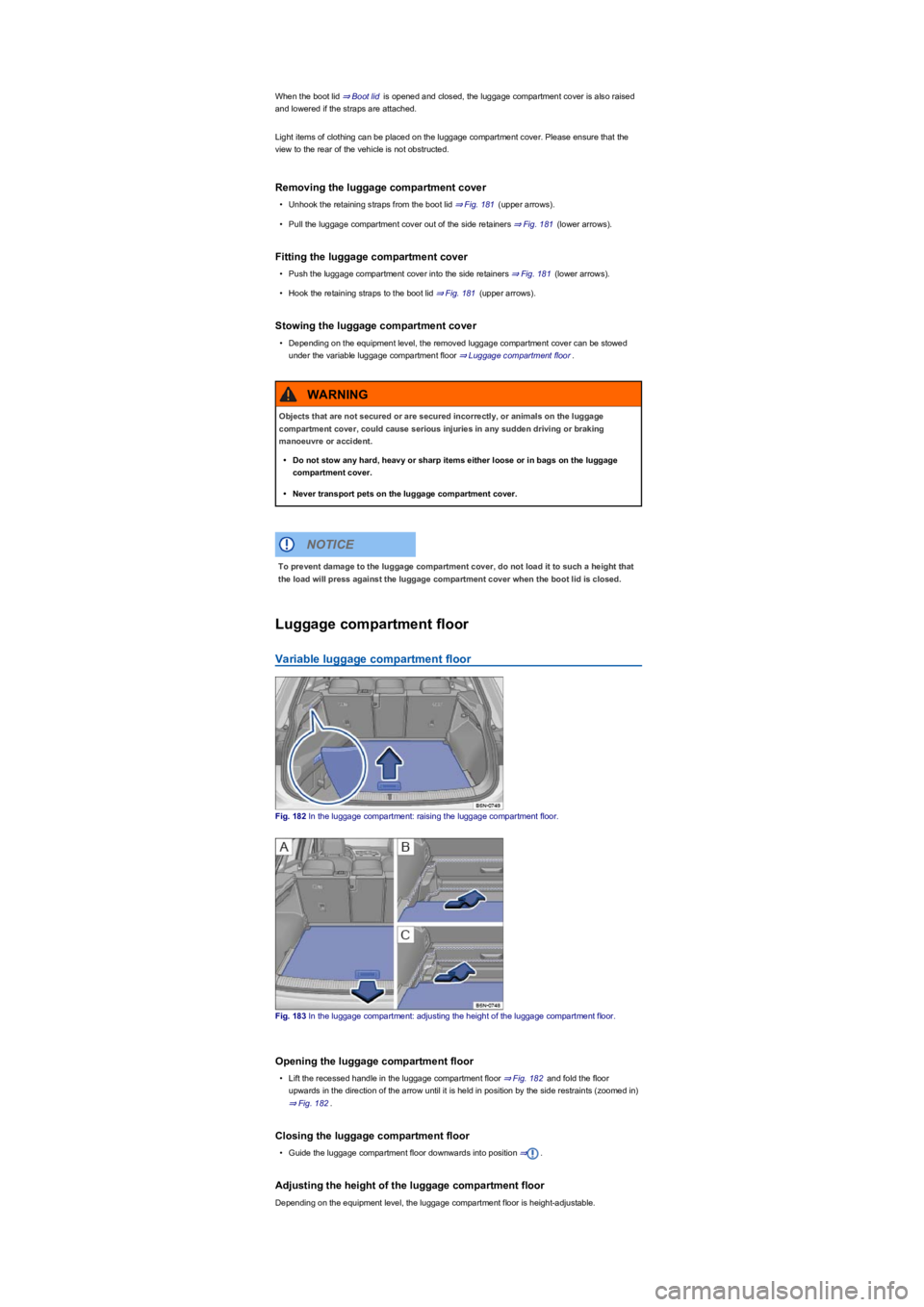
When the boot lid ⇒ Boot lid is opened and closed, the luggage compartment cover is also raised
and lowered if the straps are attached.
Light items of clothing can be placed on the luggage compartment cover. Please ensure that the
view to the rear of the vehicle is not obstructed.
Removing the luggage compartment cover
•Unhook the retaining straps from the boot lid ⇒ Fig. 181 (upper arrows).
•Pull the luggage compartment cover out of the side retainers ⇒ Fig. 181 (lower arrows).
Fitting the luggage compartment cover
•Push the luggage compartment cover into the side retainers ⇒ Fig. 181 (lower arrows).
•Hook the retaining straps to the boot lid ⇒ Fig. 181 (upper arrows).
Stowing the luggage compartment cover
•Depending on the equipment level, the removed luggage compartment cover can be stowed
under the variable luggage compartment floor ⇒ Luggage compartment floor.
Luggage compartment floor
Variable luggage compartment floor
Fig. 182 In the luggage compartment: raising the luggage compartment floor.
Fig. 183 In the luggage compartment: adjusting the height of the luggage compartment floor.
Opening the luggage compartment floor
•Lift the recessed handle in the luggage compartment floor ⇒ Fig. 182 and fold the floor
upwards in the direction of the arrow until it is held in position by the side restraints (zoomed in)
⇒ Fig. 182.
Closing the luggage compartment floor
•Guide the luggage compartment floor downwards into position ⇒.
Adjusting the height of the luggage compartment floor
Depending on the equipment level, the luggage compartment floor is height-adjustable.
Objects that are not secured or are secured incorrectly, or animals on the luggage
compartment cover, could cause serious injuries in any sudden driving or braking
manoeuvre or accident.
•Do not stow any hard, heavy or sharp items either loose or in bags on the luggage
compartment cover.
•Never transport pets on the luggage compartment cover.
WARNING
To prevent damage to the luggage compartment cover, do not load it to such a height that
the load will press against the luggage compartment cover when the boot lid is closed.
NOTICE
Page 230 of 341
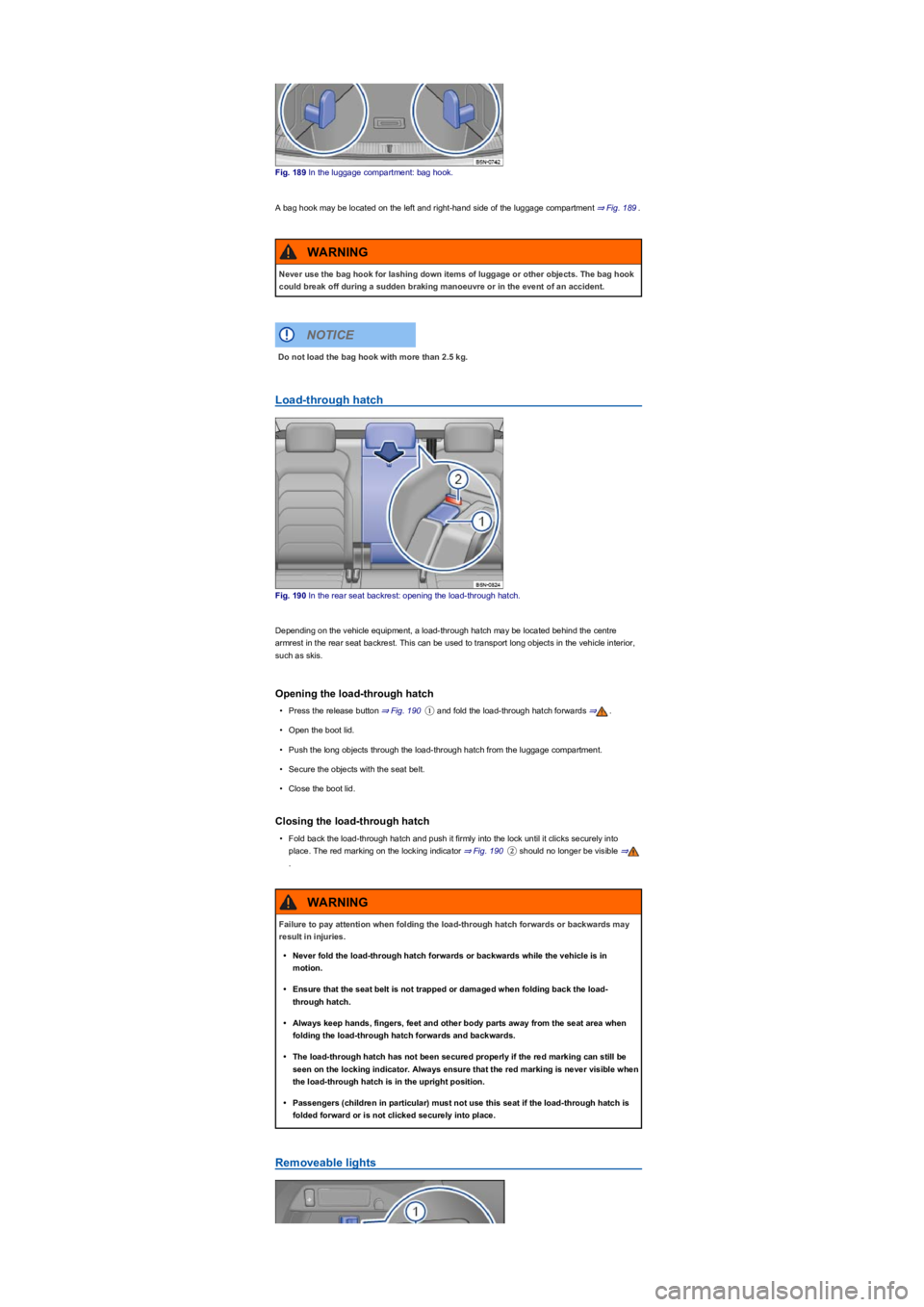
Fig. 189 In the luggage compartment: bag hook.
A bag hook may be located on the left and right-hand side of the luggage compartment ⇒ Fig. 189.
Load-through hatch
Fig. 190 In the rear seat backrest: opening the load-through hatch.
Depending on the vehicle equipment, a load-through hatch may be located behind the centre
armrest in the rear seat backrest. This can be used to transport long objects in the vehicle interior,
such as skis.
Opening the load-through hatch
•Press the release button ⇒ Fig. 190① and fold the load-through hatch forwards ⇒.
•Open the boot lid.
•Push the long objects through the load-through hatch from the luggage compartment.
•Secure the objects with the seat belt.
•Close the boot lid.
Closing the load-through hatch
•Fold back the load-through hatch and push it firmly into the lock until it clicks securely into
place. The red marking on the locking indicator ⇒ Fig. 190② should no longer be visible ⇒
.
Removeable lights
Never use the bag hook for lashing down items of luggage or other objects. The bag hook
could break off during a sudden braking manoeuvre or in the event of an accident.
WARNING
Do not load the bag hook with more than 2.5 kg.
NOTICE
Failure to pay attention when folding the load-through hatch forwards or backwards may
result in injuries.
•Never fold the load-through hatch forwards or backwards while the vehicle is in
motion.
•Ensure that the seat belt is not trapped or damaged when folding back the load-
through hatch.
•Always keep hands, fingers, feet and other body parts away from the seat area when
folding the load-through hatch forwards and backwards.
•The load-through hatch has not been secured properly if the red marking can still be
seen on the locking indicator. Always ensure that the red marking is never visible when
the load-through hatch is in the upright position.
•Passengers (children in particular) must not use this seat if the load-through hatch is
folded forward or is not clicked securely into place.
WARNING
Page 239 of 341
If there is a fault in the vehicle or trailer electrical systems or in the anti-theft alarm or if there
is a fault in the anti-theft alarm, have the vehicle checked by a qualified workshop.
If the engine is not running and electrical equipment is switched on in the trailer via the trailer
socket, the 12-volt vehicle battery will discharge.
If the 12-volt vehicle battery charge level is low, the electrical connection to the trailer will be
interrupted automatically.
Loading the trailer
First read and observe the introductoryinformation and safety warnings⇒
Introduction
Trailer weight and drawbar load
The trailer weight is the weight that the vehicle can pull ⇒. The drawbar load is the load that is
exerted vertically from above onto the ball head of the towing bracket ⇒ Information on technical
data.
The figures for trailer weights and draw bar weights that are given on the data plate of the towing
bracket are for certification purposes only. The correct values for your specific model, which may be
lower than these figures, are given in the vehicle registration documents. All data in the official
vehicle documents take precedence over these data.
The maximum permitted drawbar load exerted by the trailer drawbar on the ball head of the towing
bracket must not exceed 100 kg.
In the interest of driving safety, Volkswagen recommends that you always use the maximum
drawbar load. The response of the trailer on the road will be poor if the drawbar load is too small.
The drawbar load increases the weight on the rear axle and reduces the maximum load level as a
result.
Gross combination weight rating
The combination weight is made up of the actual weight of the loaded vehicle and of the loaded
trailer.
In some countries, trailers are divided into different classes. Volkswagen recommends that you
contact a qualified workshop to find out about suitable trailers.
Loading the trailer
The weight of the load should be distributed evenly. The maximum permitted drawbar load should
be utilised. Do not place the load only at the front or the rear of the trailer:
•Distribute the load in the trailer so that heavy objects are either over or as near to the axle as
possible.
•Secure all loads on the trailer properly.
Tyre pressure
Follow the trailer manufacturer's recommendations concerning the tyre pressure for the trailer tyres.
When towing a trailer, inflate the tyres on the towing vehicle with the maximum permitted tyre
pressure ⇒ Tyre pressure.
Accidents and serious injuries can occur if you exceed the vehicle's maximum permitted
gross axle weight rating, drawbar load, gross vehicle weight rating or gross combination
weight rating.
•Never exceed the specified values.
•Never let the actual weights at the front and rear axles exceed the gross axle weight
ratings. Never exceed the permissible gross vehicle weight for the vehicle with weight
at the front and rear of the vehicle.
WARNING
Loads that may slide can severely impair stability and driving safety, which can cause
accidents and severe injuries.
•Always load trailers correctly.
•Always secure loads properly using suitable and undamaged securing straps.
WARNING
Page 248 of 341
The refill bottle must be disposed of in accordance with regulations governing the protection
of the environment.
Catalytic converter
First read and observe the introductoryinformation and safety warnings⇒
Introduction
To help ensure long-term functionality in the exhaust system and the catalytic converter:
•Use unleaded petrol only ⇒ Fuel types and refuelling.
•Do not allow the fuel tank to run completely empty.
•Do not overfill engine oil ⇒ Engine oil.
•Do not tow start the vehicle. Use jump leads ⇒ Jump starting.
If you notice misfiring, uneven running or loss of power when the vehicle is moving, reduce speed
immediately. The vehicle should be inspected at the nearest qualified workshop
⇒ Troubleshooting. If this happens, unburnt fuel can enter the exhaust system and escape into the
atmosphere. The catalytic converter can also be damaged by overheating.
The emissions may have a sulphur-like smell even if the emission purification system is
working properly.
Particulate filter
First read and observe the introductoryinformation and safety warnings⇒
Introduction
Function
The particulate filter filters out soot particles in the exhaust gas. Observe the following points to
ensure that the exhaust purification system will work properly for a long time:
AdBlue is an irritant and corrosive fluid that can damage the skin, eyes and breathing
passages upon contact.
•Always observe the instructions for use when using AdBlue. If containers are used
according to the instructions, it is unlikely that a user will come into contact with
AdBlue.
•AdBlue must be kept in the closed original container. Never use empty food
containers, bottles or other containers for this purpose.
•Always store in a safe place out of reach of children.
•If AdBlue gets into the eyes, immediately rinse the eyes with plenty of water for at
least 15 minutes and consult a doctor.
•If AdBlue gets onto the skin, immediately wash the area with plenty of water for at
least 15 minutes and consult a doctor if the skin becomes irritated.
•If AdBlue is swallowed, immediately rinse the mouth out with lots of water for at least
15 minutes. Do not induce vomiting unless instructed to do so by a doctor. Seek
medical assistance immediately.
CAUTION
®
®
®
®
®
®
®
Overfilling AdBlue may damage the tank system and the vehicle.
•Do not fill with more than the maximum refill quantity indicated on the instrument
cluster display.
•Remove any spilt AdBlue as quickly as possible with a damp cloth and plenty of cold
water.
•If the AdBlue has already formed crystals, use warm water and a sponge to remove.
NOTICE
®
®
®
Improper use of AdBlue may cause damage to the vehicle that is not covered by the
warranty.
•Only use AdBlue that complies with the standard ISO 22241-1.
•Do not mix with water, fuel or additives.
•Never fill AdBlue in the diesel tank.
•Do not transport the refill bottle in the vehicle habitually. The bottle may develop a leak
following changes in temperature and damage and the AdBlue may damage the
vehicle interior.
NOTICE
®
®
®
®