low outside VOLKSWAGEN TRANSPORTER 2014 Owner's Guide
[x] Cancel search | Manufacturer: VOLKSWAGEN, Model Year: 2014, Model line: TRANSPORTER, Model: VOLKSWAGEN TRANSPORTER 2014Pages: 486, PDF Size: 69.28 MB
Page 325 of 486
:
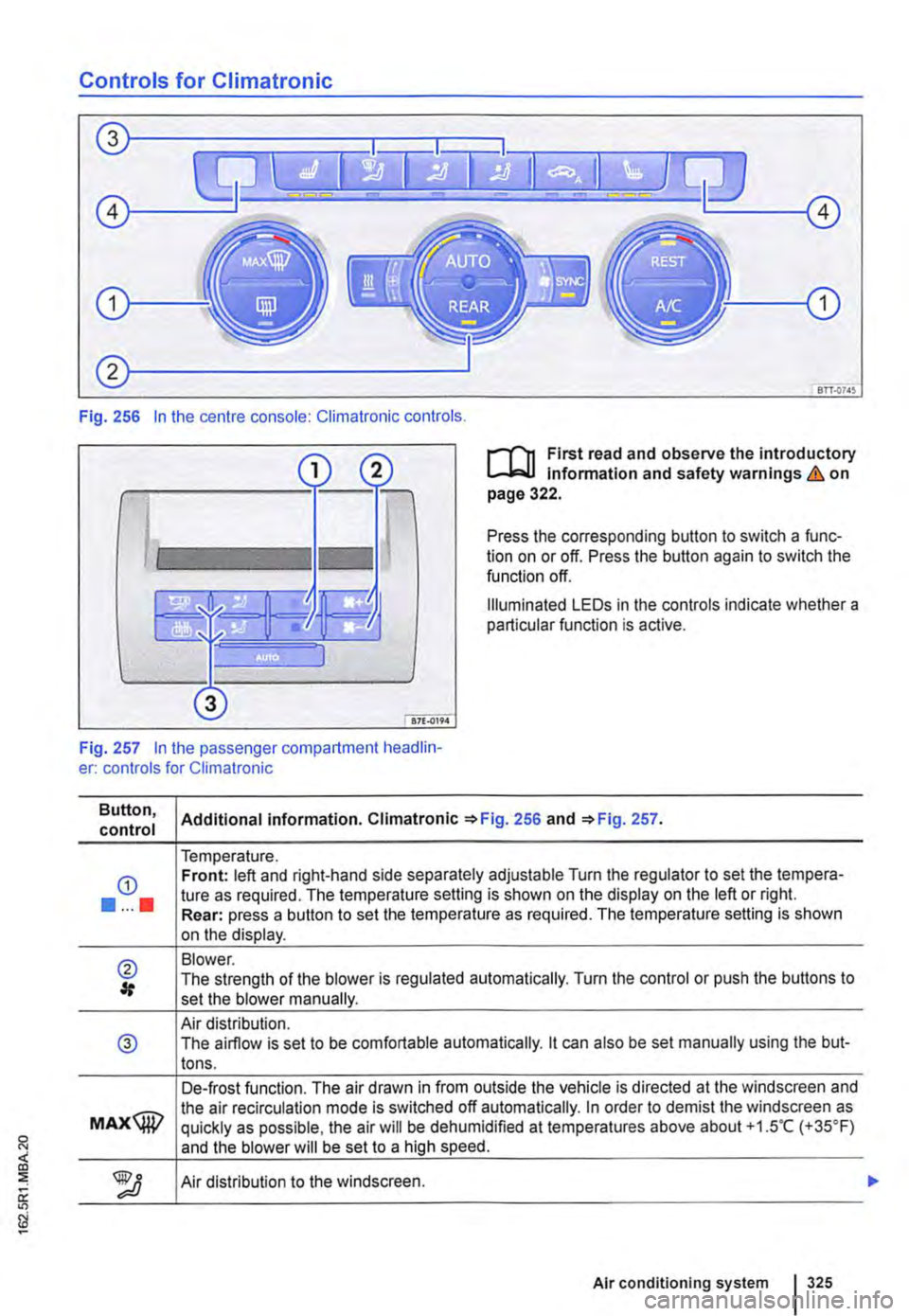
Controls for Climatronic
Fig. 256 In the centre console: Climatronic controls.
l"'"l'"'n First read and observe the introductory l.-Jo:.l.l Information and safety warnings & on page 322.
Press the corresponding button to switch a func-tion on or off. Press the button again to switch the function off.
Illuminated LEDs in the controls indicate whether a particular function is active.
Fig. 257 In the passenger compartment headlin-er: controls for Climatronic
Button, control
G)
•••••
® #
@
MAX@
Additional information. Climatronic =>Fig. 256 and =>Fig. 257.
Temperature. Front: left and right-hand side separately adjustable Turn the regulator to set the tempera-ture as required. The temperature setting is shown on the display on the left or right. Rear: press a button to set the temperature as required. The temperature setting is shown on the display.
Blower. The strength of the blower is regulated automatically. Turn the control or push the buttons to set the blower manually.
Air distribution. The airflow is set to be comfortable automatically. lt can also be set manually using the but-tons.
De-frost function. The air drawn in from outside the vehicle is directed at the windscreen and the air recirculation mode is switched off automatically. In order to demist the windscreen as quickly as possible, the air will be dehumidified at temperatures above about +1.5"C (+35°F) and the blower will be set to a high speed.
Air distribution to the windscreen.
Air conditioning system 325
Page 328 of 486
Settings for optimal road visibility
• Switch off air recirculation mode 330.
• Set blower® to level 1 or 2.
• Set the temperature selector G) to the required position.
• Open and position all vents on the dash panel.
• Turn the air distribution Fig. 258 0 to the desired position.
Rear window heating
A button for the rear window heating @ may be contained in the dash panel.
• When the engine is running, press the @ but-ton to switch on the rear window heating.
• The rear window heating is switched off auto-matically after approx. 10 minutes. To switch it off before the automatic switch-off, press the(!) but-ton again.
A WARNING
Stale air can quickly make the driver tired and affect their concentration, which in turn can cause collisions, accidents and serious inju-ries.
• Never switch off the blowers or switch on the air recirculatlon mode for an extended pe-riod as this prevents fresh air from entering the vehicle Interior.
.........r'n First read and observe the Introductory L-.lr:.ll Information and safety warnings & on page 322.
The cooling system for the vehicle interior only works when the engine is running and the blower is switched on.
The air conditioning system operates most effec-tively with the windows and the sliding/tilting roof closed. However, if the vehicle has heated up after standing in the sun for some time, the air inside can be cooled more quickly by opening the win-dows and the sliding/tilting roof for a short time.
Settings for optimal road visibility
Switching the cooling system on not only reduces the temperature of the vehicle interior, but also the humidity. This improves comfort for the vehicle oc-cupants and prevents the windows from misting when the outside humidity is high.
Climatic
• Switch off air recirculation mode 330.
• Set the blowers to the required level.
• Set the temperature to +22•c (+72.F).
• Open and position all vents on the dash panel 329.
• Turn the air distribution controller to the desired position.
• Press the@) button to switch the cooling sys-tem on. The indicator lamp in the button lights up.
328 I While driving
Cllmatronlc
• Press button.
• Set the temperature to +22•c (+72.F).
• Open and position all vents on the dash panel 329.
The cooling system cannot be switched on
The following criteria may prevent the cooling sys-tem from being switched on:
• The engine is not running.
• The blower is switched off.
• The air conditioning system fuse has blown.
• The ambient temperature is lower than approxi-mately +3"C (+38°F).
• The compressor has been temporarily switched off because the coolant temperature is too high.
• There is a different fault in the vehicle. The air conditioning system should be checked by a quali-fied workshop.
Things to note
If the humidity and temperature outside the vehicle are high, condensation can drip off the evaporator in the cooling system and form a pool underneath the vehicle. This is normal and does not indicate a
Page 330 of 486
Air recirculation mode
.-r'n First read and observe the introductory information and safety warnings .1:!. on page 322.
General notes
There are different types of air recirculation mode:
Manual air recirculation mode (Heating and fresh air system).
Manual air recirculation mode (air condi-tioning system).
Left indicator lamp lit up in the button: manual air recirculation mode (Ciima-
------------Right indicator lamp lit up in the button: automatic air recircutation mode (Ciima-tronic).
The air recirculation mode prevents outside air from entering the vehicle.
if the outside temperature is very low or very high, the manual air recirculation mode should be selec-ted for a short time in order to heat or cool the ve-hicle interior more quickly.
For safety reasons, the air recirculation mode will switch off if the@ button is pressed, or if the air distribution regulator is switched to lliil => .1:!,.
Switching the manual air recirculation mode on and off .o I c:;;:,
Switching on: press button repeatedly until the indicator lamp in the button lights up.
Switching off. press@) button until the indi-cator lamp in the button is no longer lit up.
Switching the manual air recirculation mode on and off in the Climatronic e<>A
Switching on: press the button until the left in-dicator lamp in the button tights up.
Switching off. press the repeatedly until the indicator lamp in the button is no longer lit up.
Function of the automatic air recirculation mode e<>A
In position a>• fresh air will enter the vehicle interi-or. The air recirculation mode will switch on auto-matically if the system detects an increase in the
330 I While driving
concentration of noxious substances in the outside air. The air recirculation mode will switch off as soon as this level has returned to normal.
The system cannot detect unpleasant odours.
The air recirculation mode will not be switched on automatically in certain circumstances such as when the ambient temperature is low or the air conditioning system has been switched on.
Switching the automatic air recirculation mode on and off
Switching on: press button repeatedly until the right indicator lamp in the button lights up.
Switching off: press button repeatedly until the indicator lamp in the button is no longer lit up.
A WARNING
Stale air can quickly make the driver tired and affect their concentration, which In turn can cause collisions, accidents and serious inju-ries.
• Never use the air reclrculation mode for an extended period as no fresh air will enter the vehicle Interior.
• If the cooling system is switched off, the windows can mist up very quickly In air recir-culatlon mode and reduce visibility consider-ably.
• Always switch off the air reclrculation mode when it is not required.
CD
In vehicles with an air conditioning system, do not smoke when the air reclrculatlon mode Is switched on. The smoke drawn Into the cooling system can leave a residue on the evaporator and the dust and pollen filter with active carbon insert, producing a lasting unpleasant odour.
m Cllmatronic: when reversing the vehicle, or l!J when the wash and wipe system is being used, the air recirculation mode will switch on tem-porarily to prevent exhaust emissions from entering the vehicle interior.
Page 331 of 486
Windscreen heating
1111 First read and observe the introductory L.-J,::.U information and safety warnings & on page 322.
Windscreen heating helps to de-ice the
windscreen and only works when the en-
gine is running.
Switching on and off
Press the button ®in the centre console or the Climatronic to switch the windscreen heating on and off.
Roof ventilator
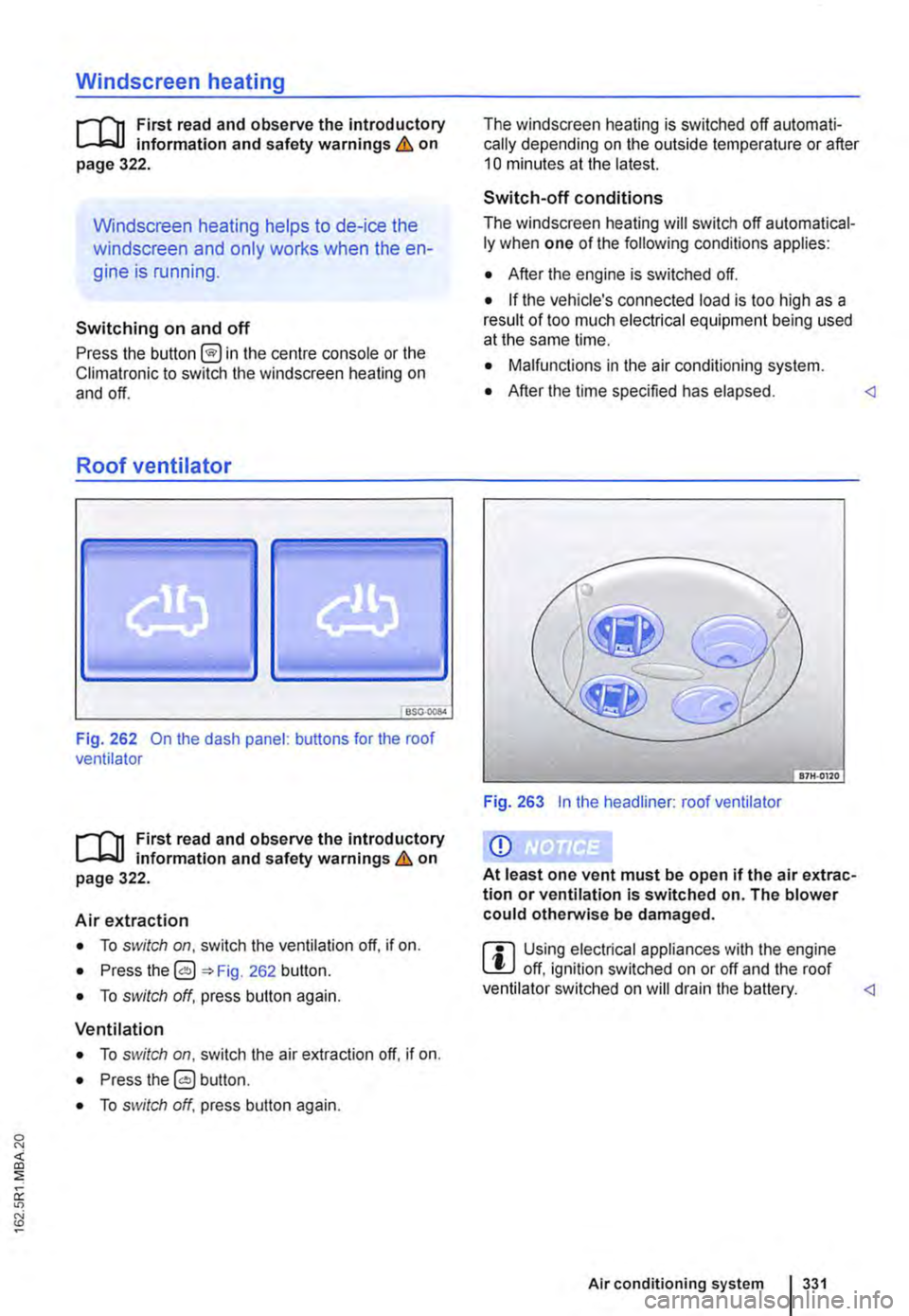
BS0-000<
Fig. 262 On the dash panel: buttons for the roof ventilator
1111 First read and observe the introductory L.-J,::.U Information and safety warnings & on page 322.
Air extraction
• To switch on, switch the ventilation off, if on.
• Press the 0 262 button.
• To switch off, press button again.
Ventilation
• To switch on, switch the air extraction off. if on.
• Press the 0 button.
• To switch off, press button again.
The windscreen heating is switched off automati-cally depending on the outside temperature or after 10 minutes at the latest.
Switch-off conditions
The windscreen heating will switch off automatical-ly when one of the following conditions applies:
• After the engine is switched off.
• If the vehicle's connected load is too high as a result of too much electrical equipment being used at the same lime.
• Malfunctions in the air conditioning system.
• After the time specified has elapsed.
Q)
At least one vent must be open if the air extrac-tion or ventilation Is switched on. The blower could otherwise be damaged.
ffi Using electrical appliances with the engine L!J off, ignition switched on or off and the roof ventilator switched on will drain the battery.
Page 339 of 486
Switching the childproof lock on and off
B7f·0201
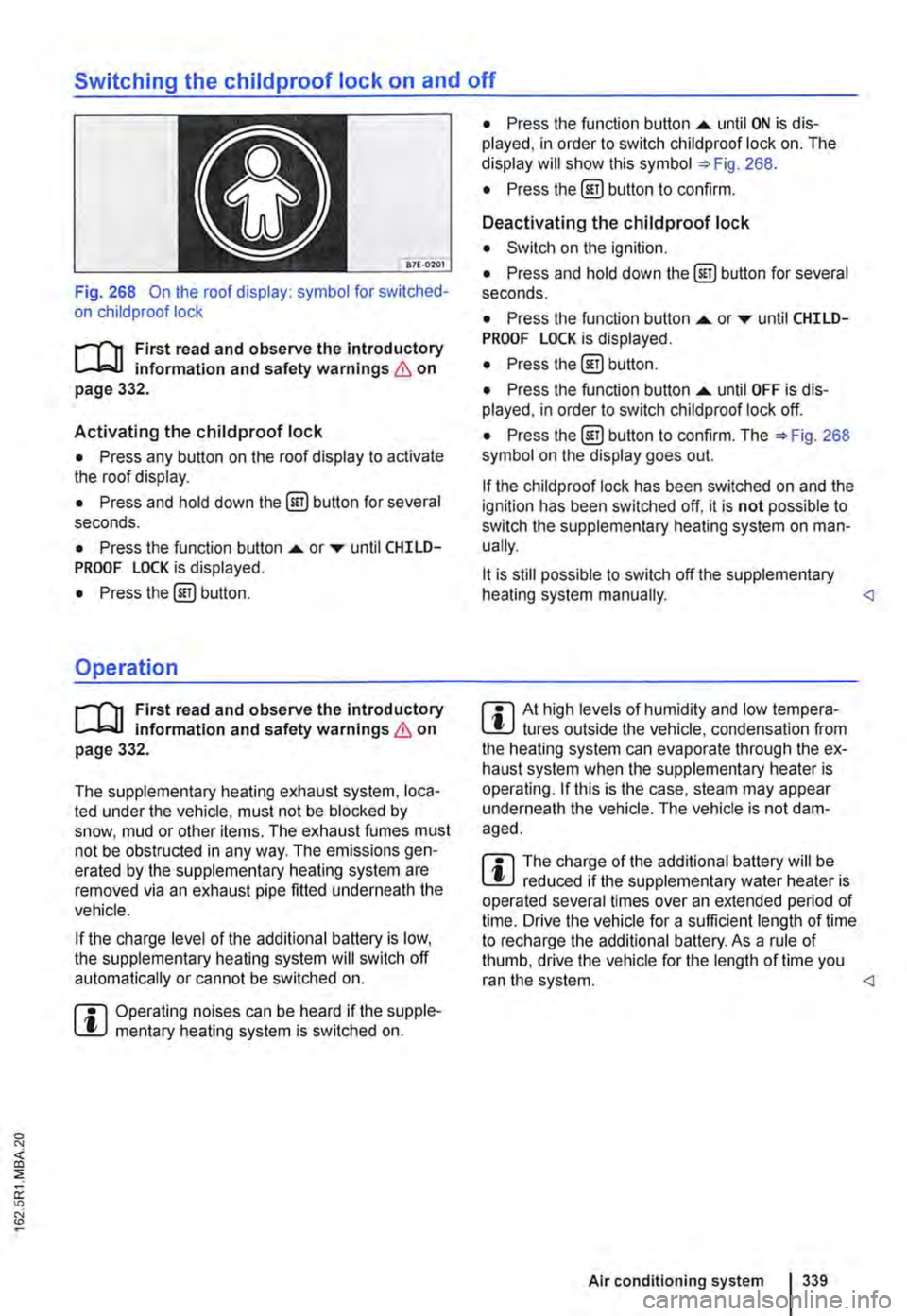
Fig. 268 On the roof display: symbol for switched-on child proof lock
r-T'n First read and observe the introductory L-.bU information and safety warnings & on page 332.
Activating the childproof lock
• Press any button on the roof display to activate the roof display.
• Press and hold down the @) button for several seconds.
• Press the function button .... or ..-until CHILD-PROOF LOCK is displayed.
• Press the@) button.
Operation
r-T'n First read and observe the introductory L-.bU information and safety warnings & on page 332.
The supplementary heating exhaust system, loca-ted under the vehicle, must not be blocked by snow, mud or other items. The exhaust fumes must not be obstructed in any way. The emissions gen-erated by the supplementary heating system are removed via an exhaust pipe fitted underneath the vehicle.
If the charge level of the additional battery is low, the supplementary heating system will switch off automatically or cannot be switched on.
m Operating noises can be heard if the supple-l!J mentary heating system is switched on.
• Press the function button .... until ON is dis-played, in order to switch child proof lock on. The display will show this symbol =>Fig. 268.
• Press the @] button to confirm.
Deactivating the childproof lock
• Switch on the ignition.
• Press and hold down the@] button for several seconds.
• Press the function button....._ or..-until CHILD-PROOF LOCK is displayed.
• Press the@) button.
• Press the function button .... until OFF is dis-played. in order to switch child proof lock off.
• Press the@) button to confirm. The =>Fig. 268 symbol on the display goes out.
If the child proof lock has been switched on and the ignition has been switched off, it is not possible to switch the supplementary heating system on man-ually.
lt is still possible to switch off the supplementary heating system manually.
r::l The charge of the additional battery will be W reduced if the supplementary water heater is operated several times over an extended period of time. Drive the vehicle for a sufficient length of time to recharge the additional battery. As a rule of thumb, drive the vehicle for the length of time you ran the system.
Page 345 of 486
CD
• Fuels that are identified at the fuel pump as containing metallic additives may not be used. LRP fuel (lead replacement petrol) also con-tains high concentrations of metallic additives. Risk of engine damage I
Diesel
r'""'('n First read and observe the Introductory L-J,:.U Information and safety warnings & on page 343.
Diesel
Diesel fuel must comply with the European stand-ard EN 590 (in Germany DIN EN 590).
The service intervals are shorter if you use diesel with a high sulphur content =>Booklet Service schedule =>CD. A Volkswagen Commercial Vehicles dealership will be able to tell you which countries have diesel with a high sulphur content.
Where diesel fuel complying with the EN 590 standard is not available, Volkswagen Commercial Vehicles dealerships and filling stations will have information on which fuels do comply with the EN 590 standard.
Do not mix fuel additives (thinners. or similar addi-tives) with diesel.
Winter diesel
When using summer-grade diesel. difficulties may be experienced at temperatures below o•c (+32.F)
because the fuel thickens due to paraffin separa-tion. For this reason winter-grade diesel which can be used at temperatures below -2o•c (·4°F) is available in countries such as Germany during the cold months.
In countries with different climatic conditions the diesel sold generally has different temperature characteristics. Check with a Volkswagen Com-mercial Vehicles dealer or filling stations in the country concerned regarding the type of diesel fuels available.
it is not unusual for a cold diesel engine to be loud-er in cold temperatures that in warm weather. In addition, exhaust emissions may be tinged with blue while the engine starts and reaches operating temperature. The amount of exhaust fumes de-pends on the outside temperature.
CD
• Just one tankful of leaded fuel, or fuel con-taining other metallic additives, can seriously Impair the efficiency of the catalytic converter and can also cause considerable damage to the catalytic converter and engine.
Diesel vehicles are equipped with a filter pre-heat-er system. This ensures that the fuel system re-mains operational even down to approximately -24•c (-11.F) provided that winter-grade diesel which is safe down to -15•c (+5.F) is used.
However, if the fuel has thickened to such an ex-tent that the engine will not start at temperatures below -24•c (-11.F) simply place the vehicle in a warm garage or workshop for a while.
Supplementary heater
Vehicles fitted with a diesel engine may also be equipped with a fuel-driven supplementary heater. This heater is powered with fuel from the vehicle tank. In this case, odour and water vapour may es-cape from the vehicle, and there may be a greater quantity of smoke. This is quite normal when the system is in use, and does not indicate damage or a fault in the system.
The supplementary heater will be switched off au-tomatically if the level in the fuel tank is low (re-serve level).
A WARNING
Never use a start booster. Start boosters may explode or cause the engine to suddenly run at high revs, which can cause serious Injuries and engine damage.
CD
• Before filling up with diesel, check whether the fuel corresponds to the vehicle's require-ments according to the fuel standard Informa-tion at the pump.
• Only use fuel that complies with the EN 590 standard and has the correct cetane number. Otherwise, the engine and the fuel system can suffer considerable damage. The engine can al-so lose power or fall. ..,.
At the filling station 1345
Page 376 of 486
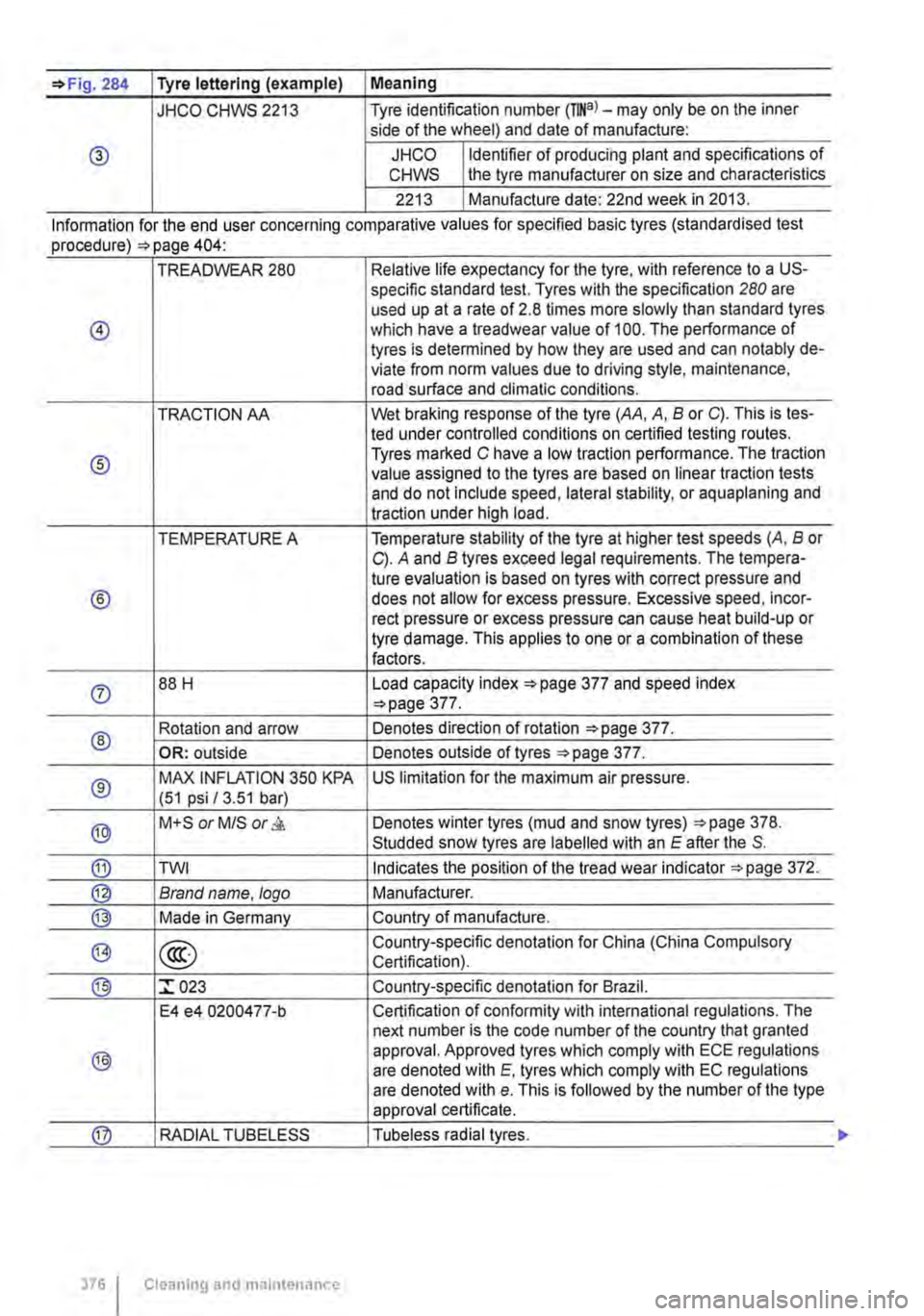
=>Fig. 284 Tyre lettering (example) I Meaning
JHCO CHWS 2213 Tyre identification number (TINa)-may only be on the inner side of the wheel) and date of manufacture:
® JHCO Identifier of producing plant and specifications of CHWS the tyre manufacturer on size and characteristics
2213 Manufacture date: 22nd week in 2013.
Information for the end user concernmg comparat1ve values for spec1fied bas1c tyres (standardised test procedure) =>page 404·
TREADWEAR 280 Relative life expectancy for the tyre, with reference to a US-specific standard test. Tyres with the specification 280 are used up at a rate of 2.8 times more slowly than standard tyres
@ which have a treadwear value of 100. The performance of tyres is determined by how they are used and can notably de-viate from norm values due to driving style, maintenance, road surface and climatic conditions.
TRACTION AA Wet braking response of the tyre (AA, A, B or C). This is tes-led under controlled conditions on certified testing routes.
® Tyres marked C have a low traction performance. The traction value assigned to the tyres are based on linear traction tests and do not include speed, lateral stability, or aquaplaning and traction under high load.
TEMPERATURE A Temperature stability of the tyre at higher test speeds (A, B or C). A and B tyres exceed legal requirements. The tempera-tu re evaluation is based on tyres with correct pressure and
® does not allow for excess pressure. Excessive speed, incor-reel pressure or excess pressure can cause heat build-up or tyre damage. This applies to one or a combination of these factors.
0 88 H Load capacity index ::.page 377 and speed index ::.page 377.
® Rotation and arrow Denotes direction of rotation ::.page 377.
OR: outside Denotes outside of tyres ::.page 377.
® MAX INFLATION 350 KPA US limitation for the maximum air pressure. (51 psi /3.51 bar)
® M+S or M/S or & Denotes winter tyres (mud and snow tyres) ::.page 378. Studded snow tyres are labelled with an E after the S.
® TWI Indicates the position of the tread wear indicator ::.page 372.
@ Brand name. logo Manufacturer.
@ Made in Germany Country of manufacture.
@> @ Country-specific denotation for China (China Compulsory Certification).
® :r 023 Country-specific denotation for Brazil.
E4 e4 0200477-b Certification of conformity with international regulations. The next number is the code number of the country that granted
® approval. Approved tyres which comply with ECE regulations are denoted with E. tyres which comply with EC regulations are denoted with e. This is followed by the number of the type approval certificate.
@ RADIAL TUBELESS Tubeless radial tyres.
376 I Cleaning and maintenance
Page 380 of 486
Vehicle care and maintenance
Caring for and cleaning the vehicle exterior
o:n Introduction
This chapter contains information on the following subjects:
Washing the vehicle . . . . . . . . . . . . . . . 381
Washing the vehicle with a high-pressure cleaner . . . . . . . . . . . . . . . . . . . . . . . . . . . 382 Cleaning windows and exterior mirrors . . . . . . 382
Cleaning and changing wiper blades 383
Waxing and polishing the vehicle 384
Cleaning and caring for chrome and aluminium trim parts . . . . . . . . . . . . . . 385
Cleaning and caring for the decorative film . . 385
Cleaning wheels . . . . . . . . . . . . . . . . . . . . . 386
Care of rubber seals . . . . . . . . . . . . . . . . . . . . . 386
De-icing door lock cylinders . . . . . . • . . . . . . . . 387
Undersea! . . . . . . . . . . . . . . . . . . . . . . . . . . . . . . 387
Cleaning the engine compartment . 387
Regular and expert care helps to maintain the val-ue of the vehicle. Proper maintenance may also be one of the requirements for the approval of warran-ty claims in the event of corrosion or paint defects.
Suitable care products are available from Volkswa-gen Commercial Vehicles dealers.
Additional information and warnings:
• Preparation for working in the engine compart-ment ::-page 350
• Cleaning and caring for the interior ::-page 388
• Accessories, modifications, repairs and renewal of parts ::-page 394
A WARNING
Car care products can be toxic and hazard-ous. Unsuitable care products and Incorrect application of care products can cause acci-dents, serious Injuries, burns or poisoning.
• The care product must be kept In Its origi-nal sealed container.
380 Cleaning and maintenance
A WARNING (Continued)
• Read the manufacturer's Instructions .
• Never store car care products in empty food containers, bottles or any other non-original containers as people finding these containers may not know that they contain care products.
• Keep children away from care products .
• The products can give off harmful fumes during use. They should therefore only be used outside or In well-ventilated spaces.
• Never use fuel, turpentine, engine oil, nail varnish remover or other volatile fluids to wash, clean or care for your vehicle. These substances are toxic and highly Inflammable.
A WARNING
Incorrect care and cleaning of vehicle parts can Impair the safety features of the vehicle and thus cause serious Injury.
• Vehicle parts must be cleaned according to the manufacturer's Instructions.
• Only use approved or recommended cleaning products.
CD
Cleaning agents that contain solvents attack the material and can cause damage.
r:Q:... In the interests of environmental protection, "C!S the vehicle should only be washed in special-ly provided wash bays. This prevents waste water contaminated with oil, grease or fuel from entering the sewerage system. In some countries, washing vehicles anywhere else may be prohibited.
r:Q:... Environmentally-friendly care products "C!S should be used.
r:Q:... Leftover car care products should not be dis-"C!S posed of with ordinary household waste. Read the manufacturer's instructions.
Page 388 of 486
r1ih In the interests of environmental protection, 'r!!S the engine compartment should be washed only in specially provided wash bays. This pre-vents toxic waste water containing oil, grease and
fuel from entering the sewerage system. In some districts, washing the engine compartment any-where else may be prohibited.
o::JJ Introduction
This chapter contains information on the following subjects:
Handling seat covers . . . . . . . . . . . . . . . . . . . . 389
Cleaning cloth seat covers, fabric trim and Alcantara® upholstery . . . . . . . . . . . . . . . . . . . . 389
Cleaning and caring for natural leather covers 391
Cleaning leatherette upholstery . . 392
Cleaning stowage compartments, drink holders and ash trays . . . . . . . . . . . . . . . . . . . . 392 Cleaning and caring for the dash panel, wooden trims and plastic parts . . . . . . . . . . 392
Cleaning seat belts . . . . . . . . . . . . . . . . . . . . . . 392 Cleaning cool box . . . . . . . . . . . . . • . . . . . . . . . 393
Cleaning seat rails . . . . . . . . . . . . . . . . . . . 393
Cleaning opaque shades 393
Modern fabrics, such as dark denim, are often not colourfast. Light-coloured upholstery (soft materials or leather) is particularly sensitive to staining caused by these fabrics, even if you are careful. This is not caused by a fault in the upholstery, but by the non-colourfast nature of the garments.
Leaving stains, dirt and other deposits on the sur-face of vehicle components and cloth seat covers for a long time can make it difficult to clean and treat them. Stains, dirt and deposits may become impossible to remove, particularly if left for a long time.
Additional information and warnings:
• Cleaning and caring for the vehicle exterior 380
• Accessories, modifications, repairs and renewal of parts 394
A WARNING
Car care products can be toxic and hazard-ous. Unsuitable care products and Incorrect application of care products can cause acci-dents, serious injuries, burns or poisoning.
388 Cleaning and maintenance
A WARNING (Continued)
• The care product must be kept In its origi-nal sealed container.
• Read the manufacturer's Instructions.
• Never store car care products in empty food containers, bottles or any other non-original containers as people finding these containers may not know that they contain care products.
• Keep children away from care products.
• The products can give off harmful fumes during use. They should therefore only be used outside or In well-ventilated spaces.
• Never use fuel, turpentine, engine oil, nail varnish remover or other volatile fluids to wash, clean or care for your vehicle. These substances are toxic and highly Inflammable.
A WARNING
Incorrect care and cleaning of vehicle parts can Impair the safety features of the vehicle and cause serious Injury.
• Vehicle parts must be cleaned according to the manufacturer's Instructions.
• Only use approved or recommended cleaning products.
CD
• Cleaning products that contain solvents at-tack the material and may cause Irreparable damage.
• Stains, dirt and other deposits containing aggressive and solvent-based Ingredients at-tack the material and may cause Irreparable damage, even If only left for a short time.
• Stains, dirt and other deposits should be re-moved as quickly as possible and not allowed to dry In.
• To avoid damage, stubborn stains should be removed by a specialist cleaning company, .,.
Page 392 of 486
Cleaning leatherette upholstery
,......-('n First read and observe the introductory information and safety warnings & on page 388.
Only use water and neutral detergents to clean the ieatherette upholstery.
CD
Do not use solvents, wax polish, shoe cream, spot removers or similar products on the leath-erette upholstery. These may cause the materi-al to become hard and brittle prematurely.
,......-('n First read and observe the introductory information and safety warnings & on page 388.
Cleaning stowage compartments and drink holders
Some stowage compartments and drink holders have a removable rubber insert in the base.
• Moisten a clean, lint-free cloth with water and clean the parts.
• If this does not provide satisfactory results, use a special solvent-free plastic cleaning product.
Cleaning the ashtray
• Remove and empty the ashtray.
• Wipe the ashtray with a cloth to clean it.
To clean the snuffer, use a toothpick or similar ob-ject to pick out the ashes.
,......-('n First read and observe the introductory Information and safety warnings & on page 388.
• Moisten a clean, lint-free cloth with water and clean the parts.
• Treat plastic parts (inside and outside the vehi-cle) and the dash panel with a special solvent-free plastic cleaning and care product that has been approved by Volkswagen Commercial Vehicles
""'&.
• Treat wooden trims with a mild soap solution.
Cleaning seat belts
,......-('n First read and observe the introductory information and safety warnings & on page 388.
Large particles of dirt on the automatic belt prevent it from roiling back properly and thus from working effectively.
The seat belts must never be removed for cleaning purposes.
3921 Cleaning and maintenance
A WARNING
Cleaning agents that contain solvents cause the surface of the airbag modules to become porous. In an accident that triggers the air-bag, loose plastic parts can cause serious in-jury.
• Never clean the dash panel or the airbag covers with cleansers that contain solvents.
• Carefully pull the dirty seat belt right out and leave it out.
• Clean the seat belt with a mild soap solution.
• Allow the seat belt fabric to dry completely.
• Do not allow the seat belt to roil up until it has dried completely. 11>