low outside VOLKSWAGEN TRANSPORTER 2014 Service Manual
[x] Cancel search | Manufacturer: VOLKSWAGEN, Model Year: 2014, Model line: TRANSPORTER, Model: VOLKSWAGEN TRANSPORTER 2014Pages: 486, PDF Size: 69.28 MB
Page 398 of 486
Retrofitting two-way radios
.--m First read and observe the introductory L-.lc.U information and safety warnings & on page 394.
You will need an external aerial to use a two-way radio in the vehicle.
Any retrofit installation of electrical or electronic equipment in the vehicle will affect its vehicle type approval. Under certain circumstances, this can negate the type approval for the vehicle.
Volkswagen Commercial Vehicles has approved the vehicle for use with two-way radios providing the following conditions are observed:
• Correct installation of external aerial.
• A maximum transmitting power of 10 watts.
The equipment can only operate at maximum range with an external aerial.
Check first with a qualified workshop if you wish to use a two-way radio with a transmitting power of over 10 watts. Qualified workshops are familiar with the technical options for retrofitting. Volkswa-gen Commercial Vehicles recommends using a Volkswagen Commercial Vehicles dealership for this purpose.
Information stored in the control units
.--m First read and observe the introductory L-.lc.U Information and safety warnings & on page 394.
Your vehicle is factory fitted with electronic control units which are responsible for engine and gearbox management. The control units also monitor the function of the exhaust system and the airbags.
These electronic control units continuously evalu-ate data relevant to the vehicle while the vehicle is being driven. Only these data will be stored if there are any faults recorded or any deviations from the specified values. This is generally displayed by the indicator lamps on the instrument cluster.
Special units are required to read and evaluate da-ta stored in the control units.
These data are stored so that specialist workshops can diagnose and solve problems. The following data may have been stored:
• Engine and gearbox-relevant data.
• Speed.
• Direction of travel.
398 Cleaning and maintenance
Please comply with relevant legislation and the in-structions and information given in the operating manuals for radio equipment.
A WARNING
If radio equipment is not secured or not prop-erly secured in the vehicle, it could be flung though the interior during a sudden driving or braking manoeuvre, or In the event of an accident. This can cause Injuries.
• While the vehicle is in motion, always se-cure radio equipment properly outside the airbag deployment zone or stow them away safely.
A CAUTION
If you use two-way radios in the car without an external aerial, electromagnetic radiation in the vehicle could exceed limit values. This also applies to external aerials which have not been correctly installed.
• Two-way radios should only be used In the vehicle If an external aerial Is properly connected.
• Braking power.
• Seat belt monitor.
The control units never record conversations that take place in the vehicle. it is neither possible nor permitted to use the stored data to create move-ment profiles.
When the vehicle is being used, situations may arise in which the stored data (alone or in conjunc-tion with other information such as accident re-ports, vehicle damage, witness statements etc.) can become assignable to a particular person, whereby consultation of an expert and use of the expert's information may be necessary.
In vehicles with an emergency call function via a mobile telephone or other units, the current loca-tion can be transmitted. In the event of an accident in which the control units register that an airbag has been triggered, the system can automatically send out a signal. This depends on your service provider. Transmission is possible only in areas
Page 402 of 486
Mobile on line services
c:QJ Introduction
This chapter contains information on the following subjects:
Volkswagen Car-Net services Applications (apps) .. 402 404
Information on the Volkswagen Car-Net
mobile online services and applications
(apps) can be transmitted directly to your
vehicle and integrated.
For information on Volkswagen Car-Net services and applications, their availability and the related technical requirements and compatible devices go to www.volkswagen-commercial-vehicles-carnet.com.
Additional information and warnings:
• 399, Using a mobile telephone in the vehicle without a connection to the external aerial
• Radio. provision for mobile tele-phone, infotainment system, navigation system
A WARNING
If mobile equipment is not secured or Is in-correctly secured in the vehicle, it could be flung though the interior during a sudden driving or braking manoeuvre, or in the event of an accident. This can cause injuries.
Volkswagen Car-Net services
r--T'n First read and observe the introductory l-J,:.lJ information and safety warnings & on page 402.
402 I Cleaning and maintenance
A WARNING (Continued)
• While the vehicle is in motion, always se-cure mobile equipment properly outside the airbag deployment zone or stow them away safely.
A WARNING
Unsuitable or incorrect use of applications and Volkswagen Car-Net services can cause damage to the vehicle, accidents or serious injury.
• Volkswagen recommends that you only use Volkswagen applications and Volkswa-gen Car-Net services for your vehicle.
• Protect the mobile device and the applica-tions on it from misuse.
• Never make changes to applications or Volkswagen Car-Net services.
• Observe the user guide for your mobile device.
A WARNING
Using applications and Volkswagen Car-Net services while driving can distract you from the road. Accidents and Injuries can occur if the driver is distracted.
• Always drive carefully and responsibly.
CD
Your mobile devices must always be switched off In areas where special regulations apply and when the use of such devices Is not per-mitted. The radiation emitted by these mobile devices when switched on could interfere with sensitive technical and medical equipment, possibly resulting in malfunction of or damage to the equipment.
Page 409 of 486
• Use unleaded petrol only.
• Do not allow the fuel tank to run empty.
• Do not overfill engine oil 353.
• Do not tow-start the vehicle. Use jump leads 443.
If you notice misfiring, uneven running or loss of power when the vehicle is moving, reduce speed Immediately. The vehicle should be inspected at
Diesel particulate filter
r-f'n First read and observe the Introductory L-J,:,.IJ Information and safety warnings & on page 407.
The diesel particulate filter filters out soot particles in the exhaust gas. The soot particles gather in the filter and are burnt under high temperatures peri-odically (regeneration). Heat produced can warm the engine.
Regeneration can cause noises, light smells and delay in radiator fan irrespective of the outside temperature, even after the engine is switched off.
To assist the regeneration of diesel particle filter, Volkswagen recommends that you avoid making only short journeys. In vehicles with a DSG® dual clutch gearbox the engine speed can increase while the vehicle is being driven. However, the indi-cator lamp • will not light up.
Observe the following points to ensure that the ex-haust system and the diesel particulate filter will work properly for a long time:
the nearest qualified workshop. If this happens, un-bumt fuel can enter the exhaust system and es-cape into the atmosphere. The catalytic converter can also be damaged by overheating.
Even when the exhaust purification system is W working perfectly, there may be a smell of sulphur from the exhaust in some conditions. This depends on the sulphur content of the fuel being used. <1
• Only use diesel with low sulphur levels 343.
• Never use biodiesel, petrol or heating oil.
• Do not allow the fuel tank to run empty.
• Do not overfill engine oil 353.
• Do not tow-start the vehicle. Use jump leads =page 443.
Even when the exhaust purification system is W working perfectly, there may be a smell of sulphur from the exhaust in some conditions. This depends on the sulphur content of the fuel being used.
m Note for courier vehicles: vehicles with diesel l!J particulate filter are identified accordingly with
Vehicle care and maintenance 409
Page 410 of 486
If and when
Practical tips
Frequently asked questions
If you suspect that a vehicle fault has arisen or your vehicle has been damaged, read and observe the following information before contacting a Volkswagen Commercial Vehicles dealership or
qualified workshop. You may also find useful infor-mation in the index under the headings "Things to note" or "Checklist".
To note Some possible causes Possible solution
Vehicle battery is discharged. -How to jump start =>page 443. -Recharge vehicle battery 362.
Engine does not start. The incorrect vehicle key is be-Use a valid vehicle key 36. ing used.
Fuel level is too low. Fill the tank 340.
Supplementary heating system Switch off the supplementary heating
Smoke is coming from the is running. system 332. wing. Supplementary heater is run-No solution 345. ning.
-Battery in the remote control -Replace the battery 36. Vehicle cannot be locked or key is flat. -Move closer to the vehicle. unlocked with the remote -Located too far away from the -Synchronise the vehicle key =>page 36. vehicle. control key. -Buttons were pressed outside -Lock or unlock the vehicle manually
the range. 413.
Cold engine. brake assist sys-Refer to the index under entries for Unusual noises. tems, supplementary heating "Noises". system.
Assist systems are active. Refer to the index under entries for "As-sist systems". Unusual handling. DSG® dual clutch gearbox is too Stop the vehicle immediately hot. 266.
Front seats cannot be ad-Vehicle battery is discharged. Recharge vehicle battery 362.
justed electrically. Fuse blown. Check fuse and replace as necessary 429.
The vehicle has no vehicle No direct solutions possible as it depends
jack, spare wheel or break-Equipment depends on type of on the equipment level. Contact a Volks-vehicle. wagen Commercial Vehicles dealership if down set. necessary 416.
-Windows or sliding roof are open. The interior monitoring sys--Item attached to the interior Remove any objects that could trigger a tem triggers a false alarm. mirror is moving. false alarm 44. -A mobile telephone is vibrating inside the vehicle.
Functions are not working Settings have been made in the Check and if necessary reset back to fac-as described in the owner's manual. Volkswagen information system. tory settings 24.
410 I If and when
Page 413 of 486
First aid kit, warning triangle, high-visibility waistcoat and fire
extinguisher
l"'""'('n First read and observe the introductory L.-J,::,JI Information and safety warnings & on page 411.
High-visibility waistcoat
In some vehicles there is a stowage compartment for a high-visibility waistcoat in the driver door 9.
Warning triangle
The warning triangle must comply with legal re-quirements.
First aid kit
The first aid kit must comply with legal require-ments. Comply with the expiry dates of the con-tents.
In some vehicles, there is a bag containing the warning triangle and first aid kit next to the vehicle toolkit.
To remove the bag, pull it inwards by the long end at the front while turning it downwards slightly.
Manual opening and closing
COl Introduction
This chapter contains information on the following subjects:
Unlocking the driver door manually . . . . . . . . . 414 Unlocking the tailgate manually ............ 414
Closing the sliding/tilting roof manually . . . . . 415
Unlocking the selector lever lock manually . . . 415
Should the radio signal of the remote control key or the central locking system fails, the doors, tailgate and sliding/tilting roof can be locked and, with some exceptions, unlocked manually.
Additional information and warnings:
• Vehicle key set 36
• Central locking system 39
• Doors 45
• Tailgate 49
• Sliding/tilting roof 58
• Closing the electric pop-up roof manually, Cali-fornia 192
In vehicles with a kitchenette, the first aid kit is lo-cated on the rear panel of the left stowage com-partment in the kitchen unit.
Fire extinguisher
Before using the fire extinguisher, make sure you are familiar with its operation. If an operating man-ual is supplied with the fire extinguisher, place it in the vehicle wallet.
The fire extinguisher must comply with the valid legal requirements. lt must be fully functional and checked regularly. See the test certificate on the fire extinguisher.
A WARNING
In the event of a sudden driving or braking manoeuvre or accident, loose objects could be flung though the vehicle and cause severe Injuries.
• Always secure the fire extinguisher, high-visibility waistcoat, first aid kit and warning triangle safely In the holders.
• In an emergency 411
A WARNING
Careless manual opening and closing can cause serious Injury.
• If the vehicle Is locked from the outside, the doors and windows cannot be opened from the inside.
• Never leave children or people requiring assistance alone In the vehicle. They could become trapped In the vehicle In an emergen-cy and may not be able to get themselves to safety.
• Temperatures Inside a locked vehicle may reach extremes of heat or cold, according to season. This can cause serious Injuries and Illness or fatalities, especially to small chil-dren. .,.
Practical tips 413
Page 425 of 486
• Clean the area around the fastening holes of the spare wheel.
• Position the spare wheel.
• Insert the anti-theft wheel bolt using the adapter at position 298 @or® and tighten it slight-ly.
• Screw in all the other wheel bolts in a clockwise direction and use the box spanner to tighten them gently.
• Lower the vehicle with the jack.
• Use the box spanner to tighten all the wheel bolts securely in a clockwise direction &. Do not tighten the bolts in clockwise or anticlockwise se-quence. Tighten them in diagonal sequence.
• Fit the cover caps, centre covers or wheel cov-ers 417.
After changing a wheel
rl'l1 First read and observe the Introductory L-.lo:.ll Information and safety warnings & on page 420.
• If necessary, clean the vehicle tools and stow them safely in the vehicle 416.
• Stow the spare wheel or the removed wheel safely under the vehicle.
Breakdown set
CQJ Introduction
This chapter contains information on the following subjects:
Storing . . . . . . . . . . . . . . . . . . . . 426
Contents of the breakdown set . . . . . . . . . . . . 427 Preparation . . . . . . . . . . . . . . . . . . . . . . . . . . . 427
Sealing and inflating tyres . . . . • . . . . . . . 428
Test after driving for 10 minutes . . . . 429
You can use the breakdown set (tyre mobility set) to safely seal any tyre damage caused by foreign bodies or punctures (up to 4 mm (0.16 Inches) in diameter). Do not remove foreign objects (e.g. screws or nails) from the tyrel
Once the sealant has been added to the tyre, the tyre pressure must be checked again after approxi-mately 10 minutes of driving.
,A WARNING
Incorrect torque or incorrect use of wheel bolts can lead to a loss of control of the vehi-cle, cause accidents and serious Injuries.
• Always keep all wheel bolts and threads In the wheel hubs clean and free from oil and grease. The wheel bolts must be easy to turn and be tightened to the specified torque.
• The hexagonal socket In the screwdriver handle should only be used for turning wheel bolts, not use for loosening or tightening them.
• The damaged wheel should be replaced as soon as possible.
m In vehicles with a tyre monitoring system, the L!..J system may have to "re-learn" if new tyres are fitted 318.
Only use the breakdown set if the car is parked in a safe place, you are familiar with the required ac-tions and safety procedures, and you have access to the correct breakdown set. Seek expert assis-tance if this is not the case.
The tyre sealant must not be used:
• If the rim is damaged.
• If the outside temperature is below -2o•c (-4 ·F).
• If there are cuts or punctures in the tyre that are larger than 4 mm. .,.
Practical tips 425
Page 440 of 486
![VOLKSWAGEN TRANSPORTER 2014 Service Manual The actions should only be carried out in the specified order:
8. Close the service flap CD in the wheel housing liner.
Bulb H11 <]
Fig. 313 Changing the tail light bulbs.
ro First read and observ](/img/18/55783/w960_55783-439.png "VOLKSWAGEN TRANSPORTER 2014 Service Manual The actions should only be carried out in the specified order:
8. Close the service flap CD in the wheel housing liner.
Bulb H11 <]
Fig. 313 Changing the tail light bulbs.
ro First read and observ")
The actions should only be carried out in the specified order:
8. Close the service flap CD in the wheel housing liner.
Bulb H11 <]
Fig. 313 Changing the tail light bulbs.
ro First read and observe the introductory Information and safety warnings & on page 432.
The actions should only be carried out in the specified order:
Brake light/tail Rear fog light bulb '*Fig. 313 Tail light bulb Turn signal bulb light bulb or reversing light bulb
1. Observe and follow the instructions on the checklist =>page 433.
2. Unscrew the two securing bolts G).
3. Push the tail light cluster towards the outside out of the mounting, release the connec-tor, and pull it off the bulb holder.
4. Unscrew the four securing bolts@, and pull the bulb holder@ out of the tail light cl us-ter.
Push the bulb® Push the bulb 0 Pull the bulb@ Pull the bulb ® slightly into the bulb slightly into the bulb 5. straight out of the straight out of the holder, turn it anti-holder, turn it anti-bulb holder. bulb holder. clockwise, and pull it clockwise, and pull it out straight. out straight.
6. Replace the defective bulb with a new bulb of the same type (see the last line in the table "Bulbs").
7. Insert the bulb holder into the tail light cluster and tighten the bolts.
8. Carefully insert the tail light cluster into the body so that it is flush with the vehicle body-work, and tighten the bolts.
Bulb W5W I W16W I P21/4W I H21Wor P21W <]
440 I If and whon
Page 441 of 486
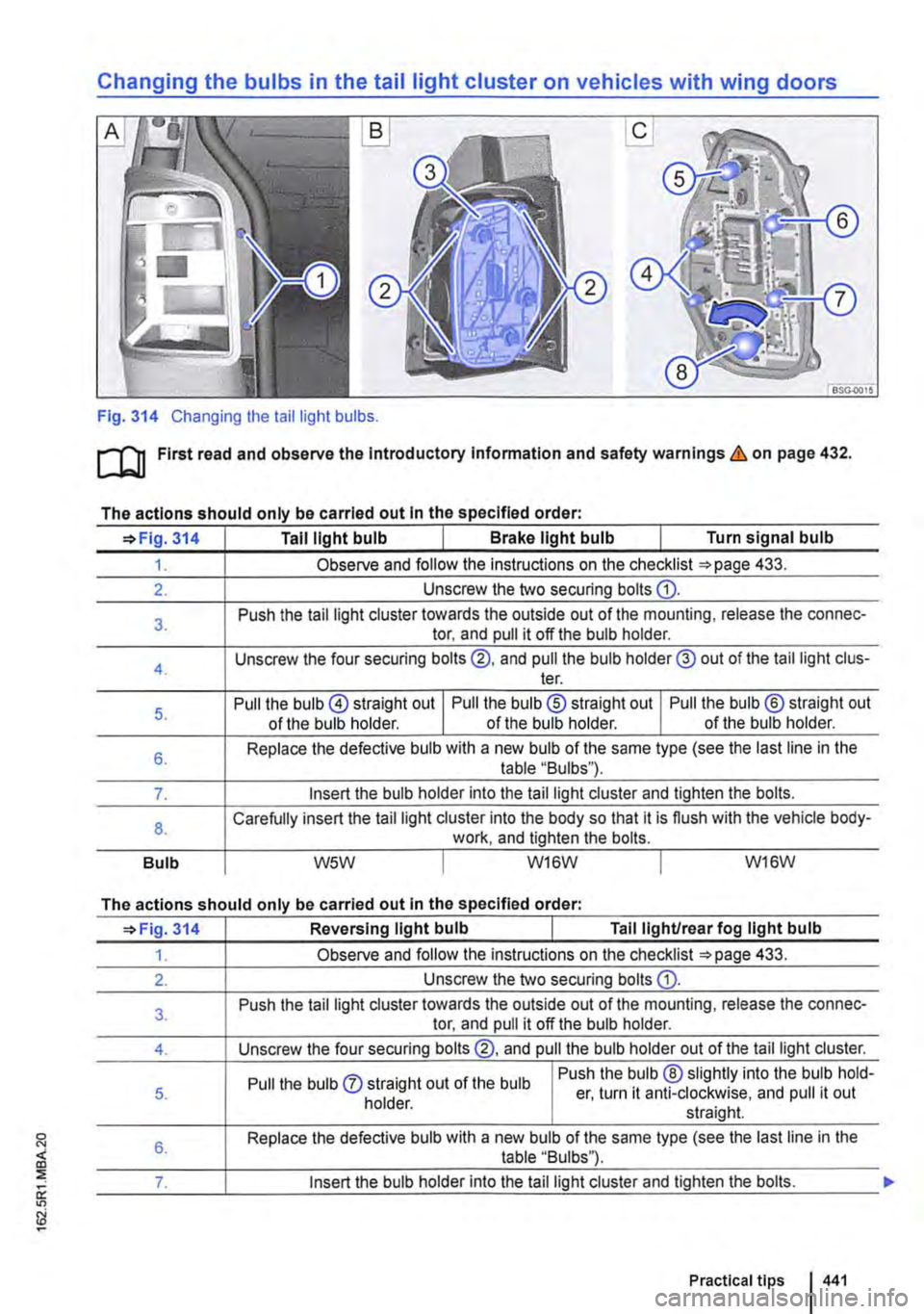
Changing the bulbs in the tail light cluster on vehicles with wing doors
Fig. 314 Changing the tail light bulbs.
ru First read and observe the Introductory Information and safety warnings&, on page 432.
The actions should only be carried out In the specified order:
'*Fig. 314 Tall light bulb 1 Brake light bulb I Turn signal bulb
1. Observe and follow the instructions on the checklist =:-page 433.
2. Unscrew the two securing bolts G).
3. Push the tail light cluster towards the outside out of the mounting, release the connec-tor, and pull it off the bulb holder.
4. Unscrew the four securing bolts®. and pull the bulb holder@ out of the tail light cl us-ter.
5. Pull the bulb @ straight out I Pull the bulb ® straight out I Pull the bulb ® straight out of the bulb holder. of the bulb holder. of the bulb holder.
6. Replace the defective bulb with a new bulb of the same type (see the last line in the table "Bulbs").
7. Insert the bulb holder into the tail light cluster and tighten the bolts.
8. Carefully insert the tail light cluster into the body so that it is flush with the vehicle body-work, and tighten the bolts.
Bulb wsw I W16W I W16W
The actions should only be carried out In the specified order:
'*Fig. 314 Reversing light bulb Tall light/rear fog light bulb
1. Observe and follow the instructions on the checklist =:-page 433.
2. Unscrew the two securing bolts G).
3. Push the tail light cluster towards the outside out of the mounting, release the connec-tor, and pull it off the bulb holder.
4. Unscrew the four securing bolts ®. and pull the bulb holder out of the tail light cluster.
Pull the bulb 0 straight out of the bulb Push the bulb ®slightly into the bulb hold-5. er, turn it anti-clockwise, and pull it out holder. straight.
6. Replace the defective bulb with a new bulb of the same type (see the last line in the table "Bulbs").
7. Insert the bulb holder into the tail light cluster and tighten the bolts.
Practical tips 441
Page 442 of 486
The actions should only be carried out in the specified order:
=>Fig. 314 Reversing light bulb Tail lighUrear fog light bulb
8.
Bulb
Carefully insert the tail light cluster into the body so that it is flush with the vehicle body-work, and tighten the bolts.
P21W P21/4W
Changing the bulbs in the LED tail light cluster
BSG-0017
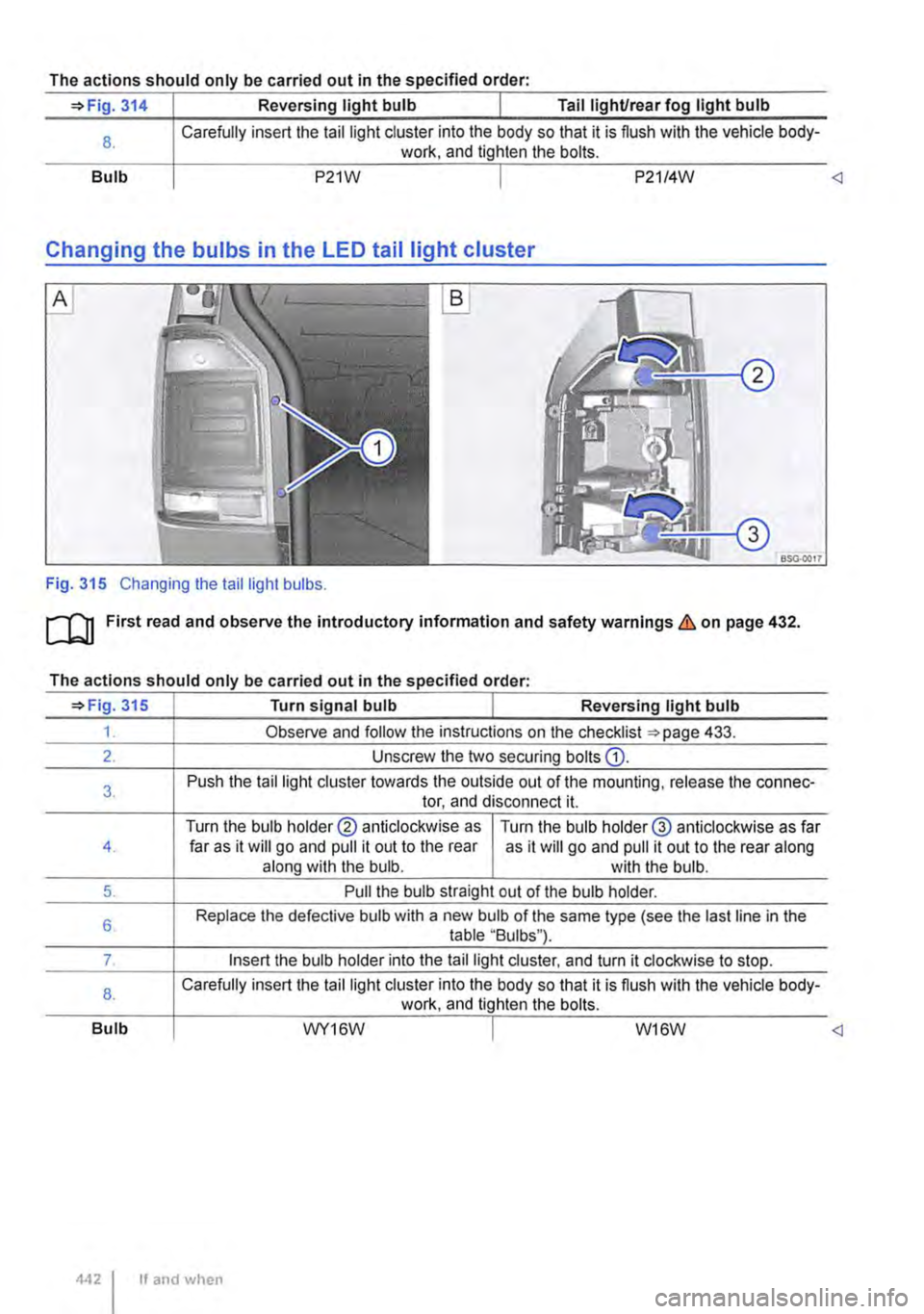
Fig. 315 Changing the tail light bulbs.
[Q] First read and observe the introductory information and safety warnings & on page 432.
The actions should only be carried out in the specified order:
=>Fig 315 I Turn signal bulb I Reversing light bulb
1. Observe and follow the instructions on the checklist =>page 433.
2. Unscrew the two securing bolts G).
3. Push the tail light cluster towards the outside out of the mounting, release the connec-tor, and disconnect it.
Turn the bulb holder@ anticlockwise as Tu m the bulb holder@ anticlockwise as far 4. far as it will go and pull it out to the rear as it will go and pull it out to the rear along along with the bulb. with the bulb.
5. Pull the bulb straight out of the bulb holder.
6. Replace the defective bulb with a new bulb of the same type (see the last line in the table "Bulbs").
7. Insert the bulb holder into the tail light cluster, and turn it clockwise to stop.
8. Carefully insert the tail light cluster into the body so that it is flush with the vehicle body-work, and tighten the bolts.
Bulb WY16W I W16W
If and when
Page 451 of 486
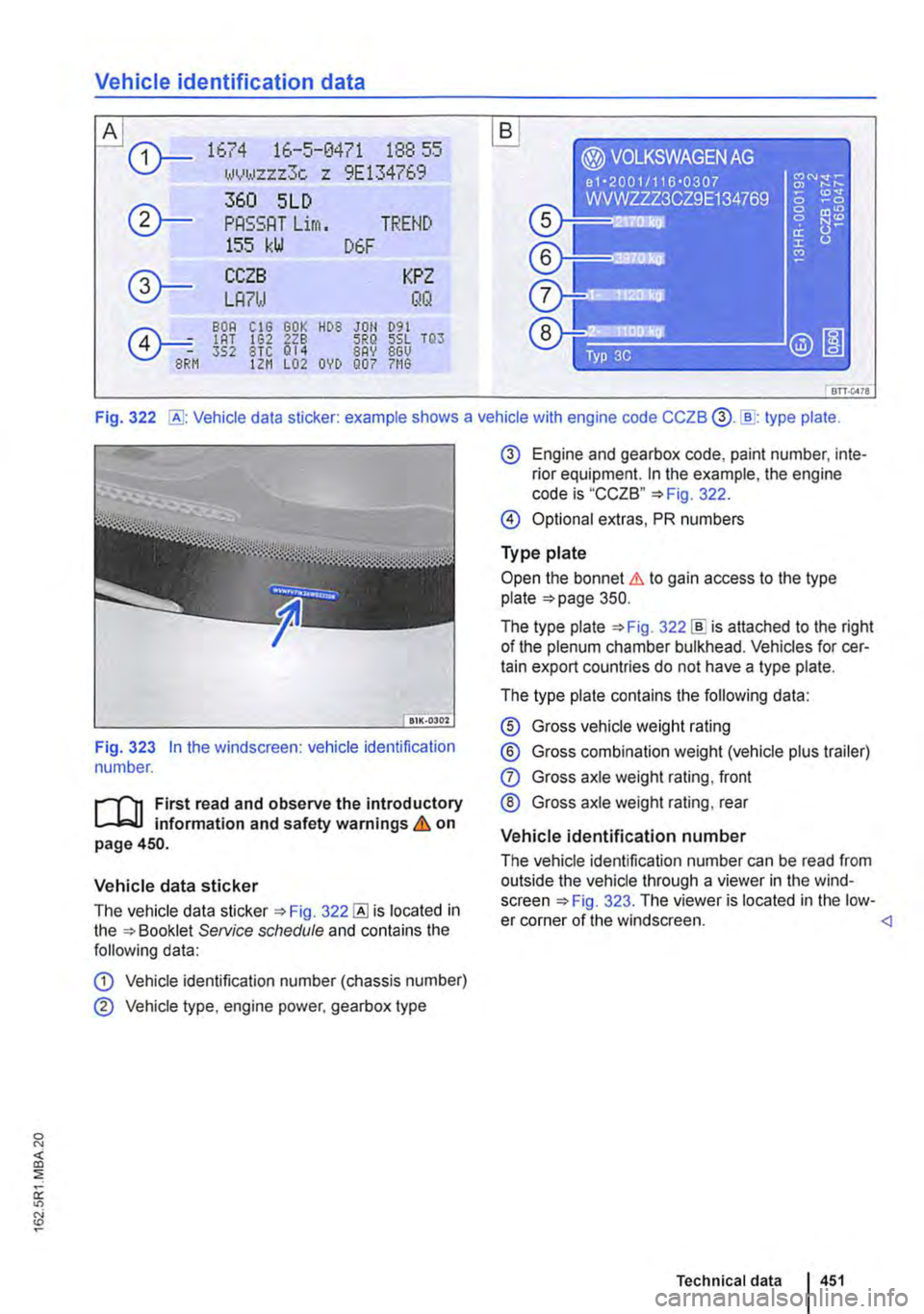
Vehicle identification data
A B
0--1674 16-5-0471 188 55 lN1,1ZZZ3C Z 9E134769
®-
360 5LD
PRSSRT Lim. TREND 155 kW D6F
®---CCZB KPZ
LRnJ QQ
BOA CIG GOK H08 JOH 091 IAT IG2 228 5RQ 5SL TQ3 352 STC Ql4 8AV SGV SRM 1211 L02 OVI> Q07 7116
en.(A71!
Fig. 322 data sticker: example shows a vehicle with engine code CCZB plate.
0 Engine and gearbox code, paint number, inte-rior equipment. In the example, the engine code is "CCZB" =)Fig. 322.
Fig. 323 In the windscreen: vehicle identification number.
r--('n First read and observe the introductory L-lc.J.I information and safety warnings & on page 450.
Vehicle data sticker
The vehicle data sticker =)Fig. 322 located in the =)Booklet SeNice schedule and contains the following data:
G) Vehicle identification number (chassis number)
® Vehicle type, engine power, gearbox type
G) Optional extras, PR numbers
Type plate
Open the bonnet &. to gain access to the type plate =)page 350.
The type plate =)Fig. 322 [[is attached to the right of the plenum chamber bulkhead. Vehicles for cer-tain export countries do not have a type plate.
The type plate contains the following data:
® Gross vehicle weight rating
® Gross combination weight (vehicle plus trailer)
Q) Gross axle weight rating, front
® Gross axle weight rating, rear
Vehicle identification number
The vehicle identification number can be read from outside the vehicle through a viewer in the wind-screen =)Fig. 323. The viewer is located in the low-er corner of the windscreen.