lock VOLKSWAGEN TRANSPORTER 2015 Owner´s Manual
[x] Cancel search | Manufacturer: VOLKSWAGEN, Model Year: 2015, Model line: TRANSPORTER, Model: VOLKSWAGEN TRANSPORTER 2015Pages: 486, PDF Size: 72.17 MB
Page 348 of 486
![VOLKSWAGEN TRANSPORTER 2015 Owner´s Manual Refilling AdBiue®
Fig. 271 Behind the tank flap: filler cap of the Ad Blue tank unscrewed [A CD and attached in holder [[ ®. Fill the Ad Blue tank using a filler bottle [B@ or a filler nozzle C] @.](/img/18/40253/w960_40253-347.png "VOLKSWAGEN TRANSPORTER 2015 Owner´s Manual Refilling AdBiue®
Fig. 271 Behind the tank flap: filler cap of the Ad Blue tank unscrewed [A CD and attached in holder [[ ®. Fill the Ad Blue tank using a filler bottle [B@ or a filler nozzle C] @.")
Refilling AdBiue®
Fig. 271 Behind the tank flap: filler cap of the Ad Blue tank unscrewed [A CD and attached in holder [[ ®. Fill the Ad Blue tank using a filler bottle [B@ or a filler nozzle C] @.
,....-.('n First read and observe the Introductory 1.-J=,U Information and safety warnings & on page 346.
To refill with Ad Blue®, park the vehicle on a level surface and not on any kind of incline. The tank level gauge may not detect the refill quantity cor-rectly if the vehicle is not parked on a level surface.
Do not fill fuel and AdBiue® at the same lime.
If a message about the Ad Blue® level appears on the instrument cluster display, refill with at least 7 litres of Ad Blue®. A smaller amount of refill is insufficient. if no message about the AdBiue® level appears on the instrument cluster display, use any quantity to refill the tank to the maximum level.
Opening the tank filler neck
• Opening the tank flap.
• Unscrew the cap of the tank filler neck =>Fig. 271 anticlockwise.
• Fit the cap of the filler neck into the holder]) @.
Use only Ad Blue® that complies with the stand-ard ISO 22241-1.
Refilling using a refill bottle
• Please read the manufacturer's notes and infor-mation on the refill bottle.
• Observe the expiry date.
• Remove the screw top of the refill bottle.
• Place the neck of the refill bottle =>Fig. 271 [ID @ vertically onto the tank filler neck and turn it clockwise hand-tight.
• Push the refill bottle towards the filler neck, press and hold down.
348 While driving
• Wait until the contents of the refill bottle have entered the Ad Blue® tank. Do not crumple up or damage the refill bottle!
• Unscrew the refill bottle anticlockwise and lift it carefully up and out =>CD.
• When the Ad Blue® tank is full, Ad Blue® will no longer flow out of the bottle and into the tank.
Refilling using a filler bottle
• Please read the manufacturer's notes and infor-mation on the container.
• Observe the expiry date.
• Use the integrated spout.
• Refill at least 7 litres of AdBiue®. A smaller amount of refill is insufficient.
• Do overfill the tank. The Ad Blue® tank is com-pletely filled when Ad Blue® reaches the top level of tank filler neck.
Refilling using a filler nozzle
• The procedure for refilling with an Ad Blue® filler nozzle =>Fig. 271 @]@) is the same as for refilling the fuel tank with fuel =>CD.
• The Ad Blue® tank is full as soon as the (proper-ly operated) filler nozzle clicks off for the first time =>CD.
Closing the tank filler neck
• Screw the cap onto the tank filler neck =>Fig. 271 clockwise until it clicks into place.
• Close the tank flap.
Page 350 of 486
Cleaning and maintenance
In the engine compartment
Preparation for working in the engine compartment
ClJ Introduction
This chapter contains information on the following subjects:
Preparing the vehicle for working in the engine compartment . . . . . . . . . . . . . . . . . 352 Opening and closing the bonnet 352
Always park the vehicle on a level and stable sur-face before carrying out any work in the engine compartment.
The engine compartment of a motor vehicle is a hazardous area. Never carry out any work on the engine or in the engine compartment if you are not familiar with the requisite procedures and general safety requirements, or if you only have access to incorrect operating equipment, service fluids, and unsuitable tools &. The work should be carried out by a qualified workshop if you are uncertain. Serious injuries can be caused if work is carried out incorrectly.
Additional information and warnings:
• Exterior views 5
• Wipers/washer 116
• Starting and stopping the engine 257
• Brake fluid 269
• Pull-away assist systems (starUstop system) 282
• Checks when filling the tank 340
• Engine oil 353
• Engine coolant 358
• Battery page 362
• Accessories, modifications, repairs and renewal of parts 394
A wARNING
Unintentional vehicle movements during service work can cause serious injury.
• Never work underneath a vehicle if it is not secured against rolling away. If you are working underneath the vehicle while the wheels are on the ground, the vehicle must
350 I Cleanmg and maintenance
A WARNING (Continued)
be on a level, the wheels must be blocked and the vehicle key must be removed from the ignition lock.
• If you have to work underneath the vehi-cle, use suitable stands to provide extra sup-port for the vehicle. The vehicle jack is not sufficient for this task and can fail, which can lead to serious injuries.
• The start/stop system must have been de-activated.
A WARNING
The engine compartment of any motor vehi-cle is a dangerous area. Serious injuries can be sustained here.
• The utmost care and attention must be paid when carrying out any work and you must follow the general safety rules. Never take any risks.
• Never do any work on the engine or in the engine compartment unless you know exact-ly how to carry it out. If you are uncertain of what to do, the work should be carried out by a qualified workshop. Serious Injuries can re-sult from work that has not been carried out properly.
• Never open the bonnet if you see steam or coolant escaping from the engine compart-ment. Hot steam or coolant can cause seri-ous burns. Always wait until you can no lon-ger see or hear steam or coolant coming from the engine compartment.
• Always allow the engine to cool down be-fore opening the bonnet.
• Hot parts of the engine or exhaust system can burn the skin.
• The following points should be noted be-fore opening the bonnet once it has cooled down.
-Apply the handbrake fully and move the selector lever to position P or move the manual gear lever to the neutral position. .,..
Page 351 of 486
A WARNING (Continued)
-Remove the vehicle key from the igni-tion lock.
-Always keep children away from the en-gine compartment and never leave the ve-hicle unattended.
• The engine cooling system Is under pres-sure when the engine Is hot. Never open the cap of the coolant expansion tank when the engine Is hot. Coolant may spray out and cause serious burns and other Injuries.
-Turn the cap slowly and very carefully anti-clockwise while exerting gentle down-ward pressure on the cap.
-Always protect the face, hands and arms from hot coolant or steam with a large, thick cloth.
• When refilling, do not spill any service flu-ids on engine components or on the exhaust system. The spilt service fluids can start a fire.
A WARNING
High voltages in the electrical system can cause electric shocks, burns, serious injuries and death!
• Never short circuit the electric system. The vehicle battery could explode.
• Please note the following guidelines to help reduce the risk of an electric shock and serious Injuries while the engine is running or being started:
-Never touch the electrical wiring of the Ignition system.
A WARNING
There are rotating components in the engine compartment that can cause serious injury.
• Never place your hand near these compo-nents or In the radiator fan. Touching the ro-tary blades can result in serious injuries. The fan Is temperature-controlled and can start automatically, even if the engine has been switched off and the vehicle key has been re-moved from the ignition lock.
• If any work has to be performed when the engine Is started or with the engine running, there is an additional, potentially fatal, safety risk from the rotating parts, such as the drive belts, alternator, radiator fan, etc., and from the high-voltage ignition system. Always be particularly careful.
A WARNING (Continued)
-Always ensure that no body parts, jew-ellery, ties, loose items of clothing or long hair can be caught up in rotating engine components. Before starting work, re-move any jewellery and ties, tie up long hair and pull clothes In tightly to avoid them getting caught In the engine com-partment.
-Always depress the accelerator careful-ly and never without due consideration. The vehicle can start to move even if the handbrake is applied.
• Always ensure that you have not left any objects, such as cleaning cloths and tools, in the engine compartment. Any forgotten items can cause malfunctions, engine damage and fires.
A WARNING
Additional insulating materials such as cov-ers in the engine compartment could disrupt the operation of the engine, cause damage and lead to severe Injuries.
• Never cover the engine with any Insulating materials.
A WARNING
Service fluids and some materials In the en-glne compartment are highly flammable and can cause fires and serious Injuries!
• Never smoke while working on the vehl-cl e.
• Never work near naked flames or sparks .
• Never spill fluids onto the engine. They could Ignite on hot engine components and hence cause injuries.
• Please note the following when carrying out any work on the fuel system or the elec-trlcal system:
-Always disconnect the vehicle battery. Ensure that the vehicle Is unlocked when the vehicle battery Is disconnected as oth-erwlse the anti-theft alarm will be activa-ted.
-Never work in the direct proximity of heating systems, water heaters or any oth-er open flames.
• Always have a fully functional and tested fire extinguisher to hand.
In the engine compartment I 351
...
Page 353 of 486
Opening the bonnet
• Please ensure that the wiper arms are lying on the windscreen before opening the bonnet =:.CD.
• Pull the release lever in the direction of the ar-row =:.Fig. 272. The bonnet is released from its lock by a spring mechanism =:. &.
• Lift the bonnet at the release lever =:.Fig. 273 (arrow) and open fully.
• Vehicles with gas struts: the bonnet is held in the open position by the gas-filled strut.
• Vehicles with support rods: hold the bonnet open.
• Remove the support rod on the right-hand side of the lock carrier.
• Hook the end of the support rod correctly in the retainer on the right side of the open bonnet.
Closing the bonnet (vehicles with gas struts)
• To close the bonnet, pull it down to overcome the gas strut pressure =:. &.
• Let the bonnet drop into the catches-do not press it down!
If the bonnet is not closed, open it again and close it properly.
The bonnet sits flush with the body parts around it when it is closed properly.
Closing the bonnet (vehicles with support rods)
• Raise the bonnet until you can release the sup-port rod.
• Hold the bonnet open and fold the support rod back into the bracket.
• Let the bonnet drop into the catches -do not press it down!
Engine oil
CO Introduction
This chapter contains information on the following subjects:
Warning and indicator lamps 354 Engine oil specification . . . . 354 Checking the engine oil level and refilling engine oil . . . . . . . . . . . . . . 356 Engine oil consumption . . . . . . . . . . . . . . . . . . . 357
Changing engine oil . . . . . . . . . . . . . . . . . . . . . 357
If the bonnet is not closed, open it again and close it properly.
The bonnet sits flush with the body parts around it when it is closed properly.
A WARNING
If the bonnet is not closed properly, it can open suddenly while you are driving and completely obscure your view of the road. This can lead to accidents and serious Inju-ries.
• After closing the bonnet, always check that it is properly secured. The bonnet must be flush with the surrounding body panels.
• If you notice that the bonnet is not closed properly while the vehicle is in motion, stop the vehicle as soon as possible and close the bonnet.
• Therefore the bonnet should only be opened or closed when you are sure that no-body is in its path.
CD
• The bonnet should only be opened when the wiper arms are flush to the windscreen and when they are switched off in order to avoid damage to the bonnet and the wiper arms.
• Always fold the wiper arms back onto the windscreen before driving away.
• Preparation for working in the engine compart-ment =:.page 350
• Accessories, modifications, repairs and renewal of parts =:.page 394
• =:. Booklet SeNice schedule ._
In the engine compartment 1353
Page 362 of 486
A WARNING (Continued)
-Always keep children away from the en-gine compartment and never leave the ve-hicle unattended.
• The engine cooling system is under pres-sure when the engine is hot. Never open the cap of the coolant expansion tank when the engine is hot. Coolant may spray out and cause serious burns and other injuries.
-Turn the cap slowly and very carefully anti-clockwise while exerting gentle down-ward pressure on the cap.
-Always protect the face, hands and arms from hot coolant or steam with a large, thick cloth.
• When refilling, do not spill any service flu-ids on engine components or on the exhaust system. The spilt service fluids can start a fire. In certain circumstances, the ethylene glycol in the engine can catch fire.
CD
• Refill only with distilled water. All other types of water can cause corrosion in the en-gine due to the chemical components con-
Vehicle battery
CQJ Introduction
This chapter conlains information on the following subjects:
Warning lamp . . . . . . . . . . . . . . . . . . . . . . . . . . . 364
Checking the electrolyte level of the vehicle battery ................................. 364 Charging, replacing, disconnecling and connecting the vehicle battery . . . . . . . . . . . . . 365
The vehicle battery is a component of the electrical system in the vehicle.
Never carry out any work on the electrical system if you are not familiar with the necessary procedures and the general safety requirements and only un-suitable tools are available => &. The work should be carried out by a qualified workshop if you are uncertain. Volkswagen Commercial Vehicles rec-ommends using a Volkswagen Commercial Vehi-cles dealership for this purpose. Serious injuries can be caused if work is carried out incorrectly.
3621 Cleaning and maintenance
(j)
tained therein. This can also lead to engine fail-ure. If any other type of water is refilled, the flu-id in the engine cooling system should be com-pletely replaced immediately by a qualified workshop.
• Do not fill coolant above the top of the marked area =>Fig. 277. Otherwise the excess coolant will be pressed out of the cooling sys-tem when the engine is hot and could cause damage.
• If a large amount of coolant has been lost, do not refill the coolant until the engine has cooled completely. Heavy coolant loss is an in-dication of leaks in the engine cooling system. The engine cooling system should be checked by a qualified workshop as soon as possible. Failure to do so can result in engine damage.
• Do not top up with coolant if there is no more coolant in the coolant expansion tank. Air could enter the cooling system. Do not drive on! Seek expert assistance. Failure to do so can result in engine damage.
• When refilling service fluids, please ensure that the correct container is filled. The use of incorrect service fluids can result In serious faults and engine damage.
The vehicle battery is located on the left of the en-gine compartment.
Depending on the vehicle equipment level, the ve-hicle could have two vehicle batteries. Camper vans can have up to three vehicle batteries. The second vehicle battery is located under the left front seat: the third battery in camper vans is loca-ted in the wardrobe on the rear left of the vehicle. •
Page 365 of 486
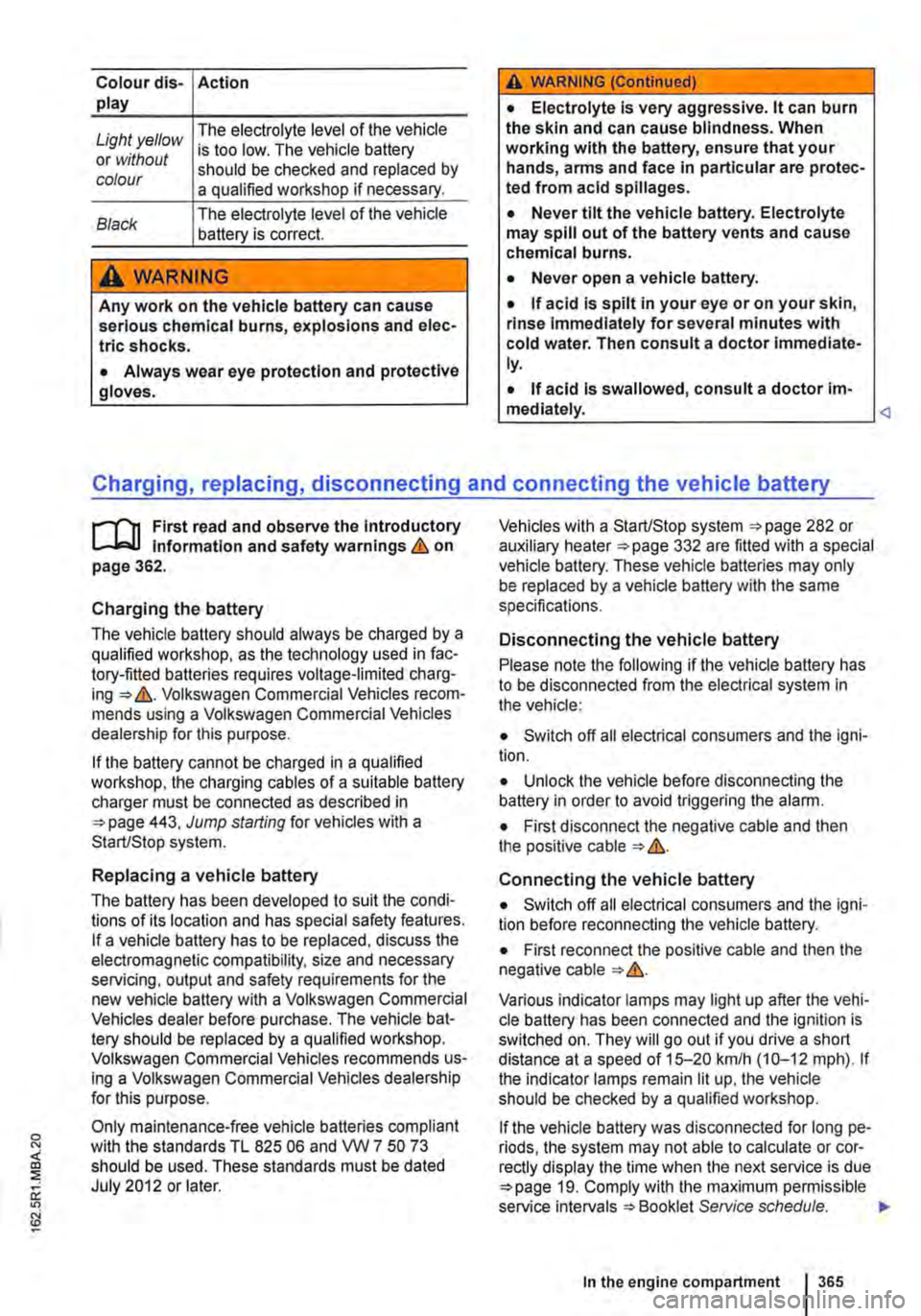
Colour dis-Action play
Light yellow The electrolyte level of the vehicle
or without is too low. The vehicle battery
colour should be checked and replaced by a qualified workshop if necessary.
Black The electrolyte level of the vehicle battery is correct.
A WARNING
Any work on the vehicle battery can cause serious chemical burns, explosions and elec-trlc shocks.
• Always wear eye protection and protective gloves.
A WARNING (Continued)
• Electrolyte is very aggressive. lt can burn the skin and can cause blindness. When working with the battery, ensure that your hands, arms and face in particular are protec-ted from acid spillages.
• Never tilt the vehicle battery. Electrolyte may spill out of the battery vents and cause chemical burns.
• Never open a vehicle battery.
• if acid is spilt in your eye or on your skin, rinse immediately for several minutes with cold water. Then consult a doctor immediate-ly.
• If acid is swallowed, consult a doctor im-mediately.
r-"f'n First read and observe the introductory L-Jo:.l.l information and safety warnings & on page 362.
Charging the battery
The vehicle battery should always be charged by a qualified workshop, as the technology used in fac-tory-fitted batteries requires voltage-limited charg-ing => &. Volkswagen Commercial Vehicles recom-mends using a Volkswagen Commercial Vehicles dealership for this purpose.
If the battery cannot be charged in a qualified workshop, the charging cables of a suitable battery charger must be connected as described in =>page 443, Jump starting for vehicles with a Start/Stop system.
Replacing a vehicle battery
The battery has been developed to suit the condi-tions of its location and has special safety features. If a vehicle battery has to be replaced, discuss the electromagnetic compatibility, size and necessary servicing, output and safety requirements for the new vehicle battery with a Volkswagen Commercial Vehicles dealer before purchase. The vehicle bat-tery should be replaced by a qualified workshop. Volkswagen Commercial Vehicles recommends us-ing a Volkswagen Commercial Vehicles dealership for this purpose.
Only maintenance-free vehicle batteries compliant with the standards TL 825 06 and VVV 7 50 73 should be used. These standards must be dated July 2012 or later.
Vehicles with a Start/Stop system =>page 282 or auxiliary heater =>page 332 are fitted with a special vehicle battery. These vehicle batteries may only be replaced by a vehicle battery with the same specifications.
Disconnecting the vehicle battery
Please note the following if the vehicle battery has to be disconnected from the electrical system in the vehicle:
• Switch off all electrical consumers and the igni-tion.
• Unlock the vehicle before disconnecting the battery in order to avoid triggering the alarm.
• First disconnect the negative cable and then the positive cable => &.
Connecting the vehicle battery
• Switch off all electrical consumers and the igni-tion before reconnecting the vehicle battery.
• First reconnect the positive cable and then the negative cable=>&.
Various indicator lamps may light up after the vehi-cle battery has been connected and the ignition is switched on. They will go out if you drive a short distance at a speed of 15-20 kmlh (10-12 mph). If the indicator lamps remain lit up, the vehicle should be checked by a qualified workshop.
if the vehicle battery was disconnected for long pe-riods, the system may not able to calculate or cor-rectly display the time when the next service is due =>page 19. Comply with the maximum permissible service intervals =>Booklet Service schedule. ""
In the engine compartment 365
Page 370 of 486
be repaired by a qualified workshop. Volkswagen Commercial Vehides recommends using a Volks-wagen Commercial Vehicles dealership for this purpose => &.
Rims with bolted-on trims
Rims may have removable trims that are attached to the rim with self-locking bolts. Damaged trims may only be repaired by a qualified workshop. Volkswagen Commercial Vehicles recommends us-ing a Volkswagen Commercial Vehicles dealership for this purpose => &.
Rim identification
In some countries, new rims are legally required to contain certain specifications on them. The follow-ing information may appear on the rims (varying from region to region):
• Seal of conformity
• Rim size
• Name of manufacturer or brand name
• Date manufactured (month/year)
• Country of origin
• Production number
New wheels and tyres
r--f'n First read and observe the introductory L-Wl information and safety warnings & on page 367.
New tyres
• Drive particularly carefully for the first 600 km with new tyres as the tyres have to be run in. Tyres that have not been run in have reduced grip=>& and braking effect => &.
• All four wheels must be fitted with radial tyres of the same type, size (rolling circumference) and the same tread.
• The tread depth of new tyres may vary, accord-ing to the type and make of tyre and the tread pat-tern.
370 I Clcanmg and maintenance
• Raw materials batch number
• Product code
A WARNING
The use of unsuitable or damaged rims can impair vehicle safety and cause accidents and serious injury.
• Only use rims that have been approved for the vehicle.
• Check the rims regularly for damage and replace as necessary.
A WARNING
Incorrect loosening and tightening of the bolts on rims with bolted-on rings can cause accidents and serious Injury.
• Never remove the bolts on rims with bot-ted-on rings.
• All work on rims with bolted-on rings must be carried out by a qualified workshop. Volks-wagen Commercial Vehicles recommends us-ing a Volkswagen Commercial Vehicles deal-ership for this purpose.
Replacing tyres
• Tyres should be replaced at least in pairs and not individually (i.e. both front tyres or both rear tyres together) => &.
• Old tyres should only be replaced by tyres that have been approved by Volkswagen Commercial Vehicles for the vehicle type. Make sure that the tyres used are correct in respect of size, diameter. load-carrying capacity and maximum speed.
• Never use tyres with an effective size that is larger than tyres approved by Volkswagen Com-mercial Vehicles. Larger wheels could rub against the body or other parts of the vehide.
Additional information for vehicles with tyre monitoring system
For vehides with a tyre monitoring system, the sys-tem will have to be "re-synchronised" after any wheel changes, regardless of whether the wheel in question is being fitted in the same or in a different position =>page 318.
Further information about the tyre monitoring sys-tem, how it functions and what you must know
Page 371 of 486
A wARNING
New tyres will have to be run in as they will Initially have reduced grip and braking effect.
• Drive particularly carefully for the first 600 km in order to prevent accidents and se-rious injury.
A WARNING
Wheels must have the necessary freedom of operation. If the wheels do not have the nec-essary freedom of operation, the tyre could rub on parts of the running gear, the vehicle body and the brake lines. This can lead to a fault in the brake system and to tread separa-tion and thus to a tyre bursting.
Tyre pressure
r-T'n First read and observe the introductory L-k.U Information and safety warnings & on page 367.
The correct tyre pressure for factory-fitted tyres is shown on the tyre pressure label and applies to all-season, summer and winter tyres. The tyre pres-sure label is located on the lock column on the left front door.
If the tyre pressure is too low or too high, the tyres will wear prematurely and the vehicle will not han-dle well => &. The correct tyre pressure is particu-larly important at high speeds. Incorrect tyre pres-sure causes premature wear and can cause a tyre burst.
The pressure should therefore be checked at least once a month and before starting a journey.
The given tyre pressure applies to cold tyres. Tyre pressure is always higher in warm tyres than it is in cold tyres.
For this reason, never reduce the pressure in warm tyres to adjust the tyre pressure. This would result in low tyre pressures that could potentially cause the tyre to burst suddenly.
Checking tyre pressure
Always check the tyre inflation pressure on "cold" tyres. A "cold" tyre can be defined as one on a ve-hicle that has only been driven a few kilometres (miles) within 3 hours prior to the test and at low speeds.
A WARNING (Continued)
• The actual tyre size must not exceed the tyre dimensions of manufacturers approved by Volkswagen Commercial Vehicles and must not rub on any vehicle body parts.
m Despite identical size details, the actual size L!..J of the various tyre makes may vary from these specified dimensions, or the tyre contours may vary considerably.
m Volkswagen Commercial Vehicles-approved L!..J tyres are guaranteed to have the dimensions that are suitable for the vehicle. The salesperson will have to provide a certificate from the tyre man-ufacturer for other tyre makes to prove that the tyre is also suitable for the vehicle. This certificate must be stored in a safe place in the vehicle.
• The tyre pressures must be adjusted to suit a heavy vehicle load.
• After altering the tyre pressures, please ensure that the valve caps are screwed on and observe any information and instructions on setting the tyre monitoring system =>page 318.
The temporary spare wheel is filled to the highest tyre pressure permissible for the vehicle.
A WARNING
Too high or too low a pressure may cause the tyre to suddenly lose pressure or burst while the vehicle is in motion. This can cause seri-ous accidents and fatal Injuries.
• If the tyre pressure Is too low, it is possi-ble that the tyre temperature will increase to such an extent when driving that the tread peels off and the tyre bursts.
• Fast speeds or overloading of the vehicle can cause overheating, sudden tyre damage including tyre bursts and ripping of the tread surface and thus to a loss of control of the vehicle.
• If the tyre pressure is too low or too high, the tyres will wear prematurely and the vehi-cle will not handle well. .,.
Wheels and tyres 371
Page 373 of 486
A WARNING (Continued)
• Worn tyres reduce the possibility of con-trolling the vehicle well in normal and difficult driving situations and Increase braking dis-tance and the risk of sliding.
...--m First read and observe the introductory l-.W.I Information and safety warnings&,. on page 367.
Damage to tyres and rims is often not readily visi-ble. Any unusual vibrations or signs that the car is pulling to one side may indicate that one of the tyres is damaged =:. &,..
• Reduce your speed immediately if you suspect that a wheel is damaged.
• Check the tyres and rims for damage.
• If the tyre is damaged, do not drive on. Seek expert assistance.
• If there is no visible damage, drive slowly and cautiously to the next qualified workshop in order to have the vehicle checked.
Foreign bodies in the tyre
• Leave the foreign body in the tyre if it has en-tered the inner tyre. However, foreign bodies that are stuck between the tyre tread blocks can be re-moved.
• For vehicles with a spare wheel: where appro-priate, change the damaged wheel =:>page 420 If required, seek expert assistance when changing the damaged wheel. Volkswagen Commercial Ve-hicles recommends using a Volkswagen Commer-cial Vehicles dealership for this purpose.
• For vehicles with a breakdown set: the tyre can be sealed and pumped up using the tools in the breakdown set =:.page 425. Go to a qualified workshop. Volkswagen Commercial Vehicles rec-ommends using a Volkswagen Commercial Vehi-cles dealership for this purpose.
Tyre wear
The tyre wear is affected by several factors, for ex-ample:
• Driving style.
• Unbalanced wheels.
• Running gear setting.
Driving style-fast cornering, heavy acceleration and hard braking all increase tyre wear. The run-ning gear should be checked by a qualified work-shop if the tyres show excessive wear despite a normal driving style.
Unbalanced wheels -the wheels on new vehicles are balanced. However, various factors encoun-tered in normal driving can cause them to become unbalanced, which results in steering vibration. Un-balanced wheels will affect levels of wear on the steering system and the suspension. In this case the wheels should be balanced again. New tyres have to be balanced after fitting.
Running gear setting-incorrect wheel alignment causes excessive tyre wear, impairing the safety of the vehicle. The wheel alignment should be checked by a qualified workshop if tyres show ex-cessive wear.
A WARNING
If you notice unusual vibration or the car pull-Ing to one side while the vehicle is In motion, this may indicate that one of the tyres is dam-aged.
• Reduce speed immediately and park the vehicle without obstructing traffic.
• Check the tyres and rims for damage.
• Never drive on if wheels or tyres are dam-aged. Seek expert assistance Instead.
• If there Is no visible damage, drive slowly and cautiously to the next qualified workshop In order to have the vehicle checked.
Page 380 of 486
Vehicle care and maintenance
Caring for and cleaning the vehicle exterior
o:n Introduction
This chapter contains information on the following subjects:
Washing the vehicle . . . . . . . . . . . . . . . 381
Washing the vehicle with a high-pressure cleaner . . . . . . . . . . . . . . . . . . . . . . . . . . . 382 Cleaning windows and exterior mirrors . . . . . . 382
Cleaning and changing wiper blades 383
Waxing and polishing the vehicle 384
Cleaning and caring for chrome and aluminium trim parts . . . . . . . . . . . . . . 385
Cleaning and caring for the decorative film . . 385
Cleaning wheels . . . . . . . . . . . . . . . . . . . . . 386
Care of rubber seals . . . . . . . . . . . . . . . . . . . . . 386
De-icing door lock cylinders . . . . . . • . . . . . . . . 387
Undersea! . . . . . . . . . . . . . . . . . . . . . . . . . . . . . . 387
Cleaning the engine compartment . 387
Regular and expert care helps to maintain the val-ue of the vehicle. Proper maintenance may also be one of the requirements for the approval of warran-ty claims in the event of corrosion or paint defects.
Suitable care products are available from Volkswa-gen Commercial Vehicles dealers.
Additional information and warnings:
• Preparation for working in the engine compart-ment ::-page 350
• Cleaning and caring for the interior ::-page 388
• Accessories, modifications, repairs and renewal of parts ::-page 394
A WARNING
Car care products can be toxic and hazard-ous. Unsuitable care products and Incorrect application of care products can cause acci-dents, serious Injuries, burns or poisoning.
• The care product must be kept In Its origi-nal sealed container.
380 Cleaning and maintenance
A WARNING (Continued)
• Read the manufacturer's Instructions .
• Never store car care products in empty food containers, bottles or any other non-original containers as people finding these containers may not know that they contain care products.
• Keep children away from care products .
• The products can give off harmful fumes during use. They should therefore only be used outside or In well-ventilated spaces.
• Never use fuel, turpentine, engine oil, nail varnish remover or other volatile fluids to wash, clean or care for your vehicle. These substances are toxic and highly Inflammable.
A WARNING
Incorrect care and cleaning of vehicle parts can Impair the safety features of the vehicle and thus cause serious Injury.
• Vehicle parts must be cleaned according to the manufacturer's Instructions.
• Only use approved or recommended cleaning products.
CD
Cleaning agents that contain solvents attack the material and can cause damage.
r:Q:... In the interests of environmental protection, "C!S the vehicle should only be washed in special-ly provided wash bays. This prevents waste water contaminated with oil, grease or fuel from entering the sewerage system. In some countries, washing vehicles anywhere else may be prohibited.
r:Q:... Environmentally-friendly care products "C!S should be used.
r:Q:... Leftover car care products should not be dis-"C!S posed of with ordinary household waste. Read the manufacturer's instructions.