mirror VOLKSWAGEN UP! 2021 Owner´s Manual
[x] Cancel search | Manufacturer: VOLKSWAGEN, Model Year: 2021, Model line: UP!, Model: VOLKSWAGEN UP! 2021Pages: 211, PDF Size: 5.98 MB
Page 68 of 211
allow the driver to see the entre side and rear area of the vehicle. The area that cannot be seen is
known as the blind spot. Objects and other road users may also be located in the blind spot.
Additional information and warnings:
•Exterior views ⇒ Exterior views
•Adjusting the seat position ⇒ Adjusting the seat position
•Changing gear ⇒ Changing gear
•Braking, stopping and parking ⇒ Braking, stopping and parking
Interior mirror
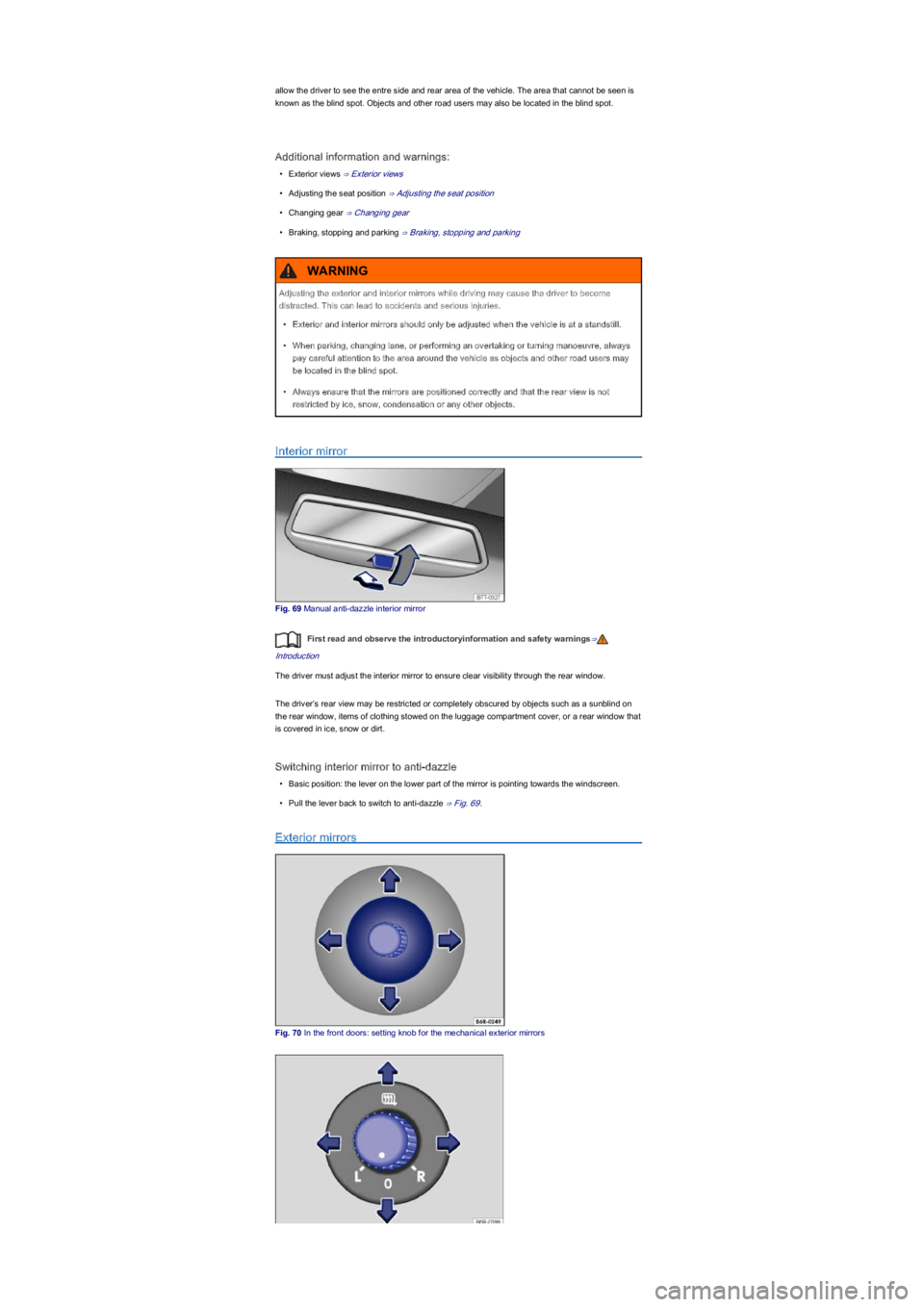
Fig. 69 Manual anti-dazzle interior mirror
First read and observe the introductoryinformation and safety warnings⇒
Introduction
The driver must adjust the interior mirror to ensure clear visibility through the rear window.
The driver’s rear view may be restricted or completely obscured by objects such as a sunblind on
the rear window, items of clothing stowed on the luggage compartment cover, or a rear window that
is covered in ice, snow or dirt.
Switching interior mirror to anti-dazzle
•Basic position: the lever on the lower part of the mirror is pointing towards the windscreen.
•Pull the lever back to switch to anti-dazzle ⇒ Fig. 69.
Exterior mirrors
Fig. 70 In the front doors: setting knob for the mechanical exterior mirrors
Adjusting the exterior and interior mirrors while driving may cause the driver to become
distracted. This can lead to accidents and serious injuries.
•Exterior and interior mirrors should only be adjusted when the vehicle is at a standstill.
•When parking, changing lane, or performing an overtaking or turning manoeuvre, always
pay careful attention to the area around the vehicle as objects and other road users may
be located in the blind spot.
•Always ensure that the mirrors are positioned correctly and that the rear view is not
restricted by ice, snow, condensation or any other objects.
WARNING
Page 69 of 211
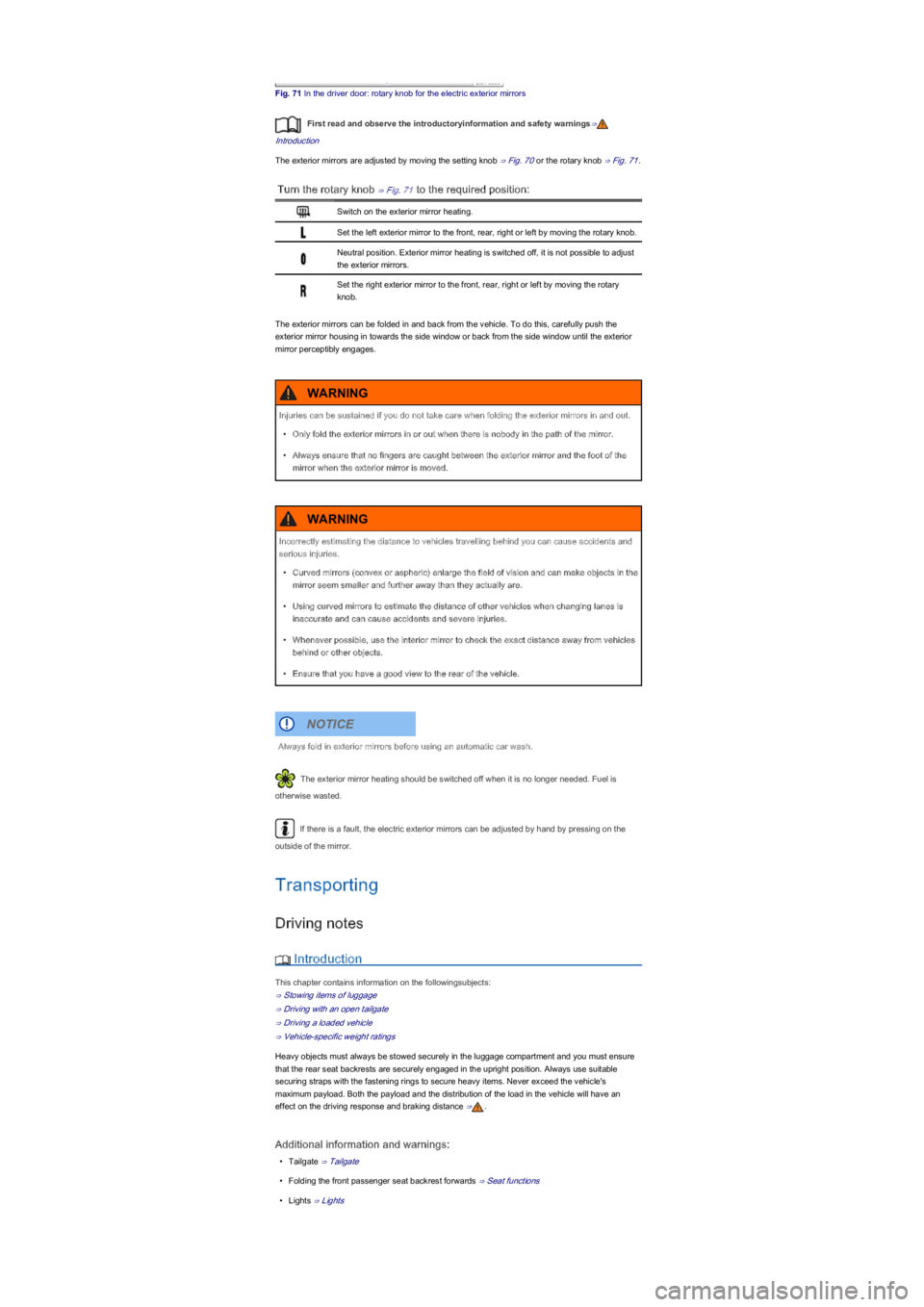
Fig. 71 In the driver door: rotary knob for the electric exterior mirrors
First read and observe the introductoryinformation and safety warnings⇒
Introduction
The exterior mirrors are adjusted by moving the setting knob ⇒ Fig. 70 or the rotary knob ⇒ Fig. 71.
Turn the rotary knob ⇒ Fig. 71 to the required position:
Switch on the exterior mirror heating.
Set the left exterior mirror to the front, rear, right or left by moving the rotary knob.
Neutral position. Exterior mirror heating is switched off, it is not possible to adjust
the exterior mirrors.
Set the right exterior mirror to the front, rear, right or left by moving the rotary
knob.
The exterior mirrors can be folded in and back from the vehicle. To do this, carefully push the
exterior mirror housing in towards the side window or back from the side window until the exterior
mirror perceptibly engages.
The exterior mirror heating should be switched off when it is no longer needed. Fuel is
otherwise wasted.
If there is a fault, the electric exterior mirrors can be adjusted by hand by pressing on the
outside of the mirror.
Transporting
Driving notes
Introduction
This chapter contains information on the followingsubjects:
⇒ Stowing items of luggage
⇒ Driving with an open tailgate
⇒ Driving a loaded vehicle
⇒ Vehicle-specific weight ratings
Heavy objects must always be stowed securely in the luggage compartment and you must ensure
that the rear seat backrests are securely engaged in the upright position. Always use suitable
securing straps with the fastening rings to secure heavy items. Never exceed the vehicle's
maximum payload. Both the payload and the distribution of the load in the vehicle will have an
effect on the driving response and braking distance ⇒.
Additional information and warnings:
•Tailgate ⇒ Tailgate
•Folding the front passenger seat backrest forwards ⇒ Seat functions
•Lights ⇒ Lights
Injuries can be sustained if you do not take care when folding the exterior mirrors in and out.
•Only fold the exterior mirrors in or out when there is nobody in the path of the mirror.
•Always ensure that no fingers are caught between the exterior mirror and the foot of the
mirror when the exterior mirror is moved.
WARNING
Incorrectly estimating the distance to vehicles travelling behind you can cause accidents and
serious injuries.
•Curved mirrors (convex or aspheric) enlarge the field of vision and can make objects in the
mirror seem smaller and further away than they actually are.
•Using curved mirrors to estimate the distance of other vehicles when changing lanes is
inaccurate and can cause accidents and severe injuries.
•Whenever possible, use the interior mirror to check the exact distance away from vehicles
behind or other objects.
•Ensure that you have a good view to the rear of the vehicle.
WARNING
Always fold in exterior mirrors before using an automatic car wash.
NOTICE
Page 122 of 211
Keep the air intake slots in front of the windscreen free of snow, ice and leaves to ensure
heating and cooling is not impaired, and to prevent the windows from misting over.
Controls
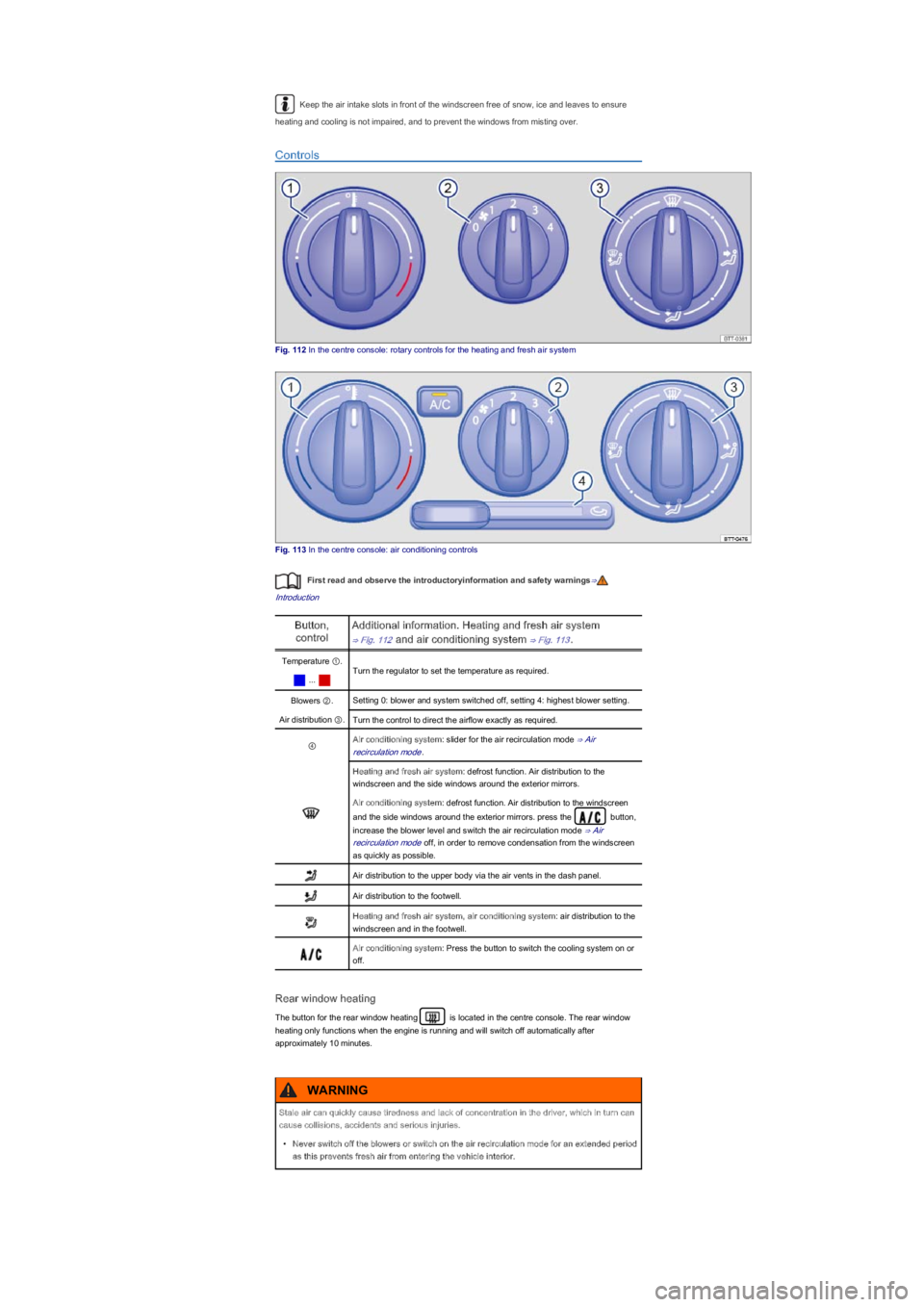
Fig. 112 In the centre console: rotary controls for the heating and fresh air system
Fig. 113 In the centre console: air conditioning controls
First read and observe the introductoryinformation and safety warnings⇒
Introduction
Button,
control
Additional information. Heating and fresh air system
⇒ Fig. 112 and air conditioning system ⇒ Fig. 113.
Temperature ①.
Turn the regulator to set the temperature as required.
...
Blowers ②.Setting 0: blower and system switched off, setting 4: highest blower setting.
Air distribution ③.Turn the control to direct the airflow exactly as required.
④Air conditioning system: slider for the air recirculation mode ⇒ Air
recirculation mode.
Heating and fresh air system: defrost function. Air distribution to the
windscreen and the side windows around the exterior mirrors.
Air conditioning system: defrost function. Air distribution to the windscreen
and the side windows around the exterior mirrors. press the button,
increase the blower level and switch the air recirculation mode ⇒ Air
recirculation mode off, in order to remove condensation from the windscreen
as quickly as possible.
Air distribution to the upper body via the air vents in the dash panel.
Air distribution to the footwell.
Heating and fresh air system, air conditioning system: air distribution to the
windscreen and in the footwell.
Air conditioning system: Press the button to switch the cooling system on or
off.
Rear window heating
The button for the rear window heating is located in the centre console. The rear window
heating only functions when the engine is running and will switch off automatically after
approximately 10 minutes.
Stale air can quickly cause tiredness and lack of concentration in the driver, which in turn can
cause collisions, accidents and serious injuries.
•Never switch off the blowers or switch on the air recirculation mode for an extended period
as this prevents fresh air from entering the vehicle interior.
WARNING
Page 145 of 211
How the vehicle battery discharges:
•Long periods at a standstill in which the engine is not running, especially if the ignition is
switched on.
•The use of electrical consumers when the engine is switched off.
Dispose of the vehicle battery as required by legislation. Batteries may contain toxic
substances such as sulphuric acid and lead.
Electrolyte can pollute the environment. Clean up any service fluid leakages and dispose of
them properly.
Vehicle care and maintenance
Caring for and cleaning the vehicle exterior
Introduction
This chapter contains information on the followingsubjects:
⇒ Washing the vehicle
⇒ Washing the vehicle with a high-pressure cleaner
⇒ Cleaning windows and exterior mirrors
⇒ Cleaning and changing windscreen wiper blades
⇒ Waxing and polishing the vehicle
⇒ Cleaning and caring for chrome and aluminium trim parts
⇒ Cleaning wheels
⇒ Care of rubber seals
⇒ De-icing the door lock cylinders
⇒ Underseal
⇒ Cleaning the engine compartment
Regular and expert care helps to maintain the value of the vehicle. Proper maintenance may also
be one of the requirements for the approval of warranty claims in the event of corrosion or paint
defects.
Suitable care products are available from Volkswagen dealers.
Additional information and warnings:
•Preparation for working in the engine compartment ⇒ Preparation for working in the engine
compartment
•Cleaning and caring for the interior ⇒ Cleaning and caring for the interior
•Accessories, modifications, repairs and renewal of parts ⇒ Accessories, modifications, repairs
and renewal of parts
Incorrectly attaching the battery and using incorrect vehicle batteries can cause short circuits,
fire and serious injuries.
•Always use maintenance-free and leak-proof batteries that have the same properties,
specifications and dimensions as the factory-fitted vehicle battery.
WARNING
A highly explosive mixture of gases is given off when the vehicle battery is being charged.
•Vehicle batteries should only be charged in well-ventilated spaces.
•Never charge a vehicle battery once it has been frozen. Discharged vehicle batteries can
even freeze at temperatures of around 0°C (+32°F).
•A vehicle battery must be replaced if it has been frozen.
•Incorrectly connected cables can cause a short circuit. First connect the positive cable and
then the negative cable.
WARNING
•Never make or break connections between vehicle batteries if the ignition is switched on or
the engine is running. Never use a vehicle battery that does not correspond with the
vehicle's specifications. The vehicle's electrical system or electronic components could be
damaged, which could lead to electrical faults, for example in the start/stop system.
•Never connect equipment that provides electricity, such as solar panels or a battery
charger, to the 12-volt socket or to the cigarette lighter to charge the vehicle battery. This
can damage the vehicle electrical system.
NOTICE
Page 146 of 211
In the interests of environmental protection, the vehicle should only be washed in specially
provided wash bays. This prevents waste water contaminated with oil, grease or fuel from entering
the sewerage system. In some countries, washing vehicles anywhere else may be prohibited.
Environmentally-friendly care products should be used.
Leftover car care products should not be disposed of with ordinary household waste. Read
the manufacturer's instructions.
Washing the vehicle
First read and observe the introductoryinformation and safety warnings⇒
Introduction
The longer substances such as insects, bird droppings, resinous tree sap, road dirt, industrial
deposits, tar, soot or road salt and other corrosive materials remain on the vehicle, the more
damage they do to the paintwork. High temperatures (for instance in strong sunlight) further
intensify the corrosive effect. The underside of the vehicle should also be cleaned thoroughly and
regularly.
Car washes
Please observe the signs on the automatic car wash. Before using an automatic car wash take
the usual precautions, such as closing all windows and folding in the exterior mirrors, in order to
avoid damage to the vehicle. You must consult the car wash operator if there are special parts on
your vehicle such as spoilers, roof luggage carrier systems or radio aerials ⇒.
The paint is hard-wearing enough for the car to be generally washed in an automatic car wash.
However, the effect on the paint depends to a large extent on the design of the car wash.
Volkswagen recommends the use of car washes without brushes.
To remove any waxy residue from the windows and to stop wipers rubbing, please note the
following ⇒ Cleaning windows and exterior mirrors.
Washing the car by hand
When washing by hand, first soften the dirt with plenty of water and rinse off as well as possible.
Then clean the vehicle with a soft sponge, a glove or a brush using only light pressure. Start with
the roof and work from the top to the bottom. Use a shampoo for very stubborn dirt only.
The sponge or glove should be wrung out thoroughly at regular intervals.
Clean the wheels, sill panels etc. last. Use a different sponge for this purpose.
Car care products can be toxic and hazardous. Unsuitable care products and incorrect
application of care products can cause accidents, serious injuries, burns or poisoning.
•The care product must be kept in its original sealed container.
•Read the manufacturer's instructions.
•Never store car care products in empty food containers, bottles or any other non-original
containers as people finding these containers may not know that they contain care
products.
•Keep children away from care products.
•The products can give off harmful fumes during use. They should therefore only be used
outside or in well-ventilated spaces.
•Never use fuel, turpentine, engine oil, nail varnish remover or other volatile fluids to wash,
clean or care for your vehicle. These substances are toxic and highly inflammable.
WARNING
Incorrect care and cleaning of vehicle parts can impair the safety features of the vehicle and
thus cause serious injury.
•Vehicle parts must be cleaned according to the manufacturer's instructions.
•Only use approved or recommended cleaning products.
WARNING
Cleaning agents that contain solvents attack the material and can cause damage.
NOTICE
Page 147 of 211
Washing the vehicle with a high-pressure cleaner
First read and observe the introductoryinformation and safety warnings⇒
Introduction
Follow the instructions provided by the manufacturer when cleaning your vehicle using a high-
pressure cleaner. This applies in particular to the pressure and the spraying distance⇒.
Maintain sufficient distance to soft materials such as rubber hoses, insulation, and the ParkPilot
sensors. The ParkPilot sensors are located in the rear bumper ⇒.
Never use concentrated jet nozzles or dirt blasters⇒.
Parts of the vehicle with sharp edges can cause injury.
•Protect your hands and arms from cuts on sharp parts, for example when cleaning the
underbody or the inside of the wheel housings.
WARNING
After the car has been washed, the braking effect could set in later than normal and extend
the braking distance as the brake discs and brake pads will be wet, or iced up in winter.
•You can dry and de-ice the brakes by performing careful braking manoeuvres. Ensure that
you do not endanger any other road users or violate any legal regulations when doing so.
WARNING
•The water should be no warmer than +60°C (+140°F).
•Do not wash the vehicle in direct sunlight in order to avoid damage to the vehicle
paintwork.
•Never clean with insect sponges, rough kitchen sponges or similar products as these can
damage the surface.
•Never clean the headlights with a dry cloth or sponge. Always use a wet cloth or sponge. It
is best to use soapy water.
•Washing the vehicle in cold weather: if the vehicle is rinsed with a hose, do not direct the
water into the lock cylinders or the gaps round the doors, boot, or bonnet. The locks and
seals could freeze.
NOTICE
Observe the following guidelines before driving the vehicle into an automatic car wash in order
to avoid damage to the vehicle:
•Ensure that the gap between the guide rails in the car wash is sufficient for the vehicle
track. If the track is too narrow your wheels and tyres will be damaged.
•Switch off the city emergency brake function before driving the vehicle into an automatic
car wash.
•Check that the car wash is tall and wide enough for your vehicle.
•Fold in the exterior mirrors.
•In order to prevent damage to the paintwork on the bonnet, fold the windscreen wipers
back onto the windscreen after drying the wiper blades. Do not drop the wipers onto the
glass.
•Lock the tailgate to prevent it from opening accidentally in the car wash.
NOTICE
Page 148 of 211
Cleaning windows and exterior mirrors
First read and observe the introductoryinformation and safety warnings⇒
Introduction
Cleaning windows and exterior mirrors
Moisten the windows and exterior mirrors with commercially available, alcohol-based glass cleaner.
Dry the glass surfaces with a clean chamois leather or a lint-free cloth. Chamois leathers that have
been used on painted surfaces are not suitable for use on glass surfaces. They will be soiled with
wax deposits which could smear the surfaces.
Use window cleaner or a silicone remover to clean off rubber, oil, grease and silicone deposits ⇒
.
Removing wax
Car washes and care products could leave wax deposits on the glass surfaces. Wax residue can
only be removed using a special cleaning product or cleaning cloths. Wax deposits on the
windscreen can cause the wiper blades to rub. Volkswagen recommends using a glass cleaning
cloth - G 052 522 A1 - to remove wax deposits from the windows and exterior mirrors each time the
vehicle is washed.
A window cleaner specifically for removing wax will stop the blades rubbing if added to the
windscreen wash water. Dilute the cleaner as instructed. Grease removing cleaners will not remove
wax deposits ⇒.
Special cleaners, glass cleaners and glass cleaning cloths are available from Volkswagen
dealerships.
Removing snow
Use a small brush to remove snow from the windows and exterior mirrors.
Removing ice
The best method for removing ice is to use a de-icer spray. If you use an ice scraper, do not move
it to and fro, but push it in one direction only. Moving the ice scraper backwards can cause dirt to
scratch the window.
The incorrect use of a high-pressure cleaner can cause visible and invisible long-term
damage to tyres and other materials. This can cause accidents and serious injuries.
•Maintain sufficient distance between the washer jet and the tyres.
•Never clean the tyres with concentrated jet nozzles (dirt blasters). The tyres may incur
visible and invisible damage even if cleaned briefly with the spray at a distance.
WARNING
After the car has been washed, the braking effect could set in later than normal and extend
the braking distance as the brake discs and brake pads will be wet, or iced up in winter.
•You can dry and de-ice the brakes by performing careful braking manoeuvres. Ensure that
you do not endanger any other road users or violate any legal regulations when doing so.
WARNING
•The water may be no warmer than +60°C (+140°F).
•Do not wash the vehicle in direct sunlight in order to avoid damage to the vehicle
paintwork.
•The ParkPilot sensors in the bumpers must be kept clean and free of ice to guarantee
correct function. When cleaning with pressure hoses or steam cleaners, the sensors
should only be sprayed briefly and the steam/hose nozzle must be kept more than 10 cm
away.
•Do not clean windows that are iced over or covered in snow with a high-pressure cleaner.
•Washing the vehicle in cold weather: if the vehicle is rinsed with a hose, do not direct the
water into the lock cylinders or the gaps round the doors, boot, or bonnet. The locks and
seals could freeze.
NOTICE
Page 149 of 211
Cleaning and changing windscreen wiper blades
Fig. 126 Changing the windscreen wiper blades
Fig. 127 Changing the rear window wiper blade
First read and observe the introductoryinformation and safety warnings⇒
Introduction
The factory-fitted windscreen wiper blades are coated with graphite. The graphite coating ensures
that the windscreen wiper blade moves quietly over the windscreen. If the graphite coating is
damaged, the windscreen wiper will become louder.
Check the condition of the wiper blades on a regular basis. Rubbing wiper blades should be
changed if damaged or cleaned if dirty ⇒.
Damaged wiper blades should be replaced immediately. Windscreen wiper blades can be bought
from a qualified workshop.
Cleaning windscreen wiper blades
Note for the front windscreen wiper: move the wiper arms to the service position before lifting
them ⇒ Windscreen wiper and washer.
•When lifting a wiper arm hold it only by the wiper blade mounting.
•Clean the windscreen wiper blade carefully using a damp cloth ⇒.
•Place the windscreen wiper arm back onto the windscreen.
Changing the windscreen wiper blades
•Move the wiper arms to the service position before lifting ⇒ Windscreen wiper and washer.
•When lifting a wiper arm hold it only by the wiper blade mounting.
•Press and hold the release button ⇒ Fig. 126① and simultaneously pull off the wiper blade in
the direction of the arrow.
•Insert a new wiper blade with the same length and design onto the wiper arm. Push it on until it
engages.
Dirty or misted windows reduce visibility and increase the risk of accidents and severe
injuries.
•Only drive when you have a clear view through all windows.
•Ice, snow and mist must be removed from the inside and outside of all windows.
WARNING
•Never combine the recommended cleaning agents with other cleaning agents for use in the
windscreen washer fluid. This can cause the ingredients to separate and block the washer
jets.
•Never use warm or hot water to remove snow and ice from windows and mirrors. This can
cause the glass to crack.
•The heating elements for the rear window heater are located on the inside of the rear
window. Never apply stickers over the heating elements and never clean the inside of the
rear window with corrosive or acidic detergents or any other chemicals.
NOTICE
Page 171 of 211
The vehicle owner should keep all assembly documentation for these auxiliary fittings, and pass it
on to any scrapping company later engaged. In this way, environmentally compatible disposal
should be guaranteed for all vehicles, including refitted vehicles.
Windscreen repairs
To function properly, some items of equipment require a camera or sensor, which is located on the
inside of the windscreen near the interior mirror. If the windscreen in the viewing field of the camera
or sensors has been damaged, e.g. by stone impact, the windscreen must be replaced. Repairing
the crack can lead to malfunction or functional faults in the equipment.
After changing the windscreen, the camera and sensors must be set up and calibrated by a
qualified workshop.
Repairs and faults in the airbag system
First read and observe the introductoryinformation and safety warnings⇒
Introduction
Repairs and modifications must always be carried out according to Volkswagen specifications⇒
.
Modifications and repairs to the front bumper, the doors, the front seats, the roof, or the bodywork
should be carried out by a qualified workshop. System components and airbag system sensors can
be located on these vehicle components.
If you work on the airbag system or remove and install parts of the system when performing other
repair work, parts of the airbag system may be damaged. The consequence may be that, in the
event of an accident, the airbag inflates incorrectly or does not inflate at all.
Regulations must be observed to ensure that the effectiveness of the airbags is not reduced and
that removed parts do not cause any injuries or environmental pollution. Qualified workshops are
familiar with these requirements.
Any modifications to the vehicle's suspension could prevent the airbag system from working
properly during a collision. For example, using tyre/rim combinations that have not been approved
by Volkswagen, lowering the vehicle, making modifications to the suspension rate including work on
the springs, struts and shock absorbers could change the forces that are measured by the airbag
sensors and sent to the electronic control unit. Some changes to the suspension could cause the
forces measured by the sensors to increase. This can lead to the airbag system being triggered in
collision scenarios where it normally would not be triggered if modifications to the suspension had
not been made. Other modifications can cause the forces measured by the sensors to decrease,
therefore preventing the airbag system from being triggered when it should have been.
Retrofitting two-way radios
First read and observe the introductoryinformation and safety warnings⇒
Introduction
Incorrect repairs and modifications can cause functional problems and damage to the vehicle
and impair the effectiveness of the driver assist systems. This can result in accidents and
severe injuries.
•Repairs and modifications to your vehicle should only be carried out by a qualified
workshop.
WARNING
Incorrect repairs and modifications can cause function problems and damage to the vehicle
and impair the effectiveness of the airbag system. This can result in accidents and serious or
even fatal injuries.
•Repairs and modifications to your vehicle should only be carried out by a qualified
workshop.
•Airbag modules cannot be repaired. They must be replaced.
•Never use recycled airbag components or components that have been taken from end-of-
life vehicles in your vehicle.
WARNING
Modifications to the vehicle's suspension, including the use of unsuitable tyre/rim
combinations, can cause the airbag system to work differently and increase the risk of serious
or fatal injuries in the event of an accident.
•Never install any components in the suspension system that do not have the same
characteristics as the original factory-fitted components.
•Never use tyre/rim combinations that have not been approved by Volkswagen.
WARNING
Page 191 of 211
Find a firm and level surface suitable for lifting the vehicle.
Stop the engine, select a gear on a manual gearbox or with an automated manual
gearbox, move the selector lever to D or R with the ignition switched onChanging gear
then apply the handbrake firmly Braking, stopping and parking.
Chock the wheel diagonally opposite using the collapsible chocks or other suitable objects.
Loosen the wheel bolts on the wheel that is being changed Wheel bolts.
Find the jacking point under the vehicle which is closest to the wheel that is being
changed.
Raise the vehicle jack until it just fits under the jacking point of the vehicle.
Ensure that the foot of the jack is resting securely on the ground with its whole surface and
that the foot of the jack is positioned precisely, i.e. vertically beneath the point of
application .
Position the vehicle jack. At the same time, continue to crank the claw up until it is in
position around the vertical rib underneath the vehicle .
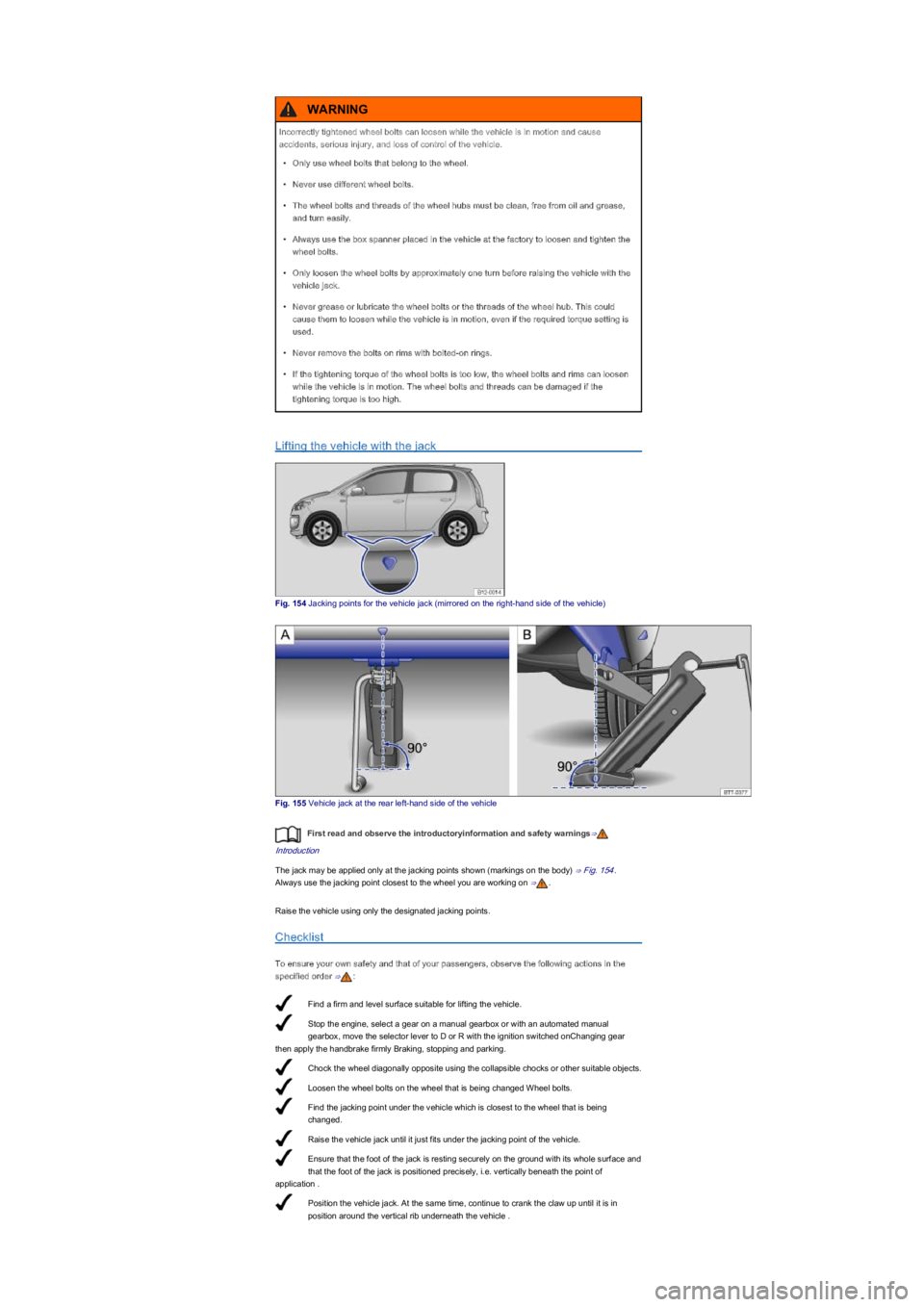
Lifting the vehicle with the jack
Fig. 154 Jacking points for the vehicle jack (mirrored on the right-hand side of the vehicle)
Fig. 155 Vehicle jack at the rear left-hand side of the vehicle
First read and observe the introductoryinformation and safety warnings⇒
Introduction
The jack may be applied only at the jacking points shown (markings on the body) ⇒ Fig. 154.
Always use the jacking point closest to the wheel you are working on ⇒.
Raise the vehicle using only the designated jacking points.
Checklist
To ensure your own safety and that of your passengers, observe the following actions in the
specified order ⇒:
Incorrectly tightened wheel bolts can loosen while the vehicle is in motion and cause
accidents, serious injury, and loss of control of the vehicle.
•Only use wheel bolts that belong to the wheel.
•Never use different wheel bolts.
•The wheel bolts and threads of the wheel hubs must be clean, free from oil and grease,
and turn easily.
•Always use the box spanner placed in the vehicle at the factory to loosen and tighten the
wheel bolts.
•Only loosen the wheel bolts by approximately one turn before raising the vehicle with the
vehicle jack.
•Never grease or lubricate the wheel bolts or the threads of the wheel hub. This could
cause them to loosen while the vehicle is in motion, even if the required torque setting is
used.
•Never remove the bolts on rims with bolted-on rings.
•If the tightening torque of the wheel bolts is too low, the wheel bolts and rims can loosen
while the vehicle is in motion. The wheel bolts and threads can be damaged if the
tightening torque is too high.
WARNING