steering VOLKSWAGEN UP! 2021 Owner´s Manual
[x] Cancel search | Manufacturer: VOLKSWAGEN, Model Year: 2021, Model line: UP!, Model: VOLKSWAGEN UP! 2021Pages: 211, PDF Size: 5.98 MB
Page 47 of 211
The belt tensioners are activated by sensors during severe frontal, side and rear collisions. They
tighten the seat belts against the direction in which they are pulled. A loose seat belt is retracted,
which can reduce the forward movement or the movement of the vehicle occupants in the direction
of the impact. The belt tensioner works together with the airbag system. If the side airbags are not
activated, the belt tensioner will not be activated if the vehicle rolls over.
A fine dust may be produced when the airbags are triggered. This is quite normal and does not
mean that there is a fire in the vehicle.
Belt tension limiter
The belt tension limiter reduces the pressure exerted by the seat belt on the body during an
accident.
All safety requirements must be observed when the vehicle or components of the system are
scrapped. Qualified workshops are familiar with these requirements ⇒ Service and disposal of belt
tensioners.
Service and disposal of belt tensioners
First read and observe the introductoryinformation and safety warnings⇒
Introduction
Seat belts may become damaged during any work on the belt tensioners or while removing or
refitting any vehicle parts in conjunction with any other repair work. This damage will not always be
noticeable. The consequence may be that the belt tensioners could function incorrectly, or not
function at all, in the event of an accident.
Regulations must be observed to ensure that the effectiveness of the belt tensioner is not reduced
and that removed parts do not cause any injuries or environmental pollution. Qualified workshops
are familiar with these requirements.
The airbag modules and belt tensioners may contain perchlorate. Please comply with
legislation regarding disposal.
Airbag system
Introduction
This chapter contains information on the followingsubjects:
⇒ Types of front passenger front airbag system
⇒ Indicator lamps
⇒ Description and function of the airbags
⇒ Front airbags
⇒ Switching the front passenger front airbag on and off manually using the key-operated switch
⇒ Side airbags
The vehicle is equipped with a front airbag for the driver and front passenger. The front airbags can
provide front seat occupants with additional chest and head protection if the seat, seat belts, head
restraints and, in the case of the driver, steering wheel are adjusted and used correctly. Airbags are
meant only for additional protection. The airbags are not a substitute for seat belts. Seat belts must
always be worn, even when the front seats are equipped with front airbags.
Additional information and warnings:
•Driving tips ⇒ Driving tips
•Central locking system ⇒ Central locking system
•Correct sitting position ⇒ Adjusting the seat position
•Seat belts ⇒ Seat belts
•Child seats (accessories) ⇒ Child seats (accessories)
•Cleaning and caring for the interior ⇒ Cleaning and caring for the interior
•Accessories, modifications, repairs and renewal of parts ⇒ Accessories, modifications, repairs
and renewal of parts
•Consumer information ⇒ Consumer information
The risk of severe or fatal injuries may be increased if the seat belts, automatic belt retractors
and belt tensioners are not used correctly, or if they are repaired by a non-professional. As a
result, the belt tensioners may not be triggered when they should, or they may be triggered
unexpectedly.
•Any repairs, adjustments or removal and refitting of parts in the belt tensioners or seat
belts should always be carried out by a qualified workshop and never by yourself
⇒ Accessories, modifications, repairs and renewal of parts.
•Belt tensioners and automatic belt retractors cannot be repaired. They must be replaced.
WARNING
Page 50 of 211
When an airbag is triggered, it is inflated by a gas generator. This causes the airbag covers to
break, and the airbags inflate forcefully to cover their deployment zones within milliseconds. Once a
vehicle occupant wearing a seat belt starts to sink into the inflated airbag, the gas inside the airbag
starts to escape to cushion the occupant and slow down their movement. This can reduce the risk
of severe and fatal injuries. A triggered airbag will not always prevent other injuries such as
swelling, bruising and grazing. Deployment of a triggered airbag can also result in frictional heat.
Airbags provide no protection for the arms or lower body.
The most important factors for triggering the airbag are the type of accident, the angle of impact,
the vehicle speed and the type of object with which the vehicle collides. Therefore, visible damage
to the vehicle does not always mean that the airbag should have been triggered.
The triggering of the airbag system depends on the vehicle deceleration rate caused by the collision
and registered by the electronic control unit. If this rate is below the reference value programmed
into the control unit, the airbags will not be triggered, even though the vehicle may be badly
damaged as a result of the collision. Vehicle damage, repair costs or even the lack of vehicle
damage in an accident do not necessarily give an indication of whether an airbag should inflate or
not. It is not possible to define a range of vehicle speeds and reference values, since the
circumstances will vary considerably between one collision and another. It is therefore impossible to
cover every possible kind and angle of impact that would trigger the airbags. Important factors in
the triggering of the airbag include the nature (hard or soft) of the object that the vehicle hits, the
angle of impact, and the vehicle speed.
Airbags only serve as a supplement to the three-point seat belt in some accident situations when
the vehicle braking is sufficient to trigger the airbags. Airbags can only be triggered once and only
in certain situations. The seat belts are always there to provide protection in situations in which the
airbags are not triggered or have already been triggered. For example, if the vehicle collides with a
further vehicle following the initial collision, or is hit by another vehicle.
The airbag system is part of the vehicle's overall passive safety concept. The airbag system can
only work effectively when the occupants are wearing their seat belts correctly and have assumed a
proper sitting position ⇒ Adjusting the seat position.
Components of the vehicle safety concept
The following vehicle safety equipment makes up the vehicle's safety concept to reduce the risk of
severe and fatal injuries. Some of this equipment may not be fitted in your particular vehicle. It may
not be available at all in some countries.
•Optimised seat belts for all seats.
•Belt tensioners for driver and front passenger.
•Belt tension limiters for driver and front passenger.
•Warning lamp .
•Front airbags for driver and front passenger.
•Side airbags for driver and front passenger.
•Airbag indicator lamp .
•Control units and sensors.
•Head restraints optimised for rear impact.
•Adjustable steering column.
•If fitted, ISOFIX anchor points for child seats on the rear outer seats.
•If applicable, securing points for the top tether for child seats.
Situations in which the front and side airbags will not be triggered:
•If the ignition is switched off during a collision.
•If the level of deceleration measured by the control unit is too low during a collision at the front
of the vehicle.
•During a minor side collision.
•During rear collisions.
•If the vehicle rolls over.
•If the speed in a collision is lower than the reference value specified in the control unit.
Front airbags
Page 51 of 211
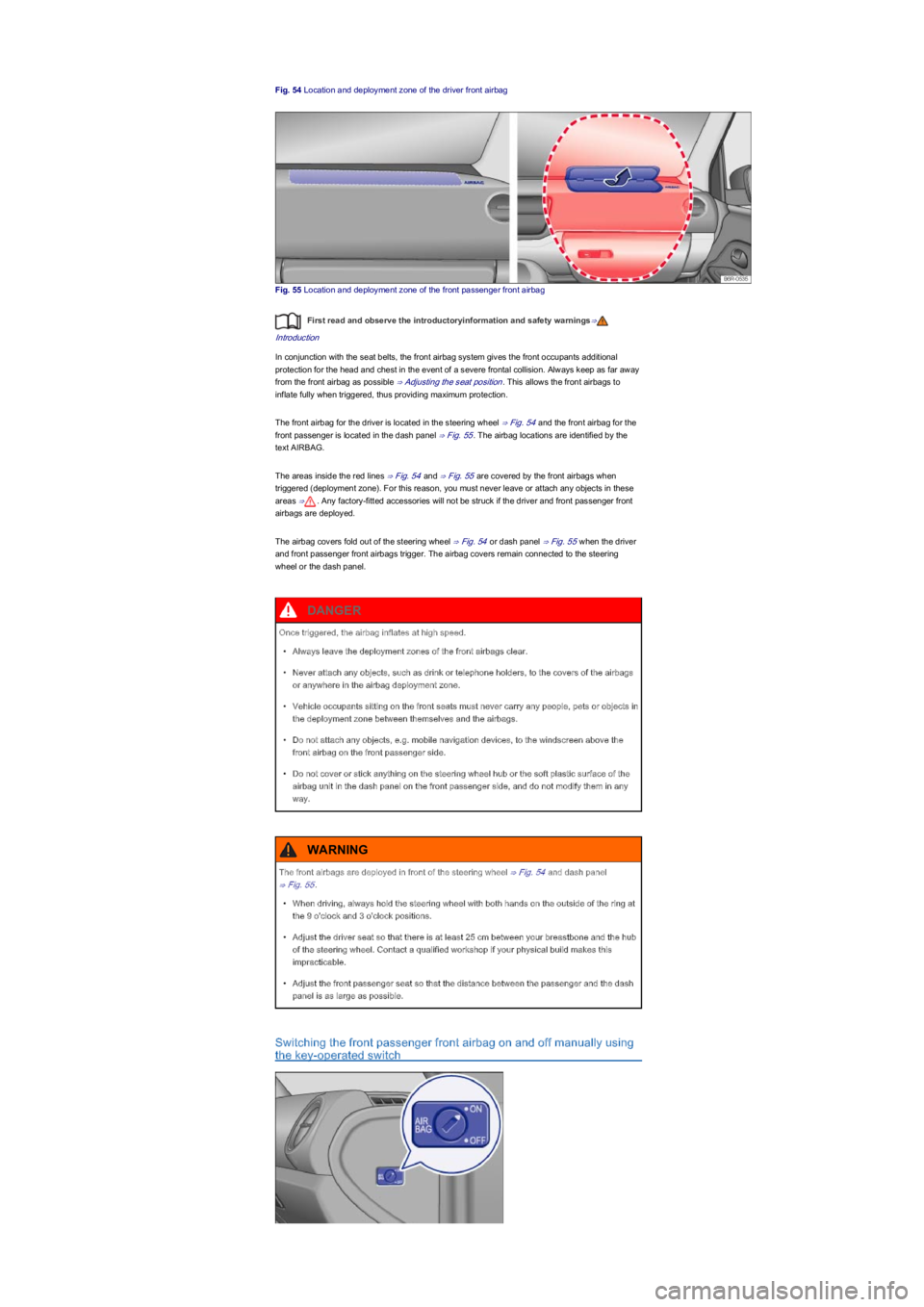
Fig. 54 Location and deployment zone of the driver front airbag
Fig. 55 Location and deployment zone of the front passenger front airbag
First read and observe the introductoryinformation and safety warnings⇒
Introduction
In conjunction with the seat belts, the front airbag system gives the front occupants additional
protection for the head and chest in the event of a severe frontal collision. Always keep as far away
from the front airbag as possible ⇒ Adjusting the seat position. This allows the front airbags to
inflate fully when triggered, thus providing maximum protection.
The front airbag for the driver is located in the steering wheel ⇒ Fig. 54 and the front airbag for the
front passenger is located in the dash panel ⇒ Fig. 55. The airbag locations are identified by the
text AIRBAG.
The areas inside the red lines ⇒ Fig. 54 and ⇒ Fig. 55 are covered by the front airbags when
triggered (deployment zone). For this reason, you must never leave or attach any objects in these
areas ⇒. Any factory-fitted accessories will not be struck if the driver and front passenger front
airbags are deployed.
The airbag covers fold out of the steering wheel ⇒ Fig. 54 or dash panel ⇒ Fig. 55 when the driver
and front passenger front airbags trigger. The airbag covers remain connected to the steering
wheel or the dash panel.
Switching the front passenger front airbag on and off manually using
the key-operated switch
Once triggered, the airbag inflates at high speed.
•Always leave the deployment zones of the front airbags clear.
•Never attach any objects, such as drink or telephone holders, to the covers of the airbags
or anywhere in the airbag deployment zone.
•Vehicle occupants sitting on the front seats must never carry any people, pets or objects in
the deployment zone between themselves and the airbags.
•Do not attach any objects, e.g. mobile navigation devices, to the windscreen above the
front airbag on the front passenger side.
•Do not cover or stick anything on the steering wheel hub or the soft plastic surface of the
airbag unit in the dash panel on the front passenger side, and do not modify them in any
way.
DANGER
The front airbags are deployed in front of the steering wheel ⇒ Fig. 54 and dash panel
⇒ Fig. 55.
•When driving, always hold the steering wheel with both hands on the outside of the ring at
the 9 o'clock and 3 o'clock positions.
•Adjust the driver seat so that there is at least 25 cm between your breastbone and the hub
of the steering wheel. Contact a qualified workshop if your physical build makes this
impracticable.
•Adjust the front passenger seat so that the distance between the passenger and the dash
panel is as large as possible.
WARNING
Page 58 of 211
Removing child seats
Unfasten seat belts only when the vehicle is stationary ⇒.
•Press the red button in the buckle. The latch plate is released and springs out.
•Guide the belt back by hand so that it rolls up easily, without twisting the seat belt and without
damaging the trim.
•Remove the child seat from the vehicle.
Securing child seats using lower anchoring points (ISOFIX, LATCH)
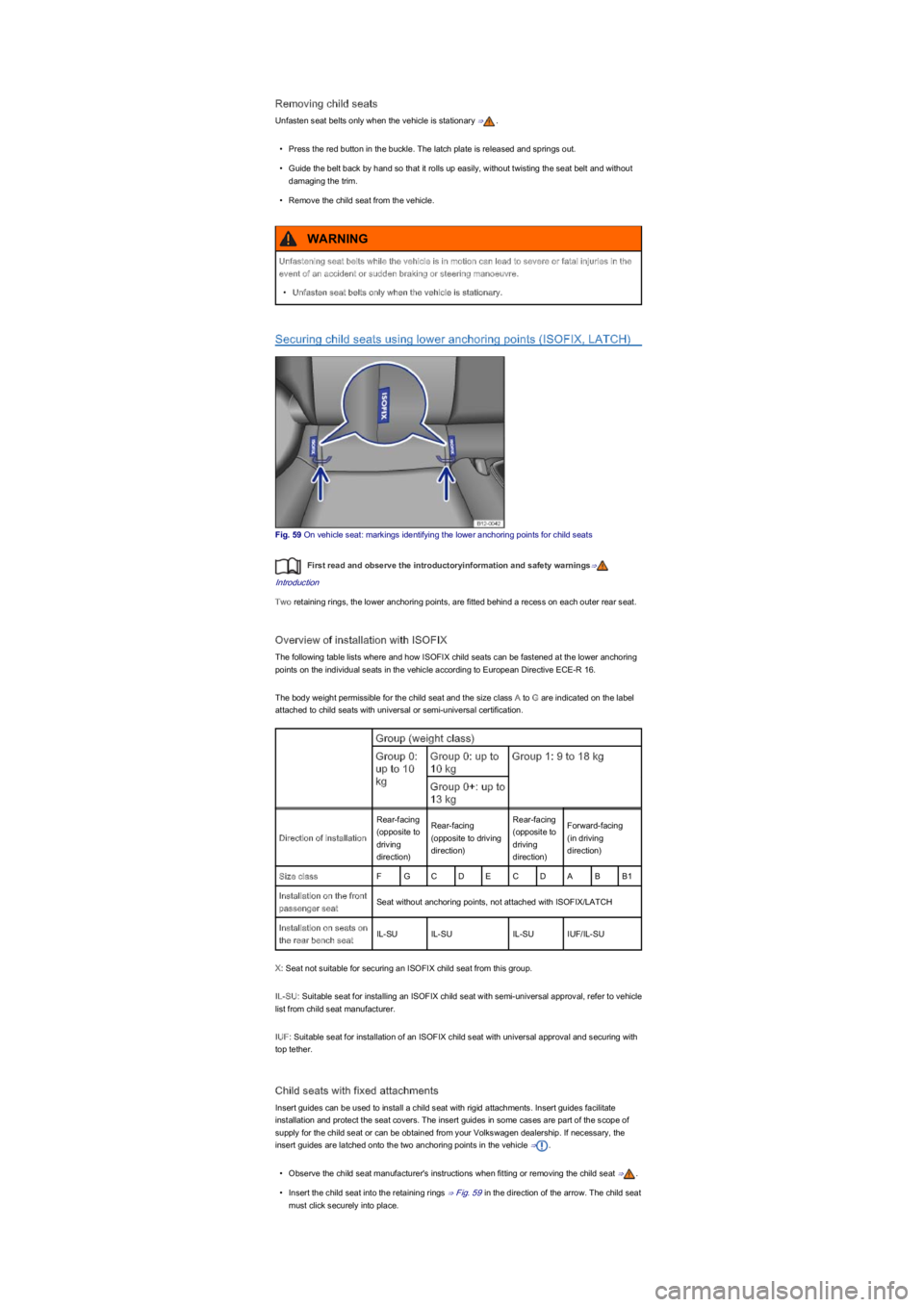
Fig. 59 On vehicle seat: markings identifying the lower anchoring points for child seats
First read and observe the introductoryinformation and safety warnings⇒
Introduction
Two retaining rings, the lower anchoring points, are fitted behind a recess on each outer rear seat.
Overview of installation with ISOFIX
The following table lists where and how ISOFIX child seats can be fastened at the lower anchoring
points on the individual seats in the vehicle according to European Directive ECE-R 16.
The body weight permissible for the child seat and the size class A to G are indicated on the label
attached to child seats with universal or semi-universal certification.
Group (weight class)
Group 0:
up to 10
kg
Group 0: up to
10 kg
Group 1: 9 to 18 kg
Group 0+: up to
13 kg
Direction of installation
Rear-facing
(opposite to
driving
direction)
Rear-facing
(opposite to driving
direction)
Rear-facing
(opposite to
driving
direction)
Forward-facing
(in driving
direction)
Size classFGCDECDABB1
Installation on the front
passenger seatSeat without anchoring points, not attached with ISOFIX/LATCH
Installation on seats on
the rear bench seatIL-SUIL-SUIL-SUIUF/IL-SU
X: Seat not suitable for securing an ISOFIX child seat from this group.
IL-SU: Suitable seat for installing an ISOFIX child seat with semi-universal approval, refer to vehicle
list from child seat manufacturer.
IUF: Suitable seat for installation of an ISOFIX child seat with universal approval and securing with
top tether.
Child seats with fixed attachments
Insert guides can be used to install a child seat with rigid attachments. Insert guides facilitate
installation and protect the seat covers. The insert guides in some cases are part of the scope of
supply for the child seat or can be obtained from your Volkswagen dealership. If necessary, the
insert guides are latched onto the two anchoring points in the vehicle ⇒.
•Observe the child seat manufacturer's instructions when fitting or removing the child seat ⇒.
•Insert the child seat into the retaining rings ⇒ Fig. 59 in the direction of the arrow. The child seat
must click securely into place.
Unfastening seat belts while the vehicle is in motion can lead to severe or fatal injuries in the
event of an accident or sudden braking or steering manoeuvre.
•Unfasten seat belts only when the vehicle is stationary.
WARNING
Page 61 of 211
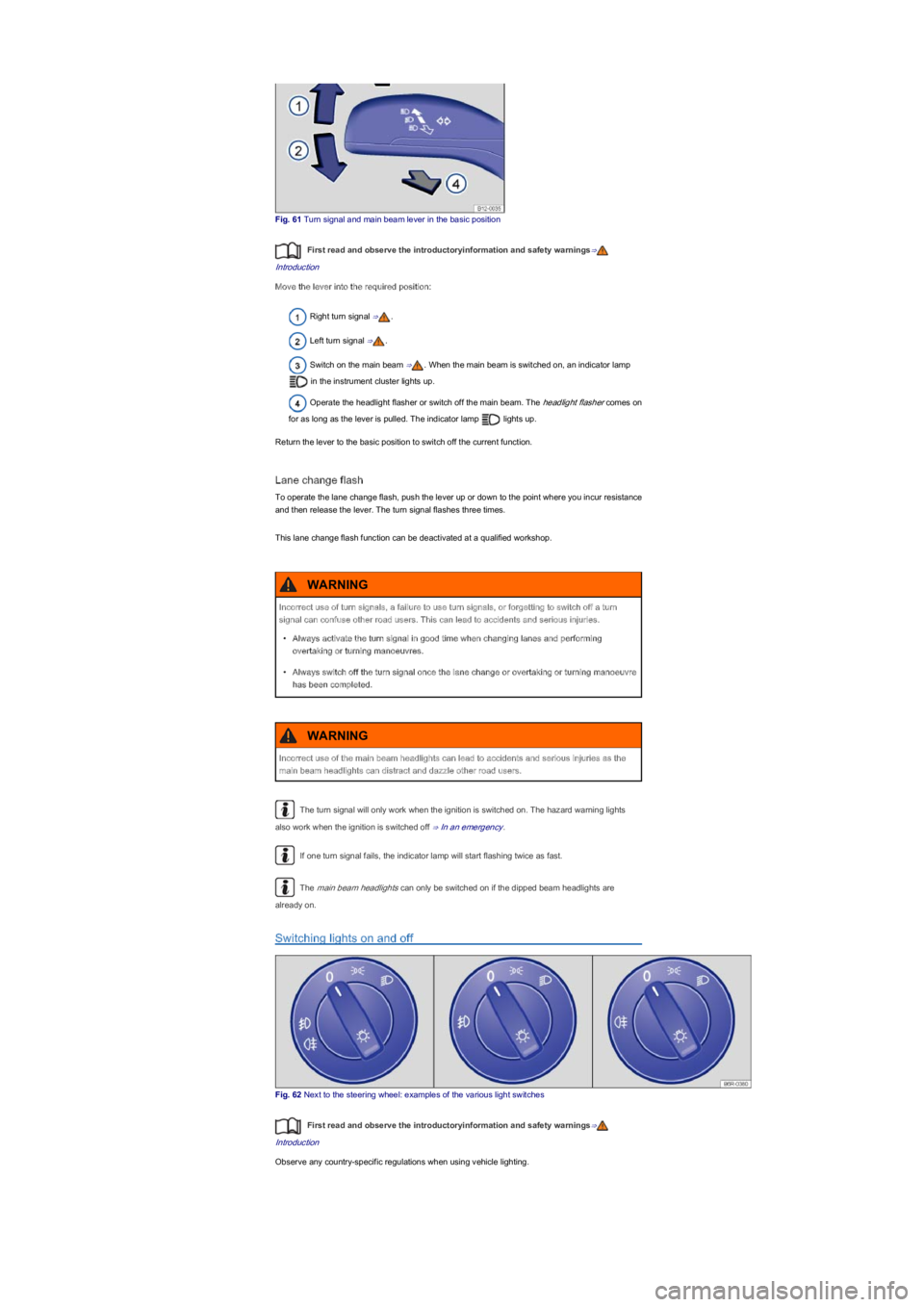
Fig. 61 Turn signal and main beam lever in the basic position
First read and observe the introductoryinformation and safety warnings⇒
Introduction
Move the lever into the required position:
Right turn signal ⇒.
Left turn signal ⇒.
Switch on the main beam ⇒. When the main beam is switched on, an indicator lamp
in the instrument cluster lights up.
Operate the headlight flasher or switch off the main beam. The headlight flasher comes on
for as long as the lever is pulled. The indicator lamp lights up.
Return the lever to the basic position to switch off the current function.
Lane change flash
To operate the lane change flash, push the lever up or down to the point where you incur resistance
and then release the lever. The turn signal flashes three times.
This lane change flash function can be deactivated at a qualified workshop.
The turn signal will only work when the ignition is switched on. The hazard warning lights
also work when the ignition is switched off ⇒ In an emergency.
If one turn signal fails, the indicator lamp will start flashing twice as fast.
The main beam headlights can only be switched on if the dipped beam headlights are
already on.
Switching lights on and off
Fig. 62 Next to the steering wheel: examples of the various light switches
First read and observe the introductoryinformation and safety warnings⇒
Introduction
Observe any country-specific regulations when using vehicle lighting.
Incorrect use of turn signals, a failure to use turn signals, or forgetting to switch off a turn
signal can confuse other road users. This can lead to accidents and serious injuries.
•Always activate the turn signal in good time when changing lanes and performing
overtaking or turning manoeuvres.
•Always switch off the turn signal once the lane change or overtaking or turning manoeuvre
has been completed.
WARNING
Incorrect use of the main beam headlights can lead to accidents and serious injuries as the
main beam headlights can distract and dazzle other road users.
WARNING
Page 63 of 211
If you have to drive a right-hand drive vehicle in a left-hand drive country, or vice versa, the
asymmetric dipped beam headlights may dazzle oncoming traffic.
Therefore you may have to apply stickers to certain parts of the headlight lenses if you are driving
abroad. A qualified workshop can provide you with further information. Volkswagen recommends
using a Volkswagen dealership for this purpose.
Stickers may only be used on the headlights for a limited period. Please contact a qualified
workshop for a permanent alteration. Volkswagen recommends using a Volkswagen dealership for
this purpose.
Headlight range control, instrument and switch lighting
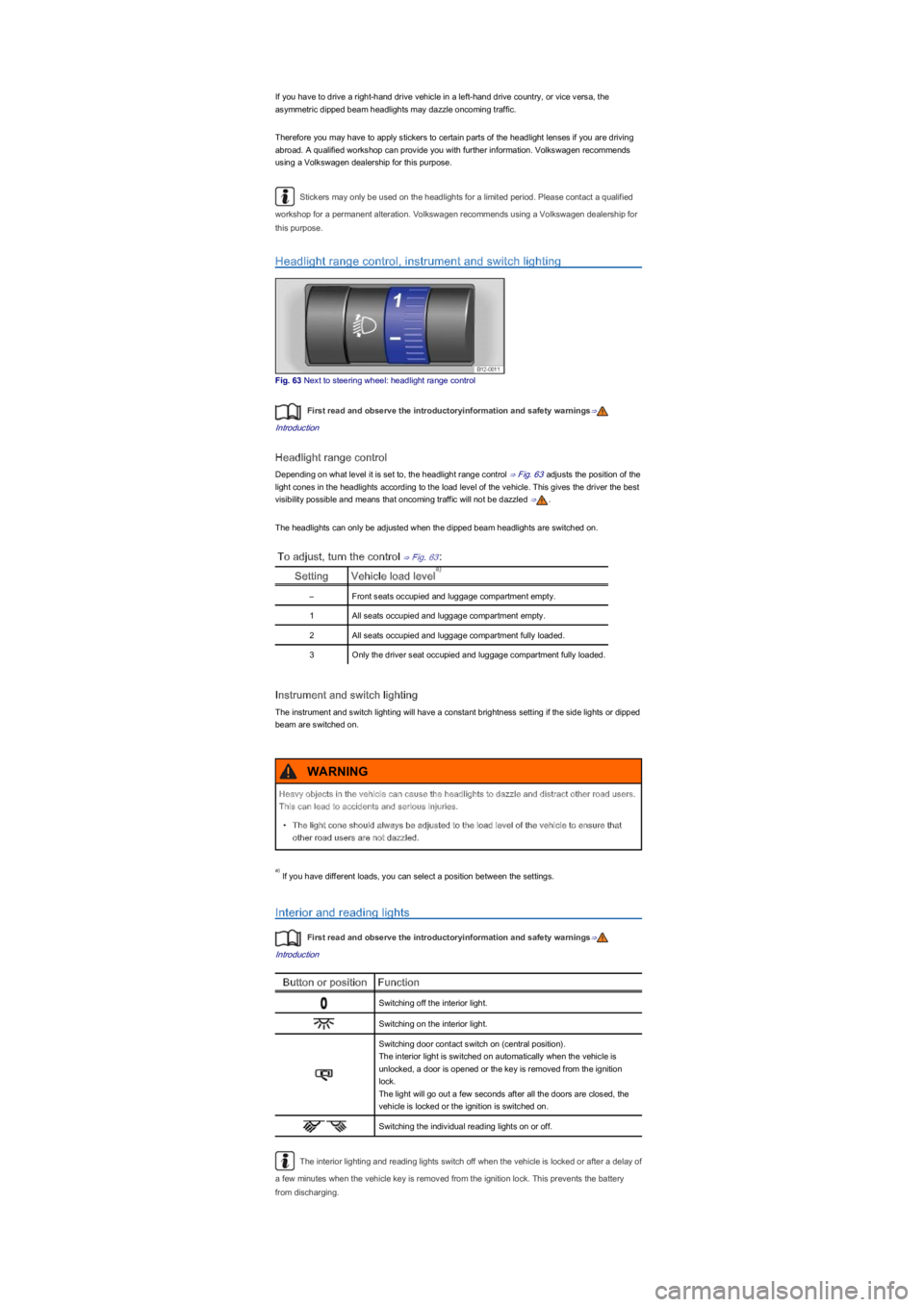
Fig. 63 Next to steering wheel: headlight range control
First read and observe the introductoryinformation and safety warnings⇒
Introduction
Headlight range control
Depending on what level it is set to, the headlight range control ⇒ Fig. 63 adjusts the position of the
light cones in the headlights according to the load level of the vehicle. This gives the driver the best
visibility possible and means that oncoming traffic will not be dazzled ⇒.
The headlights can only be adjusted when the dipped beam headlights are switched on.
To adjust, turn the control ⇒ Fig. 63:
SettingVehicle load level
–Front seats occupied and luggage compartment empty.
1All seats occupied and luggage compartment empty.
2All seats occupied and luggage compartment fully loaded.
3Only the driver seat occupied and luggage compartment fully loaded.
Instrument and switch lighting
The instrument and switch lighting will have a constant brightness setting if the side lights or dipped
beam are switched on.
If you have different loads, you can select a position between the settings.
Interior and reading lights
First read and observe the introductoryinformation and safety warnings⇒
Introduction
Button or positionFunction
Switching off the interior light.
Switching on the interior light.
Switching door contact switch on (central position).
The interior light is switched on automatically when the vehicle is
unlocked, a door is opened or the key is removed from the ignition
lock.
The light will go out a few seconds after all the doors are closed, the
vehicle is locked or the ignition is switched on.
Switching the individual reading lights on or off.
The interior lighting and reading lights switch off when the vehicle is locked or after a delay of
a few minutes when the vehicle key is removed from the ignition lock. This prevents the battery
from discharging.
a)
Heavy objects in the vehicle can cause the headlights to dazzle and distract other road users.
This can lead to accidents and serious injuries.
•The light cone should always be adjusted to the load level of the vehicle to ensure that
other road users are not dazzled.
WARNING
a)
Page 87 of 211
Starting the engine, changing gear and
parking
Starting and stopping the engine
Introduction
This chapter contains information on the followingsubjects:
⇒ Ignition lock
⇒ Starting the engine
⇒ Stopping the engine
⇒ Electronic immobilizer
Immobilizer display
If the vehicle key is not valid or there is a fault in the system, then may be displayed in the
instrument cluster. The engine cannot be started ⇒ Electronic immobilizer.
Push-starting or towing
For technical reasons, your vehicle must not be push-started or tow-started. Use jump leads to
start the engine instead.
Additional information and warnings:
•Vehicle key set ⇒ Vehicle key set
•Changing gear ⇒ Changing gear
•Braking, stopping and parking ⇒ Braking, stopping and parking
•Steering ⇒ Steering
•Pull-away assist systems ⇒ Pull-away assist systems
•Filling the tank ⇒ Filling the tank
•Fuel ⇒ Fuel
•Manual opening and closing ⇒ Manual opening and closing
•Starting the engine with jump leads ⇒ Starting the engine with jump leads
•Tow starting and towing ⇒ Tow-starting and towing
•Observe the operating instructions for any device that you plug into the socket.
•Never exceed the maximum power rating as this could damage the whole vehicle electrical
system.
•12-volt socket:
- Only use accessories that have been approved in accordance with the relevant
guidelines on electromagnetic compatibility.
- Never feed electricity into the socket.
NOTICE
While driving
Page 88 of 211
Ignition lock
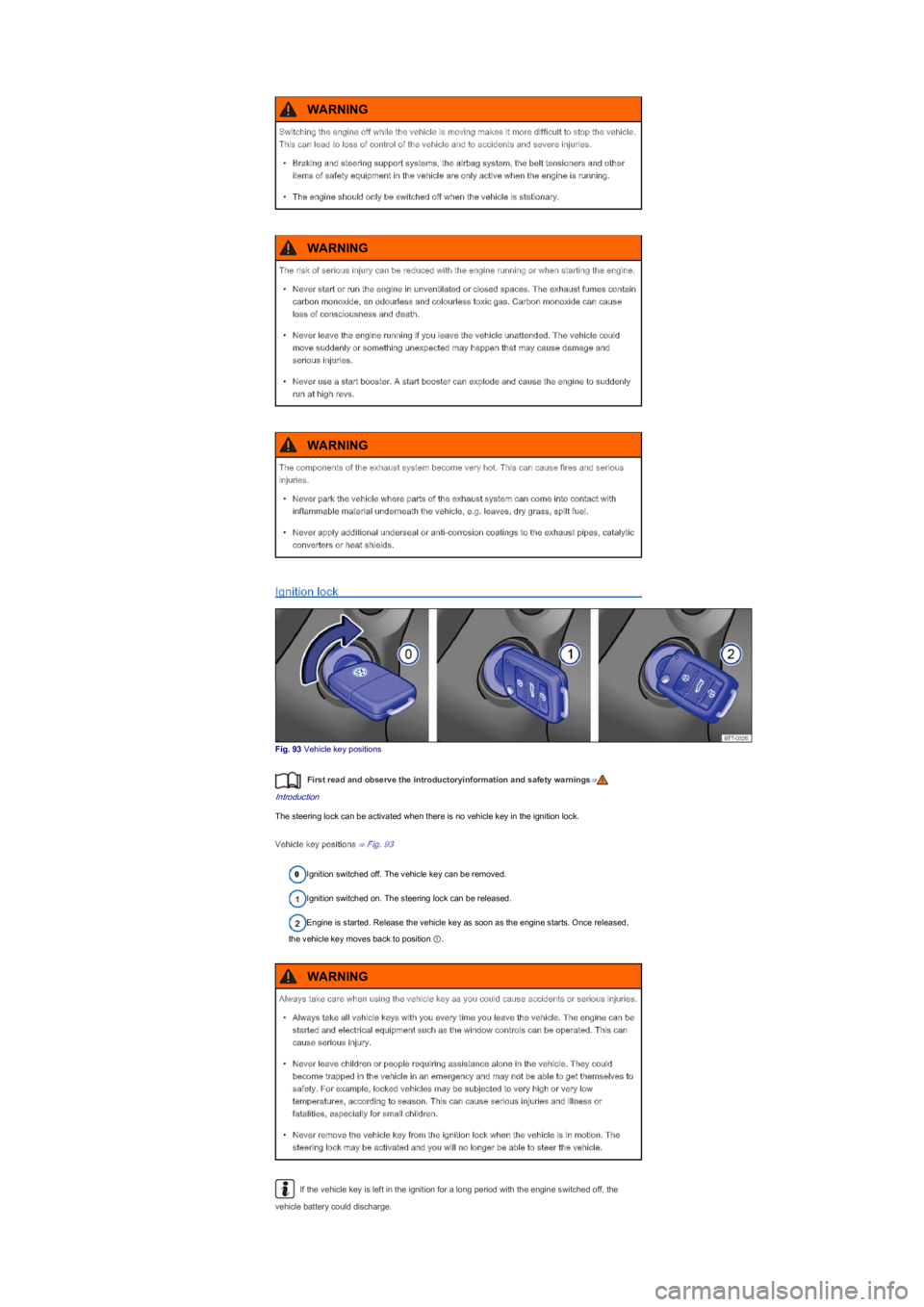
Fig. 93 Vehicle key positions
First read and observe the introductoryinformation and safety warnings⇒
Introduction
The steering lock can be activated when there is no vehicle key in the ignition lock.
Vehicle key positions ⇒ Fig. 93
Ignition switched off. The vehicle key can be removed.
Ignition switched on. The steering lock can be released.
Engine is started. Release the vehicle key as soon as the engine starts. Once released,
the vehicle key moves back to position ①.
If the vehicle key is left in the ignition for a long period with the engine switched off, the
vehicle battery could discharge.
Switching the engine off while the vehicle is moving makes it more difficult to stop the vehicle.
This can lead to loss of control of the vehicle and to accidents and severe injuries.
•Braking and steering support systems, the airbag system, the belt tensioners and other
items of safety equipment in the vehicle are only active when the engine is running.
•The engine should only be switched off when the vehicle is stationary.
WARNING
The risk of serious injury can be reduced with the engine running or when starting the engine.
•Never start or run the engine in unventilated or closed spaces. The exhaust fumes contain
carbon monoxide, an odourless and colourless toxic gas. Carbon monoxide can cause
loss of consciousness and death.
•Never leave the engine running if you leave the vehicle unattended. The vehicle could
move suddenly or something unexpected may happen that may cause damage and
serious injuries.
•Never use a start booster. A start booster can explode and cause the engine to suddenly
run at high revs.
WARNING
The components of the exhaust system become very hot. This can cause fires and serious
injuries.
•Never park the vehicle where parts of the exhaust system can come into contact with
inflammable material underneath the vehicle, e.g. leaves, dry grass, spilt fuel.
•Never apply additional underseal or anti-corrosion coatings to the exhaust pipes, catalytic
converters or heat shields.
WARNING
Always take care when using the vehicle key as you could cause accidents or serious injuries.
•Always take all vehicle keys with you every time you leave the vehicle. The engine can be
started and electrical equipment such as the window controls can be operated. This can
cause serious injury.
•Never leave children or people requiring assistance alone in the vehicle. They could
become trapped in the vehicle in an emergency and may not be able to get themselves to
safety. For example, locked vehicles may be subjected to very high or very low
temperatures, according to season. This can cause serious injuries and illness or
fatalities, especially for small children.
•Never remove the vehicle key from the ignition lock when the vehicle is in motion. The
steering lock may be activated and you will no longer be able to steer the vehicle.
WARNING
Page 90 of 211
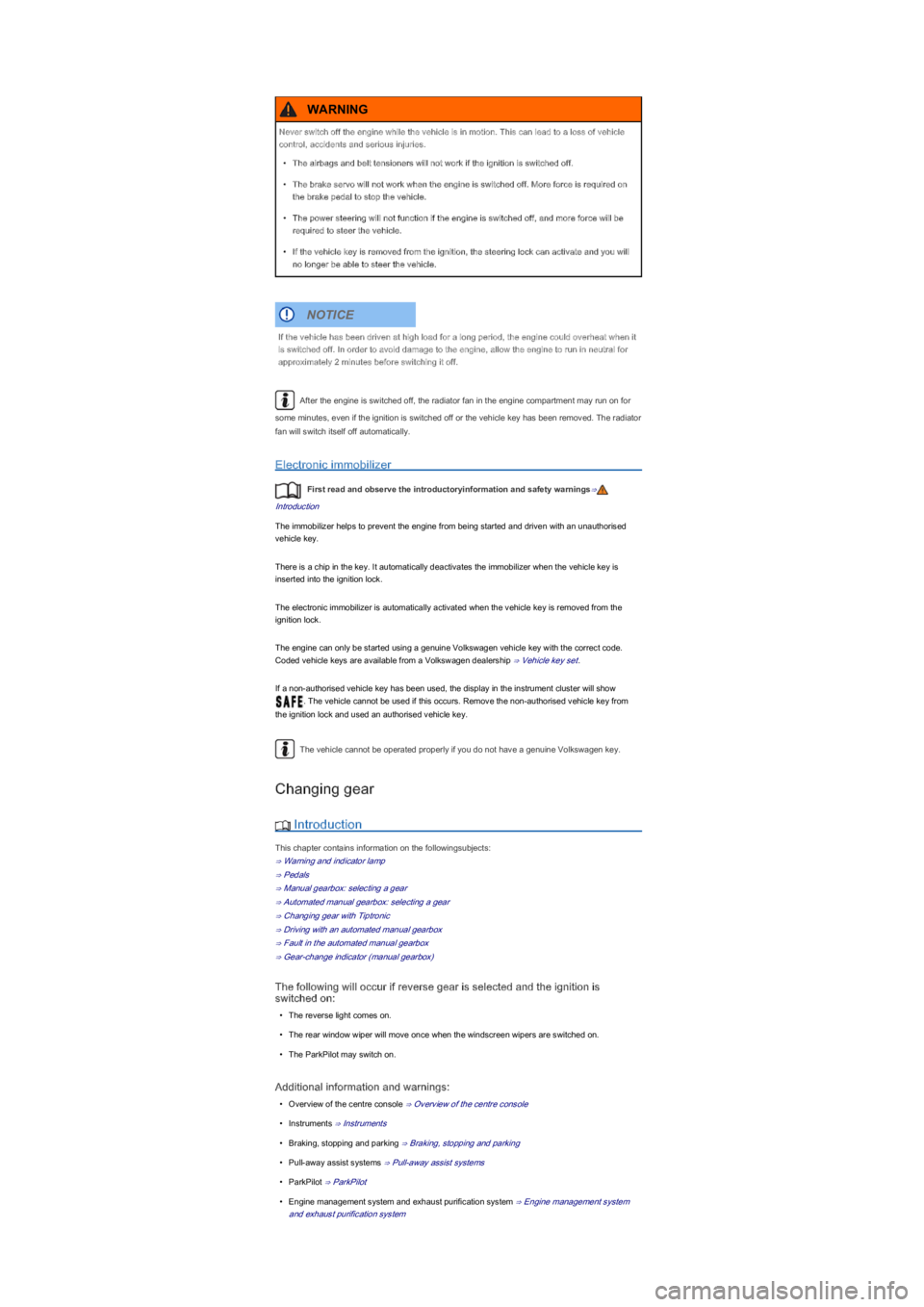
After the engine is switched off, the radiator fan in the engine compartment may run on for
some minutes, even if the ignition is switched off or the vehicle key has been removed. The radiator
fan will switch itself off automatically.
Electronic immobilizer
First read and observe the introductoryinformation and safety warnings⇒
Introduction
The immobilizer helps to prevent the engine from being started and driven with an unauthorised
vehicle key.
There is a chip in the key. It automatically deactivates the immobilizer when the vehicle key is
inserted into the ignition lock.
The electronic immobilizer is automatically activated when the vehicle key is removed from the
ignition lock.
The engine can only be started using a genuine Volkswagen vehicle key with the correct code.
Coded vehicle keys are available from a Volkswagen dealership ⇒ Vehicle key set.
If a non-authorised vehicle key has been used, the display in the instrument cluster will show
. The vehicle cannot be used if this occurs. Remove the non-authorised vehicle key from
the ignition lock and used an authorised vehicle key.
The vehicle cannot be operated properly if you do not have a genuine Volkswagen key.
Changing gear
Introduction
This chapter contains information on the followingsubjects:
⇒ Warning and indicator lamp
⇒ Pedals
⇒ Manual gearbox: selecting a gear
⇒ Automated manual gearbox: selecting a gear
⇒ Changing gear with Tiptronic
⇒ Driving with an automated manual gearbox
⇒ Fault in the automated manual gearbox
⇒ Gear-change indicator (manual gearbox)
The following will occur if reverse gear is selected and the ignition is
switched on:
•The reverse light comes on.
•The rear window wiper will move once when the windscreen wipers are switched on.
•The ParkPilot may switch on.
Additional information and warnings:
•Overview of the centre console ⇒ Overview of the centre console
•Instruments ⇒ Instruments
•Braking, stopping and parking ⇒ Braking, stopping and parking
•Pull-away assist systems ⇒ Pull-away assist systems
•ParkPilot ⇒ ParkPilot
•Engine management system and exhaust purification system ⇒ Engine management system
and exhaust purification system
Never switch off the engine while the vehicle is in motion. This can lead to a loss of vehicle
control, accidents and serious injuries.
•The airbags and belt tensioners will not work if the ignition is switched off.
•The brake servo will not work when the engine is switched off. More force is required on
the brake pedal to stop the vehicle.
•The power steering will not function if the engine is switched off, and more force will be
required to steer the vehicle.
•If the vehicle key is removed from the ignition, the steering lock can activate and you will
no longer be able to steer the vehicle.
WARNING
If the vehicle has been driven at high load for a long period, the engine could overheat when it
is switched off. In order to avoid damage to the engine, allow the engine to run in neutral for
approximately 2 minutes before switching it off.
NOTICE
Page 98 of 211
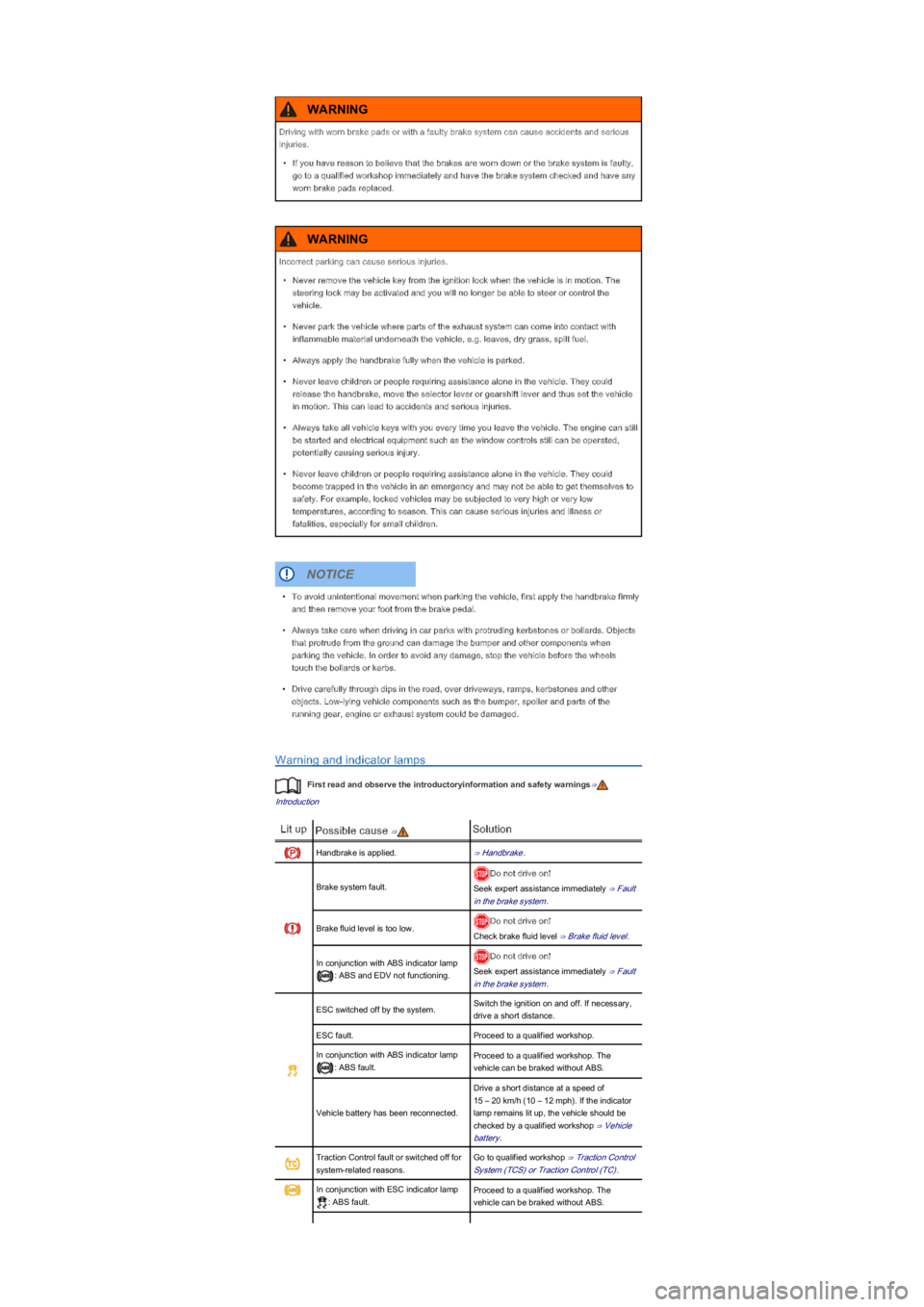
Warning and indicator lamps
First read and observe the introductoryinformation and safety warnings⇒
Introduction
Lit upPossible cause ⇒Solution
Handbrake is applied.⇒ Handbrake.
Brake system fault.
Do not drive on!
Seek expert assistance immediately ⇒ Fault
in the brake system.
Brake fluid level is too low.Do not drive on!
Check brake fluid level ⇒ Brake fluid level.
In conjunction with ABS indicator lamp
: ABS and EDV not functioning.
Do not drive on!
Seek expert assistance immediately ⇒ Fault
in the brake system.
ESC switched off by the system.Switch the ignition on and off. If necessary,
drive a short distance.
ESC fault.Proceed to a qualified workshop.
In conjunction with ABS indicator lamp
: ABS fault.
Proceed to a qualified workshop. The
vehicle can be braked without ABS.
Vehicle battery has been reconnected.
Drive a short distance at a speed of
15 – 20 km/h (10 – 12 mph). If the indicator
lamp remains lit up, the vehicle should be
checked by a qualified workshop ⇒ Vehicle
battery.
Traction Control fault or switched off for
system-related reasons.
Go to qualified workshop ⇒ Traction Control
System (TCS) or Traction Control (TC).
In conjunction with ESC indicator lamp
: ABS fault.
Proceed to a qualified workshop. The
vehicle can be braked without ABS.
Driving with worn brake pads or with a faulty brake system can cause accidents and serious
injuries.
•If you have reason to believe that the brakes are worn down or the brake system is faulty,
go to a qualified workshop immediately and have the brake system checked and have any
worn brake pads replaced.
WARNING
Incorrect parking can cause serious injuries.
•Never remove the vehicle key from the ignition lock when the vehicle is in motion. The
steering lock may be activated and you will no longer be able to steer or control the
vehicle.
•Never park the vehicle where parts of the exhaust system can come into contact with
inflammable material underneath the vehicle, e.g. leaves, dry grass, spilt fuel.
•Always apply the handbrake fully when the vehicle is parked.
•Never leave children or people requiring assistance alone in the vehicle. They could
release the handbrake, move the selector lever or gearshift lever and thus set the vehicle
in motion. This can lead to accidents and serious injuries.
•Always take all vehicle keys with you every time you leave the vehicle. The engine can still
be started and electrical equipment such as the window controls still can be operated,
potentially causing serious injury.
•Never leave children or people requiring assistance alone in the vehicle. They could
become trapped in the vehicle in an emergency and may not be able to get themselves to
safety. For example, locked vehicles may be subjected to very high or very low
temperatures, according to season. This can cause serious injuries and illness or
fatalities, especially for small children.
WARNING
•To avoid unintentional movement when parking the vehicle, first apply the handbrake firmly
and then remove your foot from the brake pedal.
•Always take care when driving in car parks with protruding kerbstones or bollards. Objects
that protrude from the ground can damage the bumper and other components when
parking the vehicle. In order to avoid any damage, stop the vehicle before the wheels
touch the bollards or kerbs.
•Drive carefully through dips in the road, over driveways, ramps, kerbstones and other
objects. Low-lying vehicle components such as the bumper, spoiler and parts of the
running gear, engine or exhaust system could be damaged.
NOTICE