steering VOLKSWAGEN UP! 2021 Owner´s Manual
[x] Cancel search | Manufacturer: VOLKSWAGEN, Model Year: 2021, Model line: UP!, Model: VOLKSWAGEN UP! 2021Pages: 211, PDF Size: 5.98 MB
Page 181 of 211
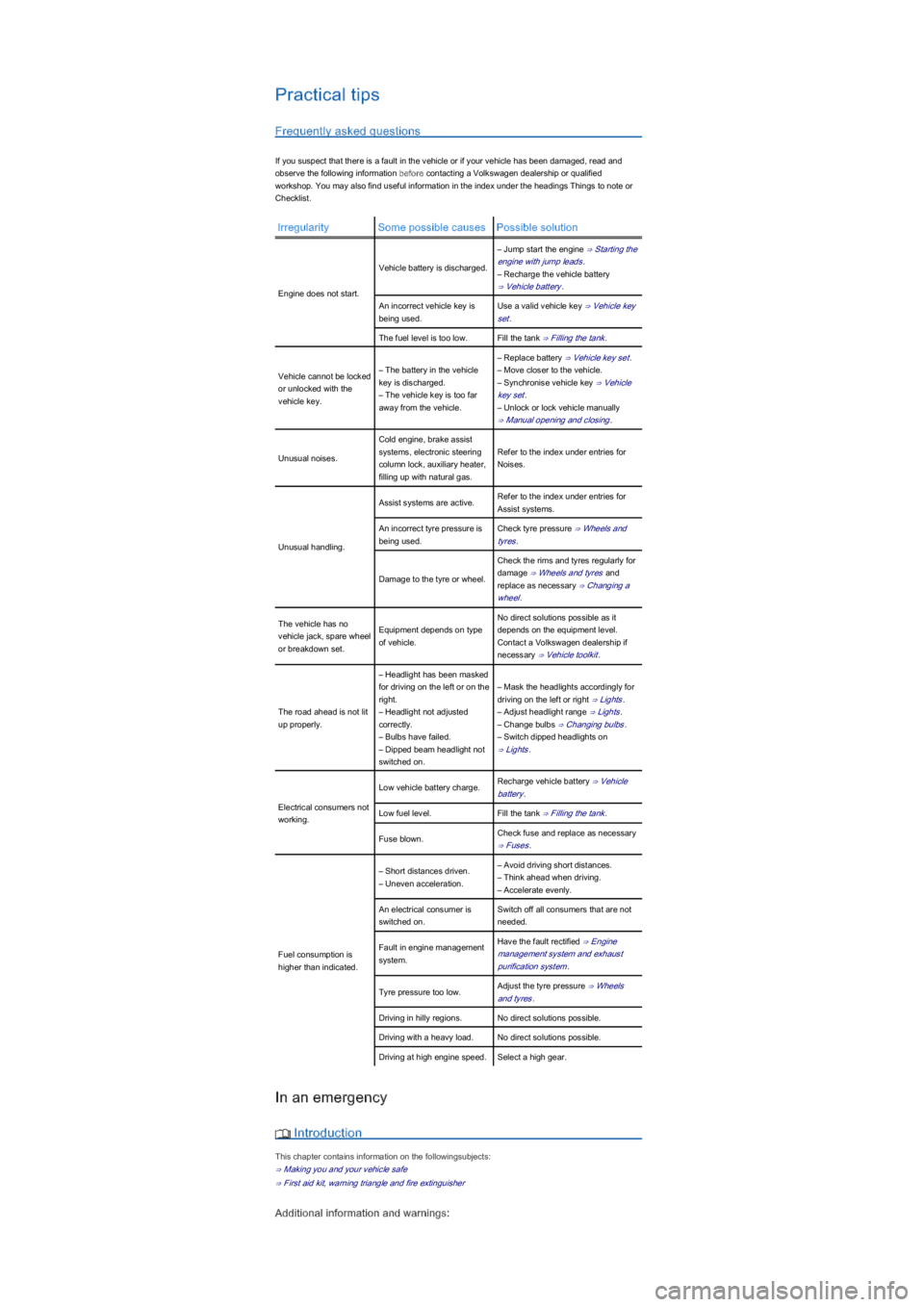
Practical tips
Frequently asked questions
If you suspect that there is a fault in the vehicle or if your vehicle has been damaged, read and
observe the following information before contacting a Volkswagen dealership or qualified
workshop. You may also find useful information in the index under the headings Things to note or
Checklist.
IrregularitySome possible causesPossible solution
Engine does not start.
Vehicle battery is discharged.
– Jump start the engine ⇒ Starting the
engine with jump leads.
– Recharge the vehicle battery
⇒ Vehicle battery.
An incorrect vehicle key is
being used.
Use a valid vehicle key ⇒ Vehicle key
set.
The fuel level is too low.Fill the tank ⇒ Filling the tank.
Vehicle cannot be locked
or unlocked with the
vehicle key.
– The battery in the vehicle
key is discharged.
– The vehicle key is too far
away from the vehicle.
– Replace battery ⇒ Vehicle key set.
– Move closer to the vehicle.
– Synchronise vehicle key ⇒ Vehicle
key set.
– Unlock or lock vehicle manually
⇒ Manual opening and closing.
Unusual noises.
Cold engine, brake assist
systems, electronic steering
column lock, auxiliary heater,
filling up with natural gas.
Refer to the index under entries for
Noises.
Unusual handling.
Assist systems are active.Refer to the index under entries for
Assist systems.
An incorrect tyre pressure is
being used.
Check tyre pressure ⇒ Wheels and
tyres.
Damage to the tyre or wheel.
Check the rims and tyres regularly for
damage ⇒ Wheels and tyres and
replace as necessary ⇒ Changing a
wheel.
The vehicle has no
vehicle jack, spare wheel
or breakdown set.
Equipment depends on type
of vehicle.
No direct solutions possible as it
depends on the equipment level.
Contact a Volkswagen dealership if
necessary ⇒ Vehicle toolkit.
The road ahead is not lit
up properly.
– Headlight has been masked
for driving on the left or on the
right.
– Headlight not adjusted
correctly.
– Bulbs have failed.
– Dipped beam headlight not
switched on.
– Mask the headlights accordingly for
driving on the left or right ⇒ Lights.
– Adjust headlight range ⇒ Lights.
– Change bulbs ⇒ Changing bulbs.
– Switch dipped headlights on
⇒ Lights.
Electrical consumers not
working.
Low vehicle battery charge.Recharge vehicle battery ⇒ Vehicle
battery.
Low fuel level.Fill the tank ⇒ Filling the tank.
Fuse blown.Check fuse and replace as necessary
⇒ Fuses.
Fuel consumption is
higher than indicated.
– Short distances driven.
– Uneven acceleration.
– Avoid driving short distances.
– Think ahead when driving.
– Accelerate evenly.
An electrical consumer is
switched on.
Switch off all consumers that are not
needed.
Fault in engine management
system.
Have the fault rectified ⇒ Engine
management system and exhaust
purification system.
Tyre pressure too low.Adjust the tyre pressure ⇒ Wheels
and tyres.
Driving in hilly regions.No direct solutions possible.
Driving with a heavy load.No direct solutions possible.
Driving at high engine speed.Select a high gear.
In an emergency
Introduction
This chapter contains information on the followingsubjects:
⇒ Making you and your vehicle safe
⇒ First aid kit, warning triangle and fire extinguisher
Additional information and warnings:
Page 207 of 211
⇒ Fitting the front towing eye
⇒ Driving tips when towing
Observe any legal requirements when towing or tow-starting.
For technical reasons, vehicles with a discharged battery must not be tow-started.
For technical reasons, vehicles with an automated manual gearbox must not be tow started
unless it has been ascertained that the gearbox is in position N⇒ When a vehicle with an
automated manual gearbox has to be towed:.
Towing a vehicle when the engine is switched off and the ignition is switched on discharges the
vehicle battery. In some vehicles battery charge level, the drop in voltage can be large enough after
just a few minutes that electrical consumers in the vehicle will no longer function, e.g. the hazard
warning lights.
Additional information and warnings:
•Exterior views ⇒ Exterior views
•Changing gear ⇒ Changing gear
•Engine management system and exhaust purification system ⇒ Engine management system
and exhaust purification system
•Starting the engine with jump leads ⇒ Starting the engine with jump leads
You will not be able to fit a towing eye onto the rear bumper. The vehicle is not suited for
towing other vehicles.
Notes on tow-starting
First read and observe the introductoryinformation and safety warnings⇒
Introduction
Vehicles should not be tow-started wherever possible. Use jump leads to start the engine
instead⇒ Starting the engine with jump leads.
For technical reasons, the following vehicles cannot be tow-started:
•If the vehicle battery has discharged, the engine control unit will not function properly.
However, if the vehicle still has to be tow-started (manual gearbox):
•Engage 2nd or 3rd gear.
•Keep the clutch pressed down.
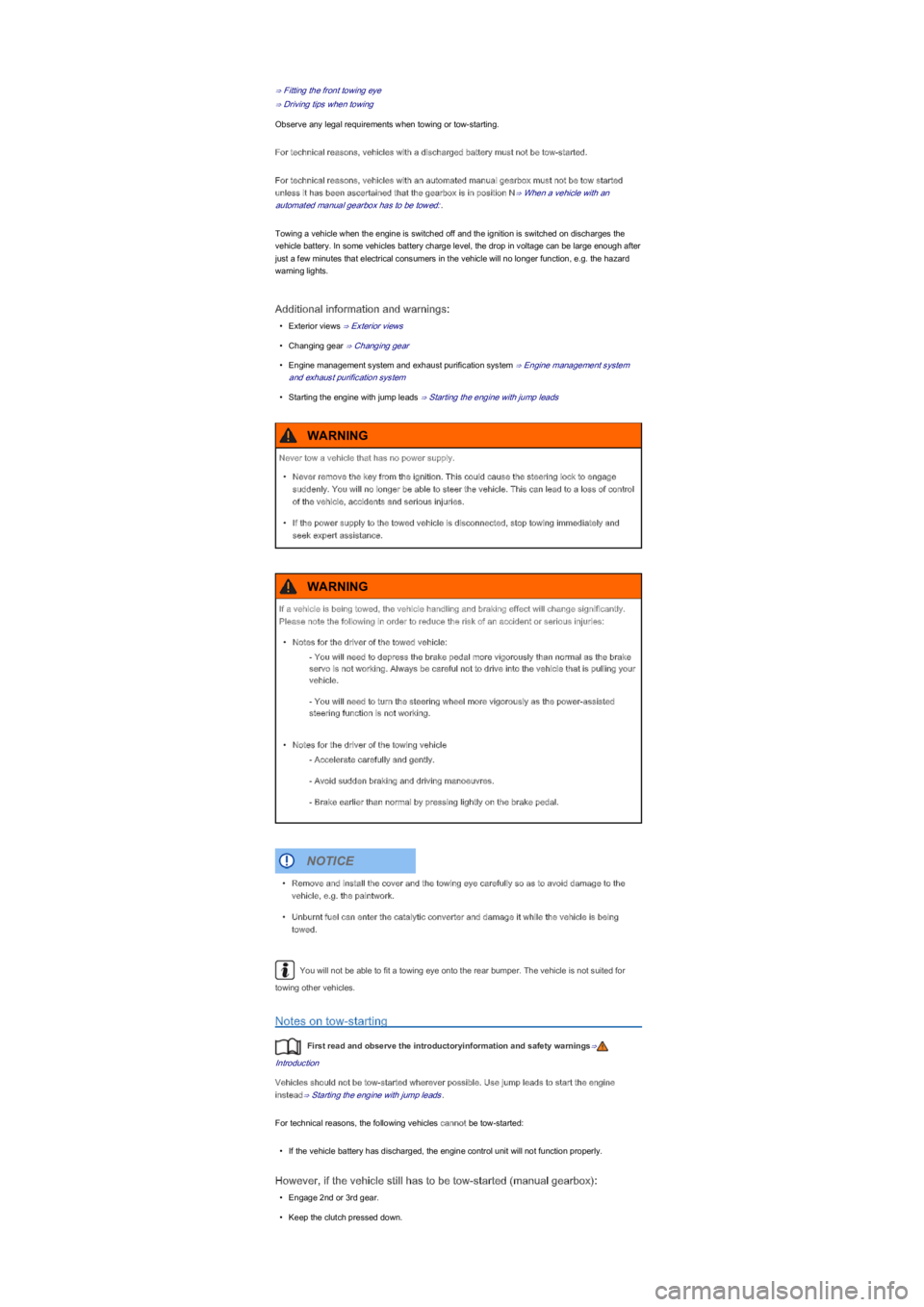
Never tow a vehicle that has no power supply.
•Never remove the key from the ignition. This could cause the steering lock to engage
suddenly. You will no longer be able to steer the vehicle. This can lead to a loss of control
of the vehicle, accidents and serious injuries.
•If the power supply to the towed vehicle is disconnected, stop towing immediately and
seek expert assistance.
WARNING
If a vehicle is being towed, the vehicle handling and braking effect will change significantly.
Please note the following in order to reduce the risk of an accident or serious injuries:
•Notes for the driver of the towed vehicle:
- You will need to depress the brake pedal more vigorously than normal as the brake
servo is not working. Always be careful not to drive into the vehicle that is pulling your
vehicle.
- You will need to turn the steering wheel more vigorously as the power-assisted
steering function is not working.
•Notes for the driver of the towing vehicle
- Accelerate carefully and gently.
- Avoid sudden braking and driving manoeuvres.
- Brake earlier than normal by pressing lightly on the brake pedal.
WARNING
•Remove and install the cover and the towing eye carefully so as to avoid damage to the
vehicle, e.g. the paintwork.
•Unburnt fuel can enter the catalytic converter and damage it while the vehicle is being
towed.
NOTICE
Page 208 of 211
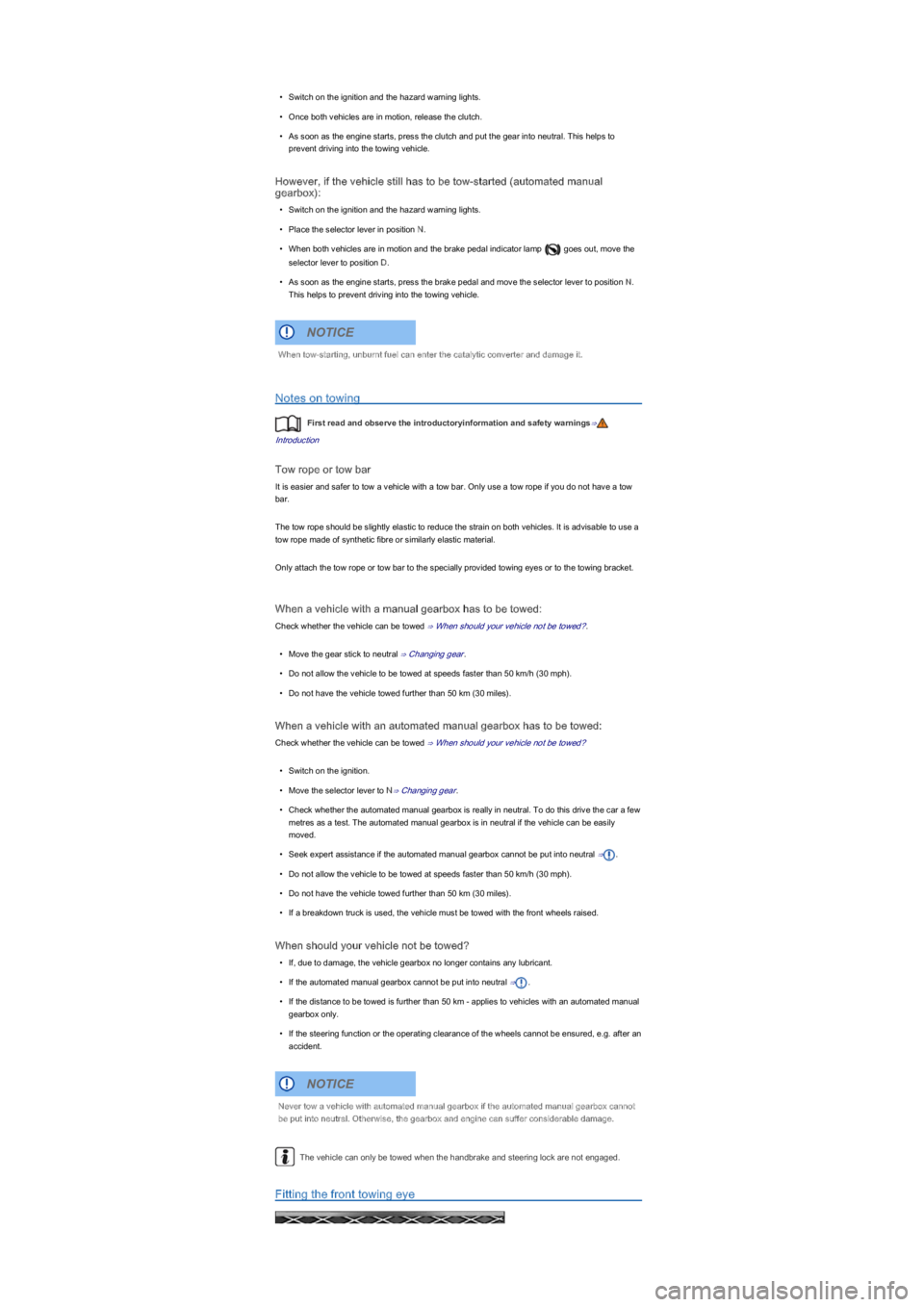
•Switch on the ignition and the hazard warning lights.
•Once both vehicles are in motion, release the clutch.
•As soon as the engine starts, press the clutch and put the gear into neutral. This helps to
prevent driving into the towing vehicle.
However, if the vehicle still has to be tow-started (automated manual
gearbox):
•Switch on the ignition and the hazard warning lights.
•Place the selector lever in position N.
•When both vehicles are in motion and the brake pedal indicator lamp goes out, move the
selector lever to position D.
•As soon as the engine starts, press the brake pedal and move the selector lever to position N.
This helps to prevent driving into the towing vehicle.
Notes on towing
First read and observe the introductoryinformation and safety warnings⇒
Introduction
Tow rope or tow bar
It is easier and safer to tow a vehicle with a tow bar. Only use a tow rope if you do not have a tow
bar.
The tow rope should be slightly elastic to reduce the strain on both vehicles. It is advisable to use a
tow rope made of synthetic fibre or similarly elastic material.
Only attach the tow rope or tow bar to the specially provided towing eyes or to the towing bracket.
When a vehicle with a manual gearbox has to be towed:
Check whether the vehicle can be towed ⇒ When should your vehicle not be towed?.
•Move the gear stick to neutral ⇒ Changing gear.
•Do not allow the vehicle to be towed at speeds faster than 50 km/h (30 mph).
•Do not have the vehicle towed further than 50 km (30 miles).
When a vehicle with an automated manual gearbox has to be towed:
Check whether the vehicle can be towed ⇒ When should your vehicle not be towed?
•Switch on the ignition.
•Move the selector lever to N⇒ Changing gear.
•Check whether the automated manual gearbox is really in neutral. To do this drive the car a few
metres as a test. The automated manual gearbox is in neutral if the vehicle can be easily
moved.
•Seek expert assistance if the automated manual gearbox cannot be put into neutral ⇒.
•Do not allow the vehicle to be towed at speeds faster than 50 km/h (30 mph).
•Do not have the vehicle towed further than 50 km (30 miles).
•If a breakdown truck is used, the vehicle must be towed with the front wheels raised.
When should your vehicle not be towed?
•If, due to damage, the vehicle gearbox no longer contains any lubricant.
•If the automated manual gearbox cannot be put into neutral ⇒.
•If the distance to be towed is further than 50 km - applies to vehicles with an automated manual
gearbox only.
•If the steering function or the operating clearance of the wheels cannot be ensured, e.g. after an
accident.
The vehicle can only be towed when the handbrake and steering lock are not engaged.
Fitting the front towing eye
When tow-starting, unburnt fuel can enter the catalytic converter and damage it.
NOTICE
Never tow a vehicle with automated manual gearbox if the automated manual gearbox cannot
be put into neutral. Otherwise, the gearbox and engine can suffer considerable damage.
NOTICE
Page 209 of 211
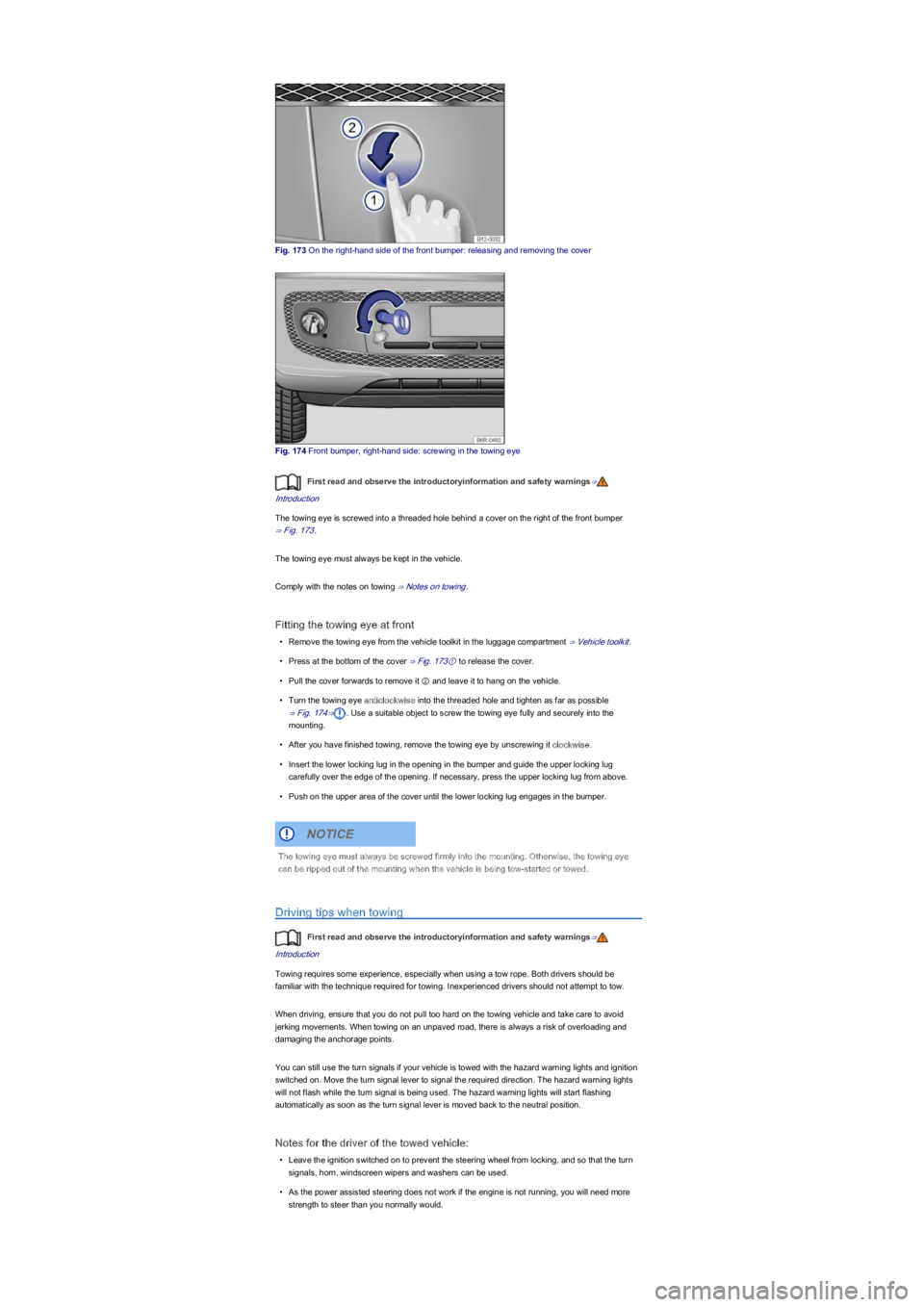
Fig. 173 On the right-hand side of the front bumper: releasing and removing the cover
Fig. 174 Front bumper, right-hand side: screwing in the towing eye
First read and observe the introductoryinformation and safety warnings⇒
Introduction
The towing eye is screwed into a threaded hole behind a cover on the right of the front bumper
⇒ Fig. 173.
The towing eye must always be kept in the vehicle.
Comply with the notes on towing ⇒ Notes on towing.
Fitting the towing eye at front
•Remove the towing eye from the vehicle toolkit in the luggage compartment ⇒ Vehicle toolkit.
•Press at the bottom of the cover ⇒ Fig. 173① to release the cover.
•Pull the cover forwards to remove it ② and leave it to hang on the vehicle.
•Turn the towing eye anticlockwise into the threaded hole and tighten as far as possible
⇒ Fig. 174⇒. Use a suitable object to screw the towing eye fully and securely into the
mounting.
•After you have finished towing, remove the towing eye by unscrewing it clockwise.
•Insert the lower locking lug in the opening in the bumper and guide the upper locking lug
carefully over the edge of the opening. If necessary, press the upper locking lug from above.
•Push on the upper area of the cover until the lower locking lug engages in the bumper.
Driving tips when towing
First read and observe the introductoryinformation and safety warnings⇒
Introduction
Towing requires some experience, especially when using a tow rope. Both drivers should be
familiar with the technique required for towing. Inexperienced drivers should not attempt to tow.
When driving, ensure that you do not pull too hard on the towing vehicle and take care to avoid
jerking movements. When towing on an unpaved road, there is always a risk of overloading and
damaging the anchorage points.
You can still use the turn signals if your vehicle is towed with the hazard warning lights and ignition
switched on. Move the turn signal lever to signal the required direction. The hazard warning lights
will not flash while the turn signal is being used. The hazard warning lights will start flashing
automatically as soon as the turn signal lever is moved back to the neutral position.
Notes for the driver of the towed vehicle:
•Leave the ignition switched on to prevent the steering wheel from locking, and so that the turn
signals, horn, windscreen wipers and washers can be used.
•As the power assisted steering does not work if the engine is not running, you will need more
strength to steer than you normally would.
The towing eye must always be screwed firmly into the mounting. Otherwise, the towing eye
can be ripped out of the mounting when the vehicle is being tow-started or towed.
NOTICE