tailgate VOLKSWAGEN UP! 2021 Owner´s Manual
[x] Cancel search | Manufacturer: VOLKSWAGEN, Model Year: 2021, Model line: UP!, Model: VOLKSWAGEN UP! 2021Pages: 211, PDF Size: 5.98 MB
Page 69 of 211
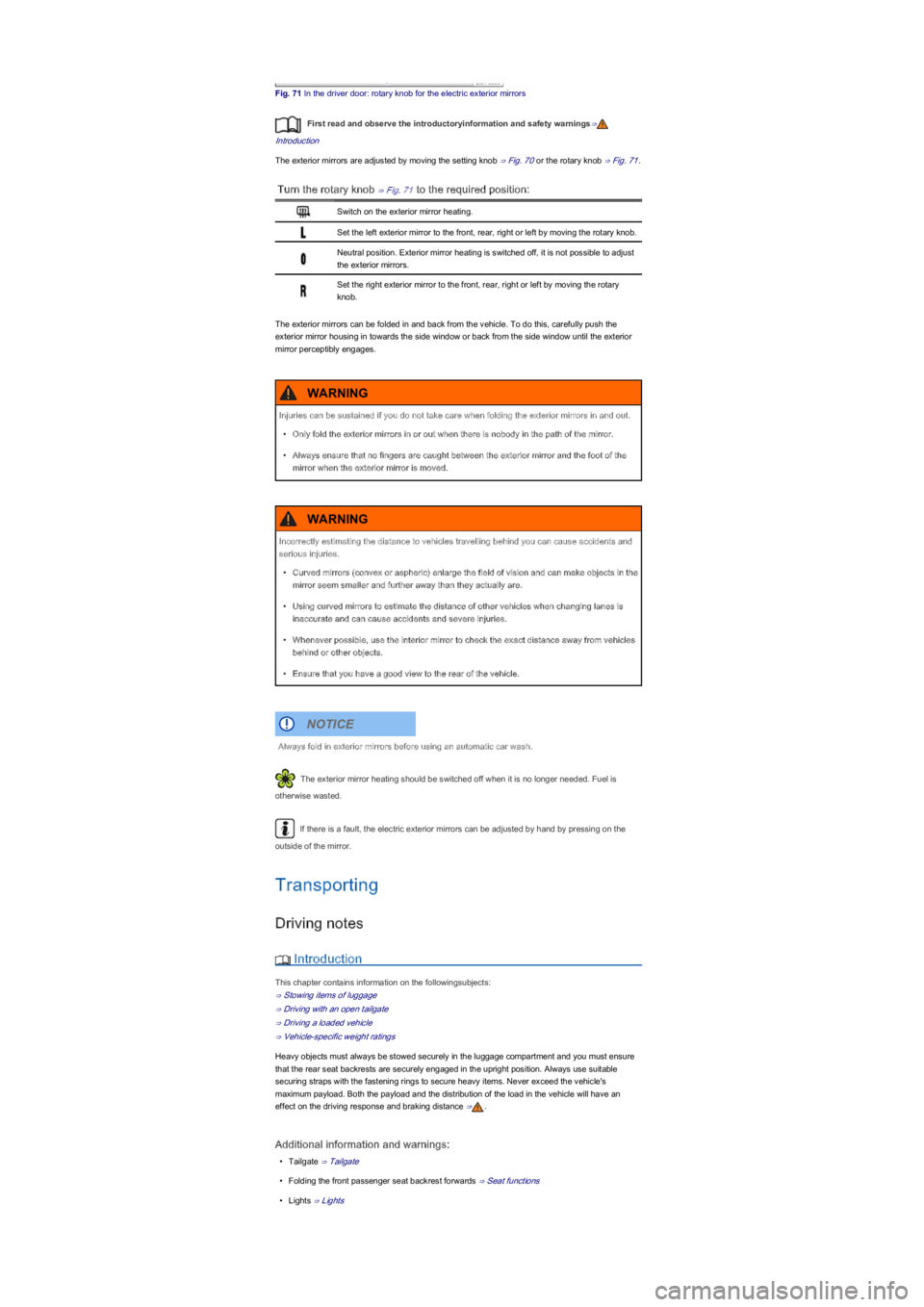
Fig. 71 In the driver door: rotary knob for the electric exterior mirrors
First read and observe the introductoryinformation and safety warnings⇒
Introduction
The exterior mirrors are adjusted by moving the setting knob ⇒ Fig. 70 or the rotary knob ⇒ Fig. 71.
Turn the rotary knob ⇒ Fig. 71 to the required position:
Switch on the exterior mirror heating.
Set the left exterior mirror to the front, rear, right or left by moving the rotary knob.
Neutral position. Exterior mirror heating is switched off, it is not possible to adjust
the exterior mirrors.
Set the right exterior mirror to the front, rear, right or left by moving the rotary
knob.
The exterior mirrors can be folded in and back from the vehicle. To do this, carefully push the
exterior mirror housing in towards the side window or back from the side window until the exterior
mirror perceptibly engages.
The exterior mirror heating should be switched off when it is no longer needed. Fuel is
otherwise wasted.
If there is a fault, the electric exterior mirrors can be adjusted by hand by pressing on the
outside of the mirror.
Transporting
Driving notes
Introduction
This chapter contains information on the followingsubjects:
⇒ Stowing items of luggage
⇒ Driving with an open tailgate
⇒ Driving a loaded vehicle
⇒ Vehicle-specific weight ratings
Heavy objects must always be stowed securely in the luggage compartment and you must ensure
that the rear seat backrests are securely engaged in the upright position. Always use suitable
securing straps with the fastening rings to secure heavy items. Never exceed the vehicle's
maximum payload. Both the payload and the distribution of the load in the vehicle will have an
effect on the driving response and braking distance ⇒.
Additional information and warnings:
•Tailgate ⇒ Tailgate
•Folding the front passenger seat backrest forwards ⇒ Seat functions
•Lights ⇒ Lights
Injuries can be sustained if you do not take care when folding the exterior mirrors in and out.
•Only fold the exterior mirrors in or out when there is nobody in the path of the mirror.
•Always ensure that no fingers are caught between the exterior mirror and the foot of the
mirror when the exterior mirror is moved.
WARNING
Incorrectly estimating the distance to vehicles travelling behind you can cause accidents and
serious injuries.
•Curved mirrors (convex or aspheric) enlarge the field of vision and can make objects in the
mirror seem smaller and further away than they actually are.
•Using curved mirrors to estimate the distance of other vehicles when changing lanes is
inaccurate and can cause accidents and severe injuries.
•Whenever possible, use the interior mirror to check the exact distance away from vehicles
behind or other objects.
•Ensure that you have a good view to the rear of the vehicle.
WARNING
Always fold in exterior mirrors before using an automatic car wash.
NOTICE
Page 70 of 211
•Luggage compartment ⇒ Luggage compartment
•Roof carrier ⇒ Roof carrier
•Wheels and tyres ⇒ Wheels and tyres
Stowing items of luggage
First read and observe the introductoryinformation and safety warnings⇒
Introduction
Always stow all items of luggage in the vehicle securely.
•Always distribute any loads in the vehicle and on the roof as evenly as possible.
•Place heavy objects as far forward in the luggage compartment as possible. Position the rear
seat backrests securely in the upright position.
•Secure luggage in the luggage compartment to the fastening rings with suitable straps
⇒ Luggage compartment.
•Adjust the headlight range ⇒ Lights.
•Adjust the tyre pressure according to the vehicle load. Please read the tyre pressure sticker
⇒ Wheels and tyres.
Observe any information concerning the loading of a roof carrier ⇒ Roof carrier.
Driving with an open tailgate
First read and observe the introductoryinformation and safety warnings⇒
Introduction
Driving with an open tailgate is particularly dangerous. Ensure that the open tailgate and any
objects are secured properly, and take appropriate measures to reduce the quantity of toxic
exhaust fumes entering the vehicle.
Objects that are not secured, or are secured incorrectly, can cause serious injuries in the
event of a sudden driving or braking manoeuvre or accident. This applies particularly if
objects are struck by the airbag when activated and then flung through the vehicle interior.
Please apply the following rules to reduce the risk of accidents:
•Always stow all objects in the vehicle securely. Always stow luggage and heavy objects in
the luggage compartment.
•Always use suitable straps to prevent luggage from entering the deployment zones of the
side airbag or the front airbag in the event of a sudden driving or braking manoeuvre or an
accident.
•Objects should be stowed in the vehicle interior in such a way that they can never enter
the airbag deployment zones while the vehicle is in motion.
•Always keep stowage compartments closed while the vehicle is in motion.
•All objects must be removed from the seat cushion of the front passenger seat if the front
passenger backrest is folded forward. Even light and small objects could be pressed into
the weight detection mat underneath the seat cushion by the backrest when it is folded
forwards and thus send incorrect information to the airbag control units.
•The front airbag must be switched off and the indicator lamp PASSENGER AIR BAG OFF
must light up for as long as the front passenger seat backrest is folded forwards.
•Stowed objects must never cause passengers to assume an incorrect sitting position.
•Any seat blocked by stowed objects must not be used by any passengers.
WARNING
The vehicle handling and braking effect may alter significantly if large or heavy objects are
being transported.
•Adapt your speed and driving style to suit visibility, weather, road and traffic conditions.
•Accelerate carefully and gently.
•Avoid sudden braking and driving manoeuvres.
•Brake earlier than in normal driving.
WARNING
Hard objects on the shelf can chafe against the wires of the heating element in the rear
window and cause damage.
NOTICE
Page 71 of 211
Driving a loaded vehicle
First read and observe the introductoryinformation and safety warnings⇒
Introduction
For good vehicle handling when driving a loaded vehicle, please observe the following:
•Stow all items of luggage securely ⇒ Stowing items of luggage.
•Accelerate carefully and gently.
•Avoid sudden braking and driving manoeuvres.
•Brake earlier than in normal driving.
•If applicable, heed the information about driving with a roof carrier ⇒ Roof carrier.
Vehicle-specific weight ratings
First read and observe the introductoryinformation and safety warnings⇒
Introduction
All data in the official vehicle documents take precedence over these data. All data in this manual
apply to the basic model. The vehicle data sticker in the service schedule and the official vehicle
documents show which engine is installed in your vehicle.
The values quoted here may differ if additional equipment is fitted, for different models or for special
vehicles.
The values for the kerb weight in the following table apply for the road-ready vehicle with driver
(75 kg), service fluids including fuel tank carrying 90% of its capacity and, if applicable, tools and
Driving with an unlocked or open tailgate can cause serious injuries.
•Always drive with the tailgate closed.
•Always stow all items in the luggage compartment securely. Loose objects can fall out of
the luggage compartment and injure other road users.
•Always drive carefully and ensure that you think ahead.
•Avoid any abrupt or sudden driving and braking manoeuvres as this can cause the open
tailgate to move unpredictably.
•Any objects protruding from the luggage compartment must be marked to ensure that they
are visible to other road users. Comply with legal regulations.
•Any objects protruding from the luggage compartment must never be held in position by
the tailgate.
•If it is necessary to drive with the tailgate open, all luggage racks and cargo stowed on the
rack must be removed from the tailgate.
WARNING
Poisonous exhaust fumes can enter the vehicle interior when the tailgate is open. This could
result in loss of consciousness, carbon monoxide poisoning, serious injury and accidents.
•Always drive with the tailgate closed in order to prevent toxic gases from entering the
vehicle.
•If exceptional circumstances require you to drive with an open tailgate, you must do the
following to reduce the quantity of toxic exhaust fumes that could enter the vehicle:
- Close the electric panorama sliding/tilting glass roof.
- Switch off air recirculation mode.
- Open all vents in the dash panel.
- Switch the blowers to the highest setting.
WARNING
The vehicle length and height are different when the tailgate is open.
NOTICE
Moving loads can severely impair the vehicle's stability and driving safety, which can cause
accidents and severe injuries.
•Secure objects properly to prevent them from sliding.
•Use suitable straps when securing heavy objects.
•Engage the rear seat backrests securely in an upright position.
WARNING
Page 73 of 211
The ventilation openings between the rear window and the luggage compartment cover must
not be covered as this would prevent stale air escaping from the vehicle.
Folding the backrests on the rear bench seat forwards and backwards
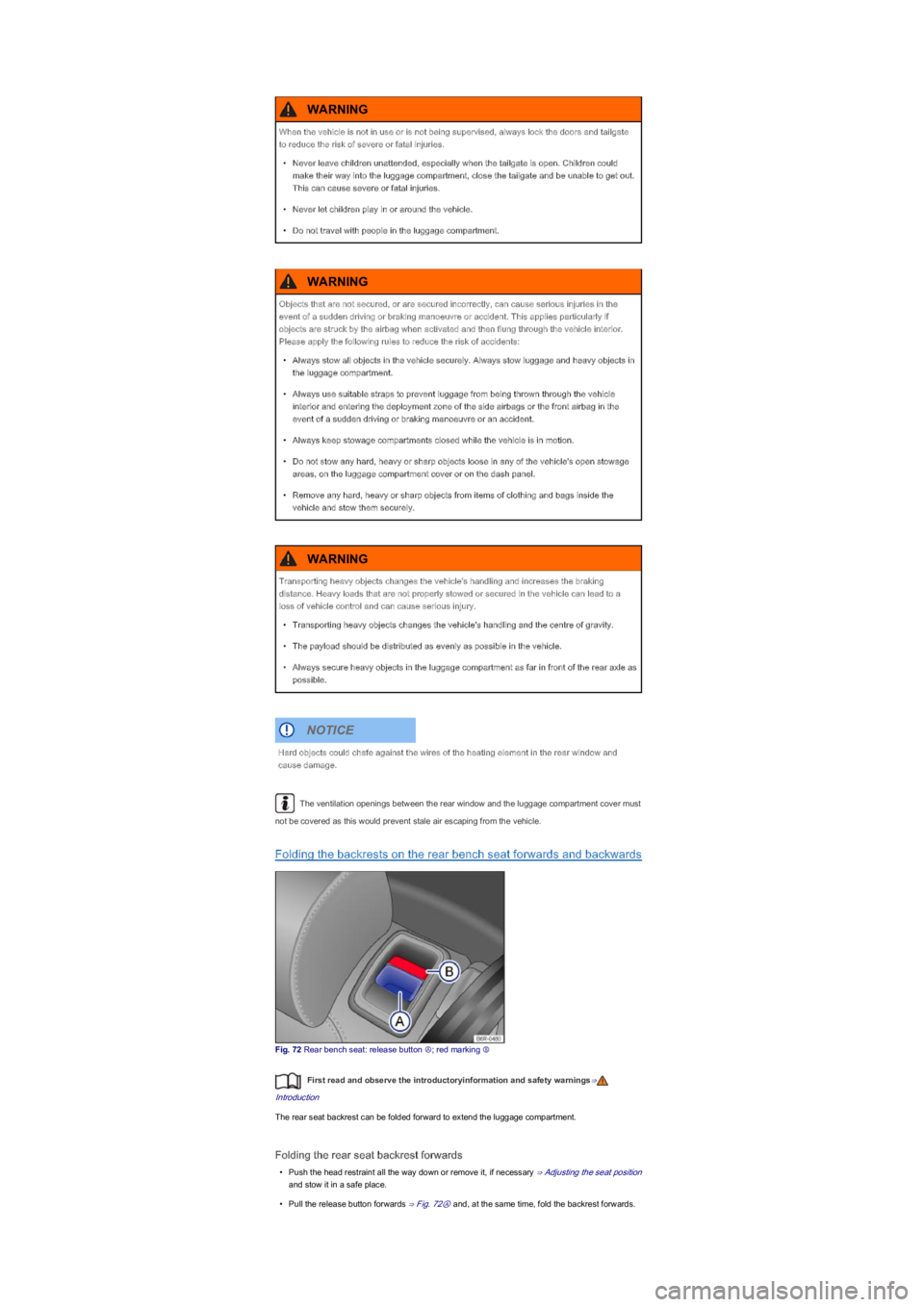
Fig. 72 Rear bench seat: release button Ⓐ; red marking Ⓑ
First read and observe the introductoryinformation and safety warnings⇒
Introduction
The rear seat backrest can be folded forward to extend the luggage compartment.
Folding the rear seat backrest forwards
•Push the head restraint all the way down or remove it, if necessary ⇒ Adjusting the seat position
and stow it in a safe place.
•Pull the release button forwards ⇒ Fig. 72Ⓐ and, at the same time, fold the backrest forwards.
When the vehicle is not in use or is not being supervised, always lock the doors and tailgate
to reduce the risk of severe or fatal injuries.
•Never leave children unattended, especially when the tailgate is open. Children could
make their way into the luggage compartment, close the tailgate and be unable to get out.
This can cause severe or fatal injuries.
•Never let children play in or around the vehicle.
•Do not travel with people in the luggage compartment.
WARNING
Objects that are not secured, or are secured incorrectly, can cause serious injuries in the
event of a sudden driving or braking manoeuvre or accident. This applies particularly if
objects are struck by the airbag when activated and then flung through the vehicle interior.
Please apply the following rules to reduce the risk of accidents:
•Always stow all objects in the vehicle securely. Always stow luggage and heavy objects in
the luggage compartment.
•Always use suitable straps to prevent luggage from being thrown through the vehicle
interior and entering the deployment zone of the side airbags or the front airbag in the
event of a sudden driving or braking manoeuvre or an accident.
•Always keep stowage compartments closed while the vehicle is in motion.
•Do not stow any hard, heavy or sharp objects loose in any of the vehicle's open stowage
areas, on the luggage compartment cover or on the dash panel.
•Remove any hard, heavy or sharp objects from items of clothing and bags inside the
vehicle and stow them securely.
WARNING
Transporting heavy objects changes the vehicle's handling and increases the braking
distance. Heavy loads that are not properly stowed or secured in the vehicle can lead to a
loss of vehicle control and can cause serious injury.
•Transporting heavy objects changes the vehicle's handling and the centre of gravity.
•The payload should be distributed as evenly as possible in the vehicle.
•Always secure heavy objects in the luggage compartment as far in front of the rear axle as
possible.
WARNING
Hard objects could chafe against the wires of the heating element in the rear window and
cause damage.
NOTICE
Page 75 of 211
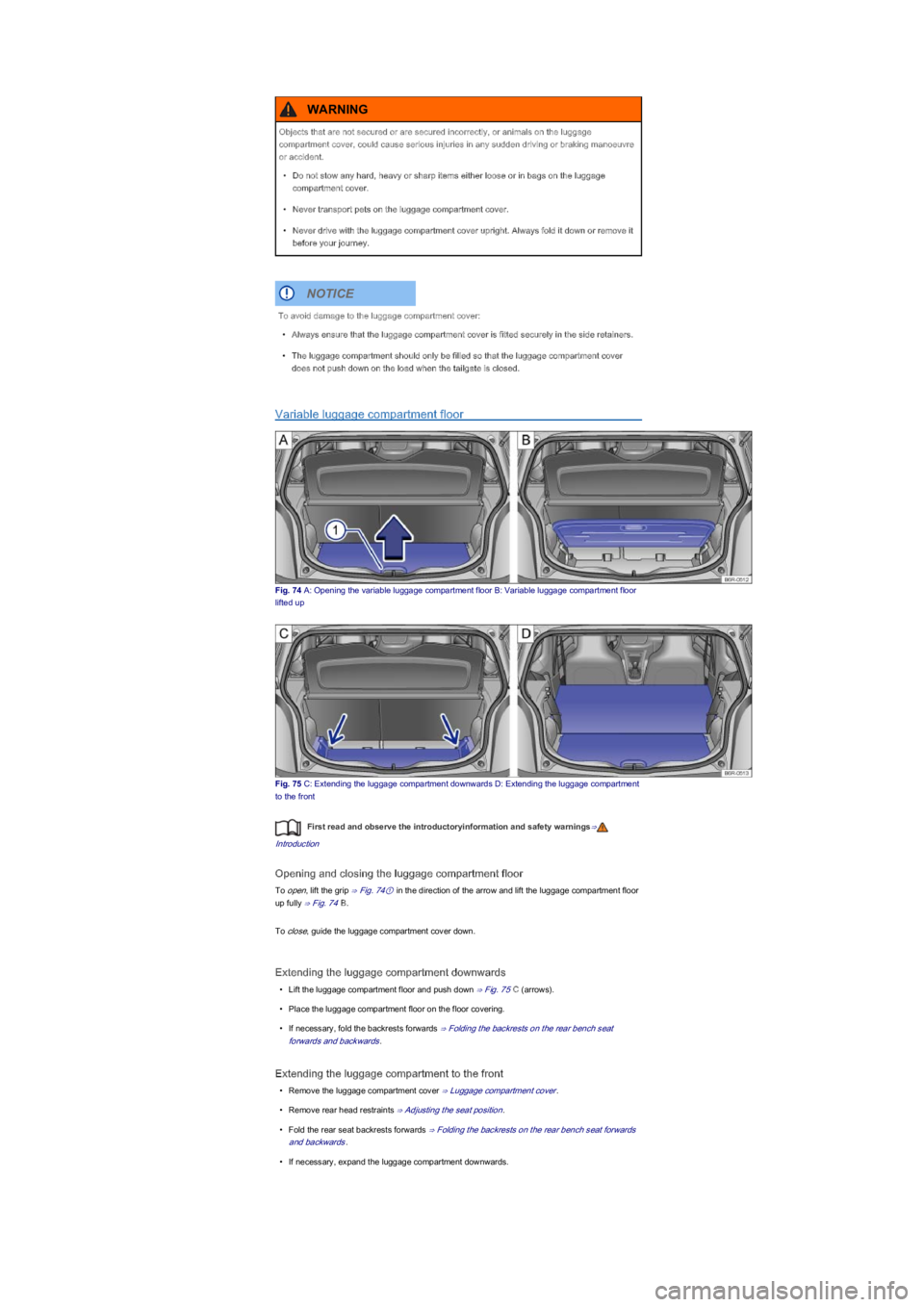
Variable luggage compartment floor
Fig. 74 A: Opening the variable luggage compartment floor B: Variable luggage compartment floor
lifted up
Fig. 75 C: Extending the luggage compartment downwards D: Extending the luggage compartment
to the front
First read and observe the introductoryinformation and safety warnings⇒
Introduction
Opening and closing the luggage compartment floor
To open, lift the grip ⇒ Fig. 74① in the direction of the arrow and lift the luggage compartment floor
up fully ⇒ Fig. 74B.
To close, guide the luggage compartment cover down.
Extending the luggage compartment downwards
•Lift the luggage compartment floor and push down ⇒ Fig. 75C (arrows).
•Place the luggage compartment floor on the floor covering.
•If necessary, fold the backrests forwards ⇒ Folding the backrests on the rear bench seat
forwards and backwards.
Extending the luggage compartment to the front
•Remove the luggage compartment cover ⇒ Luggage compartment cover.
•Remove rear head restraints ⇒ Adjusting the seat position.
•Fold the rear seat backrests forwards ⇒ Folding the backrests on the rear bench seat forwards
and backwards.
•If necessary, expand the luggage compartment downwards.
Objects that are not secured or are secured incorrectly, or animals on the luggage
compartment cover, could cause serious injuries in any sudden driving or braking manoeuvre
or accident.
•Do not stow any hard, heavy or sharp items either loose or in bags on the luggage
compartment cover.
•Never transport pets on the luggage compartment cover.
•Never drive with the luggage compartment cover upright. Always fold it down or remove it
before your journey.
WARNING
To avoid damage to the luggage compartment cover:
•Always ensure that the luggage compartment cover is fitted securely in the side retainers.
•The luggage compartment should only be filled so that the luggage compartment cover
does not push down on the load when the tailgate is closed.
NOTICE
Page 77 of 211
Roof carrier
Introduction
This chapter contains information on the followingsubjects:
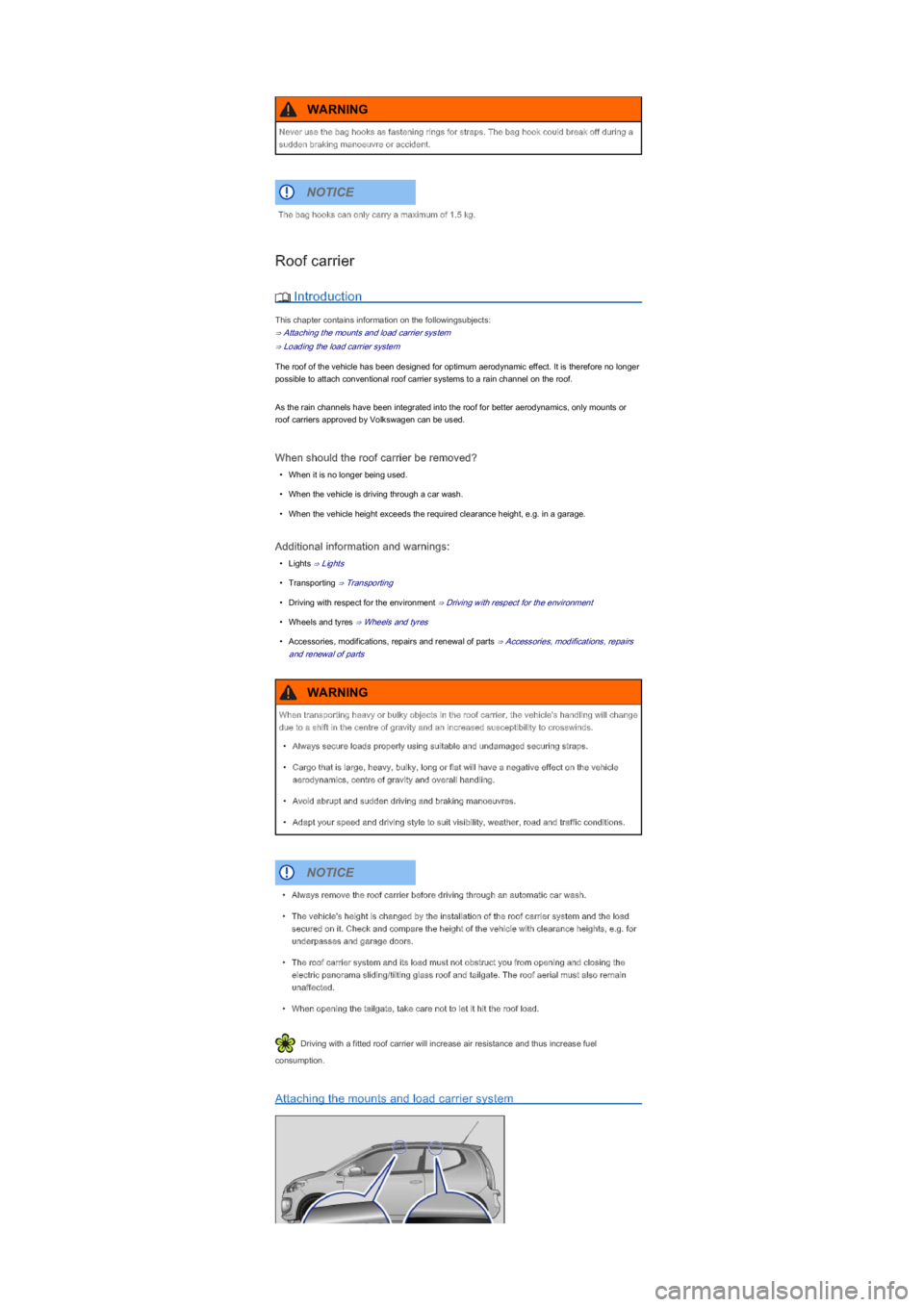
⇒ Attaching the mounts and load carrier system
⇒ Loading the load carrier system
The roof of the vehicle has been designed for optimum aerodynamic effect. It is therefore no longer
possible to attach conventional roof carrier systems to a rain channel on the roof.
As the rain channels have been integrated into the roof for better aerodynamics, only mounts or
roof carriers approved by Volkswagen can be used.
When should the roof carrier be removed?
•When it is no longer being used.
•When the vehicle is driving through a car wash.
•When the vehicle height exceeds the required clearance height, e.g. in a garage.
Additional information and warnings:
•Lights ⇒ Lights
•Transporting ⇒ Transporting
•Driving with respect for the environment ⇒ Driving with respect for the environment
•Wheels and tyres ⇒ Wheels and tyres
•Accessories, modifications, repairs and renewal of parts ⇒ Accessories, modifications, repairs
and renewal of parts
Driving with a fitted roof carrier will increase air resistance and thus increase fuel
consumption.
Attaching the mounts and load carrier system
Never use the bag hooks as fastening rings for straps. The bag hook could break off during a
sudden braking manoeuvre or accident.
WARNING
The bag hooks can only carry a maximum of 1.5 kg.
NOTICE
When transporting heavy or bulky objects in the roof carrier, the vehicle's handling will change
due to a shift in the centre of gravity and an increased susceptibility to crosswinds.
•Always secure loads properly using suitable and undamaged securing straps.
•Cargo that is large, heavy, bulky, long or flat will have a negative effect on the vehicle
aerodynamics, centre of gravity and overall handling.
•Avoid abrupt and sudden driving and braking manoeuvres.
•Adapt your speed and driving style to suit visibility, weather, road and traffic conditions.
WARNING
•Always remove the roof carrier before driving through an automatic car wash.
•The vehicle's height is changed by the installation of the roof carrier system and the load
secured on it. Check and compare the height of the vehicle with clearance heights, e.g. for
underpasses and garage doors.
•The roof carrier system and its load must not obstruct you from opening and closing the
electric panorama sliding/tilting glass roof and tailgate. The roof aerial must also remain
unaffected.
•When opening the tailgate, take care not to let it hit the roof load.
NOTICE
Page 113 of 211
Please contact a qualified workshop if there is a fault in the system. Volkswagen
recommends using a Volkswagen dealership for this purpose.
Volkswagen recommends that drivers practise using the ParkPilot in a traffic-calmed area or
car park to allow them to familiarise themselves with the system and its functions.
Operating ParkPilot
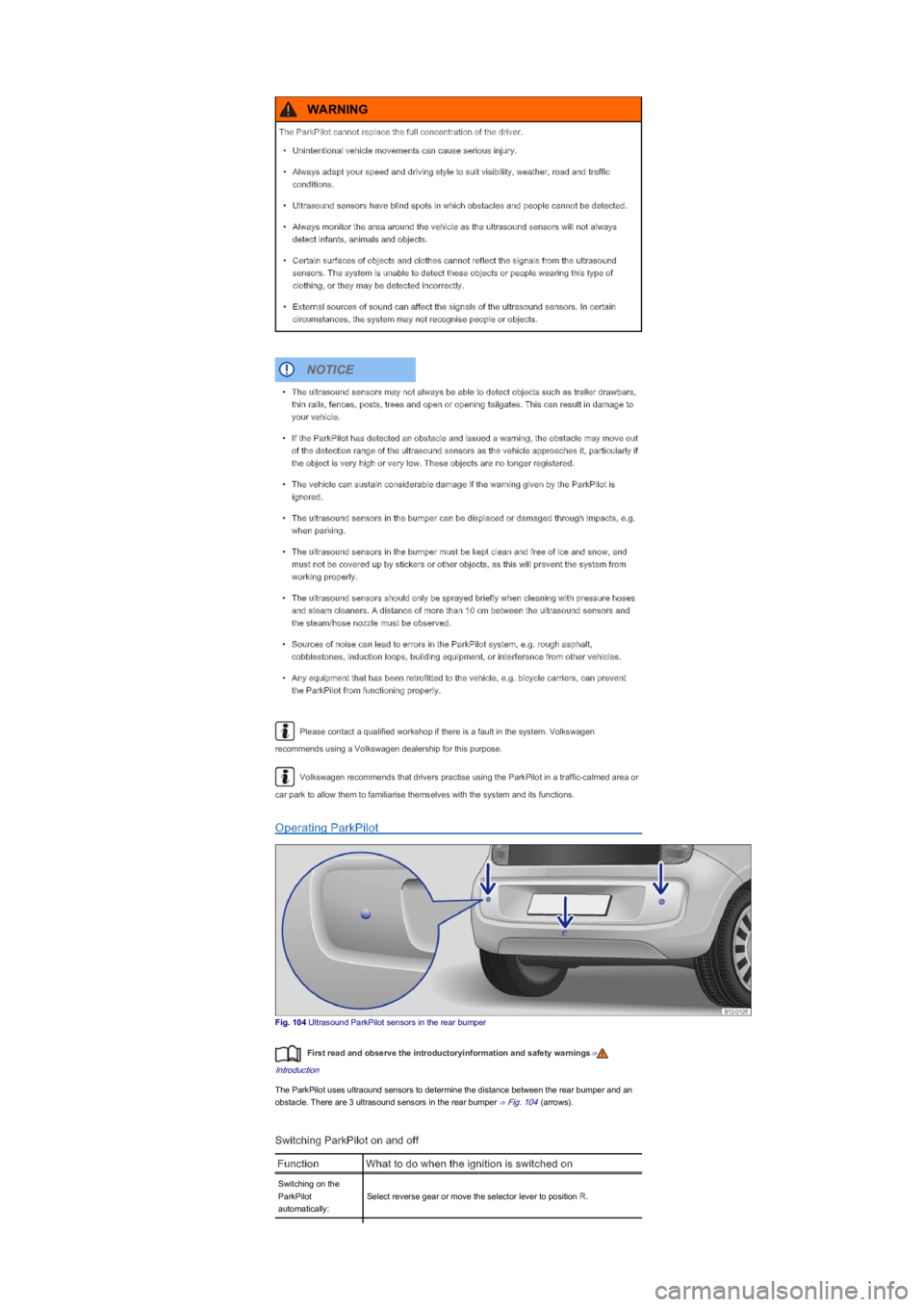
Fig. 104 Ultrasound ParkPilot sensors in the rear bumper
First read and observe the introductoryinformation and safety warnings⇒
Introduction
The ParkPilot uses ultraound sensors to determine the distance between the rear bumper and an
obstacle. There are 3 ultrasound sensors in the rear bumper ⇒ Fig. 104 (arrows).
Switching ParkPilot on and off
FunctionWhat to do when the ignition is switched on
Switching on the
ParkPilot
automatically:
Select reverse gear or move the selector lever to position R.
The ParkPilot cannot replace the full concentration of the driver.
•Unintentional vehicle movements can cause serious injury.
•Always adapt your speed and driving style to suit visibility, weather, road and traffic
conditions.
•Ultrasound sensors have blind spots in which obstacles and people cannot be detected.
•Always monitor the area around the vehicle as the ultrasound sensors will not always
detect infants, animals and objects.
•Certain surfaces of objects and clothes cannot reflect the signals from the ultrasound
sensors. The system is unable to detect these objects or people wearing this type of
clothing, or they may be detected incorrectly.
•External sources of sound can affect the signals of the ultrasound sensors. In certain
circumstances, the system may not recognise people or objects.
WARNING
•The ultrasound sensors may not always be able to detect objects such as trailer drawbars,
thin rails, fences, posts, trees and open or opening tailgates. This can result in damage to
your vehicle.
•If the ParkPilot has detected an obstacle and issued a warning, the obstacle may move out
of the detection range of the ultrasound sensors as the vehicle approaches it, particularly if
the object is very high or very low. These objects are no longer registered.
•The vehicle can sustain considerable damage if the warning given by the ParkPilot is
ignored.
•The ultrasound sensors in the bumper can be displaced or damaged through impacts, e.g.
when parking.
•The ultrasound sensors in the bumper must be kept clean and free of ice and snow, and
must not be covered up by stickers or other objects, as this will prevent the system from
working properly.
•The ultrasound sensors should only be sprayed briefly when cleaning with pressure hoses
and steam cleaners. A distance of more than 10 cm between the ultrasound sensors and
the steam/hose nozzle must be observed.
•Sources of noise can lead to errors in the ParkPilot system, e.g. rough asphalt,
cobblestones, induction loops, building equipment, or interference from other vehicles.
•Any equipment that has been retrofitted to the vehicle, e.g. bicycle carriers, can prevent
the ParkPilot from functioning properly.
NOTICE
Page 119 of 211
Switching city emergency brake function on and off
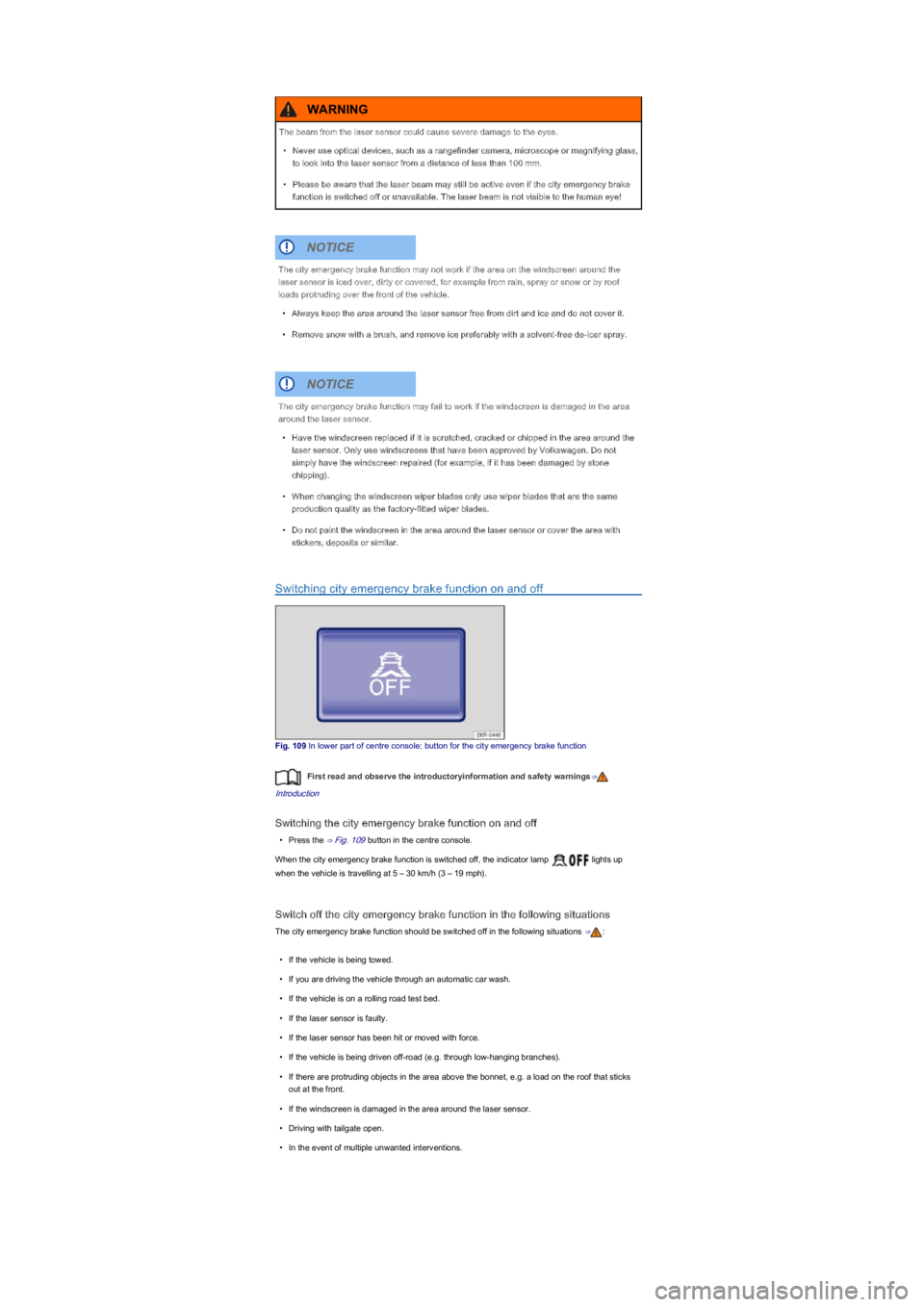
Fig. 109 In lower part of centre console: button for the city emergency brake function
First read and observe the introductoryinformation and safety warnings⇒
Introduction
Switching the city emergency brake function on and off
•Press the ⇒ Fig. 109 button in the centre console.
When the city emergency brake function is switched off, the indicator lamp lights up
when the vehicle is travelling at 5 – 30 km/h (3 – 19 mph).
Switch off the city emergency brake function in the following situations
The city emergency brake function should be switched off in the following situations ⇒:
•If the vehicle is being towed.
•If you are driving the vehicle through an automatic car wash.
•If the vehicle is on a rolling road test bed.
•If the laser sensor is faulty.
•If the laser sensor has been hit or moved with force.
•If the vehicle is being driven off-road (e.g. through low-hanging branches).
•If there are protruding objects in the area above the bonnet, e.g. a load on the roof that sticks
out at the front.
•If the windscreen is damaged in the area around the laser sensor.
•Driving with tailgate open.
•In the event of multiple unwanted interventions.
The beam from the laser sensor could cause severe damage to the eyes.
•Never use optical devices, such as a rangefinder camera, microscope or magnifying glass,
to look into the laser sensor from a distance of less than 100 mm.
•Please be aware that the laser beam may still be active even if the city emergency brake
function is switched off or unavailable. The laser beam is not visible to the human eye!
WARNING
The city emergency brake function may not work if the area on the windscreen around the
laser sensor is iced over, dirty or covered, for example from rain, spray or snow or by roof
loads protruding over the front of the vehicle.
•Always keep the area around the laser sensor free from dirt and ice and do not cover it.
•Remove snow with a brush, and remove ice preferably with a solvent-free de-icer spray.
NOTICE
The city emergency brake function may fail to work if the windscreen is damaged in the area
around the laser sensor.
•Have the windscreen replaced if it is scratched, cracked or chipped in the area around the
laser sensor. Only use windscreens that have been approved by Volkswagen. Do not
simply have the windscreen repaired (for example, if it has been damaged by stone
chipping).
•When changing the windscreen wiper blades only use wiper blades that are the same
production quality as the factory-fitted wiper blades.
•Do not paint the windscreen in the area around the laser sensor or cover the area with
stickers, deposits or similar.
NOTICE
Page 147 of 211
Washing the vehicle with a high-pressure cleaner
First read and observe the introductoryinformation and safety warnings⇒
Introduction
Follow the instructions provided by the manufacturer when cleaning your vehicle using a high-
pressure cleaner. This applies in particular to the pressure and the spraying distance⇒.
Maintain sufficient distance to soft materials such as rubber hoses, insulation, and the ParkPilot
sensors. The ParkPilot sensors are located in the rear bumper ⇒.
Never use concentrated jet nozzles or dirt blasters⇒.
Parts of the vehicle with sharp edges can cause injury.
•Protect your hands and arms from cuts on sharp parts, for example when cleaning the
underbody or the inside of the wheel housings.
WARNING
After the car has been washed, the braking effect could set in later than normal and extend
the braking distance as the brake discs and brake pads will be wet, or iced up in winter.
•You can dry and de-ice the brakes by performing careful braking manoeuvres. Ensure that
you do not endanger any other road users or violate any legal regulations when doing so.
WARNING
•The water should be no warmer than +60°C (+140°F).
•Do not wash the vehicle in direct sunlight in order to avoid damage to the vehicle
paintwork.
•Never clean with insect sponges, rough kitchen sponges or similar products as these can
damage the surface.
•Never clean the headlights with a dry cloth or sponge. Always use a wet cloth or sponge. It
is best to use soapy water.
•Washing the vehicle in cold weather: if the vehicle is rinsed with a hose, do not direct the
water into the lock cylinders or the gaps round the doors, boot, or bonnet. The locks and
seals could freeze.
NOTICE
Observe the following guidelines before driving the vehicle into an automatic car wash in order
to avoid damage to the vehicle:
•Ensure that the gap between the guide rails in the car wash is sufficient for the vehicle
track. If the track is too narrow your wheels and tyres will be damaged.
•Switch off the city emergency brake function before driving the vehicle into an automatic
car wash.
•Check that the car wash is tall and wide enough for your vehicle.
•Fold in the exterior mirrors.
•In order to prevent damage to the paintwork on the bonnet, fold the windscreen wipers
back onto the windscreen after drying the wiper blades. Do not drop the wipers onto the
glass.
•Lock the tailgate to prevent it from opening accidentally in the car wash.
NOTICE
Page 164 of 211
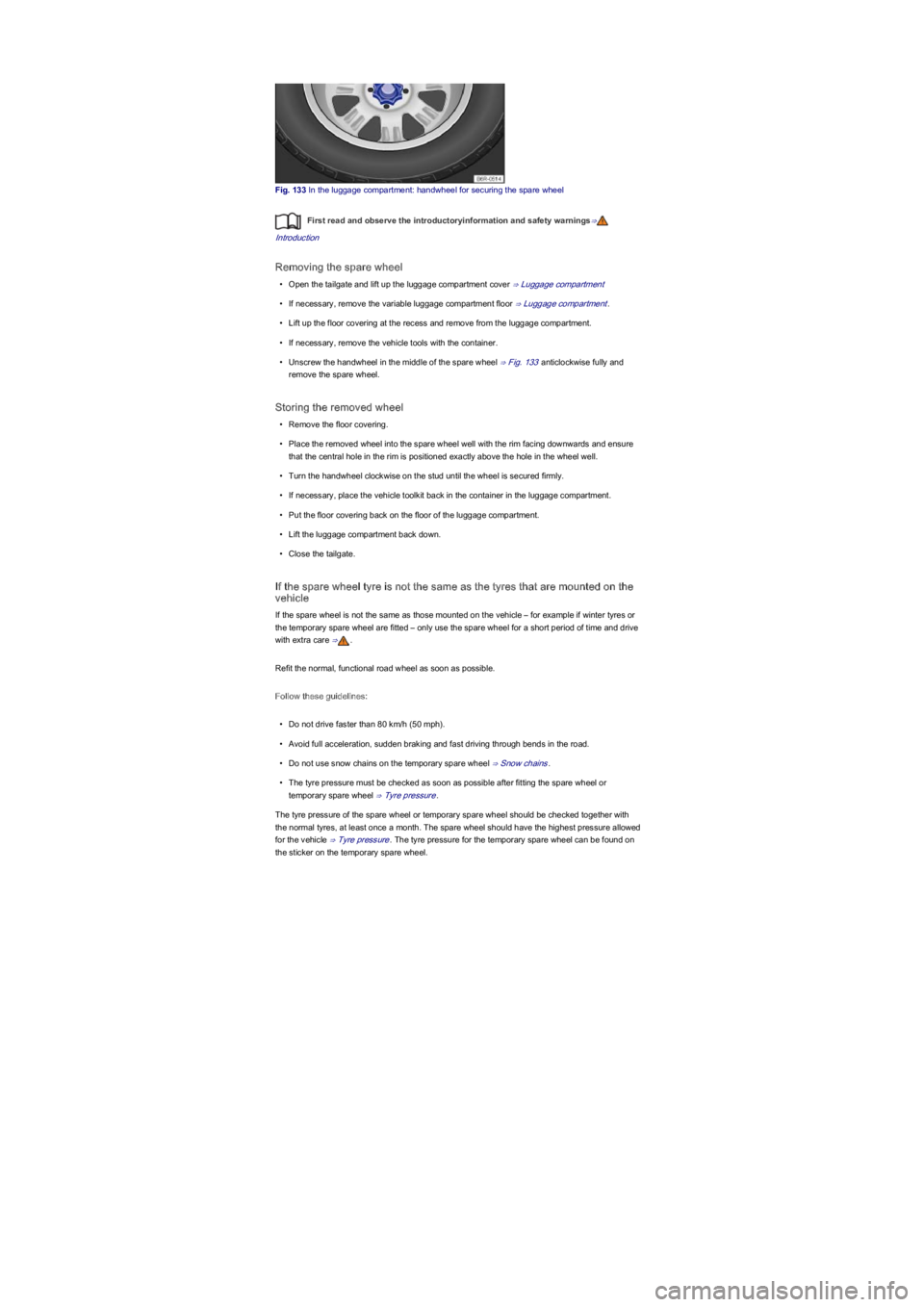
Fig. 133 In the luggage compartment: handwheel for securing the spare wheel
First read and observe the introductoryinformation and safety warnings⇒
Introduction
Removing the spare wheel
•Open the tailgate and lift up the luggage compartment cover ⇒ Luggage compartment
•If necessary, remove the variable luggage compartment floor ⇒ Luggage compartment.
•Lift up the floor covering at the recess and remove from the luggage compartment.
•If necessary, remove the vehicle tools with the container.
•Unscrew the handwheel in the middle of the spare wheel ⇒ Fig. 133 anticlockwise fully and
remove the spare wheel.
Storing the removed wheel
•Remove the floor covering.
•Place the removed wheel into the spare wheel well with the rim facing downwards and ensure
that the central hole in the rim is positioned exactly above the hole in the wheel well.
•Turn the handwheel clockwise on the stud until the wheel is secured firmly.
•If necessary, place the vehicle toolkit back in the container in the luggage compartment.
•Put the floor covering back on the floor of the luggage compartment.
•Lift the luggage compartment back down.
•Close the tailgate.
If the spare wheel tyre is not the same as the tyres that are mounted on the
vehicle
If the spare wheel is not the same as those mounted on the vehicle – for example if winter tyres or
the temporary spare wheel are fitted – only use the spare wheel for a short period of time and drive
with extra care ⇒.
Refit the normal, functional road wheel as soon as possible.
Follow these guidelines:
•Do not drive faster than 80 km/h (50 mph).
•Avoid full acceleration, sudden braking and fast driving through bends in the road.
•Do not use snow chains on the temporary spare wheel ⇒ Snow chains.
•The tyre pressure must be checked as soon as possible after fitting the spare wheel or
temporary spare wheel ⇒ Tyre pressure.
The tyre pressure of the spare wheel or temporary spare wheel should be checked together with
the normal tyres, at least once a month. The spare wheel should have the highest pressure allowed
for the vehicle ⇒ Tyre pressure. The tyre pressure for the temporary spare wheel can be found on
the sticker on the temporary spare wheel.