display VOLKSWAGEN UP! 2021 Owner´s Manual
[x] Cancel search | Manufacturer: VOLKSWAGEN, Model Year: 2021, Model line: UP!, Model: VOLKSWAGEN UP! 2021Pages: 211, PDF Size: 5.98 MB
Page 172 of 211
You will need an external aerial to use a two-way radio in the vehicle.
Any retrofit installation of electrical or electronic equipment in the vehicle will affect its vehicle type
approval. Under certain circumstances, this can negate the type approval for the vehicle.
Volkswagen has approved the vehicle for use with two-way radios subject to the following
conditions:
•Correct installation of external aerial.
•A maximum transmitting power of 10 watts.
An external aerial is needed to give the equipment its optimal range.
Check first with a qualified workshop if you wish to use a two-way radio with a transmitting power of
over 10 watts. A qualified workshop is familiar with the technical options for retrofitting. Volkswagen
recommends using a Volkswagen dealership for this purpose.
Please observe legislation and the instructions and information given in the operating manuals for
radio equipment.
Information stored in the control units
First read and observe the introductoryinformation and safety warnings⇒
Introduction
Your vehicle is factory fitted with electronic control units which are responsible for engine and
gearbox management. The control units also monitor the function of the exhaust system and the
airbags.
These electronic control units continuously evaluate data relevant to the vehicle while the vehicle is
being driven. Only these data will be stored if there are any faults recorded or any deviations from
the specified values. This is generally displayed by the indicator lamps on the instrument cluster.
Special units are required to read and evaluate data stored in the control units.
These data are stored so that specialist workshops can diagnose and solve problems. The
following data may have been stored:
•Engine and gearbox-relevant data.
•Speed.
•Direction of travel.
•Braking power.
•Seat belt monitor.
The control units never record conversations that take place in the vehicle. It is neither possible nor
permitted to use the stored data to create movement profiles.
When the vehicle is being used, situations may arise in which the stored data (alone or in
conjunction with other information such as accident reports, vehicle damage, witness statements
etc.) can become assignable to a particular person, in which case it may be necessary to consult an
expert and use the expert's information.
In vehicles with an emergency call function via a mobile telephone or other units, the current
location can be transmitted. In the event of an accident in which the control units register that an
airbag has been triggered, the system can automatically send out a signal. This depends on your
service provider. Transmission is possible only in areas with a sufficiently strong mobile telephone
signal.
Additional functions that are contractually agreed with the customer, e.g. vehicle positioning in an
emergency, allow certain vehicle data to be transmitted from the vehicle.
If radio equipment is not secured or not properly secured in the vehicle, it could be flung
though the interior during a sudden driving or braking manoeuvre, or in the event of an
accident. This can cause injuries.
•While the vehicle is in motion, always secure two-way radios properly outside the airbag
deployment zones or stow them away safely.
WARNING
If two-way radios that are not connected to an external aerial are used, electromagnetic
radiation in the vehicle could exceed limit values and thus be a health hazard for drivers and
other vehicle occupants. This also applies to external aerials that have not been correctly
installed.
•Two-way radios should only be used in the vehicle if an external aerial is properly
connected.
CAUTION
Page 173 of 211
Event data recorder
The vehicle is not fitted with an event data recorder.
Event data recorders temporarily store vehicle information. This provides precise information in the
event of an accident. In vehicles with an airbag system, data that might be relevant in the event of
an accident can be stored, e.g. impact speed, belt buckle status, seat positions and trigger speed.
The scope of the data is manufacturer-specific.
An event data recorder may only be fitted if the owner has approved the procedure. This is covered
by legislation in some countries.
Reprogramming control units
All data for the control of components are stored in the control units. Some convenience functions,
such as lane change flash, single door unlocking and displays, can be reprogrammed using special
workshop equipment. If this is the case, the descriptions in your vehicle wallet will no longer
correspond with the original functions. Volkswagen recommends that you have any reprogramming
confirmed in the service schedule under Workshop comments.
Information about possible reprogramming can be obtained from the Volkswagen dealership.
Reading the vehicle's event memory
A diagnostic interface for reading the event memories is located in the vehicle interior ⇒. Data
relating to the function and status of the electronic control units are stored in the event memory.
Additional information on the stored data is available from qualified workshops.
The diagnosis interface is located behind near the fuse box in the footwell on the driver side.
The event memory should only be read and reset by a qualified workshop.
After a fault has been rectified, the information in the memory pertaining to the fault is deleted.
Other memory content is overwritten on an on-going basis.
Using a mobile telephone in the vehicle without a connection to the
external aerial
First read and observe the introductoryinformation and safety warnings⇒
Introduction
Both during telephone calls and in standby mode, mobile telephones transmit and receive radio
waves, which may also be termed "high-frequency energy". Current scientific literature warns us
that radio waves can be harmful to human beings if they exceed certain limits. Government bodies
and international committees have introduced threshold values and guidelines to ensure that
electromagnetic radiation produced by mobile telephones does not pose a hazard to health.
However, there is no proven scientific evidence that demonstrates that cordless telephones are
absolutely safe.
For this reason, some experts are calling for more precautions to be taken in the use of mobile
telephones, by taking steps to reduce the level of personal exposure to electromagnetic radiation.
If a mobile telephone that is not connected to the vehicle's external aerial is used inside the vehicle,
the level of electromagnetic radiation could be higher than when the mobile telephone is connected
to an integrated aerial or any other external aerial.
If the vehicle is fitted with a suitable hands-free unit which enables the use of innumerable
additional functions of Bluetooth compatible mobile telephones, this will satisfy the legal
requirements in many countries which permit the use of a mobile telephone in a vehicle only if a
hands-free unit is used.
The hands-free system of the portable navigation device (delivered by Volkswagen) in your vehicle
has been developed for mobile telephones that are compatible with Bluetooth⇒ Portable
navigation device. Mobile telephones must be located in a suitable telephone holder or be stored
securely in the vehicle. If a telephone holder is used it must be securely attached to the base plate.
This is the only way to ensure that the mobile telephone is securely attached to the dash panel and
always within reach of the driver. Depending on the hands-free system, the connection between the
mobile telephone and the external aerial is established either via the telephone holder or via an
existing Bluetooth connection between the mobile telephone and the vehicle.
Connecting the mobile telephone is to a telephone aerial integrated in the vehicle or to an external
telephone aerial reduces the electromagnetic radiation generated by the telephone which could
affect the human body. Using an aerial also improves the quality of the signal.
Incorrect use of the diagnostic interface can cause faults, which can result in accidents and
serious injuries.
•Never read the event memory using the diagnostic interface yourself.
•The diagnostic interface should only be read by a qualified workshop.
WARNING
®
®
®
Page 174 of 211
If a mobile telephone is used in the vehicle interior without this hands-free system, it is not safely
secured in the vehicle and also not connected to the vehicle's external telephone aerial.
Furthermore, the mobile telephone is not being charged in the telephone holder. It is also likely that
the telephone connection will be disrupted and the signal strength will be poor.
A mobile telephone should only be used in the vehicle if it is connected to a hands-free unit.
Volkswagen recommends the use of an external aerial when using a mobile telephone in the
vehicle.
Bluetooth is a registered trademark of Bluetooth SIG, Inc.
Portable navigation device
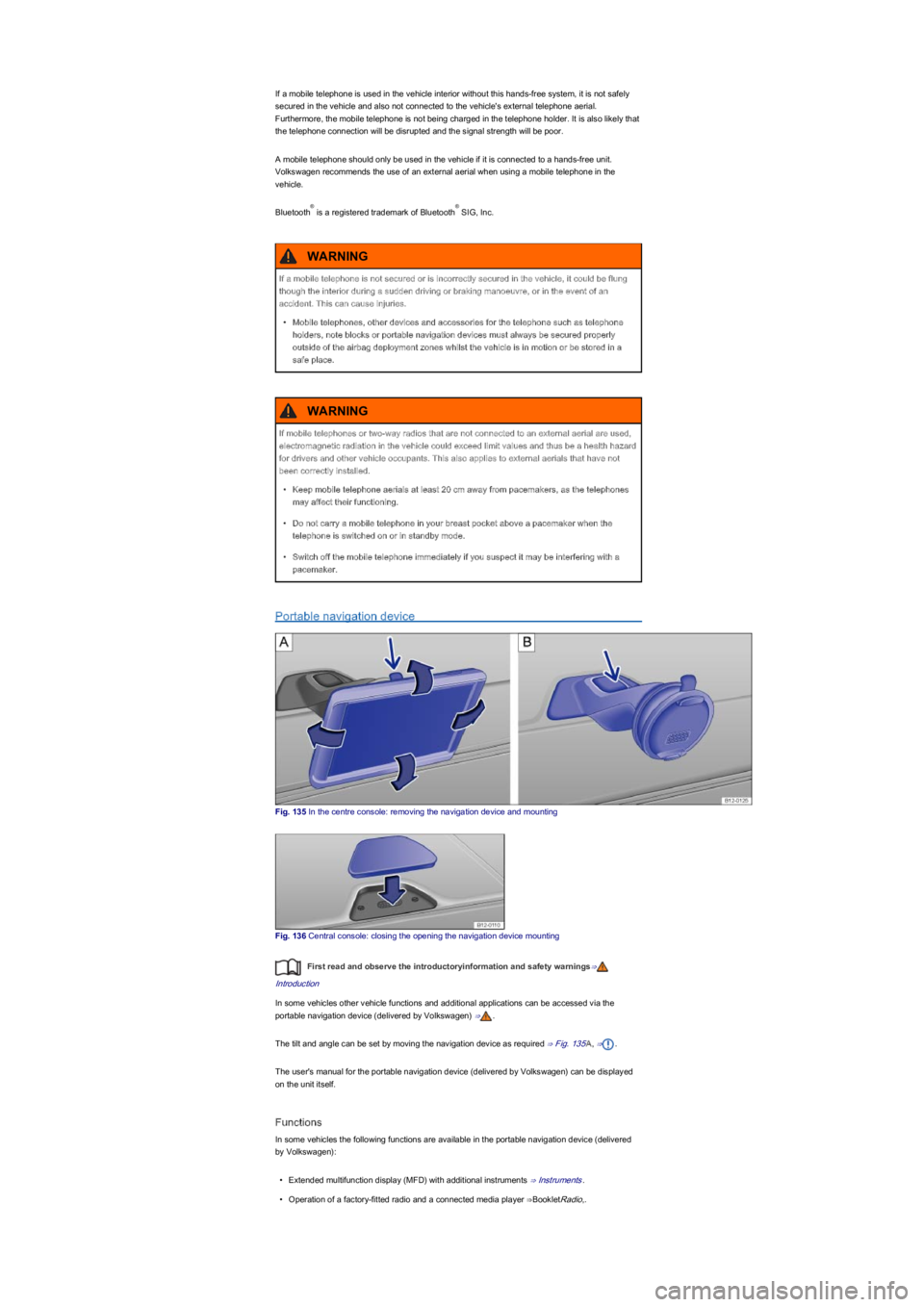
Fig. 135 In the centre console: removing the navigation device and mounting
Fig. 136 Central console: closing the opening the navigation device mounting
First read and observe the introductoryinformation and safety warnings⇒
Introduction
In some vehicles other vehicle functions and additional applications can be accessed via the
portable navigation device (delivered by Volkswagen) ⇒.
The tilt and angle can be set by moving the navigation device as required ⇒ Fig. 135A, ⇒.
The user's manual for the portable navigation device (delivered by Volkswagen) can be displayed
on the unit itself.
Functions
In some vehicles the following functions are available in the portable navigation device (delivered
by Volkswagen):
•Extended multifunction display (MFD) with additional instruments ⇒ Instruments.
•Operation of a factory-fitted radio and a connected media player ⇒BookletRadio,.
®®
If a mobile telephone is not secured or is incorrectly secured in the vehicle, it could be flung
though the interior during a sudden driving or braking manoeuvre, or in the event of an
accident. This can cause injuries.
•Mobile telephones, other devices and accessories for the telephone such as telephone
holders, note blocks or portable navigation devices must always be secured properly
outside of the airbag deployment zones whilst the vehicle is in motion or be stored in a
safe place.
WARNING
If mobile telephones or two-way radios that are not connected to an external aerial are used,
electromagnetic radiation in the vehicle could exceed limit values and thus be a health hazard
for drivers and other vehicle occupants. This also applies to external aerials that have not
been correctly installed.
•Keep mobile telephone aerials at least 20 cm away from pacemakers, as the telephones
may affect their functioning.
•Do not carry a mobile telephone in your breast pocket above a pacemaker when the
telephone is switched on or in standby mode.
•Switch off the mobile telephone immediately if you suspect it may be interfering with a
pacemaker.
WARNING
Page 175 of 211
•Picture viewer.
•Navigation.
•Hands-free system for a mobile telephone via Bluetooth.
•Display for open doors or tailgate.
•ParkPilot ⇒ ParkPilot.
•Gear change indicator and driving style.
•Think-Blue-Trainer.
•Fuel warning.
Select user's manual for the portable navigation device (delivered by
Volkswagen)
•Switch on portable navigation device (delivered by Volkswagen).
•Touch the more function button on the screen.
•Press the Handbook function button.
•Select the required chapter and press the corresponding function button.
Removing the portable navigation device
•Use one hand to get a secure grip on the upper and lower edges of the portable navigation
device.
•Press the release button ⇒ Fig. 135A (arrow) until the device can be removed from the holder.
•Remove the portable navigation device and stow it securely.
•Remove the portable navigation device holder if necessary.
Installing the portable navigation device
•Fit the portable navigation device holder if necessary ⇒.
•Use one hand to get a secure grip on the upper and lower edges of the portable navigation
device.
•Place the portable navigation device in the upper holder and push on the lower edge until it
perceptibly engages ⇒.
Removing the portable navigation device holder
•If necessary, remove the portable navigation device.
•With one hand, take a firm grip of the holder's supporting arm and press the release button
⇒ Fig. 135B (arrow).
•Pull the holder up out of the dash panel.
•If necessary, close the opening by attaching the cover in the direction of the arrow ⇒ Fig. 136.
Fitting the portable navigation device holder mounting
•If necessary, remove the cover for the holder mount in the opposite direction of the arrow
⇒ Fig. 136.
•Insert the holder into the opening from above and push down until it perceptibly engages ⇒.
Accidents and injuries can occur if the driver is distracted. Operating the portable navigation
device can distract you from the road.
•Always drive carefully and responsibly.
•Select volume settings that allow signals from outside the vehicle to be easily heard at all
times (e.g. emergency service sirens).
•Setting the volume too high may damage your hearing. This also applies even if you are
only exposed to high volumes for short periods.
WARNING
Driving recommendations and traffic symbols displayed by the navigation system may differ
from the current traffic situation.
•Traffic signs and traffic regulations have priority over the recommendations and displays
provided by the navigation system.
•Adapt your speed and driving style to suit visibility, weather, road and traffic conditions.
WARNING
Page 194 of 211
Dispose of used or out-of-date sealant in accordance with legal requirements.
You can get a new tyre filler bottle from a Volkswagen dealership.
Observe the separate instructions from the manufacturer of the breakdown set.
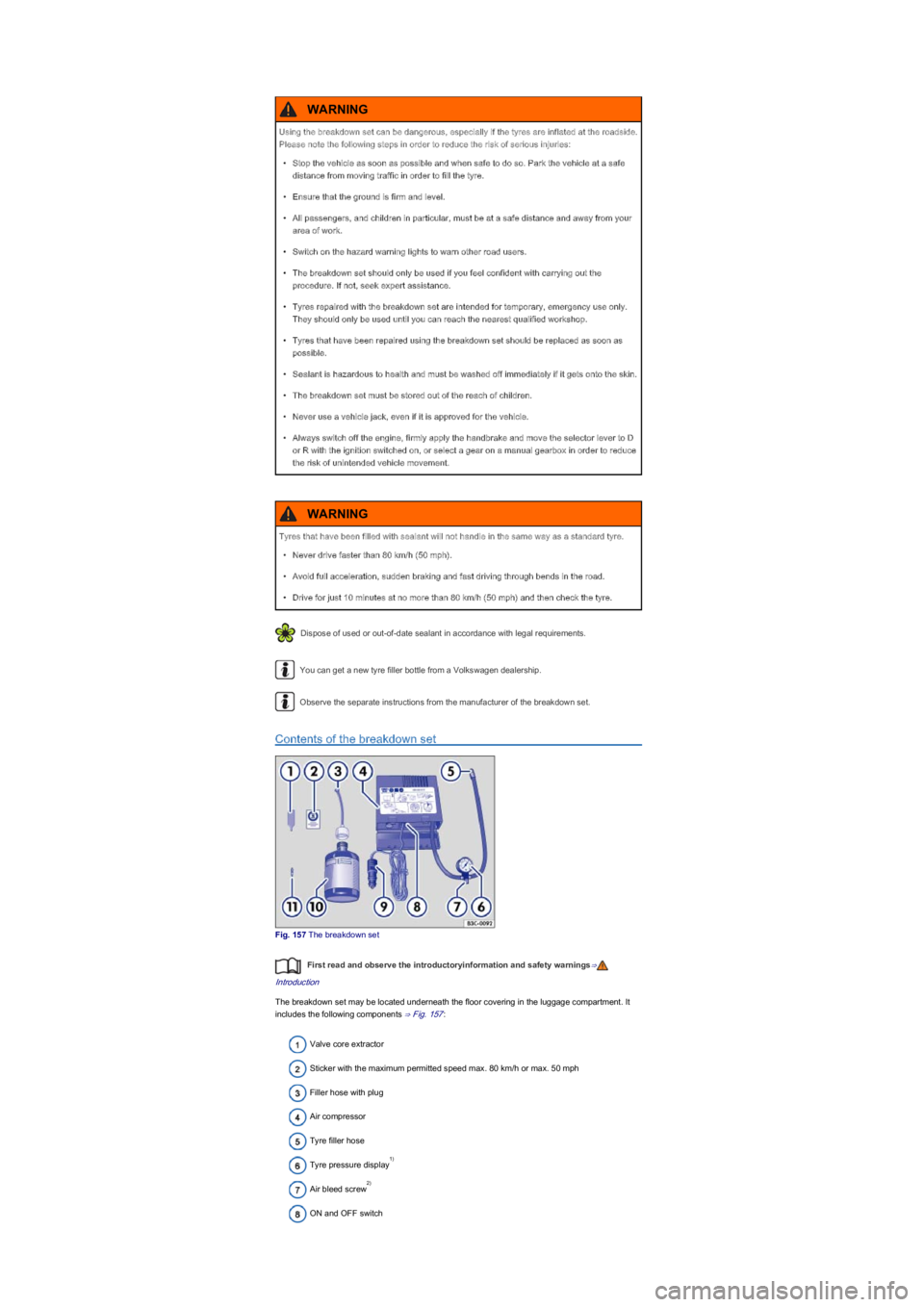
Contents of the breakdown set
Fig. 157 The breakdown set
First read and observe the introductoryinformation and safety warnings⇒
Introduction
The breakdown set may be located underneath the floor covering in the luggage compartment. It
includes the following components ⇒ Fig. 157:
Valve core extractor
Sticker with the maximum permitted speed max. 80 km/h or max. 50 mph
Filler hose with plug
Air compressor
Tyre filler hose
Tyre pressure display
Air bleed screw
ON and OFF switch
Using the breakdown set can be dangerous, especially if the tyres are inflated at the roadside.
Please note the following steps in order to reduce the risk of serious injuries:
•Stop the vehicle as soon as possible and when safe to do so. Park the vehicle at a safe
distance from moving traffic in order to fill the tyre.
•Ensure that the ground is firm and level.
•All passengers, and children in particular, must be at a safe distance and away from your
area of work.
•Switch on the hazard warning lights to warn other road users.
•The breakdown set should only be used if you feel confident with carrying out the
procedure. If not, seek expert assistance.
•Tyres repaired with the breakdown set are intended for temporary, emergency use only.
They should only be used until you can reach the nearest qualified workshop.
•Tyres that have been repaired using the breakdown set should be replaced as soon as
possible.
•Sealant is hazardous to health and must be washed off immediately if it gets onto the skin.
•The breakdown set must be stored out of the reach of children.
•Never use a vehicle jack, even if it is approved for the vehicle.
•Always switch off the engine, firmly apply the handbrake and move the selector lever to D
or R with the ignition switched on, or select a gear on a manual gearbox in order to reduce
the risk of unintended vehicle movement.
WARNING
Tyres that have been filled with sealant will not handle in the same way as a standard tyre.
•Never drive faster than 80 km/h (50 mph).
•Avoid full acceleration, sudden braking and fast driving through bends in the road.
•Drive for just 10 minutes at no more than 80 km/h (50 mph) and then check the tyre.
WARNING
1)
2)
Page 196 of 211
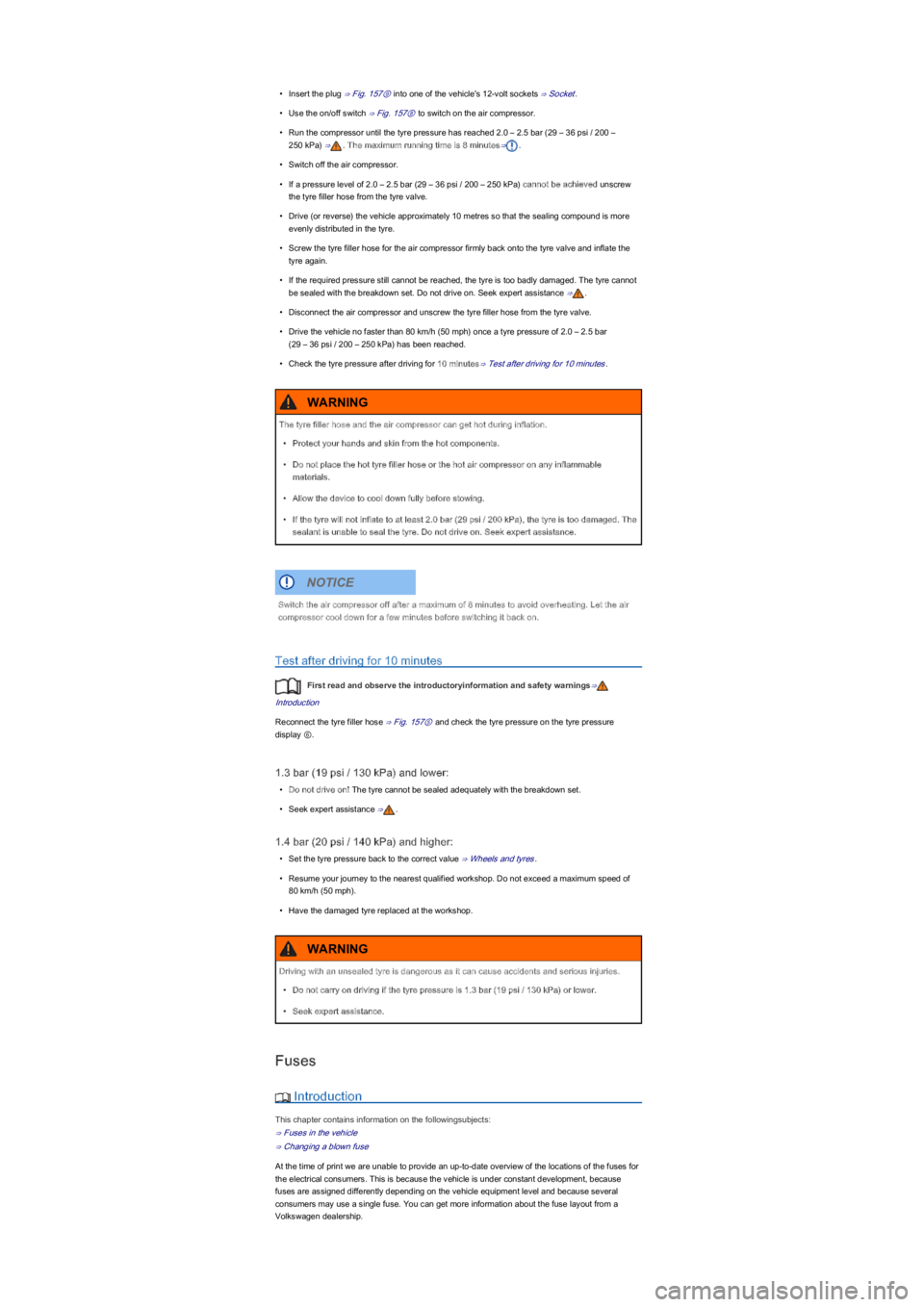
•Insert the plug ⇒ Fig. 157⑨ into one of the vehicle's 12-volt sockets ⇒ Socket.
•Use the on/off switch ⇒ Fig. 157⑧ to switch on the air compressor.
•Run the compressor until the tyre pressure has reached 2.0 – 2.5 bar (29 – 36 psi / 200 –
250 kPa) ⇒. The maximum running time is 8 minutes⇒.
•Switch off the air compressor.
•If a pressure level of 2.0 – 2.5 bar (29 – 36 psi / 200 – 250 kPa) cannot be achieved unscrew
the tyre filler hose from the tyre valve.
•Drive (or reverse) the vehicle approximately 10 metres so that the sealing compound is more
evenly distributed in the tyre.
•Screw the tyre filler hose for the air compressor firmly back onto the tyre valve and inflate the
tyre again.
•If the required pressure still cannot be reached, the tyre is too badly damaged. The tyre cannot
be sealed with the breakdown set. Do not drive on. Seek expert assistance ⇒.
•Disconnect the air compressor and unscrew the tyre filler hose from the tyre valve.
•Drive the vehicle no faster than 80 km/h (50 mph) once a tyre pressure of 2.0 – 2.5 bar
(29 – 36 psi / 200 – 250 kPa) has been reached.
•Check the tyre pressure after driving for 10 minutes⇒ Test after driving for 10 minutes.
Test after driving for 10 minutes
First read and observe the introductoryinformation and safety warnings⇒
Introduction
Reconnect the tyre filler hose ⇒ Fig. 157⑤ and check the tyre pressure on the tyre pressure
display ⑥.
1.3 bar (19 psi / 130 kPa) and lower:
•Do not drive on! The tyre cannot be sealed adequately with the breakdown set.
•Seek expert assistance ⇒.
1.4 bar (20 psi / 140 kPa) and higher:
•Set the tyre pressure back to the correct value ⇒ Wheels and tyres.
•Resume your journey to the nearest qualified workshop. Do not exceed a maximum speed of
80 km/h (50 mph).
•Have the damaged tyre replaced at the workshop.
Fuses
Introduction
This chapter contains information on the followingsubjects:
⇒ Fuses in the vehicle
⇒ Changing a blown fuse
At the time of print we are unable to provide an up-to-date overview of the locations of the fuses for
the electrical consumers. This is because the vehicle is under constant development, because
fuses are assigned differently depending on the vehicle equipment level and because several
consumers may use a single fuse. You can get more information about the fuse layout from a
Volkswagen dealership.
The tyre filler hose and the air compressor can get hot during inflation.
•Protect your hands and skin from the hot components.
•Do not place the hot tyre filler hose or the hot air compressor on any inflammable
materials.
•Allow the device to cool down fully before stowing.
•If the tyre will not inflate to at least 2.0 bar (29 psi / 200 kPa), the tyre is too damaged. The
sealant is unable to seal the tyre. Do not drive on. Seek expert assistance.
WARNING
Switch the air compressor off after a maximum of 8 minutes to avoid overheating. Let the air
compressor cool down for a few minutes before switching it back on.
NOTICE
Driving with an unsealed tyre is dangerous as it can cause accidents and serious injuries.
•Do not carry on driving if the tyre pressure is 1.3 bar (19 psi / 130 kPa) or lower.
•Seek expert assistance.
WARNING
Page 206 of 211
The discharged vehicle battery must be properly connected to the vehicle's electrical system.
The vehicles must not touch. Otherwise electricity could flow as soon as the positive terminals are
connected.
Ensure that the battery clamps have good metal-to-metal contact with the battery terminals.
If the engine does not start immediately, switch off the starter after about 10 seconds and try again
after about half a minute.
The steps should only be carried out in the specified order.
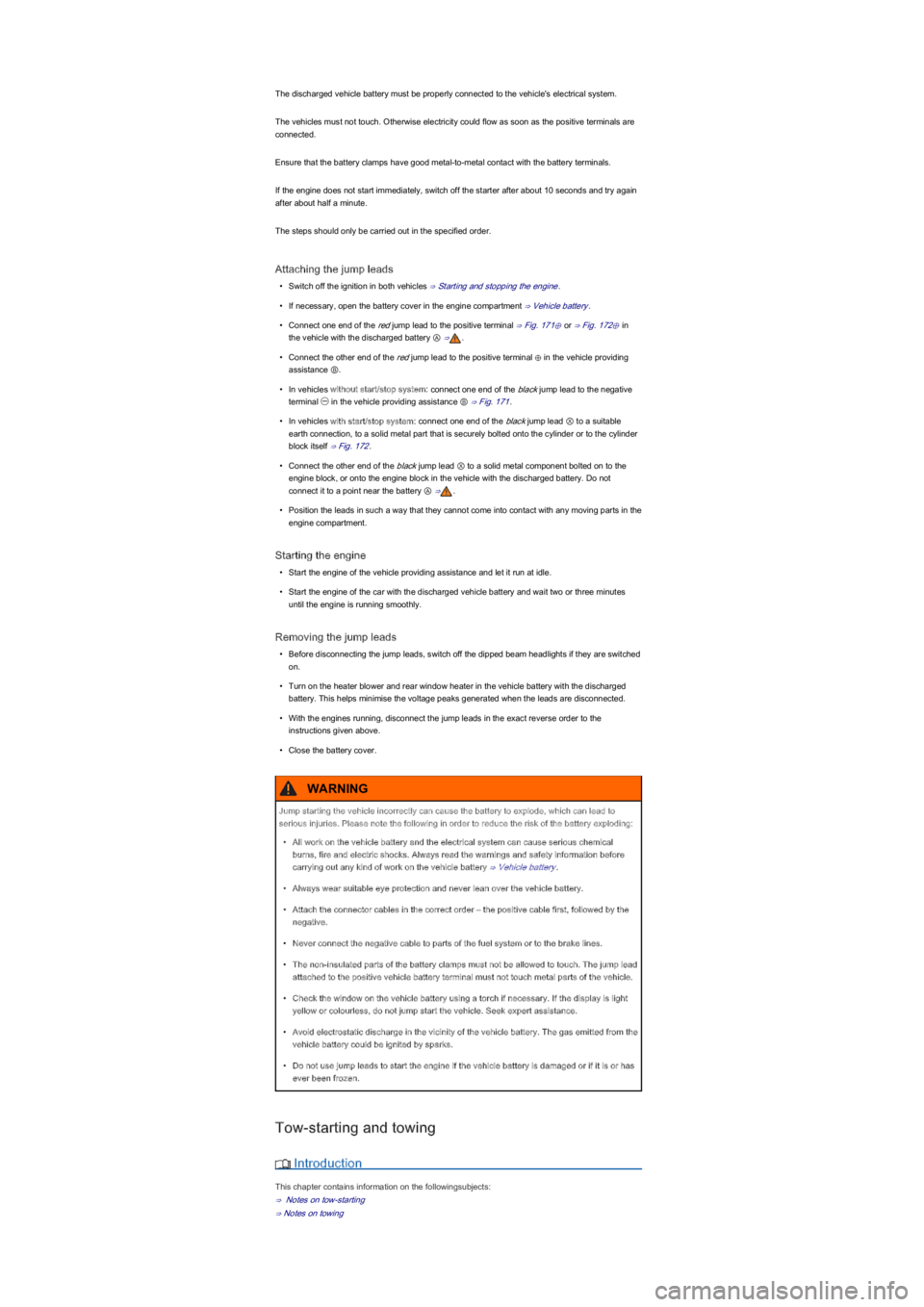
Attaching the jump leads
•Switch off the ignition in both vehicles ⇒ Starting and stopping the engine.
•If necessary, open the battery cover in the engine compartment ⇒ Vehicle battery.
•Connect one end of the red jump lead to the positive terminal ⇒ Fig. 171⊕ or ⇒ Fig. 172⊕ in
the vehicle with the discharged battery Ⓐ ⇒.
•Connect the other end of the red jump lead to the positive terminal ⊕ in the vehicle providing
assistance Ⓑ.
•In vehicles without start/stop system: connect one end of the black jump lead to the negative
terminal ㊀ in the vehicle providing assistance Ⓑ ⇒ Fig. 171.
•In vehicles with start/stop system: connect one end of the black jump lead Ⓧ to a suitable
earth connection, to a solid metal part that is securely bolted onto the cylinder or to the cylinder
block itself ⇒ Fig. 172.
•Connect the other end of the black jump lead Ⓧ to a solid metal component bolted on to the
engine block, or onto the engine block in the vehicle with the discharged battery. Do not
connect it to a point near the battery Ⓐ ⇒.
•Position the leads in such a way that they cannot come into contact with any moving parts in the
engine compartment.
Starting the engine
•Start the engine of the vehicle providing assistance and let it run at idle.
•Start the engine of the car with the discharged vehicle battery and wait two or three minutes
until the engine is running smoothly.
Removing the jump leads
•Before disconnecting the jump leads, switch off the dipped beam headlights if they are switched
on.
•Turn on the heater blower and rear window heater in the vehicle battery with the discharged
battery. This helps minimise the voltage peaks generated when the leads are disconnected.
•With the engines running, disconnect the jump leads in the exact reverse order to the
instructions given above.
•Close the battery cover.
Tow-starting and towing
Introduction
This chapter contains information on the followingsubjects:
⇒ Notes on tow-starting
⇒ Notes on towing
Jump starting the vehicle incorrectly can cause the battery to explode, which can lead to
serious injuries. Please note the following in order to reduce the risk of the battery exploding:
•All work on the vehicle battery and the electrical system can cause serious chemical
burns, fire and electric shocks. Always read the warnings and safety information before
carrying out any kind of work on the vehicle battery ⇒ Vehicle battery.
•Always wear suitable eye protection and never lean over the vehicle battery.
•Attach the connector cables in the correct order – the positive cable first, followed by the
negative.
•Never connect the negative cable to parts of the fuel system or to the brake lines.
•The non-insulated parts of the battery clamps must not be allowed to touch. The jump lead
attached to the positive vehicle battery terminal must not touch metal parts of the vehicle.
•Check the window on the vehicle battery using a torch if necessary. If the display is light
yellow or colourless, do not jump start the vehicle. Seek expert assistance.
•Avoid electrostatic discharge in the vicinity of the vehicle battery. The gas emitted from the
vehicle battery could be ignited by sparks.
•Do not use jump leads to start the engine if the vehicle battery is damaged or if it is or has
ever been frozen.
WARNING
Page 210 of 211
•You will need to depress the brake pedal more vigorously than normal as the brake servo is not
working. Do not drive too close to the towing vehicle.
•Read and comply with the information and notes in the owner's manual of the towing vehicle.
Notes for the driver of the towing vehicle
•Accelerate carefully and gently. Avoid any sudden driving manoeuvres.
•Brake earlier than normal by pressing lightly on the brake pedal.
•Read and comply with any information and notes in the owner's manual of the towed vehicle.
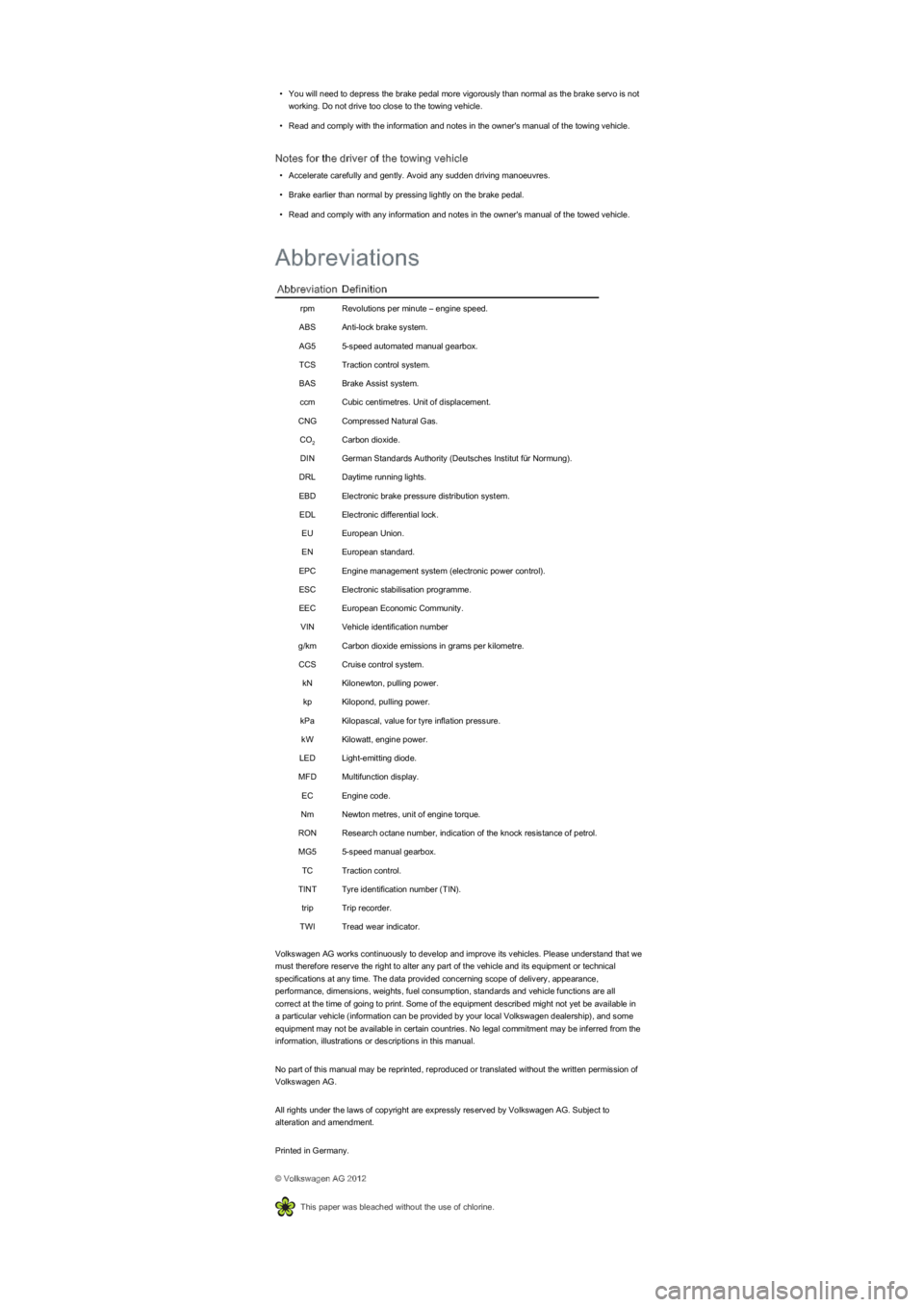
AbbreviationDefinition
rpmRevolutions per minute – engine speed.
ABSAnti-lock brake system.
AG55-speed automated manual gearbox.
TCSTraction control system.
BASBrake Assist system.
ccmCubic centimetres. Unit of displacement.
CNGCompressed Natural Gas.
COCarbon dioxide.
DINGerman Standards Authority (Deutsches Institut für Normung).
DRLDaytime running lights.
EBDElectronic brake pressure distribution system.
EDLElectronic differential lock.
EUEuropean Union.
ENEuropean standard.
EPCEngine management system (electronic power control).
ESCElectronic stabilisation programme.
EECEuropean Economic Community.
VINVehicle identification number
g/kmCarbon dioxide emissions in grams per kilometre.
CCSCruise control system.
kNKilonewton, pulling power.
kpKilopond, pulling power.
kPaKilopascal, value for tyre inflation pressure.
kWKilowatt, engine power.
LEDLight-emitting diode.
MFDMultifunction display.
ECEngine code.
NmNewton metres, unit of engine torque.
RONResearch octane number, indication of the knock resistance of petrol.
MG55-speed manual gearbox.
TCTraction control.
TINT Tyre identification number (TIN).
tripTrip recorder.
TWITread wear indicator.
Volkswagen AG works continuously to develop and improve its vehicles. Please understand that we
must therefore reserve the right to alter any part of the vehicle and its equipment or technical
specifications at any time. The data provided concerning scope of delivery, appearance,
performance, dimensions, weights, fuel consumption, standards and vehicle functions are all
correct at the time of going to print. Some of the equipment described might not yet be available in
a particular vehicle (information can be provided by your local Volkswagen dealership), and some
equipment may not be available in certain countries. No legal commitment may be inferred from the
information, illustrations or descriptions in this manual.
No part of this manual may be reprinted, reproduced or translated without the written permission of
Volkswagen AG.
All rights under the laws of copyright are expressly reserved by Volkswagen AG. Subject to
alteration and amendment.
Printed in Germany.
© Volkswagen AG 2012
This paper was bleached without the use of chlorine.
Abbreviations
2