engine VOLKSWAGEN UP! 2021 Owner´s Manual
[x] Cancel search | Manufacturer: VOLKSWAGEN, Model Year: 2021, Model line: UP!, Model: VOLKSWAGEN UP! 2021Pages: 211, PDF Size: 5.98 MB
Page 92 of 211
Several warning and indicator lamps will light up briefly as a functional check when the ignition is
switched on. They will switch off after a few seconds.
Pedals
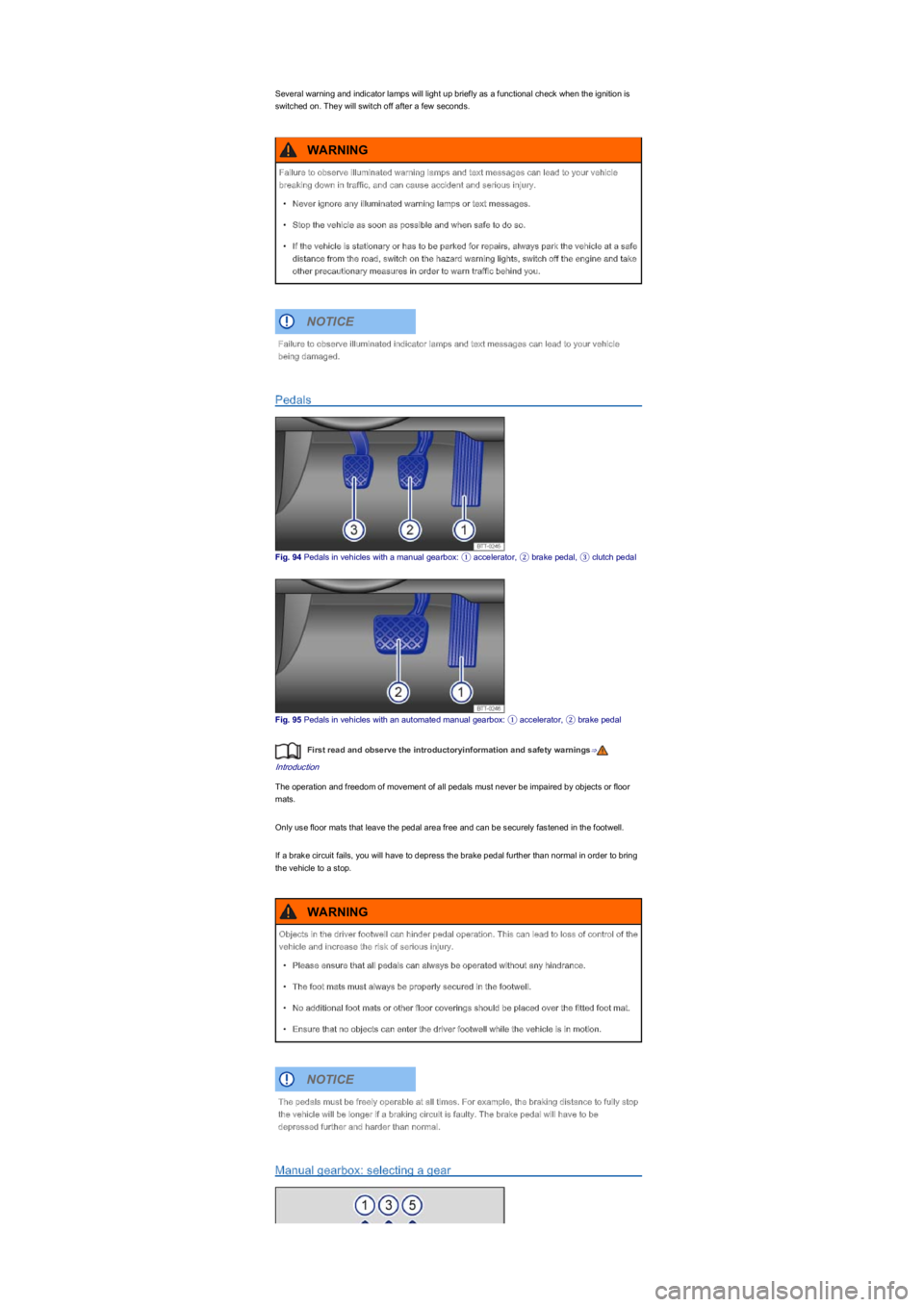
Fig. 94 Pedals in vehicles with a manual gearbox: ① accelerator, ② brake pedal, ③ clutch pedal
Fig. 95 Pedals in vehicles with an automated manual gearbox: ① accelerator, ② brake pedal
First read and observe the introductoryinformation and safety warnings⇒
Introduction
The operation and freedom of movement of all pedals must never be impaired by objects or floor
mats.
Only use floor mats that leave the pedal area free and can be securely fastened in the footwell.
If a brake circuit fails, you will have to depress the brake pedal further than normal in order to bring
the vehicle to a stop.
Manual gearbox: selecting a gear
Failure to observe illuminated warning lamps and text messages can lead to your vehicle
breaking down in traffic, and can cause accident and serious injury.
•Never ignore any illuminated warning lamps or text messages.
•Stop the vehicle as soon as possible and when safe to do so.
•If the vehicle is stationary or has to be parked for repairs, always park the vehicle at a safe
distance from the road, switch on the hazard warning lights, switch off the engine and take
other precautionary measures in order to warn traffic behind you.
WARNING
Failure to observe illuminated indicator lamps and text messages can lead to your vehicle
being damaged.
NOTICE
Objects in the driver footwell can hinder pedal operation. This can lead to loss of control of the
vehicle and increase the risk of serious injury.
•Please ensure that all pedals can always be operated without any hindrance.
•The foot mats must always be properly secured in the footwell.
•No additional foot mats or other floor coverings should be placed over the fitted foot mat.
•Ensure that no objects can enter the driver footwell while the vehicle is in motion.
WARNING
The pedals must be freely operable at all times. For example, the braking distance to fully stop
the vehicle will be longer if a braking circuit is faulty. The brake pedal will have to be
depressed further and harder than normal.
NOTICE
Page 93 of 211
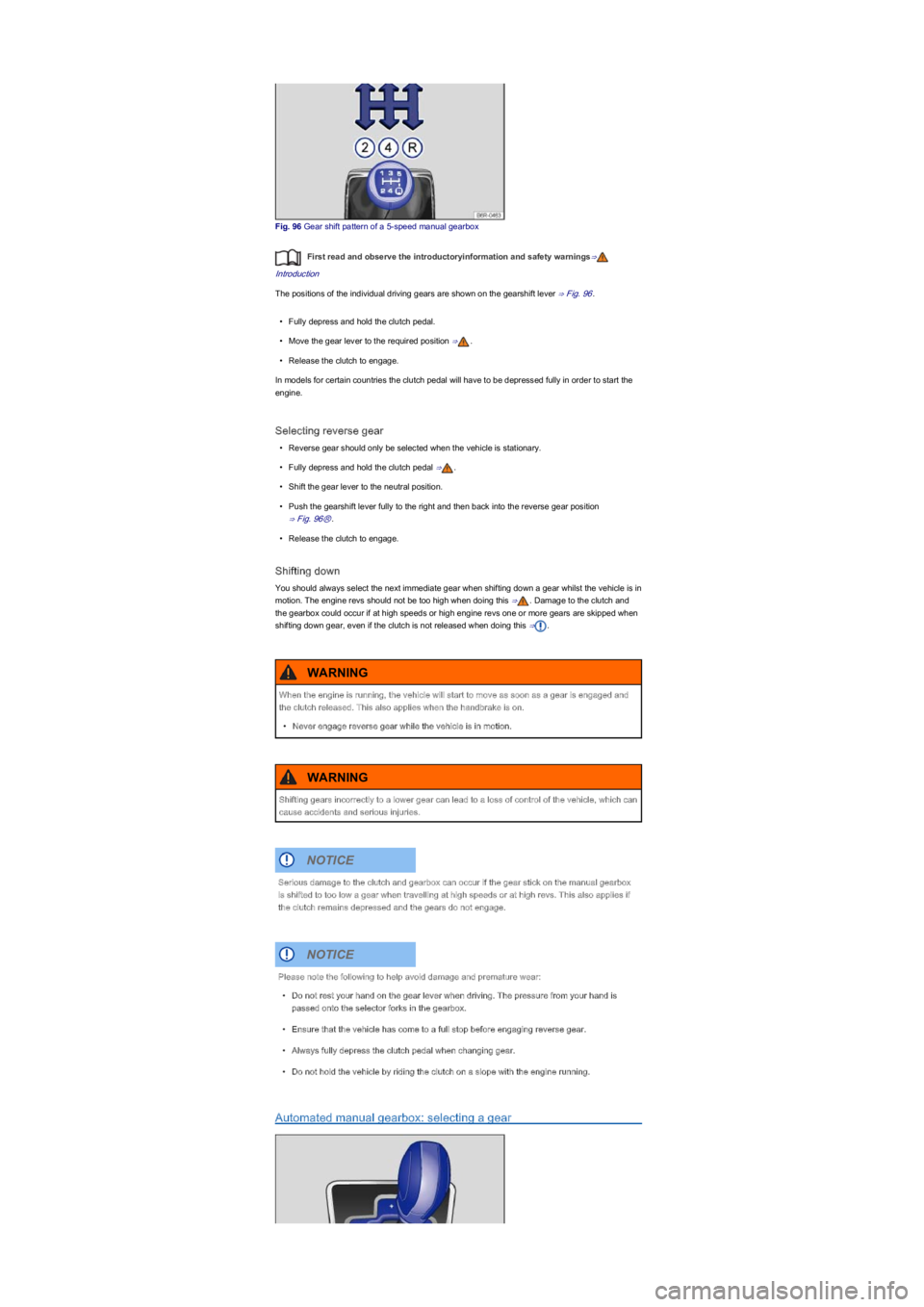
Fig. 96 Gear shift pattern of a 5-speed manual gearbox
First read and observe the introductoryinformation and safety warnings⇒
Introduction
The positions of the individual driving gears are shown on the gearshift lever ⇒ Fig. 96.
•Fully depress and hold the clutch pedal.
•Move the gear lever to the required position ⇒.
•Release the clutch to engage.
In models for certain countries the clutch pedal will have to be depressed fully in order to start the
engine.
Selecting reverse gear
•Reverse gear should only be selected when the vehicle is stationary.
•Fully depress and hold the clutch pedal ⇒.
•Shift the gear lever to the neutral position.
•Push the gearshift lever fully to the right and then back into the reverse gear position
⇒ Fig. 96Ⓡ.
•Release the clutch to engage.
Shifting down
You should always select the next immediate gear when shifting down a gear whilst the vehicle is in
motion. The engine revs should not be too high when doing this ⇒. Damage to the clutch and
the gearbox could occur if at high speeds or high engine revs one or more gears are skipped when
shifting down gear, even if the clutch is not released when doing this ⇒.
Automated manual gearbox: selecting a gear
When the engine is running, the vehicle will start to move as soon as a gear is engaged and
the clutch released. This also applies when the handbrake is on.
•Never engage reverse gear while the vehicle is in motion.
WARNING
Shifting gears incorrectly to a lower gear can lead to a loss of control of the vehicle, which can
cause accidents and serious injuries.
WARNING
Serious damage to the clutch and gearbox can occur if the gear stick on the manual gearbox
is shifted to too low a gear when travelling at high speeds or at high revs. This also applies if
the clutch remains depressed and the gears do not engage.
NOTICE
Please note the following to help avoid damage and premature wear:
•Do not rest your hand on the gear lever when driving. The pressure from your hand is
passed onto the selector forks in the gearbox.
•Ensure that the vehicle has come to a full stop before engaging reverse gear.
•Always fully depress the clutch pedal when changing gear.
•Do not hold the vehicle by riding the clutch on a slope with the engine running.
NOTICE
Page 94 of 211
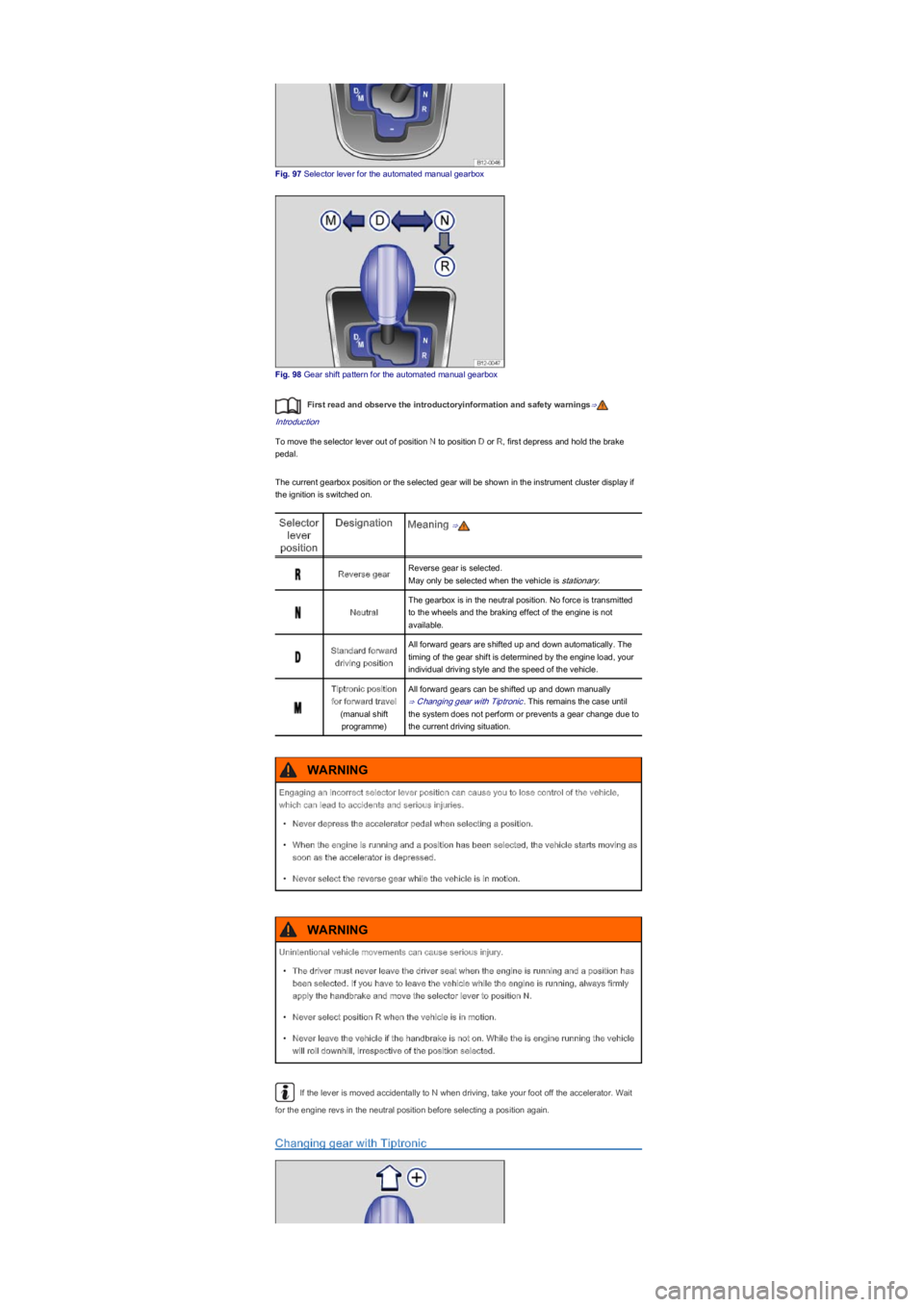
Fig. 97 Selector lever for the automated manual gearbox
Fig. 98 Gear shift pattern for the automated manual gearbox
First read and observe the introductoryinformation and safety warnings⇒
Introduction
To move the selector lever out of position N to position D or R, first depress and hold the brake
pedal.
The current gearbox position or the selected gear will be shown in the instrument cluster display if
the ignition is switched on.
Selector
lever
position
DesignationMeaning ⇒
Reverse gearReverse gear is selected.
May only be selected when the vehicle is stationary.
Neutral
The gearbox is in the neutral position. No force is transmitted
to the wheels and the braking effect of the engine is not
available.
Standard forward
driving position
All forward gears are shifted up and down automatically. The
timing of the gear shift is determined by the engine load, your
individual driving style and the speed of the vehicle.
Tiptronic position
for forward travel
(manual shift
programme)
All forward gears can be shifted up and down manually
⇒ Changing gear with Tiptronic. This remains the case until
the system does not perform or prevents a gear change due to
the current driving situation.
If the lever is moved accidentally to N when driving, take your foot off the accelerator. Wait
for the engine revs in the neutral position before selecting a position again.
Changing gear with Tiptronic
Engaging an incorrect selector lever position can cause you to lose control of the vehicle,
which can lead to accidents and serious injuries.
•Never depress the accelerator pedal when selecting a position.
•When the engine is running and a position has been selected, the vehicle starts moving as
soon as the accelerator is depressed.
•Never select the reverse gear while the vehicle is in motion.
WARNING
Unintentional vehicle movements can cause serious injury.
•The driver must never leave the driver seat when the engine is running and a position has
been selected. If you have to leave the vehicle while the engine is running, always firmly
apply the handbrake and move the selector lever to position N.
•Never select position R when the vehicle is in motion.
•Never leave the vehicle if the handbrake is not on. While the is engine running the vehicle
will roll downhill, irrespective of the position selected.
WARNING
Page 95 of 211
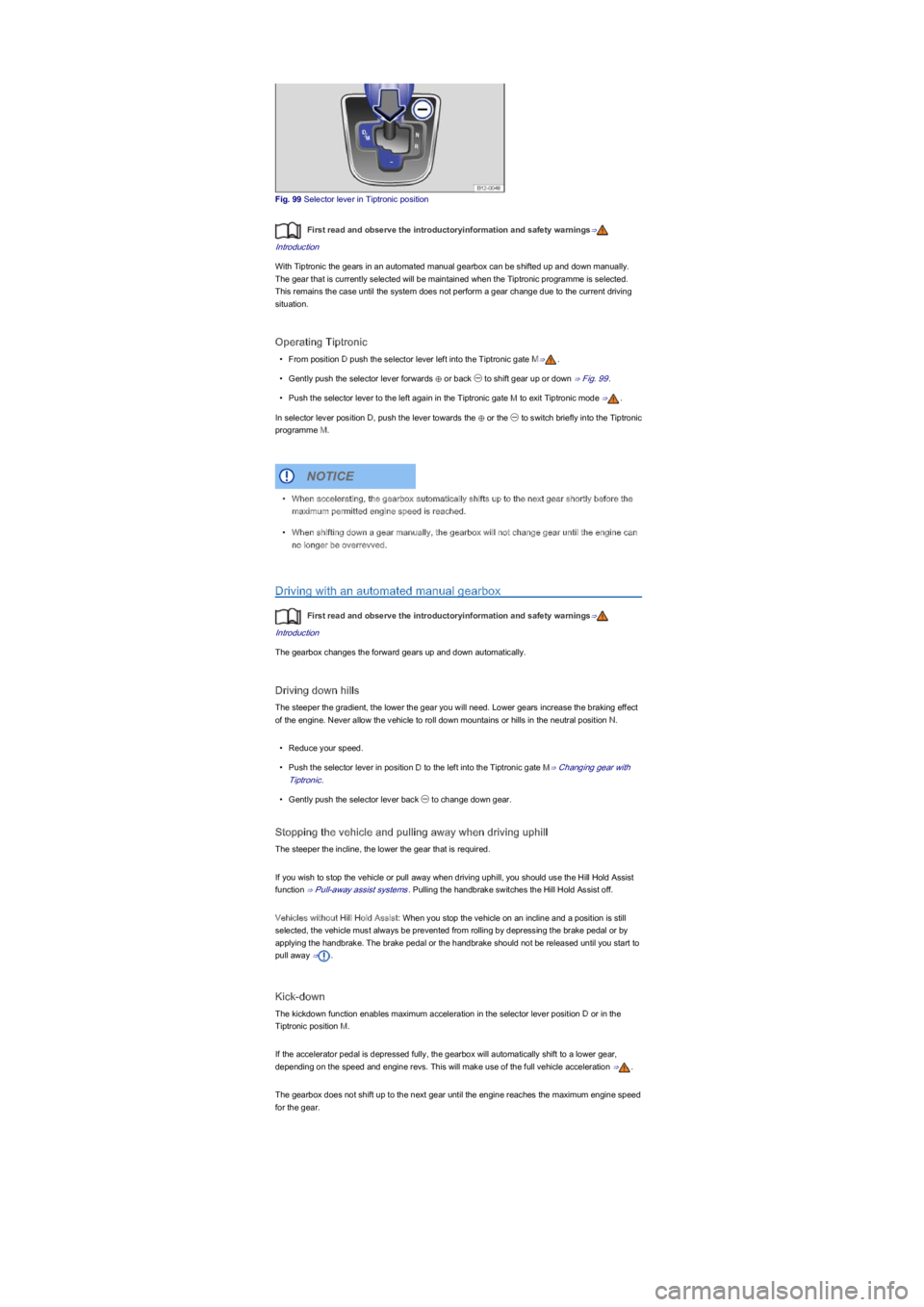
Fig. 99 Selector lever in Tiptronic position
First read and observe the introductoryinformation and safety warnings⇒
Introduction
With Tiptronic the gears in an automated manual gearbox can be shifted up and down manually.
The gear that is currently selected will be maintained when the Tiptronic programme is selected.
This remains the case until the system does not perform a gear change due to the current driving
situation.
Operating Tiptronic
•From position D push the selector lever left into the Tiptronic gate M⇒.
•Gently push the selector lever forwards ⊕ or back ㊀ to shift gear up or down ⇒ Fig. 99.
•Push the selector lever to the left again in the Tiptronic gate M to exit Tiptronic mode ⇒.
In selector lever position D, push the lever towards the ⊕ or the ㊀ to switch briefly into the Tiptronic
programme M.
Driving with an automated manual gearbox
First read and observe the introductoryinformation and safety warnings⇒
Introduction
The gearbox changes the forward gears up and down automatically.
Driving down hills
The steeper the gradient, the lower the gear you will need. Lower gears increase the braking effect
of the engine. Never allow the vehicle to roll down mountains or hills in the neutral position N.
•Reduce your speed.
•Push the selector lever in position D to the left into the Tiptronic gate M⇒ Changing gear with
Tiptronic.
•Gently push the selector lever back ㊀ to change down gear.
Stopping the vehicle and pulling away when driving uphill
The steeper the incline, the lower the gear that is required.
If you wish to stop the vehicle or pull away when driving uphill, you should use the Hill Hold Assist
function ⇒ Pull-away assist systems. Pulling the handbrake switches the Hill Hold Assist off.
Vehicles without Hill Hold Assist: When you stop the vehicle on an incline and a position is still
selected, the vehicle must always be prevented from rolling by depressing the brake pedal or by
applying the handbrake. The brake pedal or the handbrake should not be released until you start to
pull away ⇒.
Kick-down
The kickdown function enables maximum acceleration in the selector lever position D or in the
Tiptronic position M.
If the accelerator pedal is depressed fully, the gearbox will automatically shift to a lower gear,
depending on the speed and engine revs. This will make use of the full vehicle acceleration ⇒.
The gearbox does not shift up to the next gear until the engine reaches the maximum engine speed
for the gear.
•When accelerating, the gearbox automatically shifts up to the next gear shortly before the
maximum permitted engine speed is reached.
•When shifting down a gear manually, the gearbox will not change gear until the engine can
no longer be overrevved.
NOTICE
Page 96 of 211
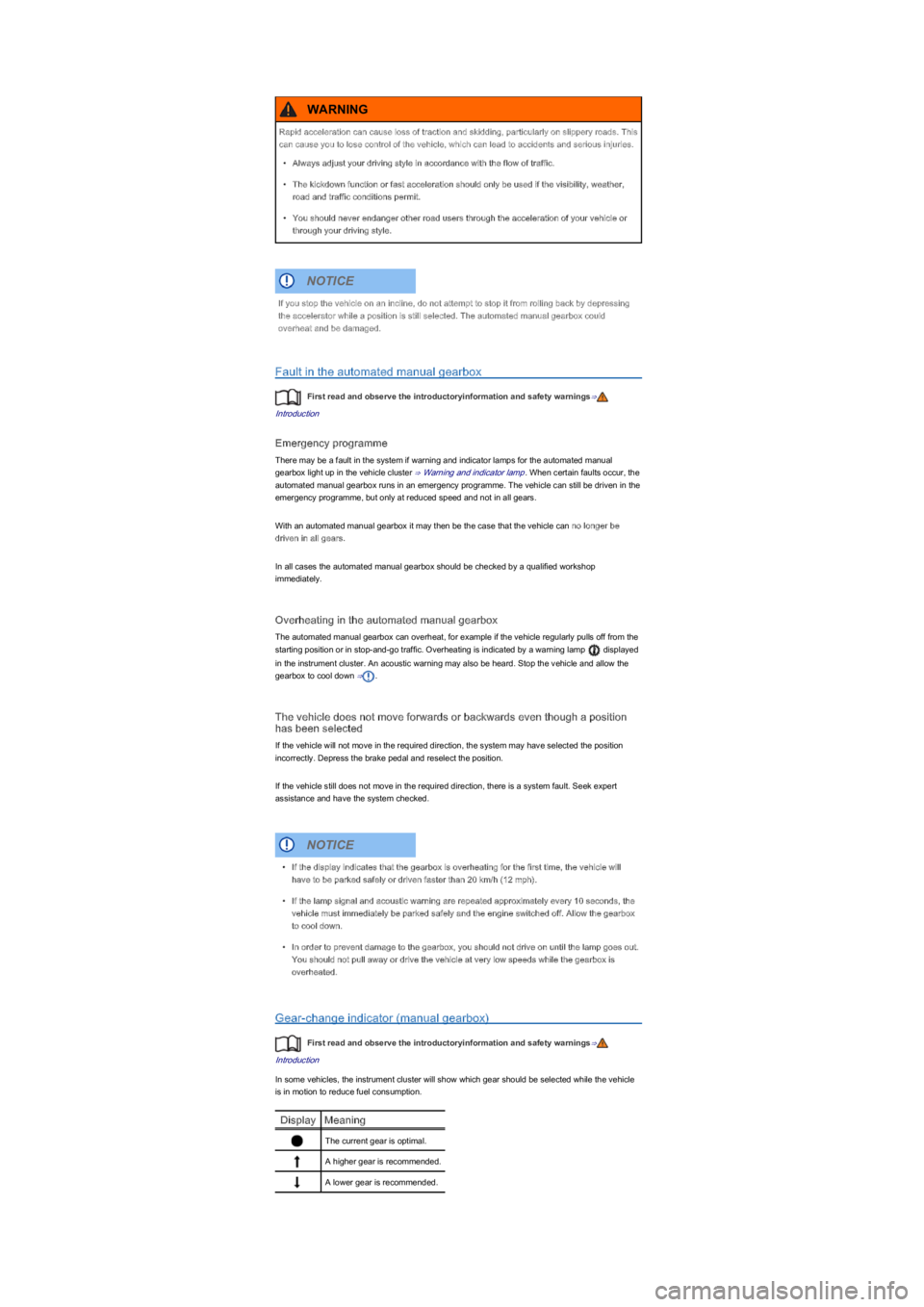
Fault in the automated manual gearbox
First read and observe the introductoryinformation and safety warnings⇒
Introduction
Emergency programme
There may be a fault in the system if warning and indicator lamps for the automated manual
gearbox light up in the vehicle cluster ⇒ Warning and indicator lamp. When certain faults occur, the
automated manual gearbox runs in an emergency programme. The vehicle can still be driven in the
emergency programme, but only at reduced speed and not in all gears.
With an automated manual gearbox it may then be the case that the vehicle can no longer be
driven in all gears.
In all cases the automated manual gearbox should be checked by a qualified workshop
immediately.
Overheating in the automated manual gearbox
The automated manual gearbox can overheat, for example if the vehicle regularly pulls off from the
starting position or in stop-and-go traffic. Overheating is indicated by a warning lamp displayed
in the instrument cluster. An acoustic warning may also be heard. Stop the vehicle and allow the
gearbox to cool down ⇒.
The vehicle does not move forwards or backwards even though a position
has been selected
If the vehicle will not move in the required direction, the system may have selected the position
incorrectly. Depress the brake pedal and reselect the position.
If the vehicle still does not move in the required direction, there is a system fault. Seek expert
assistance and have the system checked.
Gear-change indicator (manual gearbox)
First read and observe the introductoryinformation and safety warnings⇒
Introduction
In some vehicles, the instrument cluster will show which gear should be selected while the vehicle
is in motion to reduce fuel consumption.
DisplayMeaning
The current gear is optimal.
A higher gear is recommended.
A lower gear is recommended.
Rapid acceleration can cause loss of traction and skidding, particularly on slippery roads. This
can cause you to lose control of the vehicle, which can lead to accidents and serious injuries.
•Always adjust your driving style in accordance with the flow of traffic.
•The kickdown function or fast acceleration should only be used if the visibility, weather,
road and traffic conditions permit.
•You should never endanger other road users through the acceleration of your vehicle or
through your driving style.
WARNING
If you stop the vehicle on an incline, do not attempt to stop it from rolling back by depressing
the accelerator while a position is still selected. The automated manual gearbox could
overheat and be damaged.
NOTICE
•If the display indicates that the gearbox is overheating for the first time, the vehicle will
have to be parked safely or driven faster than 20 km/h (12 mph).
•If the lamp signal and acoustic warning are repeated approximately every 10 seconds, the
vehicle must immediately be parked safely and the engine switched off. Allow the gearbox
to cool down.
•In order to prevent damage to the gearbox, you should not drive on until the lamp goes out.
You should not pull away or drive the vehicle at very low speeds while the gearbox is
overheated.
NOTICE
Page 98 of 211
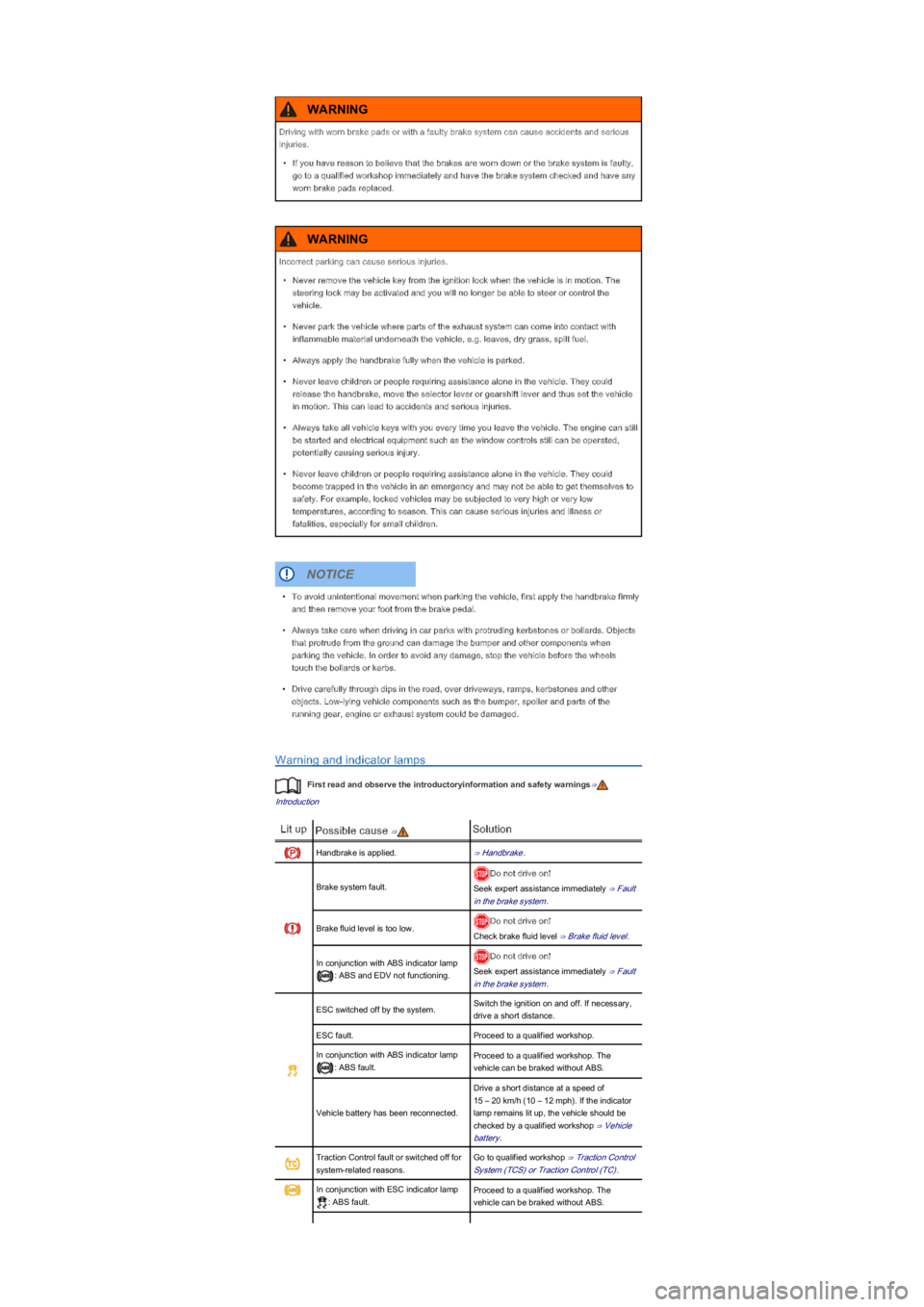
Warning and indicator lamps
First read and observe the introductoryinformation and safety warnings⇒
Introduction
Lit upPossible cause ⇒Solution
Handbrake is applied.⇒ Handbrake.
Brake system fault.
Do not drive on!
Seek expert assistance immediately ⇒ Fault
in the brake system.
Brake fluid level is too low.Do not drive on!
Check brake fluid level ⇒ Brake fluid level.
In conjunction with ABS indicator lamp
: ABS and EDV not functioning.
Do not drive on!
Seek expert assistance immediately ⇒ Fault
in the brake system.
ESC switched off by the system.Switch the ignition on and off. If necessary,
drive a short distance.
ESC fault.Proceed to a qualified workshop.
In conjunction with ABS indicator lamp
: ABS fault.
Proceed to a qualified workshop. The
vehicle can be braked without ABS.
Vehicle battery has been reconnected.
Drive a short distance at a speed of
15 – 20 km/h (10 – 12 mph). If the indicator
lamp remains lit up, the vehicle should be
checked by a qualified workshop ⇒ Vehicle
battery.
Traction Control fault or switched off for
system-related reasons.
Go to qualified workshop ⇒ Traction Control
System (TCS) or Traction Control (TC).
In conjunction with ESC indicator lamp
: ABS fault.
Proceed to a qualified workshop. The
vehicle can be braked without ABS.
Driving with worn brake pads or with a faulty brake system can cause accidents and serious
injuries.
•If you have reason to believe that the brakes are worn down or the brake system is faulty,
go to a qualified workshop immediately and have the brake system checked and have any
worn brake pads replaced.
WARNING
Incorrect parking can cause serious injuries.
•Never remove the vehicle key from the ignition lock when the vehicle is in motion. The
steering lock may be activated and you will no longer be able to steer or control the
vehicle.
•Never park the vehicle where parts of the exhaust system can come into contact with
inflammable material underneath the vehicle, e.g. leaves, dry grass, spilt fuel.
•Always apply the handbrake fully when the vehicle is parked.
•Never leave children or people requiring assistance alone in the vehicle. They could
release the handbrake, move the selector lever or gearshift lever and thus set the vehicle
in motion. This can lead to accidents and serious injuries.
•Always take all vehicle keys with you every time you leave the vehicle. The engine can still
be started and electrical equipment such as the window controls still can be operated,
potentially causing serious injury.
•Never leave children or people requiring assistance alone in the vehicle. They could
become trapped in the vehicle in an emergency and may not be able to get themselves to
safety. For example, locked vehicles may be subjected to very high or very low
temperatures, according to season. This can cause serious injuries and illness or
fatalities, especially for small children.
WARNING
•To avoid unintentional movement when parking the vehicle, first apply the handbrake firmly
and then remove your foot from the brake pedal.
•Always take care when driving in car parks with protruding kerbstones or bollards. Objects
that protrude from the ground can damage the bumper and other components when
parking the vehicle. In order to avoid any damage, stop the vehicle before the wheels
touch the bollards or kerbs.
•Drive carefully through dips in the road, over driveways, ramps, kerbstones and other
objects. Low-lying vehicle components such as the bumper, spoiler and parts of the
running gear, engine or exhaust system could be damaged.
NOTICE
Page 100 of 211
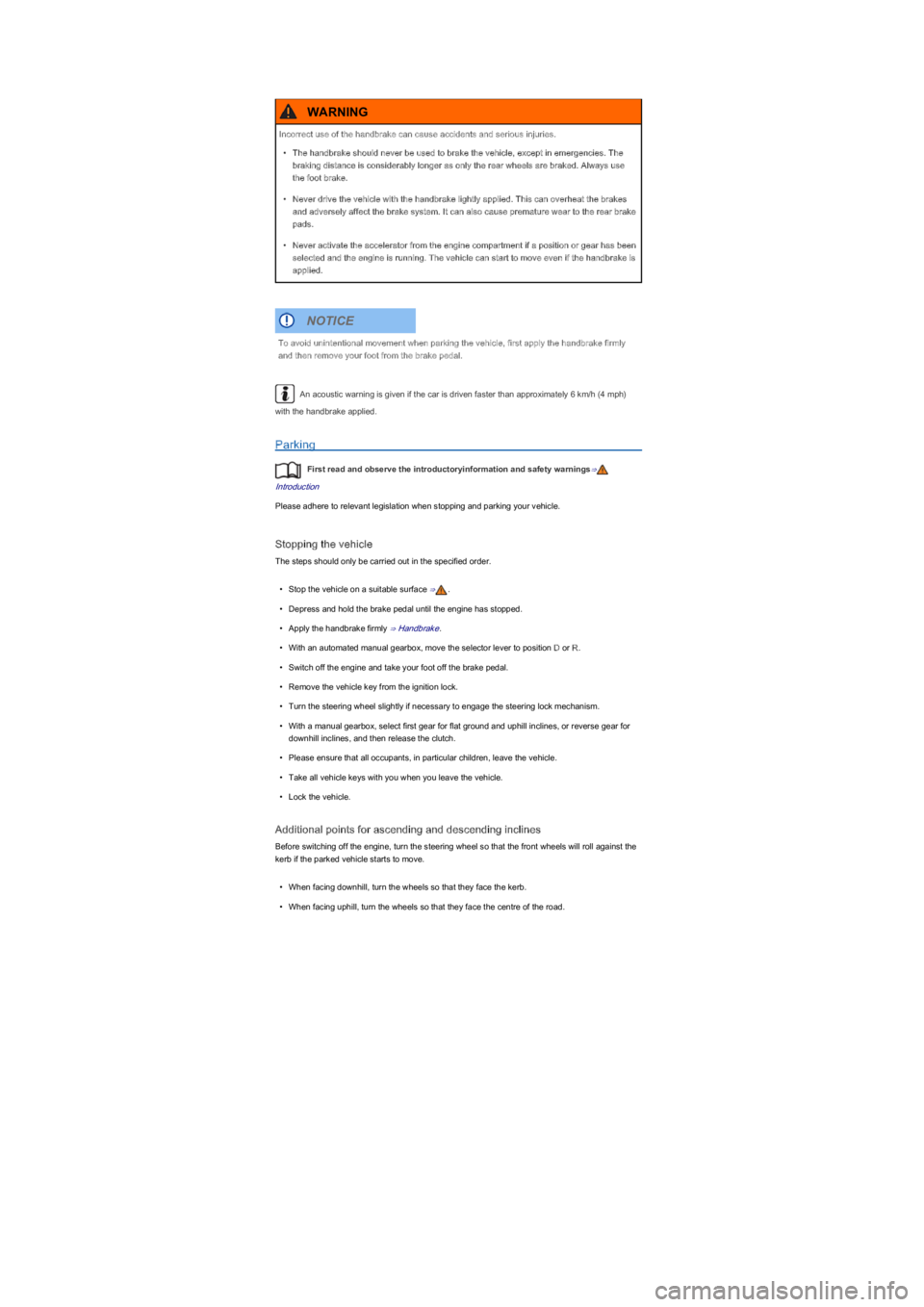
An acoustic warning is given if the car is driven faster than approximately 6 km/h (4 mph)
with the handbrake applied.
Parking
First read and observe the introductoryinformation and safety warnings⇒
Introduction
Please adhere to relevant legislation when stopping and parking your vehicle.
Stopping the vehicle
The steps should only be carried out in the specified order.
•Stop the vehicle on a suitable surface ⇒.
•Depress and hold the brake pedal until the engine has stopped.
•Apply the handbrake firmly ⇒ Handbrake.
•With an automated manual gearbox, move the selector lever to position D or R.
•Switch off the engine and take your foot off the brake pedal.
•Remove the vehicle key from the ignition lock.
•Turn the steering wheel slightly if necessary to engage the steering lock mechanism.
•With a manual gearbox, select first gear for flat ground and uphill inclines, or reverse gear for
downhill inclines, and then release the clutch.
•Please ensure that all occupants, in particular children, leave the vehicle.
•Take all vehicle keys with you when you leave the vehicle.
•Lock the vehicle.
Additional points for ascending and descending inclines
Before switching off the engine, turn the steering wheel so that the front wheels will roll against the
kerb if the parked vehicle starts to move.
•When facing downhill, turn the wheels so that they face the kerb.
•When facing uphill, turn the wheels so that they face the centre of the road.
Incorrect use of the handbrake can cause accidents and serious injuries.
•The handbrake should never be used to brake the vehicle, except in emergencies. The
braking distance is considerably longer as only the rear wheels are braked. Always use
the foot brake.
•Never drive the vehicle with the handbrake lightly applied. This can overheat the brakes
and adversely affect the brake system. It can also cause premature wear to the rear brake
pads.
•Never activate the accelerator from the engine compartment if a position or gear has been
selected and the engine is running. The vehicle can start to move even if the handbrake is
applied.
WARNING
To avoid unintentional movement when parking the vehicle, first apply the handbrake firmly
and then remove your foot from the brake pedal.
NOTICE
Page 101 of 211
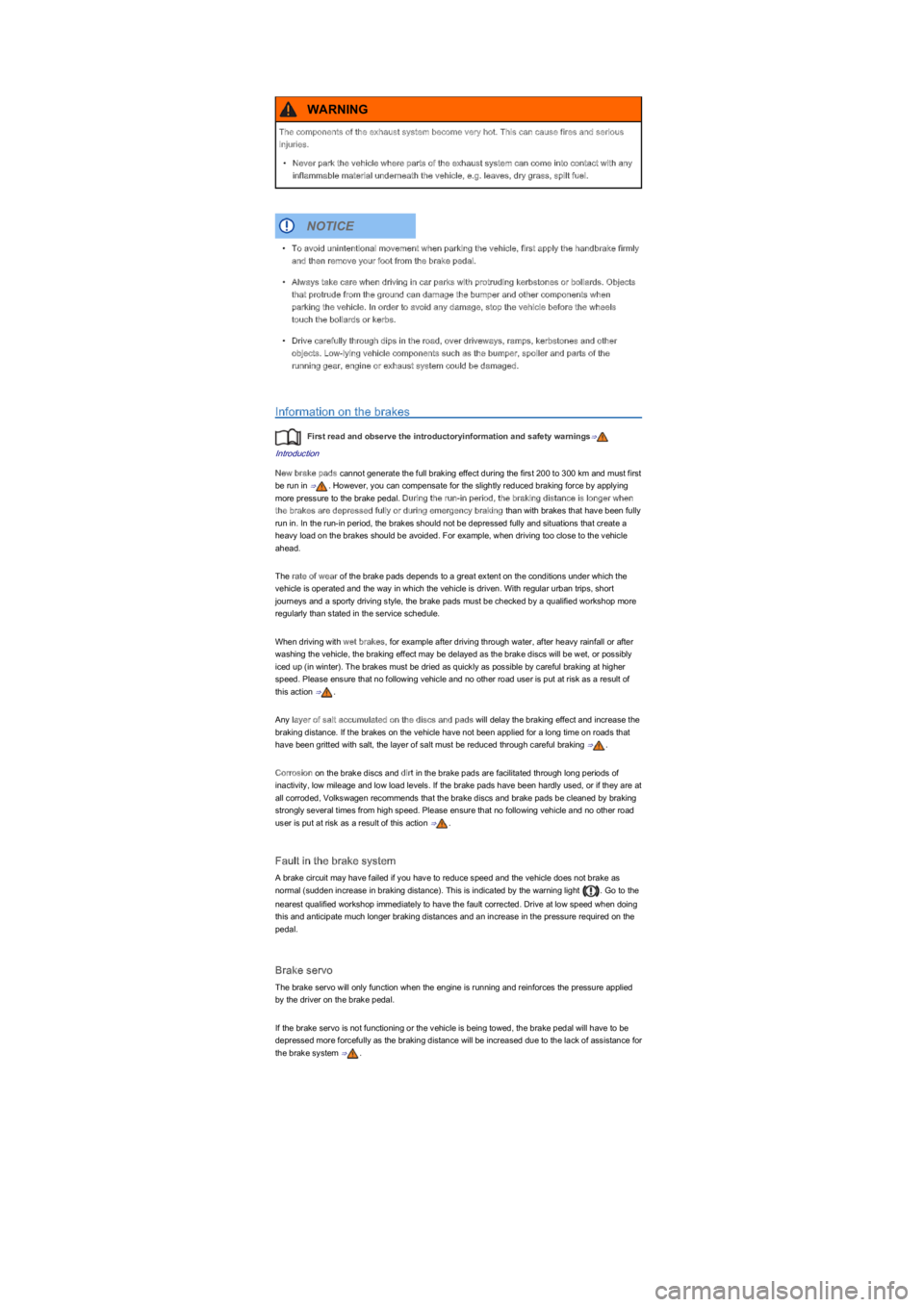
Information on the brakes
First read and observe the introductoryinformation and safety warnings⇒
Introduction
New brake pads cannot generate the full braking effect during the first 200 to 300 km and must first
be run in ⇒. However, you can compensate for the slightly reduced braking force by applying
more pressure to the brake pedal. During the run-in period, the braking distance is longer when
the brakes are depressed fully or during emergency braking than with brakes that have been fully
run in. In the run-in period, the brakes should not be depressed fully and situations that create a
heavy load on the brakes should be avoided. For example, when driving too close to the vehicle
ahead.
The rate of wear of the brake pads depends to a great extent on the conditions under which the
vehicle is operated and the way in which the vehicle is driven. With regular urban trips, short
journeys and a sporty driving style, the brake pads must be checked by a qualified workshop more
regularly than stated in the service schedule.
When driving with wet brakes, for example after driving through water, after heavy rainfall or after
washing the vehicle, the braking effect may be delayed as the brake discs will be wet, or possibly
iced up (in winter). The brakes must be dried as quickly as possible by careful braking at higher
speed. Please ensure that no following vehicle and no other road user is put at risk as a result of
this action ⇒.
Any layer of salt accumulated on the discs and pads will delay the braking effect and increase the
braking distance. If the brakes on the vehicle have not been applied for a long time on roads that
have been gritted with salt, the layer of salt must be reduced through careful braking ⇒.
Corrosion on the brake discs and dirt in the brake pads are facilitated through long periods of
inactivity, low mileage and low load levels. If the brake pads have been hardly used, or if they are at
all corroded, Volkswagen recommends that the brake discs and brake pads be cleaned by braking
strongly several times from high speed. Please ensure that no following vehicle and no other road
user is put at risk as a result of this action ⇒.
Fault in the brake system
A brake circuit may have failed if you have to reduce speed and the vehicle does not brake as
normal (sudden increase in braking distance). This is indicated by the warning light . Go to the
nearest qualified workshop immediately to have the fault corrected. Drive at low speed when doing
this and anticipate much longer braking distances and an increase in the pressure required on the
pedal.
Brake servo
The brake servo will only function when the engine is running and reinforces the pressure applied
by the driver on the brake pedal.
If the brake servo is not functioning or the vehicle is being towed, the brake pedal will have to be
depressed more forcefully as the braking distance will be increased due to the lack of assistance for
the brake system ⇒.
The components of the exhaust system become very hot. This can cause fires and serious
injuries.
•Never park the vehicle where parts of the exhaust system can come into contact with any
inflammable material underneath the vehicle, e.g. leaves, dry grass, spilt fuel.
WARNING
•To avoid unintentional movement when parking the vehicle, first apply the handbrake firmly
and then remove your foot from the brake pedal.
•Always take care when driving in car parks with protruding kerbstones or bollards. Objects
that protrude from the ground can damage the bumper and other components when
parking the vehicle. In order to avoid any damage, stop the vehicle before the wheels
touch the bollards or kerbs.
•Drive carefully through dips in the road, over driveways, ramps, kerbstones and other
objects. Low-lying vehicle components such as the bumper, spoiler and parts of the
running gear, engine or exhaust system could be damaged.
NOTICE
Page 102 of 211
If the front brake pads are tested, the rear brake pads should be tested at the same time.
Regularly check the thickness of the brake pads through the openings in the rims or from the
underside of the vehicle. If necessary, remove the wheels to carry out a comprehensive check.
Volkswagen recommends using a Volkswagen dealership for this purpose.
Brake assist systems
First read and observe the introductoryinformation and safety warnings⇒
Introduction
The brake assist systems ESC, ABS, EBV, BAS, TCS, TC and EDL will only function when the
engine is running. They make a considerable contribution to active driving safety.
Electronic stability control (ESC)
The ESC helps to reduce the risk of skidding and to improve driving stability by braking individual
wheels in certain driving situations. The ESC detects critical driving situations such as oversteer,
understeer and wheelspin. The system supports the stabilisation process for the vehicle by targeted
braking or by reducing engine torque.
ESC has its limitations. It is important to realise that ESC cannot overcome the laws of physics.
ESC will not be able to assist in every situation faced by a driver. For example, ESC will not be able
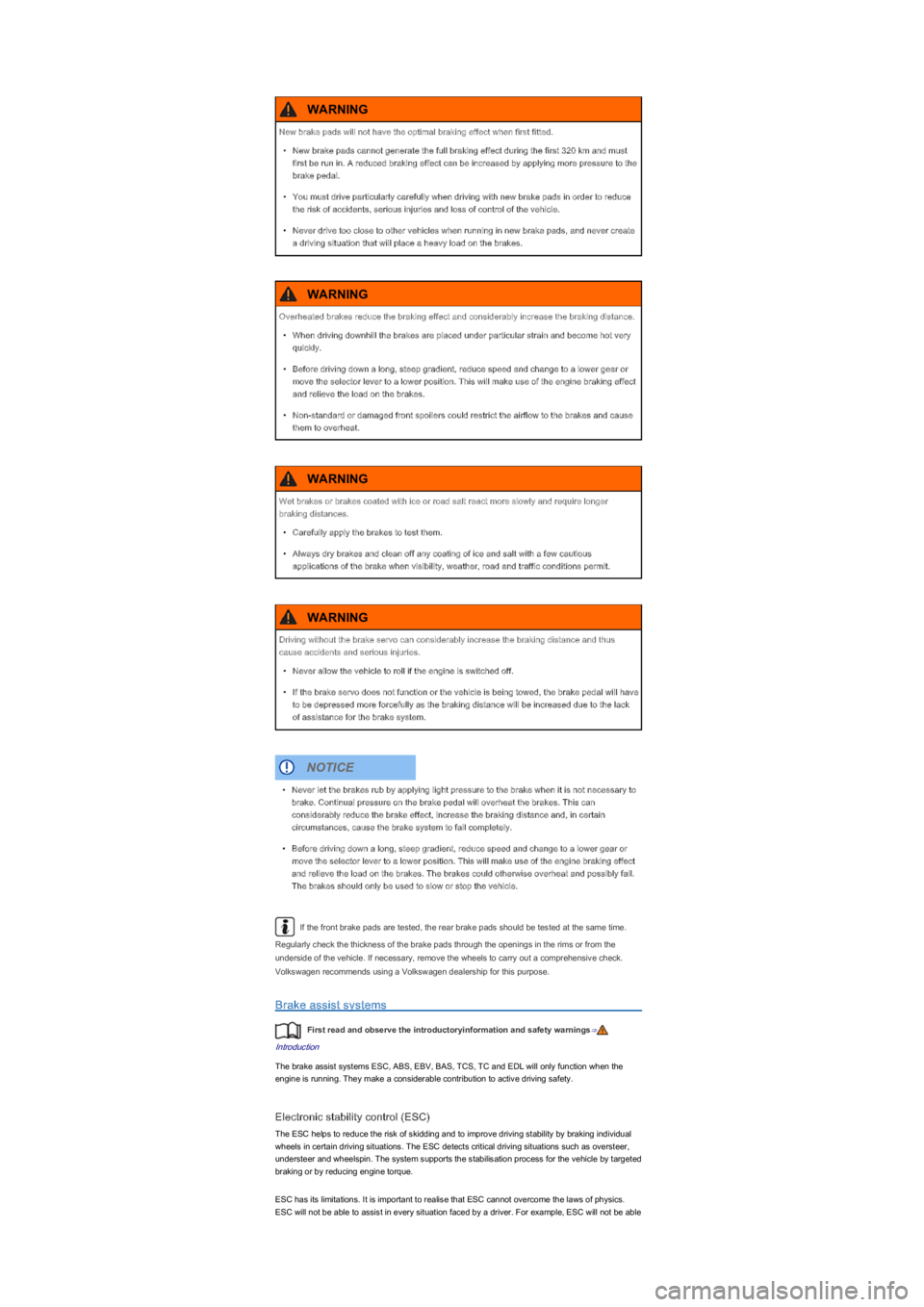
New brake pads will not have the optimal braking effect when first fitted.
•New brake pads cannot generate the full braking effect during the first 320 km and must
first be run in. A reduced braking effect can be increased by applying more pressure to the
brake pedal.
•You must drive particularly carefully when driving with new brake pads in order to reduce
the risk of accidents, serious injuries and loss of control of the vehicle.
•Never drive too close to other vehicles when running in new brake pads, and never create
a driving situation that will place a heavy load on the brakes.
WARNING
Overheated brakes reduce the braking effect and considerably increase the braking distance.
•When driving downhill the brakes are placed under particular strain and become hot very
quickly.
•Before driving down a long, steep gradient, reduce speed and change to a lower gear or
move the selector lever to a lower position. This will make use of the engine braking effect
and relieve the load on the brakes.
•Non-standard or damaged front spoilers could restrict the airflow to the brakes and cause
them to overheat.
WARNING
Wet brakes or brakes coated with ice or road salt react more slowly and require longer
braking distances.
•Carefully apply the brakes to test them.
•Always dry brakes and clean off any coating of ice and salt with a few cautious
applications of the brake when visibility, weather, road and traffic conditions permit.
WARNING
Driving without the brake servo can considerably increase the braking distance and thus
cause accidents and serious injuries.
•Never allow the vehicle to roll if the engine is switched off.
•If the brake servo does not function or the vehicle is being towed, the brake pedal will have
to be depressed more forcefully as the braking distance will be increased due to the lack
of assistance for the brake system.
WARNING
•Never let the brakes rub by applying light pressure to the brake when it is not necessary to
brake. Continual pressure on the brake pedal will overheat the brakes. This can
considerably reduce the brake effect, increase the braking distance and, in certain
circumstances, cause the brake system to fail completely.
•Before driving down a long, steep gradient, reduce speed and change to a lower gear or
move the selector lever to a lower position. This will make use of the engine braking effect
and relieve the load on the brakes. The brakes could otherwise overheat and possibly fail.
The brakes should only be used to slow or stop the vehicle.
NOTICE
Page 103 of 211
to assist every time that there is a sudden change in the road surface quality. If a section of dry
road is suddenly covered with water, mud or snow, ESC will not be able to assist in the same
manner as on a dry road. If the vehicle aquaplanes (drives on a layer of water rather than on the
road surface), ESC will not be able to assist in steering the vehicle as the contact to the road
surface has been interrupted and it is therefore no longer possible to steer or brake the vehicle.
Always adapt your speed and driving style to suit visibility, weather, road and traffic conditions. ESC
cannot defy the laws of motion, improve the available power output, or keep the vehicle on the road
if insufficient care and attention on the part of the driver causes the vehicle to leave the road.
Instead, ESC increases the possibility of keeping the vehicle under control and, in extreme on-road
driving situations, it assesses the driver’s steering input and helps the vehicle to continue in the
required direction. If the vehicle is driving at a speed that leads it to leave the road before the ESC
can provide any kind of support, the ESC will be unable to provide any assistance.
The ABS, BAS, TCS and EDL systems are integrated into the ESC. The ESC is always on.
Anti-lock brake system (ABS)
The ABS prevents the wheels from locking when the brakes are applied up until the point where the
vehicle is nearly stationary and assists the driver in steering the vehicle and keeping it under
control. This means that the vehicle is less likely to spin, even when the brakes are depressed fully:
•Depress and hold the brake pedal with force. Do not take your foot off the brake pedal or
reduce the force on the brake pedal!
•Do not pump the brake pedal or reduce the pressure on the brake pedal!
•Steer the vehicle while the brake pedal is fully depressed.
•The ABS will switch off when the brake pedal is released or if the pressure on the brake pedal is
reduced.
If the ABS is taking corrective action, there is a pulsing movement in the brake pedal and some
noise. However, ABS will not necessarily guarantee shorter braking distances in all conditions. The
braking distance could even be longer when braking on gravel or on fresh snow covering an icy or
slippery surface.
Electronic brake pressure distribution system (EBD)
Every vehicle's centre of gravity moves forwards whenever the brake is operated. This means that
the rear wheels are in danger of locking due to the lower traction. The electronic brake pressure
distribution system controls the brake pressure for the rear wheels and thereby ensures the
optimum distribution of brake pressure between the front and rear axles. Under normal conditions,
the system will prevent the rear from breaking away if too much brake pressure if applied to the rear
wheels. The electronic brake pressure distribution system is included in the ABS' scope of
functions.
Brake Assist system (BAS)
The brake assist system can help to reduce the braking distance. The brake assist system
reinforces brake pressure hydraulically when the driver depresses the brake pedal quickly in an
emergency situation. As a result, full braking power is made accessible very quickly, brake pressure
is increased and the braking distance reduced. In this way, the ABS is activated more quickly and
more effectively.
Do not reduce the pressure on the brake pedal. The brake assist system will switch off the
hydraulic brake servo automatically when the brake pedal is released or if the pressure on the
brake pedal is reduced.
Traction Control System (TCS) or Traction Control (TC)
The TCS or TC reduces the engine output if wheelspin occurs and adapts the output to suit road
surface conditions. TCS or TC helps the car to start moving, accelerate and climb gradients in
unfavourable road conditions.
Electronic differential lock (EDL)
The EDL is available for normal driving on straight roads. EDL brakes the wheel that has lost
traction and distributes the driving force to the other drive wheel. To prevent the disc brake of the
braked wheel from overheating, the EDL cuts out automatically if subjected to excessive loads. The
EDL will switch on again automatically when the brake has cooled down.