oil VOLKSWAGEN UP! 2021 Owner´s Manual
[x] Cancel search | Manufacturer: VOLKSWAGEN, Model Year: 2021, Model line: UP!, Model: VOLKSWAGEN UP! 2021Pages: 211, PDF Size: 5.98 MB
Page 159 of 211
The tyres and wheel rims are an essential part of the vehicle's design. The tyres and rims approved
by Volkswagen are specifically matched to the characteristics of the vehicle and make a major
contribution to good road holding and safe handling.
Avoiding damage to the tyres
•If you have to drive over a kerb or similar obstacle, drive slowly and at a right angle if possible.
•Inspect the tyres regularly for damage such as cuts, cracks or blisters.
•Remove foreign objects that are in the outer tyre tread and have not penetrated the inner
tyre⇒ Tyre damage.
•Always respond to any warning messages given by the tyre monitoring system.
•Damaged or worn tyres must be replaced immediately ⇒ Tyre damage.
•Regularly check the tyres for hidden damage ⇒ Tyre damage.
•Never exceed the top speed and load permitted for the tyres that are fitted ⇒ Tyre lettering.
•Protect the wheels, including the spare wheel, from contact with corrosive substances, including
oils, lubricants, fuel and brake fluid ⇒.
•Replace missing dust caps immediately.
Tyres with directional tread pattern
Tyres with directional tread pattern have been developed to roll in one direction only. An arrow on
the tyre sidewall indicates the direction of rotation on tyres with directional tread ⇒ Tyre lettering.
The direction of rotation must be adhered to. This is the only guarantee for optimum grip and helps
to avoid aquaplaning, excessive noise and wear.
If, however, the tyre is fitted in the opposite direction to the tread pattern, you must take more care
when driving as the tyre is now no longer being used according to its designation. This is
particularly important on wet roads. The tyres must be replaced as quickly as possible or be fitted
with the tread in the correct direction.
Rotating wheels front to rear
Regularly rotating the wheels as shown in the illustration ⇒ Fig. 130 is recommended to help
ensure that tyres wear evenly. All the tyres will then last for about the same time.
Volkswagen recommends having the wheels changed by a qualified workshop.
Tyres that are older than 6 years
Tyres age through physical and chemical processes that can impair their function. Tyres that are
stored unused for an extended period will harden and become brittle more quickly than tyres which
are in constant use.
Volkswagen recommends replacing tyres that are older than 6 years with new tyres. This also
applies to tyres, including the spare wheel, which appear to still be in good condition and whose
tread depth has not yet reached the minimum value stipulated by legislation ⇒.
The age of a tyre can be determined from the manufacturing date, which is a component of the tyre
identification number () ⇒ Tyre lettering.
Storing tyres
Mark tyres before you remove them to indicate the direction of rotation. This ensures you will be
able to mount them correctly when you replace them (left, right, front, rear). When removed, the
wheels or tyres should be stored in a cool, dry and preferably dark place. Do not store tyres
mounted on the rim vertically.
Any tyres not fitted on rims should be kept in suitable sleeves to protect against dirt and should be
stored vertically (standing on the tread).
Old tyres should be disposed of as required by legislation.
Corrosive liquids and other substances can cause visible and invisible damage to the tyres,
which can cause the tyre to burst.
•Always keep chemicals, oils, lubricants, fuel, brake fluid and other corrosive substances
away from the tyres.
WARNING
Old tyres – even if they have not been used – can suddenly lose pressure or burst, especially
at high speeds, and thus cause accidents and serious injuries.
•Avoid using tyres that are more than six years old. If you have no alternative, drive slowly
and with extra care at all times.
WARNING
Page 168 of 211
Snow chains are available in a range of sizes for a vehicle type.
Accessories, modifications, repairs and renewal of
parts
Introduction
This chapter contains information on the followingsubjects:
⇒ Running-in
⇒ Accessories and parts
⇒ Service fluids and consumables
⇒ Repairs and technical modifications
⇒ Repairs and faults in the airbag system
⇒ Retrofitting two-way radios
⇒ Information stored in the control units
⇒ Using a mobile telephone in the vehicle without a connection to the external aerial
⇒ Portable navigation device
⇒ Vehicle lifting points
Additional information and warnings:
•Seat belts ⇒ Seat belts
•Airbag system ⇒ Airbag system
•Roof carrier ⇒ Roof carrier
•Ashtray and cigarette lighter ⇒ Ashtray and cigarette lighter
•Electrical socket ⇒ Socket
•Braking, stopping and parking ⇒ Braking, stopping and parking
•Pull-away assist systems ⇒ Pull-away assist systems
•ParkPilot ⇒ ParkPilot
•Cruise Control System (CCS) ⇒ Cruise control system (CCS)
•Preparation for working in the engine compartment ⇒ Preparation for working in the engine
compartment
•Engine oil ⇒ Engine oil
•Engine coolant ⇒ Coolant
•Battery ⇒ Vehicle battery
•Cleaning and caring for the vehicle exterior ⇒ Caring for and cleaning the vehicle exterior
•Cleaning and caring for the interior ⇒ Cleaning and caring for the interior
•Consumer information ⇒ Consumer information
•⇒BookletRadio,
•User's manual for the portable navigation device (delivered by Volkswagen)
The use of snow chains that are unsuitable for your vehicle or the incorrect installation of
snow chains can cause accidents and serious injuries.
•Always use the correct snow chains.
•Follow the assembly instructions provided by the snow chain manufacturer.
•Never exceed the maximum speed permitted for the snow chains that are fitted.
WARNING
•Remove the snow chains when driving on roads that are free of snow. The snow chains will
otherwise impair handling, damage the tyres and wear out very quickly.
•Snow chains that are in direct contact with the wheel can scratch or damage it.
Volkswagen recommends using non-scratch snow chains.
NOTICE
Page 169 of 211
Running-in
First read and observe the introductoryinformation and safety warnings⇒
Introduction
Please follow the regulations concerning running-in new parts.
Running in a new engine
Any new engine has to be run in during the first 1,500 kilometres. During its first few hours of
running, the internal friction in the engine is greater than later on when all the moving parts have
bedded down.
The style of driving during the first 1,500 kilometres will also affect the engine quality. Even after
this time – and especially with a cold engine – drive the vehicle at moderate speeds in order to
reduce engine wear and to increase the mileage that the engine can cover. Do not drive at engine
speeds that are too low. Always shift down gear if the engine is not running smoothly. The
following applies up to 1,000 kilometres:
•Do not depress the accelerator fully.
•Do not drive the vehicle at more than 2/3 of the top engine speed.
From 1,000 to 1,500 kilometres, gradually increase driving performance to top speed and highest
engine speed.
Running in new tyres and brake pads
•New wheels and tyres ⇒ Wheels and tyres
•Information on the brakes ⇒ Braking, stopping and parking
If the engine is run in gently, the life of the engine will be increased and its oil consumption
reduced.
Accessories and parts
First read and observe the introductoryinformation and safety warnings⇒
Introduction
Volkswagen recommends that you seek advice from a Volkswagen dealership before purchasing
accessories, spare parts or service fluids. For example, if the vehicle is to be retrofitted with
accessories or if parts have to be renewed. Volkswagen dealerships can recommend accessories,
parts and service fluids suitable for your requirements. They can also answer any questions you
might have regarding official regulations.
Volkswagen recommends that you only use approved Volkswagen accessories and Volkswagen
Genuine Parts. These parts and accessories have been specially tested by Volkswagen for
suitability, reliability and safety. And Volkswagen dealerships are qualified to install them correctly.
Although the market is constantly scrutinised, Volkswagen cannot assume responsibility for the
reliability, safety and suitability of products Volkswagen has not approved. Volkswagen can
therefore assume no responsibility for these parts, even if they have been approved by an official
testing agency or are covered by an official approval certificate.
Any retro-fitted equipment that has a direct effect on the vehicle and/or the way it is driven must be
approved by Volkswagen for use in your vehicle and bear the e mark (the European Union's
authorization symbol). These devices include cruise control systems or an electronically controlled
suspension.
Any additional electrical components fitted that do not serve to control the vehicle itself must bear
the mark (manufacturer conformity declaration in the European Union). Such devices include
refrigerator boxes, laptops and ventilator fans.
Unsuitable spare parts and accessories, incorrectly carried out work, modifications and
repairs can lead to damage to the vehicle and cause accidents and serious injuries.
•Volkswagen strongly recommends that you only use approved Volkswagen accessories
and Volkswagen Genuine Parts. These parts and accessories have been specially tested
by Volkswagen for suitability, reliability and safety.
•Repairs and modifications to your vehicle should only be carried out by a qualified
workshop. Qualified workshops have the necessary tools, diagnostic equipment, repair
information and qualified personnel.
•Never fit parts to your vehicle that are in any way different from the factory-fitted parts.
•Never secure or mount objects such as drink holders or telephone holders on or next to
the airbag covers or within the deployment zone of the airbag.
•Only use rim/tyre combinations that have been approved by Volkswagen for your vehicle
type.
WARNING
®
®
Page 170 of 211
Service fluids and consumables
First read and observe the introductoryinformation and safety warnings⇒
Introduction
All service fluids and consumables, e.g. toothed belts, tyres, coolant, engine oil, spark plugs and
vehicle batteries, are being constantly developed. For this reason, service fluids and consumables
should be replaced at a qualified workshop. A Volkswagen dealership is always kept up to date on
innovations.
Leaking service fluids can pollute the environment. Spilt service fluids must be collected in
suitable containers and disposed of properly and with respect for the environment.
Repairs and technical modifications
First read and observe the introductoryinformation and safety warnings⇒
Introduction
Repairs and modifications must always be carried out according to Volkswagen specifications⇒
.
Unauthorised modifications to the electronic components or software in the vehicle may cause
faults. As the electronic components are linked together in networks, these faults may indirectly
affect the working of other systems. This can seriously impair safety, lead to excessive wear of
components, and also invalidate the type approval for the vehicle.
The Volkswagen dealership cannot be held liable for any damage caused by technical
modifications and/or work performed incorrectly.
The Volkswagen dealership cannot be held liable for any damage caused by technical
modifications and/or work performed incorrectly, nor are these covered by the Volkswagen
guarantee.
Volkswagen recommends that all repairs and technical modifications are performed by an
authorised Volkswagen dealership using Volkswagen Genuine Parts.
Vehicles with special auxiliary equipment or body parts
The manufacturer of these components must ensure that these parts (fittings) adhere to the
stipulated environmental laws and regulations, particularly the EU directive 2000/53/EC concerning
end-of-life vehicles and EU directive 2003/11/EC concerning the restriction on the marketing and
use of certain dangerous substances and preparations.
Incorrectly performed repairs or modifications to your vehicle can impair the effectiveness of
the airbags, cause faults, accidents and fatal injury.
•Never secure or mount objects such as drink holders or telephone holders either on or
next to the airbag covers or within the deployment zones of the airbag modules.
•Objects either on or next to the airbag module covers or are in the deployment zone of the
airbags can cause serious or even fatal injuries should the airbags be activated.
WARNING
Unsuitable service fluids and consumables, and the incorrect use of these fluids and
consumables, can cause accidents, serious injuries, burns or poisoning.
•Service fluids must be kept in their original sealed container.
•Never store service fluids in empty food containers, bottles or any other non-original
containers as people finding these containers could drink them.
•Keep children away from all service fluids and consumables.
•Always read and follow the information and warnings on the service fluid packaging.
•When using products that give off harmful fumes, always work outdoors or in a well-
ventilated area.
•Never use fuel, turpentine, engine oil, nail varnish remover or other volatile fluids for
vehicle care. They are toxic and highly flammable. They could cause fires and explosions.
WARNING
•Only use suitable service fluids for refilling. Never use the wrong service fluid. Failure to
observe this warning can result in serious malfunctions and engine damage.
•Optional equipment and other accessories in front of the air inlet reduce the cooling effect
of the coolant. The engine may overheat at high ambient temperatures and high engine
loads.
NOTICE
®
Page 177 of 211
There are many precautions that have to be followed when lifting a vehicle on a workshop hoist or
floor jack. Do not try to lift a vehicle on a lifting platform or vehicle jack unless you have the training,
knowledge and experience to be able to do so safely.
Using the jack to lift the vehicle ⇒ Changing a wheel.
Consumer information
Introduction
This chapter contains information on the followingsubjects:
⇒ Information stickers and plates
⇒ Using the vehicle in other countries and continents
⇒ Radio reception and aerials
⇒ Volkswagen repair information
⇒ Declaration of conformity
⇒ Declaration of conformity for wheels and tyres
⇒ Recycling and scrapping end-of-life vehicles
Additional information and warnings:
•Exterior views ⇒ Exterior views
•Pull-away assist systems ⇒ Pull-away assist systems
•Accessories, modifications, repairs and renewal of parts ⇒ Accessories, modifications, repairs
and renewal of parts
•⇒BookletService schedule,
Lifting your vehicle incorrectly with a lifting platform or vehicle jack can cause accidents and
serious personal injury:
•Always read and heed the operating instructions from the lifting platform or vehicle jack
manufacturer and any legal regulations before lifting the vehicle.
•All occupants should leave the vehicle before it is lifted.
•The vehicle should only be lifted at the points indicated in the illustrations ⇒ Fig. 137 and
⇒ Fig. 138. If the vehicle is not lifted at the points shown, it could fall off the lifting platform
when work is carried out, e.g. when the engine or gearbox is removed.
•The vehicle jacking points must be placed on the centre of the vehicle lift support surfaces,
with as much surface contact between the vehicle and the support surfaces as possible.
•Never start the engine when the vehicle is raised. The vibration of the engine could cause
the vehicle to fall off the lifting point.
•If work has to be carried out underneath the lifted vehicle, secure the vehicle with suitable
jack stands with a sufficient load-bearing capacity.
•Never climb up the lifting platform.
•Always ensure that the vehicle is not heavier than the lifting capacity of the lifting platform.
WARNING
•Never lift the vehicle by the engine oil sump, the gearbox or the front or rear axle.
•To prevent damage to the underside of the vehicle when lifting, rubber pads must be used.
Ensure that the lifting platform arms are able to move freely.
•The lifting platform arms must not be allowed to come into contact with the sills or any
other part of the vehicle.
NOTICE
Handling the vehicle incorrectly will increase the risk of accident and injuries.
•Comply with legal regulations.
•Observe the owner's manual.
WARNING
Handling the vehicle incorrectly could lead to the vehicle becoming damaged.
•Comply with legal regulations.
•Carry out service jobs in accordance with the service schedule.
•Observe the owner's manual.
NOTICE
Page 180 of 211
⇒ Catalytic converter
Additional information and warnings:
•Changing gear ⇒ Changing gear
•Filling the tank ⇒ Filling the tank
•Fuel ⇒ Fuel
•Engine oil ⇒ Engine oil
•Battery ⇒ Vehicle battery
•Information stored in the control units ⇒ Accessories, modifications, repairs and renewal of parts
•Tow-starting and towing ⇒ Tow-starting and towing
Indicator lamps
First read and observe the introductoryinformation and safety warnings⇒
Introduction
Lit upPossible causeSolution
Engine management system fault
(Electronic Power Control).
The engine should be checked by a qualified
workshop as soon as possible.
Fault in catalytic converter.
Decrease speed. Drive carefully to the next
qualified workshop. The engine should be
checked.
FlashesPossible causeSolution
Misfiring, which damages the catalytic
converter.
Decrease speed. Drive carefully to the next
qualified workshop. The engine should be
checked.
Several warning and indicator lamps will light up briefly as a functional check when the ignition is
switched on. They will go out soon afterwards.
If the indicator lamps or are lit up, fuel consumption may be higher, and engine
performance reduced.
Catalytic converter
First read and observe the introductoryinformation and safety warnings⇒
Introduction
The catalytic converter is used for exhaust gas post-treatment and helps to reduce exhaust
emissions. To help ensure long-term functionality in the exhaust system and the catalytic converter:
•Use unleaded petrol only.
•Do not allow the fuel tank to run empty.
•Do not overfill engine oil ⇒ Engine oil.
•Do not tow-start the vehicle. Use jump leads ⇒ Starting the engine with jump leads.
If you notice misfiring, uneven running or loss of power when the vehicle is moving, reduce speed
immediately. The vehicle should be inspected at the nearest qualified workshop. If this happens,
unburnt fuel can enter the exhaust system and escape into the atmosphere. The catalytic converter
can also be damaged by overheating.
Even when the exhaust purification system is working perfectly, there may be a smell of
sulphur from the exhaust in some conditions. This depends on the sulphur content of the fuel being
used.
The components of the exhaust system become very hot. This can cause fires.
•Park the vehicle so that no part of the exhaust system can come into contact with any
inflammable material underneath the vehicle, e.g. dry grass.
•Never apply additional underseal or anti-corrosion coatings to the exhaust pipes, catalytic
converters or heat shields.
WARNING
To avoid damage to your vehicle, always observe the indicator lamps and associated warning
texts.
NOTICE
If and when
Page 191 of 211
Find a firm and level surface suitable for lifting the vehicle.
Stop the engine, select a gear on a manual gearbox or with an automated manual
gearbox, move the selector lever to D or R with the ignition switched onChanging gear
then apply the handbrake firmly Braking, stopping and parking.
Chock the wheel diagonally opposite using the collapsible chocks or other suitable objects.
Loosen the wheel bolts on the wheel that is being changed Wheel bolts.
Find the jacking point under the vehicle which is closest to the wheel that is being
changed.
Raise the vehicle jack until it just fits under the jacking point of the vehicle.
Ensure that the foot of the jack is resting securely on the ground with its whole surface and
that the foot of the jack is positioned precisely, i.e. vertically beneath the point of
application .
Position the vehicle jack. At the same time, continue to crank the claw up until it is in
position around the vertical rib underneath the vehicle .
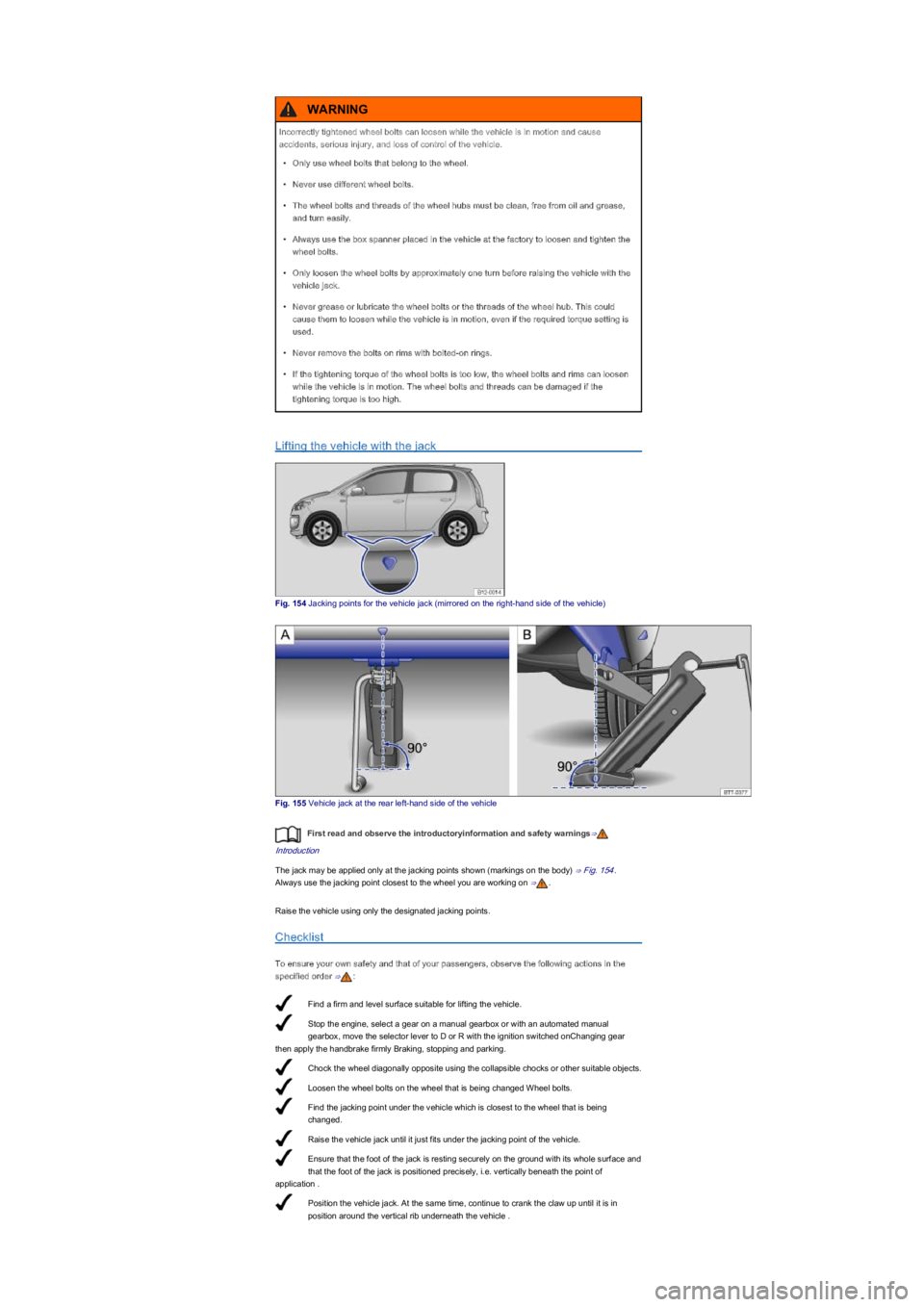
Lifting the vehicle with the jack
Fig. 154 Jacking points for the vehicle jack (mirrored on the right-hand side of the vehicle)
Fig. 155 Vehicle jack at the rear left-hand side of the vehicle
First read and observe the introductoryinformation and safety warnings⇒
Introduction
The jack may be applied only at the jacking points shown (markings on the body) ⇒ Fig. 154.
Always use the jacking point closest to the wheel you are working on ⇒.
Raise the vehicle using only the designated jacking points.
Checklist
To ensure your own safety and that of your passengers, observe the following actions in the
specified order ⇒:
Incorrectly tightened wheel bolts can loosen while the vehicle is in motion and cause
accidents, serious injury, and loss of control of the vehicle.
•Only use wheel bolts that belong to the wheel.
•Never use different wheel bolts.
•The wheel bolts and threads of the wheel hubs must be clean, free from oil and grease,
and turn easily.
•Always use the box spanner placed in the vehicle at the factory to loosen and tighten the
wheel bolts.
•Only loosen the wheel bolts by approximately one turn before raising the vehicle with the
vehicle jack.
•Never grease or lubricate the wheel bolts or the threads of the wheel hub. This could
cause them to loosen while the vehicle is in motion, even if the required torque setting is
used.
•Never remove the bolts on rims with bolted-on rings.
•If the tightening torque of the wheel bolts is too low, the wheel bolts and rims can loosen
while the vehicle is in motion. The wheel bolts and threads can be damaged if the
tightening torque is too high.
WARNING
Page 193 of 211
After changing a wheel
First read and observe the introductoryinformation and safety warnings⇒
Introduction
•Clean the tools as necessary and place them back in the foam rubber holder in the luggage
compartment ⇒ Vehicle toolkit.
•Stow the spare wheel, temporary spare wheel or the removed wheel safely in the luggage
compartment.
•The tightening torque of the wheel bolts should be checked immediately with a torque wrench
⇒ Tightening torque for the wheel bolts.
•The damaged wheel should be replaced as soon as possible.
Breakdown set
Introduction
This chapter contains information on the followingsubjects:
⇒ Contents of the breakdown set
⇒ Preparation
⇒ Sealing and inflating tyres
⇒ Test after driving for 10 minutes
You can use the breakdown set (tyre mobility set) to safely seal any tyre damage caused by foreign
bodies or punctures (up to 4 mm in diameter). Do not remove foreign objects (e.g. screws or
nails) from the tyre!
Once the sealant has been added to the tyre, the tyre pressure must be checked again after
approximately 10 minutes of driving.
Seek expert assistance if more than one vehicle tyre is damaged. The breakdown set is only
designed for filling one tyre.
Only use the breakdown set if the car is parked in a safe place, you are familiar with the required
actions and safety procedures, and you have access to the correct breakdown set. Seek expert
assistance if this is not the case.
The tyre sealant must not be used:
•If the rim is damaged.
•If the outside temperature is below -20°C (-4°F).
•If there are cuts or punctures in the tyre that are larger than 4 mm.
•If the tyre pressure is very low or the tyres are flat.
•If the use-by date on the tyre filler bottle has expired.
•If a foreign object has been removed from the tyre.
Additional information and warnings:
•Vehicle key set ⇒ Vehicle key set
•Braking, stopping and parking ⇒ Braking, stopping and parking
•Wheels and tyres ⇒ Wheels and tyres
•In an emergency ⇒ In an emergency
•Hubcaps ⇒ Hubcaps
Incorrect torque or incorrect use of wheel bolts can lead to a loss of control of the vehicle,
cause accidents and serious injuries.
•Always keep all wheel bolts and threads in the wheel hubs clean and free from oil and
grease. The wheel bolts must be easy to turn and be tightened to the specified torque.
•The hexagonal socket in the screwdriver handle should only be used for turning wheel
bolts, not use for loosening or tightening them.
WARNING
Page 195 of 211
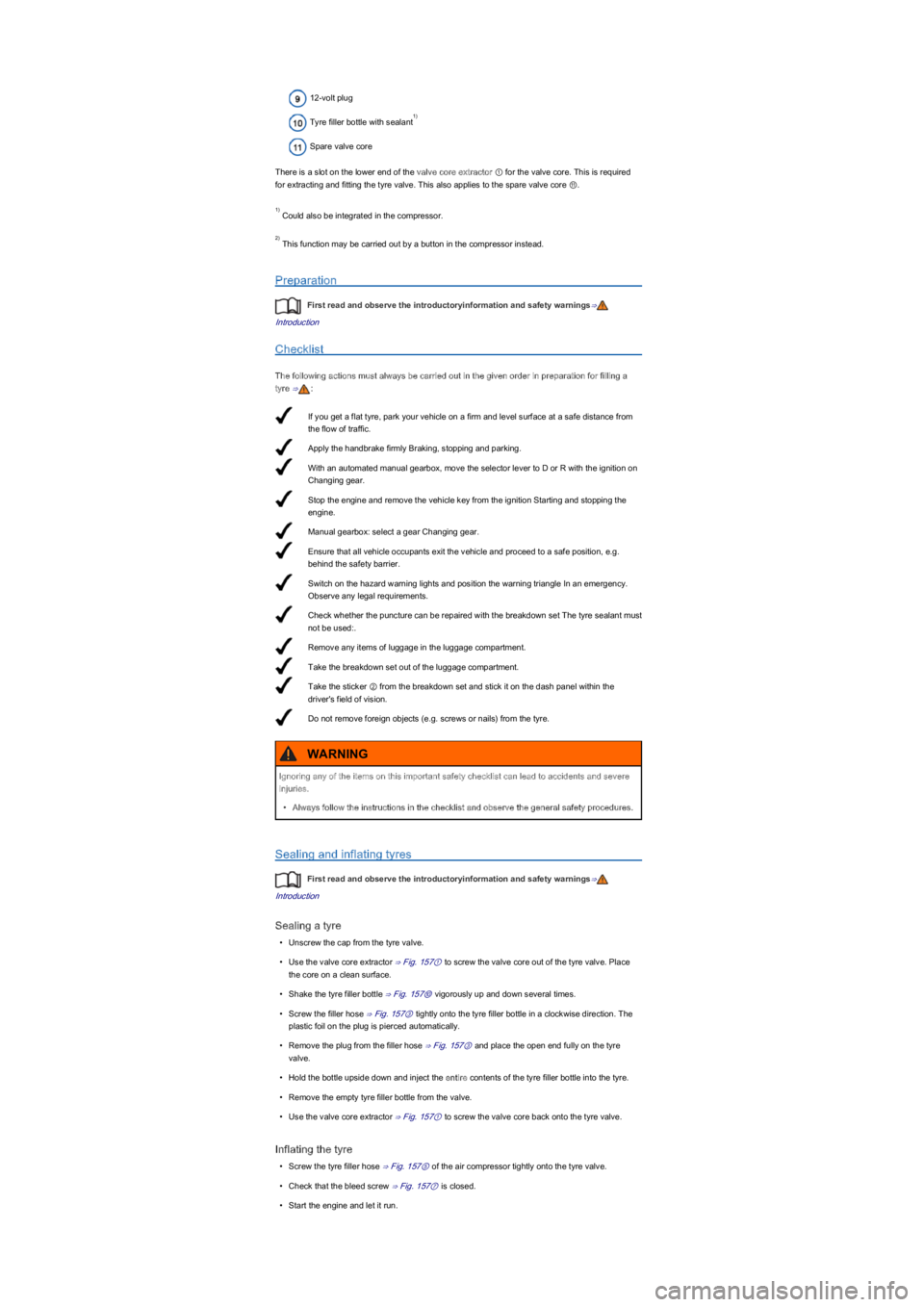
If you get a flat tyre, park your vehicle on a firm and level surface at a safe distance from
the flow of traffic.
Apply the handbrake firmly Braking, stopping and parking.
With an automated manual gearbox, move the selector lever to D or R with the ignition on
Changing gear.
Stop the engine and remove the vehicle key from the ignition Starting and stopping the
engine.
Manual gearbox: select a gear Changing gear.
Ensure that all vehicle occupants exit the vehicle and proceed to a safe position, e.g.
behind the safety barrier.
Switch on the hazard warning lights and position the warning triangle In an emergency.
Observe any legal requirements.
Check whether the puncture can be repaired with the breakdown set The tyre sealant must
not be used:.
Remove any items of luggage in the luggage compartment.
Take the breakdown set out of the luggage compartment.
Take the sticker ② from the breakdown set and stick it on the dash panel within the
driver's field of vision.
Do not remove foreign objects (e.g. screws or nails) from the tyre.
12-volt plug
Tyre filler bottle with sealant
Spare valve core
There is a slot on the lower end of the valve core extractor ① for the valve core. This is required
for extracting and fitting the tyre valve. This also applies to the spare valve core ⑪.
Could also be integrated in the compressor.
This function may be carried out by a button in the compressor instead.
Preparation
First read and observe the introductoryinformation and safety warnings⇒
Introduction
Checklist
The following actions must always be carried out in the given order in preparation for filling a
tyre ⇒:
Sealing and inflating tyres
First read and observe the introductoryinformation and safety warnings⇒
Introduction
Sealing a tyre
•Unscrew the cap from the tyre valve.
•Use the valve core extractor ⇒ Fig. 157① to screw the valve core out of the tyre valve. Place
the core on a clean surface.
•Shake the tyre filler bottle ⇒ Fig. 157⑩ vigorously up and down several times.
•Screw the filler hose ⇒ Fig. 157③ tightly onto the tyre filler bottle in a clockwise direction. The
plastic foil on the plug is pierced automatically.
•Remove the plug from the filler hose ⇒ Fig. 157③ and place the open end fully on the tyre
valve.
•Hold the bottle upside down and inject the entire contents of the tyre filler bottle into the tyre.
•Remove the empty tyre filler bottle from the valve.
•Use the valve core extractor ⇒ Fig. 157① to screw the valve core back onto the tyre valve.
Inflating the tyre
•Screw the tyre filler hose ⇒ Fig. 157⑤ of the air compressor tightly onto the tyre valve.
•Check that the bleed screw ⇒ Fig. 157⑦ is closed.
•Start the engine and let it run.
1)
1)
2)
Ignoring any of the items on this important safety checklist can lead to accidents and severe
injuries.
•Always follow the instructions in the checklist and observe the general safety procedures.
WARNING