oil VOLKSWAGEN UP! 2021 Owner´s Manual
[x] Cancel search | Manufacturer: VOLKSWAGEN, Model Year: 2021, Model line: UP!, Model: VOLKSWAGEN UP! 2021Pages: 211, PDF Size: 5.98 MB
Page 137 of 211

With the engine at operating temperature, park the vehicle on a level surface to ensure
that the engine oil reading is correct.
Switch off the engine and wait a few minutes for the engine oil to flow back into the sump.
Open the bonnet .
Identify the engine oil filler cap and oil dipstick. The engine oil filler opening bears the
symbol on the cap and the oil dipstick has a coloured handle. If you cannot find the cap
and dipstick please contact a qualified workshop.
Pull the dipstick out of the guide tube and wipe it off with a clean cloth.
Insert the oil dipstick into the guide tube again as far as it will go. If there is a marking on
the oil dipstick, this marking must fit in the corresponding groove at the top end of the
guide tube when inserting.
After reading the oil level, push the oil dipstick back into the guide tube as far as it will go.
Unscrew the engine oil filler opening cap .
Using only the engine oil approved by Volkswagen expressly for this engine, top up the oil
in small gradual amounts (no more than 0.5 l).
To avoid overfilling, wait for approximately one minute after each pour to allow the engine
oil to flow into the oil sump up to the marking on the engine oil dipstick.
Read the engine oil level from the dipstick again before refilling with a further small
quantity of engine oil. Never overfill engine oil .
After the refilling procedure, the engine oil level should be at least in the centre of area Ⓑ,
but never above area Ⓐ .
After refilling, screw the engine oil filler cap back on correctly.
Reinsert the oil dipstick correctly into the guide tube as far as it will go.
Close the bonnet correctly .
Checklist
Carry out the steps in the specified order ⇒:
Pull the dipstick out again and read the engine oil level on the dipstick as follows: Ⓐ: do not
refill oil . Proceed to step 15. Ⓑ: oil can be refilled (approximately 0.5 l). Proceed to step 8
or 15. Ⓒ: oil must be refilled (approximately 1.0 l). Proceed to step 8.
The engine oil level must never be above area ⇒ Fig. 121Ⓐ. Otherwise oil can be drawn in
through the crankcase breather and escape into the atmosphere via the exhaust system.
Engine oil consumption
First read and observe the introductoryinformation and safety warnings⇒
Introduction
Engine oil consumption can vary from engine to engine and can change during the working life of
an engine.
Depending on how you drive and the conditions in which the car is used, oil consumption can be up
to 1.0 litre/2,000 km – and is likely to be higher for the first 5,000 km for new vehicles. The engine
oil level must therefore be checked at regular intervals, preferably when refuelling and before long
journeys.
When the engine is working hard the oil level must be kept within the area shown in ⇒ Fig. 121Ⓐ,
for instance during long motorway cruising in summer or climbing mountain passes.
Engine oil can ignite if it comes into contact with hot engine components. It can cause fires,
burns and other serious injuries.
•If engine oil is spilt on cold engine parts it can heat up and ignite when the engine is
running.
•Always ensure that the engine oil filler cap is securely tightened after refilling, and that the
dipstick is properly inserted back into the guide tube. This will prevent the engine oil from
draining out on to hot engine components when the engine is running.
WARNING
•Do not start the engine if the engine oil level is above area ⇒ Fig. 121Ⓐ. Seek expert
assistance. The catalytic converter and the engine could otherwise be damaged.
•When refilling or changing operating fluids please ensure that the fluids are in the correct
container. Incorrect operating fluids can cause serious functional problems and engine
damage.
NOTICE
Page 138 of 211
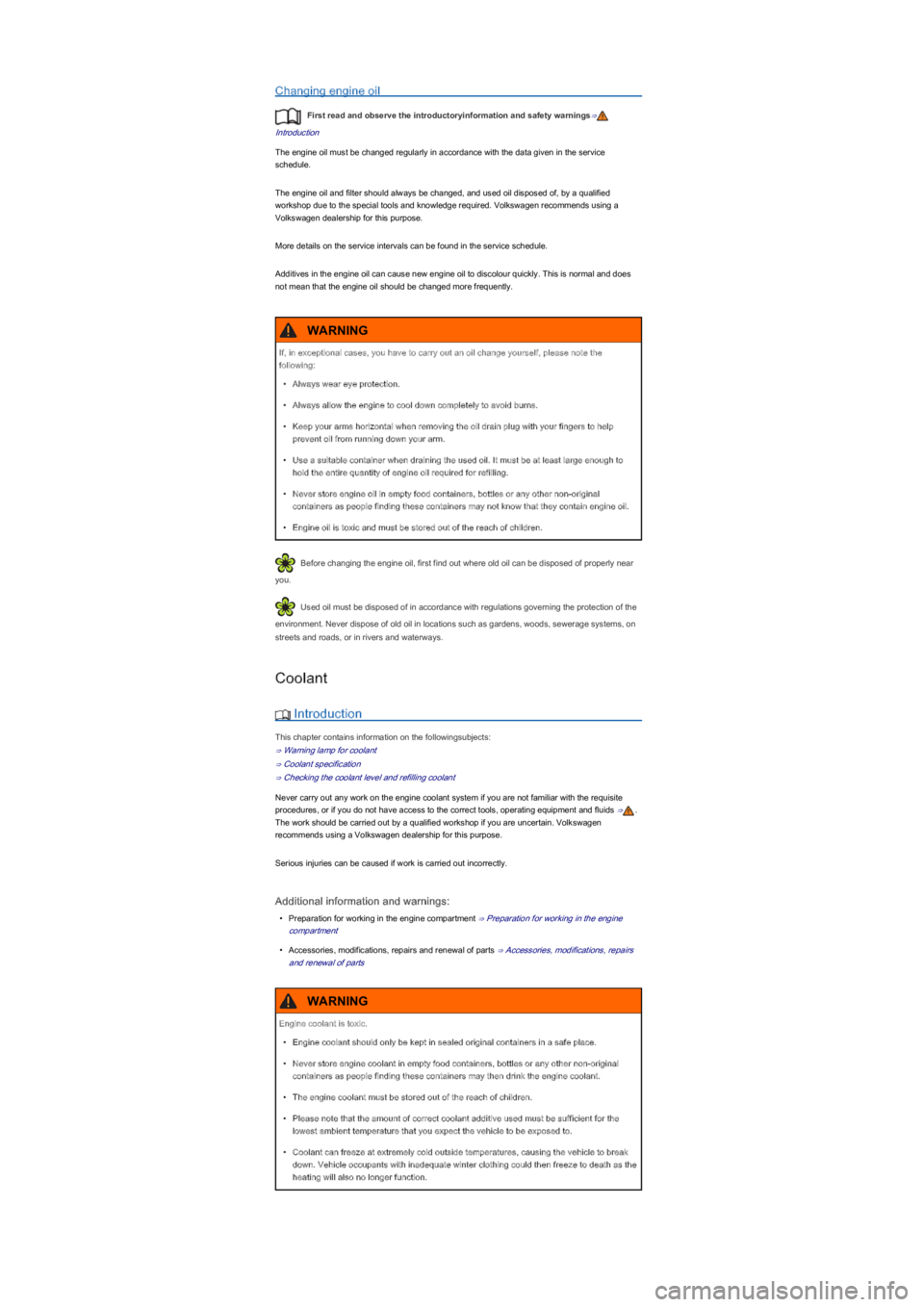
Changing engine oil
First read and observe the introductoryinformation and safety warnings⇒
Introduction
The engine oil must be changed regularly in accordance with the data given in the service
schedule.
The engine oil and filter should always be changed, and used oil disposed of, by a qualified
workshop due to the special tools and knowledge required. Volkswagen recommends using a
Volkswagen dealership for this purpose.
More details on the service intervals can be found in the service schedule.
Additives in the engine oil can cause new engine oil to discolour quickly. This is normal and does
not mean that the engine oil should be changed more frequently.
Before changing the engine oil, first find out where old oil can be disposed of properly near
you.
Used oil must be disposed of in accordance with regulations governing the protection of the
environment. Never dispose of old oil in locations such as gardens, woods, sewerage systems, on
streets and roads, or in rivers and waterways.
Coolant
Introduction
This chapter contains information on the followingsubjects:
⇒ Warning lamp for coolant
⇒ Coolant specification
⇒ Checking the coolant level and refilling coolant
Never carry out any work on the engine coolant system if you are not familiar with the requisite
procedures, or if you do not have access to the correct tools, operating equipment and fluids ⇒.
The work should be carried out by a qualified workshop if you are uncertain. Volkswagen
recommends using a Volkswagen dealership for this purpose.
Serious injuries can be caused if work is carried out incorrectly.
Additional information and warnings:
•Preparation for working in the engine compartment ⇒ Preparation for working in the engine
compartment
•Accessories, modifications, repairs and renewal of parts ⇒ Accessories, modifications, repairs
and renewal of parts
If, in exceptional cases, you have to carry out an oil change yourself, please note the
following:
•Always wear eye protection.
•Always allow the engine to cool down completely to avoid burns.
•Keep your arms horizontal when removing the oil drain plug with your fingers to help
prevent oil from running down your arm.
•Use a suitable container when draining the used oil. It must be at least large enough to
hold the entire quantity of engine oil required for refilling.
•Never store engine oil in empty food containers, bottles or any other non-original
containers as people finding these containers may not know that they contain engine oil.
•Engine oil is toxic and must be stored out of the reach of children.
WARNING
Engine coolant is toxic.
•Engine coolant should only be kept in sealed original containers in a safe place.
•Never store engine coolant in empty food containers, bottles or any other non-original
containers as people finding these containers may then drink the engine coolant.
•The engine coolant must be stored out of the reach of children.
•Please note that the amount of correct coolant additive used must be sufficient for the
lowest ambient temperature that you expect the vehicle to be exposed to.
•Coolant can freeze at extremely cold outside temperatures, causing the vehicle to break
down. Vehicle occupants with inadequate winter clothing could then freeze to death as the
heating will also no longer function.
WARNING
Page 139 of 211
Coolant and coolant additives can pollute the environment. Spilt operating fluids must be
collected and disposed of properly and with respect for the environment.
Warning lamp for coolant
First read and observe the introductoryinformation and safety warnings⇒
Introduction
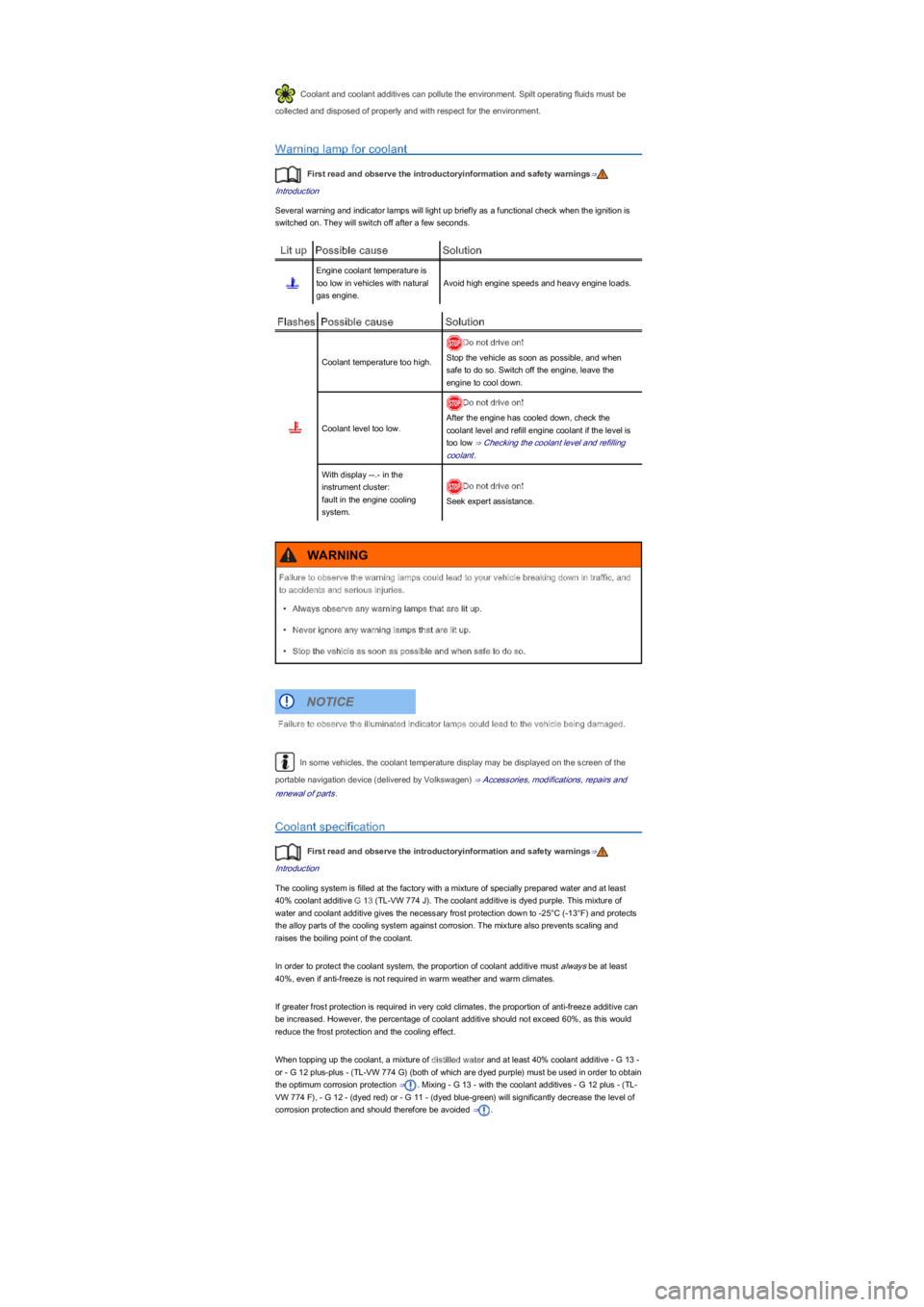
Several warning and indicator lamps will light up briefly as a functional check when the ignition is
switched on. They will switch off after a few seconds.
Lit upPossible causeSolution
Engine coolant temperature is
too low in vehicles with natural
gas engine.
Avoid high engine speeds and heavy engine loads.
FlashesPossible causeSolution
Coolant temperature too high.
Do not drive on!
Stop the vehicle as soon as possible, and when
safe to do so. Switch off the engine, leave the
engine to cool down.
Coolant level too low.
Do not drive on!
After the engine has cooled down, check the
coolant level and refill engine coolant if the level is
too low ⇒ Checking the coolant level and refilling
coolant.
With display --.- in the
instrument cluster:
fault in the engine cooling
system.
Do not drive on!
Seek expert assistance.
In some vehicles, the coolant temperature display may be displayed on the screen of the
portable navigation device (delivered by Volkswagen) ⇒ Accessories, modifications, repairs and
renewal of parts.
Coolant specification
First read and observe the introductoryinformation and safety warnings⇒
Introduction
The cooling system is filled at the factory with a mixture of specially prepared water and at least
40% coolant additive G 13 (TL-VW 774 J). The coolant additive is dyed purple. This mixture of
water and coolant additive gives the necessary frost protection down to -25°C (-13°F) and protects
the alloy parts of the cooling system against corrosion. The mixture also prevents scaling and
raises the boiling point of the coolant.
In order to protect the coolant system, the proportion of coolant additive must always be at least
40%, even if anti-freeze is not required in warm weather and warm climates.
If greater frost protection is required in very cold climates, the proportion of anti-freeze additive can
be increased. However, the percentage of coolant additive should not exceed 60%, as this would
reduce the frost protection and the cooling effect.
When topping up the coolant, a mixture of distilled water and at least 40% coolant additive - G 13 -
or - G 12 plus-plus - (TL-VW 774 G) (both of which are dyed purple) must be used in order to obtain
the optimum corrosion protection ⇒. Mixing - G 13 - with the coolant additives - G 12 plus - (TL-
VW 774 F), - G 12 - (dyed red) or - G 11 - (dyed blue-green) will significantly decrease the level of
corrosion protection and should therefore be avoided ⇒.
Failure to observe the warning lamps could lead to your vehicle breaking down in traffic, and
to accidents and serious injuries.
•Always observe any warning lamps that are lit up.
•Never ignore any warning lamps that are lit up.
•Stop the vehicle as soon as possible and when safe to do so.
WARNING
Failure to observe the illuminated indicator lamps could lead to the vehicle being damaged.
NOTICE
Page 146 of 211
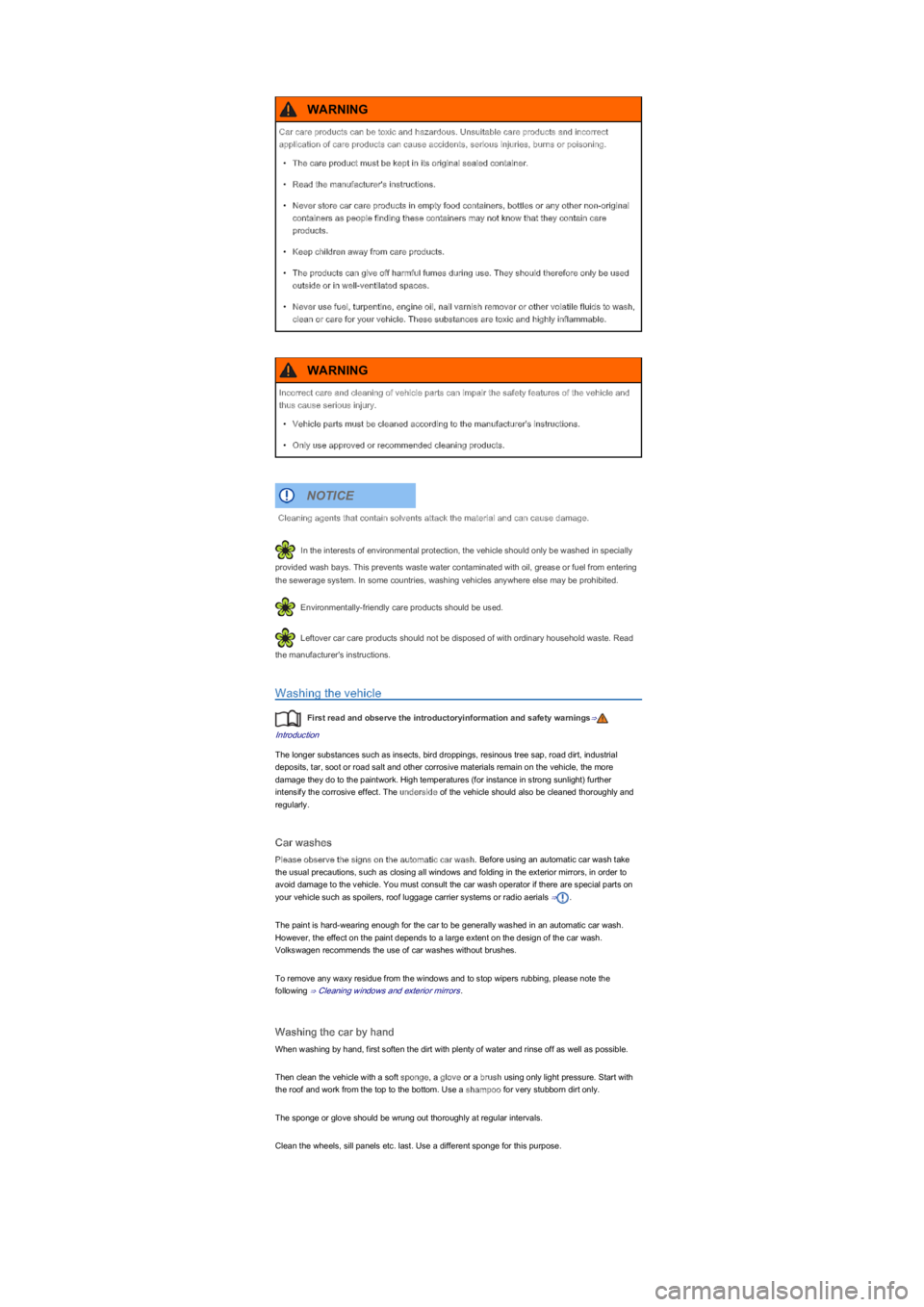
In the interests of environmental protection, the vehicle should only be washed in specially
provided wash bays. This prevents waste water contaminated with oil, grease or fuel from entering
the sewerage system. In some countries, washing vehicles anywhere else may be prohibited.
Environmentally-friendly care products should be used.
Leftover car care products should not be disposed of with ordinary household waste. Read
the manufacturer's instructions.
Washing the vehicle
First read and observe the introductoryinformation and safety warnings⇒
Introduction
The longer substances such as insects, bird droppings, resinous tree sap, road dirt, industrial
deposits, tar, soot or road salt and other corrosive materials remain on the vehicle, the more
damage they do to the paintwork. High temperatures (for instance in strong sunlight) further
intensify the corrosive effect. The underside of the vehicle should also be cleaned thoroughly and
regularly.
Car washes
Please observe the signs on the automatic car wash. Before using an automatic car wash take
the usual precautions, such as closing all windows and folding in the exterior mirrors, in order to
avoid damage to the vehicle. You must consult the car wash operator if there are special parts on
your vehicle such as spoilers, roof luggage carrier systems or radio aerials ⇒.
The paint is hard-wearing enough for the car to be generally washed in an automatic car wash.
However, the effect on the paint depends to a large extent on the design of the car wash.
Volkswagen recommends the use of car washes without brushes.
To remove any waxy residue from the windows and to stop wipers rubbing, please note the
following ⇒ Cleaning windows and exterior mirrors.
Washing the car by hand
When washing by hand, first soften the dirt with plenty of water and rinse off as well as possible.
Then clean the vehicle with a soft sponge, a glove or a brush using only light pressure. Start with
the roof and work from the top to the bottom. Use a shampoo for very stubborn dirt only.
The sponge or glove should be wrung out thoroughly at regular intervals.
Clean the wheels, sill panels etc. last. Use a different sponge for this purpose.
Car care products can be toxic and hazardous. Unsuitable care products and incorrect
application of care products can cause accidents, serious injuries, burns or poisoning.
•The care product must be kept in its original sealed container.
•Read the manufacturer's instructions.
•Never store car care products in empty food containers, bottles or any other non-original
containers as people finding these containers may not know that they contain care
products.
•Keep children away from care products.
•The products can give off harmful fumes during use. They should therefore only be used
outside or in well-ventilated spaces.
•Never use fuel, turpentine, engine oil, nail varnish remover or other volatile fluids to wash,
clean or care for your vehicle. These substances are toxic and highly inflammable.
WARNING
Incorrect care and cleaning of vehicle parts can impair the safety features of the vehicle and
thus cause serious injury.
•Vehicle parts must be cleaned according to the manufacturer's instructions.
•Only use approved or recommended cleaning products.
WARNING
Cleaning agents that contain solvents attack the material and can cause damage.
NOTICE
Page 148 of 211
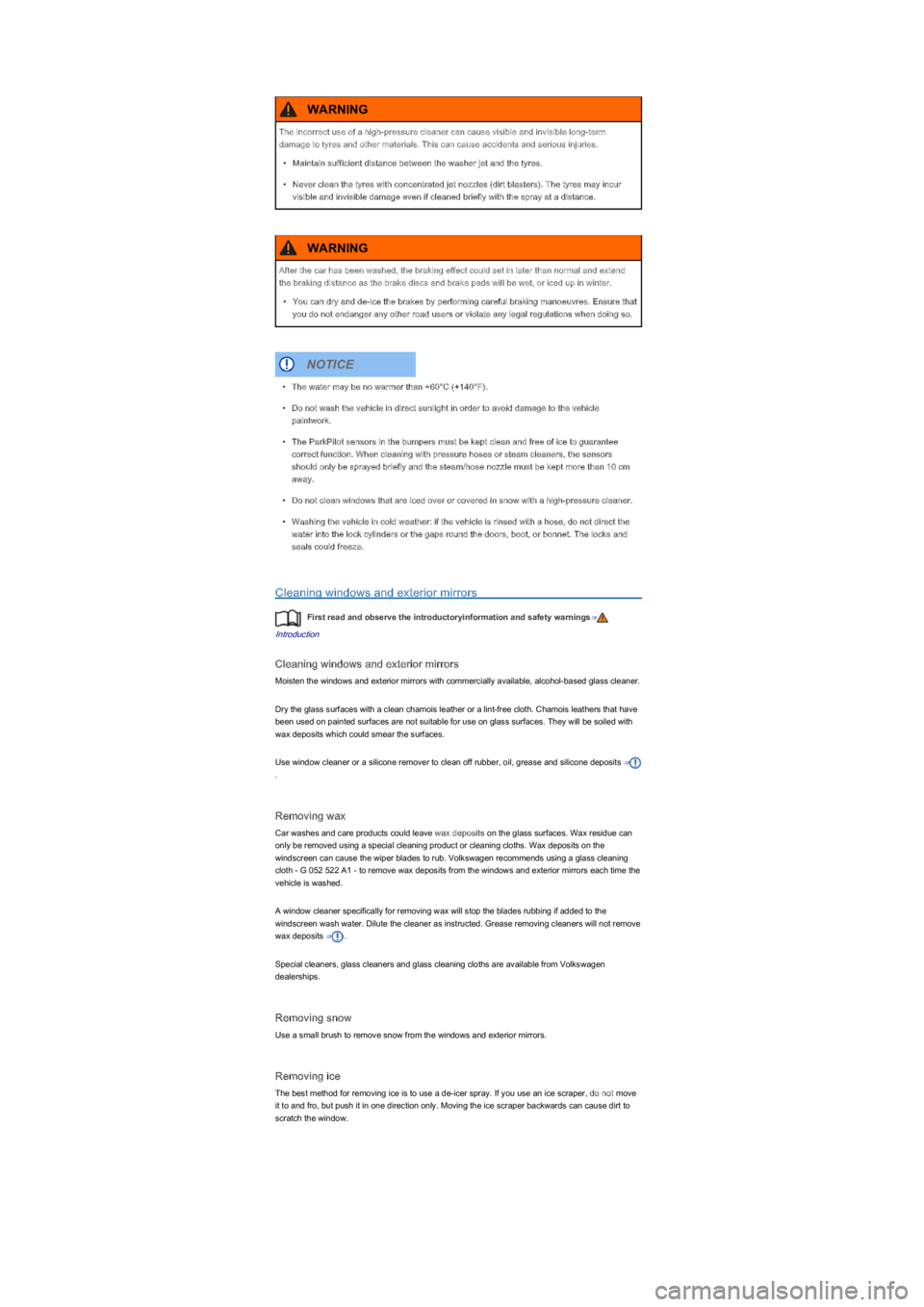
Cleaning windows and exterior mirrors
First read and observe the introductoryinformation and safety warnings⇒
Introduction
Cleaning windows and exterior mirrors
Moisten the windows and exterior mirrors with commercially available, alcohol-based glass cleaner.
Dry the glass surfaces with a clean chamois leather or a lint-free cloth. Chamois leathers that have
been used on painted surfaces are not suitable for use on glass surfaces. They will be soiled with
wax deposits which could smear the surfaces.
Use window cleaner or a silicone remover to clean off rubber, oil, grease and silicone deposits ⇒
.
Removing wax
Car washes and care products could leave wax deposits on the glass surfaces. Wax residue can
only be removed using a special cleaning product or cleaning cloths. Wax deposits on the
windscreen can cause the wiper blades to rub. Volkswagen recommends using a glass cleaning
cloth - G 052 522 A1 - to remove wax deposits from the windows and exterior mirrors each time the
vehicle is washed.
A window cleaner specifically for removing wax will stop the blades rubbing if added to the
windscreen wash water. Dilute the cleaner as instructed. Grease removing cleaners will not remove
wax deposits ⇒.
Special cleaners, glass cleaners and glass cleaning cloths are available from Volkswagen
dealerships.
Removing snow
Use a small brush to remove snow from the windows and exterior mirrors.
Removing ice
The best method for removing ice is to use a de-icer spray. If you use an ice scraper, do not move
it to and fro, but push it in one direction only. Moving the ice scraper backwards can cause dirt to
scratch the window.
The incorrect use of a high-pressure cleaner can cause visible and invisible long-term
damage to tyres and other materials. This can cause accidents and serious injuries.
•Maintain sufficient distance between the washer jet and the tyres.
•Never clean the tyres with concentrated jet nozzles (dirt blasters). The tyres may incur
visible and invisible damage even if cleaned briefly with the spray at a distance.
WARNING
After the car has been washed, the braking effect could set in later than normal and extend
the braking distance as the brake discs and brake pads will be wet, or iced up in winter.
•You can dry and de-ice the brakes by performing careful braking manoeuvres. Ensure that
you do not endanger any other road users or violate any legal regulations when doing so.
WARNING
•The water may be no warmer than +60°C (+140°F).
•Do not wash the vehicle in direct sunlight in order to avoid damage to the vehicle
paintwork.
•The ParkPilot sensors in the bumpers must be kept clean and free of ice to guarantee
correct function. When cleaning with pressure hoses or steam cleaners, the sensors
should only be sprayed briefly and the steam/hose nozzle must be kept more than 10 cm
away.
•Do not clean windows that are iced over or covered in snow with a high-pressure cleaner.
•Washing the vehicle in cold weather: if the vehicle is rinsed with a hose, do not direct the
water into the lock cylinders or the gaps round the doors, boot, or bonnet. The locks and
seals could freeze.
NOTICE
Page 150 of 211
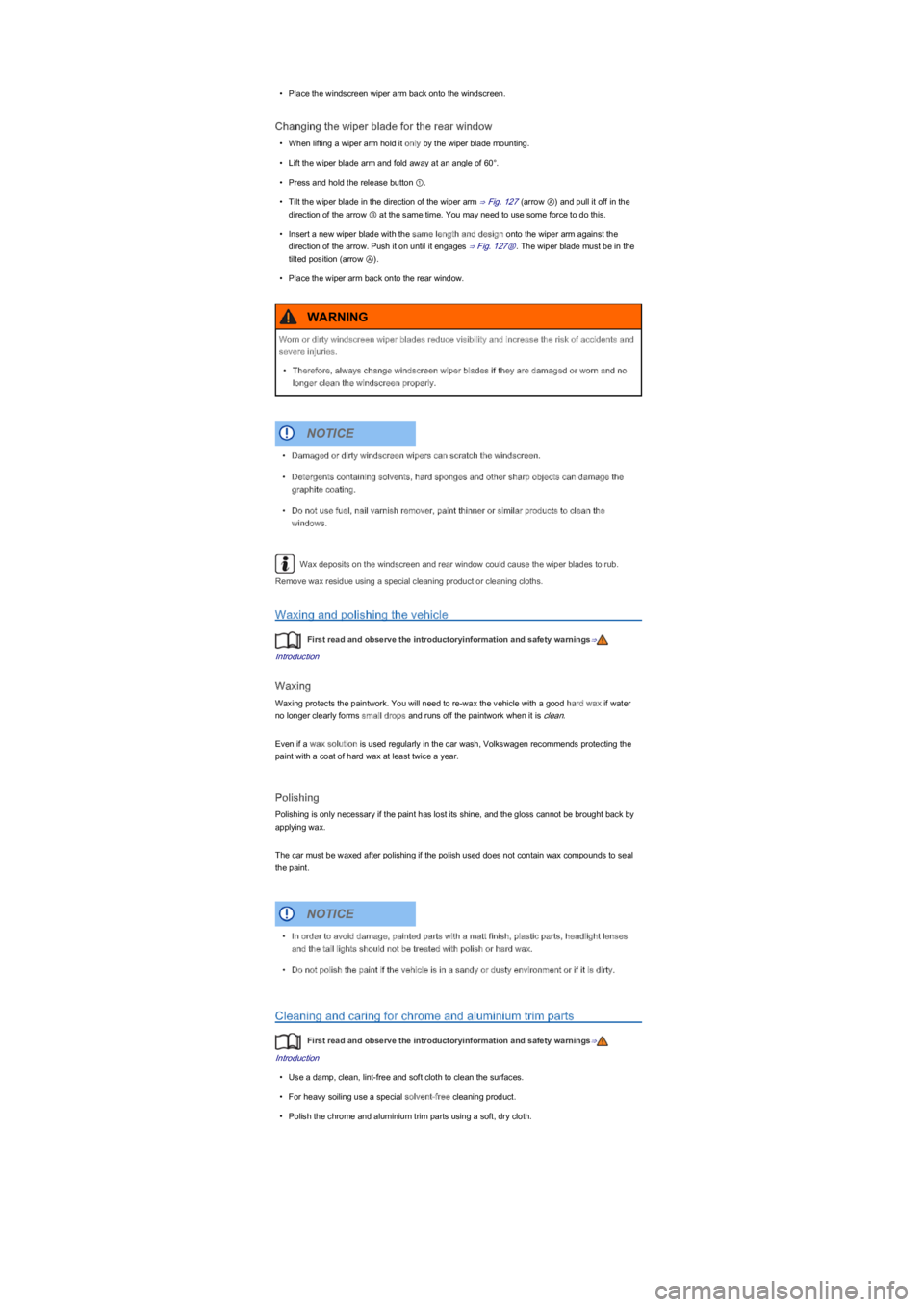
•Place the windscreen wiper arm back onto the windscreen.
Changing the wiper blade for the rear window
•When lifting a wiper arm hold it only by the wiper blade mounting.
•Lift the wiper blade arm and fold away at an angle of 60°.
•Press and hold the release button ①.
•Tilt the wiper blade in the direction of the wiper arm ⇒ Fig. 127 (arrow Ⓐ) and pull it off in the
direction of the arrow Ⓑ at the same time. You may need to use some force to do this.
•Insert a new wiper blade with the same length and design onto the wiper arm against the
direction of the arrow. Push it on until it engages ⇒ Fig. 127Ⓑ. The wiper blade must be in the
tilted position (arrow Ⓐ).
•Place the wiper arm back onto the rear window.
Wax deposits on the windscreen and rear window could cause the wiper blades to rub.
Remove wax residue using a special cleaning product or cleaning cloths.
Waxing and polishing the vehicle
First read and observe the introductoryinformation and safety warnings⇒
Introduction
Waxing
Waxing protects the paintwork. You will need to re-wax the vehicle with a good hard wax if water
no longer clearly forms small drops and runs off the paintwork when it is clean.
Even if a wax solution is used regularly in the car wash, Volkswagen recommends protecting the
paint with a coat of hard wax at least twice a year.
Polishing
Polishing is only necessary if the paint has lost its shine, and the gloss cannot be brought back by
applying wax.
The car must be waxed after polishing if the polish used does not contain wax compounds to seal
the paint.
Cleaning and caring for chrome and aluminium trim parts
First read and observe the introductoryinformation and safety warnings⇒
Introduction
•Use a damp, clean, lint-free and soft cloth to clean the surfaces.
•For heavy soiling use a special solvent-free cleaning product.
•Polish the chrome and aluminium trim parts using a soft, dry cloth.
Worn or dirty windscreen wiper blades reduce visibility and increase the risk of accidents and
severe injuries.
•Therefore, always change windscreen wiper blades if they are damaged or worn and no
longer clean the windscreen properly.
WARNING
•Damaged or dirty windscreen wipers can scratch the windscreen.
•Detergents containing solvents, hard sponges and other sharp objects can damage the
graphite coating.
•Do not use fuel, nail varnish remover, paint thinner or similar products to clean the
windows.
NOTICE
•In order to avoid damage, painted parts with a matt finish, plastic parts, headlight lenses
and the tail lights should not be treated with polish or hard wax.
•Do not polish the paint if the vehicle is in a sandy or dusty environment or if it is dirty.
NOTICE
Page 152 of 211
recommends that the protective coating on the underside of the vehicle and on the running gear
should be checked regularly and repaired if necessary.
Cleaning the engine compartment
First read and observe the introductoryinformation and safety warnings⇒
Introduction
The engine compartment of any motor vehicle is a hazardous area ⇒ Preparation for working in the
engine compartment.
The engine compartment should be cleaned by a qualified workshop. An incorrect cleaning
procedure could possibly remove corrosion protection and damage electrical components.
Furthermore, water could enter the vehicle interior directly via the plenum chamber ⇒.
If the engine compartment is very dirty, we recommend that you always proceed to a qualified
workshop to have it cleaned by a professional mechanic. Volkswagen recommends using a
Volkswagen dealership for this purpose.
Plenum chamber
The plenum chamber is located in the engine compartment between the windscreen and the engine
and has a perforated cover. Air from outside is drawn in from the plenum chamber and is passed
into the vehicle interior via the heating and air conditioning system.
Leaves and other loose objects must be removed from the cover of the plenum chamber at regular
intervals using a vacuum cleaner or by hand.
In the interests of environmental protection, the engine compartment should be washed only
in specially provided wash bays. This prevents toxic waste water containing oil, grease and fuel
from entering the sewerage system. In some districts, washing the engine compartment anywhere
else may be prohibited.
Cleaning and caring for the interior
Introduction
This chapter contains information on the followingsubjects:
⇒ Seat covers
⇒ Cleaning cloth seat covers, fabric trim and Alcantara upholstery
⇒ Cleaning and caring for natural leather covers
⇒ Cleaning leatherette upholstery
⇒ Cleaning stowage compartments, drink holders and ash trays
⇒ Cleaning and caring for the dash panel, wooden trims and plastic parts
⇒ Cleaning seat belts
Modern fabrics, such as dark denim, are often not colourfast. Light-coloured upholstery (soft
materials or leather) is particularly sensitive to staining caused by these fabrics, even if you are
careful. This is not caused by a fault in the upholstery, but by the non-colourfast nature of the
garments.
Leaving stains, dirt and other deposits on the surface of vehicle components and cloth seat covers
for a long time can make it difficult to clean and treat them. Stains, dirt and deposits may become
impossible to remove, particularly if left for a long time.
Additional information and warnings:
•Cleaning and caring for the vehicle exterior ⇒ Caring for and cleaning the vehicle exterior
Underseal and anti-corrosion coatings can ignite on the hot exhaust system or on other hot
engine parts.
•Never apply underseal or anti-corrosion coatings to the exhaust pipes, catalytic converter,
heat shields or other vehicle components that become hot.
CAUTION
All work in the engine compartment carries the risk of injury, scalding, accidents and fire.
•Before carrying out any work ensure that you are familiar with the requisite procedures
and general safety regulations ⇒ Preparation for working in the engine compartment.
•Volkswagen recommends having the work carried out by a qualified workshop.
WARNING
Water that has entered the plenum chamber via a manual process (e.g. from a high-pressure
cleaner) can cause considerable damage to the vehicle.
NOTICE
Page 153 of 211
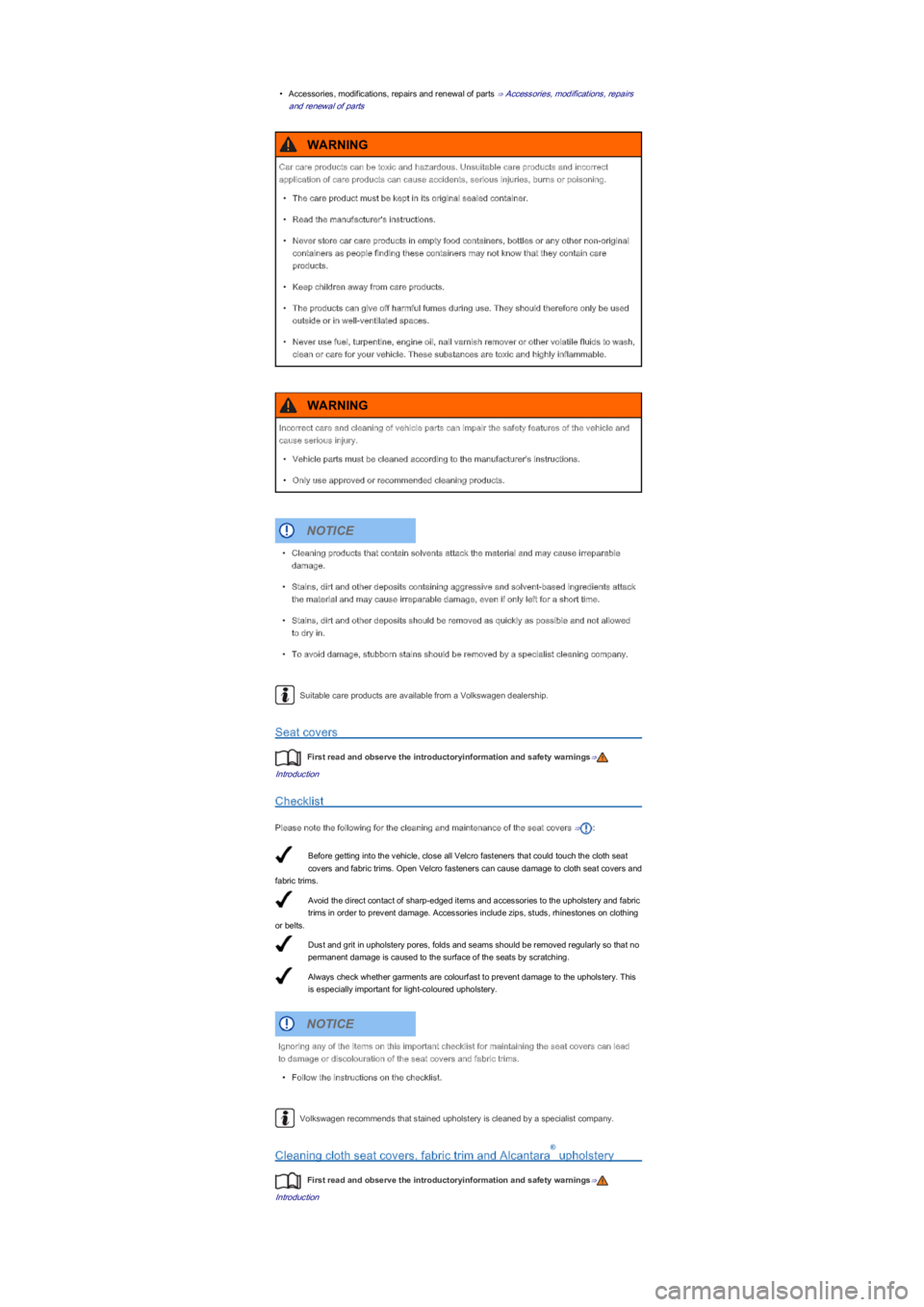
Before getting into the vehicle, close all Velcro fasteners that could touch the cloth seat
covers and fabric trims. Open Velcro fasteners can cause damage to cloth seat covers and
fabric trims.
Avoid the direct contact of sharp-edged items and accessories to the upholstery and fabric
trims in order to prevent damage. Accessories include zips, studs, rhinestones on clothing
or belts.
Dust and grit in upholstery pores, folds and seams should be removed regularly so that no
permanent damage is caused to the surface of the seats by scratching.
Always check whether garments are colourfast to prevent damage to the upholstery. This
is especially important for light-coloured upholstery.
•Accessories, modifications, repairs and renewal of parts ⇒ Accessories, modifications, repairs
and renewal of parts
Suitable care products are available from a Volkswagen dealership.
Seat covers
First read and observe the introductoryinformation and safety warnings⇒
Introduction
Checklist
Please note the following for the cleaning and maintenance of the seat covers ⇒:
Volkswagen recommends that stained upholstery is cleaned by a specialist company.
Cleaning cloth seat covers, fabric trim and Alcantara upholstery
First read and observe the introductoryinformation and safety warnings⇒
Introduction
Car care products can be toxic and hazardous. Unsuitable care products and incorrect
application of care products can cause accidents, serious injuries, burns or poisoning.
•The care product must be kept in its original sealed container.
•Read the manufacturer's instructions.
•Never store car care products in empty food containers, bottles or any other non-original
containers as people finding these containers may not know that they contain care
products.
•Keep children away from care products.
•The products can give off harmful fumes during use. They should therefore only be used
outside or in well-ventilated spaces.
•Never use fuel, turpentine, engine oil, nail varnish remover or other volatile fluids to wash,
clean or care for your vehicle. These substances are toxic and highly inflammable.
WARNING
Incorrect care and cleaning of vehicle parts can impair the safety features of the vehicle and
cause serious injury.
•Vehicle parts must be cleaned according to the manufacturer's instructions.
•Only use approved or recommended cleaning products.
WARNING
•Cleaning products that contain solvents attack the material and may cause irreparable
damage.
•Stains, dirt and other deposits containing aggressive and solvent-based ingredients attack
the material and may cause irreparable damage, even if only left for a short time.
•Stains, dirt and other deposits should be removed as quickly as possible and not allowed
to dry in.
•To avoid damage, stubborn stains should be removed by a specialist cleaning company.
NOTICE
Ignoring any of the items on this important checklist for maintaining the seat covers can lead
to damage or discolouration of the seat covers and fabric trims.
•Follow the instructions on the checklist.
NOTICE
®
Page 154 of 211
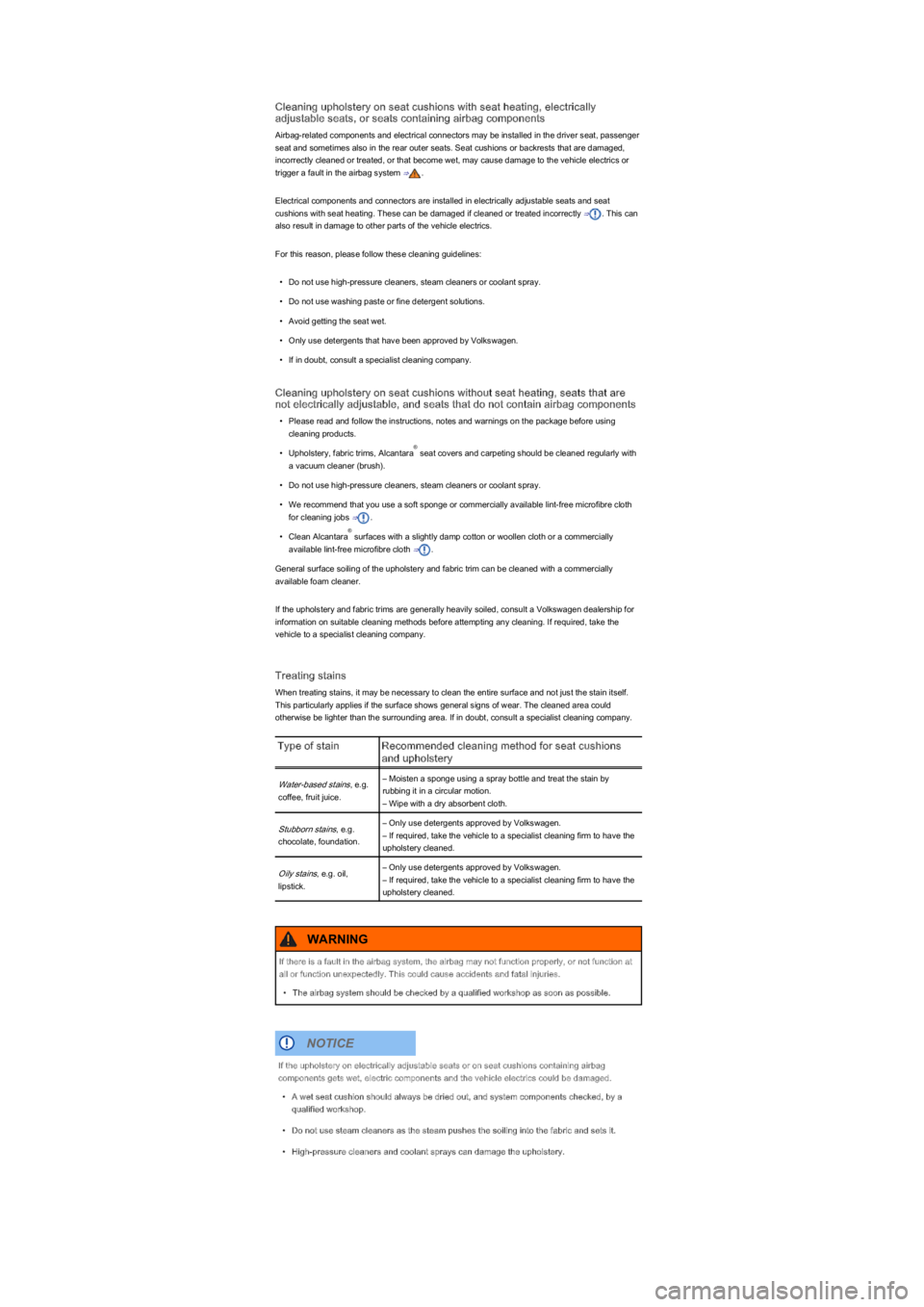
Cleaning upholstery on seat cushions with seat heating, electrically
adjustable seats, or seats containing airbag components
Airbag-related components and electrical connectors may be installed in the driver seat, passenger
seat and sometimes also in the rear outer seats. Seat cushions or backrests that are damaged,
incorrectly cleaned or treated, or that become wet, may cause damage to the vehicle electrics or
trigger a fault in the airbag system ⇒.
Electrical components and connectors are installed in electrically adjustable seats and seat
cushions with seat heating. These can be damaged if cleaned or treated incorrectly ⇒. This can
also result in damage to other parts of the vehicle electrics.
For this reason, please follow these cleaning guidelines:
•Do not use high-pressure cleaners, steam cleaners or coolant spray.
•Do not use washing paste or fine detergent solutions.
•Avoid getting the seat wet.
•Only use detergents that have been approved by Volkswagen.
•If in doubt, consult a specialist cleaning company.
Cleaning upholstery on seat cushions without seat heating, seats that are
not electrically adjustable, and seats that do not contain airbag components
•Please read and follow the instructions, notes and warnings on the package before using
cleaning products.
•Upholstery, fabric trims, Alcantara seat covers and carpeting should be cleaned regularly with
a vacuum cleaner (brush).
•Do not use high-pressure cleaners, steam cleaners or coolant spray.
•We recommend that you use a soft sponge or commercially available lint-free microfibre cloth
for cleaning jobs ⇒.
•Clean Alcantara surfaces with a slightly damp cotton or woollen cloth or a commercially
available lint-free microfibre cloth ⇒.
General surface soiling of the upholstery and fabric trim can be cleaned with a commercially
available foam cleaner.
If the upholstery and fabric trims are generally heavily soiled, consult a Volkswagen dealership for
information on suitable cleaning methods before attempting any cleaning. If required, take the
vehicle to a specialist cleaning company.
Treating stains
When treating stains, it may be necessary to clean the entire surface and not just the stain itself.
This particularly applies if the surface shows general signs of wear. The cleaned area could
otherwise be lighter than the surrounding area. If in doubt, consult a specialist cleaning company.
Type of stainRecommended cleaning method for seat cushions
and upholstery
Water-based stains, e.g.
coffee, fruit juice.
– Moisten a sponge using a spray bottle and treat the stain by
rubbing it in a circular motion.
– Wipe with a dry absorbent cloth.
Stubborn stains, e.g.
chocolate, foundation.
– Only use detergents approved by Volkswagen.
– If required, take the vehicle to a specialist cleaning firm to have the
upholstery cleaned.
Oily stains, e.g. oil,
lipstick.
– Only use detergents approved by Volkswagen.
– If required, take the vehicle to a specialist cleaning firm to have the
upholstery cleaned.
®
®
If there is a fault in the airbag system, the airbag may not function properly, or not function at
all or function unexpectedly. This could cause accidents and fatal injuries.
•The airbag system should be checked by a qualified workshop as soon as possible.
WARNING
If the upholstery on electrically adjustable seats or on seat cushions containing airbag
components gets wet, electric components and the vehicle electrics could be damaged.
•A wet seat cushion should always be dried out, and system components checked, by a
qualified workshop.
•Do not use steam cleaners as the steam pushes the soiling into the fabric and sets it.
•High-pressure cleaners and coolant sprays can damage the upholstery.
NOTICE
Page 155 of 211
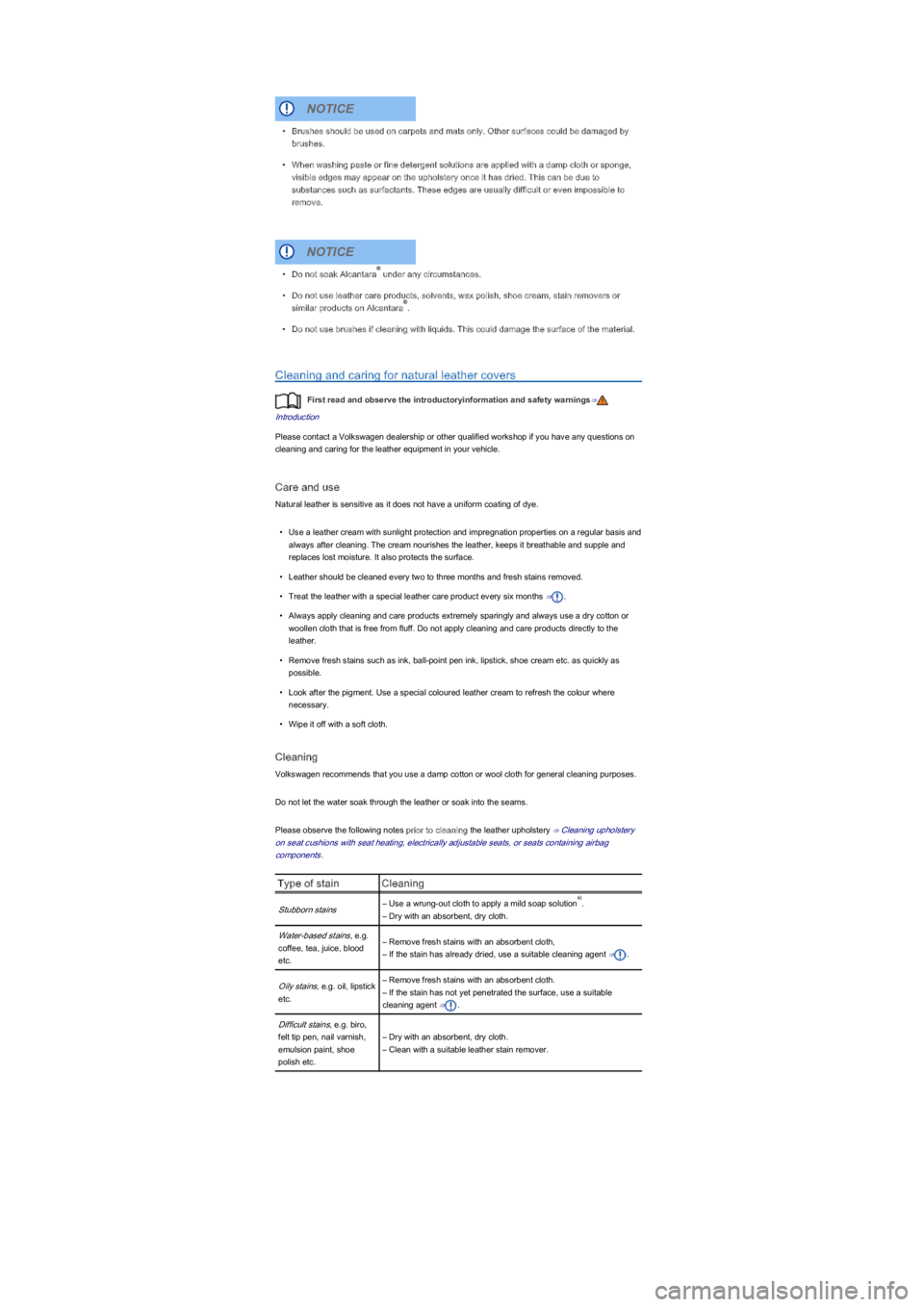
Cleaning and caring for natural leather covers
First read and observe the introductoryinformation and safety warnings⇒
Introduction
Please contact a Volkswagen dealership or other qualified workshop if you have any questions on
cleaning and caring for the leather equipment in your vehicle.
Care and use
Natural leather is sensitive as it does not have a uniform coating of dye.
•Use a leather cream with sunlight protection and impregnation properties on a regular basis and
always after cleaning. The cream nourishes the leather, keeps it breathable and supple and
replaces lost moisture. It also protects the surface.
•Leather should be cleaned every two to three months and fresh stains removed.
•Treat the leather with a special leather care product every six months ⇒.
•Always apply cleaning and care products extremely sparingly and always use a dry cotton or
woollen cloth that is free from fluff. Do not apply cleaning and care products directly to the
leather.
•Remove fresh stains such as ink, ball-point pen ink, lipstick, shoe cream etc. as quickly as
possible.
•Look after the pigment. Use a special coloured leather cream to refresh the colour where
necessary.
•Wipe it off with a soft cloth.
Cleaning
Volkswagen recommends that you use a damp cotton or wool cloth for general cleaning purposes.
Do not let the water soak through the leather or soak into the seams.
Please observe the following notes prior to cleaning the leather upholstery ⇒ Cleaning upholstery
on seat cushions with seat heating, electrically adjustable seats, or seats containing airbag
components.
Type of stainCleaning
Stubborn stains– Use a wrung-out cloth to apply a mild soap solution.
– Dry with an absorbent, dry cloth.
Water-based stains, e.g.
coffee, tea, juice, blood
etc.
– Remove fresh stains with an absorbent cloth,
– If the stain has already dried, use a suitable cleaning agent ⇒.
Oily stains, e.g. oil, lipstick
etc.
– Remove fresh stains with an absorbent cloth.
– If the stain has not yet penetrated the surface, use a suitable
cleaning agent ⇒.
Difficult stains, e.g. biro,
felt tip pen, nail varnish,
emulsion paint, shoe
polish etc.
– Dry with an absorbent, dry cloth.
– Clean with a suitable leather stain remover.
•Brushes should be used on carpets and mats only. Other surfaces could be damaged by
brushes.
•When washing paste or fine detergent solutions are applied with a damp cloth or sponge,
visible edges may appear on the upholstery once it has dried. This can be due to
substances such as surfactants. These edges are usually difficult or even impossible to
remove.
NOTICE
•Do not soak Alcantara under any circumstances.
•Do not use leather care products, solvents, wax polish, shoe cream, stain removers or
similar products on Alcantara.
•Do not use brushes if cleaning with liquids. This could damage the surface of the material.
NOTICE
®
®
a)