lock VOLKSWAGEN UP! 2021 Owner´s Manual
[x] Cancel search | Manufacturer: VOLKSWAGEN, Model Year: 2021, Model line: UP!, Model: VOLKSWAGEN UP! 2021Pages: 211, PDF Size: 5.98 MB
Page 163 of 211
Tyre damage
First read and observe the introductoryinformation and safety warnings⇒
Introduction
Damage to tyres and rims is often not readily visible. Any unusual vibrations or signs that the car is
pulling to one side may indicate that one of the tyres is damaged ⇒.
•Reduce your speed immediately if you suspect that a wheel is damaged.
•Check the tyres and rims for damage.
•If the tyre is damaged, do not drive on. Seek expert assistance.
•If there is no visible damage, drive slowly and cautiously to the next qualified workshop in order
to have the vehicle checked.
Foreign bodies in the tyre
•Leave the foreign body in the tyre if it has entered the inner tyre. However, foreign bodies that
are stuck between the tyre tread blocks can be removed.
•For vehicles with a spare wheel or temporary spare wheel: where appropriate, change the
damaged wheel ⇒ Changing a wheel If required, seek expert assistance when changing the
damaged wheel. Volkswagen recommends using a Volkswagen dealership for this purpose.
•For vehicles with a breakdown set: if required, seal the tyre and pump it up using the
breakdown set ⇒ Breakdown set. Proceed to a qualified workshop. Volkswagen recommends
using a Volkswagen dealership for this purpose.
•Check the pressure and adjust it as required.
Tyre wear
Tyre wear is affected by several factors. These include:
•Driving style.
•Unbalanced wheels.
•Running gear setting.
Driving style – fast cornering, heavy acceleration and hard braking all increase tyre wear. The
running gear should be checked by a qualified workshop if the tyres show excessive wear despite a
normal driving style.
Unbalanced wheels – the wheels on new vehicles are balanced. However, various factors
encountered in normal driving can cause them to become unbalanced, which results in steering
vibration. Unbalanced wheels will affect levels of wear on the steering system and the suspension.
In this case the wheels should be balanced again. A new tyre will have to be balanced after fitting.
Running gear setting – incorrect wheel alignment causes excessive tyre wear, impairing the safety
of the vehicle. The wheel alignment should be checked by a qualified workshop if tyres show
excessive wear.
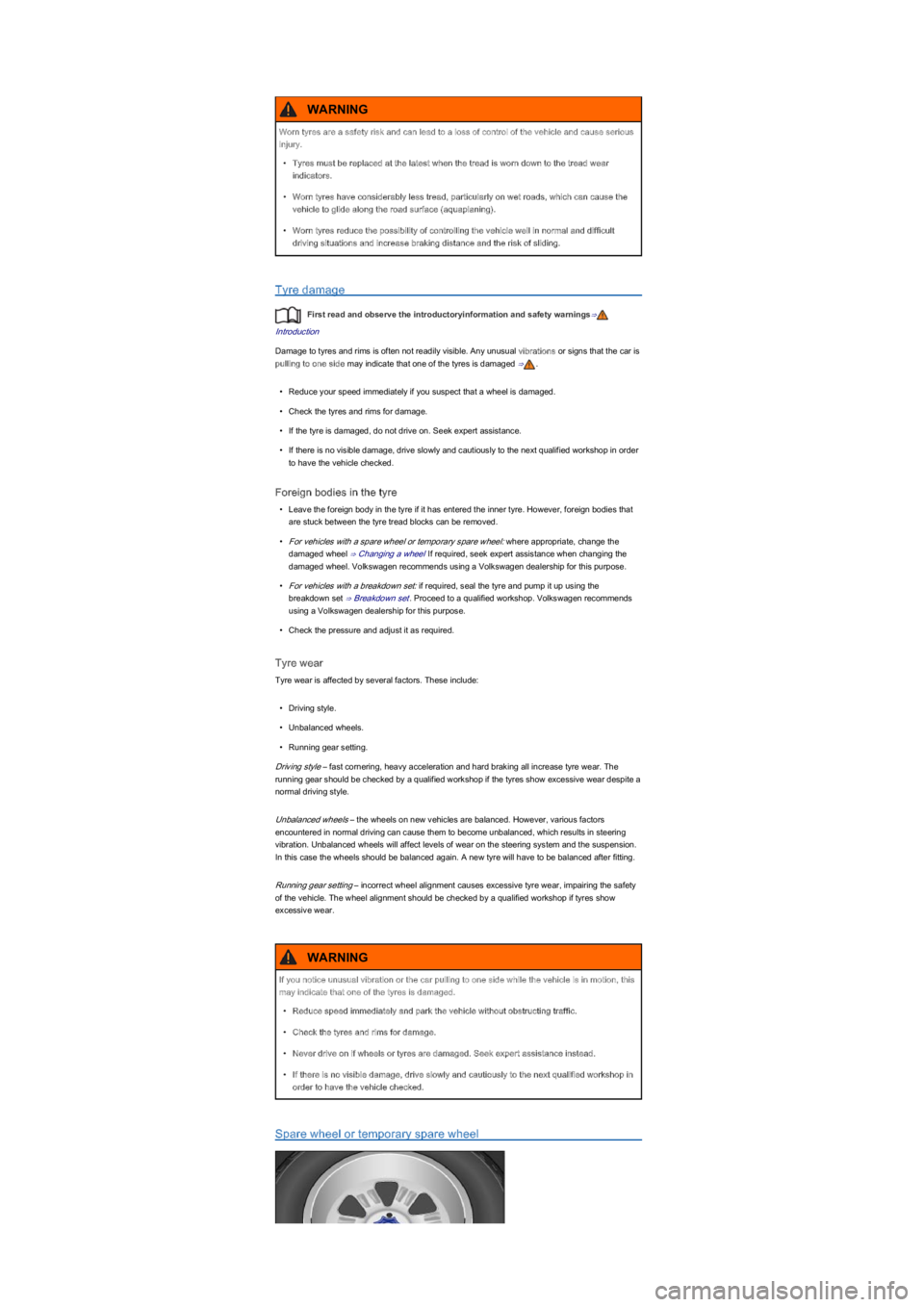
Spare wheel or temporary spare wheel
Worn tyres are a safety risk and can lead to a loss of control of the vehicle and cause serious
injury.
•Tyres must be replaced at the latest when the tread is worn down to the tread wear
indicators.
•Worn tyres have considerably less tread, particularly on wet roads, which can cause the
vehicle to glide along the road surface (aquaplaning).
•Worn tyres reduce the possibility of controlling the vehicle well in normal and difficult
driving situations and increase braking distance and the risk of sliding.
WARNING
If you notice unusual vibration or the car pulling to one side while the vehicle is in motion, this
may indicate that one of the tyres is damaged.
•Reduce speed immediately and park the vehicle without obstructing traffic.
•Check the tyres and rims for damage.
•Never drive on if wheels or tyres are damaged. Seek expert assistance instead.
•If there is no visible damage, drive slowly and cautiously to the next qualified workshop in
order to have the vehicle checked.
WARNING
Page 164 of 211
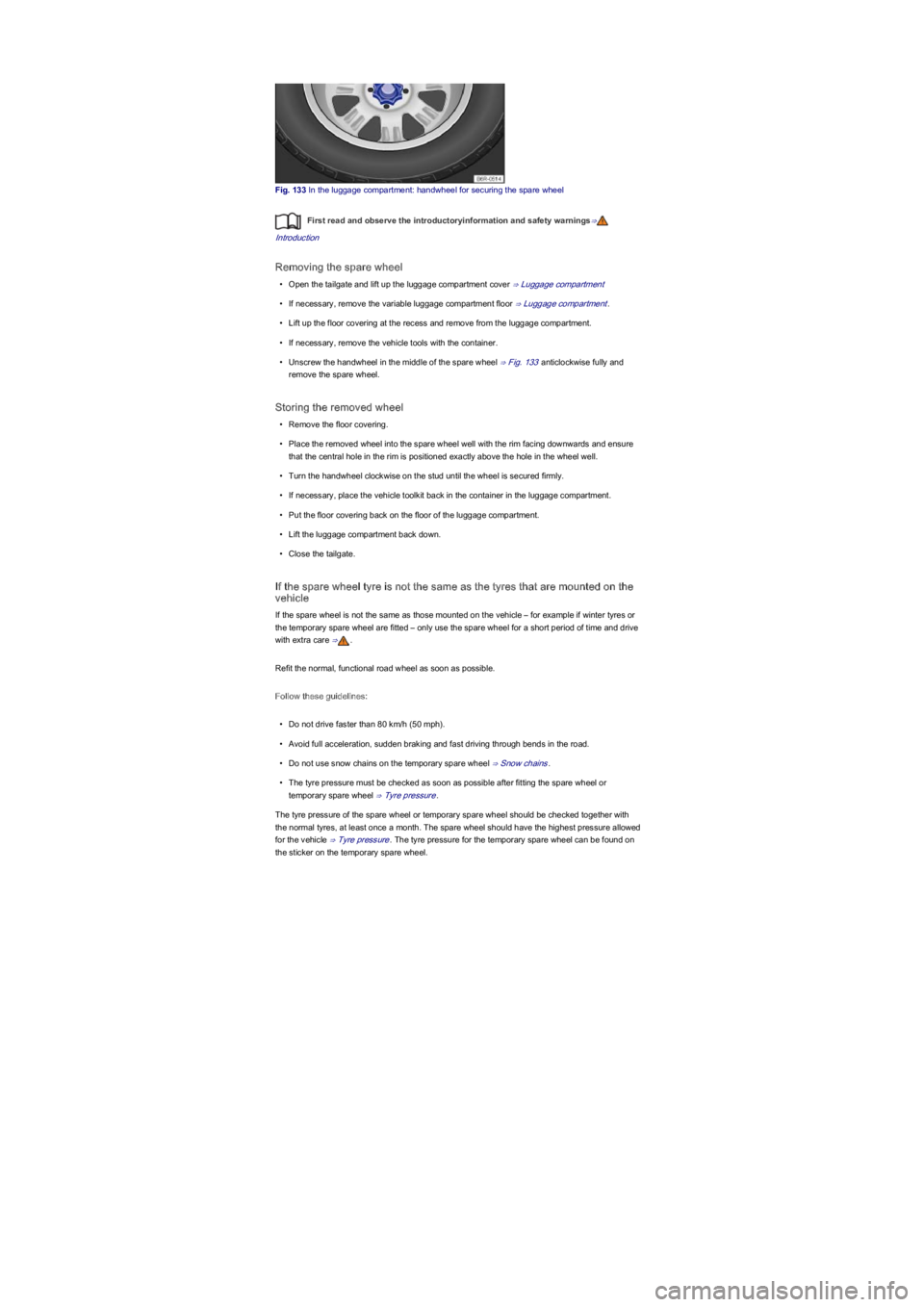
Fig. 133 In the luggage compartment: handwheel for securing the spare wheel
First read and observe the introductoryinformation and safety warnings⇒
Introduction
Removing the spare wheel
•Open the tailgate and lift up the luggage compartment cover ⇒ Luggage compartment
•If necessary, remove the variable luggage compartment floor ⇒ Luggage compartment.
•Lift up the floor covering at the recess and remove from the luggage compartment.
•If necessary, remove the vehicle tools with the container.
•Unscrew the handwheel in the middle of the spare wheel ⇒ Fig. 133 anticlockwise fully and
remove the spare wheel.
Storing the removed wheel
•Remove the floor covering.
•Place the removed wheel into the spare wheel well with the rim facing downwards and ensure
that the central hole in the rim is positioned exactly above the hole in the wheel well.
•Turn the handwheel clockwise on the stud until the wheel is secured firmly.
•If necessary, place the vehicle toolkit back in the container in the luggage compartment.
•Put the floor covering back on the floor of the luggage compartment.
•Lift the luggage compartment back down.
•Close the tailgate.
If the spare wheel tyre is not the same as the tyres that are mounted on the
vehicle
If the spare wheel is not the same as those mounted on the vehicle – for example if winter tyres or
the temporary spare wheel are fitted – only use the spare wheel for a short period of time and drive
with extra care ⇒.
Refit the normal, functional road wheel as soon as possible.
Follow these guidelines:
•Do not drive faster than 80 km/h (50 mph).
•Avoid full acceleration, sudden braking and fast driving through bends in the road.
•Do not use snow chains on the temporary spare wheel ⇒ Snow chains.
•The tyre pressure must be checked as soon as possible after fitting the spare wheel or
temporary spare wheel ⇒ Tyre pressure.
The tyre pressure of the spare wheel or temporary spare wheel should be checked together with
the normal tyres, at least once a month. The spare wheel should have the highest pressure allowed
for the vehicle ⇒ Tyre pressure. The tyre pressure for the temporary spare wheel can be found on
the sticker on the temporary spare wheel.
Page 173 of 211
Event data recorder
The vehicle is not fitted with an event data recorder.
Event data recorders temporarily store vehicle information. This provides precise information in the
event of an accident. In vehicles with an airbag system, data that might be relevant in the event of
an accident can be stored, e.g. impact speed, belt buckle status, seat positions and trigger speed.
The scope of the data is manufacturer-specific.
An event data recorder may only be fitted if the owner has approved the procedure. This is covered
by legislation in some countries.
Reprogramming control units
All data for the control of components are stored in the control units. Some convenience functions,
such as lane change flash, single door unlocking and displays, can be reprogrammed using special
workshop equipment. If this is the case, the descriptions in your vehicle wallet will no longer
correspond with the original functions. Volkswagen recommends that you have any reprogramming
confirmed in the service schedule under Workshop comments.
Information about possible reprogramming can be obtained from the Volkswagen dealership.
Reading the vehicle's event memory
A diagnostic interface for reading the event memories is located in the vehicle interior ⇒. Data
relating to the function and status of the electronic control units are stored in the event memory.
Additional information on the stored data is available from qualified workshops.
The diagnosis interface is located behind near the fuse box in the footwell on the driver side.
The event memory should only be read and reset by a qualified workshop.
After a fault has been rectified, the information in the memory pertaining to the fault is deleted.
Other memory content is overwritten on an on-going basis.
Using a mobile telephone in the vehicle without a connection to the
external aerial
First read and observe the introductoryinformation and safety warnings⇒
Introduction
Both during telephone calls and in standby mode, mobile telephones transmit and receive radio
waves, which may also be termed "high-frequency energy". Current scientific literature warns us
that radio waves can be harmful to human beings if they exceed certain limits. Government bodies
and international committees have introduced threshold values and guidelines to ensure that
electromagnetic radiation produced by mobile telephones does not pose a hazard to health.
However, there is no proven scientific evidence that demonstrates that cordless telephones are
absolutely safe.
For this reason, some experts are calling for more precautions to be taken in the use of mobile
telephones, by taking steps to reduce the level of personal exposure to electromagnetic radiation.
If a mobile telephone that is not connected to the vehicle's external aerial is used inside the vehicle,
the level of electromagnetic radiation could be higher than when the mobile telephone is connected
to an integrated aerial or any other external aerial.
If the vehicle is fitted with a suitable hands-free unit which enables the use of innumerable
additional functions of Bluetooth compatible mobile telephones, this will satisfy the legal
requirements in many countries which permit the use of a mobile telephone in a vehicle only if a
hands-free unit is used.
The hands-free system of the portable navigation device (delivered by Volkswagen) in your vehicle
has been developed for mobile telephones that are compatible with Bluetooth⇒ Portable
navigation device. Mobile telephones must be located in a suitable telephone holder or be stored
securely in the vehicle. If a telephone holder is used it must be securely attached to the base plate.
This is the only way to ensure that the mobile telephone is securely attached to the dash panel and
always within reach of the driver. Depending on the hands-free system, the connection between the
mobile telephone and the external aerial is established either via the telephone holder or via an
existing Bluetooth connection between the mobile telephone and the vehicle.
Connecting the mobile telephone is to a telephone aerial integrated in the vehicle or to an external
telephone aerial reduces the electromagnetic radiation generated by the telephone which could
affect the human body. Using an aerial also improves the quality of the signal.
Incorrect use of the diagnostic interface can cause faults, which can result in accidents and
serious injuries.
•Never read the event memory using the diagnostic interface yourself.
•The diagnostic interface should only be read by a qualified workshop.
WARNING
®
®
®
Page 174 of 211
If a mobile telephone is used in the vehicle interior without this hands-free system, it is not safely
secured in the vehicle and also not connected to the vehicle's external telephone aerial.
Furthermore, the mobile telephone is not being charged in the telephone holder. It is also likely that
the telephone connection will be disrupted and the signal strength will be poor.
A mobile telephone should only be used in the vehicle if it is connected to a hands-free unit.
Volkswagen recommends the use of an external aerial when using a mobile telephone in the
vehicle.
Bluetooth is a registered trademark of Bluetooth SIG, Inc.
Portable navigation device
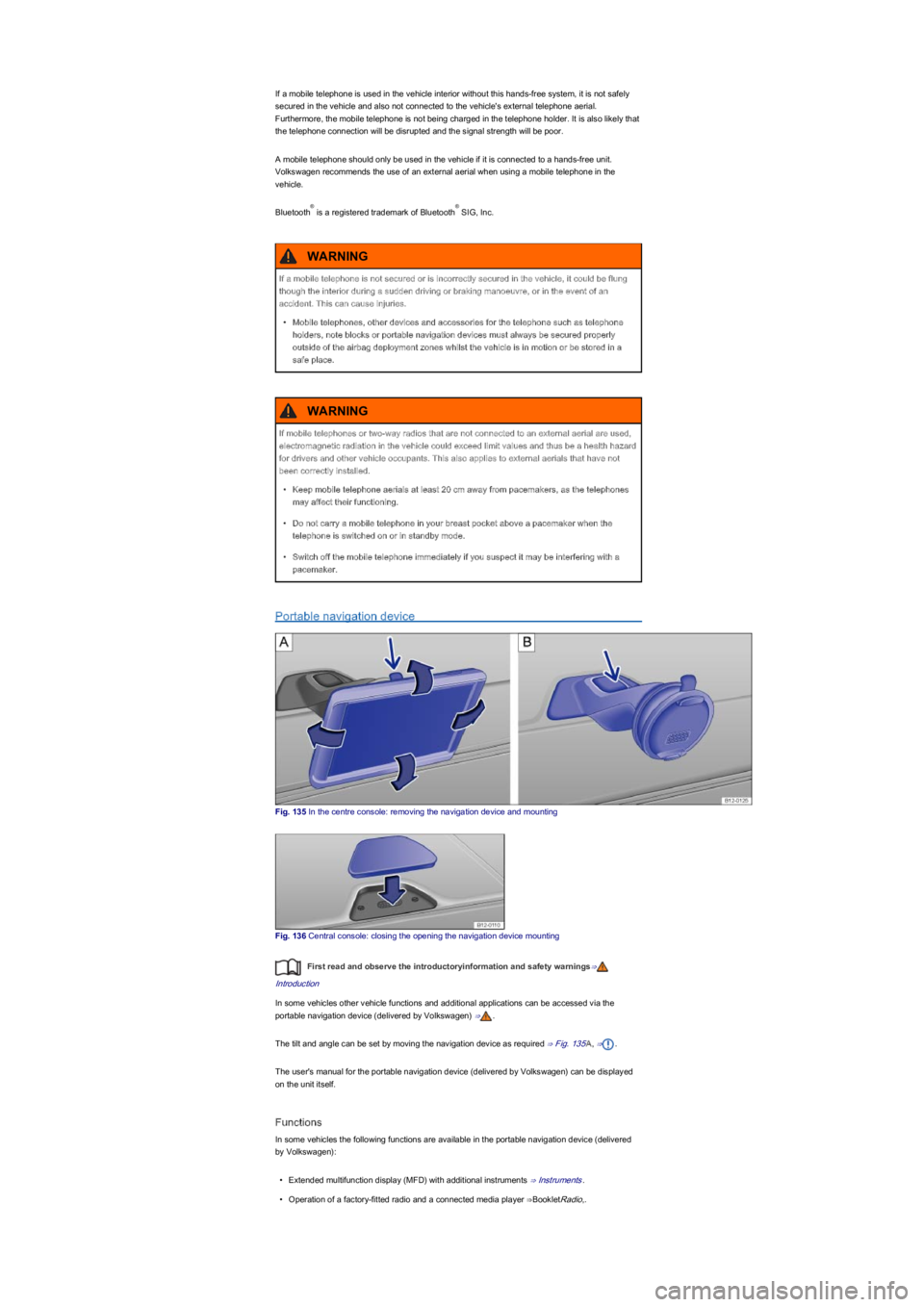
Fig. 135 In the centre console: removing the navigation device and mounting
Fig. 136 Central console: closing the opening the navigation device mounting
First read and observe the introductoryinformation and safety warnings⇒
Introduction
In some vehicles other vehicle functions and additional applications can be accessed via the
portable navigation device (delivered by Volkswagen) ⇒.
The tilt and angle can be set by moving the navigation device as required ⇒ Fig. 135A, ⇒.
The user's manual for the portable navigation device (delivered by Volkswagen) can be displayed
on the unit itself.
Functions
In some vehicles the following functions are available in the portable navigation device (delivered
by Volkswagen):
•Extended multifunction display (MFD) with additional instruments ⇒ Instruments.
•Operation of a factory-fitted radio and a connected media player ⇒BookletRadio,.
®®
If a mobile telephone is not secured or is incorrectly secured in the vehicle, it could be flung
though the interior during a sudden driving or braking manoeuvre, or in the event of an
accident. This can cause injuries.
•Mobile telephones, other devices and accessories for the telephone such as telephone
holders, note blocks or portable navigation devices must always be secured properly
outside of the airbag deployment zones whilst the vehicle is in motion or be stored in a
safe place.
WARNING
If mobile telephones or two-way radios that are not connected to an external aerial are used,
electromagnetic radiation in the vehicle could exceed limit values and thus be a health hazard
for drivers and other vehicle occupants. This also applies to external aerials that have not
been correctly installed.
•Keep mobile telephone aerials at least 20 cm away from pacemakers, as the telephones
may affect their functioning.
•Do not carry a mobile telephone in your breast pocket above a pacemaker when the
telephone is switched on or in standby mode.
•Switch off the mobile telephone immediately if you suspect it may be interfering with a
pacemaker.
WARNING
Page 178 of 211
Information stickers and plates
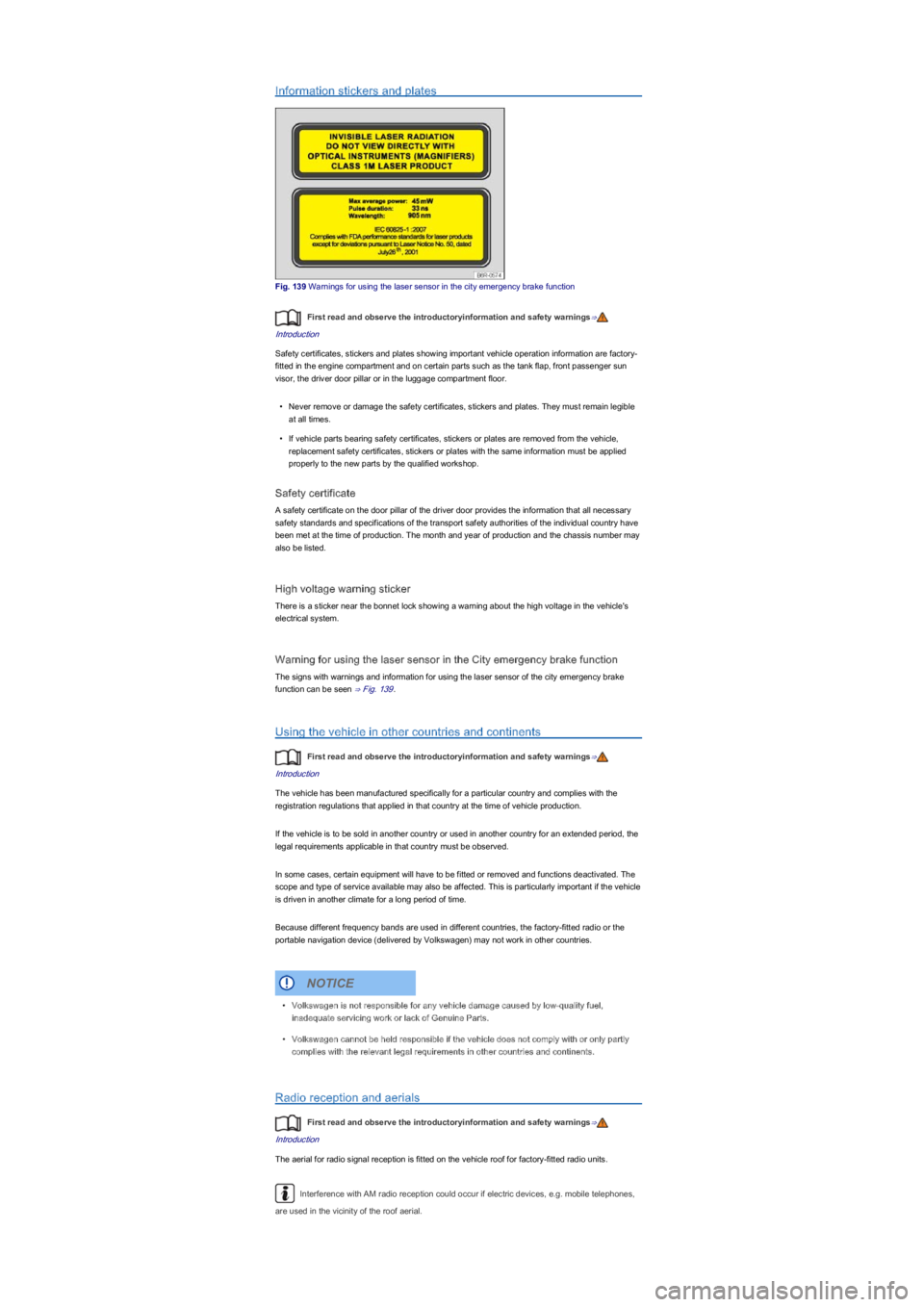
Fig. 139 Warnings for using the laser sensor in the city emergency brake function
First read and observe the introductoryinformation and safety warnings⇒
Introduction
Safety certificates, stickers and plates showing important vehicle operation information are factory-
fitted in the engine compartment and on certain parts such as the tank flap, front passenger sun
visor, the driver door pillar or in the luggage compartment floor.
•Never remove or damage the safety certificates, stickers and plates. They must remain legible
at all times.
•If vehicle parts bearing safety certificates, stickers or plates are removed from the vehicle,
replacement safety certificates, stickers or plates with the same information must be applied
properly to the new parts by the qualified workshop.
Safety certificate
A safety certificate on the door pillar of the driver door provides the information that all necessary
safety standards and specifications of the transport safety authorities of the individual country have
been met at the time of production. The month and year of production and the chassis number may
also be listed.
High voltage warning sticker
There is a sticker near the bonnet lock showing a warning about the high voltage in the vehicle's
electrical system.
Warning for using the laser sensor in the City emergency brake function
The signs with warnings and information for using the laser sensor of the city emergency brake
function can be seen ⇒ Fig. 139.
Using the vehicle in other countries and continents
First read and observe the introductoryinformation and safety warnings⇒
Introduction
The vehicle has been manufactured specifically for a particular country and complies with the
registration regulations that applied in that country at the time of vehicle production.
If the vehicle is to be sold in another country or used in another country for an extended period, the
legal requirements applicable in that country must be observed.
In some cases, certain equipment will have to be fitted or removed and functions deactivated. The
scope and type of service available may also be affected. This is particularly important if the vehicle
is driven in another climate for a long period of time.
Because different frequency bands are used in different countries, the factory-fitted radio or the
portable navigation device (delivered by Volkswagen) may not work in other countries.
Radio reception and aerials
First read and observe the introductoryinformation and safety warnings⇒
Introduction
The aerial for radio signal reception is fitted on the vehicle roof for factory-fitted radio units.
Interference with AM radio reception could occur if electric devices, e.g. mobile telephones,
are used in the vicinity of the roof aerial.
•Volkswagen is not responsible for any vehicle damage caused by low-quality fuel,
inadequate servicing work or lack of Genuine Parts.
•Volkswagen cannot be held responsible if the vehicle does not comply with or only partly
complies with the relevant legal requirements in other countries and continents.
NOTICE
Page 181 of 211
Practical tips
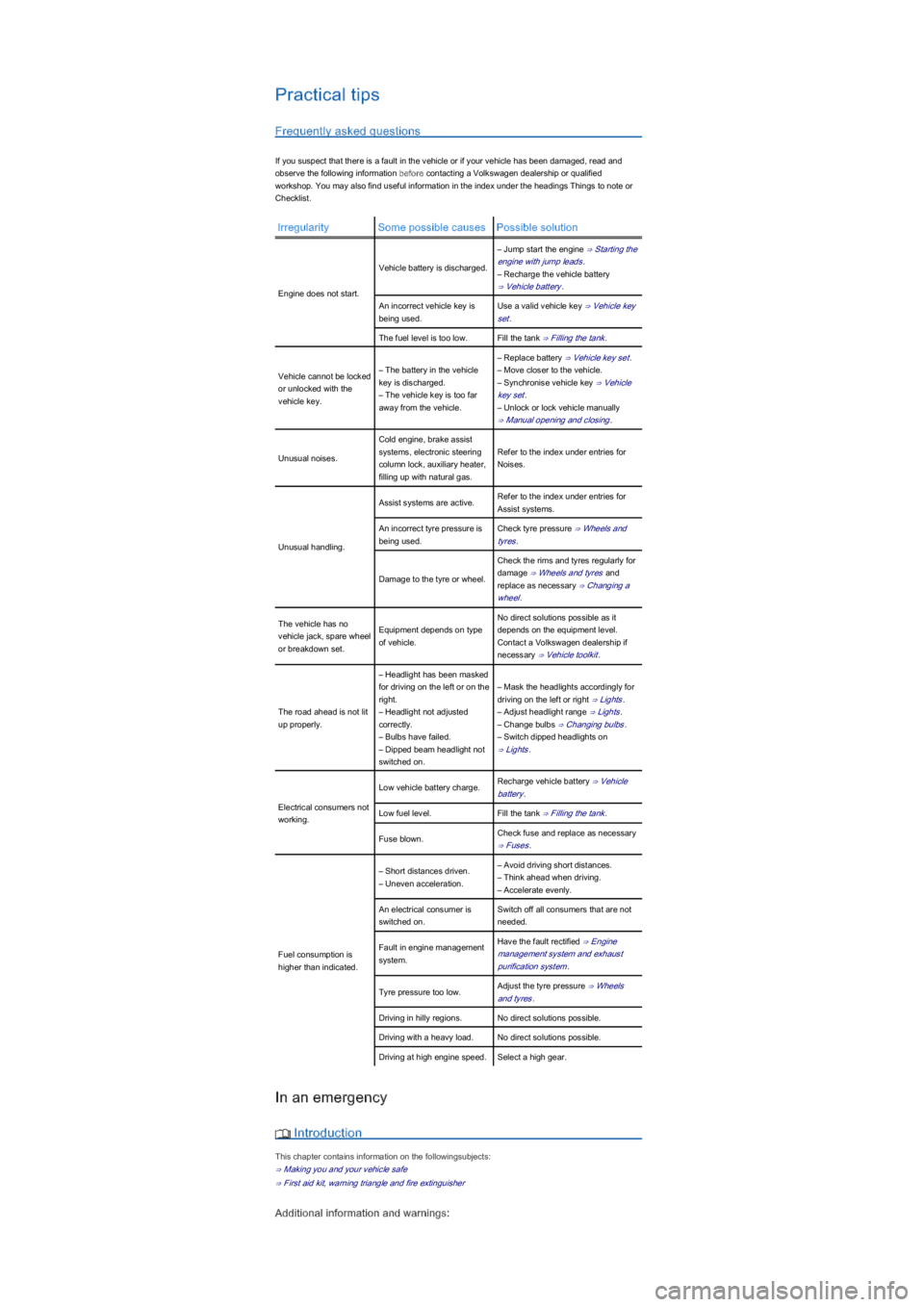
Frequently asked questions
If you suspect that there is a fault in the vehicle or if your vehicle has been damaged, read and
observe the following information before contacting a Volkswagen dealership or qualified
workshop. You may also find useful information in the index under the headings Things to note or
Checklist.
IrregularitySome possible causesPossible solution
Engine does not start.
Vehicle battery is discharged.
– Jump start the engine ⇒ Starting the
engine with jump leads.
– Recharge the vehicle battery
⇒ Vehicle battery.
An incorrect vehicle key is
being used.
Use a valid vehicle key ⇒ Vehicle key
set.
The fuel level is too low.Fill the tank ⇒ Filling the tank.
Vehicle cannot be locked
or unlocked with the
vehicle key.
– The battery in the vehicle
key is discharged.
– The vehicle key is too far
away from the vehicle.
– Replace battery ⇒ Vehicle key set.
– Move closer to the vehicle.
– Synchronise vehicle key ⇒ Vehicle
key set.
– Unlock or lock vehicle manually
⇒ Manual opening and closing.
Unusual noises.
Cold engine, brake assist
systems, electronic steering
column lock, auxiliary heater,
filling up with natural gas.
Refer to the index under entries for
Noises.
Unusual handling.
Assist systems are active.Refer to the index under entries for
Assist systems.
An incorrect tyre pressure is
being used.
Check tyre pressure ⇒ Wheels and
tyres.
Damage to the tyre or wheel.
Check the rims and tyres regularly for
damage ⇒ Wheels and tyres and
replace as necessary ⇒ Changing a
wheel.
The vehicle has no
vehicle jack, spare wheel
or breakdown set.
Equipment depends on type
of vehicle.
No direct solutions possible as it
depends on the equipment level.
Contact a Volkswagen dealership if
necessary ⇒ Vehicle toolkit.
The road ahead is not lit
up properly.
– Headlight has been masked
for driving on the left or on the
right.
– Headlight not adjusted
correctly.
– Bulbs have failed.
– Dipped beam headlight not
switched on.
– Mask the headlights accordingly for
driving on the left or right ⇒ Lights.
– Adjust headlight range ⇒ Lights.
– Change bulbs ⇒ Changing bulbs.
– Switch dipped headlights on
⇒ Lights.
Electrical consumers not
working.
Low vehicle battery charge.Recharge vehicle battery ⇒ Vehicle
battery.
Low fuel level.Fill the tank ⇒ Filling the tank.
Fuse blown.Check fuse and replace as necessary
⇒ Fuses.
Fuel consumption is
higher than indicated.
– Short distances driven.
– Uneven acceleration.
– Avoid driving short distances.
– Think ahead when driving.
– Accelerate evenly.
An electrical consumer is
switched on.
Switch off all consumers that are not
needed.
Fault in engine management
system.
Have the fault rectified ⇒ Engine
management system and exhaust
purification system.
Tyre pressure too low.Adjust the tyre pressure ⇒ Wheels
and tyres.
Driving in hilly regions.No direct solutions possible.
Driving with a heavy load.No direct solutions possible.
Driving at high engine speed.Select a high gear.
In an emergency
Introduction
This chapter contains information on the followingsubjects:
⇒ Making you and your vehicle safe
⇒ First aid kit, warning triangle and fire extinguisher
Additional information and warnings:
Page 182 of 211
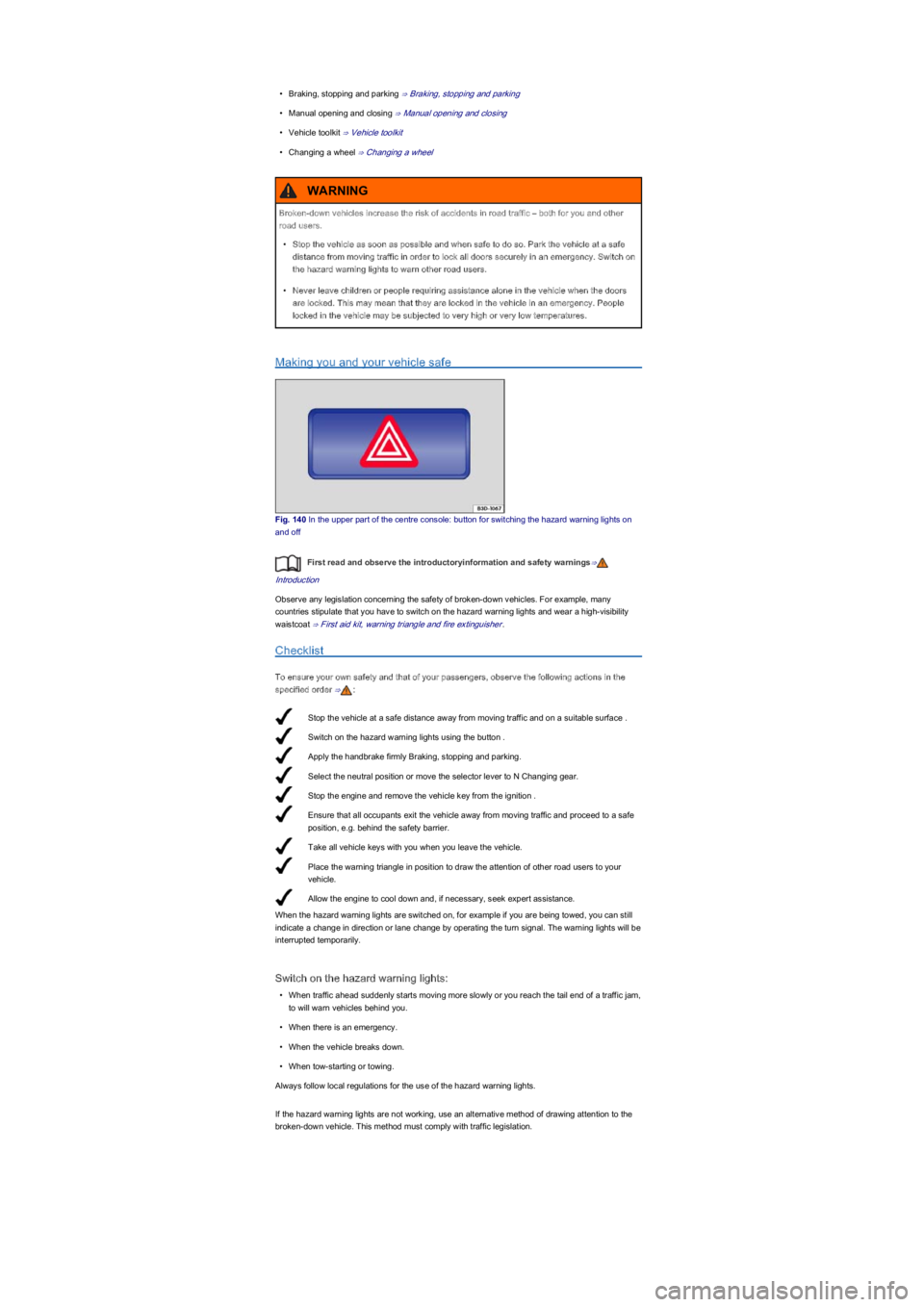
Stop the vehicle at a safe distance away from moving traffic and on a suitable surface .
Switch on the hazard warning lights using the button .
Apply the handbrake firmly Braking, stopping and parking.
Select the neutral position or move the selector lever to N Changing gear.
Stop the engine and remove the vehicle key from the ignition .
Ensure that all occupants exit the vehicle away from moving traffic and proceed to a safe
position, e.g. behind the safety barrier.
Take all vehicle keys with you when you leave the vehicle.
Place the warning triangle in position to draw the attention of other road users to your
vehicle.
Allow the engine to cool down and, if necessary, seek expert assistance.
•Braking, stopping and parking ⇒ Braking, stopping and parking
•Manual opening and closing ⇒ Manual opening and closing
•Vehicle toolkit ⇒ Vehicle toolkit
•Changing a wheel ⇒ Changing a wheel
Making you and your vehicle safe
Fig. 140 In the upper part of the centre console: button for switching the hazard warning lights on
and off
First read and observe the introductoryinformation and safety warnings⇒
Introduction
Observe any legislation concerning the safety of broken-down vehicles. For example, many
countries stipulate that you have to switch on the hazard warning lights and wear a high-visibility
waistcoat ⇒ First aid kit, warning triangle and fire extinguisher.
Checklist
To ensure your own safety and that of your passengers, observe the following actions in the
specified order ⇒:
When the hazard warning lights are switched on, for example if you are being towed, you can still
indicate a change in direction or lane change by operating the turn signal. The warning lights will be
interrupted temporarily.
Switch on the hazard warning lights:
•When traffic ahead suddenly starts moving more slowly or you reach the tail end of a traffic jam,
to will warn vehicles behind you.
•When there is an emergency.
•When the vehicle breaks down.
•When tow-starting or towing.
Always follow local regulations for the use of the hazard warning lights.
If the hazard warning lights are not working, use an alternative method of drawing attention to the
broken-down vehicle. This method must comply with traffic legislation.
Broken-down vehicles increase the risk of accidents in road traffic – both for you and other
road users.
•Stop the vehicle as soon as possible and when safe to do so. Park the vehicle at a safe
distance from moving traffic in order to lock all doors securely in an emergency. Switch on
the hazard warning lights to warn other road users.
•Never leave children or people requiring assistance alone in the vehicle when the doors
are locked. This may mean that they are locked in the vehicle in an emergency. People
locked in the vehicle may be subjected to very high or very low temperatures.
WARNING
Page 183 of 211
The vehicle battery will discharge if the hazard warning lights are left on over a long period of
time – even when the ignition is switched off.
If you brake hard at speeds over approximately 80 km/h (50 mph), the brake lights will flash
to warn the traffic behind. If you then continue to brake, the hazard warning lights will be switched
on automatically at speeds under approximately 10 km/h (6 mph). The brake light will light up
continuously. Once the vehicle starts to accelerate, the hazard warning lights will switch off again.
First aid kit, warning triangle and fire extinguisher
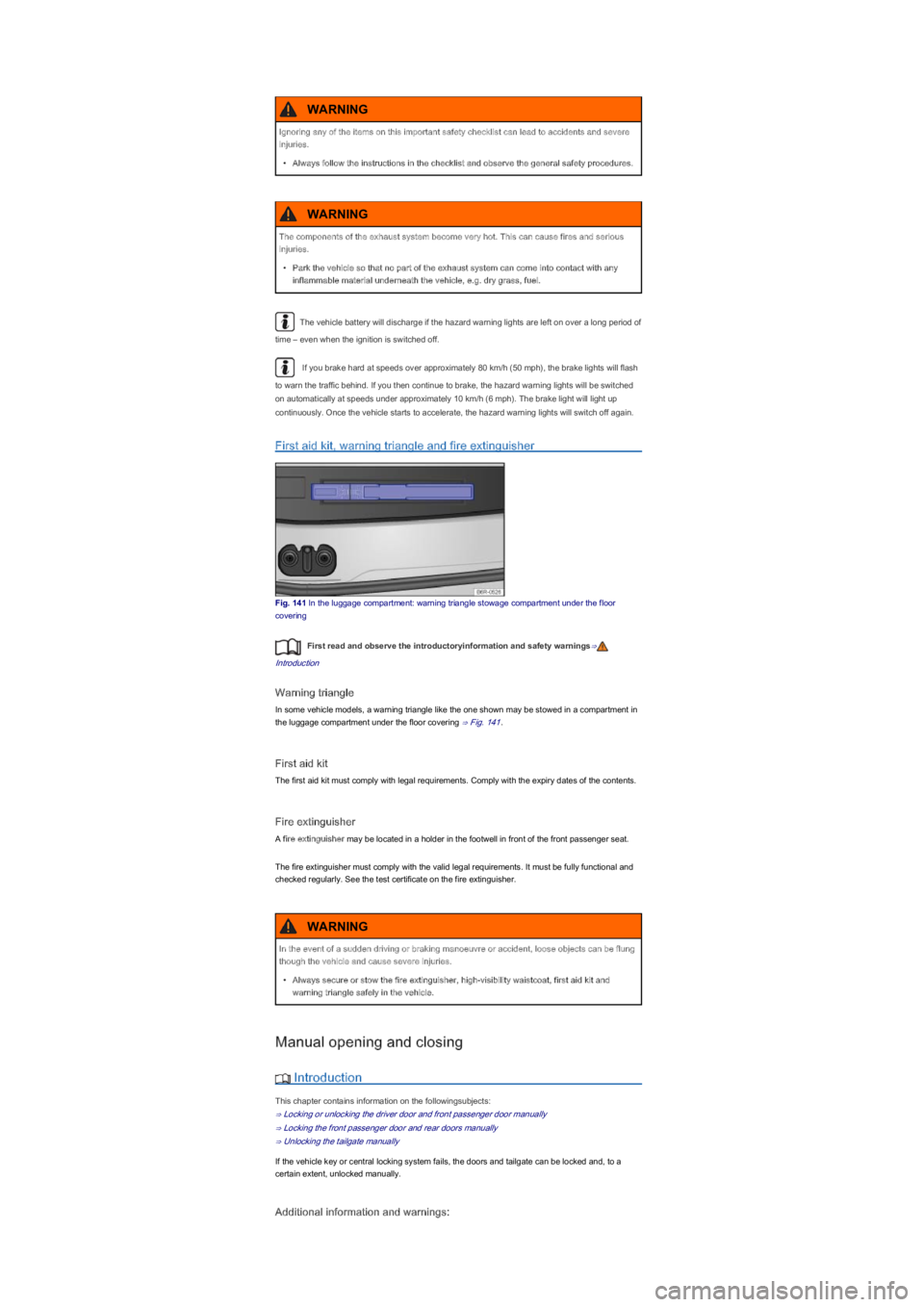
Fig. 141 In the luggage compartment: warning triangle stowage compartment under the floor
covering
First read and observe the introductoryinformation and safety warnings⇒
Introduction
Warning triangle
In some vehicle models, a warning triangle like the one shown may be stowed in a compartment in
the luggage compartment under the floor covering ⇒ Fig. 141.
First aid kit
The first aid kit must comply with legal requirements. Comply with the expiry dates of the contents.
Fire extinguisher
A fire extinguisher may be located in a holder in the footwell in front of the front passenger seat.
The fire extinguisher must comply with the valid legal requirements. It must be fully functional and
checked regularly. See the test certificate on the fire extinguisher.
Manual opening and closing
Introduction
This chapter contains information on the followingsubjects:
⇒ Locking or unlocking the driver door and front passenger door manually
⇒ Locking the front passenger door and rear doors manually
⇒ Unlocking the tailgate manually
If the vehicle key or central locking system fails, the doors and tailgate can be locked and, to a
certain extent, unlocked manually.
Additional information and warnings:
Ignoring any of the items on this important safety checklist can lead to accidents and severe
injuries.
•Always follow the instructions in the checklist and observe the general safety procedures.
WARNING
The components of the exhaust system become very hot. This can cause fires and serious
injuries.
•Park the vehicle so that no part of the exhaust system can come into contact with any
inflammable material underneath the vehicle, e.g. dry grass, fuel.
WARNING
In the event of a sudden driving or braking manoeuvre or accident, loose objects can be flung
though the vehicle and cause severe injuries.
•Always secure or stow the fire extinguisher, high-visibility waistcoat, first aid kit and
warning triangle safely in the vehicle.
WARNING
Page 184 of 211
•Vehicle key set ⇒ Vehicle key set
•Central locking system ⇒ Central locking system
•Doors ⇒ Doors
•Tailgate ⇒ Tailgate
•In an emergency ⇒ In an emergency
Locking or unlocking the driver door and front passenger door
manually
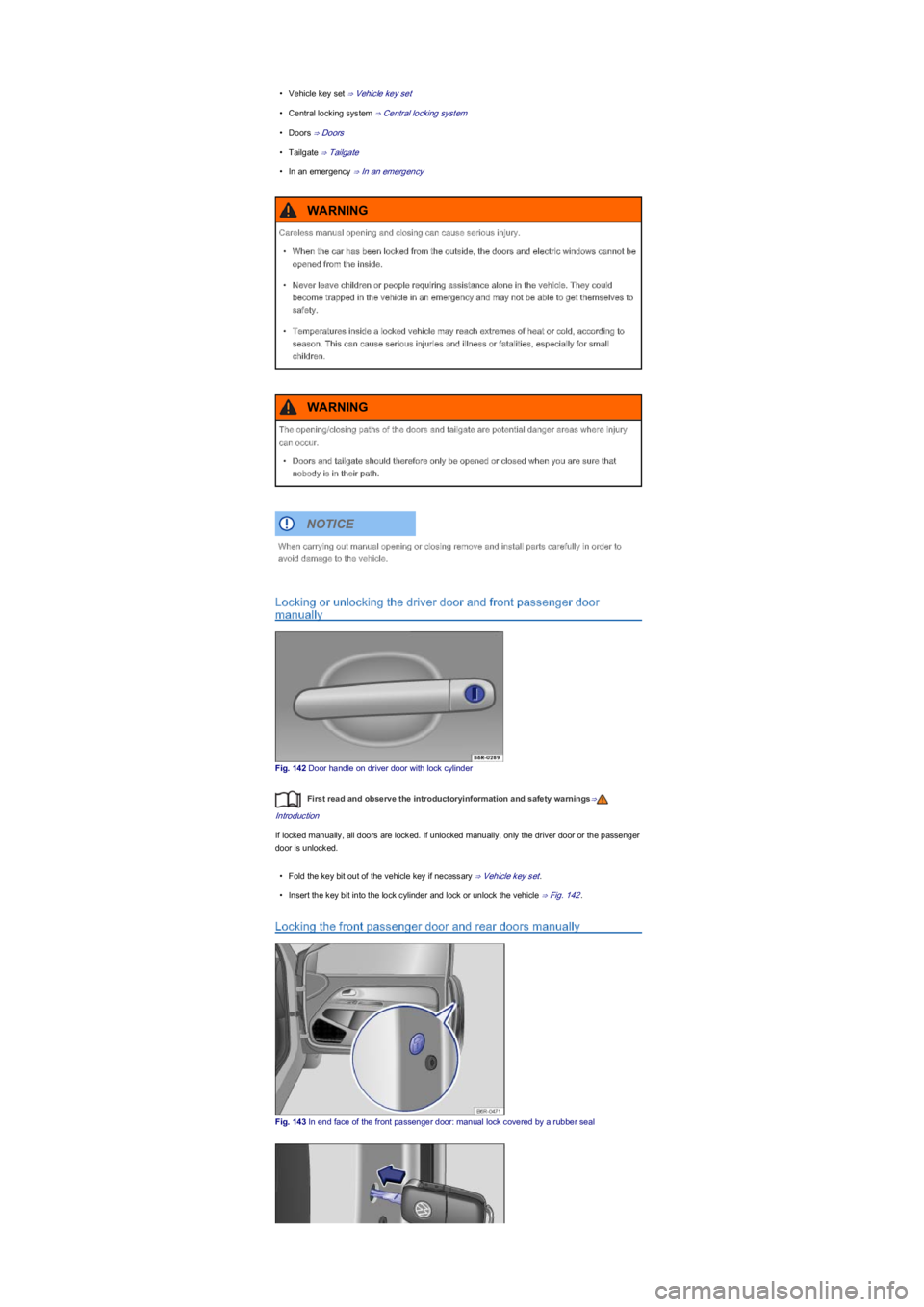
Fig. 142 Door handle on driver door with lock cylinder
First read and observe the introductoryinformation and safety warnings⇒
Introduction
If locked manually, all doors are locked. If unlocked manually, only the driver door or the passenger
door is unlocked.
•Fold the key bit out of the vehicle key if necessary ⇒ Vehicle key set.
•Insert the key bit into the lock cylinder and lock or unlock the vehicle ⇒ Fig. 142.
Locking the front passenger door and rear doors manually
Fig. 143 In end face of the front passenger door: manual lock covered by a rubber seal
Careless manual opening and closing can cause serious injury.
•When the car has been locked from the outside, the doors and electric windows cannot be
opened from the inside.
•Never leave children or people requiring assistance alone in the vehicle. They could
become trapped in the vehicle in an emergency and may not be able to get themselves to
safety.
•Temperatures inside a locked vehicle may reach extremes of heat or cold, according to
season. This can cause serious injuries and illness or fatalities, especially for small
children.
WARNING
The opening/closing paths of the doors and tailgate are potential danger areas where injury
can occur.
•Doors and tailgate should therefore only be opened or closed when you are sure that
nobody is in their path.
WARNING
When carrying out manual opening or closing remove and install parts carefully in order to
avoid damage to the vehicle.
NOTICE
Page 185 of 211
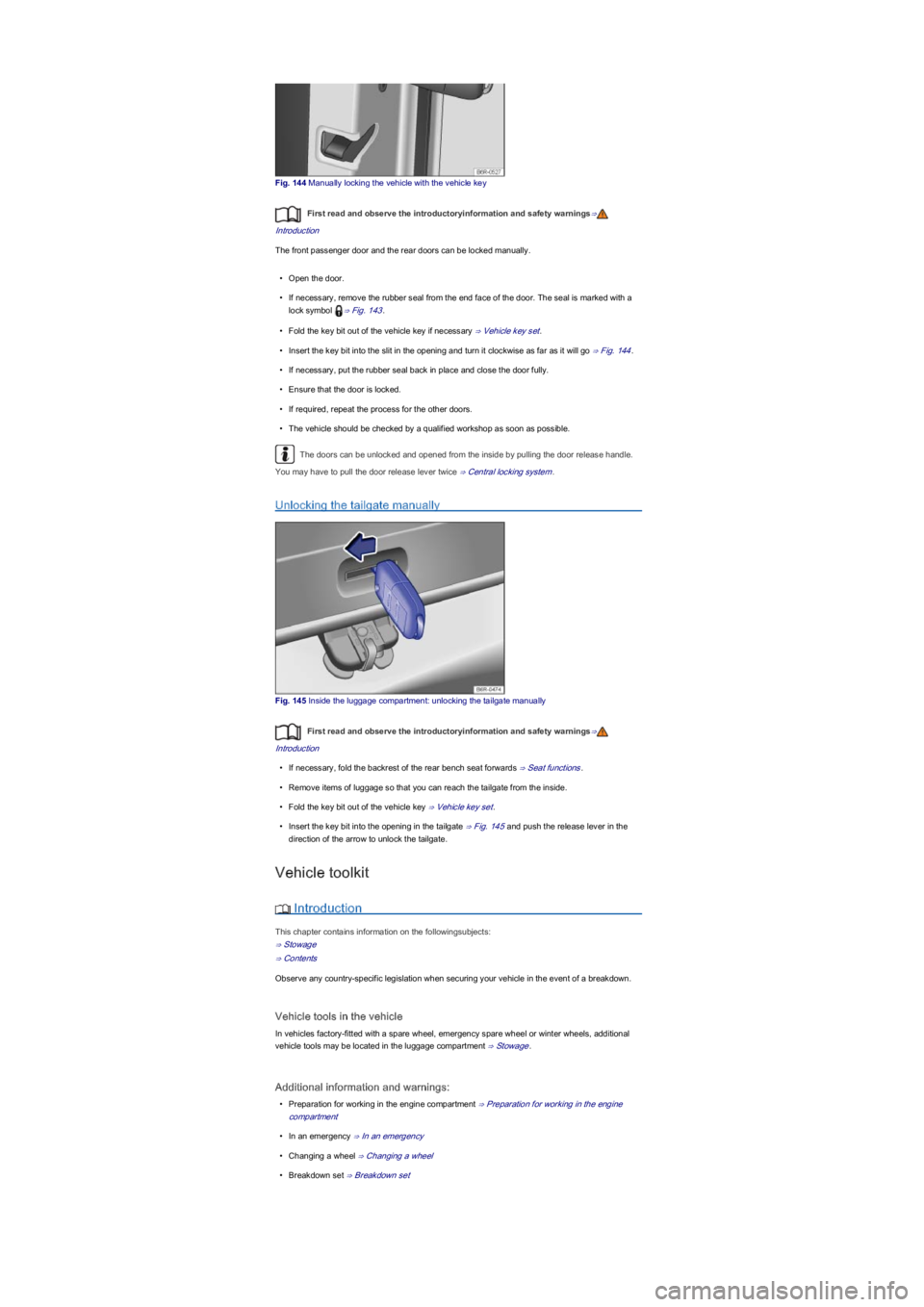
Fig. 144 Manually locking the vehicle with the vehicle key
First read and observe the introductoryinformation and safety warnings⇒
Introduction
The front passenger door and the rear doors can be locked manually.
•Open the door.
•If necessary, remove the rubber seal from the end face of the door. The seal is marked with a
lock symbol ⇒ Fig. 143.
•Fold the key bit out of the vehicle key if necessary ⇒ Vehicle key set.
•Insert the key bit into the slit in the opening and turn it clockwise as far as it will go ⇒ Fig. 144.
•If necessary, put the rubber seal back in place and close the door fully.
•Ensure that the door is locked.
•If required, repeat the process for the other doors.
•The vehicle should be checked by a qualified workshop as soon as possible.
The doors can be unlocked and opened from the inside by pulling the door release handle.
You may have to pull the door release lever twice ⇒ Central locking system.
Unlocking the tailgate manually
Fig. 145 Inside the luggage compartment: unlocking the tailgate manually
First read and observe the introductoryinformation and safety warnings⇒
Introduction
•If necessary, fold the backrest of the rear bench seat forwards ⇒ Seat functions.
•Remove items of luggage so that you can reach the tailgate from the inside.
•Fold the key bit out of the vehicle key ⇒ Vehicle key set.
•Insert the key bit into the opening in the tailgate ⇒ Fig. 145 and push the release lever in the
direction of the arrow to unlock the tailgate.
Vehicle toolkit
Introduction
This chapter contains information on the followingsubjects:
⇒ Stowage
⇒ Contents
Observe any country-specific legislation when securing your vehicle in the event of a breakdown.
Vehicle tools in the vehicle
In vehicles factory-fitted with a spare wheel, emergency spare wheel or winter wheels, additional
vehicle tools may be located in the luggage compartment ⇒ Stowage.
Additional information and warnings:
•Preparation for working in the engine compartment ⇒ Preparation for working in the engine
compartment
•In an emergency ⇒ In an emergency
•Changing a wheel ⇒ Changing a wheel
•Breakdown set ⇒ Breakdown set