lock VOLKSWAGEN UP! 2021 Owner´s Manual
[x] Cancel search | Manufacturer: VOLKSWAGEN, Model Year: 2021, Model line: UP!, Model: VOLKSWAGEN UP! 2021Pages: 211, PDF Size: 5.98 MB
Page 99 of 211
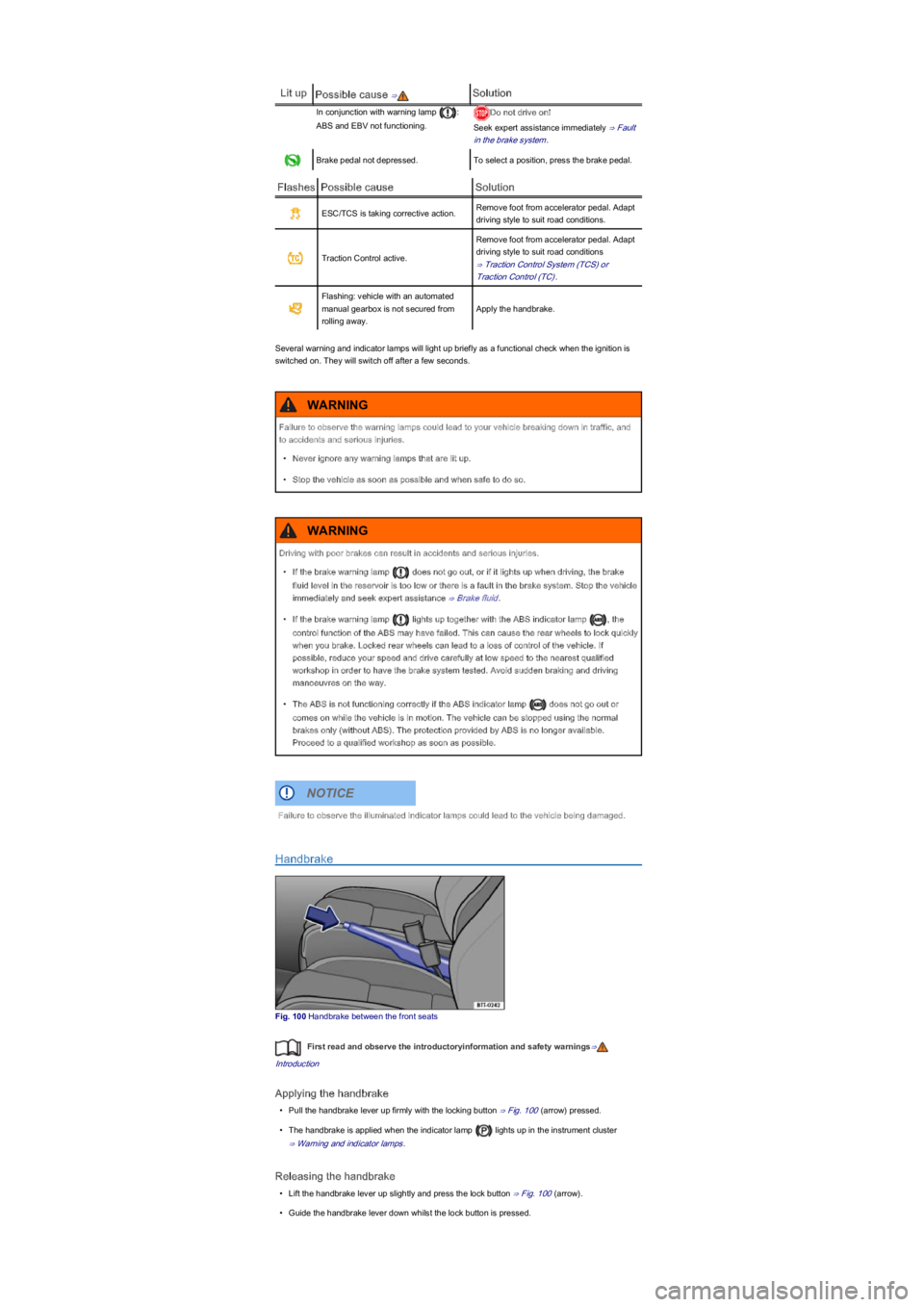
Lit upPossible cause ⇒Solution
In conjunction with warning lamp :
ABS and EBV not functioning.
Do not drive on!
Seek expert assistance immediately ⇒ Fault
in the brake system.
Brake pedal not depressed.To select a position, press the brake pedal.
FlashesPossible causeSolution
ESC/TCS is taking corrective action.Remove foot from accelerator pedal. Adapt
driving style to suit road conditions.
Traction Control active.
Remove foot from accelerator pedal. Adapt
driving style to suit road conditions
⇒ Traction Control System (TCS) or
Traction Control (TC).
Flashing: vehicle with an automated
manual gearbox is not secured from
rolling away.
Apply the handbrake.
Several warning and indicator lamps will light up briefly as a functional check when the ignition is
switched on. They will switch off after a few seconds.
Handbrake
Fig. 100 Handbrake between the front seats
First read and observe the introductoryinformation and safety warnings⇒
Introduction
Applying the handbrake
•Pull the handbrake lever up firmly with the locking button ⇒ Fig. 100 (arrow) pressed.
•The handbrake is applied when the indicator lamp lights up in the instrument cluster
⇒ Warning and indicator lamps.
Releasing the handbrake
•Lift the handbrake lever up slightly and press the lock button ⇒ Fig. 100 (arrow).
•Guide the handbrake lever down whilst the lock button is pressed.
Failure to observe the warning lamps could lead to your vehicle breaking down in traffic, and
to accidents and serious injuries.
•Never ignore any warning lamps that are lit up.
•Stop the vehicle as soon as possible and when safe to do so.
WARNING
Driving with poor brakes can result in accidents and serious injuries.
•If the brake warning lamp does not go out, or if it lights up when driving, the brake
fluid level in the reservoir is too low or there is a fault in the brake system. Stop the vehicle
immediately and seek expert assistance ⇒ Brake fluid.
•If the brake warning lamp lights up together with the ABS indicator lamp , the
control function of the ABS may have failed. This can cause the rear wheels to lock quickly
when you brake. Locked rear wheels can lead to a loss of control of the vehicle. If
possible, reduce your speed and drive carefully at low speed to the nearest qualified
workshop in order to have the brake system tested. Avoid sudden braking and driving
manoeuvres on the way.
•The ABS is not functioning correctly if the ABS indicator lamp does not go out or
comes on while the vehicle is in motion. The vehicle can be stopped using the normal
brakes only (without ABS). The protection provided by ABS is no longer available.
Proceed to a qualified workshop as soon as possible.
WARNING
Failure to observe the illuminated indicator lamps could lead to the vehicle being damaged.
NOTICE
Page 100 of 211
An acoustic warning is given if the car is driven faster than approximately 6 km/h (4 mph)
with the handbrake applied.
Parking
First read and observe the introductoryinformation and safety warnings⇒
Introduction
Please adhere to relevant legislation when stopping and parking your vehicle.
Stopping the vehicle
The steps should only be carried out in the specified order.
•Stop the vehicle on a suitable surface ⇒.
•Depress and hold the brake pedal until the engine has stopped.
•Apply the handbrake firmly ⇒ Handbrake.
•With an automated manual gearbox, move the selector lever to position D or R.
•Switch off the engine and take your foot off the brake pedal.
•Remove the vehicle key from the ignition lock.
•Turn the steering wheel slightly if necessary to engage the steering lock mechanism.
•With a manual gearbox, select first gear for flat ground and uphill inclines, or reverse gear for
downhill inclines, and then release the clutch.
•Please ensure that all occupants, in particular children, leave the vehicle.
•Take all vehicle keys with you when you leave the vehicle.
•Lock the vehicle.
Additional points for ascending and descending inclines
Before switching off the engine, turn the steering wheel so that the front wheels will roll against the
kerb if the parked vehicle starts to move.
•When facing downhill, turn the wheels so that they face the kerb.
•When facing uphill, turn the wheels so that they face the centre of the road.
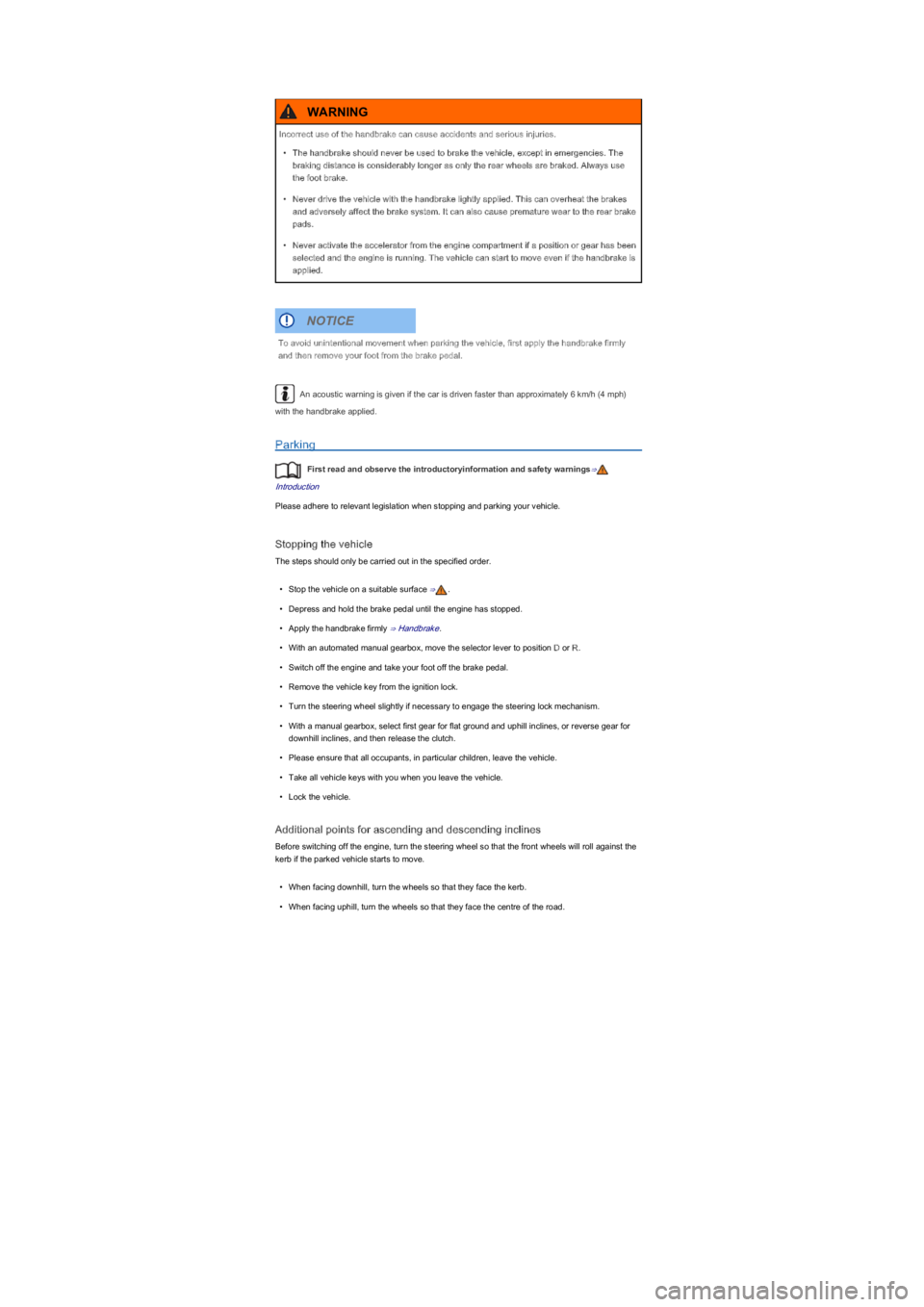
Incorrect use of the handbrake can cause accidents and serious injuries.
•The handbrake should never be used to brake the vehicle, except in emergencies. The
braking distance is considerably longer as only the rear wheels are braked. Always use
the foot brake.
•Never drive the vehicle with the handbrake lightly applied. This can overheat the brakes
and adversely affect the brake system. It can also cause premature wear to the rear brake
pads.
•Never activate the accelerator from the engine compartment if a position or gear has been
selected and the engine is running. The vehicle can start to move even if the handbrake is
applied.
WARNING
To avoid unintentional movement when parking the vehicle, first apply the handbrake firmly
and then remove your foot from the brake pedal.
NOTICE
Page 103 of 211
to assist every time that there is a sudden change in the road surface quality. If a section of dry
road is suddenly covered with water, mud or snow, ESC will not be able to assist in the same
manner as on a dry road. If the vehicle aquaplanes (drives on a layer of water rather than on the
road surface), ESC will not be able to assist in steering the vehicle as the contact to the road
surface has been interrupted and it is therefore no longer possible to steer or brake the vehicle.
Always adapt your speed and driving style to suit visibility, weather, road and traffic conditions. ESC
cannot defy the laws of motion, improve the available power output, or keep the vehicle on the road
if insufficient care and attention on the part of the driver causes the vehicle to leave the road.
Instead, ESC increases the possibility of keeping the vehicle under control and, in extreme on-road
driving situations, it assesses the driver’s steering input and helps the vehicle to continue in the
required direction. If the vehicle is driving at a speed that leads it to leave the road before the ESC
can provide any kind of support, the ESC will be unable to provide any assistance.
The ABS, BAS, TCS and EDL systems are integrated into the ESC. The ESC is always on.
Anti-lock brake system (ABS)
The ABS prevents the wheels from locking when the brakes are applied up until the point where the
vehicle is nearly stationary and assists the driver in steering the vehicle and keeping it under
control. This means that the vehicle is less likely to spin, even when the brakes are depressed fully:
•Depress and hold the brake pedal with force. Do not take your foot off the brake pedal or
reduce the force on the brake pedal!
•Do not pump the brake pedal or reduce the pressure on the brake pedal!
•Steer the vehicle while the brake pedal is fully depressed.
•The ABS will switch off when the brake pedal is released or if the pressure on the brake pedal is
reduced.
If the ABS is taking corrective action, there is a pulsing movement in the brake pedal and some
noise. However, ABS will not necessarily guarantee shorter braking distances in all conditions. The
braking distance could even be longer when braking on gravel or on fresh snow covering an icy or
slippery surface.
Electronic brake pressure distribution system (EBD)
Every vehicle's centre of gravity moves forwards whenever the brake is operated. This means that
the rear wheels are in danger of locking due to the lower traction. The electronic brake pressure
distribution system controls the brake pressure for the rear wheels and thereby ensures the
optimum distribution of brake pressure between the front and rear axles. Under normal conditions,
the system will prevent the rear from breaking away if too much brake pressure if applied to the rear
wheels. The electronic brake pressure distribution system is included in the ABS' scope of
functions.
Brake Assist system (BAS)
The brake assist system can help to reduce the braking distance. The brake assist system
reinforces brake pressure hydraulically when the driver depresses the brake pedal quickly in an
emergency situation. As a result, full braking power is made accessible very quickly, brake pressure
is increased and the braking distance reduced. In this way, the ABS is activated more quickly and
more effectively.
Do not reduce the pressure on the brake pedal. The brake assist system will switch off the
hydraulic brake servo automatically when the brake pedal is released or if the pressure on the
brake pedal is reduced.
Traction Control System (TCS) or Traction Control (TC)
The TCS or TC reduces the engine output if wheelspin occurs and adapts the output to suit road
surface conditions. TCS or TC helps the car to start moving, accelerate and climb gradients in
unfavourable road conditions.
Electronic differential lock (EDL)
The EDL is available for normal driving on straight roads. EDL brakes the wheel that has lost
traction and distributes the driving force to the other drive wheel. To prevent the disc brake of the
braked wheel from overheating, the EDL cuts out automatically if subjected to excessive loads. The
EDL will switch on again automatically when the brake has cooled down.
Page 104 of 211
The ESC or the TCS/TC can only function properly if all four wheels have the same tyres.
Any differences in the rolling radius of the tyres can cause the system to reduce engine power
unexpectedly.
If the ABS fails, the ESC, TCS, TC and EDL will also cease to function.
Control processes running in the systems described may cause operating noises.
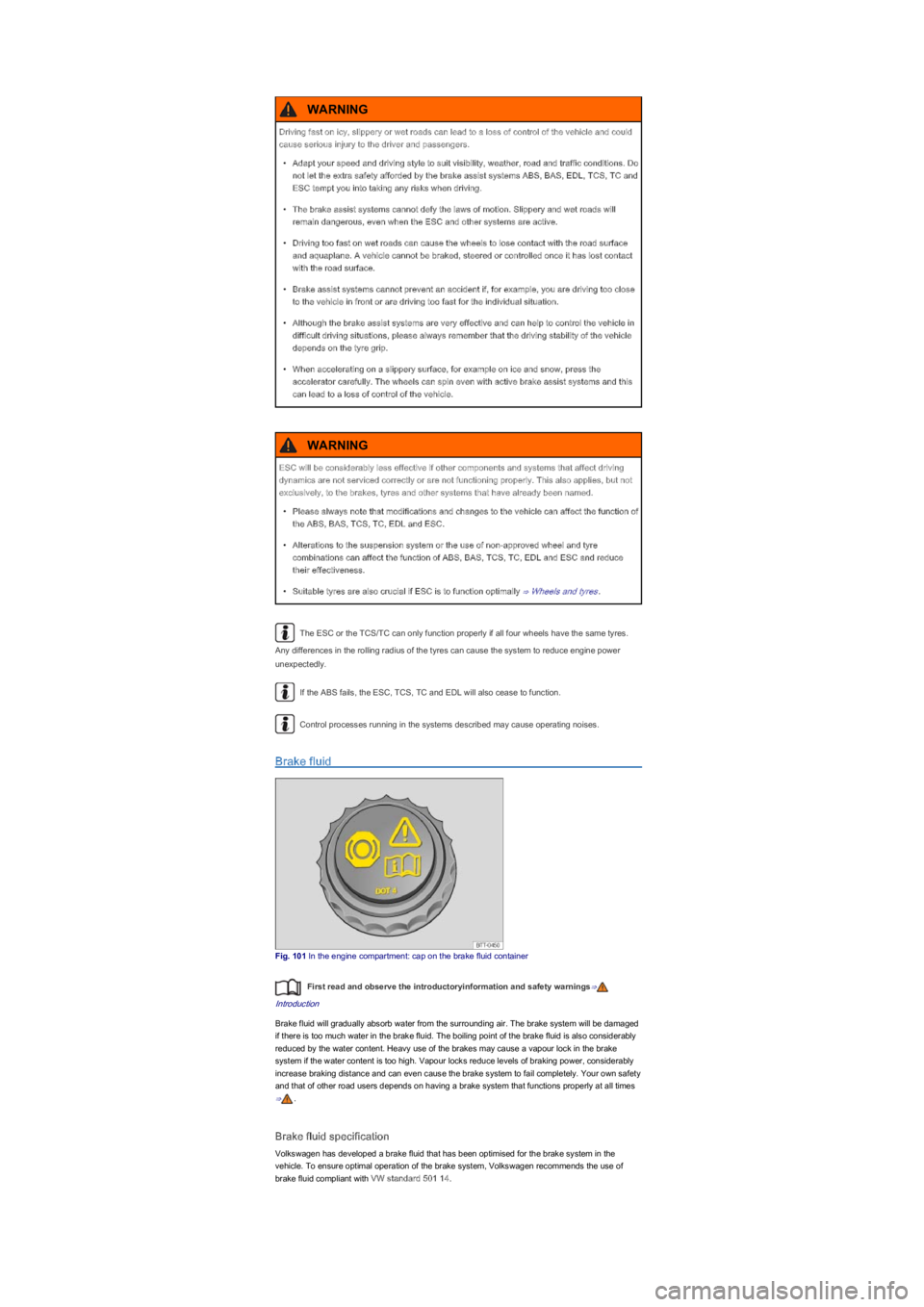
Brake fluid
Fig. 101 In the engine compartment: cap on the brake fluid container
First read and observe the introductoryinformation and safety warnings⇒
Introduction
Brake fluid will gradually absorb water from the surrounding air. The brake system will be damaged
if there is too much water in the brake fluid. The boiling point of the brake fluid is also considerably
reduced by the water content. Heavy use of the brakes may cause a vapour lock in the brake
system if the water content is too high. Vapour locks reduce levels of braking power, considerably
increase braking distance and can even cause the brake system to fail completely. Your own safety
and that of other road users depends on having a brake system that functions properly at all times
⇒.
Brake fluid specification
Volkswagen has developed a brake fluid that has been optimised for the brake system in the
vehicle. To ensure optimal operation of the brake system, Volkswagen recommends the use of
brake fluid compliant with VW standard 501 14.
Driving fast on icy, slippery or wet roads can lead to a loss of control of the vehicle and could
cause serious injury to the driver and passengers.
•Adapt your speed and driving style to suit visibility, weather, road and traffic conditions. Do
not let the extra safety afforded by the brake assist systems ABS, BAS, EDL, TCS, TC and
ESC tempt you into taking any risks when driving.
•The brake assist systems cannot defy the laws of motion. Slippery and wet roads will
remain dangerous, even when the ESC and other systems are active.
•Driving too fast on wet roads can cause the wheels to lose contact with the road surface
and aquaplane. A vehicle cannot be braked, steered or controlled once it has lost contact
with the road surface.
•Brake assist systems cannot prevent an accident if, for example, you are driving too close
to the vehicle in front or are driving too fast for the individual situation.
•Although the brake assist systems are very effective and can help to control the vehicle in
difficult driving situations, please always remember that the driving stability of the vehicle
depends on the tyre grip.
•When accelerating on a slippery surface, for example on ice and snow, press the
accelerator carefully. The wheels can spin even with active brake assist systems and this
can lead to a loss of control of the vehicle.
WARNING
ESC will be considerably less effective if other components and systems that affect driving
dynamics are not serviced correctly or are not functioning properly. This also applies, but not
exclusively, to the brakes, tyres and other systems that have already been named.
•Please always note that modifications and changes to the vehicle can affect the function of
the ABS, BAS, TCS, TC, EDL and ESC.
•Alterations to the suspension system or the use of non-approved wheel and tyre
combinations can affect the function of ABS, BAS, TCS, TC, EDL and ESC and reduce
their effectiveness.
•Suitable tyres are also crucial if ESC is to function optimally ⇒ Wheels and tyres.
WARNING
Page 105 of 211
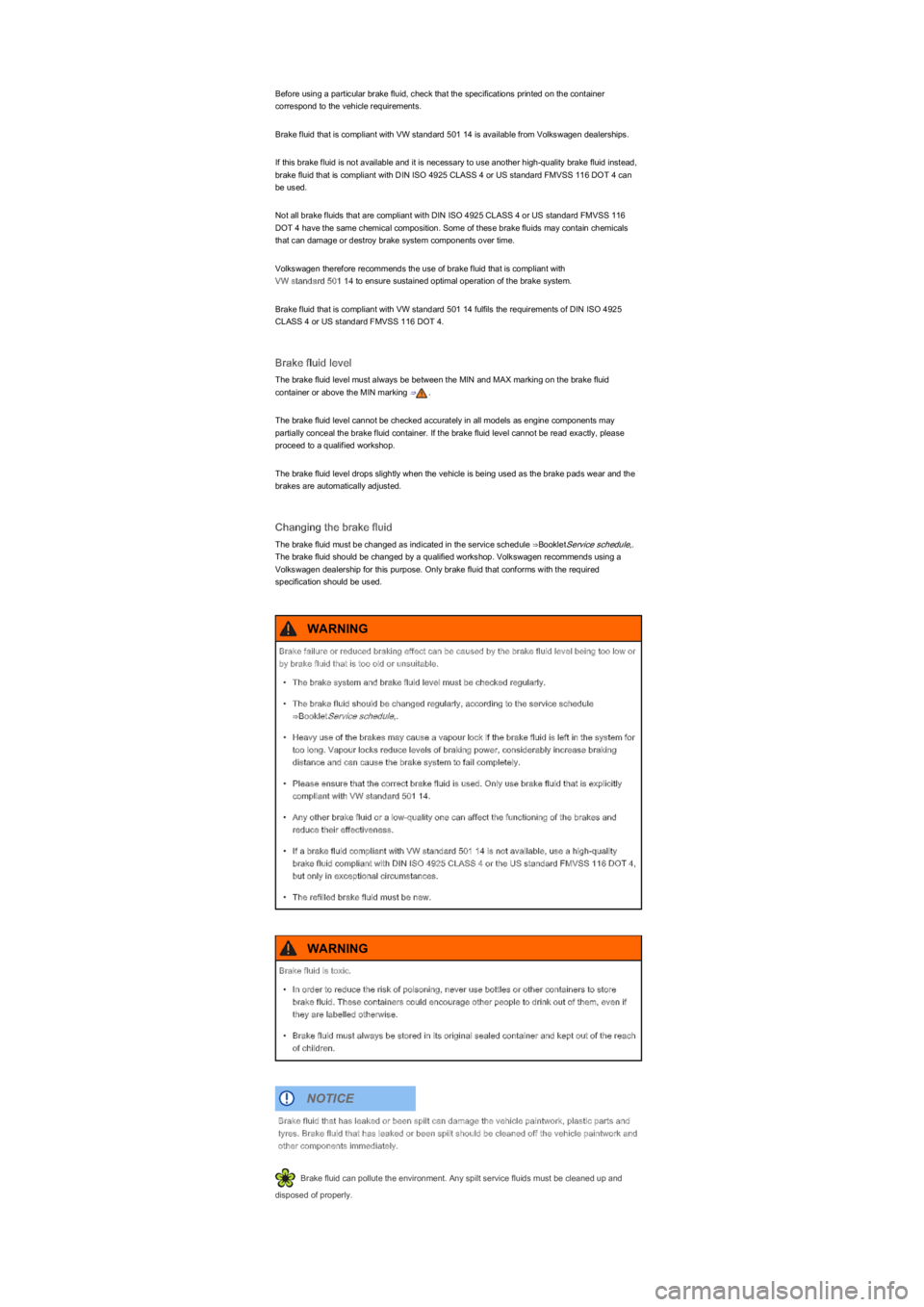
Before using a particular brake fluid, check that the specifications printed on the container
correspond to the vehicle requirements.
Brake fluid that is compliant with VW standard 501 14 is available from Volkswagen dealerships.
If this brake fluid is not available and it is necessary to use another high-quality brake fluid instead,
brake fluid that is compliant with DIN ISO 4925 CLASS 4 or US standard FMVSS 116 DOT 4 can
be used.
Not all brake fluids that are compliant with DIN ISO 4925 CLASS 4 or US standard FMVSS 116
DOT 4 have the same chemical composition. Some of these brake fluids may contain chemicals
that can damage or destroy brake system components over time.
Volkswagen therefore recommends the use of brake fluid that is compliant with
VW standard 501 14 to ensure sustained optimal operation of the brake system.
Brake fluid that is compliant with VW standard 501 14 fulfils the requirements of DIN ISO 4925
CLASS 4 or US standard FMVSS 116 DOT 4.
Brake fluid level
The brake fluid level must always be between the MIN and MAX marking on the brake fluid
container or above the MIN marking ⇒.
The brake fluid level cannot be checked accurately in all models as engine components may
partially conceal the brake fluid container. If the brake fluid level cannot be read exactly, please
proceed to a qualified workshop.
The brake fluid level drops slightly when the vehicle is being used as the brake pads wear and the
brakes are automatically adjusted.
Changing the brake fluid
The brake fluid must be changed as indicated in the service schedule ⇒BookletService schedule,.
The brake fluid should be changed by a qualified workshop. Volkswagen recommends using a
Volkswagen dealership for this purpose. Only brake fluid that conforms with the required
specification should be used.
Brake fluid can pollute the environment. Any spilt service fluids must be cleaned up and
disposed of properly.
Brake failure or reduced braking effect can be caused by the brake fluid level being too low or
by brake fluid that is too old or unsuitable.
•The brake system and brake fluid level must be checked regularly.
•The brake fluid should be changed regularly, according to the service schedule
⇒BookletService schedule,.
•Heavy use of the brakes may cause a vapour lock if the brake fluid is left in the system for
too long. Vapour locks reduce levels of braking power, considerably increase braking
distance and can cause the brake system to fail completely.
•Please ensure that the correct brake fluid is used. Only use brake fluid that is explicitly
compliant with VW standard 501 14.
•Any other brake fluid or a low-quality one can affect the functioning of the brakes and
reduce their effectiveness.
•If a brake fluid compliant with VW standard 501 14 is not available, use a high-quality
brake fluid compliant with DIN ISO 4925 CLASS 4 or the US standard FMVSS 116 DOT 4,
but only in exceptional circumstances.
•The refilled brake fluid must be new.
WARNING
Brake fluid is toxic.
•In order to reduce the risk of poisoning, never use bottles or other containers to store
brake fluid. These containers could encourage other people to drink out of them, even if
they are labelled otherwise.
•Brake fluid must always be stored in its original sealed container and kept out of the reach
of children.
WARNING
Brake fluid that has leaked or been spilt can damage the vehicle paintwork, plastic parts and
tyres. Brake fluid that has leaked or been spilt should be cleaned off the vehicle paintwork and
other components immediately.
NOTICE
Page 108 of 211
Avoid unnecessary loads
The lighter the vehicle, the more economical and environmentally-friendly it is. An extra weight of
100 kg can increase fuel consumption by up to 0.3 l/100 km.
Remove all unnecessary objects and loads from the vehicle.
Remove any unnecessary special equipment and accessories
The more aerodynamic a vehicle, the lower its fuel consumption. Special equipment and
accessories, such as roof carriers or bicycle carriers, make the vehicle less aerodynamic.
You should therefore remove any special equipment and luggage carriers that are not in use,
especially if you are going to be driving at high speeds.
Steering
Introduction
This chapter contains information on the followingsubjects:
⇒ Warning and indicator lamps
⇒ Information on steering
Depending on its equipment level the vehicle may have power steering.
The power steering is not hydraulic. It is an electromechanical system. The advantage of this
steering system is that no hydraulic hoses, hydraulic oil, pumps, filter or other parts are required.
The electromechanical system reduces fuel consumption. A hydraulic system requires constant oil
pressure in the system, whereas an electromechanical steering system only needs an energy
supply while steering.
The power steering provided by the electromechanical steering system automatically adjusts to the
vehicle speed, steering wheel torque and steering wheel angle. The electromechanical steering
only functions when the engine is running.
Additional information and warnings:
•Starting and stopping the engine ⇒ Starting and stopping the engine
•Battery ⇒ Vehicle battery
•Tow-starting and towing ⇒ Tow-starting and towing
Warning and indicator lamps
First read and observe the introductoryinformation and safety warnings⇒
Introduction
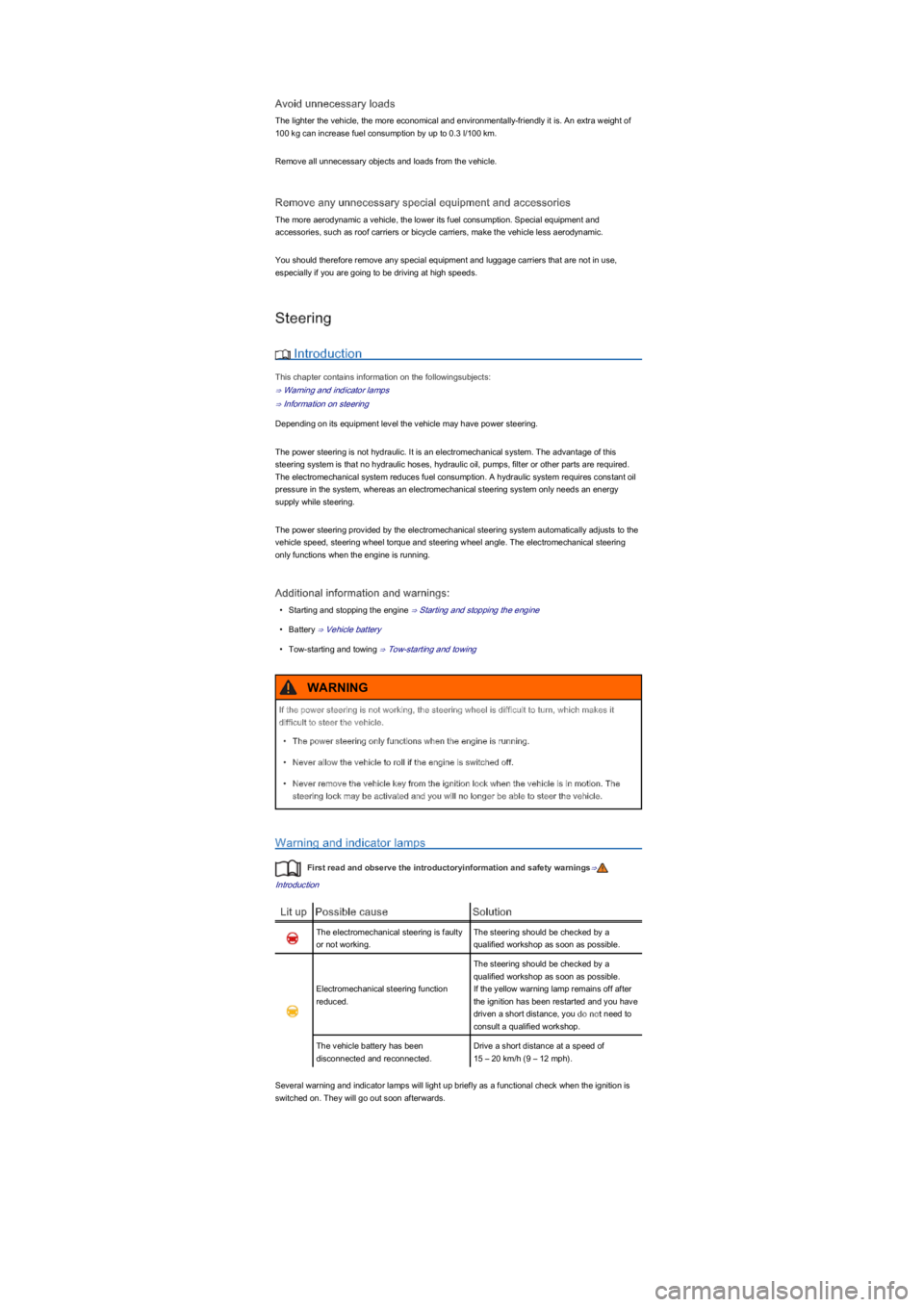
Lit upPossible causeSolution
The electromechanical steering is faulty
or not working.
The steering should be checked by a
qualified workshop as soon as possible.
Electromechanical steering function
reduced.
The steering should be checked by a
qualified workshop as soon as possible.
If the yellow warning lamp remains off after
the ignition has been restarted and you have
driven a short distance, you do not need to
consult a qualified workshop.
The vehicle battery has been
disconnected and reconnected.
Drive a short distance at a speed of
15 – 20 km/h (9 – 12 mph).
Several warning and indicator lamps will light up briefly as a functional check when the ignition is
switched on. They will go out soon afterwards.
If the power steering is not working, the steering wheel is difficult to turn, which makes it
difficult to steer the vehicle.
•The power steering only functions when the engine is running.
•Never allow the vehicle to roll if the engine is switched off.
•Never remove the vehicle key from the ignition lock when the vehicle is in motion. The
steering lock may be activated and you will no longer be able to steer the vehicle.
WARNING
Page 109 of 211
Information on steering
First read and observe the introductoryinformation and safety warnings⇒
Introduction
The steering should be locked every time you leave the vehicle to make it more difficult for the
vehicle to be stolen.
Mechanical steering column lock
The steering column is locked if the vehicle key is removed from the ignition lock when the vehicle
is stationary.
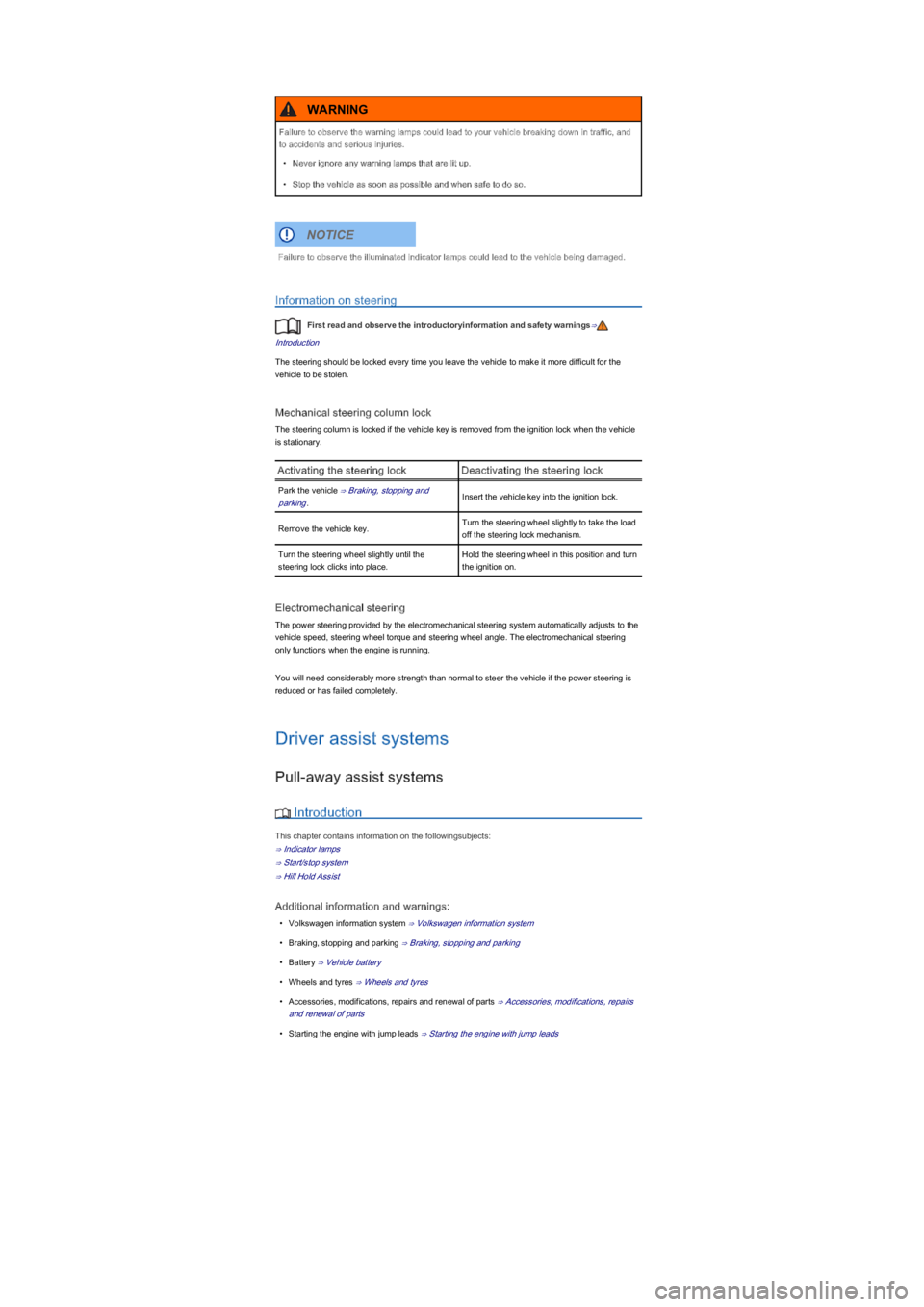
Activating the steering lockDeactivating the steering lock
Park the vehicle ⇒ Braking, stopping and
parking.Insert the vehicle key into the ignition lock.
Remove the vehicle key.Turn the steering wheel slightly to take the load
off the steering lock mechanism.
Turn the steering wheel slightly until the
steering lock clicks into place.
Hold the steering wheel in this position and turn
the ignition on.
Electromechanical steering
The power steering provided by the electromechanical steering system automatically adjusts to the
vehicle speed, steering wheel torque and steering wheel angle. The electromechanical steering
only functions when the engine is running.
You will need considerably more strength than normal to steer the vehicle if the power steering is
reduced or has failed completely.
Driver assist systems
Pull-away assist systems
Introduction
This chapter contains information on the followingsubjects:
⇒ Indicator lamps
⇒ Start/stop system
⇒ Hill Hold Assist
Additional information and warnings:
•Volkswagen information system ⇒ Volkswagen information system
•Braking, stopping and parking ⇒ Braking, stopping and parking
•Battery ⇒ Vehicle battery
•Wheels and tyres ⇒ Wheels and tyres
•Accessories, modifications, repairs and renewal of parts ⇒ Accessories, modifications, repairs
and renewal of parts
•Starting the engine with jump leads ⇒ Starting the engine with jump leads
Failure to observe the warning lamps could lead to your vehicle breaking down in traffic, and
to accidents and serious injuries.
•Never ignore any warning lamps that are lit up.
•Stop the vehicle as soon as possible and when safe to do so.
WARNING
Failure to observe the illuminated indicator lamps could lead to the vehicle being damaged.
NOTICE
Page 127 of 211
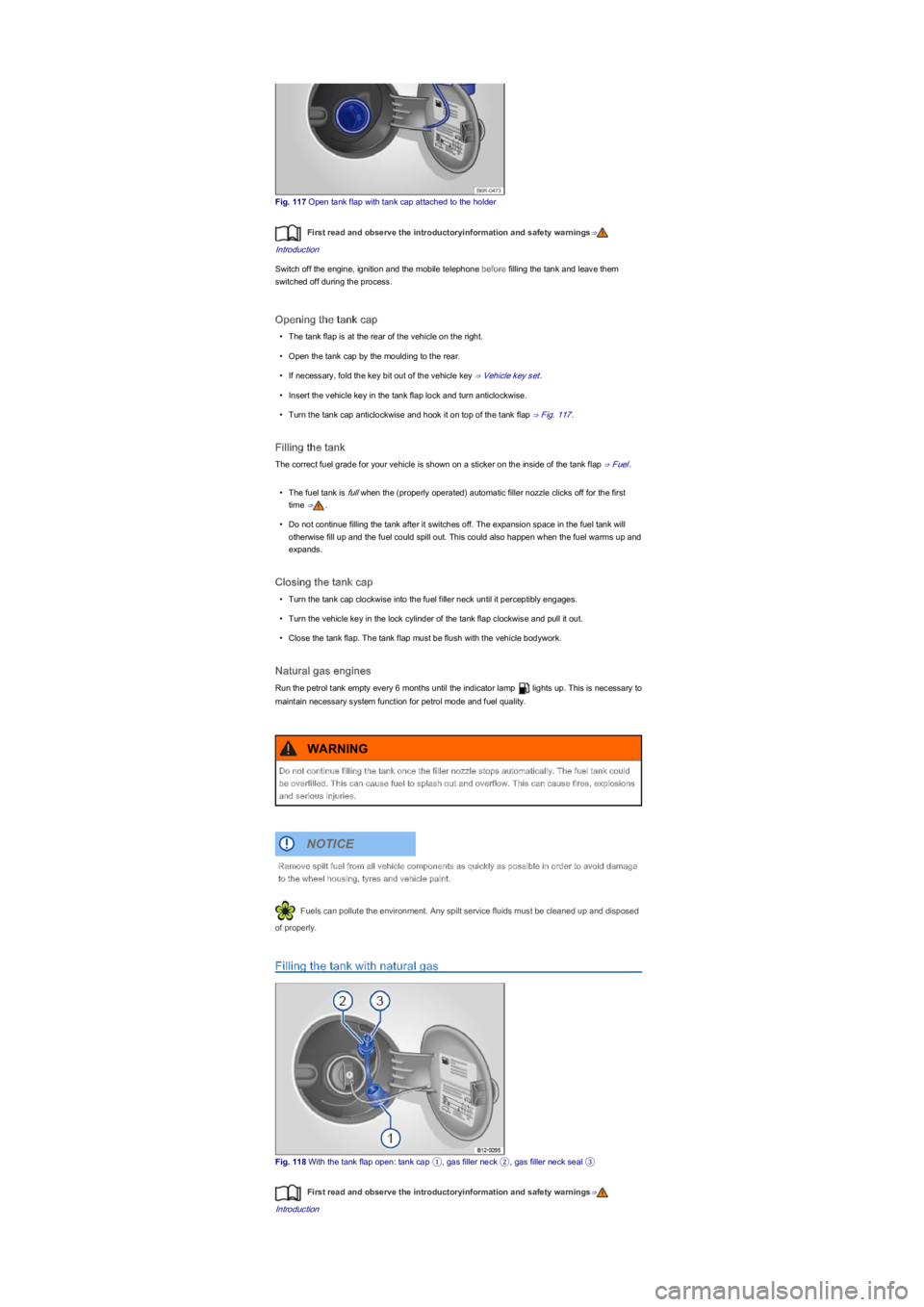
Fig. 117 Open tank flap with tank cap attached to the holder
First read and observe the introductoryinformation and safety warnings⇒
Introduction
Switch off the engine, ignition and the mobile telephone before filling the tank and leave them
switched off during the process.
Opening the tank cap
•The tank flap is at the rear of the vehicle on the right.
•Open the tank cap by the moulding to the rear.
•If necessary, fold the key bit out of the vehicle key ⇒ Vehicle key set.
•Insert the vehicle key in the tank flap lock and turn anticlockwise.
•Turn the tank cap anticlockwise and hook it on top of the tank flap ⇒ Fig. 117.
Filling the tank
The correct fuel grade for your vehicle is shown on a sticker on the inside of the tank flap ⇒ Fuel.
•The fuel tank is full when the (properly operated) automatic filler nozzle clicks off for the first
time ⇒.
•Do not continue filling the tank after it switches off. The expansion space in the fuel tank will
otherwise fill up and the fuel could spill out. This could also happen when the fuel warms up and
expands.
Closing the tank cap
•Turn the tank cap clockwise into the fuel filler neck until it perceptibly engages.
•Turn the vehicle key in the lock cylinder of the tank flap clockwise and pull it out.
•Close the tank flap. The tank flap must be flush with the vehicle bodywork.
Natural gas engines
Run the petrol tank empty every 6 months until the indicator lamp lights up. This is necessary to
maintain necessary system function for petrol mode and fuel quality.
Fuels can pollute the environment. Any spilt service fluids must be cleaned up and disposed
of properly.
Filling the tank with natural gas
Fig. 118 With the tank flap open: tank cap ①, gas filler neck ②, gas filler neck seal ③
First read and observe the introductoryinformation and safety warnings⇒
Introduction
Do not continue filling the tank once the filler nozzle stops automatically. The fuel tank could
be overfilled. This can cause fuel to splash out and overflow. This can cause fires, explosions
and serious injuries.
WARNING
Remove spilt fuel from all vehicle components as quickly as possible in order to avoid damage
to the wheel housing, tyres and vehicle paint.
NOTICE
Page 128 of 211
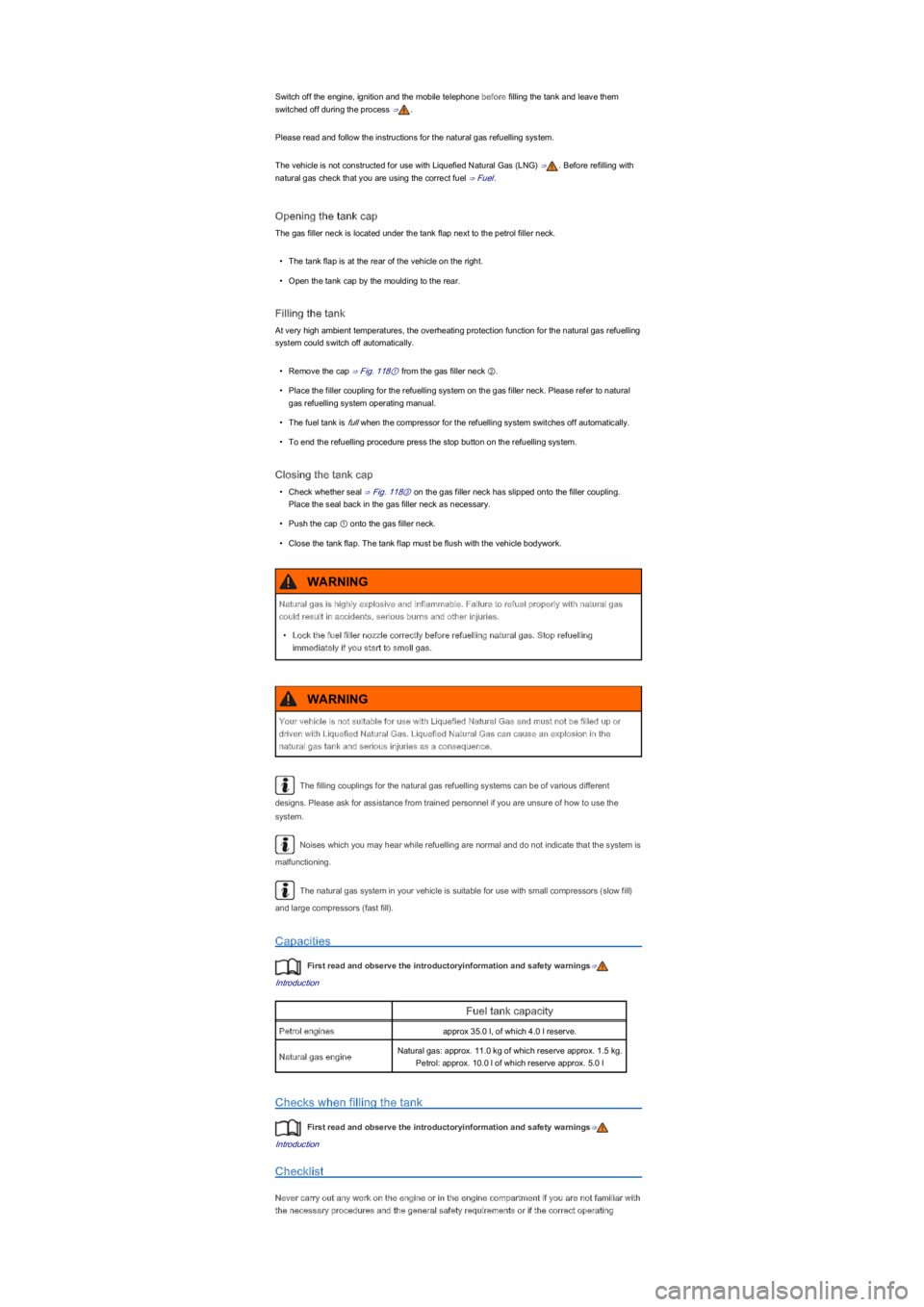
Switch off the engine, ignition and the mobile telephone before filling the tank and leave them
switched off during the process ⇒.
Please read and follow the instructions for the natural gas refuelling system.
The vehicle is not constructed for use with Liquefied Natural Gas (LNG) ⇒. Before refilling with
natural gas check that you are using the correct fuel ⇒ Fuel.
Opening the tank cap
The gas filler neck is located under the tank flap next to the petrol filler neck.
•The tank flap is at the rear of the vehicle on the right.
•Open the tank cap by the moulding to the rear.
Filling the tank
At very high ambient temperatures, the overheating protection function for the natural gas refuelling
system could switch off automatically.
•Remove the cap ⇒ Fig. 118① from the gas filler neck ②.
•Place the filler coupling for the refuelling system on the gas filler neck. Please refer to natural
gas refuelling system operating manual.
•The fuel tank is full when the compressor for the refuelling system switches off automatically.
•To end the refuelling procedure press the stop button on the refuelling system.
Closing the tank cap
•Check whether seal ⇒ Fig. 118③ on the gas filler neck has slipped onto the filler coupling.
Place the seal back in the gas filler neck as necessary.
•Push the cap ① onto the gas filler neck.
•Close the tank flap. The tank flap must be flush with the vehicle bodywork.
The filling couplings for the natural gas refuelling systems can be of various different
designs. Please ask for assistance from trained personnel if you are unsure of how to use the
system.
Noises which you may hear while refuelling are normal and do not indicate that the system is
malfunctioning.
The natural gas system in your vehicle is suitable for use with small compressors (slow fill)
and large compressors (fast fill).
Capacities
First read and observe the introductoryinformation and safety warnings⇒
Introduction
Fuel tank capacity
Petrol enginesapprox 35.0 l, of which 4.0 l reserve.
Natural gas engineNatural gas: approx. 11.0 kg of which reserve approx. 1.5 kg.
Petrol: approx. 10.0 l of which reserve approx. 5.0 l
Checks when filling the tank
First read and observe the introductoryinformation and safety warnings⇒
Introduction
Checklist
Never carry out any work on the engine or in the engine compartment if you are not familiar with
the necessary procedures and the general safety requirements or if the correct operating
Natural gas is highly explosive and inflammable. Failure to refuel properly with natural gas
could result in accidents, serious burns and other injuries.
•Lock the fuel filler nozzle correctly before refuelling natural gas. Stop refuelling
immediately if you start to smell gas.
WARNING
Your vehicle is not suitable for use with Liquefied Natural Gas and must not be filled up or
driven with Liquefied Natural Gas. Liquefied Natural Gas can cause an explosion in the
natural gas tank and serious injuries as a consequence.
WARNING
Page 132 of 211
Unintentional vehicle movements during service work can cause serious injury.
•Never work underneath a vehicle if it is not secured against rolling away. If you are
working underneath the vehicle while the wheels are on the ground, the vehicle must be
on a level, the wheels must be blocked and the vehicle key must be removed from the
ignition lock.
•If you have to work underneath the vehicle, use suitable stands to provide extra support
for the vehicle. The vehicle jack is not sufficient for this task and can fail, which can lead to
serious injuries.
•The start/stop system must have been deactivated.
WARNING
The engine compartment of any motor vehicle is a dangerous area. Serious injuries can be
sustained here.
•The utmost care and attention must be paid when carrying out any work and you must
follow the general safety rules. Never take any risks.
•Never do any work on the engine or in the engine compartment unless you know exactly
how to carry it out. If you are uncertain of what to do, the work should be carried out by a
qualified workshop. Serious injuries can result from work that has not been carried out
properly.
•Never open the bonnet if you see steam or coolant escaping from the engine
compartment. Hot steam or coolant can cause serious burns. Always wait until you can no
longer see or hear steam or coolant coming from the engine compartment.
•Always allow the engine to cool down before opening the bonnet.
•Hot parts of the engine or exhaust system can burn the skin.
•Before opening the bonnet once it has cooled down:
- Apply the handbrake fully and move the selector lever to position N or move the
manual gear lever to the neutral position.
- Remove the vehicle key from the ignition lock.
- Always keep children away from the engine compartment and never leave the
vehicle unattended.
•The engine cooling system is under pressure when the engine is hot. Never open the cap
of the coolant expansion tank when the engine is hot. Coolant may spray out and cause
serious burns and injuries.
- After cooling, turn the cap slowly and very carefully anticlockwise while exerting
some downwards pressure on the cap.
- Always protect the face, hands and arms from hot coolant or steam with a large,
thick cloth.
•When refilling, do not spill any service fluids on engine components or on the exhaust
system. The spilt service fluids can start a fire.
WARNING
High voltages in the electrical system can cause electric shocks, burns, serious injuries and
death!
•Never short circuit the electric system. The vehicle battery could explode.
•Please note the following guidelines to help reduce the risk of an electric shock and
serious injuries while the engine is running or being started:
- Never touch the electrical wiring of the ignition system.
WARNING