phone VOLKSWAGEN UP! 2021 Owner´s Manual
[x] Cancel search | Manufacturer: VOLKSWAGEN, Model Year: 2021, Model line: UP!, Model: VOLKSWAGEN UP! 2021Pages: 211, PDF Size: 5.98 MB
Page 15 of 211
Check that all lights and turn signals are working properly.
Check the tyre pressure (Wheels and tyres) and fuel level (Filling the tank).
Ensure that you have a good, clear view through all of the windows.
Secure any objects and luggage in the stowage compartments, the luggage compartment
or on the roof Driving notes.
Ensure that you are able to operate the pedals freely at all times.
Secure any children travelling in the vehicle in a restraint system suitable for their weight
and size Child seats (accessories).
Adjust the front seats, head restraints and mirrors properly in accordance with the size of
the occupants Adjusting the seat position, Mirrors.
Wear shoes that provide good grip for your feet when using the pedals.
The floor mat in the footwell on the driver side must leave the pedal area free and must be
securely fastened.
Assume a correct sitting position before setting off and maintain this position while driving.
This also applies to all passengers Adjusting the seat position.
Fasten your seat belt correctly before setting off and keep it properly fastened throughout
the journey. This also applies to all passengers Seat belts.
Each vehicle occupant must sit in a seat of their own and must have their own seat belt.
Never drive if your driving ability is impaired, e.g. by medication, alcohol or drugs.
Do not allow yourself to be distracted from the traffic, e.g. by passengers, telephone calls,
opening menus and making adjustments to settings.
Always adapt your speed and driving style to suit visibility, weather, road and traffic
conditions.
Observe traffic regulations and speed limits.
When travelling long distances, stop and take a break regularly – at least every 2 hours.
Secure animals in the vehicle using a system that is suitable for their weight and size.
Additional information and warnings:
•Sitting correctly and safely ⇒ Sitting correctly and safely
•Transporting ⇒ Transporting
•Starting the engine, changing gear and parking the vehicle ⇒ Starting the engine, changing gear
and parking
•Driving with respect for the environment ⇒ Driving with respect for the environment
•Consumer information ⇒ Consumer information
Preparing for a journey and driving safely
First read and observe the introductoryinformation and safety warnings⇒
Introduction
Checklist
Observe the following information both before and during the journey to ensure your own safety
and the safety of passengers and other road users ⇒:
Servicing the vehicle is not only about vehicle maintenance – it also ensures that your
vehicle remains roadworthy and in perfect working order. Servicing work should therefore be
carried out in accordance with the service schedule. Some work may have to be carried out before
the due date of the next service if the vehicle is subjected to severe operating conditions. Severe
operating conditions are, for example, regular stop and go driving and driving in areas with high
levels of dust. Further information can be obtained from your Volkswagen dealership or qualified
workshop.
Driving abroad
First read and observe the introductoryinformation and safety warnings⇒
Introduction
Driving under the influence of alcohol, drugs, medication or narcotics can cause serious
accidents and fatal injuries.
•Alcohol, drugs, medication and narcotics can severely impair perception, reaction times
and driving safety. This could cause you to lose control of the vehicle.
WARNING
Always observe current traffic regulations and speed limits, and think ahead when driving.
Correct interpretation of a driving situation can make the difference between reaching your
destination safely and having an accident with serious injuries.
WARNING
Page 21 of 211
Replacement key
You will need to quote the vehicle chassis number when ordering a replacement key or additional
remote control keys.
Every new key contains a microchip which must be encoded with the data for the vehicle's
electronic immobilizer. The vehicle key will not work if it is not fitted with a microchip, or if the
microchip has not been encoded. The same goes for keys that have been cut to fit the vehicle.
New keys or replacement keys are available from Volkswagen dealerships or from qualified
workshops and authorised key services that are qualified to manufacture these vehicle keys.
New and replacement vehicle keys must be synchronised before use. Proceed to a qualified
workshop.
Press the buttons on the key only if the corresponding function is actually needed. Pressing
a button when the function is not required could lead to the vehicle being unlocked unintentionally
or the alarm going off. This also applies even when you are not within the effective range.
The function of the vehicle key can be affected temporarily if there is more than one
transmitter in the direct vicinity working on the same frequency (e.g. a two-way radio or mobile
telephone).
Obstacles between the key and the vehicle, bad weather conditions and weak batteries can
reduce the range of the remote control.
If the buttons on the vehicle key ⇒ Fig. 16 or one of the central locking buttons ⇒ Central
locking system are pressed repeatedly within a short period of time, the central locking system will
switch off briefly to prevent overloading. The vehicle will then be unlocked. Lock the vehicle if
necessary.
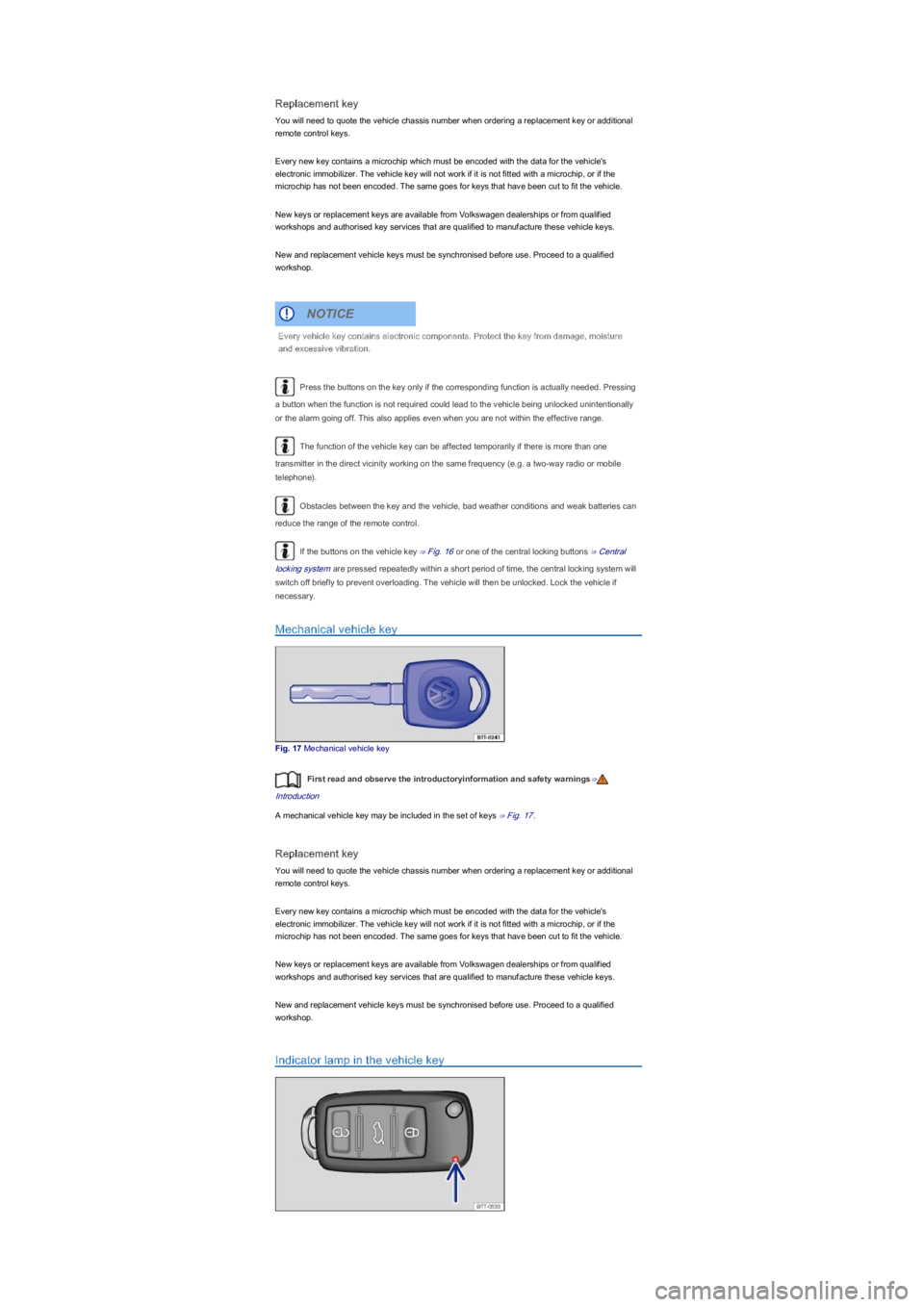
Mechanical vehicle key
Fig. 17 Mechanical vehicle key
First read and observe the introductoryinformation and safety warnings⇒
Introduction
A mechanical vehicle key may be included in the set of keys ⇒ Fig. 17.
Replacement key
You will need to quote the vehicle chassis number when ordering a replacement key or additional
remote control keys.
Every new key contains a microchip which must be encoded with the data for the vehicle's
electronic immobilizer. The vehicle key will not work if it is not fitted with a microchip, or if the
microchip has not been encoded. The same goes for keys that have been cut to fit the vehicle.
New keys or replacement keys are available from Volkswagen dealerships or from qualified
workshops and authorised key services that are qualified to manufacture these vehicle keys.
New and replacement vehicle keys must be synchronised before use. Proceed to a qualified
workshop.
Indicator lamp in the vehicle key
Every vehicle key contains electronic components. Protect the key from damage, moisture
and excessive vibration.
NOTICE
Page 51 of 211
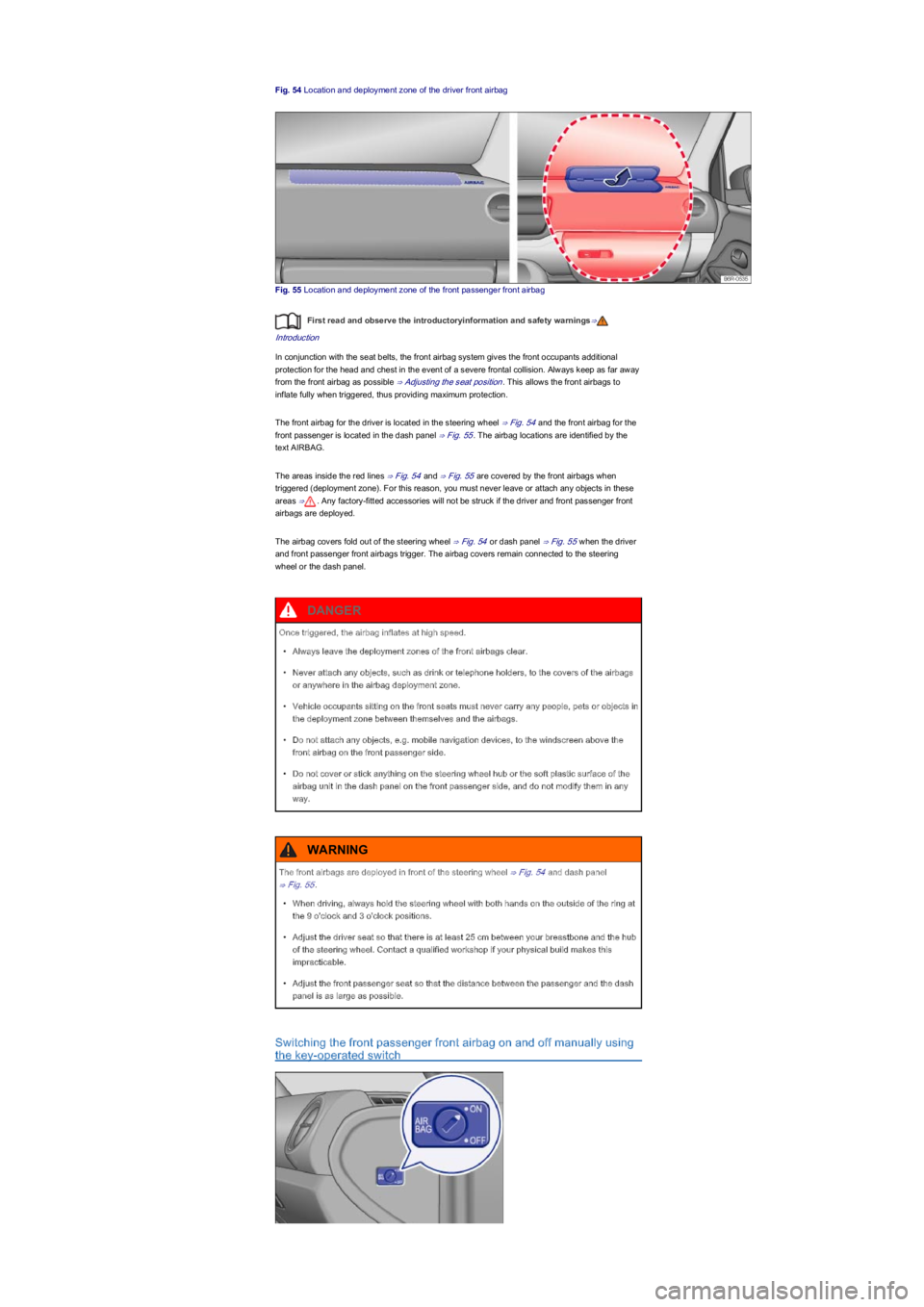
Fig. 54 Location and deployment zone of the driver front airbag
Fig. 55 Location and deployment zone of the front passenger front airbag
First read and observe the introductoryinformation and safety warnings⇒
Introduction
In conjunction with the seat belts, the front airbag system gives the front occupants additional
protection for the head and chest in the event of a severe frontal collision. Always keep as far away
from the front airbag as possible ⇒ Adjusting the seat position. This allows the front airbags to
inflate fully when triggered, thus providing maximum protection.
The front airbag for the driver is located in the steering wheel ⇒ Fig. 54 and the front airbag for the
front passenger is located in the dash panel ⇒ Fig. 55. The airbag locations are identified by the
text AIRBAG.
The areas inside the red lines ⇒ Fig. 54 and ⇒ Fig. 55 are covered by the front airbags when
triggered (deployment zone). For this reason, you must never leave or attach any objects in these
areas ⇒. Any factory-fitted accessories will not be struck if the driver and front passenger front
airbags are deployed.
The airbag covers fold out of the steering wheel ⇒ Fig. 54 or dash panel ⇒ Fig. 55 when the driver
and front passenger front airbags trigger. The airbag covers remain connected to the steering
wheel or the dash panel.
Switching the front passenger front airbag on and off manually using
the key-operated switch
Once triggered, the airbag inflates at high speed.
•Always leave the deployment zones of the front airbags clear.
•Never attach any objects, such as drink or telephone holders, to the covers of the airbags
or anywhere in the airbag deployment zone.
•Vehicle occupants sitting on the front seats must never carry any people, pets or objects in
the deployment zone between themselves and the airbags.
•Do not attach any objects, e.g. mobile navigation devices, to the windscreen above the
front airbag on the front passenger side.
•Do not cover or stick anything on the steering wheel hub or the soft plastic surface of the
airbag unit in the dash panel on the front passenger side, and do not modify them in any
way.
DANGER
The front airbags are deployed in front of the steering wheel ⇒ Fig. 54 and dash panel
⇒ Fig. 55.
•When driving, always hold the steering wheel with both hands on the outside of the ring at
the 9 o'clock and 3 o'clock positions.
•Adjust the driver seat so that there is at least 25 cm between your breastbone and the hub
of the steering wheel. Contact a qualified workshop if your physical build makes this
impracticable.
•Adjust the front passenger seat so that the distance between the passenger and the dash
panel is as large as possible.
WARNING
Page 125 of 211
•Preparation for working in the engine compartment ⇒ Preparation for working in the engine
compartment
Fuels can pollute the environment. Any spilt service fluids must be cleaned up and disposed
of properly.
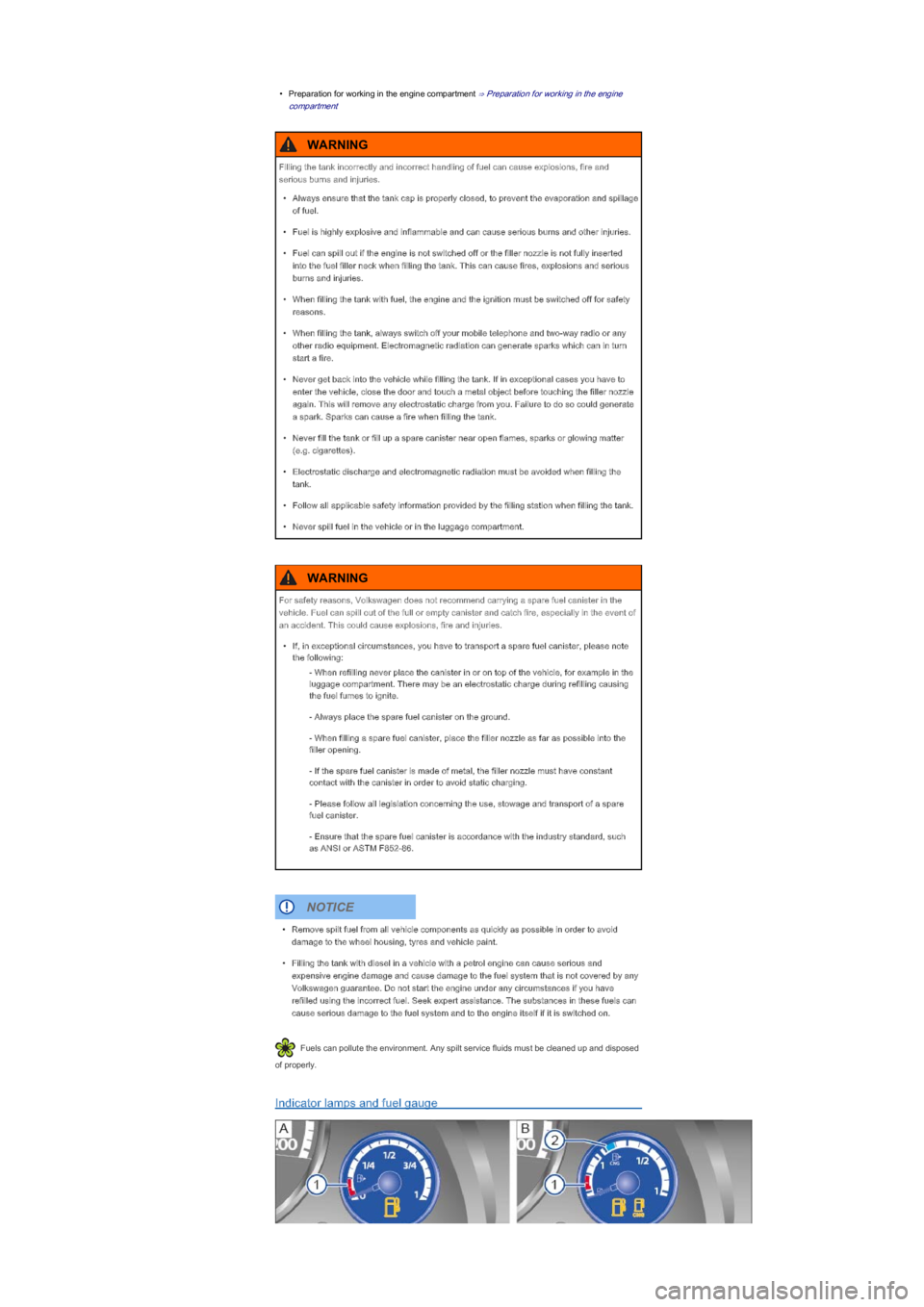
Indicator lamps and fuel gauge
Filling the tank incorrectly and incorrect handling of fuel can cause explosions, fire and
serious burns and injuries.
•Always ensure that the tank cap is properly closed, to prevent the evaporation and spillage
of fuel.
•Fuel is highly explosive and inflammable and can cause serious burns and other injuries.
•Fuel can spill out if the engine is not switched off or the filler nozzle is not fully inserted
into the fuel filler neck when filling the tank. This can cause fires, explosions and serious
burns and injuries.
•When filling the tank with fuel, the engine and the ignition must be switched off for safety
reasons.
•When filling the tank, always switch off your mobile telephone and two-way radio or any
other radio equipment. Electromagnetic radiation can generate sparks which can in turn
start a fire.
•Never get back into the vehicle while filling the tank. If in exceptional cases you have to
enter the vehicle, close the door and touch a metal object before touching the filler nozzle
again. This will remove any electrostatic charge from you. Failure to do so could generate
a spark. Sparks can cause a fire when filling the tank.
•Never fill the tank or fill up a spare canister near open flames, sparks or glowing matter
(e.g. cigarettes).
•Electrostatic discharge and electromagnetic radiation must be avoided when filling the
tank.
•Follow all applicable safety information provided by the filling station when filling the tank.
•Never spill fuel in the vehicle or in the luggage compartment.
WARNING
For safety reasons, Volkswagen does not recommend carrying a spare fuel canister in the
vehicle. Fuel can spill out of the full or empty canister and catch fire, especially in the event of
an accident. This could cause explosions, fire and injuries.
•If, in exceptional circumstances, you have to transport a spare fuel canister, please note
the following:
- When refilling never place the canister in or on top of the vehicle, for example in the
luggage compartment. There may be an electrostatic charge during refilling causing
the fuel fumes to ignite.
- Always place the spare fuel canister on the ground.
- When filling a spare fuel canister, place the filler nozzle as far as possible into the
filler opening.
- If the spare fuel canister is made of metal, the filler nozzle must have constant
contact with the canister in order to avoid static charging.
- Please follow all legislation concerning the use, stowage and transport of a spare
fuel canister.
- Ensure that the spare fuel canister is accordance with the industry standard, such
as ANSI or ASTM F852-86.
WARNING
•Remove spilt fuel from all vehicle components as quickly as possible in order to avoid
damage to the wheel housing, tyres and vehicle paint.
•Filling the tank with diesel in a vehicle with a petrol engine can cause serious and
expensive engine damage and cause damage to the fuel system that is not covered by any
Volkswagen guarantee. Do not start the engine under any circumstances if you have
refilled using the incorrect fuel. Seek expert assistance. The substances in these fuels can
cause serious damage to the fuel system and to the engine itself if it is switched on.
NOTICE
Page 127 of 211
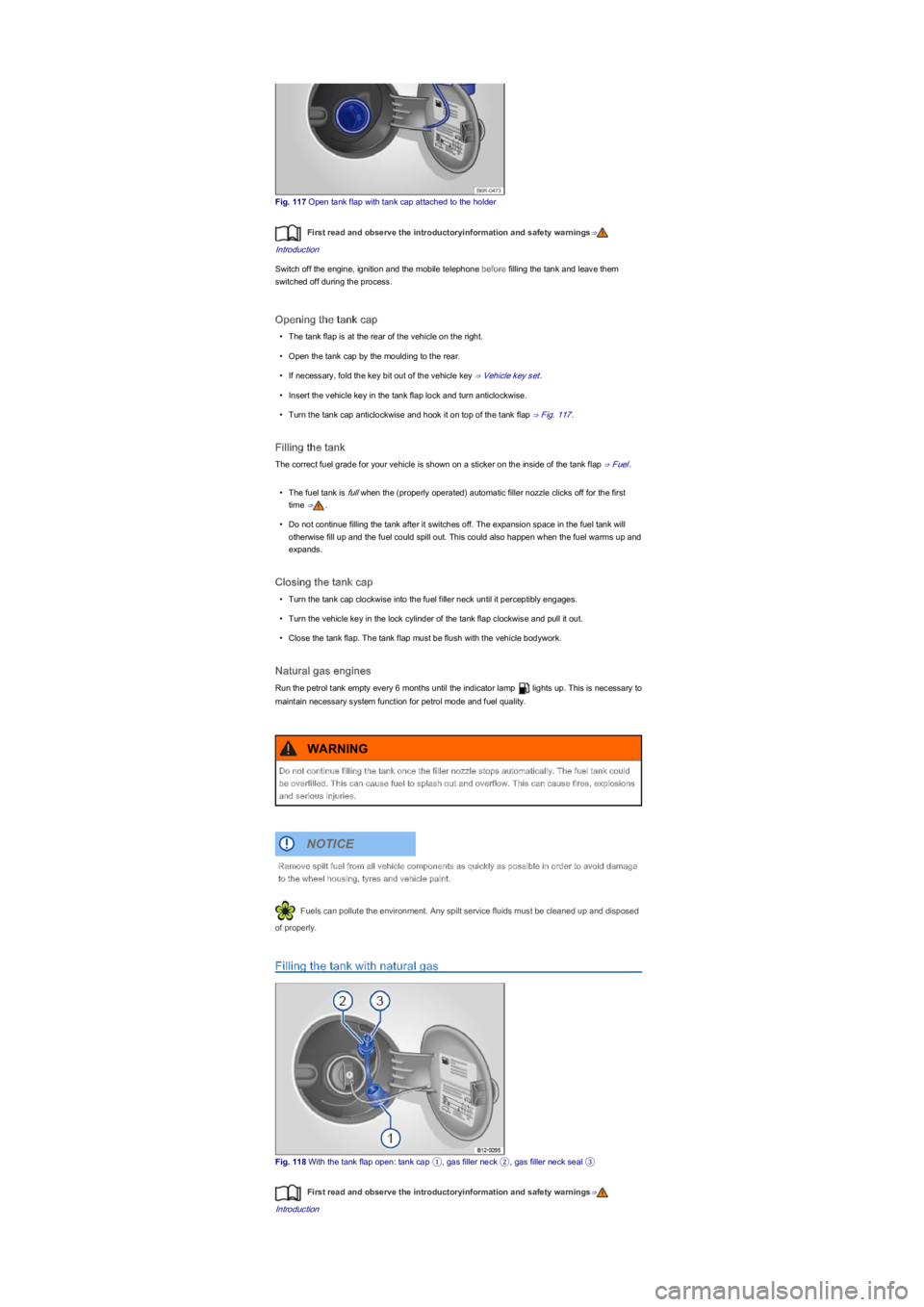
Fig. 117 Open tank flap with tank cap attached to the holder
First read and observe the introductoryinformation and safety warnings⇒
Introduction
Switch off the engine, ignition and the mobile telephone before filling the tank and leave them
switched off during the process.
Opening the tank cap
•The tank flap is at the rear of the vehicle on the right.
•Open the tank cap by the moulding to the rear.
•If necessary, fold the key bit out of the vehicle key ⇒ Vehicle key set.
•Insert the vehicle key in the tank flap lock and turn anticlockwise.
•Turn the tank cap anticlockwise and hook it on top of the tank flap ⇒ Fig. 117.
Filling the tank
The correct fuel grade for your vehicle is shown on a sticker on the inside of the tank flap ⇒ Fuel.
•The fuel tank is full when the (properly operated) automatic filler nozzle clicks off for the first
time ⇒.
•Do not continue filling the tank after it switches off. The expansion space in the fuel tank will
otherwise fill up and the fuel could spill out. This could also happen when the fuel warms up and
expands.
Closing the tank cap
•Turn the tank cap clockwise into the fuel filler neck until it perceptibly engages.
•Turn the vehicle key in the lock cylinder of the tank flap clockwise and pull it out.
•Close the tank flap. The tank flap must be flush with the vehicle bodywork.
Natural gas engines
Run the petrol tank empty every 6 months until the indicator lamp lights up. This is necessary to
maintain necessary system function for petrol mode and fuel quality.
Fuels can pollute the environment. Any spilt service fluids must be cleaned up and disposed
of properly.
Filling the tank with natural gas
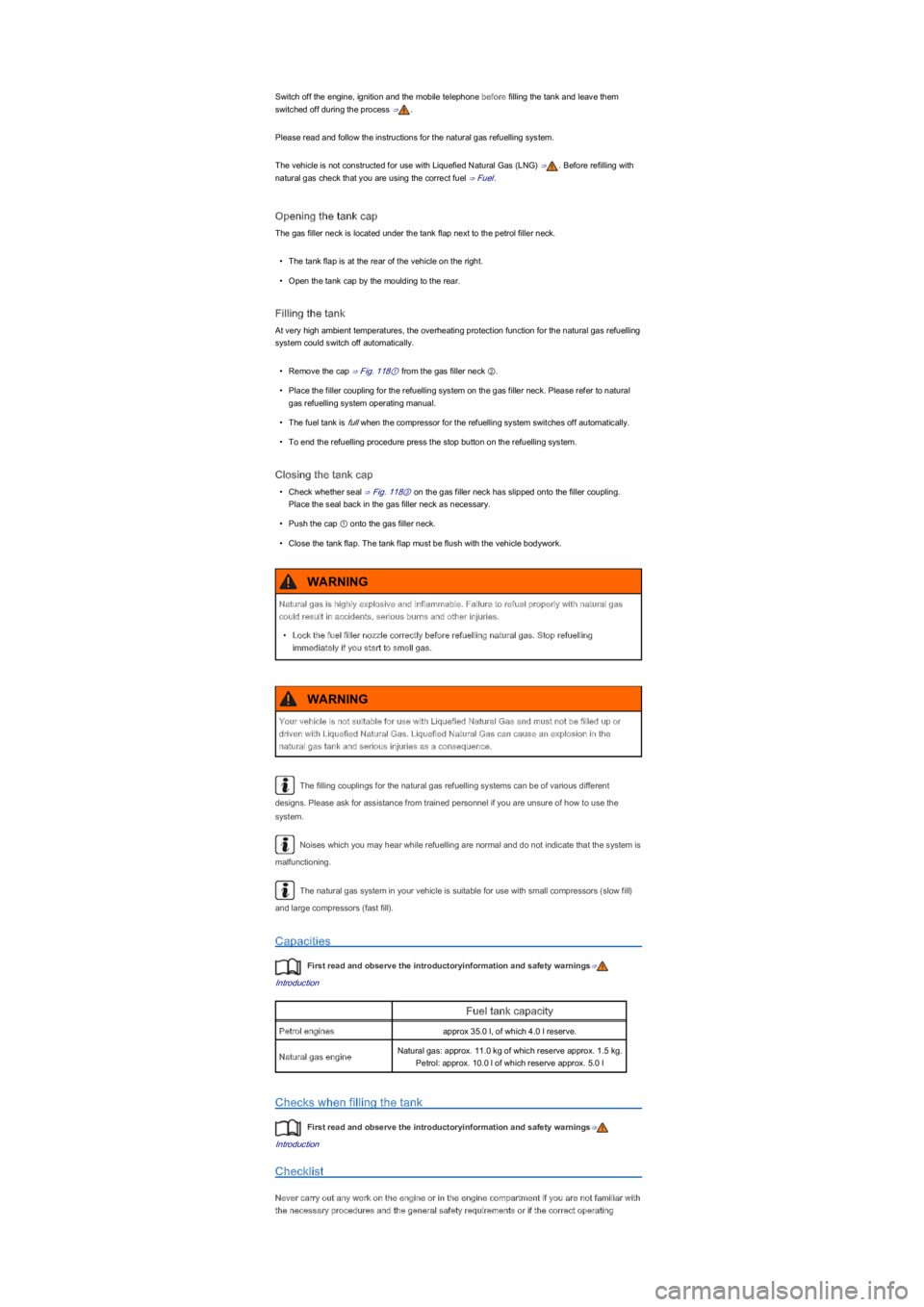
Fig. 118 With the tank flap open: tank cap ①, gas filler neck ②, gas filler neck seal ③
First read and observe the introductoryinformation and safety warnings⇒
Introduction
Do not continue filling the tank once the filler nozzle stops automatically. The fuel tank could
be overfilled. This can cause fuel to splash out and overflow. This can cause fires, explosions
and serious injuries.
WARNING
Remove spilt fuel from all vehicle components as quickly as possible in order to avoid damage
to the wheel housing, tyres and vehicle paint.
NOTICE
Page 128 of 211
Switch off the engine, ignition and the mobile telephone before filling the tank and leave them
switched off during the process ⇒.
Please read and follow the instructions for the natural gas refuelling system.
The vehicle is not constructed for use with Liquefied Natural Gas (LNG) ⇒. Before refilling with
natural gas check that you are using the correct fuel ⇒ Fuel.
Opening the tank cap
The gas filler neck is located under the tank flap next to the petrol filler neck.
•The tank flap is at the rear of the vehicle on the right.
•Open the tank cap by the moulding to the rear.
Filling the tank
At very high ambient temperatures, the overheating protection function for the natural gas refuelling
system could switch off automatically.
•Remove the cap ⇒ Fig. 118① from the gas filler neck ②.
•Place the filler coupling for the refuelling system on the gas filler neck. Please refer to natural
gas refuelling system operating manual.
•The fuel tank is full when the compressor for the refuelling system switches off automatically.
•To end the refuelling procedure press the stop button on the refuelling system.
Closing the tank cap
•Check whether seal ⇒ Fig. 118③ on the gas filler neck has slipped onto the filler coupling.
Place the seal back in the gas filler neck as necessary.
•Push the cap ① onto the gas filler neck.
•Close the tank flap. The tank flap must be flush with the vehicle bodywork.
The filling couplings for the natural gas refuelling systems can be of various different
designs. Please ask for assistance from trained personnel if you are unsure of how to use the
system.
Noises which you may hear while refuelling are normal and do not indicate that the system is
malfunctioning.
The natural gas system in your vehicle is suitable for use with small compressors (slow fill)
and large compressors (fast fill).
Capacities
First read and observe the introductoryinformation and safety warnings⇒
Introduction
Fuel tank capacity
Petrol enginesapprox 35.0 l, of which 4.0 l reserve.
Natural gas engineNatural gas: approx. 11.0 kg of which reserve approx. 1.5 kg.
Petrol: approx. 10.0 l of which reserve approx. 5.0 l
Checks when filling the tank
First read and observe the introductoryinformation and safety warnings⇒
Introduction
Checklist
Never carry out any work on the engine or in the engine compartment if you are not familiar with
the necessary procedures and the general safety requirements or if the correct operating
Natural gas is highly explosive and inflammable. Failure to refuel properly with natural gas
could result in accidents, serious burns and other injuries.
•Lock the fuel filler nozzle correctly before refuelling natural gas. Stop refuelling
immediately if you start to smell gas.
WARNING
Your vehicle is not suitable for use with Liquefied Natural Gas and must not be filled up or
driven with Liquefied Natural Gas. Liquefied Natural Gas can cause an explosion in the
natural gas tank and serious injuries as a consequence.
WARNING
Page 129 of 211
Windscreen washer fluid level Windscreen wiper and washer
Engine oil level Engine oil
Engine coolant level Coolant
Brake fluid level Braking, stopping and parking
Tyre pressure Wheels and tyres
equipment, service fluids and unsuitable tools are not available ⇒ Preparation for working in the
engine compartment! The work should be carried out by a qualified workshop if you are
uncertain. Please ensure that the following are checked regularly, preferably every time you fill
the tank:
Vehicle lighting necessary for traffic safety:
- Turn signals
- Side lights, dipped beam headlights and main beam headlights
- Tail light cluster
- Brake lights
- Rear fog light ⇒ Lights
Information on changing bulbs ⇒ Changing bulbs.
Fuel
Introduction
This chapter contains information on the followingsubjects:
⇒ Petrol
⇒ Natural gas
Different engines require different fuels. The factory-fitted sticker on the inside of the tank flap
indicates the fuel type that is required for your particular vehicle.
Volkswagen recommends using low-sulphur or sulphur-free fuels, to help reduce fuel consumption
and prevent damage to the engine.
If the engine is not running smoothly or begins to judder, this can indicate poor or inadequate fuel
quality, e.g. water in the fuel. If these symptoms appear, reduce the vehicle speed immediately and
drive to the nearest qualified workshop at medium engine speeds, avoiding high engine loading. If
these symptoms occur immediately after the vehicle has been refuelled, switch the engine off as
soon as it is safe to do so and seek expert assistance. This can help to prevent further damage.
Additional information and warnings:
•⇒BookletService schedule,
•Filling the tank ⇒ Filling the tank
•Engine management and exhaust system ⇒ Engine management system and exhaust
purification system
Petrol
First read and observe the introductoryinformation and safety warnings⇒
Introduction
Petrol types
Vehicles with a petrol engine must be run on unleaded petrol in compliance with the European
standard EN 228 or DIN 51626-1 ⇒. Fuels with a maximum ethanol content of 10% (E10) can
be used for refuelling.
Petrol types are categorised according to their octane number, e.g. 91, 95, 98 or 99 RON (RON =
Research Octane Number). The vehicle may be filled with petrol that has a higher octane number
Incorrect handling of fuel can cause explosions, fire and serious burns and injuries.
•Fuel is highly explosive and inflammable.
•Never handle fuel near open flames, sparks or glowing matter (e.g. cigarettes).
•Keep naked flames, hot parts and sparks at a safe distance.
•Switch off your mobile telephone or two-way radio when dealing with fuel. Electromagnetic
radiation can generate sparks which can in turn start a fire.
•Avoid electrostatic discharge and electromagnetic radiation in the direct vicinity of fuels.
•Never spill fuel in the vehicle or in the luggage compartment.
•Comply with any relevant safety information and legislation concerning the handling of
fuels.
WARNING
Page 168 of 211
Snow chains are available in a range of sizes for a vehicle type.
Accessories, modifications, repairs and renewal of
parts
Introduction
This chapter contains information on the followingsubjects:
⇒ Running-in
⇒ Accessories and parts
⇒ Service fluids and consumables
⇒ Repairs and technical modifications
⇒ Repairs and faults in the airbag system
⇒ Retrofitting two-way radios
⇒ Information stored in the control units
⇒ Using a mobile telephone in the vehicle without a connection to the external aerial
⇒ Portable navigation device
⇒ Vehicle lifting points
Additional information and warnings:
•Seat belts ⇒ Seat belts
•Airbag system ⇒ Airbag system
•Roof carrier ⇒ Roof carrier
•Ashtray and cigarette lighter ⇒ Ashtray and cigarette lighter
•Electrical socket ⇒ Socket
•Braking, stopping and parking ⇒ Braking, stopping and parking
•Pull-away assist systems ⇒ Pull-away assist systems
•ParkPilot ⇒ ParkPilot
•Cruise Control System (CCS) ⇒ Cruise control system (CCS)
•Preparation for working in the engine compartment ⇒ Preparation for working in the engine
compartment
•Engine oil ⇒ Engine oil
•Engine coolant ⇒ Coolant
•Battery ⇒ Vehicle battery
•Cleaning and caring for the vehicle exterior ⇒ Caring for and cleaning the vehicle exterior
•Cleaning and caring for the interior ⇒ Cleaning and caring for the interior
•Consumer information ⇒ Consumer information
•⇒BookletRadio,
•User's manual for the portable navigation device (delivered by Volkswagen)
The use of snow chains that are unsuitable for your vehicle or the incorrect installation of
snow chains can cause accidents and serious injuries.
•Always use the correct snow chains.
•Follow the assembly instructions provided by the snow chain manufacturer.
•Never exceed the maximum speed permitted for the snow chains that are fitted.
WARNING
•Remove the snow chains when driving on roads that are free of snow. The snow chains will
otherwise impair handling, damage the tyres and wear out very quickly.
•Snow chains that are in direct contact with the wheel can scratch or damage it.
Volkswagen recommends using non-scratch snow chains.
NOTICE
Page 169 of 211
Running-in
First read and observe the introductoryinformation and safety warnings⇒
Introduction
Please follow the regulations concerning running-in new parts.
Running in a new engine
Any new engine has to be run in during the first 1,500 kilometres. During its first few hours of
running, the internal friction in the engine is greater than later on when all the moving parts have
bedded down.
The style of driving during the first 1,500 kilometres will also affect the engine quality. Even after
this time – and especially with a cold engine – drive the vehicle at moderate speeds in order to
reduce engine wear and to increase the mileage that the engine can cover. Do not drive at engine
speeds that are too low. Always shift down gear if the engine is not running smoothly. The
following applies up to 1,000 kilometres:
•Do not depress the accelerator fully.
•Do not drive the vehicle at more than 2/3 of the top engine speed.
From 1,000 to 1,500 kilometres, gradually increase driving performance to top speed and highest
engine speed.
Running in new tyres and brake pads
•New wheels and tyres ⇒ Wheels and tyres
•Information on the brakes ⇒ Braking, stopping and parking
If the engine is run in gently, the life of the engine will be increased and its oil consumption
reduced.
Accessories and parts
First read and observe the introductoryinformation and safety warnings⇒
Introduction
Volkswagen recommends that you seek advice from a Volkswagen dealership before purchasing
accessories, spare parts or service fluids. For example, if the vehicle is to be retrofitted with
accessories or if parts have to be renewed. Volkswagen dealerships can recommend accessories,
parts and service fluids suitable for your requirements. They can also answer any questions you
might have regarding official regulations.
Volkswagen recommends that you only use approved Volkswagen accessories and Volkswagen
Genuine Parts. These parts and accessories have been specially tested by Volkswagen for
suitability, reliability and safety. And Volkswagen dealerships are qualified to install them correctly.
Although the market is constantly scrutinised, Volkswagen cannot assume responsibility for the
reliability, safety and suitability of products Volkswagen has not approved. Volkswagen can
therefore assume no responsibility for these parts, even if they have been approved by an official
testing agency or are covered by an official approval certificate.
Any retro-fitted equipment that has a direct effect on the vehicle and/or the way it is driven must be
approved by Volkswagen for use in your vehicle and bear the e mark (the European Union's
authorization symbol). These devices include cruise control systems or an electronically controlled
suspension.
Any additional electrical components fitted that do not serve to control the vehicle itself must bear
the mark (manufacturer conformity declaration in the European Union). Such devices include
refrigerator boxes, laptops and ventilator fans.
Unsuitable spare parts and accessories, incorrectly carried out work, modifications and
repairs can lead to damage to the vehicle and cause accidents and serious injuries.
•Volkswagen strongly recommends that you only use approved Volkswagen accessories
and Volkswagen Genuine Parts. These parts and accessories have been specially tested
by Volkswagen for suitability, reliability and safety.
•Repairs and modifications to your vehicle should only be carried out by a qualified
workshop. Qualified workshops have the necessary tools, diagnostic equipment, repair
information and qualified personnel.
•Never fit parts to your vehicle that are in any way different from the factory-fitted parts.
•Never secure or mount objects such as drink holders or telephone holders on or next to
the airbag covers or within the deployment zone of the airbag.
•Only use rim/tyre combinations that have been approved by Volkswagen for your vehicle
type.
WARNING
®
®
Page 170 of 211
Service fluids and consumables
First read and observe the introductoryinformation and safety warnings⇒
Introduction
All service fluids and consumables, e.g. toothed belts, tyres, coolant, engine oil, spark plugs and
vehicle batteries, are being constantly developed. For this reason, service fluids and consumables
should be replaced at a qualified workshop. A Volkswagen dealership is always kept up to date on
innovations.
Leaking service fluids can pollute the environment. Spilt service fluids must be collected in
suitable containers and disposed of properly and with respect for the environment.
Repairs and technical modifications
First read and observe the introductoryinformation and safety warnings⇒
Introduction
Repairs and modifications must always be carried out according to Volkswagen specifications⇒
.
Unauthorised modifications to the electronic components or software in the vehicle may cause
faults. As the electronic components are linked together in networks, these faults may indirectly
affect the working of other systems. This can seriously impair safety, lead to excessive wear of
components, and also invalidate the type approval for the vehicle.
The Volkswagen dealership cannot be held liable for any damage caused by technical
modifications and/or work performed incorrectly.
The Volkswagen dealership cannot be held liable for any damage caused by technical
modifications and/or work performed incorrectly, nor are these covered by the Volkswagen
guarantee.
Volkswagen recommends that all repairs and technical modifications are performed by an
authorised Volkswagen dealership using Volkswagen Genuine Parts.
Vehicles with special auxiliary equipment or body parts
The manufacturer of these components must ensure that these parts (fittings) adhere to the
stipulated environmental laws and regulations, particularly the EU directive 2000/53/EC concerning
end-of-life vehicles and EU directive 2003/11/EC concerning the restriction on the marketing and
use of certain dangerous substances and preparations.
Incorrectly performed repairs or modifications to your vehicle can impair the effectiveness of
the airbags, cause faults, accidents and fatal injury.
•Never secure or mount objects such as drink holders or telephone holders either on or
next to the airbag covers or within the deployment zones of the airbag modules.
•Objects either on or next to the airbag module covers or are in the deployment zone of the
airbags can cause serious or even fatal injuries should the airbags be activated.
WARNING
Unsuitable service fluids and consumables, and the incorrect use of these fluids and
consumables, can cause accidents, serious injuries, burns or poisoning.
•Service fluids must be kept in their original sealed container.
•Never store service fluids in empty food containers, bottles or any other non-original
containers as people finding these containers could drink them.
•Keep children away from all service fluids and consumables.
•Always read and follow the information and warnings on the service fluid packaging.
•When using products that give off harmful fumes, always work outdoors or in a well-
ventilated area.
•Never use fuel, turpentine, engine oil, nail varnish remover or other volatile fluids for
vehicle care. They are toxic and highly flammable. They could cause fires and explosions.
WARNING
•Only use suitable service fluids for refilling. Never use the wrong service fluid. Failure to
observe this warning can result in serious malfunctions and engine damage.
•Optional equipment and other accessories in front of the air inlet reduce the cooling effect
of the coolant. The engine may overheat at high ambient temperatures and high engine
loads.
NOTICE
®