ABS VOLVO C70 CONVERTIBLE 2007 Owner´s Manual
[x] Cancel search | Manufacturer: VOLVO, Model Year: 2007, Model line: C70 CONVERTIBLE, Model: VOLVO C70 CONVERTIBLE 2007Pages: 276, PDF Size: 9.81 MB
Page 4 of 276
2007 Volvo C70
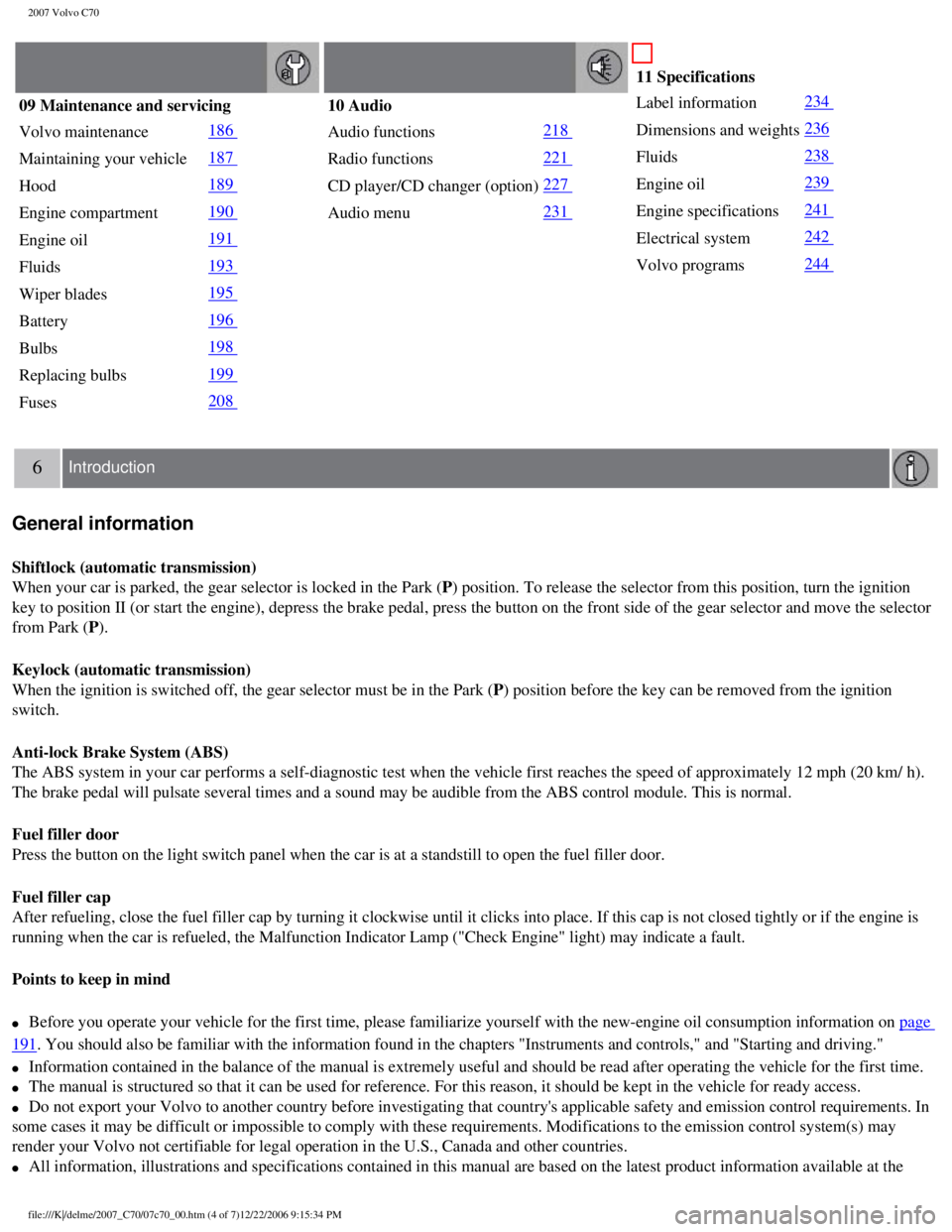
09 Maintenance and servicing
Volvo maintenance
186
Maintaining your vehicle
187
Hood
189
Engine compartment
190
Engine oil
191
Fluids
193
Wiper blades
195
Battery
196
Bulbs
198
Replacing bulbs
199
Fuses
208
10 Audio
Audio functions
218
Radio functions
221
CD player/CD changer (option)
227
Audio menu
231
11 Specifications
Label information
234
Dimensions and weights
236
Fluids
238
Engine oil
239
Engine specifications
241
Electrical system
242
Volvo programs
244
6 Introduction
General information
Shiftlock (automatic transmission)
When your car is parked, the gear selector is locked in the Park (P) position. To release the selector from this position, turn the igniti\
on
key to position II (or start the engine), depress the brake pedal, pre\
ss the button on the front side of the gear selector and move the selector
from Park (P).
Keylock (automatic transmission)
When the ignition is switched off, the gear selector must be in the Park\
(P) position before the key can be removed from the ignition
switch.
Anti-lock Brake System (ABS)
The ABS system in your car performs a self-diagnostic test when the vehi\
cle first reaches the speed of approximately 12 mph (20 km/ h).
The brake pedal will pulsate several times and a sound may be audible fr\
om the ABS control module. This is normal.
Fuel filler door
Press the button on the light switch panel when the car is at a standsti\
ll to open the fuel filler door.
Fuel filler cap
After refueling, close the fuel filler cap by turning it clockwise until\
it clicks into place. If this cap is not closed tightly or if the engine is
running when the car is refueled, the Malfunction Indicator Lamp ("Chec\
k Engine" light) may indicate a fault.
Points to keep in mind
l Before you operate your vehicle for the first time, please familiarize y\
ourself with the new-engine oil consumption information on page
191. You should also be familiar with the information found in the chapters\
"Instruments and controls," and "Starting and driving."
l Information contained in the balance of the manual is extremely useful a\
nd should be read after operating the vehicle for the first time.
l The manual is structured so that it can be used for reference. For this \
reason, it should be kept in the vehicle for ready access.
l Do not export your Volvo to another country before investigating that co\
untry's applicable safety and emission control requirements. In
some cases it may be difficult or impossible to comply with these requir\
ements. Modifications to the emission control system(s) may
render your Volvo not certifiable for legal operation in the U.S., Canad\
a and other countries.
l All information, illustrations and specifications contained in this manu\
al are based on the latest product information available at the
file:///K|/delme/2007_C70/07c70_00.htm (4 of 7)12/22/2006 9:15:34 PM
Page 9 of 276

2007 Volvo C70
12 01 Safety
Occupant safety
Volvo's concern for safety
Safety is Volvo's cornerstone. Our concern dates back to 1927 when the f\
irst Volvo rolled off the
production line. Three-point seat belts (a Volvo invention), safety ca\
ges, and energy-absorbing impact
zones were designed into Volvo cars long before it was fashionable or re\
quired by government regulation.
We will not compromise our commitment to safety. We continue to seek out\
new safety features and to
refine those already in our cars. You can help. We would appreciate hear\
ing your suggestions about
improving automobile safety. We also want to know if you ever have a saf\
ety concern with your car. Call
us in the U.S. at: 1-800-458-1552 or in Canada at: 1-800-663-8255.
Occupant safety reminders
How safely you drive doesn't depend on how old you are but rather on:
l How well you see.
l Your ability to concentrate.
l How quickly you make decisions under stress to avoid an accident.
The following suggestions are intended to help you cope with the ever ch\
anging traffic environment.
l Never drink and drive.
l If you are taking any medication, consult your physician about its poten\
tial effects on your driving
abilities.
l Take a driver-retraining course.
l Have your eyes checked regularly.
l Keep your windshield and headlights clean.
l Replace wiper blades when they start to leave streaks.
file:///K|/delme/2007_C70/07c70_01.htm (2 of 41)12/22/2006 9:15:37 PM
Page 30 of 276

2007 Volvo C70
In order for the DMIC to provide its best protection, both front seat oc\
cupants should sit in an upright
position with the seat belt properly fastened; adults using the seat bel\
t and children using the proper
child restraint system. Only adults should sit in the front seats. Child\
ren must never be allowed in the
front passenger seat. See
page 32 for guidelines. Failure to follow these instructions can result in inju\
ry
to the vehicle occupants in an accident.
26 01 Safety
Whiplash Protection System
Whiplash Protection System (WHIPS) - front seats only
The WHIPS system consists of specially designed hinges and brackets on t\
he front seat backrests
designed to help absorb some of the energy generated in a collision from\
the rear (when the vehicle is
"rear-ended").
In the event of a collision of this type, the hinges and brackets of the\
front seat backrests are designed to
change position slightly to allow the backrest/head restraint to help su\
pport the occupant's head before
moving slightly rearward. This movement helps absorb some of the forces \
that could result in whiplash.
WARNING
l The WHIPS system is designed to supplement the other safety systems in y\
our car. For this system to
function properly, the three-point seat belt must be worn. Please be awa\
re that no system can prevent all
possible injuries that may occur in an accident.
l The WHIPS system is designed to function in certain collisions from the \
rear, depending on the crash
severity, angle and speed.
file:///K|/delme/2007_C70/07c70_01.htm (23 of 41)12/22/2006 9:15:37 PM\
Page 34 of 276

2007 Volvo C70
1. Remove the ignition key.
2. Reinsert the key in the ignition switch. The vehicle will then attemp\
t to reset CRASH MODE to normal
mode.
3. Try to start the vehicle.
Moving the vehicle
If the electrical system is able to reset system status to normal (CRAS\
H MODE SEE MANUAL will no
longer be displayed), the vehicle may be moved carefully from its prese\
nt position, if for example, it is
blocking traffic. It should, however, not be moved farther than is absol\
utely necessary.
WARNING
Even if the vehicle appears to be drivable after CRASH MODE has been set\
, it should not be driven or
towed (pulled by another vehicle). There may be concealed damage that \
could make it difficult or
impossible to control. The vehicle should be transported on a flatbed to\
w truck to a trained and qualified
Volvo service technician for inspection/ repairs.
30 01 Safety
Child safety
Children should be seated safely
Volvo recommends the proper use of restraint systems for all occupants i\
ncluding children. Remember
that, regardless of age and size, a child should always be properly rest\
rained in a car.
Your car is also equipped with ISOFIX/ LATCH attachments, which make it \
more convenient to install
child seats.
Some restraint systems for children are designed to be secured in the ve\
hicle by lap belts or the lap
portion of a lap-shoulder belt. Such child restraint systems can help pr\
otect children in cars in the event of
an accident only if they are used properly. However, children could be e\
ndangered in a crash if the child
restraints are not properly secured in the vehicle. Failure to follow th\
e installation instructions for your
child restraint can result in your child striking the vehicle's interior\
in a sudden stop.
Holding a child in your arms is NOT a suitable substitute for a child re\
straint system. In an accident, a
child held in a person's arms can be crushed between the vehicle's inter\
ior and an unrestrained person. The
child could also be injured by striking the interior, or by being ejecte\
d from the vehicle during a sudden
maneuver or impact. The same can also happen if the infant or child ride\
s unrestrained on the seat. Other
occupants should also be properly restrained to help reduce the chance o\
f injuring or increasing the injury
of a child.
file:///K|/delme/2007_C70/07c70_01.htm (27 of 41)12/22/2006 9:15:37 PM\
Page 56 of 276
 monito\
rs your cars engine, transmission, electrical
and emission systems.
The CHE")
2007 Volvo C70
1. Malfunction indicator light
As you drive, a computer called On-Board Diagnostics II (OBDII) monito\
rs your car's engine, transmission, electrical
and emission systems.
The CHECK ENGINE light will light up if the computer senses a condition that potentially\
may need correcting.
When this happens, please have your car checked by a trained and qualifi\
ed Volvo service technician as soon as
possible.
A CHECK ENGINE light may have many causes. Sometimes, you may not notice a change in y\
our car's behavior.
Even so, an uncorrected condition could hurt fuel economy, emission cont\
rols, and drivability. Extended driving
without correcting the cause could even damage other components in your \
car.
NOTE
Canadian models are equipped with the second
symbol.
2. Anti-lock Brake system (ABS)
If the warning light comes on, there is a malfunction of the ABS system \
(the standard braking system will still
function).
file:///K|/delme/2007_C70/07c70_02.htm (8 of 43)12/22/2006 9:15:42 PM
Page 60 of 276

2007 Volvo C70
NOTE
Canadian models are equipped with the second
symbol.
WARNING
If the fluid level is below the MIN mark in the reservoir or if a "Brake failure - Service urgent" message \
is
displayed in the information display: DO NOT DRIVE. Have the car towed to a trained and qualified Volvo service
technician and have the brake system inspected.
If the fluid level is below the MIN mark in the reservoir or if a "BRAKE FAILURE - SERVICE URGENT" message
is displayed in the information display: DO NOT DRIVE. Have the car towed to a trained and qualified Volvo service
technician and have the brake system inspected.
If the BRAKE and ABS warning lights come on at the same time, this could\
indicate a fault in the brake
system. In this case:
1. Stop the car in a suitable place and switch off the engine.
2. Restart the engine.
3. If both warning lights go off, no further action is required and the \
car can be driven.
4. If both lights remain on after the engine has been restarted, switch \
off the engine again and check the brake fluid
level. See
page 190 for the location of the reservoir.
Door open warning
The driver will be alerted if either door, the hood, or the trunk lid ar\
e open or ajar.
At low speeds
If the car is moving at a speed of less than approximately 4 m.p.h. (7 \
km/h), the Information symbol in the instrument
panel will light up and a message will be shown in the information displ\
ay indicating which door(s), etc is not
completely closed.
file:///K|/delme/2007_C70/07c70_02.htm (12 of 43)12/22/2006 9:15:42 PM\
Page 117 of 276

2007 Volvo C70
edge of the backrest.
4. Press the side lock tabs into the holes in the side panels until they\
click into place.
5. Raise the wind blocker.
The zipper in the wind blocker can be opened to place or access objects \
in the rear seat.
CAUTION
Slide in the supports carefully to avoid damaging the
upholstery.
WARNING
l Make sure the wind blocker is securely attached. An improperly secured w\
ind blocker may cause
injury to occupants of the vehicle or to other motorists.
l No one should be allowed to sit in the rear seat when the wind blocker i\
s in place.
When not in use, the wind blocker should be stored in its bag, in the tr\
unk, against the rear seat backrest.
98 04 Interior
Interior lighting
Interior lighting
file:///K|/delme/2007_C70/07c70_04.htm (16 of 27)12/22/2006 9:15:45 PM\
Page 145 of 276
, water\
may enter the differe")
2007 Volvo C70
CAUTION
l Engine damage will occur if water is drawn into the air cleaner.
l If the vehicle is driven through water deeper than 9 in (25 cm), water\
may enter the differential and
the transmission. This reduces the oil's lubricating capacity and may sh\
orten the service life of these
components.
l Do not allow the vehicle to stand in water up to the door sills longer t\
han absolutely necessary. This
could result in electrical malfunctions.
l If the engine has been stopped while the car is in water, do not attempt\
to restart the engine. Have the
car towed out of the water.
Cold weather precautions
If you wish to check your vehicle before the approach of cold weather, t\
he following advice is worth
noting:
l Make sure that the engine coolant contains 50 percent antifreeze. Any ot\
her mixture will reduce freeze
protection. This gives protection against freezing down to - 31°F (-\
35°C). See section "Coolant". The use
of "recycled" antifreeze is not approved by Volvo. Different types of an\
tifreeze must not be mixed.
l Volvo recommends using only genuine Volvo antifreeze in your vehicle's r\
adiator. Your Volvo retailer
stocks plenty of Volvo engine coolant to help protect your vehicle durin\
g cold weather.
l Try to keep the fuel tank well filled - this prevents the formation of c\
ondensation in the tank. In
addition, in extremely cold weather conditions it is worthwhile to add f\
uel line de-icer before refueling.
l The viscosity of the engine oil is important. Oil with low viscosity (t\
hinner oil) improves cold-weather
starting as well as decreasing fuel consumption while the engine is warm\
ing up. For winter use, 5W-30
oil, particularly the synthetic type
1, is recommended. Be sure to use good quality oil but do not use cold-
weather oil for hard driving or in warm weather. See
page 239 for more information.
l The load placed on the battery is greater during the winter since the wi\
ndshield wipers, lighting, etc. are
used more often. Moreover, the capacity of the battery decreases as the \
temperature drops. In very cold
weather, a poorly charged battery can freeze and be damaged. It is there\
fore advisable to check the state
of
1Synthetic oil is not used when the oil is changed at the normal maintena\
nce intervals except at owner request and
at additional charge. Please consult your Volvo retailer.
124 06 Starting and driving
General information
charge more frequently and spray an antirust oil on the battery posts.
l Volvo recommends the use of snow tires on all four wheels for winter dri\
ving - see the chapter "Wheels
and tires."
file:///K|/delme/2007_C70/07c70_06.htm (4 of 18)12/22/2006 9:15:48 PM
Page 229 of 276
2007 Volvo C70
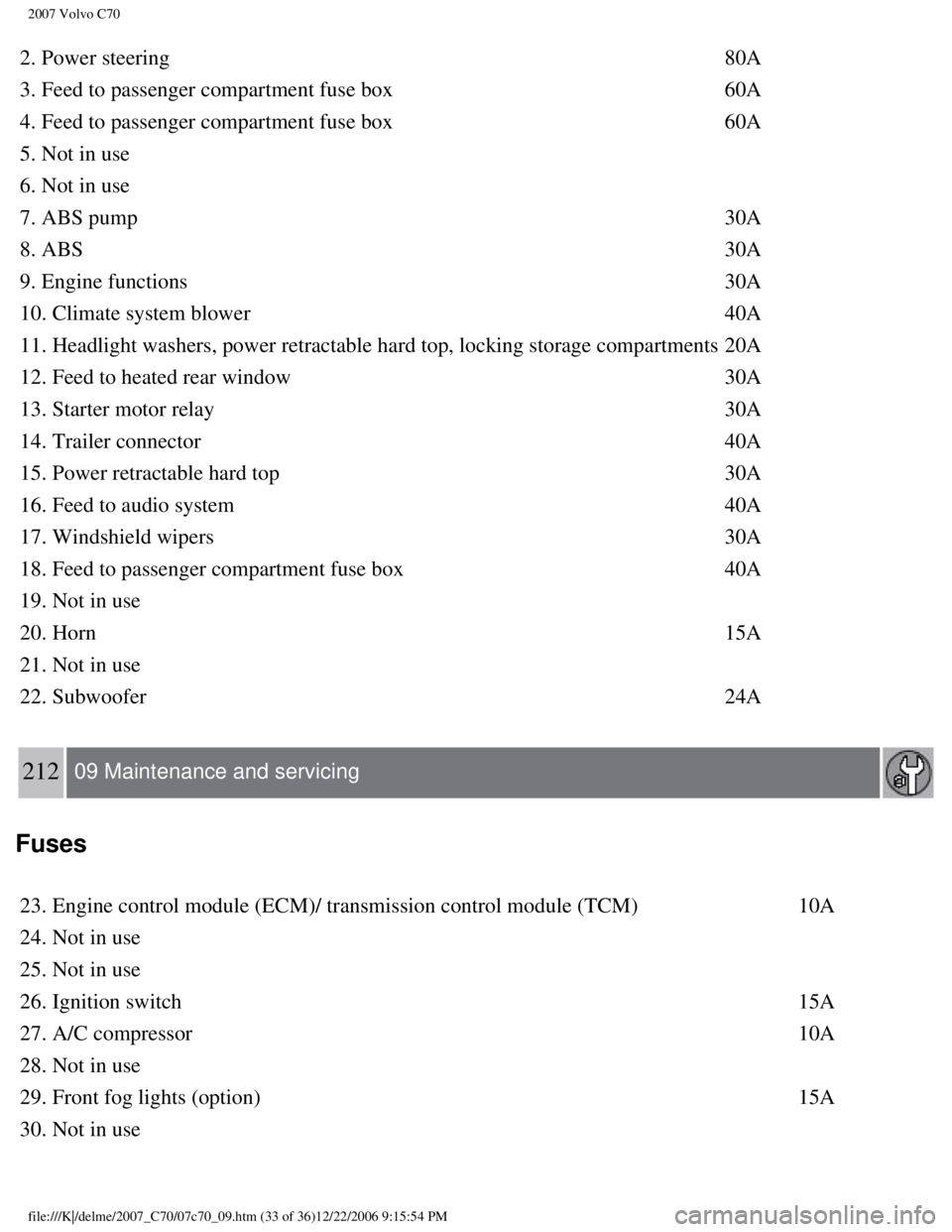
2. Power steering80A
3. Feed to passenger compartment fuse box 60A
4. Feed to passenger compartment fuse box 60A
5. Not in use
6. Not in use
7. ABS pump 30A
8. ABS 30A
9. Engine functions 30A
10. Climate system blower 40A
11. Headlight washers, power retractable hard top, locking storage compa\
rtments 20A
12. Feed to heated rear window 30A
13. Starter motor relay 30A
14. Trailer connector 40A
15. Power retractable hard top 30A
16. Feed to audio system 40A
17. Windshield wipers 30A
18. Feed to passenger compartment fuse box 40A
19. Not in use
20. Horn 15A
21. Not in use
22. Subwoofer 24A
212 09 Maintenance and servicing
Fuses
23. Engine control module (ECM)/ transmission control module (TCM) 10A
24. Not in use
25. Not in use
26. Ignition switch 15A
27. A/C compressor 10A
28. Not in use
29. Front fog lights (option) 15A
30. Not in use
file:///K|/delme/2007_C70/07c70_09.htm (33 of 36)12/22/2006 9:15:54 PM\
Page 231 of 276
, Occupant Weight Sensor (OWS)\
10A
50. Not in use
51. Park assist (option), Bi-Xenon headlights (option) 10A
52. Tran")
2007 Volvo C70
48. Windshield washers15A
49. Supplemental Restrain System (SRS), Occupant Weight Sensor (OWS)\
10A
50. Not in use
51. Park assist (option), Bi-Xenon headlights (option) 10A
52. Transmission control module (TCM), ABS 5A
53. Power steering 10A
54. Engine control module (ECM) 10A
55. Not in use
56. Alarm siren control module 10A
57. On-board diagnostic socket, brake light switch 15A
58. Right high beam, auxiliary lights relay 7.5A
214 09 Maintenance and servicing
Fuses
59. Left high beam7.5A
60. Heated driver's seat (option) 15A
61. Heated passenger's seat (option) 15A
62. Not in use
63. Power window rear passenger's side 20A
64. Lock indicator lights / door panels, Volvo Navigation system (optio\
n) 5A
65. Audio system 5A
66. Audio system control module (ICM), climate system 10A
67. Not in use
68. Cruise control 5A
69. Climate system, rain sensor (option) 5A
70. Not in use
71. Not in use
72. Not in use
73. Front ceiling lighting 5A
74. Fuel pump relay 15A
75. Not in use
76. Not in use
77. 12-volt socket in trunk, auxiliary equipment control module (AEM) 15A
file:///K|/delme/2007_C70/07c70_09.htm (35 of 36)12/22/2006 9:15:54 PM\