roof VOLVO V60 2014 Owner's Manual
[x] Cancel search | Manufacturer: VOLVO, Model Year: 2014, Model line: V60, Model: VOLVO V60 2014Pages: 442, PDF Size: 13.85 MB
Page 173 of 442
06 Locks and alarm
06
* Option/accessory, for more information, see Introduction.171
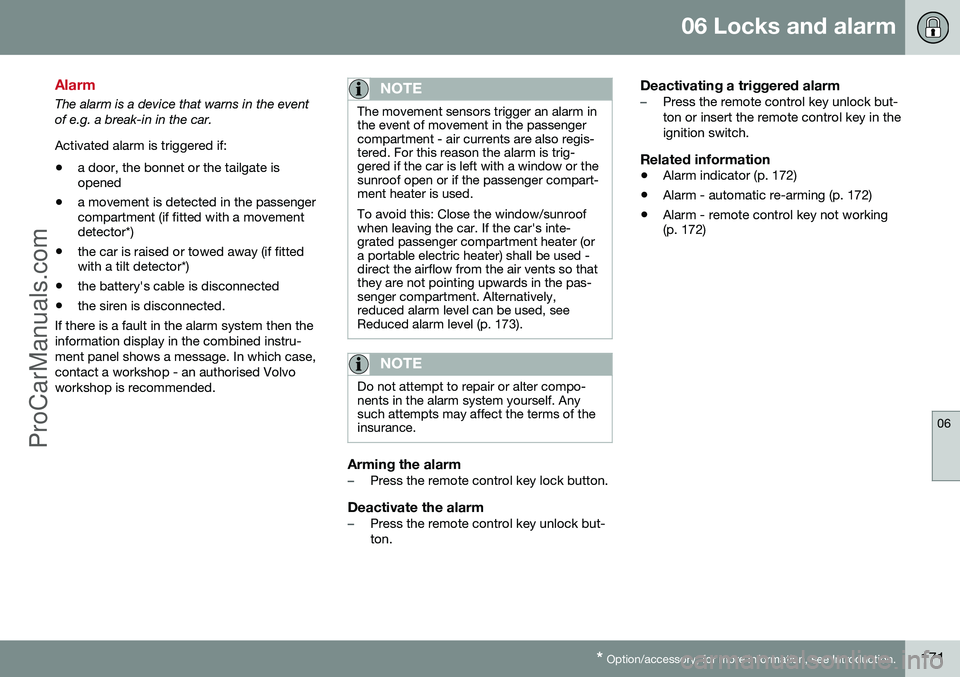
Alarm
The alarm is a device that warns in the event of e.g. a break-in in the car. Activated alarm is triggered if:
• a door, the bonnet or the tailgate is opened
• a movement is detected in the passengercompartment (if fitted with a movementdetector*)
• the car is raised or towed away (if fittedwith a tilt detector*)
• the battery's cable is disconnected
• the siren is disconnected.
If there is a fault in the alarm system then the information display in the combined instru-ment panel shows a message. In which case,contact a workshop - an authorised Volvoworkshop is recommended.NOTE
The movement sensors trigger an alarm in the event of movement in the passengercompartment - air currents are also regis-tered. For this reason the alarm is trig-gered if the car is left with a window or thesunroof open or if the passenger compart-ment heater is used. To avoid this: Close the window/sunroof when leaving the car. If the car's inte-grated passenger compartment heater (ora portable electric heater) shall be used -direct the airflow from the air vents so thatthey are not pointing upwards in the pas-senger compartment. Alternatively,reduced alarm level can be used, seeReduced alarm level (p. 173).
NOTE
Do not attempt to repair or alter compo- nents in the alarm system yourself. Anysuch attempts may affect the terms of theinsurance.
Arming the alarm–Press the remote control key lock button.
Deactivate the alarm–Press the remote control key unlock but- ton.
Deactivating a triggered alarm–Press the remote control key unlock but- ton or insert the remote control key in theignition switch.
Related information
• Alarm indicator (p. 172)
• Alarm - automatic re-arming (p. 172)
• Alarm - remote control key not working (p. 172)
ProCarManuals.co’
Page 308 of 442
||
08 Starting and driving
08
306* Option/accessory, for more information, see Introduction.
• For lowest fuel consumption, activate ECO (p. 288)* 16
.
• Use the ECO Guide which indicates how fuel-efficiently the car is being driven, seeEco guide & Power guide* (p. 63).
• Drive in the highest gear possible, adap-ted to the current traffic situation androad - lower engine speeds result in lowerfuel consumption. Use the gear indicator(p. 272).
• Avoid sudden unnecessary accelerationand heavy braking.
• High speed results in increased fuel con-sumption - the wind resistance increaseswith speed.
• Do not run the engine to operating tem-perature at idling speed, but rather drivewith a light load as soon as possible - acold engine consumes more fuel than awarm one.
• Drive with the correct air pressure in thetyres and check this regularly - selectECO tyre pressure for best results, seeTyres - approved tyre pressures (p. 407).
• Choice of tyres can affect fuel consump-tion - seek advice on suitable tyres from adealer.
• Remove unnecessary items from the car -the greater the load the higher the con-sumption. •
Use engine braking to slow down, when itcan take place without risk to other roadusers.
• A roof load and ski box increase air resis-tance, leading to higher consumption -remove the load carriers when not in use.
• Avoid driving with open windows.
For information about Volvo Car Corpora- tion's environmental philosophy, see VolvoCars' environmental philosophy (p. 19). For more information about fuel consumption, see Fuel consumption and CO2 emissions (p.403).
WARNING
Never switch off the engine while moving, such as downhill, this deactivates impor-tant systems such as the power steeringand brake servo.
Related information
• Fuel - handling (p. 301)
• Fuel consumption and CO2 emissions (p. 403)
• Fuel tank - volume (p. 402)
Driving with a trailer
When driving with a trailer there are a number of important points to think about regardinge.g. the towing bracket, the trailer and howthe load is positioned in the trailer. Payload depends on the car's kerb weight. The total of the weight of the passengers andall accessories, e.g. towbar, reduces the car'spayload by a corresponding weight. For moredetailed information on weights, see Weights(p. 390). If the towing bracket is mounted by Volvo, then the car is delivered with the necessaryequipment for driving with a trailer. • The car's towing bracket must be of an approved type.
• If the towbar is retrofitted, check withyour Volvo dealer that the car is fullyequipped for driving with a trailer.
• Distribute the load on the trailer so thatthe weight on the towing bracket com-plies with the specified maximum towballload.
• Increase the tyre pressure to the recom-mended pressure for a full load. For tyrepressure label location, see Tyres - airpressure (p. 328).
• The engine is loaded more heavily thanusual when driving with a trailer.
16
Only applies to cars with automatic gearbox.
ProCarManuals.co’
Page 375 of 442
10 Maintenance and service
10
* Option/accessory, for more information, see Introduction.373
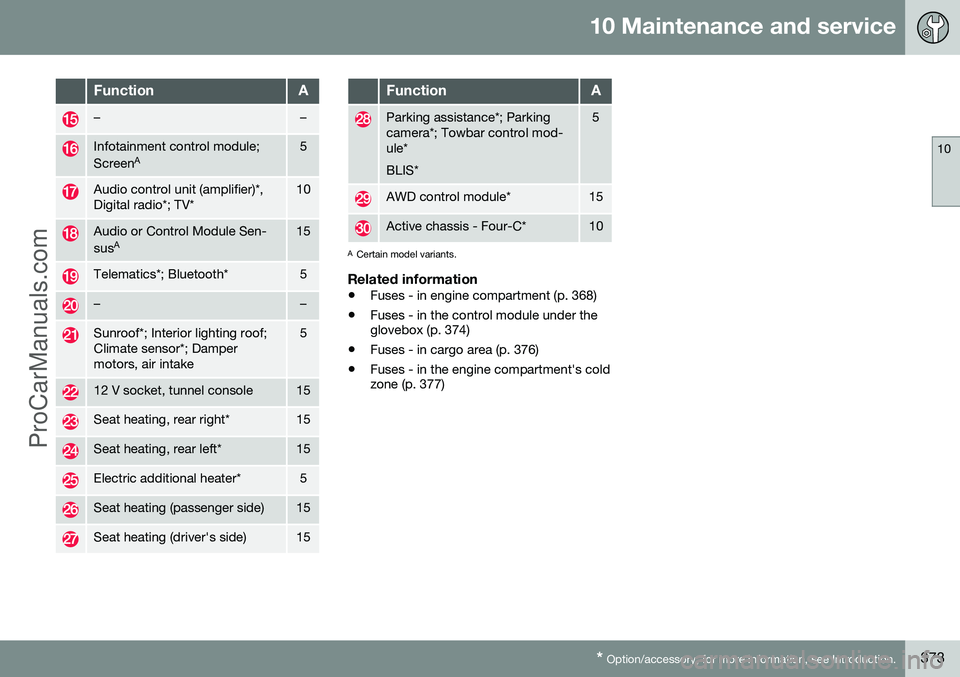
FunctionA
––
Infotainment control module; Screen A5
Audio control unit (amplifier)*, Digital radio*; TV*10
Audio or Control Module Sen- sus
A15
Telematics*; Bluetooth*5
––
Sunroof*; Interior lighting roof; Climate sensor*; Dampermotors, air intake5
12 V socket, tunnel console15
Seat heating, rear right*15
Seat heating, rear left*15
Electric additional heater*5
Seat heating (passenger side)15
Seat heating (driver's side)15
FunctionA
Parking assistance*; Parking camera*; Towbar control mod-ule* BLIS*5
AWD control module*15
Active chassis - Four-C*10
A
Certain model variants.
Related information
• Fuses - in engine compartment (p. 368)
• Fuses - in the control module under the glovebox (p. 374)
• Fuses - in cargo area (p. 376)
• Fuses - in the engine compartment's coldzone (p. 377)
ProCarManuals.co’
Page 377 of 442
10 Maintenance and service
10
* Option/accessory, for more information, see Introduction.375
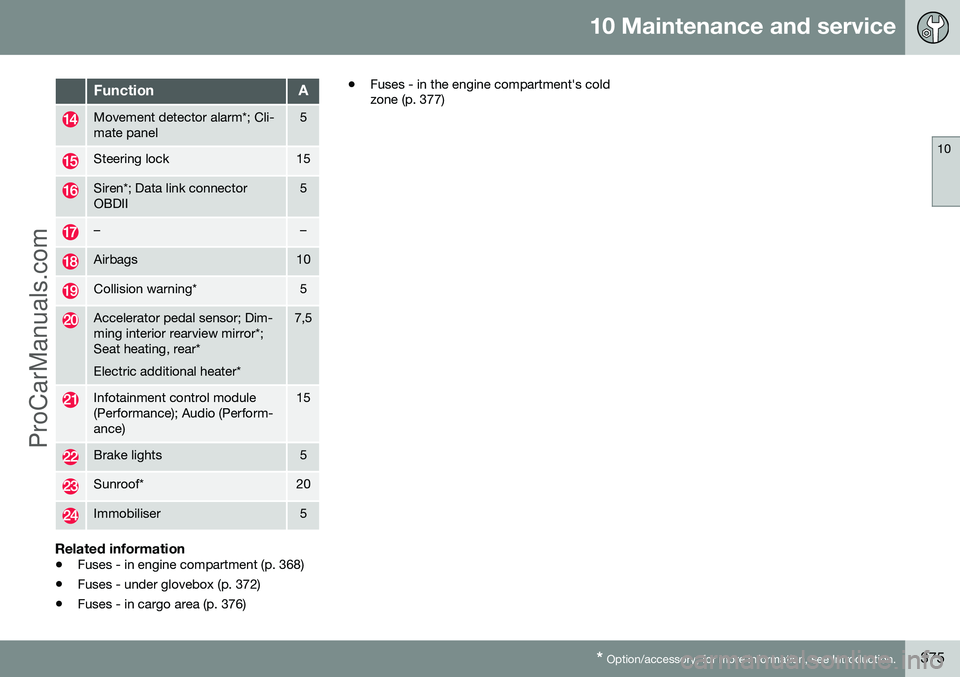
FunctionA
Movement detector alarm*; Cli- mate panel5
Steering lock15
Siren*; Data link connector OBDII5
––
Airbags10
Collision warning*5
Accelerator pedal sensor; Dim- ming interior rearview mirror*;Seat heating, rear* Electric additional heater*7,5
Infotainment control module (Performance); Audio (Perform-ance)15
Brake lights5
Sunroof*20
Immobiliser5
Related information
• Fuses - in engine compartment (p. 368)
• Fuses - under glovebox (p. 372)
• Fuses - in cargo area (p. 376) •
Fuses - in the engine compartment's cold zone (p. 377)
ProCarManuals.co’
Page 383 of 442
10 Maintenance and service
10
* Option/accessory, for more information, see Introduction.381
Water and dirt-repellent coating
The windows are treated with a surface coa- ting that improves visibility in difficult weatherconditions.
Water and dirt-repellent coating*There is natural wear of the water-repellent coating.
Maintenance:
• Never use products such as car wax, degreaser or similar on glass surfaces asthis could ruin their water-repellent prop-erties.
• Take care when cleaning so as not todamage the glass surface.
• To avoid damaging glass surfaces whenremoving ice – only use plastic ice scra-pers.
• Treatment with a special finishing agentavailable from Volvo dealers is recom-mended in order to maintain the water-repellent properties. This should be usedfirst after three years and then each year.
IMPORTANT
Do not use a metal ice scraper to remove ice from the windows. Use the heating toremove ice from the door mirrors, see Win-dows and rearview and door mirrors -heating (p. 96).
Related information
•Car washing (p. 379)
Rustproofing
The car received a thorough and complete rustproofing at the factory. Parts of the bodyare made of galvanised sheet metal. Theunderbody is protected by a wear-resistantanti-corrosion compound. A thin, penetratingrustproofing fluid was sprayed into theexposed members, cavities, closed sectionsand side doors.
Inspection and maintenanceDirt and road salt can lead to corrosion so itis important to keep the car clean. The car'srustproofing needs to be checked regularlyand touched-up if necessary in order for it tobe maintained. Under normal conditions the rustproofing does not require treatment for approximately12 years. After this period, it should be trea-ted at three-year intervals. Volvo recom-mends that you engage an authorised Volvoworkshop for assistance if the car needs fur-ther treatment.
Related information
•Paint damage (p. 383)
Cleaning the interior
Only use cleaning agents and car care prod- ucts recommended by Volvo. Clean regularlyand follow the instructions included with thecar care product. Vacuuming is important prior to using clean- ing agents.
Carpets and cargo areaRemove inlaid carpets for separate cleaningof the floor carpet and the inlaid carpets. Usea vacuum cleaner to remove dust and dirt.Each inlay mat is secured with pins. Take hold of the inlay mat at each pin and lift the mat straight up. Fit the inlay mat in place by pressing it in at each pin.
WARNING
Before setting off check that the inlaid mat in the driver area is firmly affixed andsecured in the bosses in order to avoidgetting caught adjacent to and under thepedals.
A special textile cleaner is recommended for stains on the floor mat after vacuuming. Floormats should be cleaned with agents recom-mended by your Volvo dealer.
ProCarManuals.co’
Page 384 of 442
||
10 Maintenance and service
10
382
Stains on fabric upholstery and roof
upholstery
A special fabric cleaning agent, available from authorised Volvo dealers, is recommended toavoid impairing the fire retardant qualities ofthe upholstery.
IMPORTANT
Sharp objects and Velcro may damage the fabric upholstery.
Stains on leather upholsteryVolvo's leather upholstery is treated to pre- serve its original appearance. Leather upholstery ages and acquires a beau- tiful patina over time. The leather is refinedand processed so that it retains its naturalcharacteristics. It is given a protective coa-ting, but regular cleaning is required in orderto maintain both characteristics and appear-ance. Volvo offers a comprehensive productfor the cleaning and treatment of leatherupholstery which, when used in accordancewith the instructions, preserves the leather'sprotective coating. After a period of use thenatural appearance of the leather will never-theless emerge, depending more or less onthe surface texture of the leather. This is anatural maturing of the leather and showsthat it is a natural product. To achieve best results Volvo recommendscleaning and the application of protectivecream once to four times per year (or more ifnecessary). The Volvo Leather Care kit isavailable from your Volvo dealer.
IMPORTANT
•
Certain items of coloured clothing (for example, jeans and suede garments)may stain the upholstery.
• Never use strong solvents. Such prod-ucts may damage fabric, vinyl andleather upholstery.
Washing instructions for leather upholstery
1. Pour the leather cleaner on the damp-
ened sponge and squeeze out a strong foam.
2. Work the dirt away with gentle circular movements.
3. Dab accurately with the sponge on the stains. Allow the sponge to absorb thestain. Do not rub.
4. Wipe off with soft paper or a cloth and allow the leather to dry completely.
Protective treatment of leather upholstery
1. Pour a small amount of the protective cream on the felted cloth and massage in a thin layer of cream with gentle circularmovements on the leather.
2. Allow the leather to dry for 20 minutes before use.
The leather has now been given improvedprotection against stains and improved UVprotection.
Washing instructions for the leather steering wheel
• Remove dirt and dust with a soft pre- moistened sponge and neutral soap.
• Leather needs to breathe. Never coverthe leather steering wheel with protectiveplastic.
• Use natural oils. Volvo's leather careagents are recommended for best results.
If the steering wheel has stains: Group 1 (ink, wine, coffee, milk, sweat and
blood)
–Use a soft cloth or sponge. Mix a 5% ammonia solution. (For blood stains, usea solution of 2 dl water and 25g salt.)
Group 2 (fats, oils, sauces and chocolate)
1. Same procedure as for group 1.
2. Polish with an absorbent paper or cloth.
ProCarManuals.co’
Page 385 of 442
10 Maintenance and service
10
383
Group 3
(dry dirt, dust)
1. Use a soft brush to remove the dirt.
2. Same procedure as for group 1.
Stains on interior plastic parts, metal parts and wood parts
A fibrillated fibre or microfibre cloth, lightly moistened with water, available from Volvodealers, is recommended for cleaning interiorparts and surfaces. Do not scrape or rub stains. Never use strong stain removers. A special cleaning agentavailable from Volvo dealers can be used formore difficult cleaning.
SeatbeltsUse water and a synthetic detergent. A spe-cial textile cleaning agent is available fromyour Volvo dealer. Make sure the seatbelt isdry before allowing it to retract.
Related information
• Car washing (p. 379)
Paint damage
Paint is an important part of the car's rust- proofing and should therefore be checkedregularly. The most common types of paint-work damage are stone chips, scratches, andmarks on the edges of wings, doors andbumpers.
Touching up minor paintwork damageTo avoid the onset of rust, damaged paint-work should be rectified immediately. Materials
• primer 17
- a special adhesive primer in a
spray can is available for e.g. plastic- coated bumpers
• basecoat and clearcoat - available in spray cans or as touch-up pens/sticks 18
• masking tape
• fine sand paper 17
.
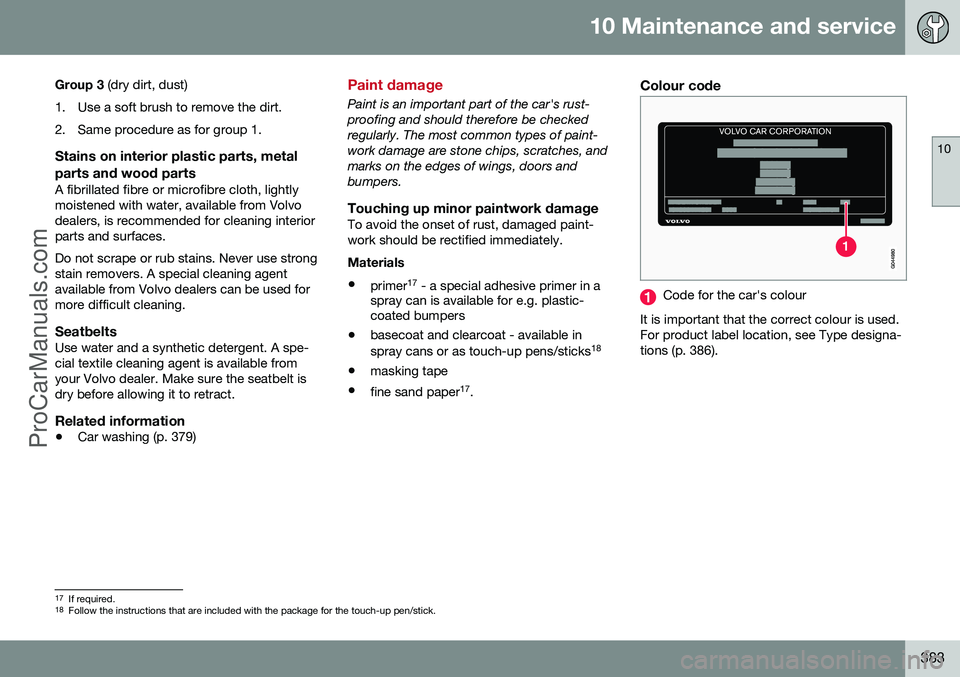
Colour code
Code for the car's colour
It is important that the correct colour is used. For product label location, see Type designa-tions (p. 386).
17 If required.
18 Follow the instructions that are included with the package for the touch-up pen/stick.
ProCarManuals.co’
Page 386 of 442
||
10 Maintenance and service
10
384
Repair minor paintwork damage such
as stone chips and scratches
G021832
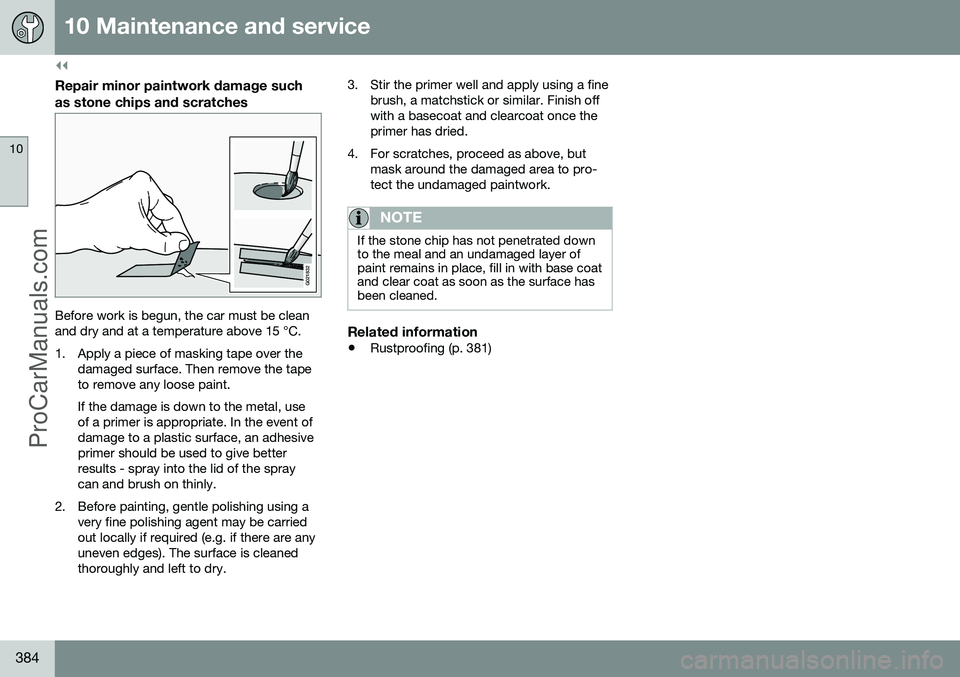
Before work is begun, the car must be clean and dry and at a temperature above 15 °C.
1. Apply a piece of masking tape over the damaged surface. Then remove the tape to remove any loose paint. If the damage is down to the metal, use of a primer is appropriate. In the event ofdamage to a plastic surface, an adhesiveprimer should be used to give betterresults - spray into the lid of the spraycan and brush on thinly.
2. Before painting, gentle polishing using a very fine polishing agent may be carriedout locally if required (e.g. if there are anyuneven edges). The surface is cleanedthoroughly and left to dry. 3. Stir the primer well and apply using a fine
brush, a matchstick or similar. Finish offwith a basecoat and clearcoat once theprimer has dried.
4. For scratches, proceed as above, but mask around the damaged area to pro-tect the undamaged paintwork.
NOTE
If the stone chip has not penetrated down to the meal and an undamaged layer ofpaint remains in place, fill in with base coatand clear coat as soon as the surface hasbeen cleaned.
Related information
• Rustproofing (p. 381)
ProCarManuals.co’
Page 392 of 442
11 Specifications
11
390
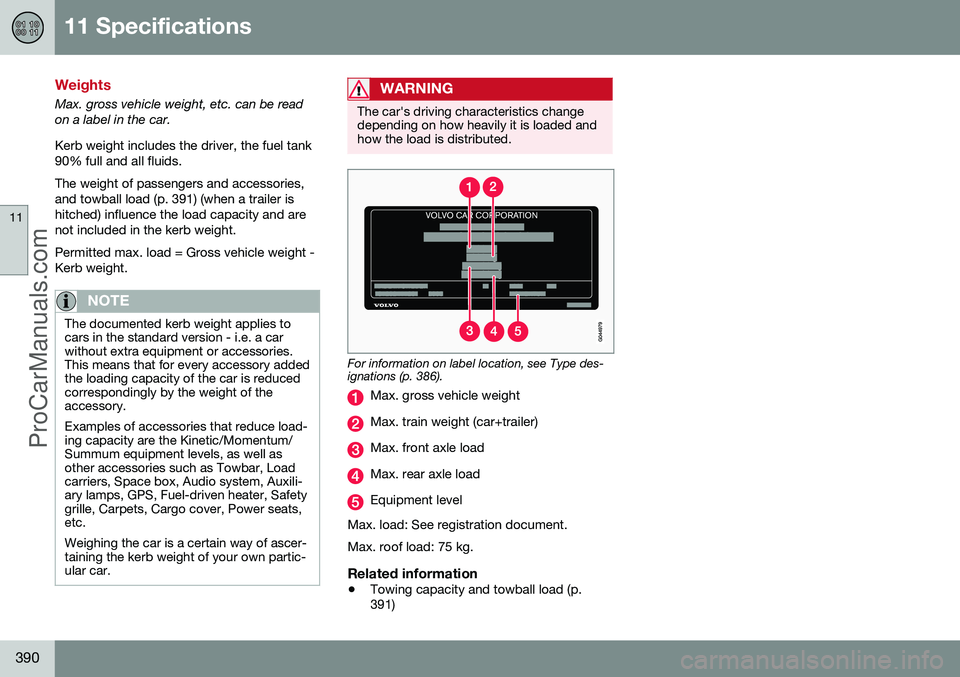
Weights
Max. gross vehicle weight, etc. can be read on a label in the car. Kerb weight includes the driver, the fuel tank 90% full and all fluids. The weight of passengers and accessories, and towball load (p. 391) (when a trailer ishitched) influence the load capacity and arenot included in the kerb weight. Permitted max. load = Gross vehicle weight - Kerb weight.
NOTE
The documented kerb weight applies to cars in the standard version - i.e. a carwithout extra equipment or accessories.This means that for every accessory addedthe loading capacity of the car is reducedcorrespondingly by the weight of theaccessory. Examples of accessories that reduce load- ing capacity are the Kinetic/Momentum/Summum equipment levels, as well asother accessories such as Towbar, Loadcarriers, Space box, Audio system, Auxili-ary lamps, GPS, Fuel-driven heater, Safetygrille, Carpets, Cargo cover, Power seats,etc. Weighing the car is a certain way of ascer- taining the kerb weight of your own partic-ular car.
WARNING
The car's driving characteristics change depending on how heavily it is loaded andhow the load is distributed.
For information on label location, see Type des- ignations (p. 386).
Max. gross vehicle weight
Max. train weight (car+trailer)
Max. front axle load
Max. rear axle load
Equipment level
Max. load: See registration document. Max. roof load: 75 kg.
Related information
• Towing capacity and towball load (p. 391)
ProCarManuals.co’
Page 429 of 442
11 Specifications
11
* Option/accessory, for more information, see Introduction.427
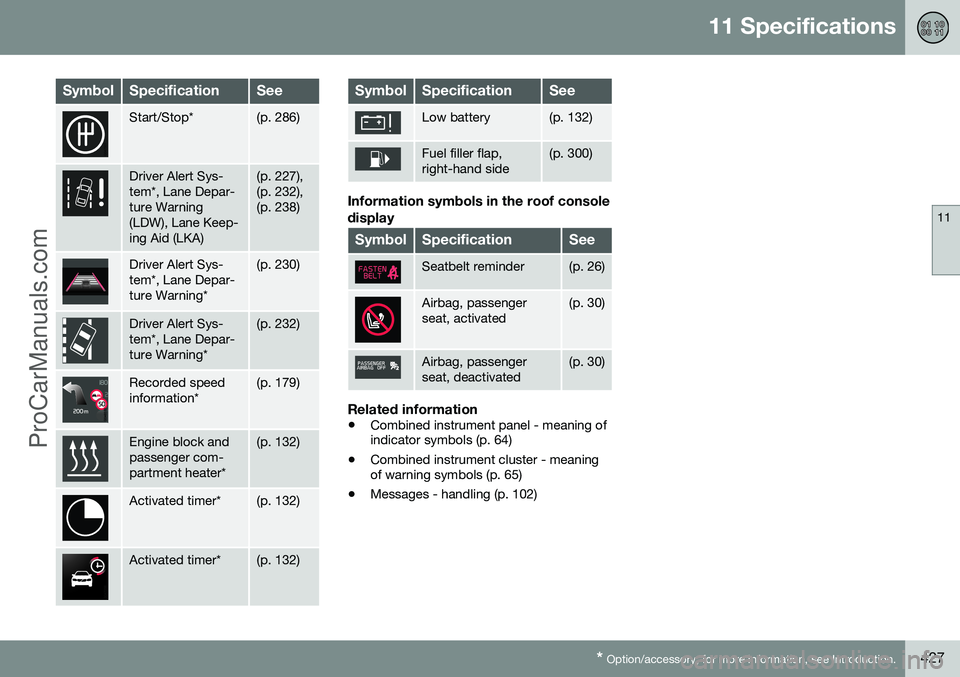
SymbolSpecificationSee
Start/Stop*(p. 286)
Driver Alert Sys- tem*, Lane Depar-ture Warning(LDW), Lane Keep-ing Aid (LKA)(p. 227), (p. 232),(p. 238)
Driver Alert Sys- tem*, Lane Depar-ture Warning*(p. 230)
Driver Alert Sys- tem*, Lane Depar-ture Warning*(p. 232)
Recorded speed information*(p. 179)
Engine block and passenger com-partment heater*(p. 132)
Activated timer*(p. 132)
Activated timer*(p. 132)
SymbolSpecificationSee
Low battery(p. 132)
Fuel filler flap, right-hand side(p. 300)
Information symbols in the roof console display
SymbolSpecificationSee
Seatbelt reminder(p. 26)
Airbag, passenger seat, activated(p. 30)
Airbag, passenger seat, deactivated(p. 30)
Related information
• Combined instrument panel - meaning of indicator symbols (p. 64)
• Combined instrument cluster - meaningof warning symbols (p. 65)
• Messages - handling (p. 102)
ProCarManuals.co’