ESP VOLVO V60 2014 Manual PDF
[x] Cancel search | Manufacturer: VOLVO, Model Year: 2014, Model line: V60, Model: VOLVO V60 2014Pages: 442, PDF Size: 13.85 MB
Page 310 of 442
08 Starting and driving
08
308* Option/accessory, for more information, see Introduction.
Driving with a trailer - manual gearbox
When driving with a trailer in hilly terrain in a hot climate there may be a risk of overheating.
OverheatingWhen driving with a trailer in hilly terrain in ahot climate there may be a risk of overheat-ing. • Do not run the engine at higher revolu- tions than 4500 rpm(diesel engines: 3500 rpm) - otherwise theoil temperature may become too high.
Diesel engine 5-cyl
•In the event of a risk of overheating theoptimal speed for the engine is2300-3000 rpm for optimal circulation ofthe coolant.
Related information
•Driving with a trailer (p. 306)
Driving with a trailer - automatic gearbox
When driving with a trailer in hilly terrain in a hot climate there may be a risk of overheating.
• An automatic gearbox selects the opti- mum gear related to load and enginespeed.
• In the event of overheating a warningsymbol is illuminated in the combinedinstrument panel with a message that isshown in the information display - followthe recommendation given.
Steep inclines
•Do not lock the automatic transmission ina higher gear than the engine "can copewith" - it is not always a good idea todrive at a high gear with low engine revo-lutions.
Parking on a hill1. Depress the foot brake.
2. Activate the parking brake.
3. Move the gear selector to position
P.
4. Release the foot brake.
• Move the gear selector to park position
P
when parking an automatic car with a hitched trailer. Always use the parkingbrake.
• Block the wheels with chocks when park-ing a car with hitched trailer on a hill.
IMPORTANT
See also the specific information on slow driving with a trailer for cars with thePowershift automatic transmission, seeAutomatic gearbox -- Powershift* (p. 276).
Starting on a hill1. Depress the foot brake.
2. Move the gear selector to driving posi-
tion D.
3. Release the parking brake.
4. Release the foot brake and start driving off.
Related information
• Automatic gearbox -- Geartronic* (p. 273)
ProCarManuals.co’
Page 320 of 442
09 Wheels and tyres
09
318
Tyres - direction of rotation
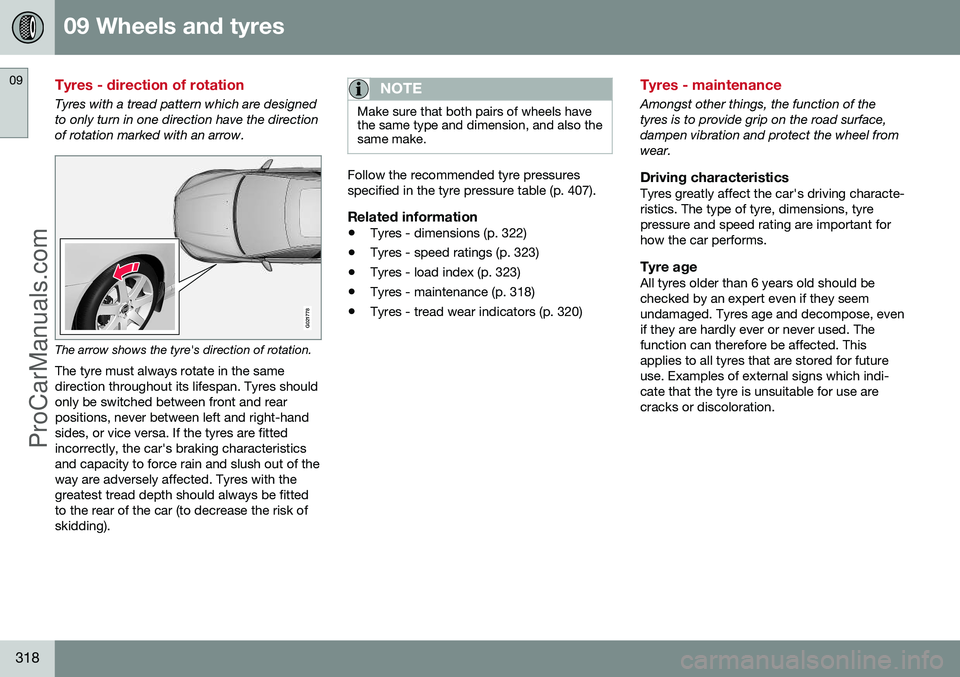
Tyres with a tread pattern which are designed to only turn in one direction have the directionof rotation marked with an arrow.
G021778
The arrow shows the tyre's direction of rotation.The tyre must always rotate in the same direction throughout its lifespan. Tyres shouldonly be switched between front and rearpositions, never between left and right-handsides, or vice versa. If the tyres are fittedincorrectly, the car's braking characteristicsand capacity to force rain and slush out of theway are adversely affected. Tyres with thegreatest tread depth should always be fittedto the rear of the car (to decrease the risk ofskidding).
NOTE
Make sure that both pairs of wheels have the same type and dimension, and also thesame make.
Follow the recommended tyre pressures specified in the tyre pressure table (p. 407).
Related information
• Tyres - dimensions (p. 322)
• Tyres - speed ratings (p. 323)
• Tyres - load index (p. 323)
• Tyres - maintenance (p. 318)
• Tyres - tread wear indicators (p. 320)
Tyres - maintenance
Amongst other things, the function of the tyres is to provide grip on the road surface,dampen vibration and protect the wheel fromwear.
Driving characteristicsTyres greatly affect the car's driving characte-ristics. The type of tyre, dimensions, tyrepressure and speed rating are important forhow the car performs.
Tyre ageAll tyres older than 6 years old should bechecked by an expert even if they seemundamaged. Tyres age and decompose, evenif they are hardly ever or never used. Thefunction can therefore be affected. Thisapplies to all tyres that are stored for futureuse. Examples of external signs which indi-cate that the tyre is unsuitable for use arecracks or discoloration.
ProCarManuals.co’
Page 321 of 442
09 Wheels and tyres
09
319
New tyres
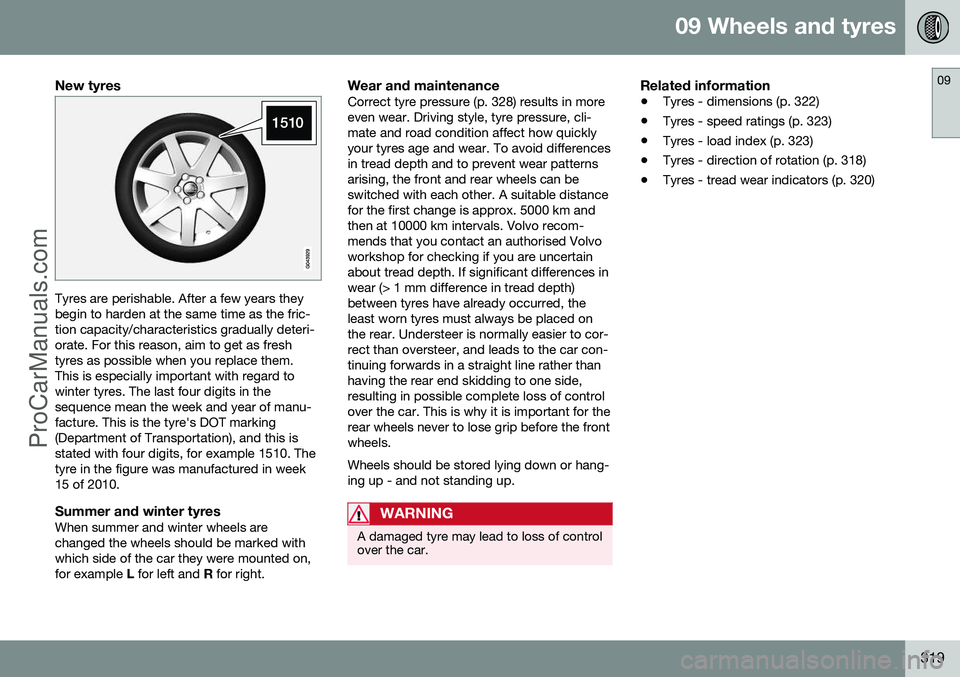
Tyres are perishable. After a few years they begin to harden at the same time as the fric-tion capacity/characteristics gradually deteri-orate. For this reason, aim to get as freshtyres as possible when you replace them.This is especially important with regard towinter tyres. The last four digits in thesequence mean the week and year of manu-facture. This is the tyre's DOT marking(Department of Transportation), and this isstated with four digits, for example 1510. Thetyre in the figure was manufactured in week15 of 2010.
Summer and winter tyresWhen summer and winter wheels arechanged the wheels should be marked withwhich side of the car they were mounted on,for example L for left and R for right.
Wear and maintenanceCorrect tyre pressure (p. 328) results in moreeven wear. Driving style, tyre pressure, cli-mate and road condition affect how quicklyyour tyres age and wear. To avoid differencesin tread depth and to prevent wear patternsarising, the front and rear wheels can beswitched with each other. A suitable distancefor the first change is approx. 5000 km andthen at 10000 km intervals. Volvo recom-mends that you contact an authorised Volvoworkshop for checking if you are uncertainabout tread depth. If significant differences inwear (> 1 mm difference in tread depth)between tyres have already occurred, theleast worn tyres must always be placed onthe rear. Understeer is normally easier to cor-rect than oversteer, and leads to the car con-tinuing forwards in a straight line rather thanhaving the rear end skidding to one side,resulting in possible complete loss of controlover the car. This is why it is important for therear wheels never to lose grip before the frontwheels. Wheels should be stored lying down or hang- ing up - and not standing up.
WARNING
A damaged tyre may lead to loss of control over the car.
Related information
• Tyres - dimensions (p. 322)
• Tyres - speed ratings (p. 323)
• Tyres - load index (p. 323)
• Tyres - direction of rotation (p. 318)
• Tyres - tread wear indicators (p. 320)
ProCarManuals.co’
Page 323 of 442
09 Wheels and tyres
09
* Option/accessory, for more information, see Introduction.321
Jack*
A jack is used to raise the car, e.g. when changing the tyres. The original jack should only be used for changing to the spare wheel. The jack'sthread must always be well greased.
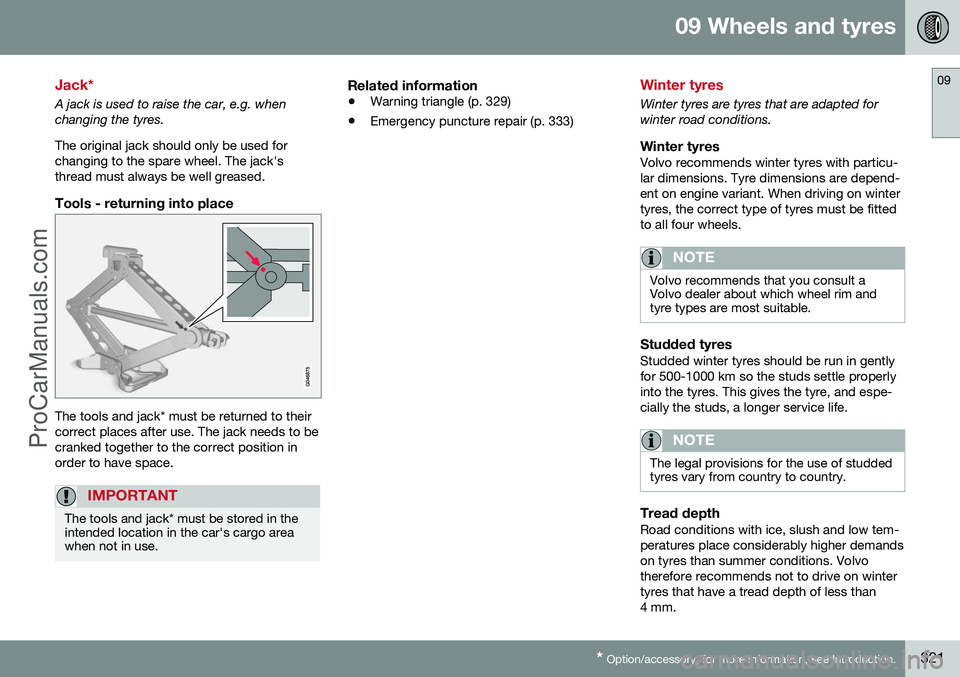
Tools - returning into place
The tools and jack* must be returned to their correct places after use. The jack needs to becranked together to the correct position inorder to have space.
IMPORTANT
The tools and jack* must be stored in the intended location in the car's cargo areawhen not in use.
Related information
• Warning triangle (p. 329)
• Emergency puncture repair (p. 333)
Winter tyres
Winter tyres are tyres that are adapted for winter road conditions.
Winter tyresVolvo recommends winter tyres with particu-lar dimensions. Tyre dimensions are depend-ent on engine variant. When driving on wintertyres, the correct type of tyres must be fittedto all four wheels.
NOTE
Volvo recommends that you consult a Volvo dealer about which wheel rim andtyre types are most suitable.
Studded tyresStudded winter tyres should be run in gently for 500-1000 km so the studs settle properlyinto the tyres. This gives the tyre, and espe-cially the studs, a longer service life.
NOTE
The legal provisions for the use of studded tyres vary from country to country.
Tread depthRoad conditions with ice, slush and low tem- peratures place considerably higher demandson tyres than summer conditions. Volvotherefore recommends not to drive on wintertyres that have a tread depth of less than4 mm.
ProCarManuals.co’
Page 325 of 442
09 Wheels and tyres
09
323
WARNING
19-inch wheels must never be used on
cars that are not equipped with the R-
Design or Sport chassis options. The use of 19-inch wheels on cars with standard
chassis constitutes a safety risk, with a
risk of vehicle damage, and it impairs thecar's driving characteristics.
Related information
• Tyres - speed ratings (p. 323)
• Tyres - load index (p. 323)
• Tyres - direction of rotation (p. 318)
• Tyres - maintenance (p. 318)
• Tyres - approved tyre pressures (p. 407)
• Wheel and wheel rim dimensions (p. 322)
Tyres - load index
Load index indicates a tyre's ability to carry a certain load. Each tyre has a certain capacity to carry a load, a load index (LI). The car's weight deter-mines the load capacity required of the tyres.Minimum permissible index is indicated in theload index table.
Related information
•Tyres - dimensions (p. 322)
• Tyres - approved tyre pressures (p. 407)
• Tyres - speed ratings (p. 323)
• Tyres - maintenance (p. 318)
Tyres - speed ratings
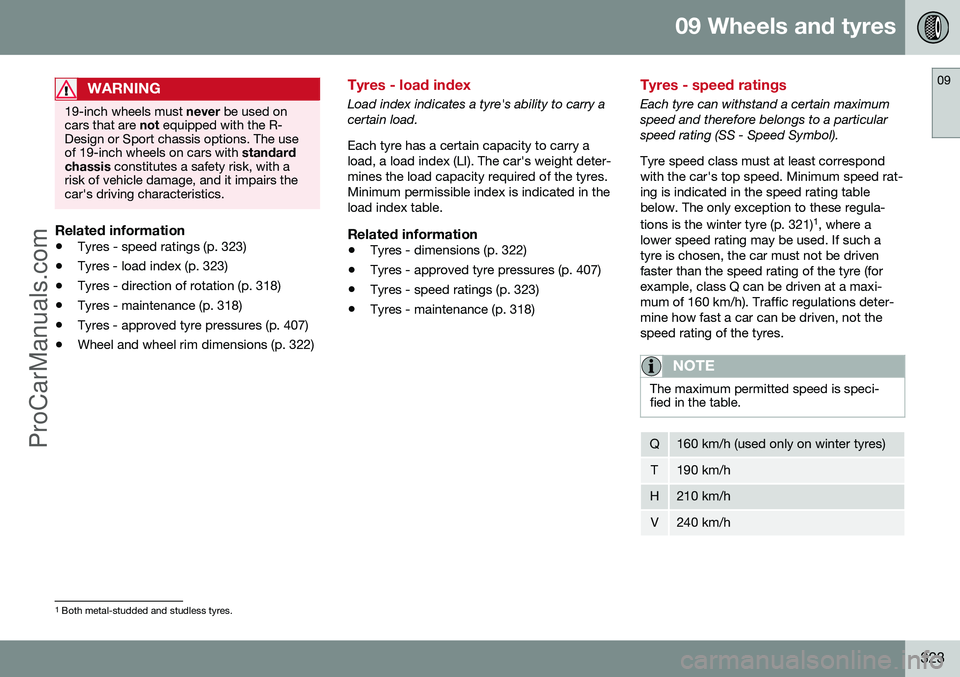
Each tyre can withstand a certain maximum speed and therefore belongs to a particularspeed rating (SS - Speed Symbol). Tyre speed class must at least correspond with the car's top speed. Minimum speed rat-ing is indicated in the speed rating tablebelow. The only exception to these regula- tions is the winter tyre (p. 321) 1
, where a
lower speed rating may be used. If such a tyre is chosen, the car must not be drivenfaster than the speed rating of the tyre (forexample, class Q can be driven at a maxi-mum of 160 km/h). Traffic regulations deter-mine how fast a car can be driven, not thespeed rating of the tyres.
NOTE
The maximum permitted speed is speci- fied in the table.
Q160 km/h (used only on winter tyres)
T190 km/h
H210 km/h
V240 km/h
1 Both metal-studded and studless tyres.
ProCarManuals.co’
Page 334 of 442
09 Wheels and tyres
09
332* Option/accessory, for more information, see Introduction.
Tyre pressure monitoring* - recommendations
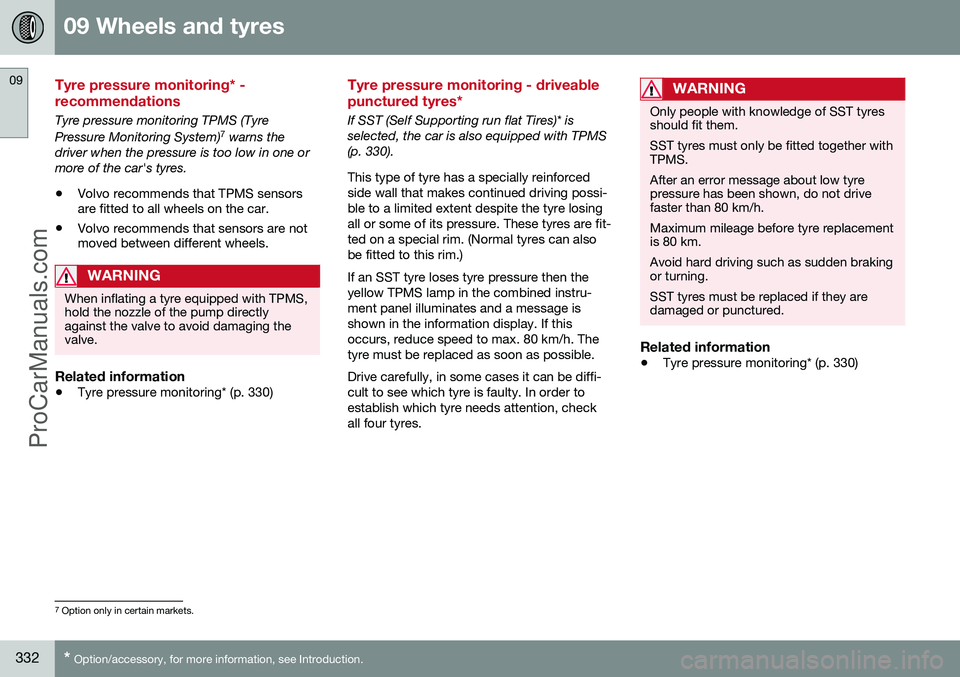
Tyre pressure monitoring TPMS (Tyre Pressure Monitoring System) 7
warns the
driver when the pressure is too low in one or more of the car's tyres.
• Volvo recommends that TPMS sensors are fitted to all wheels on the car.
• Volvo recommends that sensors are notmoved between different wheels.
WARNING
When inflating a tyre equipped with TPMS, hold the nozzle of the pump directlyagainst the valve to avoid damaging thevalve.
Related information
• Tyre pressure monitoring* (p. 330)
Tyre pressure monitoring - driveable punctured tyres*
If SST (Self Supporting run flat Tires)* is selected, the car is also equipped with TPMS(p. 330). This type of tyre has a specially reinforced side wall that makes continued driving possi-ble to a limited extent despite the tyre losingall or some of its pressure. These tyres are fit-ted on a special rim. (Normal tyres can alsobe fitted to this rim.) If an SST tyre loses tyre pressure then the yellow TPMS lamp in the combined instru-ment panel illuminates and a message isshown in the information display. If thisoccurs, reduce speed to max. 80 km/h. Thetyre must be replaced as soon as possible. Drive carefully, in some cases it can be diffi- cult to see which tyre is faulty. In order toestablish which tyre needs attention, checkall four tyres.
WARNING
Only people with knowledge of SST tyres should fit them. SST tyres must only be fitted together with TPMS. After an error message about low tyre pressure has been shown, do not drivefaster than 80 km/h. Maximum mileage before tyre replacement is 80 km. Avoid hard driving such as sudden braking or turning. SST tyres must be replaced if they are damaged or punctured.
Related information
•Tyre pressure monitoring* (p. 330)
7
Option only in certain markets.
ProCarManuals.co’
Page 348 of 442
||
10 Maintenance and service
10
346
texts. Certain variants have both systems. Contact a Volvo dealer for more information. Change the engine oil and oil filter in accord- ance with the intervals specified in the Serv-ice and Warranty Booklet. Using oil of a higher than specified grade is permitted. If the car is driven in adverse con-ditions, Volvo recommends using an oil of ahigher grade; see Engine oil - adverse drivingconditions (p. 395). For filling capacities, see Engine oil - grade and volume (p. 396).
Related information
•Engine oil - checking and filling (p. 346)
Engine oil - checking and filling
The oil level is checked on certain engine vari- ants with the electronic oil level sensor, onother engine variants with the oil dipstick.
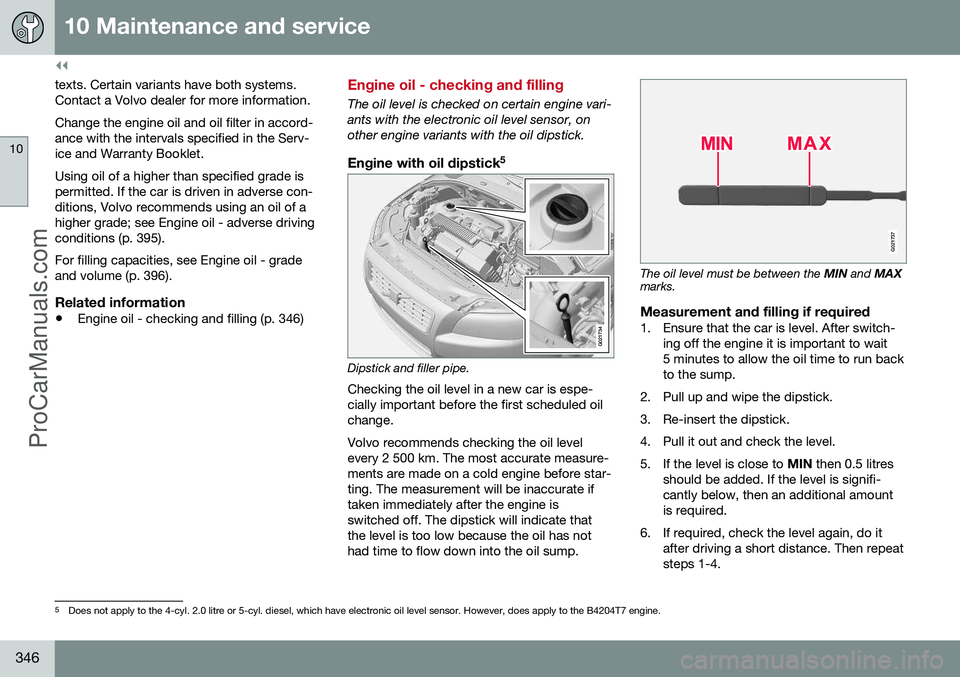
Engine with oil dipstick 5
G021734
Dipstick and filler pipe. Checking the oil level in a new car is espe- cially important before the first scheduled oilchange. Volvo recommends checking the oil level every 2 500 km. The most accurate measure-ments are made on a cold engine before star-ting. The measurement will be inaccurate iftaken immediately after the engine isswitched off. The dipstick will indicate thatthe level is too low because the oil has nothad time to flow down into the oil sump.
G021737
The oil level must be between the
MIN and MAX
marks.
Measurement and filling if required1. Ensure that the car is level. After switch-
ing off the engine it is important to wait 5 minutes to allow the oil time to run backto the sump.
2. Pull up and wipe the dipstick.
3. Re-insert the dipstick.
4. Pull it out and check the level.
5. If the level is close to MIN then 0.5 litres
should be added. If the level is signifi- cantly below, then an additional amountis required.
6. If required, check the level again, do it after driving a short distance. Then repeatsteps 1-4.
5Does not apply to the 4-cyl. 2.0 litre or 5-cyl. diesel, which have electronic oil level sensor. However, does apply to the B4204T7 engine.
ProCarManuals.co’
Page 349 of 442
10 Maintenance and service
10
}}
347
WARNING
Never fill above the MAX mark. The level
should never be above MAX or below MIN
as this could lead to engine damage.
WARNING
Do not spill oil onto the hot exhaust mani- fold due to the risk of fire.
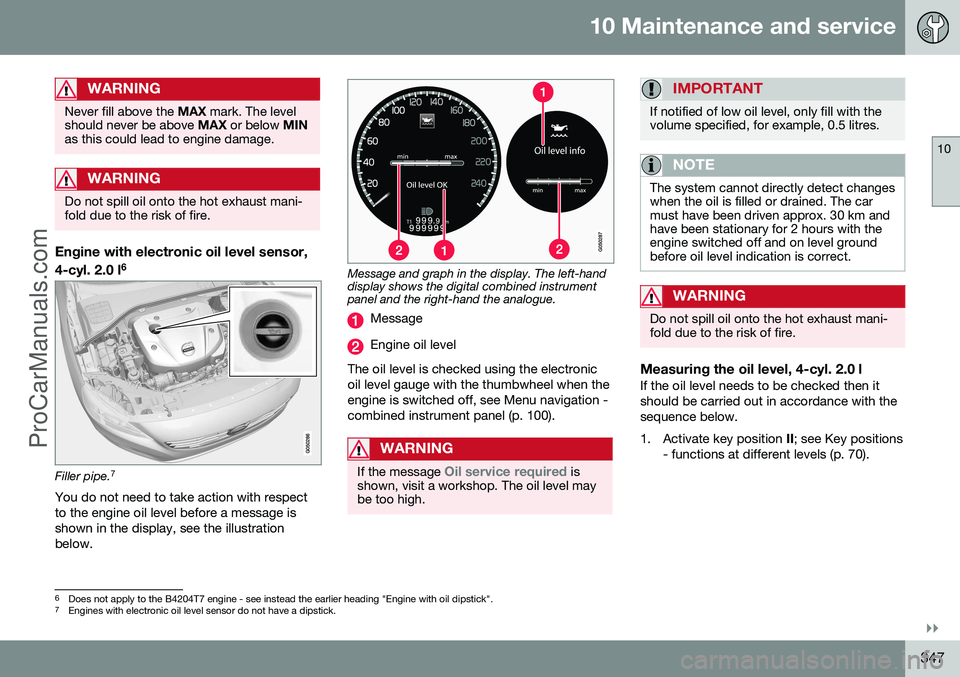
Engine with electronic oil level sensor, 4-cyl. 2.0 l 6
Filler pipe.
7
You do not need to take action with respect to the engine oil level before a message isshown in the display, see the illustrationbelow.
Message and graph in the display. The left-hand display shows the digital combined instrumentpanel and the right-hand the analogue.
Message
Engine oil level
The oil level is checked using the electronic oil level gauge with the thumbwheel when theengine is switched off, see Menu navigation -combined instrument panel (p. 100).
WARNING
If the message Oil service required is
shown, visit a workshop. The oil level may be too high.
IMPORTANT
If notified of low oil level, only fill with the volume specified, for example, 0.5 litres.
NOTE
The system cannot directly detect changes when the oil is filled or drained. The carmust have been driven approx. 30 km andhave been stationary for 2 hours with theengine switched off and on level groundbefore oil level indication is correct.
WARNING
Do not spill oil onto the hot exhaust mani- fold due to the risk of fire.
Measuring the oil level, 4-cyl. 2.0 lIf the oil level needs to be checked then it should be carried out in accordance with thesequence below.
1. Activate key position II; see Key positions
- functions at different levels (p. 70).
6 Does not apply to the B4204T7 engine - see instead the earlier heading "Engine with oil dipstick".7
Engines with electronic oil level sensor do not have a dipstick.
ProCarManuals.co’
Page 350 of 442
||
10 Maintenance and service
10
348
2. Rotate the thumbwheel on the left-handstalk switch to position Oil level.
> You will then see information displayed about the engine oil level. For more information on menu naviga- tion, see Menu navigation - combinedinstrument panel (p. 100).
NOTE
If the right conditions for measuring the oil level are not met (time after engine shut-down, the car's inclination, outside tem- perature, etc.) then the message
Not
available will be shown. This does not
mean that there is something wrong in the car's systems.
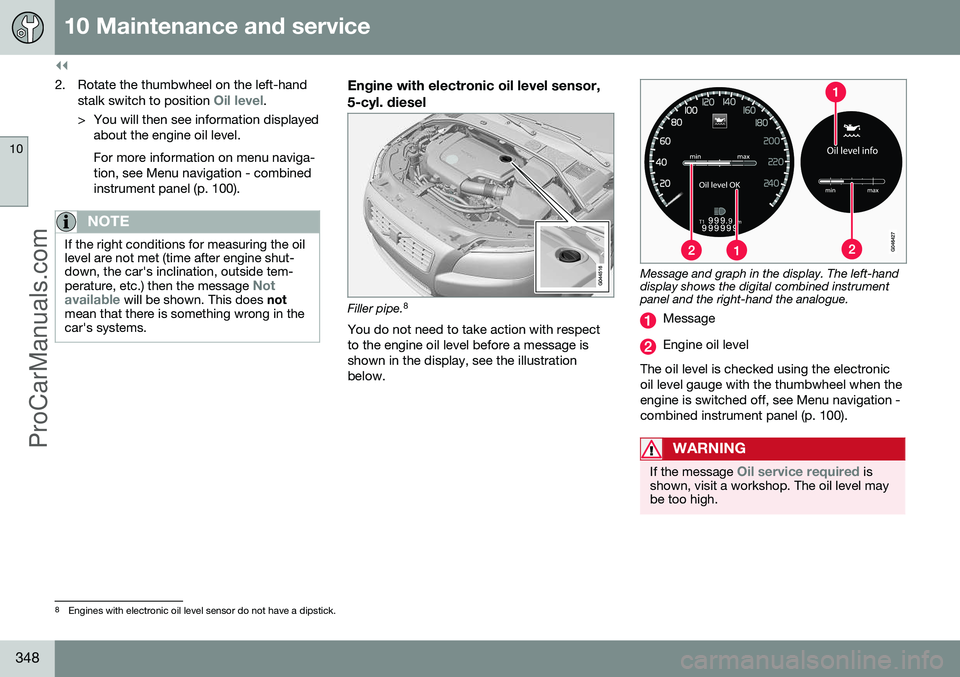
Engine with electronic oil level sensor, 5-cyl. diesel
Filler pipe. 8
You do not need to take action with respect to the engine oil level before a message isshown in the display, see the illustrationbelow.
Message and graph in the display. The left-hand display shows the digital combined instrumentpanel and the right-hand the analogue.
Message
Engine oil level
The oil level is checked using the electronic oil level gauge with the thumbwheel when theengine is switched off, see Menu navigation -combined instrument panel (p. 100).
WARNING
If the message Oil service required is
shown, visit a workshop. The oil level may be too high.
8 Engines with electronic oil level sensor do not have a dipstick.
ProCarManuals.co’
Page 390 of 442
||
11 Specifications
11
388
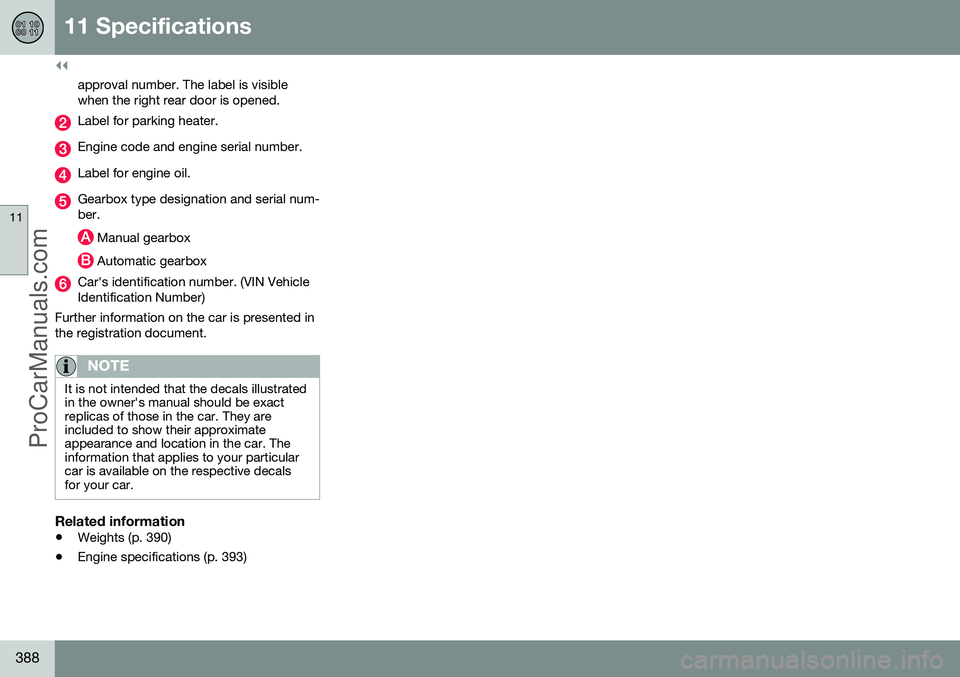
approval number. The label is visible when the right rear door is opened.
Label for parking heater.
Engine code and engine serial number.
Label for engine oil.
Gearbox type designation and serial num- ber.
Manual gearbox
Automatic gearbox
Car's identification number. (VIN Vehicle Identification Number)
Further information on the car is presented inthe registration document.
NOTE
It is not intended that the decals illustrated in the owner's manual should be exactreplicas of those in the car. They areincluded to show their approximateappearance and location in the car. Theinformation that applies to your particularcar is available on the respective decalsfor your car.
Related information
• Weights (p. 390)
• Engine specifications (p. 393)
ProCarManuals.co’