ESP VOLVO V60 2014 Repair Manual
[x] Cancel search | Manufacturer: VOLVO, Model Year: 2014, Model line: V60, Model: VOLVO V60 2014Pages: 442, PDF Size: 13.85 MB
Page 261 of 442
08 Starting and driving
08
* Option/accessory, for more information, see Introduction.259
Alcolock*
The function of the Alcolock 1
is to prevent the
car from being driven by individuals under the influence of alcohol. Before the engine can bestarted the driver must take a breath test thatverifies that he/she is not under the influenceof alcohol. Alcolock calibration takes place inaccordance with each market's limit value inforce for driving legally.
WARNING
The Alcolock is an aid and does not exempt the driver from responsibility. It isalways the responsibility of the driver to besober and to drive the car safely.
Related information
• Alcolock* - functions and operation (p. 259)
• Alcolock* - to bear in mind (p. 261)
• Alcolock* - storage (p. 260)
• Alcolock* - before starting the engine (p.260)
• Alcolock* - symbols and text messages(p. 263)
Alcolock* - functions and operation
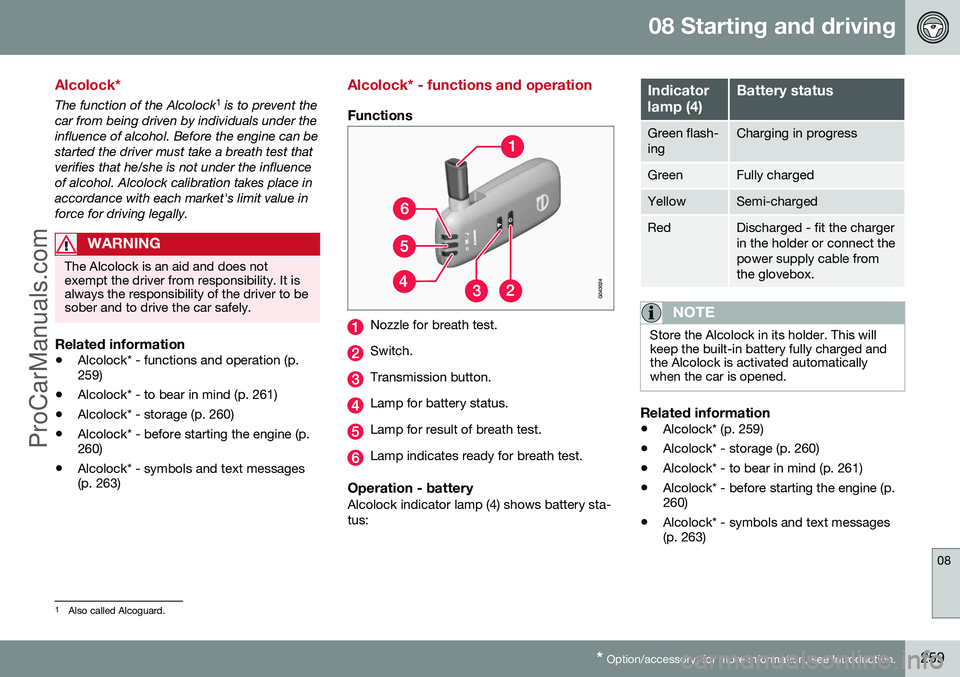
Functions
Nozzle for breath test.
Switch.
Transmission button.
Lamp for battery status.
Lamp for result of breath test.
Lamp indicates ready for breath test.
Operation - batteryAlcolock indicator lamp (4) shows battery sta- tus:
Indicator lamp (4)Battery status
Green flash- ingCharging in progress
GreenFully charged
YellowSemi-charged
RedDischarged - fit the charger in the holder or connect thepower supply cable fromthe glovebox.
NOTE
Store the Alcolock in its holder. This will keep the built-in battery fully charged andthe Alcolock is activated automaticallywhen the car is opened.
Related information
•Alcolock* (p. 259)
• Alcolock* - storage (p. 260)
• Alcolock* - to bear in mind (p. 261)
• Alcolock* - before starting the engine (p. 260)
• Alcolock* - symbols and text messages(p. 263)
1
Also called Alcoguard.
ProCarManuals.co’
Page 270 of 442
08 Starting and driving
08
268* Option/accessory, for more information, see Introduction.
Remote start (ERS) - symbols and messages
In situations where the ERS function fails or is interrupted, a symbol is shown in the com-bined instrument panel, supplemented by anexplanatory text message.
ERS function unavailable
MessageSpecification
No remote start Max 2startsERS unavailable because a maximum of 2 ERSactivations in successionare allowed.
No remote start low fuellevelERS unavailable because fuel level too low.
No remote start gear notin PERS unavailable because gear selector is not in P
position.
No remote start driver incarERS unavailable because someone is in the pas-senger compartment.
No remote start low bat-teryERS unavailable due to low battery voltage.Charge the battery bystarting the engine.
MessageSpecification
No remote start enginewarningERS unavailable due to warning message fromengine. Contact a work- shop A
.
No remote start enginecoolantERS unavailable due to error message from cool-ing system, see Coolant -level (p. 349).
No remote start dooropenERS unavailable because a door/tailgate was notclosed.
No remote start car notlockedERS unavailable because the car was not locked.
A An authorised Volvo workshop is recommended.
Interrupted ERS function
MessageSpecification
Remote start off low fuellevelERS interrupted because fuel level toolow.
Remote start off gear not inPERS interrupted because gear selector isnot in P position.
MessageSpecification
Remote start off driver incarERS interrupted because someone is inthe passenger compart-ment.
Remote start off enginewarningERS interrupted due to error message fromengine. Contact a work- shop A
.
Remote start off low batteryERS interrupted because battery voltagetoo low.
Remote start off enginecoolantERS interrupted due to error message fromcooling system.
A An authorised Volvo workshop is recommended.
Related information
• Remote start (ERS)* (p. 266)
• Remote start (ERS) - operation (p. 266)
ProCarManuals.co’
Page 271 of 442
08 Starting and driving
08
}}
* Option/accessory, for more information, see Introduction.269
Starting the engine – Flexifuel
Flexifuel engines can be driven on 95 octane unleaded petrol and bioethanol E85. Theengine is started in the same way as in a pet-rol-driven car.
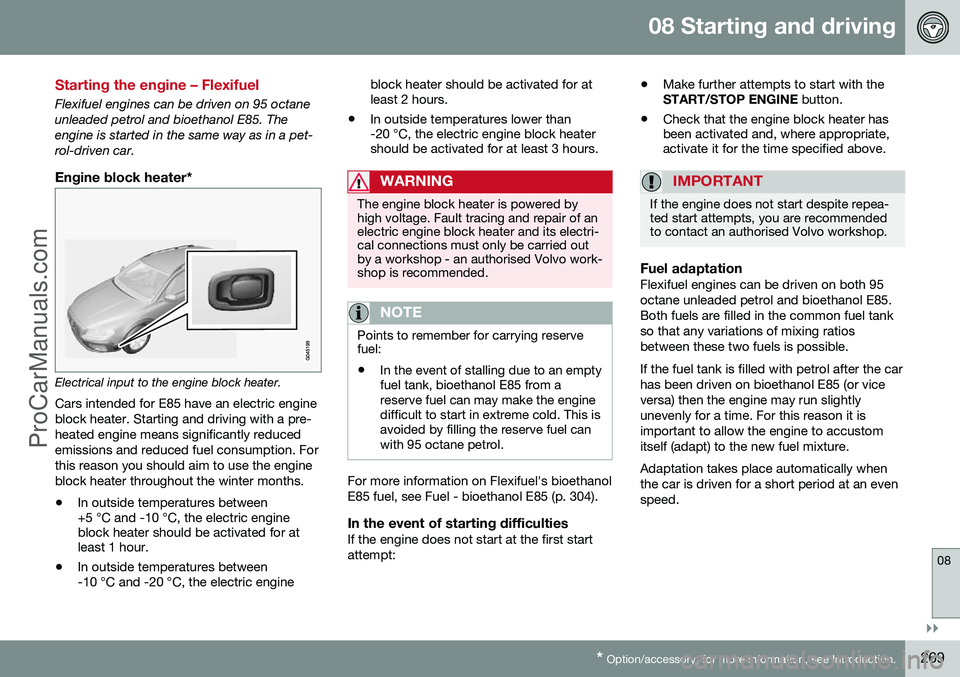
Engine block heater*
Electrical input to the engine block heater.
Cars intended for E85 have an electric engine block heater. Starting and driving with a pre-heated engine means significantly reducedemissions and reduced fuel consumption. Forthis reason you should aim to use the engineblock heater throughout the winter months. • In outside temperatures between +5 °C and -10 °C, the electric engineblock heater should be activated for atleast 1 hour.
• In outside temperatures between-10 °C and -20 °C, the electric engine block heater should be activated for atleast 2 hours.
• In outside temperatures lower than-20 °C, the electric engine block heatershould be activated for at least 3 hours.
WARNING
The engine block heater is powered by high voltage. Fault tracing and repair of anelectric engine block heater and its electri-cal connections must only be carried outby a workshop - an authorised Volvo work-shop is recommended.
NOTE
Points to remember for carrying reserve fuel:
• In the event of stalling due to an empty fuel tank, bioethanol E85 from areserve fuel can may make the enginedifficult to start in extreme cold. This isavoided by filling the reserve fuel canwith 95 octane petrol.
For more information on Flexifuel's bioethanol E85 fuel, see Fuel - bioethanol E85 (p. 304).
In the event of starting difficultiesIf the engine does not start at the first startattempt: •
Make further attempts to start with the START/STOP ENGINE
button.
• Check that the engine block heater hasbeen activated and, where appropriate,activate it for the time specified above.
IMPORTANT
If the engine does not start despite repea- ted start attempts, you are recommendedto contact an authorised Volvo workshop.
Fuel adaptationFlexifuel engines can be driven on both 95 octane unleaded petrol and bioethanol E85.Both fuels are filled in the common fuel tankso that any variations of mixing ratiosbetween these two fuels is possible. If the fuel tank is filled with petrol after the car has been driven on bioethanol E85 (or viceversa) then the engine may run slightlyunevenly for a time. For this reason it isimportant to allow the engine to accustomitself (adapt) to the new fuel mixture. Adaptation takes place automatically when the car is driven for a short period at an evenspeed.
ProCarManuals.co’
Page 275 of 442
08 Starting and driving
08
}}
* Option/accessory, for more information, see Introduction.273
Automatic gearbox -- Geartronic*
The Geartronic gearbox has two different gear modes - Automatic and Manual.
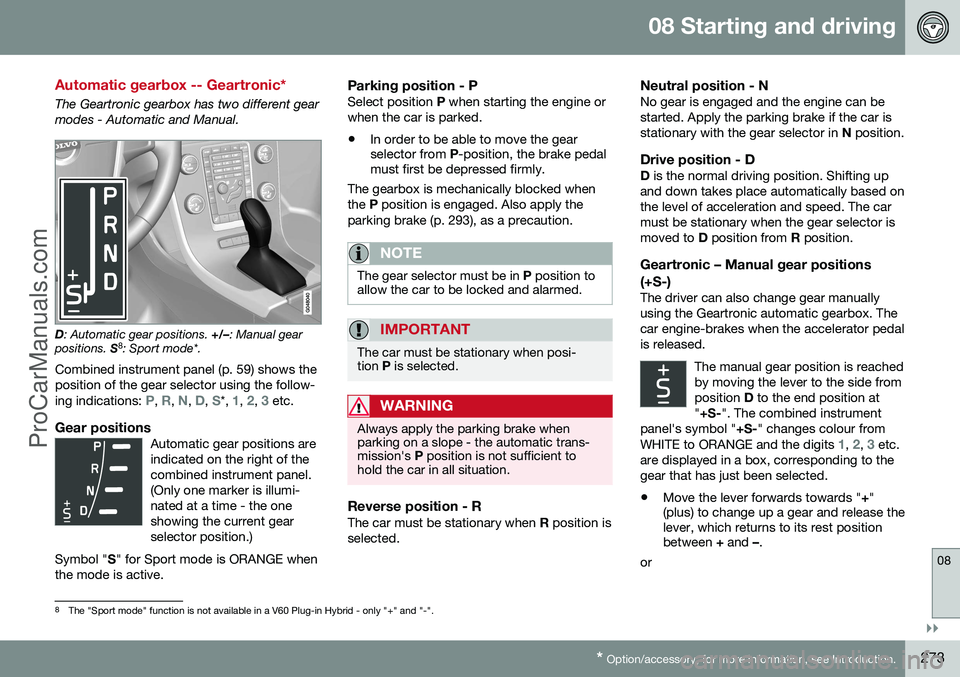
D : Automatic gear positions. +/–: Manual gear
positions. S8
: Sport mode*.
Combined instrument panel (p. 59) shows the position of the gear selector using the follow- ing indications:
P, R, N, D, S*, 1, 2, 3 etc.
Gear positionsAutomatic gear positions are indicated on the right of thecombined instrument panel.(Only one marker is illumi-nated at a time - the oneshowing the current gearselector position.)
Symbol " S" for Sport mode is ORANGE when
the mode is active.
Parking position - PSelect position P when starting the engine or
when the car is parked.
• In order to be able to move the gear selector from
P-position, the brake pedal
must first be depressed firmly.
The gearbox is mechanically blocked when the P position is engaged. Also apply the
parking brake (p. 293), as a precaution.
NOTE
The gear selector must be in P position to
allow the car to be locked and alarmed.
IMPORTANT
The car must be stationary when posi- tion P is selected.
WARNING
Always apply the parking brake when parking on a slope - the automatic trans-mission's P position is not sufficient to
hold the car in all situation.
Reverse position - RThe car must be stationary when R position is
selected.
Neutral position - NNo gear is engaged and the engine can be started. Apply the parking brake if the car isstationary with the gear selector in N position.
Drive position - DD is the normal driving position. Shifting up
and down takes place automatically based onthe level of acceleration and speed. The carmust be stationary when the gear selector ismoved to D position from R position.
Geartronic – Manual gear positions (+S-)
The driver can also change gear manually using the Geartronic automatic gearbox. Thecar engine-brakes when the accelerator pedalis released.
The manual gear position is reachedby moving the lever to the side fromposition D to the end position at
" +S- ". The combined instrument
panel's symbol " +S-" changes colour from
WHITE to ORANGE and the digits
1, 2, 3 etc.
are displayed in a box, corresponding to the gear that has just been selected.
• Move the lever forwards towards "
+"
(plus) to change up a gear and release the lever, which returns to its rest positionbetween + and –.
or
8 The "Sport mode" function is not available in a V60 Plug-in Hybrid - only "+" and "-".
ProCarManuals.co’
Page 277 of 442
08 Starting and driving
08
* Option/accessory, for more information, see Introduction.275
Geartronic - Sport mode* (S) 9The Sport programme provides sportier characteristics and allowshigher engine speed for the gears.At the same time it responds more
quickly to acceleration. During active driving,the use of a lower gear is prioritised, leadingto a delayed upshift.
To activate Sport mode: • Move the gear selector to the side from
D
position to the end position at " +S–" - the
combined instrument panel changes indi- cation from
D to S.
Sport mode can be selected at any time while driving.
Geartronic - Winter modeIt can be easier to pull away on slippery roadsif 3rd gear is engaged manually.
1. Depress the brake pedal and move the gear selector from D position to the end
position at " +S–" - the combined instru-
ment panel changes indication from
D to
the figure
110 .
2. Scroll up to gear 3 by pushing the lever forward towards " +" (plus) twice - the dis-
play shifts the indication from
1 to 3.
3. Release the brake and accelerate care- fully. The gearbox "winter mode" means that the car moves off with a lower engine speed andreduced engine power on the drive wheels.
Kick-downWhen the accelerator pedal is pressed all theway to the floor (beyond the position normallyregarded as full acceleration) a lower gear isimmediately engaged. This is known as kick-down. If the accelerator is released from the kick- down position, the gearbox automaticallychanges up. Kick-down is used when maximum accelera- tion is needed, such as for overtaking. Safety function To prevent overrevving the engine, the gear- box control program has a protective down-shift inhibitor which prevents the kick-downfunction. Geartronic does not permit downshifting/ kick-down which would result in an enginespeed high enough to damage the engine.Nothing happens if the driver still tries to shiftdown in this way at high engine speed – theoriginal gear remains engaged. When kick-down is activated the car can change one or more gears at a time depend-ing on engine speed. The car changes up when the engine reaches its maximum speedin order to prevent damage to the engine.
Related information
•
Transmission fluid - grade and volume (p. 399)
9
With some engines only.10
If the car has Sport mode* then " S" is shown first.
ProCarManuals.co’
Page 279 of 442
08 Starting and driving
08
277
SymbolMessageDriving characteristicsAction
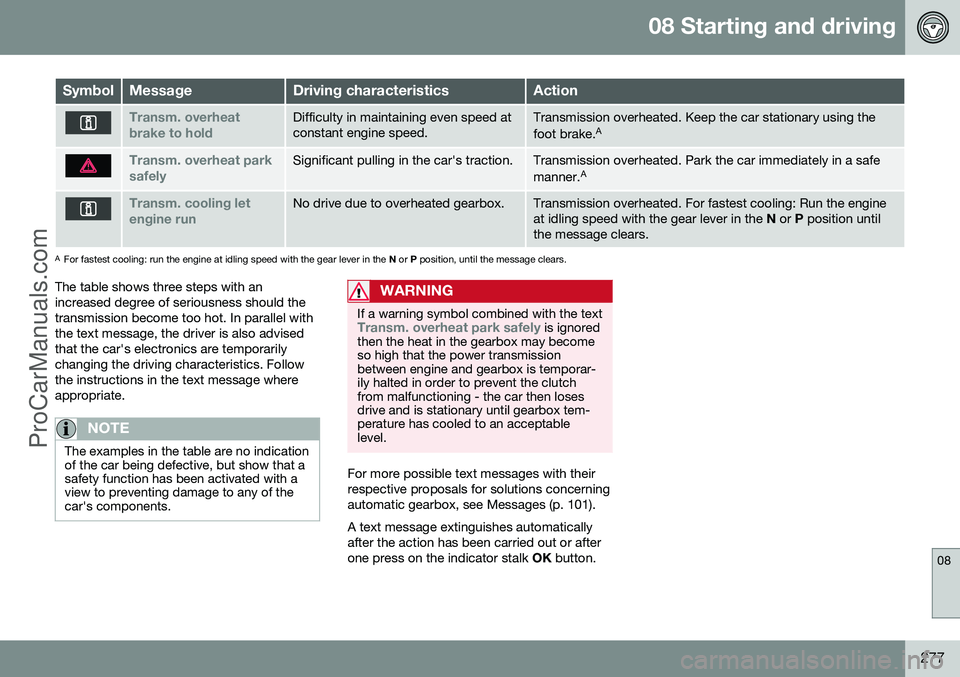
Transm. overheat brake to holdDifficulty in maintaining even speed at constant engine speed.Transmission overheated. Keep the car stationary using the foot brake.A
Transm. overheat park safelySignificant pulling in the car's traction.Transmission overheated. Park the car immediately in a safe manner.A
Transm. cooling let engine runNo drive due to overheated gearbox.Transmission overheated. For fastest cooling: Run the engine at idling speed with the gear lever in the
N or P position until
the message clears.
A For fastest cooling: run the engine at idling speed with the gear lever in the N or P position, until the message clears.
The table shows three steps with an increased degree of seriousness should thetransmission become too hot. In parallel withthe text message, the driver is also advisedthat the car's electronics are temporarilychanging the driving characteristics. Followthe instructions in the text message whereappropriate.
NOTE
The examples in the table are no indication of the car being defective, but show that asafety function has been activated with aview to preventing damage to any of thecar's components.
WARNING
If a warning symbol combined with the textTransm. overheat park safely is ignored
then the heat in the gearbox may become so high that the power transmissionbetween engine and gearbox is temporar-ily halted in order to prevent the clutchfrom malfunctioning - the car then losesdrive and is stationary until gearbox tem-perature has cooled to an acceptablelevel.
For more possible text messages with their respective proposals for solutions concerningautomatic gearbox, see Messages (p. 101). A text message extinguishes automatically after the action has been carried out or afterone press on the indicator stalk OK button.
ProCarManuals.co’
Page 280 of 442
08 Starting and driving
08
278
Gear selector inhibitor
There are two different types of gear selector inhibitor - mechanical and automatic.
Mechanical gear selector inhibitor
G021351
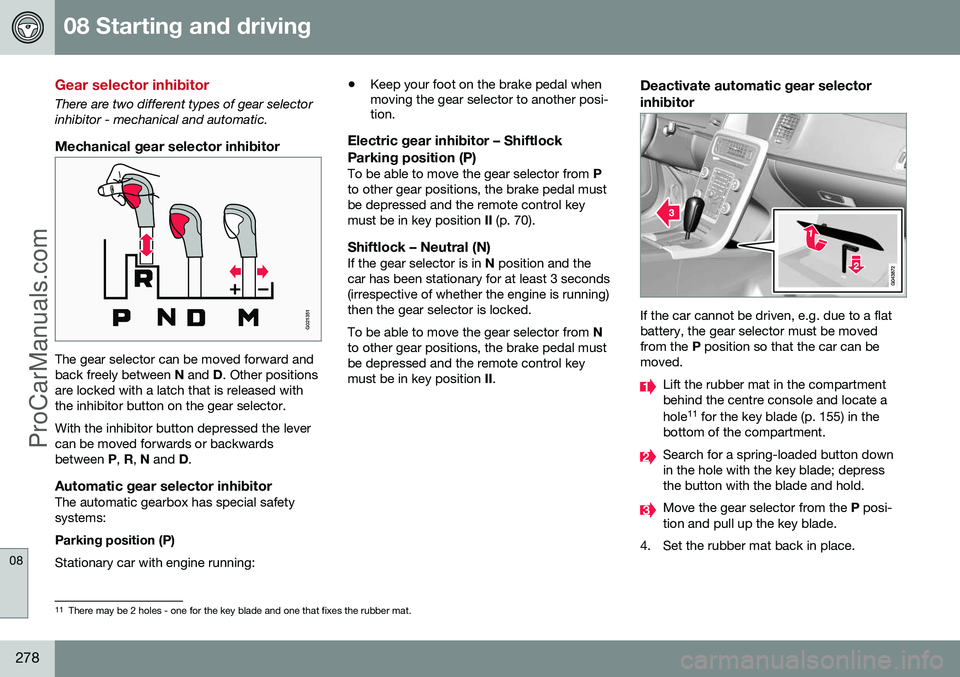
The gear selector can be moved forward and back freely between N and D. Other positions
are locked with a latch that is released withthe inhibitor button on the gear selector. With the inhibitor button depressed the lever can be moved forwards or backwardsbetween P, R , N and D.
Automatic gear selector inhibitorThe automatic gearbox has special safetysystems: Parking position (P) Stationary car with engine running: •
Keep your foot on the brake pedal when moving the gear selector to another posi-tion.
Electric gear inhibitor – Shiftlock
Parking position (P)
To be able to move the gear selector from P
to other gear positions, the brake pedal must be depressed and the remote control keymust be in key position II (p. 70).
Shiftlock – Neutral (N)If the gear selector is in N position and the
car has been stationary for at least 3 seconds(irrespective of whether the engine is running)then the gear selector is locked. To be able to move the gear selector from N
to other gear positions, the brake pedal must be depressed and the remote control keymust be in key position II.
Deactivate automatic gear selector inhibitor
If the car cannot be driven, e.g. due to a flat battery, the gear selector must be movedfrom the P position so that the car can be
moved.
Lift the rubber mat in the compartment behind the centre console and locate a hole 11
for the key blade (p. 155) in the
bottom of the compartment.
Search for a spring-loaded button down in the hole with the key blade; depressthe button with the blade and hold.
Move the gear selector from the P posi-
tion and pull up the key blade.
4. Set the rubber mat back in place.
11 There may be 2 holes - one for the key blade and one that fixes the rubber mat.
ProCarManuals.co’
Page 290 of 442
08 Starting and driving
08
288* Option/accessory, for more information, see Introduction.
ECO*
ECO is an innovative Volvo function for auto- matic-gearbox cars, capable of reducing fuelconsumption by up to 5%, depending on thedriver's driving style. The function gives thedriver the option of a more active environ-mentally conscious way of driving.
GeneralThe following are changedupon activation of the ECOfunction:
• Gearbox gearshift points.
• Engine management and response from the accelerator pedal.
• Start/Stop function - the engine can alsoauto-stop before the car has stopped tobeing fully stationary.
• The Eco Coast function is activated -engine braking ceases.
• Climate control system settings - someelectricity consumers are deactivated oroperate at reduced power.
NOTE
When the ECO function is activated, sev- eral parameters in the climate control sys-tem's settings are changed, and severalelectricity consumer functions are reduced- a press of the
AC button resets the cli-
mate control system, but then withreduced AC function.
ECO - Operation
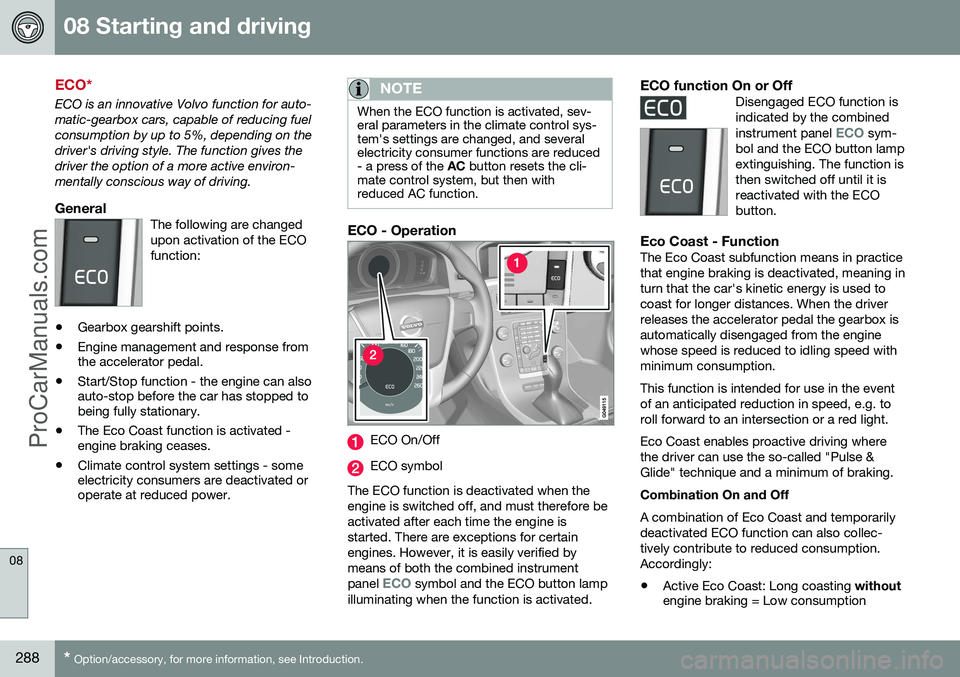
ECO On/Off
ECO symbol
The ECO function is deactivated when the engine is switched off, and must therefore beactivated after each time the engine isstarted. There are exceptions for certainengines. However, it is easily verified bymeans of both the combined instrument panel
ECO symbol and the ECO button lamp
illuminating when the function is activated.
ECO function On or OffDisengaged ECO function is indicated by the combined instrument panel
ECO sym-
bol and the ECO button lamp extinguishing. The function isthen switched off until it isreactivated with the ECObutton.
Eco Coast - FunctionThe Eco Coast subfunction means in practice that engine braking is deactivated, meaning inturn that the car's kinetic energy is used tocoast for longer distances. When the driverreleases the accelerator pedal the gearbox isautomatically disengaged from the enginewhose speed is reduced to idling speed withminimum consumption. This function is intended for use in the event of an anticipated reduction in speed, e.g. toroll forward to an intersection or a red light. Eco Coast enables proactive driving where the driver can use the so-called "Pulse &Glide" technique and a minimum of braking. Combination On and Off A combination of Eco Coast and temporarily deactivated ECO function can also collec-tively contribute to reduced consumption.Accordingly:
• Active Eco Coast: Long coasting
without
engine braking = Low consumption
ProCarManuals.co’
Page 308 of 442
||
08 Starting and driving
08
306* Option/accessory, for more information, see Introduction.
• For lowest fuel consumption, activate ECO (p. 288)* 16
.
• Use the ECO Guide which indicates how fuel-efficiently the car is being driven, seeEco guide & Power guide* (p. 63).
• Drive in the highest gear possible, adap-ted to the current traffic situation androad - lower engine speeds result in lowerfuel consumption. Use the gear indicator(p. 272).
• Avoid sudden unnecessary accelerationand heavy braking.
• High speed results in increased fuel con-sumption - the wind resistance increaseswith speed.
• Do not run the engine to operating tem-perature at idling speed, but rather drivewith a light load as soon as possible - acold engine consumes more fuel than awarm one.
• Drive with the correct air pressure in thetyres and check this regularly - selectECO tyre pressure for best results, seeTyres - approved tyre pressures (p. 407).
• Choice of tyres can affect fuel consump-tion - seek advice on suitable tyres from adealer.
• Remove unnecessary items from the car -the greater the load the higher the con-sumption. •
Use engine braking to slow down, when itcan take place without risk to other roadusers.
• A roof load and ski box increase air resis-tance, leading to higher consumption -remove the load carriers when not in use.
• Avoid driving with open windows.
For information about Volvo Car Corpora- tion's environmental philosophy, see VolvoCars' environmental philosophy (p. 19). For more information about fuel consumption, see Fuel consumption and CO2 emissions (p.403).
WARNING
Never switch off the engine while moving, such as downhill, this deactivates impor-tant systems such as the power steeringand brake servo.
Related information
• Fuel - handling (p. 301)
• Fuel consumption and CO2 emissions (p. 403)
• Fuel tank - volume (p. 402)
Driving with a trailer
When driving with a trailer there are a number of important points to think about regardinge.g. the towing bracket, the trailer and howthe load is positioned in the trailer. Payload depends on the car's kerb weight. The total of the weight of the passengers andall accessories, e.g. towbar, reduces the car'spayload by a corresponding weight. For moredetailed information on weights, see Weights(p. 390). If the towing bracket is mounted by Volvo, then the car is delivered with the necessaryequipment for driving with a trailer. • The car's towing bracket must be of an approved type.
• If the towbar is retrofitted, check withyour Volvo dealer that the car is fullyequipped for driving with a trailer.
• Distribute the load on the trailer so thatthe weight on the towing bracket com-plies with the specified maximum towballload.
• Increase the tyre pressure to the recom-mended pressure for a full load. For tyrepressure label location, see Tyres - airpressure (p. 328).
• The engine is loaded more heavily thanusual when driving with a trailer.
16
Only applies to cars with automatic gearbox.
ProCarManuals.co’
Page 309 of 442
08 Starting and driving
08
* Option/accessory, for more information, see Introduction.307
•
Do not tow a heavy trailer when the car is brand new. Wait until it has been drivenat least 1000 km.
• The brakes are loaded much more thanusual on long and steep downhill slopes.Downshift to a lower gear and adjust yourspeed.
• For safety reasons, the maximum permit-ted speed for the car when coupled witha trailer should not be exceeded. Followthe regulations in force for the permittedspeeds and weights.
• Maintain a low speed when driving with atrailer up long, steep ascents.
• Avoid driving with a trailer on inclines ofmore than 12%.
Trailer cableAn adapter is required if the car's towing bracket has 13 pin electrics and the trailerhas 7 pin electrics. Use an adapter cableapproved by Volvo. Make sure the cable doesnot drag on the ground.
Direction indicators and brake lights on
the trailer
If any of the trailer's lamps for direction indi-cators are broken, then the combined instru-ment panel's symbol for direction indicatorsflashes faster than normal and the information display shows the text
Bulb fail - Ind. signal
trailer. If any of the trailer's lamps for the brake light are broken then the
Bulb fail - Stop lamp
trailer text is shown.
Level control*The rear shock absorbers maintain a constant height irrespective of the car's load (up to themaximum permissible weight). When the caris stationary the rear of the car lowers slightly,which is normal.
Trailer weightsFor information on Volvo's permitted trailerweights, see Towing capacity and towballload (p. 391).
NOTE
The stated maximum permitted trailer weights are those permitted by Volvo.National vehicle regulations can furtherlimit trailer weights and speeds. Towbarscan be certified for higher towing weightsthan the car can actually tow.
WARNING
Follow the stated recommendations for trailer weights. Otherwise, the car andtrailer may be difficult to control in theevent of sudden movement and braking.
Related information
• Driving with a trailer - manual gearbox (p. 308)
• Driving with a trailer - automatic gearbox(p. 308)
• Towing bracket/Towbar (p. 309)
• Lamp replacement (p. 352)
ProCarManuals.co’