airbag VOLVO V90 2017 Owner's Manual
[x] Cancel search | Manufacturer: VOLVO, Model Year: 2017, Model line: V90, Model: VOLVO V90 2017Pages: 594, PDF Size: 15.07 MB
Page 83 of 594
SAFETY
81
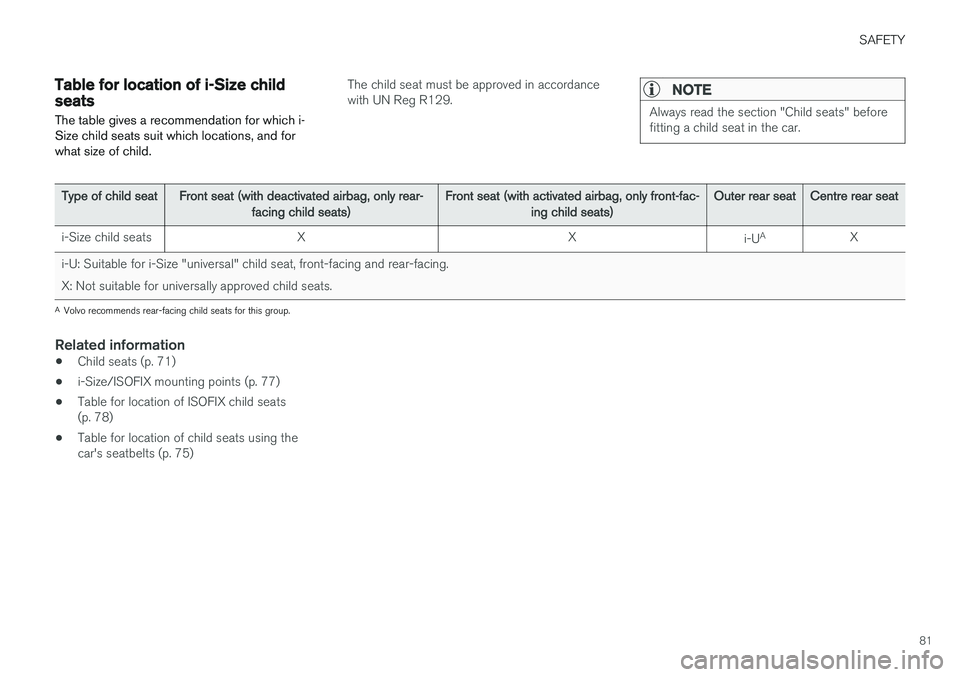
Table for location of i-Size child seats
The table gives a recommendation for which i- Size child seats suit which locations, and forwhat size of child.The child seat must be approved in accordance with UN Reg R129.NOTE
Always read the section "Child seats" before fitting a child seat in the car.
Type of child seat Front seat (with deactivated airbag, only rear-
facing child seats) Front seat (with activated airbag, only front-fac-
ing child seats) Outer rear seat
Centre rear seat
i-Size child seats X X
i-UA
X
i-U: Suitable for i-Size "universal" child seat, front-facing and rear-facing.
X: Not suitable for universally approved child seats.
A Volvo recommends rear-facing child seats for this group.
Related information
• Child seats (p. 71)
• i-Size/ISOFIX mounting points (p. 77)
• Table for location of ISOFIX child seats (p. 78)
• Table for location of child seats using thecar's seatbelts (p. 75)
Page 92 of 594
INSTRUMENTS AND CONTROLS
* Option/accessory.
90
Driver display
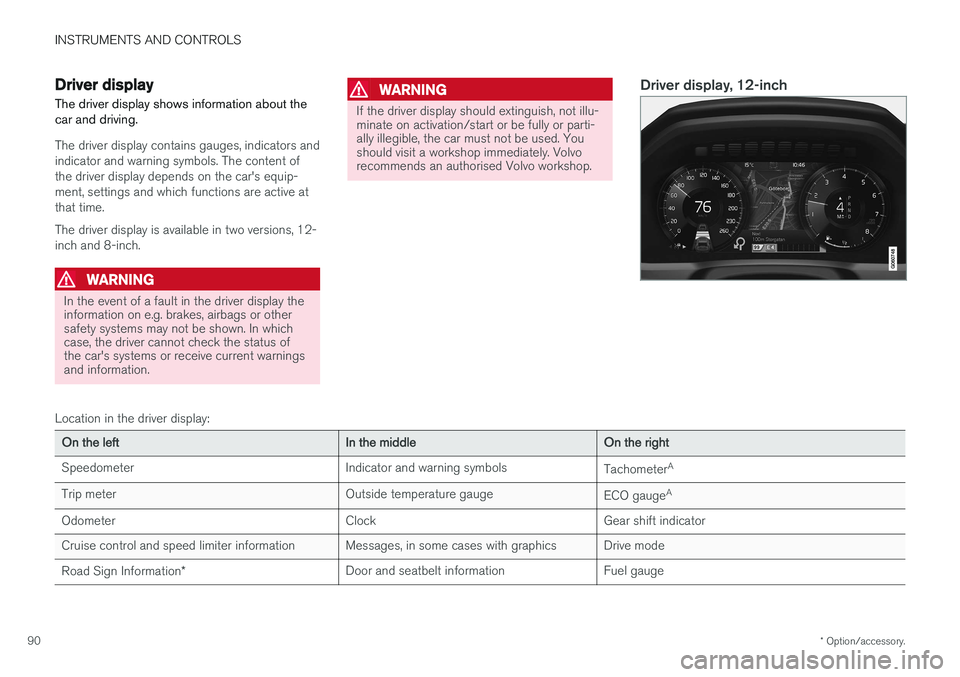
The driver display shows information about the car and driving.
The driver display contains gauges, indicators and indicator and warning symbols. The content ofthe driver display depends on the car's equip-ment, settings and which functions are active atthat time. The driver display is available in two versions, 12- inch and 8-inch.
WARNING
In the event of a fault in the driver display the information on e.g. brakes, airbags or othersafety systems may not be shown. In whichcase, the driver cannot check the status ofthe car's systems or receive current warningsand information.
WARNING
If the driver display should extinguish, not illu- minate on activation/start or be fully or parti-ally illegible, the car must not be used. Youshould visit a workshop immediately. Volvorecommends an authorised Volvo workshop.
Driver display, 12-inch
Location in the driver display:
On the left In the middleOn the right
Speedometer Indicator and warning symbols
TachometerA
Trip meter Outside temperature gauge
ECO gaugeA
Odometer ClockGear shift indicator
Cruise control and speed limiter information Messages, in some cases with graphics Drive mode Road Sign Information * Door and seatbelt information Fuel gauge
Page 99 of 594
INSTRUMENTS AND CONTROLS
}}
97
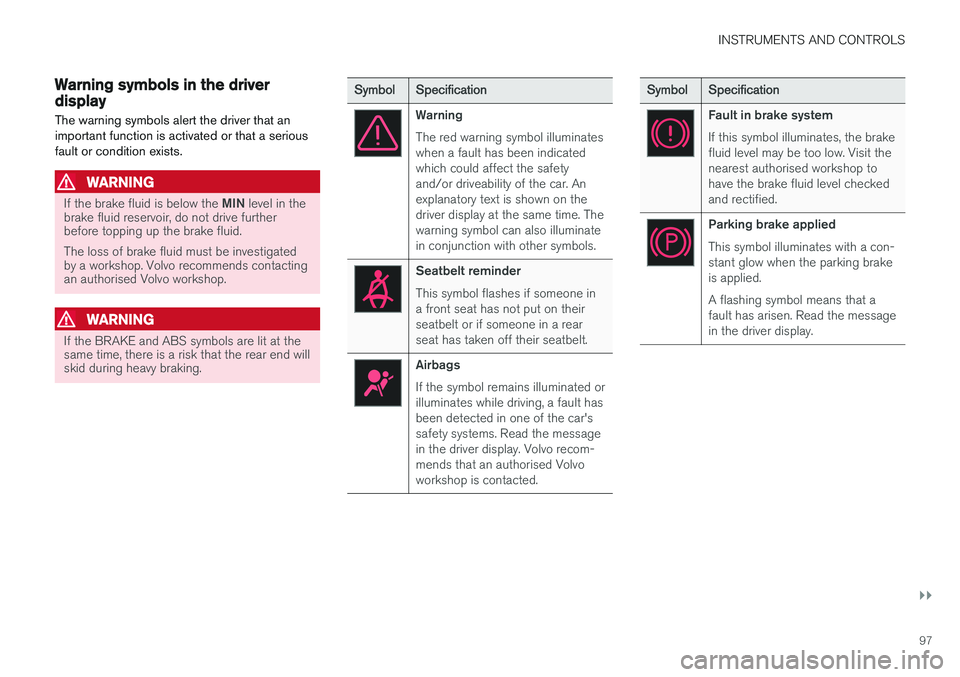
Warning symbols in the driver display The warning symbols alert the driver that an important function is activated or that a seriousfault or condition exists.
WARNING
If the brake fluid is below the MIN level in the
brake fluid reservoir, do not drive further before topping up the brake fluid. The loss of brake fluid must be investigated by a workshop. Volvo recommends contactingan authorised Volvo workshop.
WARNING
If the BRAKE and ABS symbols are lit at the same time, there is a risk that the rear end willskid during heavy braking.
Symbol Specification
Warning The red warning symbol illuminates when a fault has been indicatedwhich could affect the safetyand/or driveability of the car. Anexplanatory text is shown on thedriver display at the same time. Thewarning symbol can also illuminatein conjunction with other symbols.
Seatbelt reminder This symbol flashes if someone in a front seat has not put on theirseatbelt or if someone in a rearseat has taken off their seatbelt.
Airbags If the symbol remains illuminated or illuminates while driving, a fault hasbeen detected in one of the car'ssafety systems. Read the messagein the driver display. Volvo recom-mends that an authorised Volvoworkshop is contacted.
Symbol Specification
Fault in brake system If this symbol illuminates, the brake fluid level may be too low. Visit thenearest authorised workshop tohave the brake fluid level checkedand rectified.
Parking brake applied This symbol illuminates with a con- stant glow when the parking brakeis applied. A flashing symbol means that a fault has arisen. Read the messagein the driver display.
Page 135 of 594
INSTRUMENTS AND CONTROLS
133
Steering wheel adjustment can be made in differ- ent ways depending on whether or not the car is equipped with knee airbag
19
.
WARNING
Adjust the steering wheel and fix it before driving away.
With speed related power steering the level of steering force can be adjusted. Steering force isregulated according to the car's speed in order togive the driver enhanced road responsiveness.
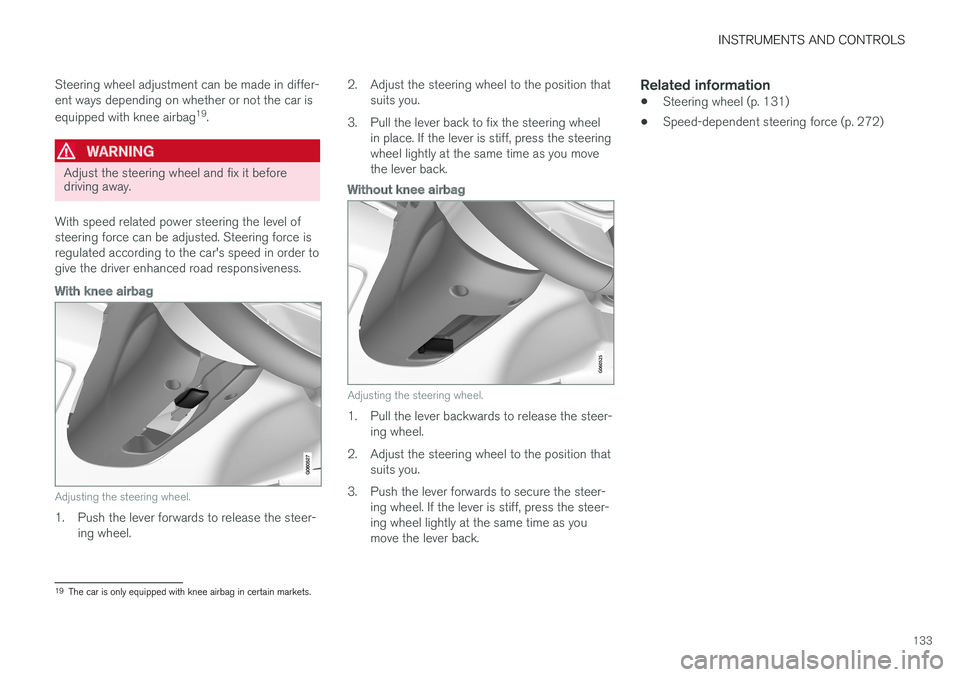
With knee airbag
Adjusting the steering wheel.
1. Push the lever forwards to release the steer- ing wheel. 2. Adjust the steering wheel to the position that
suits you.
3. Pull the lever back to fix the steering wheel in place. If the lever is stiff, press the steering wheel lightly at the same time as you movethe lever back.
Without knee airbag
Adjusting the steering wheel.
1. Pull the lever backwards to release the steer-ing wheel.
2. Adjust the steering wheel to the position that suits you.
3. Push the lever forwards to secure the steer- ing wheel. If the lever is stiff, press the steer- ing wheel lightly at the same time as youmove the lever back.
Related information
• Steering wheel (p. 131)
• Speed-dependent steering force (p. 272)
19
The car is only equipped with knee airbag in certain markets.
Page 410 of 594
STARTING AND DRIVING
408
Emergency brake lightsEmergency brake lights are activated to alert vehicles behind about heavy braking. The func-tion means that the brake light flashes instead of- as in normal braking - shining with a constantglow.
The emergency brake lights are activated during heavy braking or if the ABS system is activated athigh speeds. After emergency braking to a lowspeed, the brake lights return from flashing to thenormal constant glow. The car's hazard warningflashers are activated at the same time. Theseflash until the driver accelerates the car to ahigher speed again or switches off the hazardwarning flashers.
Related information
• Foot brake (p. 406)
• Hazard warning flashers (p. 143)
• Brake lights (p. 143)
Brake assistance
The brake assist system, BAS (Brake Assist System), helps to increase brake force duringbraking, thereby shortening the braking distance.
The system detects the way in which the driver brakes and increases brake force where neces-sary. The brake force can be boosted up to thelevel when the ABS system is engaged. Thefunction is suspended when the pressure on thebrake pedal decreases.
NOTE
When BAS is activated the brake pedal low- ers slightly more than usual, depress (hold)the brake pedal as long as necessary. When the brake pedal is released, all braking ceases.
Related information
• Foot brake (p. 406)
Auto braking after a collision In the event of a collision in which the activation level is reached for the pyrotechnic seatbelt ten-sioners or airbags, or if a collision with a largeanimal is detected, the car's brakes are automat-ically applied. This function is to prevent orreduce the effects of any subsequent collision.
After a serious collision there is a risk that it is no longer possible to control and steer the car. Inorder to avoid or mitigate a possible further colli-sion with a vehicle or an object in the vehicle'spath, the auto braking system is activated auto-matically and brakes the car in a safe manner. Brake lights and hazard warning lights are acti- vated during braking. When the car has stopped,the hazard warning lights continue to flash andthe parking brake is applied. If braking is not appropriate, e.g. if there is a risk of being hit by following traffic, the system can beoverridden by the driver depressing the accelera-tor pedal. The function assumes that the brake system is intact after the collision. See also the sections "Rear Collision Warning" and "Blind Spot Information".
Related information
• Brake functions (p. 406)
• Seatbelt tensioner (p. 59)
• Airbags (p. 63)
Page 433 of 594
STARTING AND DRIVING
}}
431
The towing eye may be used to pull the car up onto a recovery vehicle with a flatbed platform.The car's position and ground clearance deter-mine whether it is possible. If the slope of the recovery vehicle's ramp is too steep, or if the ground clearance under the car isinadequate, then the car may be damaged if youtry to pull it up using the towing eye. If necessary, raise the car by using the recovery vehicle's lifting device. Do not use the towing eye.
WARNING
No one/nothing is allowed to remain behind the recovery vehicle while the car pulled uponto the flatbed platform.
IMPORTANT
The towing eye is only designed for towing on roads -
not for pulling the car unstuck or out
of a ditch. Call a recovery service for recovery assistance.
Related information
• Towing (p. 431)
• Recovering the car (p. 432)
Towing
During towing, one vehicle pulls another vehicle along behind it by means of a towline.
Find out the statutory maximum speed limit for towing before the towing begins.
Preparations and towing1. Activate the car's hazard warning flashers.
2. Secure the towline in the towing eye.
3. Deactivate the steering lock by unlocking the car.
NOTE
In ignition position II the steering lock is
deactivated if the car has been unlocked. See section “Ignition position” for more informa-tion.
4. Set the car in ignition position II by turning
the ignition dial to START and holding the
ignition dial in the START position for
approx. 4 seconds. Then release the knob, which automatically returns to its startingposition.
5. Move the gear selector to neutral position N
and release the parking brake.
> The towing vehicle can now start towing. 6. Keep the towline taut when the towing vehi-
cle reduces speed by holding your foot gen- tly pressed on the brake pedal - therebyavoiding unnecessary jerking.
7. Be prepared to brake to stop.
IMPORTANT
Note that the car must always be towed with the wheels rolling forward. • Do not tow cars with automatic transmis- sion at speeds higher than 80 km/h(50 mph) or for distances in excess of 80km.
WARNING
•Check that the steering lock is unlocked before towing.
• Ignition position
II must be active - in
ignition position I all airbags are deacti-
vated.
• Always keep the remote control key in thecar when it is being towed.
WARNING
The brake servo and power steering do not work when the engine is switched off - thebrake pedal needs to be depressedabout 5 times more heavily and the steering isconsiderably heavier than normal.
Page 542 of 594
||
MAINTENANCE AND SERVICE
* Option/accessory.
540
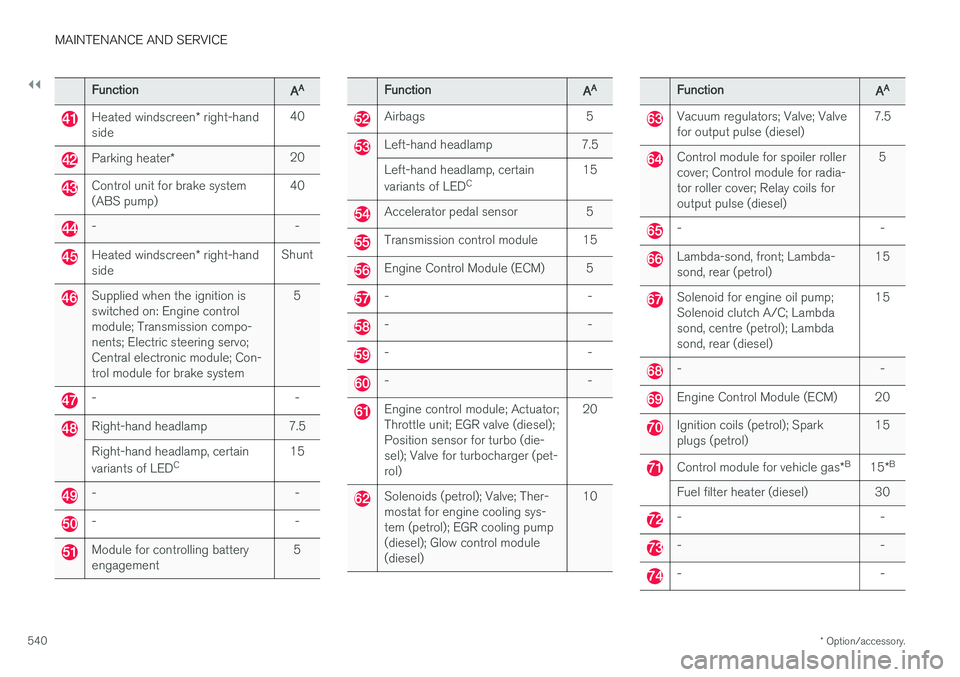
Function
AA
Heated windscreen
* right-hand
side 40
Parking heater
* 20
Control unit for brake system (ABS pump) 40
- -
Heated windscreen
* right-hand
side Shunt
Supplied when the ignition is switched on: Engine controlmodule; Transmission compo-nents; Electric steering servo;Central electronic module; Con-trol module for brake system 5
- -
Right-hand headlamp 7.5 Right-hand headlamp, certain variants of LED
C 15
- -
- -
Module for controlling battery engagement 5
Function
AA
Airbags 5
Left-hand headlamp 7.5 Left-hand headlamp, certain variants of LED C 15
Accelerator pedal sensor 5
Transmission control module 15
Engine Control Module (ECM) 5
- -
- -
- -
- -
Engine control module; Actuator; Throttle unit; EGR valve (diesel);Position sensor for turbo (die-sel); Valve for turbocharger (pet-rol) 20
Solenoids (petrol); Valve; Ther- mostat for engine cooling sys-tem (petrol); EGR cooling pump(diesel); Glow control module(diesel)10
Function
AA
Vacuum regulators; Valve; Valve for output pulse (diesel) 7.5
Control module for spoiler roller cover; Control module for radia-tor roller cover; Relay coils foroutput pulse (diesel) 5
- -
Lambda-sond, front; Lambda- sond, rear (petrol)
15
Solenoid for engine oil pump; Solenoid clutch A/C; Lambdasond, centre (petrol); Lambdasond, rear (diesel)15
- -
Engine Control Module (ECM) 20
Ignition coils (petrol); Spark plugs (petrol)
15
Control module for vehicle gas
*B
15*B
Fuel filter heater (diesel) 30
- -
- -
- -
Page 546 of 594
||
MAINTENANCE AND SERVICE
* Option/accessory.
544
Positions
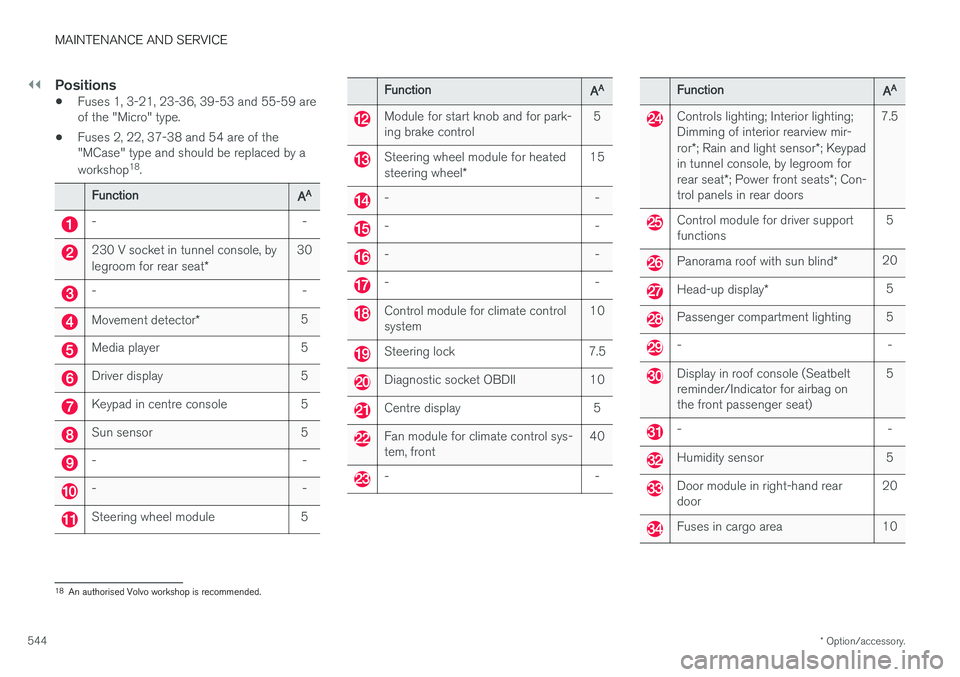
• Fuses 1, 3-21, 23-36, 39-53 and 55-59 are of the "Micro" type.
• Fuses 2, 22, 37-38 and 54 are of the"MCase" type and should be replaced by a workshop 18
.
Function AA
- -
230 V socket in tunnel console, by legroom for rear seat
*30
- -
Movement detector
* 5
Media player 5
Driver display 5
Keypad in centre console 5
Sun sensor 5
- -
- -
Steering wheel module 5
Function
AA
Module for start knob and for park- ing brake control 5
Steering wheel module for heated steering wheel
* 15
- -
- -
- -
- -
Control module for climate control system
10
Steering lock 7.5
Diagnostic socket OBDII 10
Centre display 5
Fan module for climate control sys- tem, front40
- -
Function
AA
Controls lighting; Interior lighting; Dimming of interior rearview mir- ror
*; Rain and light sensor *; Keypad
in tunnel console, by legroom forrear seat *; Power front seats *; Con-
trol panels in rear doors 7.5
Control module for driver support functions
5
Panorama roof with sun blind
*20
Head-up display
* 5
Passenger compartment lighting 5
- -
Display in roof console (Seatbelt reminder/Indicator for airbag onthe front passenger seat) 5
- -
Humidity sensor 5
Door module in right-hand rear door
20
Fuses in cargo area 10
18
An authorised Volvo workshop is recommended.
Page 548 of 594
MAINTENANCE AND SERVICE
* Option/accessory.
546
Fuses in cargo area
Fuses in the cargo area protect, amongst other things, power seats *, airbags and seatbelt ten-
sioners.
Page 550 of 594
||
MAINTENANCE AND SERVICE
* Option/accessory.
548
Positions
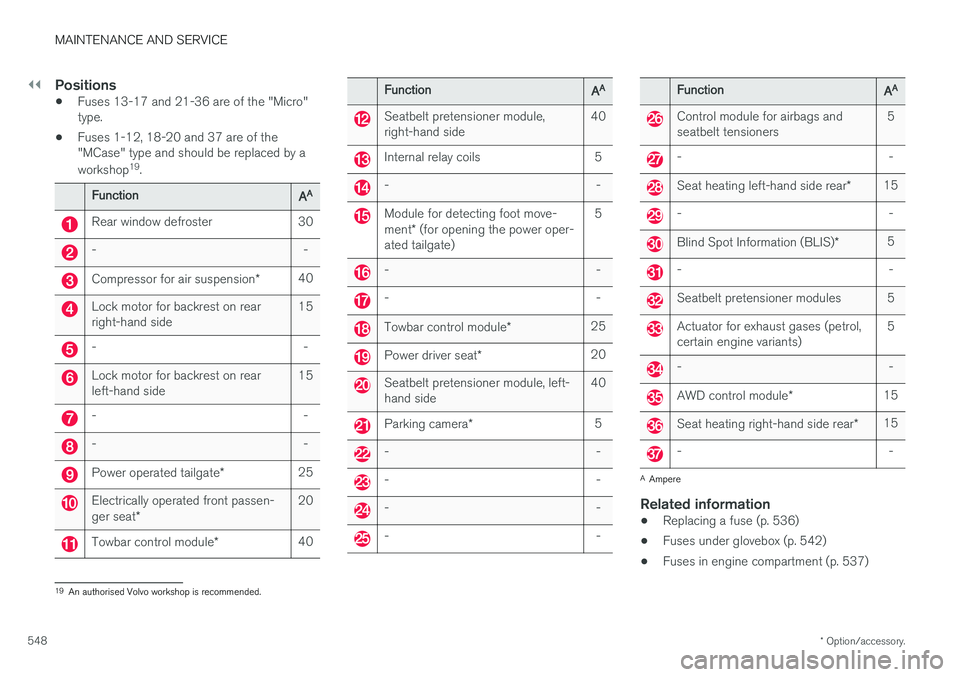
• Fuses 13-17 and 21-36 are of the "Micro" type.
• Fuses 1-12, 18-20 and 37 are of the"MCase" type and should be replaced by a workshop 19
.
Function AA
Rear window defroster 30
- -
Compressor for air suspension
*40
Lock motor for backrest on rear right-hand side 15
- -
Lock motor for backrest on rear left-hand side15
- -
- -
Power operated tailgate
*25
Electrically operated front passen- ger seat
* 20
Towbar control module
*40
Function
AA
Seatbelt pretensioner module, right-hand side 40
Internal relay coils 5
- -
Module for detecting foot move- ment
* (for opening the power oper-
ated tailgate) 5
- -
- -
Towbar control module
*25
Power driver seat
* 20
Seatbelt pretensioner module, left- hand side 40
Parking camera
* 5
- -
- -
- -
- -
Function
AA
Control module for airbags and seatbelt tensioners 5
- -
Seat heating left-hand side rear
*15
- -
Blind Spot Information (BLIS)
*5
- -
Seatbelt pretensioner modules 5
Actuator for exhaust gases (petrol, certain engine variants) 5
- -
AWD control module
*15
Seat heating right-hand side rear
*15
- -
A
Ampere
Related information
• Replacing a fuse (p. 536)
• Fuses under glovebox (p. 542)
• Fuses in engine compartment (p. 537)
19
An authorised Volvo workshop is recommended.