airbag VOLVO V90 2017 User Guide
[x] Cancel search | Manufacturer: VOLVO, Model Year: 2017, Model line: V90, Model: VOLVO V90 2017Pages: 594, PDF Size: 15.07 MB
Page 69 of 594
SAFETY
}}
67
2. Confirm the message by pressing the right-
hand steering wheel keypad's O button.
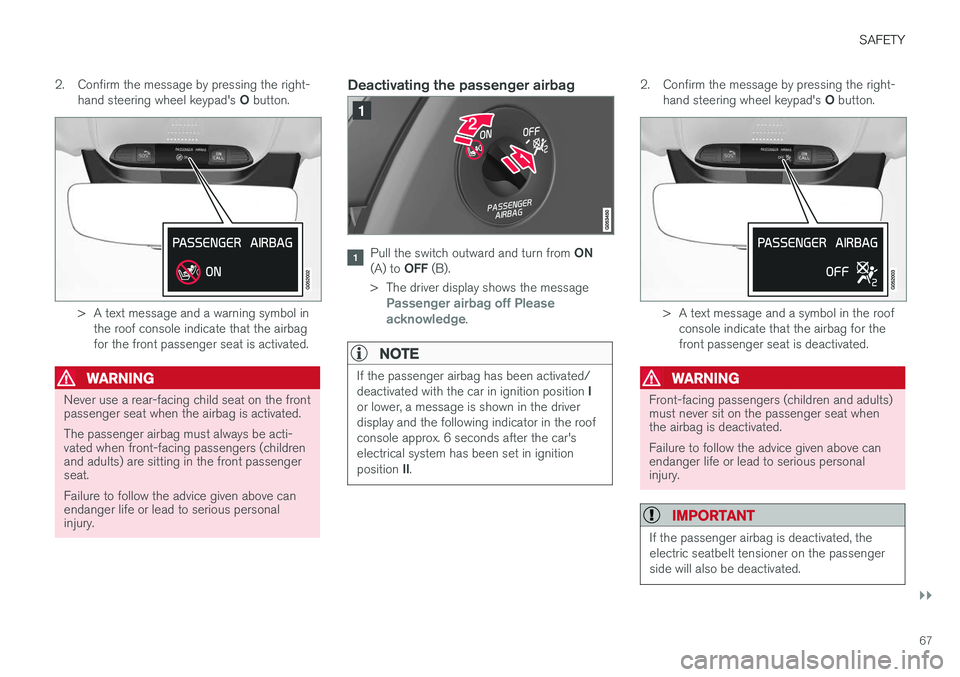
> A text message and a warning symbol in
the roof console indicate that the airbag for the front passenger seat is activated.
WARNING
Never use a rear-facing child seat on the front passenger seat when the airbag is activated. The passenger airbag must always be acti- vated when front-facing passengers (childrenand adults) are sitting in the front passengerseat. Failure to follow the advice given above can endanger life or lead to serious personalinjury.
Deactivating the passenger airbag
Pull the switch outward and turn from ON
(A) to OFF (B).
> The driver display shows the message
Passenger airbag off Please
acknowledge.
NOTE
If the passenger airbag has been activated/ deactivated with the car in ignition position I
or lower, a message is shown in the driver display and the following indicator in the roofconsole approx. 6 seconds after the car'selectrical system has been set in ignition position II.
2. Confirm the message by pressing the right-
hand steering wheel keypad's O button.
> A text message and a symbol in the roof
console indicate that the airbag for the front passenger seat is deactivated.
WARNING
Front-facing passengers (children and adults) must never sit on the passenger seat whenthe airbag is deactivated. Failure to follow the advice given above can endanger life or lead to serious personalinjury.
IMPORTANT
If the passenger airbag is deactivated, the electric seatbelt tensioner on the passengerside will also be deactivated.
Page 70 of 594
||
SAFETY
68
Related information
•Driver and passenger airbags (p. 64)
• Seatbelt tensioner (p. 59)
• Child seats (p. 71)
Side airbag
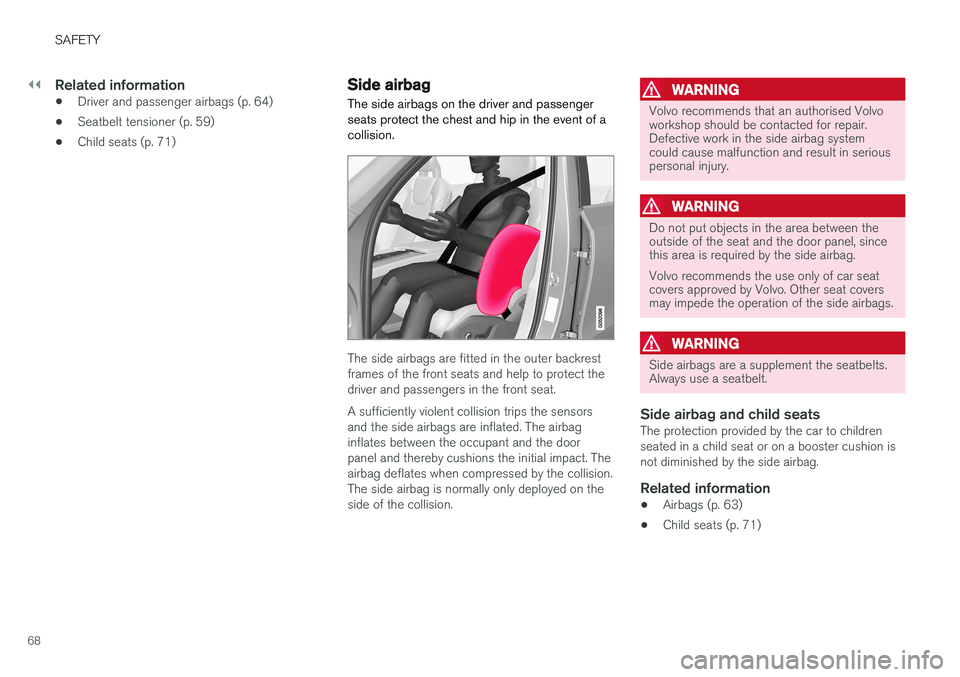
The side airbags on the driver and passenger seats protect the chest and hip in the event of acollision.
The side airbags are fitted in the outer backrest frames of the front seats and help to protect thedriver and passengers in the front seat. A sufficiently violent collision trips the sensors and the side airbags are inflated. The airbaginflates between the occupant and the doorpanel and thereby cushions the initial impact. Theairbag deflates when compressed by the collision.The side airbag is normally only deployed on theside of the collision.
WARNING
Volvo recommends that an authorised Volvo workshop should be contacted for repair.Defective work in the side airbag systemcould cause malfunction and result in seriouspersonal injury.
WARNING
Do not put objects in the area between the outside of the seat and the door panel, sincethis area is required by the side airbag. Volvo recommends the use only of car seat covers approved by Volvo. Other seat coversmay impede the operation of the side airbags.
WARNING
Side airbags are a supplement the seatbelts. Always use a seatbelt.
Side airbag and child seatsThe protection provided by the car to children seated in a child seat or on a booster cushion isnot diminished by the side airbag.
Related information
• Airbags (p. 63)
• Child seats (p. 71)
Page 71 of 594
SAFETY
}}
69
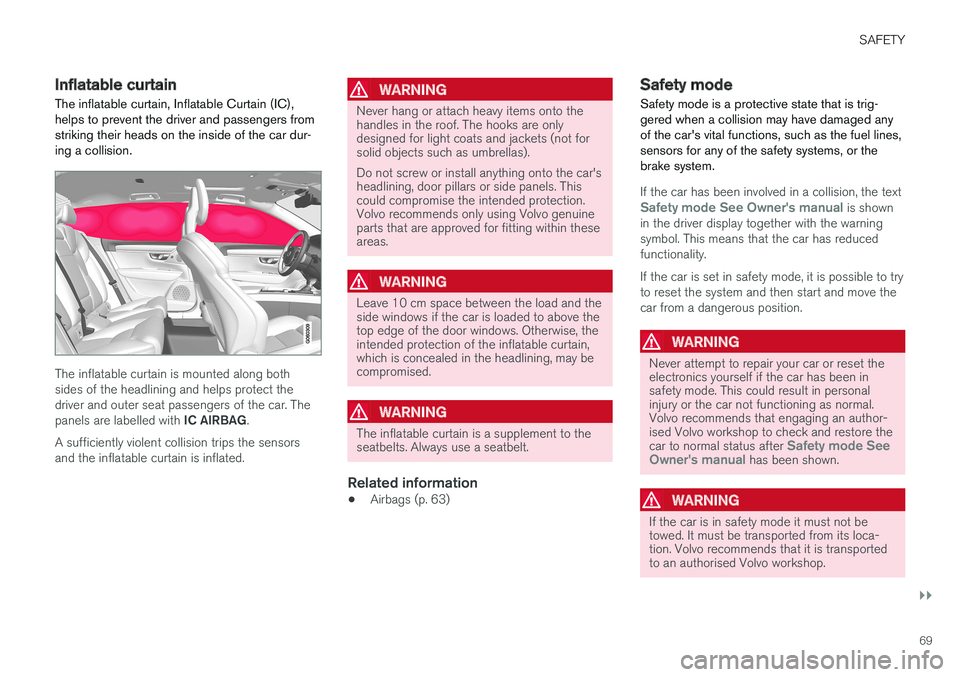
Inflatable curtain The inflatable curtain, Inflatable Curtain (IC), helps to prevent the driver and passengers fromstriking their heads on the inside of the car dur-ing a collision.
The inflatable curtain is mounted along both sides of the headlining and helps protect thedriver and outer seat passengers of the car. The panels are labelled with IC AIRBAG.
A sufficiently violent collision trips the sensors and the inflatable curtain is inflated.
WARNING
Never hang or attach heavy items onto the handles in the roof. The hooks are onlydesigned for light coats and jackets (not forsolid objects such as umbrellas). Do not screw or install anything onto the car's headlining, door pillars or side panels. Thiscould compromise the intended protection.Volvo recommends only using Volvo genuineparts that are approved for fitting within theseareas.
WARNING
Leave 10 cm space between the load and the side windows if the car is loaded to above thetop edge of the door windows. Otherwise, theintended protection of the inflatable curtain,which is concealed in the headlining, may becompromised.
WARNING
The inflatable curtain is a supplement to the seatbelts. Always use a seatbelt.
Related information
• Airbags (p. 63)
Safety mode Safety mode is a protective state that is trig- gered when a collision may have damaged anyof the car's vital functions, such as the fuel lines,sensors for any of the safety systems, or thebrake system.
If the car has been involved in a collision, the textSafety mode See Owner's manual is shown
in the driver display together with the warning symbol. This means that the car has reducedfunctionality. If the car is set in safety mode, it is possible to try to reset the system and then start and move thecar from a dangerous position.
WARNING
Never attempt to repair your car or reset the electronics yourself if the car has been insafety mode. This could result in personalinjury or the car not functioning as normal.Volvo recommends that engaging an author-ised Volvo workshop to check and restore the car to normal status after
Safety mode See
Owner's manual has been shown.
WARNING
If the car is in safety mode it must not be towed. It must be transported from its loca-tion. Volvo recommends that it is transportedto an authorised Volvo workshop.
Page 73 of 594
SAFETY
}}
* Option/accessory.71
Child safety
Volvo has child safety equipment (child seats, booster cushions and attachment devices)which is designed for fitting in this particular car.
Using Volvo's child safety equipment, the opti- mum conditions are obtained for the child totravel safely in the car. In addition, the child safetyequipment fits well and is simple to use. Children of all ages and sizes must always sit correctly secured in the car. Never allow a child tosit on the knee of a passenger. Volvo recommends that children travel in rear- facing child seats until as late an age as possible,at least up to 3-4 years of age, and then in front-facing booster cushions/child seats until thechild is 140 cm tall.
NOTE
Legal provisions about the type of child seat that must be used for children of differentages and heights vary from country to coun-try. Check what does apply.
NOTE
In the event of questions when fitting child safety products, contact the manufacturer forclearer instructions.
Related information
• Safety (p. 56)
• Child seats (p. 71)
• Integrated booster cushion
* (p. 82)
Child seats
The position of a child in the car and the choice of equipment are dictated by the child's weightand size.
Children should sit comfortably and safely. Make sure that the child seat is being used correctly. Look in the installation instructions for the child seat for the correct fitting.
NOTE
When using child safety products it is impor- tant to read the installation instructionsincluded.
Location of child seats
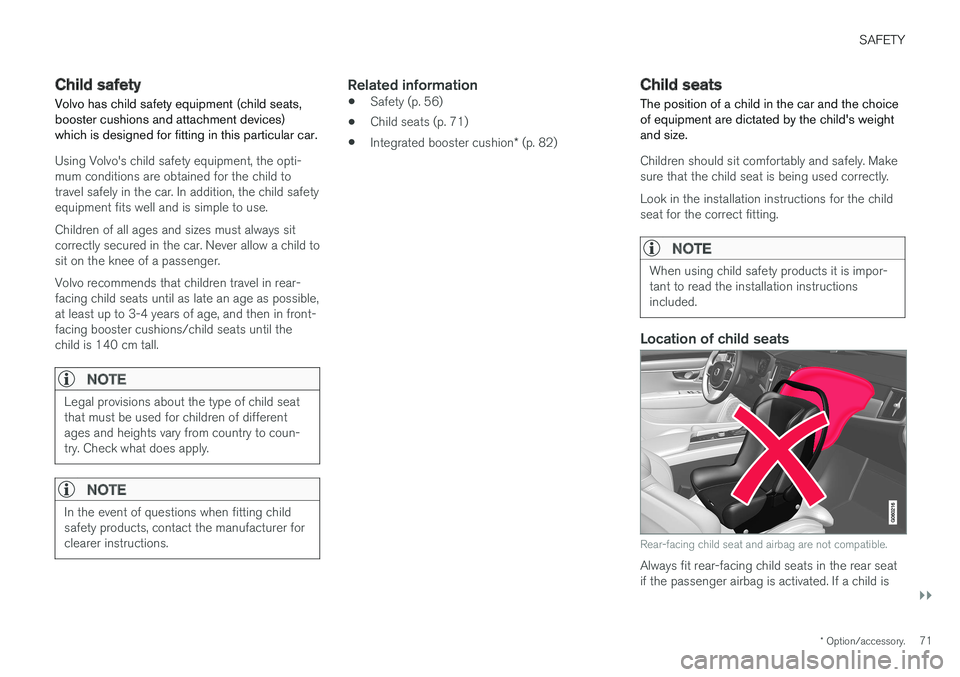
Rear-facing child seat and airbag are not compatible.
Always fit rear-facing child seats in the rear seat if the passenger airbag is activated. If a child is
Page 74 of 594
||
SAFETY
72sitting on the front passenger seat then he/she could suffer serious injury if the airbag deploys. If the passenger airbag is deactivated then rear- facing child seats can be fitted on the front pas-senger seat.
NOTE
Regulations regarding the placement of chil- dren in cars vary from country to country.Check what does apply.
WARNING
Never allow anybody to stand or sit in front of the front passenger seat. Never use a rear-facing child seat on the front passenger seat if the airbag is activated. Front-facing passengers (children and adults) must never sit on the front passenger seat ifthe passenger airbag is deactivated. Failure to follow the advice given above can endanger life or lead to serious personalinjury.
Child seat installationThe following points are important to consider when a child seat is being fitted in the car.
WARNING
Booster cushions/child seats with steel braces or some other design that could reston the seatbelt buckle's opening button mustnot be used, as they could cause the seatbeltbuckle to open accidentally. Do not secure the straps for the child seat into the seat's horizontal adjustment bar or insprings, rails or beams under the seat. Sharpedges may damage the straps. Do not allow the upper section of the child seat to rest against the windscreen.
Installation in the front seat
•
When fitting rear-facing child seats, check that the passenger airbag is deactivated.
• When fitting front-facing child seats, checkthat the passenger airbag is activated.
• Only use child seats that are recommendedby Volvo, are universally approved or aresemi-universal, and where the car is includedon the manufacturer's vehicle list.
• ISOFIX child seats can only be fitted when the car is equipped with the ISOFIX console 2
accessory.
• If the child seat is equipped with lower straps, Volvo recommends that the lower mounting points are used with these 2
. •
The ISOFIX guide can be used in order to facilitate child seat installation.
Installation in the rear seat
•Only use child seats that are recommended by Volvo, are universally approved or aresemi-universal, and where the car is includedon the manufacturer's vehicle list.
• A child seat with support legs must not befitted in the centre seat.
• The outer seats are equipped with theISOFIX fixture system and are approved for i- Size3
.
• The outer seats are equipped with upper mounting points. Volvo recommends thatchild seat's upper straps should be pulledthrough the hole in the head restraint beforebeing tensioned at the mounting point. If thisis not possible, follow the recommendationsfrom the child seat manufacturer.
• If the child seat is equipped with lowerstraps, never adjust the position of the seatin front after the straps have been fitted inthe lower mounting points. Always rememberto remove the lower straps when the childseat is not installed.
2
The accessory range varies depending on market.
3 Varies depending on market.
Page 75 of 594
SAFETY
}}
* Option/accessory.73
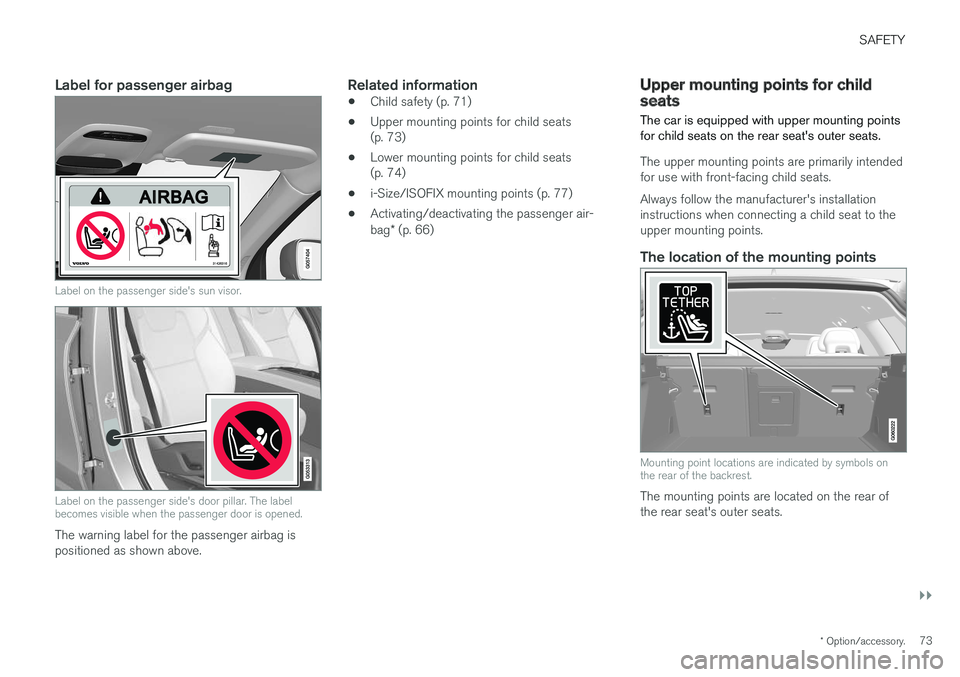
Label for passenger airbag
Label on the passenger side's sun visor.
Label on the passenger side's door pillar. The label becomes visible when the passenger door is opened.
The warning label for the passenger airbag is positioned as shown above.
Related information
•Child safety (p. 71)
• Upper mounting points for child seats(p. 73)
• Lower mounting points for child seats(p. 74)
• i-Size/ISOFIX mounting points (p. 77)
• Activating/deactivating the passenger air- bag
* (p. 66)
Upper mounting points for child seats
The car is equipped with upper mounting points for child seats on the rear seat's outer seats.
The upper mounting points are primarily intended for use with front-facing child seats. Always follow the manufacturer's installation instructions when connecting a child seat to theupper mounting points.
The location of the mounting points
Mounting point locations are indicated by symbols on the rear of the backrest.
The mounting points are located on the rear of the rear seat's outer seats.
Page 76 of 594
||
SAFETY
* Option/accessory.
74
WARNING
The child seat's upper straps must be routed through the hole in the head restraint legbefore they are tensioned at the mountingpoint. If this is not possible, follow the recom-mendations from the child seat manufacturer.
NOTE
Fold the head restraints in order to facilitate fitting this type of child seat in cars with fold-ing head restraints on the outer seats.
NOTE
In cars with a cargo cover over the luggage compartment, this must be removed beforechild seats can be attached to the securingpoints.
Related information
• Child seats (p. 71)
• Lower mounting points for child seats (p. 74)
• i-Size/ISOFIX mounting points (p. 77)
• Table for location of child seats using thecar's seatbelts (p. 75)
Lower mounting points for child seats
The car is equipped with lower mounting points for child seats in the front seat * and the rear
seat.
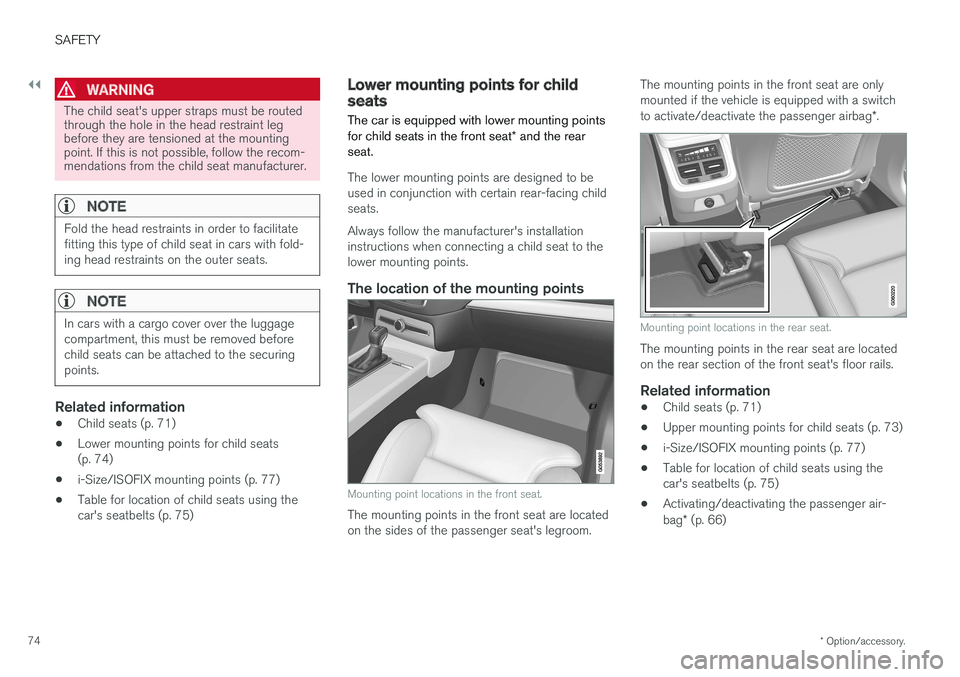
The lower mounting points are designed to be used in conjunction with certain rear-facing childseats. Always follow the manufacturer's installation instructions when connecting a child seat to thelower mounting points.
The location of the mounting points
Mounting point locations in the front seat.
The mounting points in the front seat are located on the sides of the passenger seat's legroom. The mounting points in the front seat are onlymounted if the vehicle is equipped with a switch to activate/deactivate the passenger airbag
*.
Mounting point locations in the rear seat.
The mounting points in the rear seat are located on the rear section of the front seat's floor rails.
Related information
• Child seats (p. 71)
• Upper mounting points for child seats (p. 73)
• i-Size/ISOFIX mounting points (p. 77)
• Table for location of child seats using thecar's seatbelts (p. 75)
• Activating/deactivating the passenger air- bag
* (p. 66)
Page 77 of 594
SAFETY
}}
* Option/accessory.75
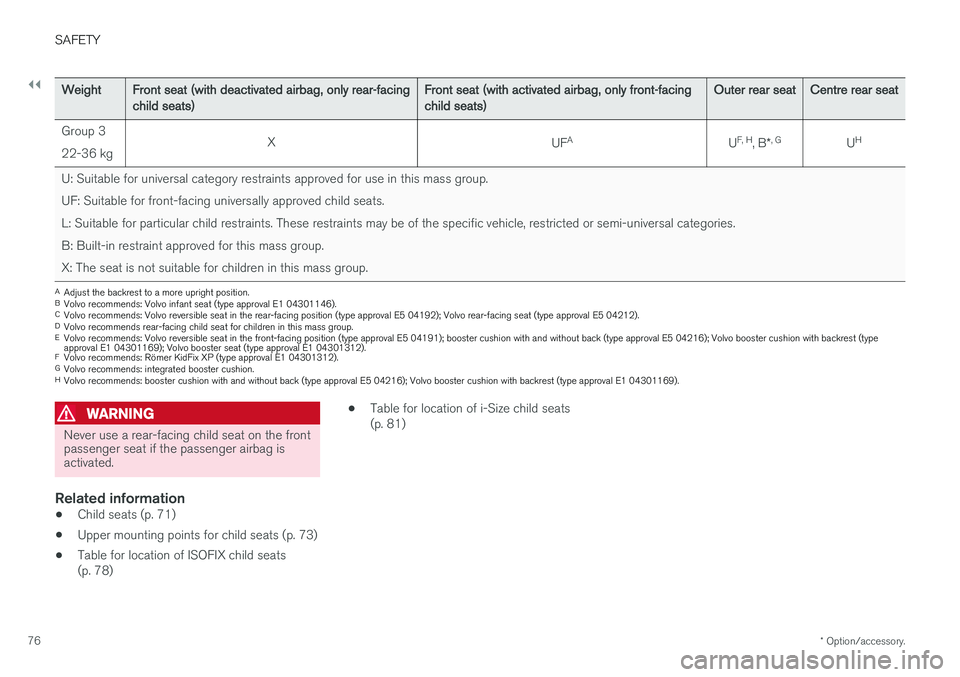
Table for location of child seats using the car's seatbelts
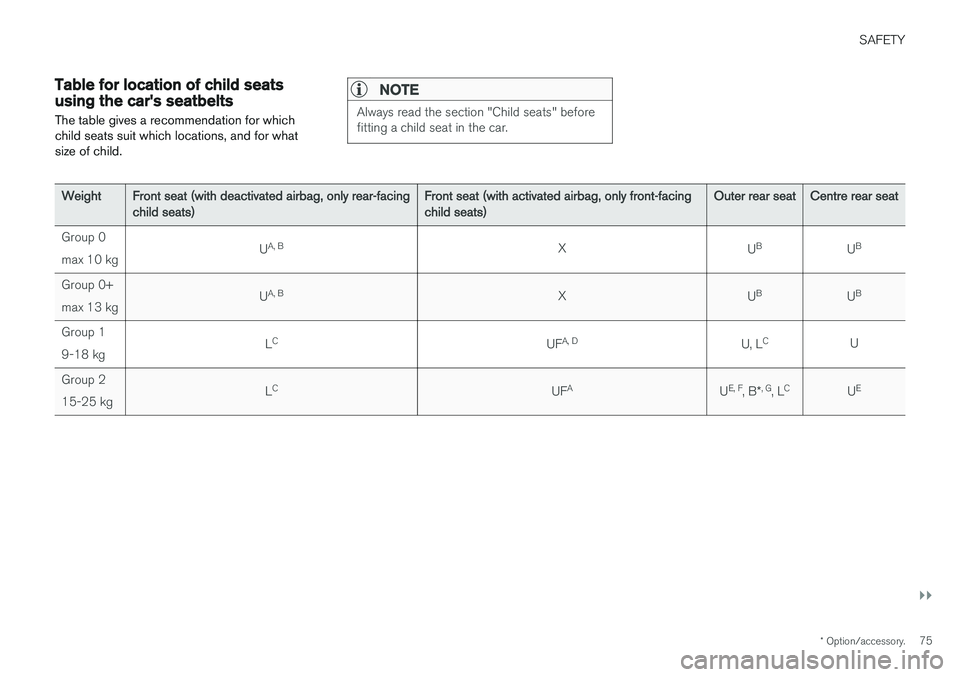
The table gives a recommendation for which
child seats suit which locations, and for what size of child.NOTE
Always read the section "Child seats" before fitting a child seat in the car.
Weight Front seat (with deactivated airbag, only rear-facing child seats) Front seat (with activated airbag, only front-facingchild seats)Outer rear seat
Centre rear seat
Group 0 max 10 kg U
A, B
XUB
UB
Group 0+max 13 kg U
A, B
XUB
UB
Group 19-18 kg L
C
UFA, D
U, LC
U
Group 215-25 kg L
C
UFA
UE, F
, B *, G
, L C
UE
Page 78 of 594
||
SAFETY
* Option/accessory.
76
Weight Front seat (with deactivated airbag, only rear-facing child seats) Front seat (with activated airbag, only front-facingchild seats)Outer rear seat
Centre rear seat
Group 3 22-36 kg X
UFA
UF, H
, B*, G
UH
U: Suitable for universal category restraints approved for use in this mass group.UF: Suitable for front-facing universally approved child seats.L: Suitable for particular child restraints. These restraints may be of the specific vehicle, restricted or semi-universal categories.B: Built-in restraint approved for this mass group.X: The seat is not suitable for children in this mass group.
A Adjust the backrest to a more upright position.
B Volvo recommends: Volvo infant seat (type approval E1 04301146).
C Volvo recommends: Volvo reversible seat in the rear-facing position (type approval E5 04192); Volvo rear-facing seat (type approval E5 04212).
D Volvo recommends rear-facing child seat for children in this mass group.
E Volvo recommends: Volvo reversible seat in the front-facing position (type approval E5 04191); booster cushion with and without back (type approval E5 04216); Volvo booster cushion with backrest (type approval E1 04301169); Volvo booster seat (type approval E1 04301312).
F Volvo recommends: Römer KidFix XP (type approval E1 04301312).
G Volvo recommends: integrated booster cushion.
H Volvo recommends: booster cushion with and without back (type approval E5 04216); Volvo booster cushion with backrest (type approval E1 04301169).
WARNING
Never use a rear-facing child seat on the front passenger seat if the passenger airbag isactivated.
Related information
• Child seats (p. 71)
• Upper mounting points for child seats (p. 73)
• Table for location of ISOFIX child seats (p. 78) •
Table for location of i-Size child seats(p. 81)
Page 81 of 594
SAFETY
}}
79
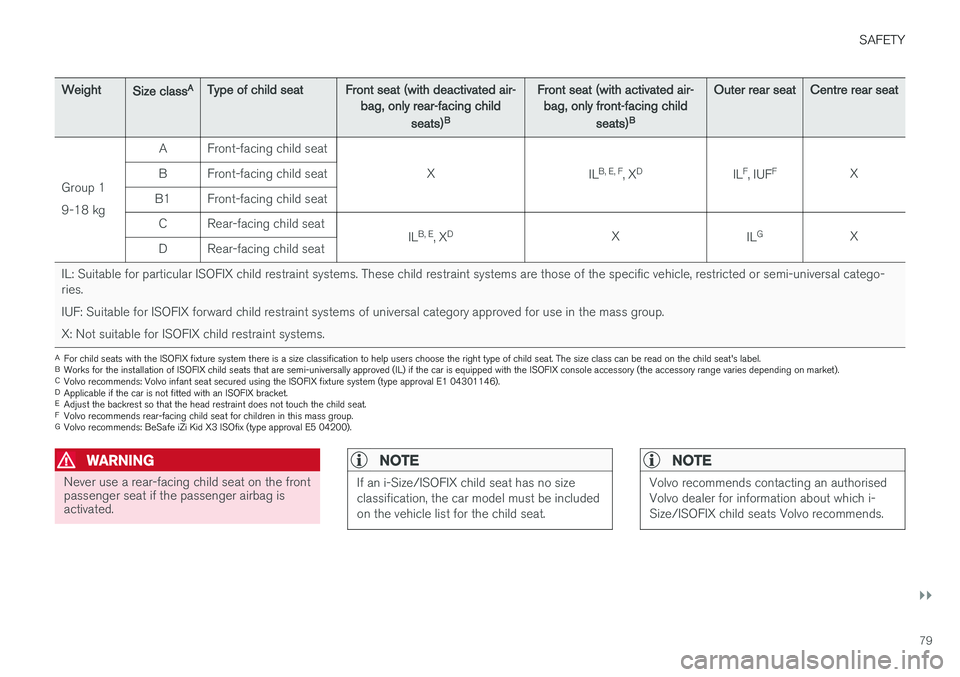
WeightSize classA
Type of child seat Front seat (with deactivated air-
bag, only rear-facing child
seats)B Front seat (with activated air-
bag, only front-facing child
seats)B Outer rear seat
Centre rear seat
Group 1 9-18 kg A Front-facing child seat
XILB, E, F
, XD
ILF
, IUF F
X
B Front-facing child seat
B1 Front-facing child seat C Rear-facing child seat ILB, E
, XD
XILG
X
D Rear-facing child seat
IL: Suitable for particular ISOFIX child restraint systems. These child restraint systems are those of the specific vehicle, restricted or semi-universal catego-
ries.IUF: Suitable for ISOFIX forward child restraint systems of universal category approved for use in the mass group.X: Not suitable for ISOFIX child restraint systems.
A For child seats with the ISOFIX fixture system there is a size classification to help users choose the right type of child seat. The size class can be read on the child seat's label.
B Works for the installation of ISOFIX child seats that are semi-universally approved (IL) if the car is equipped with the ISOFIX console accessory (the accessory range varies depending on market).
C Volvo recommends: Volvo infant seat secured using the ISOFIX fixture system (type approval E1 04301146).
D Applicable if the car is not fitted with an ISOFIX bracket.
E Adjust the backrest so that the head restraint does not touch the child seat.
F Volvo recommends rear-facing child seat for children in this mass group.
G Volvo recommends: BeSafe iZi Kid X3 ISOfix (type approval E5 04200).
WARNING
Never use a rear-facing child seat on the front passenger seat if the passenger airbag isactivated.
NOTE
If an i-Size/ISOFIX child seat has no size classification, the car model must be includedon the vehicle list for the child seat.
NOTE
Volvo recommends contacting an authorised Volvo dealer for information about which i-Size/ISOFIX child seats Volvo recommends.