gearbox VOLVO V90 2017 Owner's Guide
[x] Cancel search | Manufacturer: VOLVO, Model Year: 2017, Model line: V90, Model: VOLVO V90 2017Pages: 594, PDF Size: 15.07 MB
Page 413 of 594
STARTING AND DRIVING
}}
411
Releasing automatically
1. Put the seatbelt on.
2. Start the car.
3. With automatic gearbox:Select gear position D or R and depress the
accelerator pedal.With manual gearbox:Engage a suitable gear, release the clutch and depress the accelerator pedal.
> The parking brake releases and the sym- bol in the driver display extinguishes.
Parking on a hill
WARNING
Always use the parking brake when parking on an inclined surface. Engaging a gear or the automatic transmission's P position is not suf-
ficient to hold the car stationary in all situa- tions.
If the car is parked facing uphill: • Turn the wheels
away from the kerb.
If the car is parked facing downhill:
• Turn the wheels
towards the kerb.
Heavy load uphill
A heavy load, such as a trailer, can cause the car to roll backward when the parking brake isreleased automatically on a steep incline. Avoid this by pulling the control upwards while drivingthe car away. Release the control when theengine achieves traction.
Settings for parking brake
Automatic activation of the parking brake isselected via the centre display. Automatic activation when the car is switched off:1.
Press
Settings in the top view.
2. Press
My CarParking Brake and
Suspension and deselect/select the func-
tion Auto Activate Parking Brake.
Related information
• Parking brake (p. 409)
• In the event of a fault in the parking brake (p. 411)
• Automatic braking when stationary (p. 412)
In the event of a fault in the parking brake
Contact an authorised Volvo workshop if it is not possible to release or apply the parking brakeafter several attempts.
An acoustic warning signal sounds when driving with the parking brake applied. If the car has to be parked before a possible fault is rectified then the wheels must be turned as ifparking on a hill and the gear selector must be in position P, or engage first gear if the car has a
manual gearbox.
Low battery voltageIf the battery voltage is too low then the parking brake can neither be released nor applied. Con-nect a donor battery if the battery voltage is toolow.
Replacing the brake liningsThe rear brake linings must be replaced at aworkshop due to the design of the electrically-operated parking brake - an authorised Volvoworkshop is recommended.
Page 414 of 594
||
STARTING AND DRIVING
412
Symbols in the driver display
SymbolSpecification
If the symbol flashes, it indicates a fault has occurred. See the mes-sage in the driver display.
Fault in brake system. See the message in the driver display.
Information message in driver dis- play.
Message examples:
•
Parking brake Service required
•Parking brake System overheated
•Parking brake Temporarily unavailable
Related information
• Brake functions (p. 406)
• Using the parking brake (p. 410)
• Parking brake (p. 409)
• Using jump starting with another battery (p. 388)
Hill start assist
Hill start assist, Hill Start Assist (HSA), prevents the car from rolling backwards when starting onan uphill gradient. When reversing uphill, it pre-vents the car from rolling forwards.
The function means that the pedal pressure in the brake system remains for several secondswhile the driver's foot is moved from brake pedalto accelerator pedal. The temporary braking effect releases after sev- eral seconds or when the driver accelerates. Hill start assist is available even if the function for automatic braking when stationary (Auto hold) isdeactivated.
Related information
• Brake functions (p. 406)
• Automatic braking when stationary (p. 412)
Automatic braking when stationary
Automatic braking when stationary (Auto Hold) means that the driver can release the brakepedal while maintaining braking effect when thecar has stopped at traffic lights or a junction.
FunctionWhen the car has stopped, the brakes are acti- vated automatically. The function can use eitherfoot brake or parking brake to hold the car sta-tionary and it works on all gradients. When theaccelerator pedal is depressed again, the brakesare released. When braking to a stop on a downhill or uphill gradient - depress the brake pedal a bit harderbefore releasing to ensure that the car does notroll at all. If the driver switches off the engine when the car is stationary, the parking brake is applied.
Automatic deactivation
The function is deactivated automatically: • when the driver's door is open and the driv- er's seatbelt is unfastened.
• in gear position
N13
.
13 Applies to automatic gearbox.
Page 416 of 594
||
STARTING AND DRIVING
414
IMPORTANT
Engine damage can occur if water enters the air filter. In depths greater than 25 cm, water could enter the transmission. This reduces the lubri-cating ability of the oils and shortens theservice life of these systems. Damage to any component, engine, transmis- sion, turbocharger, differential or its internalcomponents caused by flooding, hydrostaticlocking or oil shortage, is not covered by thewarranty. In the event of the engine stalling in water, do not try restart - tow the car from the water toa workshop - an authorised Volvo workshop isrecommended. Risk of engine breakdown.
Related information
•Towing (p. 431)
• Recovering the car (p. 432)
Overheating in the engine and drive system
Under special conditions, for example hard driv- ing in hilly terrain and hot climate, there is a riskthat the engine and drive system may overheat -in particular with a heavy load.
• In the event of overheating, the engine's power may be limited temporarily.
• Remove any auxiliary lamps from in front ofthe grille when driving in hot climates.
• If the temperature in the engine's coolingsystem becomes too high then a warningsymbol is illuminated and the driver display shows the message
Engine temperature
High temperature Stop safely. Stop the
car in a safe way and allow the engine to run at idling speed for several minutes and cooldown.
• If the message
Engine temperature High
temperature Turn off engine or Engine
coolant Level low, turn off engine is
shown, stop the car and switch off the engine.
• In the event of overheating in the gearbox, analternative gear shift program will beselected. In addition, a built-in protectionfunction is activated that, amongst otherthings, illuminates a warning symbol and thedriver display shows the message
Transmission warm Reduce speed to
lower temperature or Transmission hot Stop safely, wait for cooling
. Follow the
recommendation given, reduce speed or stop the car in a safe way and allow the engine torun at idling speed for several minutes toenable the gearbox to cool down.
• If the car overheats, the air conditioning maybe switched off temporarily.
• Do not turn the engine off immediately youstop after a hard drive.
NOTE
It is normal for the engine's cooling fan to operate for a time after the engine has beenswitched off.
Symbols in the driver display
Symbol
Specification
High engine temperature. Follow the recommendation given.
Low level, coolant. Follow the rec- ommendation given.
Gearbox hot/overheated/cooled. Follow the recommendation given.
Page 430 of 594
STARTING AND DRIVING
* Option/accessory.
428
Driving with a trailer under special conditions
When driving with a trailer in hilly terrain in a hot climate there may be a risk of overheating.
In the event of overheating, a warning symbol illu- minates in the driver display together with a mes-sage, see section "Overheating in the engine anddrive system". The following only applies to cars with automatic gearbox. The automatic gearbox selects the optimum gear related to load and engine speed.
Steep inclinesDo not lock the automatic gearbox in a highergear than the engine "can cope with" - it is notalways a good idea to drive at a high gear withlow engine speed.
Parking on a hill1. Depress the brake pedal fully.
2. Activate the parking brake.3. Select gear position P.
4. Release the brake pedal.Block the wheels with chocks when parking a car with hitched trailer on a hill.
Starting on a hill1. Depress the brake pedal fully. 2.
Select gear position D.
3. Releasing the parking brake.
4. Release the brake pedal and start driving off.
Related information
• Driving with a trailer (p. 426)
• Overheating in the engine and drive system (p. 414)
• Using the parking brake (p. 410)
Trailer Stability Assist
*
The function of the trailer stability assist Trailer Stability Assist (TSA) is to stabilise cars withattached trailers in situations where they begin
Page 497 of 594
WHEELS AND TYRES
}}
* Option/accessory.495
IMPORTANT
Risk of overheating. The compressor must not run for more than 10 minutes.
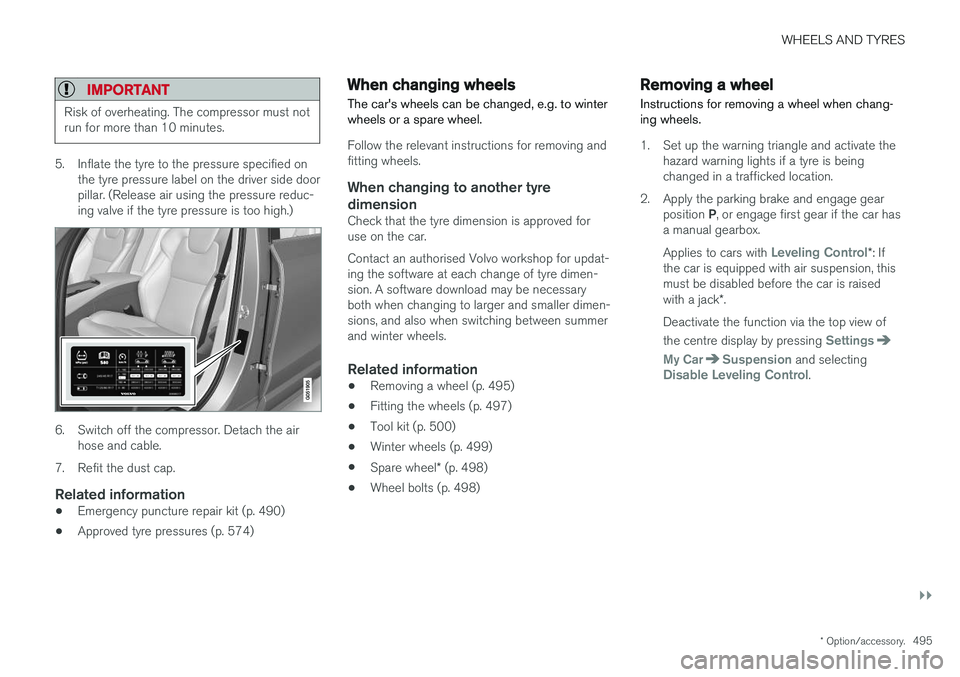
5. Inflate the tyre to the pressure specified on
the tyre pressure label on the driver side door pillar. (Release air using the pressure reduc-ing valve if the tyre pressure is too high.)
6. Switch off the compressor. Detach the airhose and cable.
7. Refit the dust cap.
Related information
• Emergency puncture repair kit (p. 490)
• Approved tyre pressures (p. 574)
When changing wheels
The car's wheels can be changed, e.g. to winter wheels or a spare wheel.
Follow the relevant instructions for removing and fitting wheels.
When changing to another tyre
dimension
Check that the tyre dimension is approved foruse on the car. Contact an authorised Volvo workshop for updat- ing the software at each change of tyre dimen-sion. A software download may be necessaryboth when changing to larger and smaller dimen-sions, and also when switching between summerand winter wheels.
Related information
• Removing a wheel (p. 495)
• Fitting the wheels (p. 497)
• Tool kit (p. 500)
• Winter wheels (p. 499)
• Spare wheel
* (p. 498)
• Wheel bolts (p. 498)
Removing a wheel
Instructions for removing a wheel when chang- ing wheels.
1. Set up the warning triangle and activate the hazard warning lights if a tyre is being changed in a trafficked location.
2. Apply the parking brake and engage gear position P, or engage first gear if the car has
a manual gearbox. Applies to cars with
Leveling Control* : If
the car is equipped with air suspension, this must be disabled before the car is raised with a jack *.
Deactivate the function via the top view of the centre display by pressing
Settings
My CarSuspension and selectingDisable Leveling Control.
Page 536 of 594
||
MAINTENANCE AND SERVICE
534
Size , L×W×H (mm) 150×90×130
Capacity (Ah) 10
AAccording to EN standard.
B Cold Cranking Amperes.
IMPORTANT
When replacing the starter battery or support battery, a battery of AGM 15
type must be fit-
ted.
NOTE
• The higher the current take-off in the car, the more the alternator must be workingand the batteries charging = Increasedfuel consumption.
• When the capacity of the starter batteryhas fallen below the lowest permissiblelevel then the Start/Stop function is dis-engaged.
Temporarily reduced Start/Stop function due to high current take-off means: •
The engine starts automatically 16
without the
driver depressing the clutch pedal (manualgearbox).
• The engine starts automatically without thedriver lifting his/her foot off the foot brakepedal (automatic gearbox).
The support battery normally requires no moreservice than the normal starter battery. A work-shop should be contacted in the event of ques-tions or problems - an authorised Volvo workshopis recommended.
IMPORTANT
If the following instruction is not observed then the Start/Stop function may temporarilycease to work after the connection of anexternal starter battery or battery charger:
• The negative battery terminal on the car's starter battery must
never be used for
connecting an external starter battery orbattery charger - only the car's negative
charging point may be used as the
grounding point.
NOTE
If the starter battery has been discharged so much that the car has no normal electricalfunctions and the engine is then jump-startedwith an external battery or a battery charger,the Start/Stop function will continue to beactivated. If the Start/Stop function thenauto-stops the engine shortly after, there is agreat risk that engine auto-start will fail dueto insufficient battery capacity, because thebattery has not had the opportunity torecharge. If the car has been jump-started, or if there is insufficient time to charge the battery with abattery charger, the recommendation is totemporarily deactivate the Start/Stop functionuntil the battery has been recharged by thecar. In an outside temperature of +15 °C, thebattery needs to be charged for at least1 hour by the car. In a lower outside tempera-ture, the charging time may increase to3-4 hours. The recommendation is to chargethe battery using an external battery charger.
Related information
• Starter battery (p. 530)
• Start/Stop (p. 396)
15
Absorbed Glass Mat.
16 Automatic starting can only take place if the gear lever is in neutral position.
Page 553 of 594
MAINTENANCE AND SERVICE
551
IMPORTANT
Avoid washing the car with cleaning agent with a pH value lower than 3.5 or higher than11.5. This may result in discolouration of ano-dised aluminium parts such as roof rack andaround the side windows. Never use metal polishing agent on anodised aluminium parts, this can result in discoloura-tion and destroy the surface treatment.
RimsOnly use rim cleaning agent recommended by Volvo. Strong rim cleaning agents can damage the sur- face and cause stains on chrome-plated alumi-nium rims.
Related information
•Polishing and waxing (p. 551)
• Wiper blades in service position (p. 527)
• Automatic braking when stationary (p. 412)
• Using the parking brake (p. 410)
• Gear positions for automatic gearbox(p. 390)
Polishing and waxing
Polish and wax the car if the paintwork is dull or to give the paintwork extra protection. The cardoes not need to be polished until it is at leastone year old. However, the car can be waxedduring this time. Do not polish or wax the car indirect sunlight.
Wash and dry the car thoroughly before you begin polishing or waxing. Clean off asphalt andtar stains using tar remover or white spirit. Morestubborn stains can be removed using fine rub-bing paste designed for car paintwork. Polish first with a polish and then wax with liquid or solid wax. Follow the instructions on the pack-aging carefully. Many preparations contain bothpolish and wax.
IMPORTANT
Avoid waxing and polishing on plastic and rubber. When using degreasant on plastic and rubber, only rub with light pressure if it is necessary.Use a soft washing sponge. Polishing glossy trim mouldings could wear away or damage the glossy surface layer. Polishing agent that contains abrasive must not be used.
IMPORTANT
Only paint treatment recommended by Volvo should be used. Other treatment such as pre-serving, sealing, protection, lustre sealing orsimilar could damage the paintwork. Paint-work damage caused by such treatments isnot covered by Volvo warranty.
Related information
• Cleaning the exterior (p. 549)
• Paint damage (p. 554)
Page 562 of 594
||
SPECIFICATIONS
560
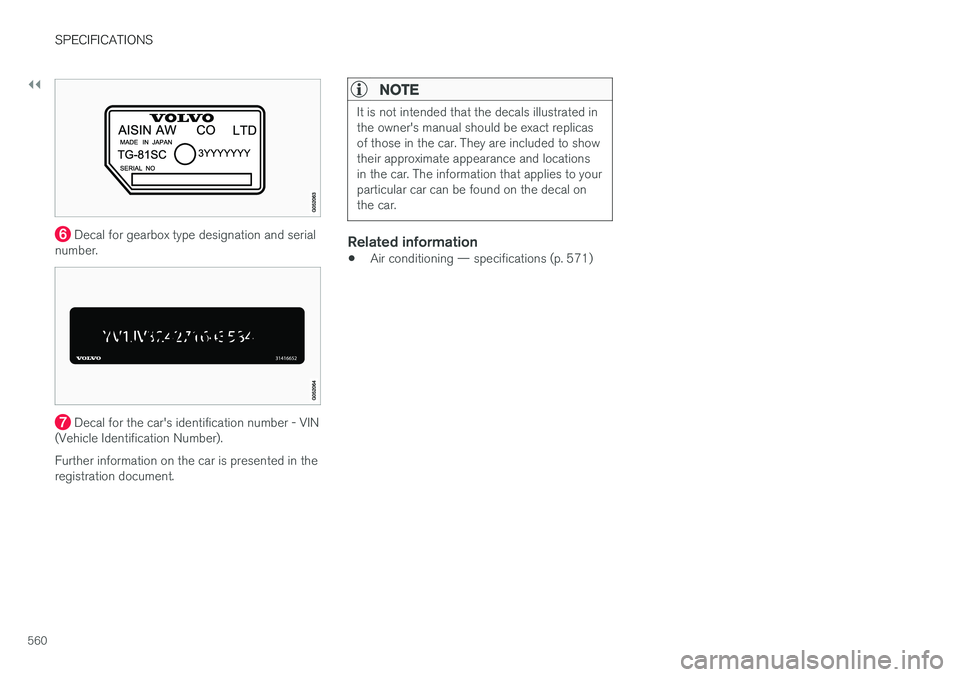
Decal for gearbox type designation and serial
number.
Decal for the car's identification number - VIN
(Vehicle Identification Number).
Further information on the car is presented in the registration document.
NOTE
It is not intended that the decals illustrated in the owner's manual should be exact replicasof those in the car. They are included to showtheir approximate appearance and locationsin the car. The information that applies to yourparticular car can be found on the decal onthe car.
Related information
• Air conditioning — specifications (p. 571)
Page 566 of 594
SPECIFICATIONS
564
Towing capacity and towball load
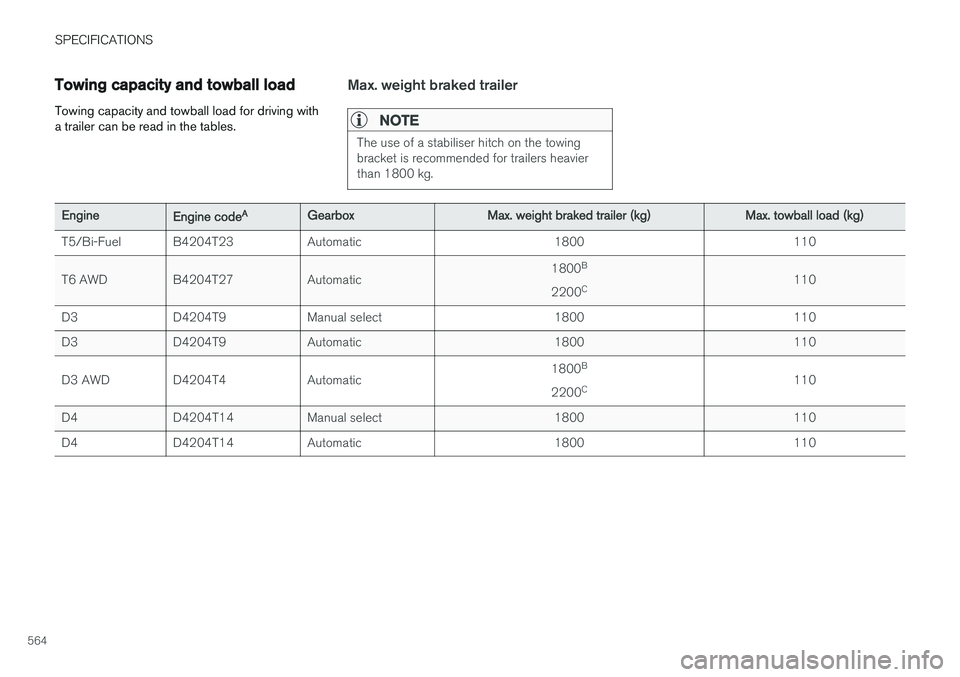
Towing capacity and towball load for driving with a trailer can be read in the tables.Max. weight braked trailer
NOTE
The use of a stabiliser hitch on the towing bracket is recommended for trailers heavierthan 1800 kg.
Engine Engine codeA
Gearbox Max. weight braked trailer (kg) Max. towball load (kg)
T5/Bi-Fuel B4204T23 Automatic 1800 110
T6 AWD B4204T27 Automatic 1800
B
2200 C 110
D3 D4204T9 Manual select 1800 110
D3 D4204T9 Automatic 1800 110
D3 AWD D4204T4 Automatic 1800
B
2200 C 110
D4 D4204T14 Manual select 1800 110
D4 D4204T14 Automatic 1800 110
Page 567 of 594
SPECIFICATIONS
* Option/accessory.565
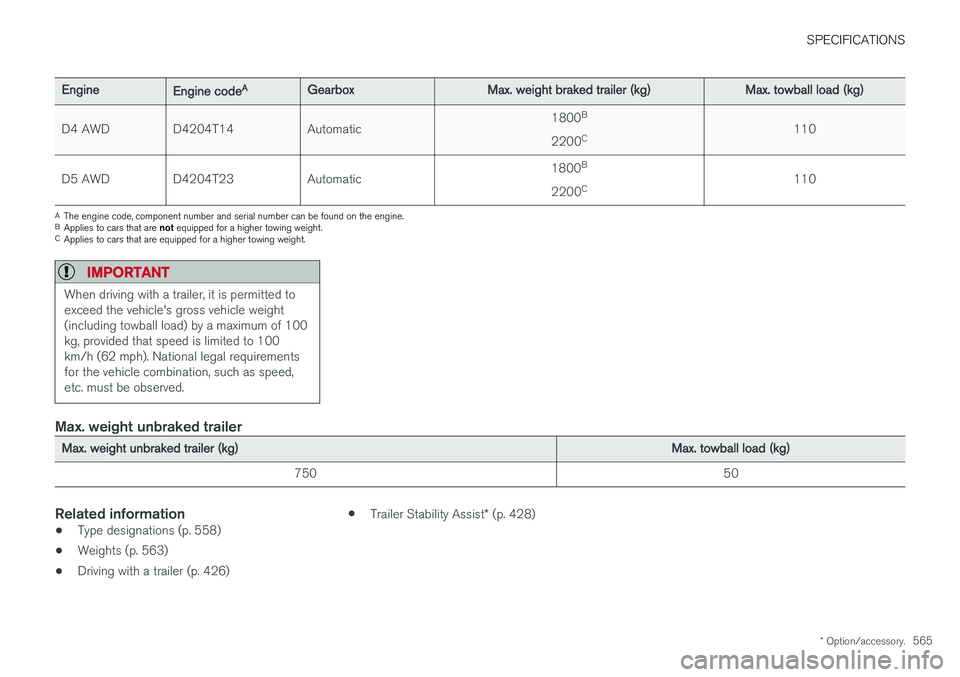
Engine
Engine codeA
Gearbox Max. weight braked trailer (kg) Max. towball load (kg)
D4 AWD D4204T14 Automatic 1800
B
2200 C 110
D5 AWD D4204T23 Automatic 1800
B
2200 C 110
A
The engine code, component number and serial number can be found on the engine.
B Applies to cars that are not equipped for a higher towing weight.
C Applies to cars that are equipped for a higher towing weight.
IMPORTANT
When driving with a trailer, it is permitted to exceed the vehicle's gross vehicle weight(including towball load) by a maximum of 100kg, provided that speed is limited to 100km/h (62 mph). National legal requirementsfor the vehicle combination, such as speed,etc. must be observed.
Max. weight unbraked trailer
Max. weight unbraked trailer (kg) Max. towball load (kg)
750 50
Related information
•Type designations (p. 558)
• Weights (p. 563)
• Driving with a trailer (p. 426) •
Trailer Stability Assist
* (p. 428)