volvo app VOLVO V90 2017 Service Manual
[x] Cancel search | Manufacturer: VOLVO, Model Year: 2017, Model line: V90, Model: VOLVO V90 2017Pages: 594, PDF Size: 15.07 MB
Page 253 of 594
LOCKS AND ALARM
}}
251
Detaching the key blade
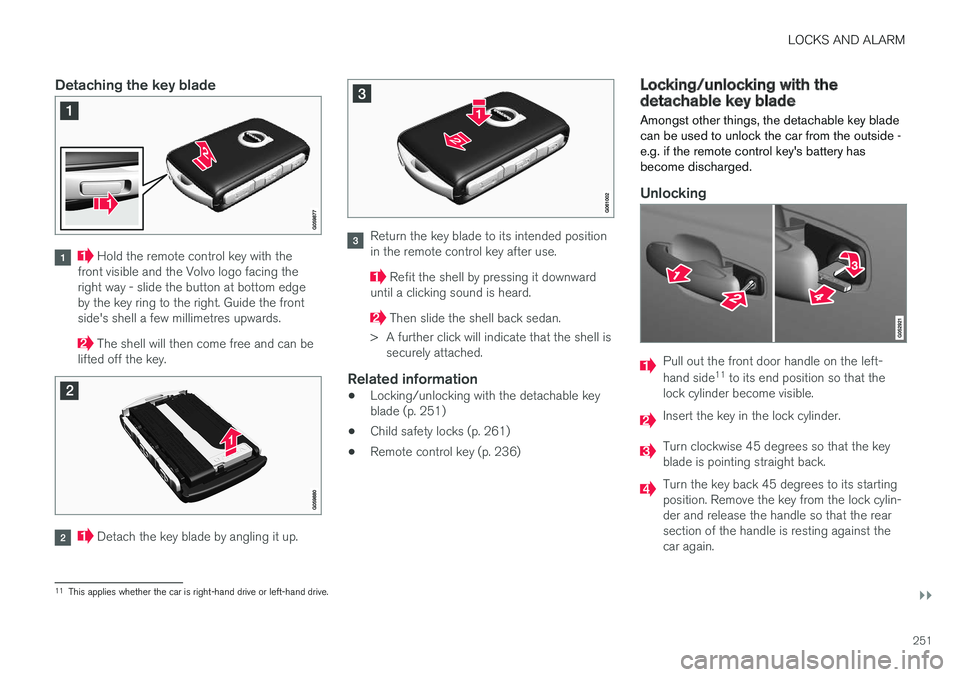
Hold the remote control key with the
front visible and the Volvo logo facing the right way - slide the button at bottom edgeby the key ring to the right. Guide the frontside's shell a few millimetres upwards.
The shell will then come free and can be
lifted off the key.
Detach the key blade by angling it up.
Return the key blade to its intended position in the remote control key after use.
Refit the shell by pressing it downward
until a clicking sound is heard.
Then slide the shell back sedan.
> A further click will indicate that the shell is securely attached.
Related information
• Locking/unlocking with the detachable key blade (p. 251)
• Child safety locks (p. 261)
• Remote control key (p. 236)
Locking/unlocking with the detachable key blade
Amongst other things, the detachable key blade can be used to unlock the car from the outside -e.g. if the remote control key's battery hasbecome discharged.
Unlocking
Pull out the front door handle on the left- hand side 11
to its end position so that the
lock cylinder become visible.
Insert the key in the lock cylinder.
Turn clockwise 45 degrees so that the key blade is pointing straight back.
Turn the key back 45 degrees to its starting position. Remove the key from the lock cylin-der and release the handle so that the rearsection of the handle is resting against thecar again.
11 This applies whether the car is right-hand drive or left-hand drive.
Page 259 of 594
LOCKS AND ALARM
}}
* Option/accessory.257
NOTE
There is a risk of reduced function, or no function, if the rear bumper is loaded withlarge amounts of ice, snow, dirt or similar. Forthis reason, make sure you keep it clean.
NOTE
Pay attention to the possibility that the sys- tem may be activated in a car wash or similarif the remote key is within range.
Related information
•Locking/unlocking the tailgate (p. 247)
• Power operated tailgate
* (p. 253)
• Remote control key range (p. 238)
Replacing the battery in the remote control key
The battery in the remote control key needs to be replaced when it has become discharged.
NOTE
All batteries have a limited service life and must eventually be replaced (does not applyto Key Tag). The service life of the battery var-ies depending on how often the vehicle/keyis used.
The battery for the remote control key should be replaced if:
the information symbol illuminates and the message
Car key battery low
See Owner's manual is shown in the
driver display
and/or
• the locks repeatedly do not react to signals from the remote control key within 20 metresfrom the car.
NOTE
Always try moving closer to the car and mak- ing another unlock attempt.
The battery in the button-less key 16
(Key Tag)
cannot be replaced - a new key can be ordered from an authorised Volvo workshop.
IMPORTANT
A discharged Key Tag must be handed over to an authorised Volvo workshop. The keymust be deleted from the car since it is stillpossible to use it to start the car via back-upstart.
16 This key is supplied with a car equipped with the keyless locking/entry option (Passive Entry *).
Page 264 of 594
||
LOCKS AND ALARM
* Option/accessory.
262
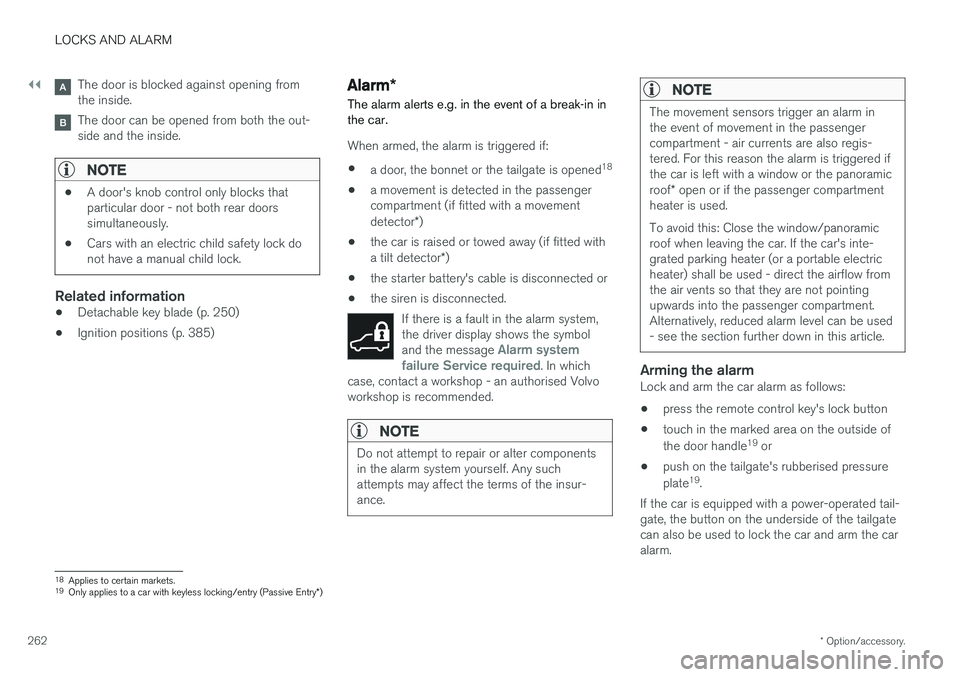
The door is blocked against opening from the inside.
The door can be opened from both the out- side and the inside.
NOTE
• A door's knob control only blocks that particular door - not both rear doorssimultaneously.
• Cars with an electric child safety lock donot have a manual child lock.
Related information
• Detachable key blade (p. 250)
• Ignition positions (p. 385)
Alarm
*
The alarm alerts e.g. in the event of a break-in in the car.
When armed, the alarm is triggered if:
• a door, the bonnet or the tailgate is opened 18
• a movement is detected in the passenger compartment (if fitted with a movement detector
*)
• the car is raised or towed away (if fitted witha tilt detector
*)
• the starter battery's cable is disconnected or
• the siren is disconnected.
If there is a fault in the alarm system, the driver display shows the symbol and the message
Alarm system
failure Service required. In which
case, contact a workshop - an authorised Volvo workshop is recommended.
NOTE
Do not attempt to repair or alter components in the alarm system yourself. Any suchattempts may affect the terms of the insur-ance.
NOTE
The movement sensors trigger an alarm in the event of movement in the passengercompartment - air currents are also regis-tered. For this reason the alarm is triggered ifthe car is left with a window or the panoramic roof * open or if the passenger compartment
heater is used. To avoid this: Close the window/panoramic roof when leaving the car. If the car's inte-grated parking heater (or a portable electricheater) shall be used - direct the airflow fromthe air vents so that they are not pointingupwards into the passenger compartment.Alternatively, reduced alarm level can be used- see the section further down in this article.
Arming the alarmLock and arm the car alarm as follows:
• press the remote control key's lock button
• touch in the marked area on the outside of the door handle 19
or
• push on the tailgate's rubberised pressureplate 19
.
If the car is equipped with a power-operated tail- gate, the button on the underside of the tailgatecan also be used to lock the car and arm the caralarm.
18 Applies to certain markets.
19 Only applies to a car with keyless locking/entry (Passive Entry *)
Page 268 of 594
||
LOCKS AND ALARM
266
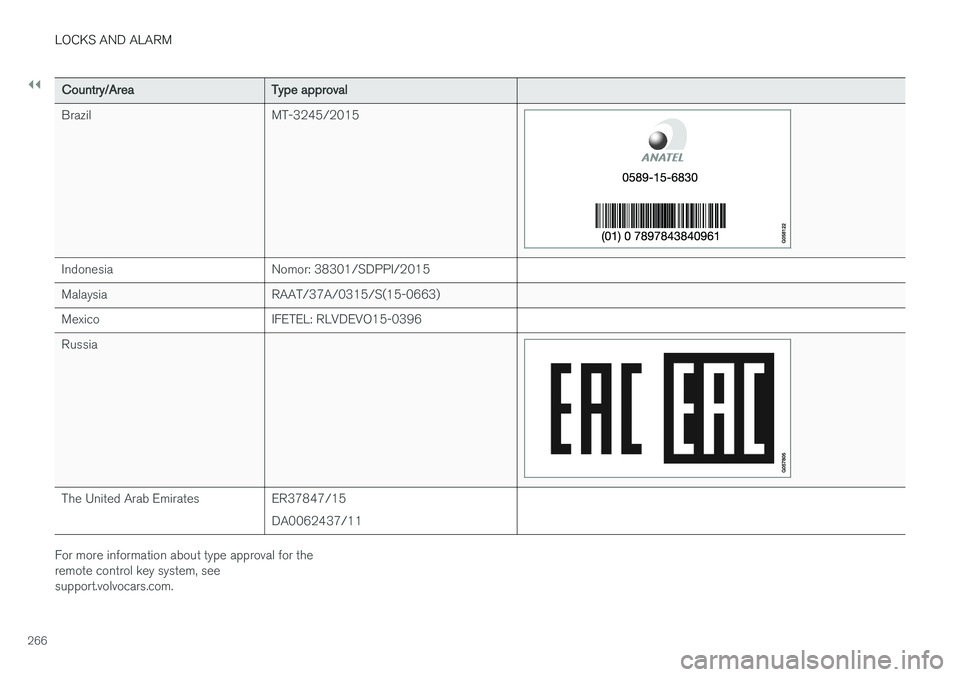
Country/AreaType approval
Brazil MT-3245/2015
Indonesia Nomor: 38301/SDPPI/2015
Malaysia RAAT/37A/0315/S(15-0663)
Mexico IFETEL: RLVDEVO15-0396Russia
The United Arab Emirates ER37847/15 DA0062437/11
For more information about type approval for the remote control key system, seesupport.volvocars.com.
Page 277 of 594
DRIVER SUPPORT
}}
275
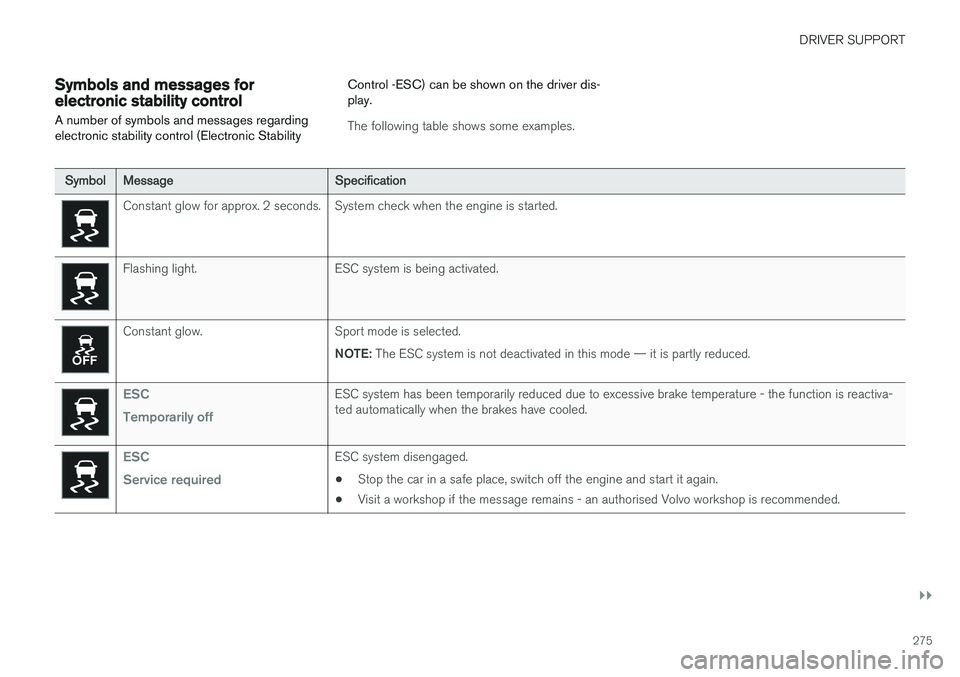
Symbols and messages for electronic stability control
A number of symbols and messages regarding electronic stability control (Electronic Stability Control -ESC) can be shown on the driver dis-play.
The following table shows some examples.
Symbol
Message Specification
Constant glow for approx. 2 seconds. System check when the engine is started.
Flashing light. ESC system is being activated.
Constant glow. Sport mode is selected.
NOTE: The ESC system is not deactivated in this mode — it is partly reduced.
ESC Temporarily offESC system has been temporarily reduced due to excessive brake temperature - the function is reactiva- ted automatically when the brakes have cooled.
ESC Service requiredESC system disengaged.
• Stop the car in a safe place, switch off the engine and start it again.
• Visit a workshop if the message remains - an authorised Volvo workshop is recommended.
Page 293 of 594
DRIVER SUPPORT
}}
291
is clear again the car returns to the selected speed.
WARNING
The Adaptive cruise control is an aid, which cannot handle all traffic, weather and roadconditions. The driver must always be observant with regard to the prevailing traffic conditions andintervene if the Adaptive cruise control doesnot maintain a suitable speed or suitable timeinterval. Read all the sections about the adaptive cruise control in the owner's manual in orderto learn about its limitations, of which thedriver should be aware before the function isused. The driver always bears responsibility for maintaining the correct time interval andspeed - even when the Adaptive cruise con-trol is being used.
Adaptive cruise control regulates the speed with acceleration and braking. It is normal for thebrakes to emit a low sound when they are beingused to adjust the speed. The adaptive cruise control aims to control the speed in a smooth way. In situations that demandsudden braking the driver must brake himself/herself. This applies in case of large speed differ- ences or if the vehicle in front brakes suddenly.Due to the limitations of the radar unit, brakingmay come unexpectedly or not at all. The adaptive cruise control aims to follow the vehicle ahead in the same lane at a time intervalset by the driver. If the radar unit cannot see anyvehicle in front then the car will instead maintainthe speed set and stored by the driver. This alsotakes place if the speed of the vehicle aheadincreases and exceeds the stored speed. The following applies for cars with automatic gearbox:
• Adaptive cruise control can follow anothervehicle at speed from 0 km/h up to200 km/h (125 mph).
The following applies for cars with manual gear-box: • The Adaptive cruise control can follow another vehicle at speeds from 30 km/h(20 mph) up to 200 km/h (125 mph).
WARNING
Adaptive cruise control is not a collision avoid- ance system. The driver must intervene if thesystem does not detect a vehicle in front. The adaptive cruise control does not brake for humans or animals, and not for small vehiclessuch as bicycles and motorcycles. Nor for lowtrailers, oncoming, slow or stationary vehiclesand objects. Do not use the Adaptive cruise control, for example, in city traffic, at junctions, on slipperysurfaces, with a lot of water or slush on theroad, in heavy rain/snow, in poor visibility, onwinding roads or on slip roads.
IMPORTANT
Maintenance of adaptive cruise control com- ponents must only be performed at a work-shop - an authorised Volvo workshop is rec-ommended.
Page 307 of 594
DRIVER SUPPORT
}}
305
WARNING
Pilot Assist is an aid which cannot handle all traffic, weather and road conditions. The driver must always be observant with regard to the prevailing traffic conditions andintervene if Pilot Assist does not provide suit-able steering assistance or maintain a suita-ble speed or suitable time interval. Read all the sections about this function in the owner's manual in order to learn about itslimitations, of which the driver should beaware before the function is used. Pilot Assist must only be used if there are clear lane lines painted on the road surfaceon each side of the lane. All other useinvolves increased risk of contact with sur-rounding obstacles that are not detected bythe function. The driver always bears responsibility for how the car is controlled as well as for maintainingthe correct distance and speed, even whenPilot Assist is being used.
Pilot Assist regulates the speed with acceleration and braking. It is normal for the brakes to emit alow sound when they are being used to adjustthe speed. Pilot Assist attempts to regulate the speed smoothly. In situations that demand sudden brak-ing the driver must brake himself/herself. Thisapplies in case of large speed differences or ifthe vehicle in front brakes suddenly. Due to the limitations of the camera and radar unit, brakingmay come unexpectedly or not at all. Pilot Assist aims to follow the vehicle ahead in the same lane at a time interval set by the driver.If the radar unit cannot see any vehicle in frontthen the car will instead maintain the speed setand stored by the driver. This also takes place ifthe speed of the vehicle ahead increases andexceeds the stored speed. The following applies for cars with automatic gearbox:
• Pilot Assist can follow another vehicle atspeeds from 0 km/h up to 200 km/h(125 mph).
• Pilot Assist can give steering assistance fromalmost stationary up to 140 km/h (87 mph).
The following applies for cars with manual gear-box: • Pilot Assist can follow another vehicle at speeds from 30 km/h (20 mph) up to200 km/h (125 mph).
• Pilot Assist can give steering assistance from30 km/h (20 mph) up to 140 km/h(87 mph).
WARNING
Pilot Assist is not a collision avoidance sys- tem. The driver must intervene if the systemdoes not detect a vehicle in front. Pilot Assist does not brake for people, ani- mals, objects, small vehicles (e.g. cycles andmotorcycles), low trailers as well as oncoming,slow or stationary vehicles. Do not use Pilot Assist, for example, in city traffic, at junctions, on slippery surfaces, witha lot of water or slush on the road, in heavyrain/snow, in poor visibility, on winding roads,on slip roads, or with a trailer connected tothe car.
IMPORTANT
Maintenance of Pilot Assist components must only be performed at a workshop - an author-ised Volvo workshop is recommended.
Page 322 of 594
||
DRIVER SUPPORT
320
CauseAction
Water or snow from the road surface swirls up and blocks the radar signals or camera view. No action. Sometimes the unit does not work on a very wet or snow-coveredroad surface.
Dirt has appeared between the inside of the windscreen and the cameraand radar unit. Visit a workshop to have the windscreen inside the unit's cover cleaned - anauthorised Volvo workshop is recommended.
NOTE
Keep the windscreen clean in front of the camera and radar unit.
Vehicle speedThe capacity of the radar unit to detect vehicles ahead is reduced significantly if:
• the speed of the vehicle ahead is signifi-cantly different from that of your own car
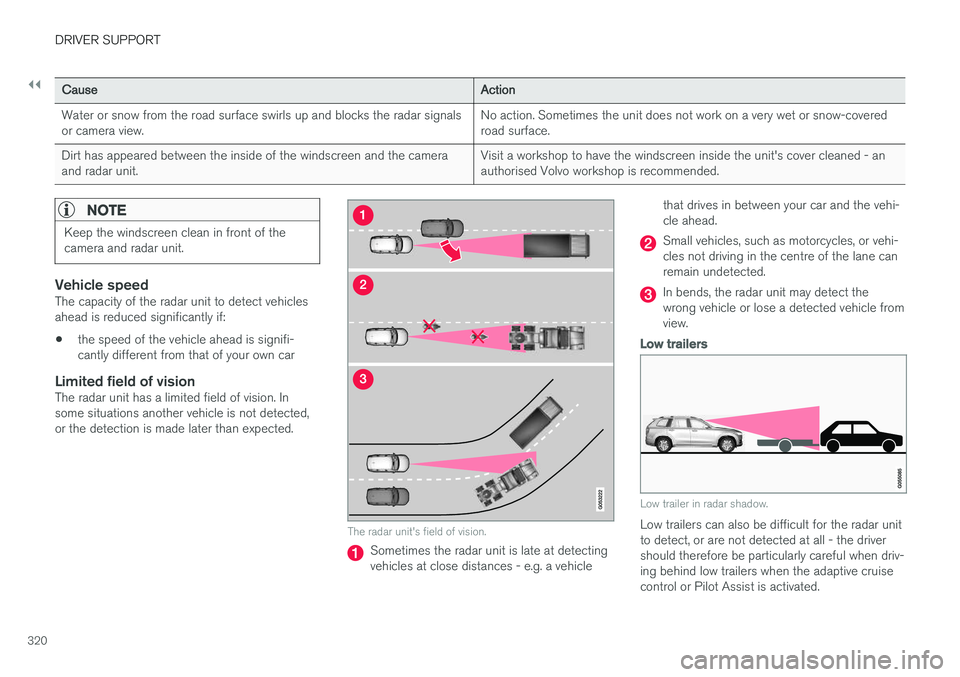
Limited field of visionThe radar unit has a limited field of vision. Insome situations another vehicle is not detected,or the detection is made later than expected.
The radar unit's field of vision.
Sometimes the radar unit is late at detecting vehicles at close distances - e.g. a vehicle that drives in between your car and the vehi-cle ahead.
Small vehicles, such as motorcycles, or vehi- cles not driving in the centre of the lane canremain undetected.
In bends, the radar unit may detect the wrong vehicle or lose a detected vehicle fromview.
Low trailers
Low trailer in radar shadow.
Low trailers can also be difficult for the radar unit to detect, or are not detected at all - the drivershould therefore be particularly careful when driv-ing behind low trailers when the adaptive cruisecontrol or Pilot Assist is activated.
Page 323 of 594
DRIVER SUPPORT
}}
* Option/accessory.321
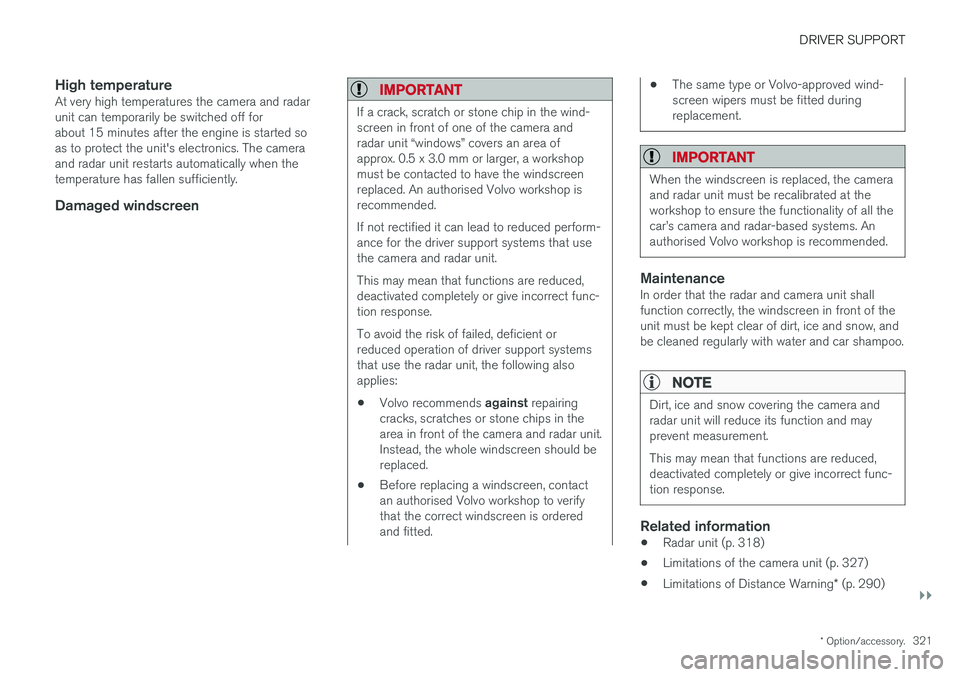
High temperatureAt very high temperatures the camera and radar unit can temporarily be switched off forabout 15 minutes after the engine is started soas to protect the unit's electronics. The cameraand radar unit restarts automatically when thetemperature has fallen sufficiently.
Damaged windscreen
IMPORTANT
If a crack, scratch or stone chip in the wind- screen in front of one of the camera andradar unit “windows” covers an area ofapprox. 0.5 x 3.0 mm or larger, a workshopmust be contacted to have the windscreenreplaced. An authorised Volvo workshop isrecommended. If not rectified it can lead to reduced perform- ance for the driver support systems that usethe camera and radar unit. This may mean that functions are reduced, deactivated completely or give incorrect func-tion response. To avoid the risk of failed, deficient or reduced operation of driver support systemsthat use the radar unit, the following alsoapplies:
• Volvo recommends
against repairing
cracks, scratches or stone chips in thearea in front of the camera and radar unit.Instead, the whole windscreen should bereplaced.
• Before replacing a windscreen, contactan authorised Volvo workshop to verifythat the correct windscreen is orderedand fitted.
• The same type or Volvo-approved wind- screen wipers must be fitted duringreplacement.
IMPORTANT
When the windscreen is replaced, the camera and radar unit must be recalibrated at theworkshop to ensure the functionality of all thecar
Page 330 of 594
||
DRIVER SUPPORT
328
CauseAction
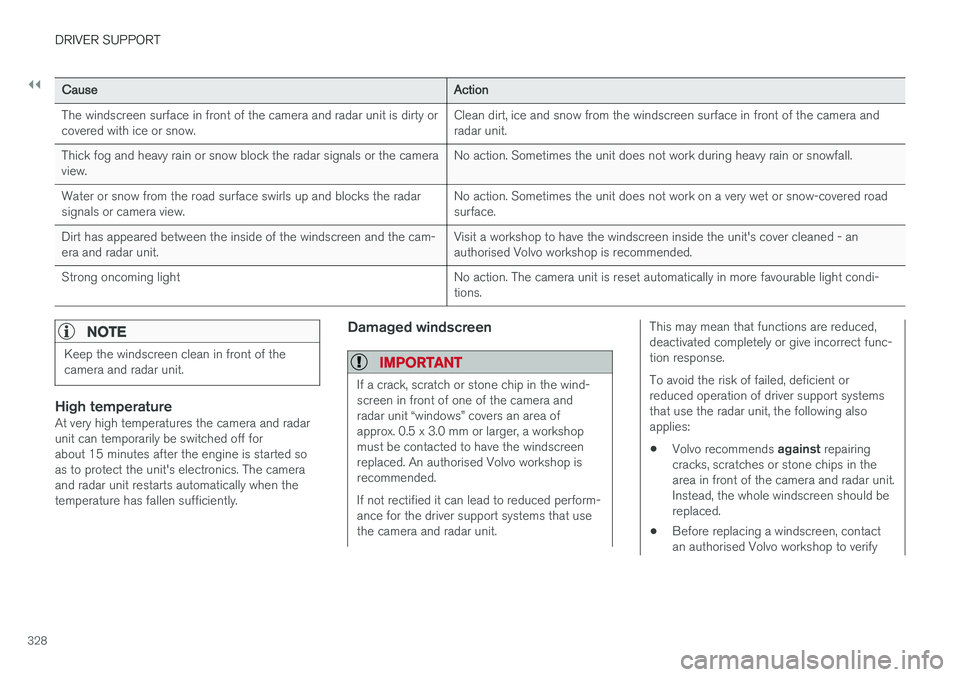
The windscreen surface in front of the camera and radar unit is dirty or covered with ice or snow. Clean dirt, ice and snow from the windscreen surface in front of the camera andradar unit.
Thick fog and heavy rain or snow block the radar signals or the cameraview. No action. Sometimes the unit does not work during heavy rain or snowfall.
Water or snow from the road surface swirls up and blocks the radarsignals or camera view. No action. Sometimes the unit does not work on a very wet or snow-covered roadsurface.
Dirt has appeared between the inside of the windscreen and the cam-era and radar unit. Visit a workshop to have the windscreen inside the unit's cover cleaned - anauthorised Volvo workshop is recommended.
Strong oncoming light No action. The camera unit is reset automatically in more favourable light condi-tions.
NOTE
Keep the windscreen clean in front of the camera and radar unit.
High temperatureAt very high temperatures the camera and radar unit can temporarily be switched off forabout 15 minutes after the engine is started soas to protect the unit's electronics. The cameraand radar unit restarts automatically when thetemperature has fallen sufficiently.
Damaged windscreen
IMPORTANT
If a crack, scratch or stone chip in the wind- screen in front of one of the camera andradar unit “windows” covers an area ofapprox. 0.5 x 3.0 mm or larger, a workshopmust be contacted to have the windscreenreplaced. An authorised Volvo workshop isrecommended. If not rectified it can lead to reduced perform- ance for the driver support systems that usethe camera and radar unit.
This may mean that functions are reduced, deactivated completely or give incorrect func-tion response. To avoid the risk of failed, deficient or reduced operation of driver support systemsthat use the radar unit, the following alsoapplies:
• Volvo recommends
against repairing
cracks, scratches or stone chips in thearea in front of the camera and radar unit.Instead, the whole windscreen should bereplaced.
• Before replacing a windscreen, contactan authorised Volvo workshop to verify