brake VOLVO V90 2017 Repair Manual
[x] Cancel search | Manufacturer: VOLVO, Model Year: 2017, Model line: V90, Model: VOLVO V90 2017Pages: 594, PDF Size: 15.07 MB
Page 411 of 594
STARTING AND DRIVING
* Option/accessory.409
•
Rear Collision Warning (p. 340)
• Blind Spot Information
* (p. 340)
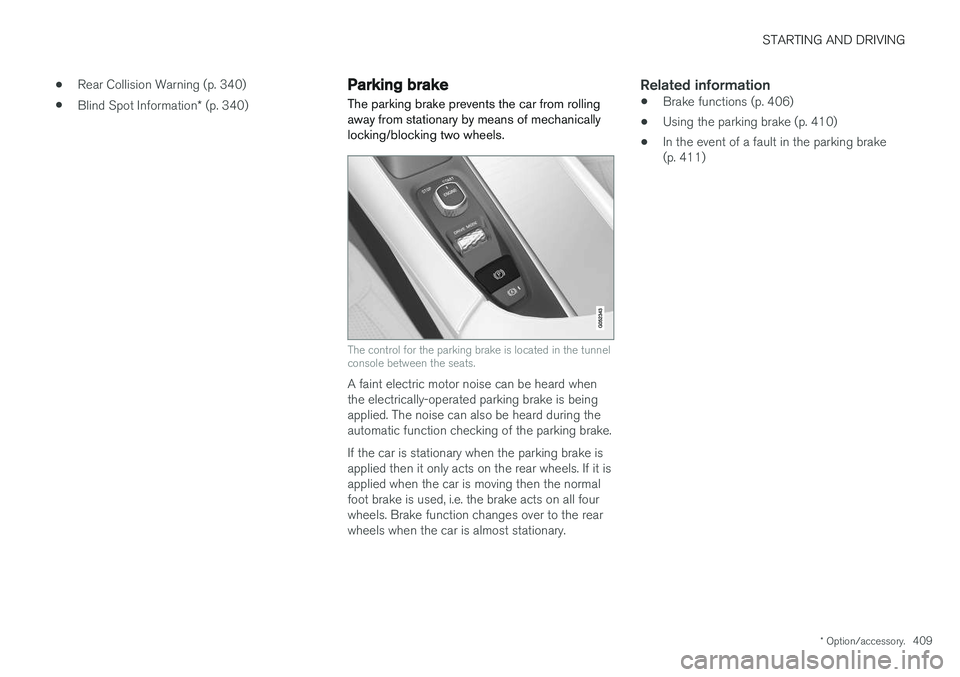
Parking brake The parking brake prevents the car from rolling away from stationary by means of mechanicallylocking/blocking two wheels.
The control for the parking brake is located in the tunnel console between the seats.
A faint electric motor noise can be heard when the electrically-operated parking brake is beingapplied. The noise can also be heard during theautomatic function checking of the parking brake. If the car is stationary when the parking brake is applied then it only acts on the rear wheels. If it isapplied when the car is moving then the normalfoot brake is used, i.e. the brake acts on all fourwheels. Brake function changes over to the rearwheels when the car is almost stationary.
Related information
• Brake functions (p. 406)
• Using the parking brake (p. 410)
• In the event of a fault in the parking brake(p. 411)
Page 412 of 594
STARTING AND DRIVING
410
Using the parking brake
Use the parking brake to prevent the car from rolling from stationary.
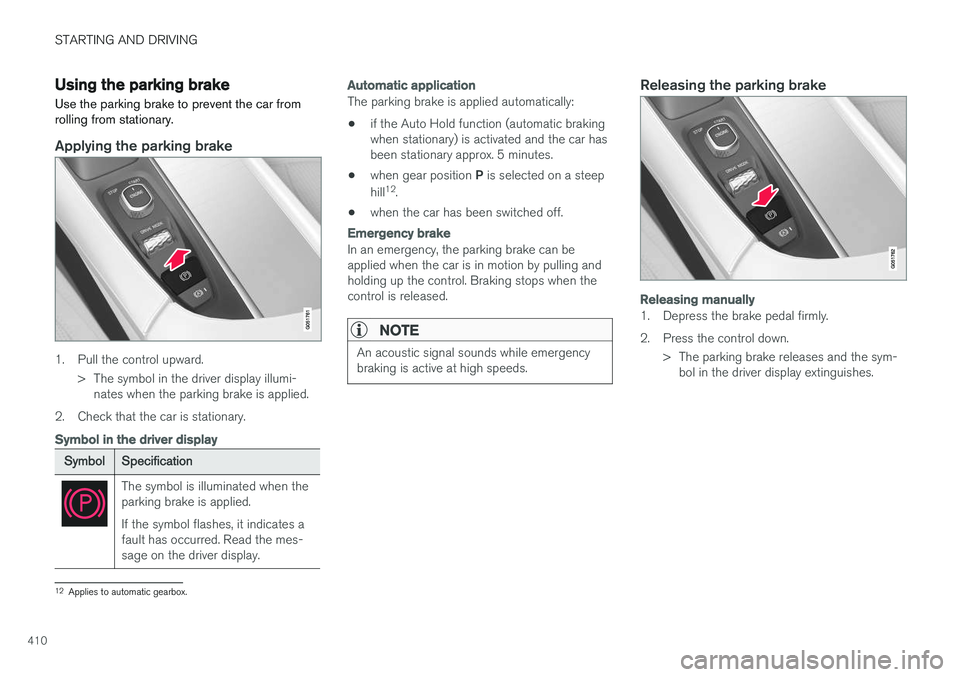
Applying the parking brake
1. Pull the control upward.
> The symbol in the driver display illumi-nates when the parking brake is applied.
2. Check that the car is stationary.
Symbol in the driver display
Symbol Specification
The symbol is illuminated when the parking brake is applied. If the symbol flashes, it indicates a fault has occurred. Read the mes-sage on the driver display.
Automatic application
The parking brake is applied automatically:
• if the Auto Hold function (automatic braking when stationary) is activated and the car hasbeen stationary approx. 5 minutes.
• when gear position
P is selected on a steep
hill 12
.
• when the car has been switched off.
Emergency brake
In an emergency, the parking brake can be applied when the car is in motion by pulling andholding up the control. Braking stops when thecontrol is released.
NOTE
An acoustic signal sounds while emergency braking is active at high speeds.
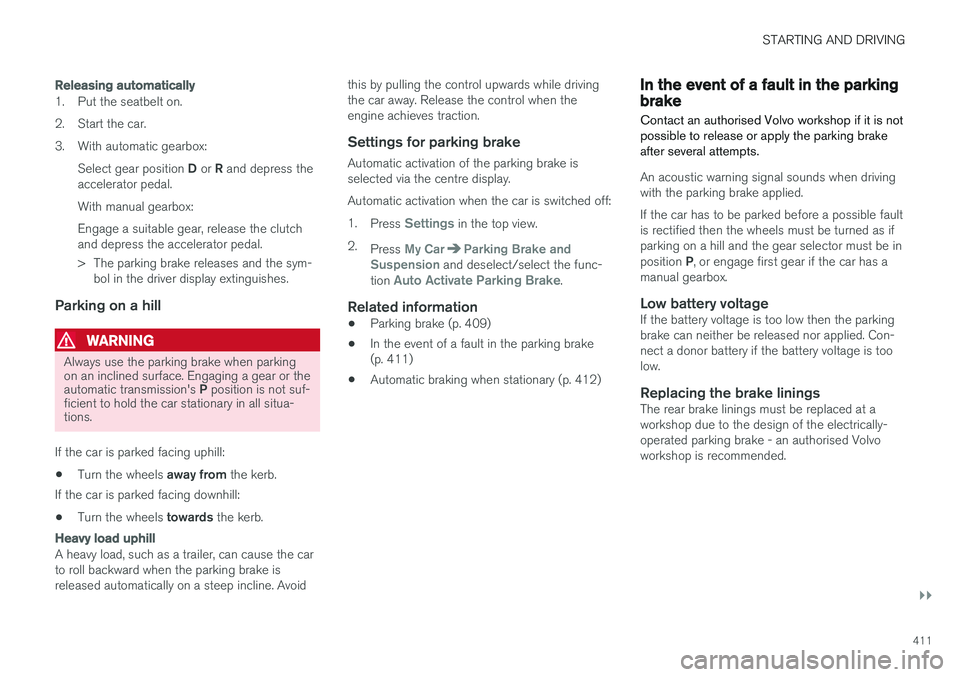
Releasing the parking brake
Releasing manually
1. Depress the brake pedal firmly.
2. Press the control down.
> The parking brake releases and the sym-bol in the driver display extinguishes.
12Applies to automatic gearbox.
Page 413 of 594
STARTING AND DRIVING
}}
411
Releasing automatically
1. Put the seatbelt on.
2. Start the car.
3. With automatic gearbox:Select gear position D or R and depress the
accelerator pedal.With manual gearbox:Engage a suitable gear, release the clutch and depress the accelerator pedal.
> The parking brake releases and the sym- bol in the driver display extinguishes.
Parking on a hill
WARNING
Always use the parking brake when parking on an inclined surface. Engaging a gear or the automatic transmission's P position is not suf-
ficient to hold the car stationary in all situa- tions.
If the car is parked facing uphill: • Turn the wheels
away from the kerb.
If the car is parked facing downhill:
• Turn the wheels
towards the kerb.
Heavy load uphill
A heavy load, such as a trailer, can cause the car to roll backward when the parking brake isreleased automatically on a steep incline. Avoid this by pulling the control upwards while drivingthe car away. Release the control when theengine achieves traction.
Settings for parking brake
Automatic activation of the parking brake isselected via the centre display. Automatic activation when the car is switched off:1.
Press
Settings in the top view.
2. Press
My CarParking Brake and
Suspension and deselect/select the func-
tion Auto Activate Parking Brake.
Related information
• Parking brake (p. 409)
• In the event of a fault in the parking brake (p. 411)
• Automatic braking when stationary (p. 412)
In the event of a fault in the parking brake
Contact an authorised Volvo workshop if it is not possible to release or apply the parking brakeafter several attempts.
An acoustic warning signal sounds when driving with the parking brake applied. If the car has to be parked before a possible fault is rectified then the wheels must be turned as ifparking on a hill and the gear selector must be in position P, or engage first gear if the car has a
manual gearbox.
Low battery voltageIf the battery voltage is too low then the parking brake can neither be released nor applied. Con-nect a donor battery if the battery voltage is toolow.
Replacing the brake liningsThe rear brake linings must be replaced at aworkshop due to the design of the electrically-operated parking brake - an authorised Volvoworkshop is recommended.
Page 414 of 594
||
STARTING AND DRIVING
412
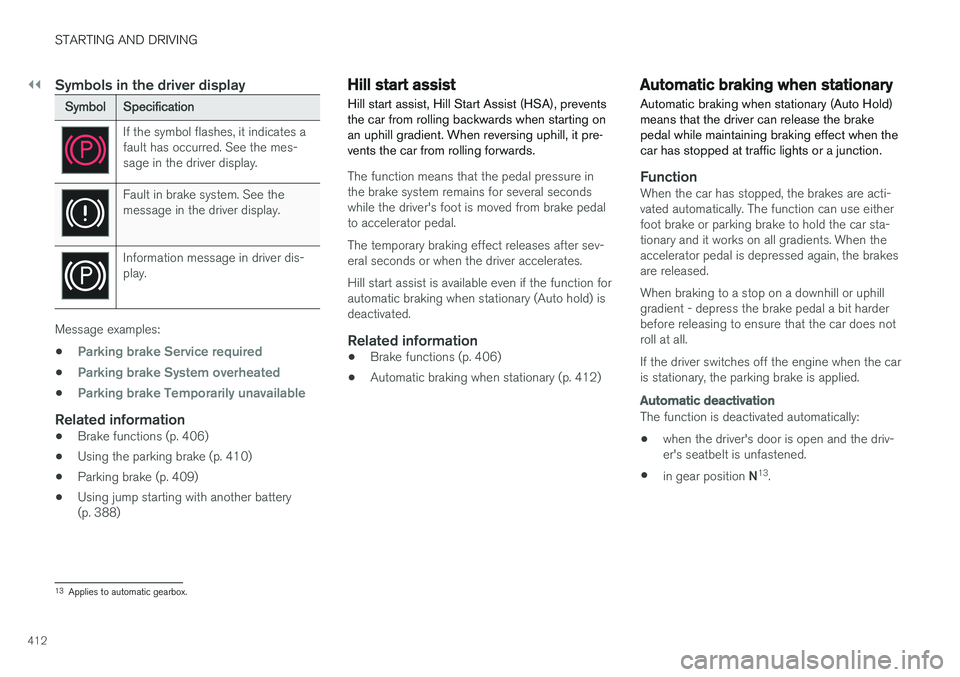
Symbols in the driver display
SymbolSpecification
If the symbol flashes, it indicates a fault has occurred. See the mes-sage in the driver display.
Fault in brake system. See the message in the driver display.
Information message in driver dis- play.
Message examples:
•
Parking brake Service required
•Parking brake System overheated
•Parking brake Temporarily unavailable
Related information
• Brake functions (p. 406)
• Using the parking brake (p. 410)
• Parking brake (p. 409)
• Using jump starting with another battery (p. 388)
Hill start assist
Hill start assist, Hill Start Assist (HSA), prevents the car from rolling backwards when starting onan uphill gradient. When reversing uphill, it pre-vents the car from rolling forwards.
The function means that the pedal pressure in the brake system remains for several secondswhile the driver's foot is moved from brake pedalto accelerator pedal. The temporary braking effect releases after sev- eral seconds or when the driver accelerates. Hill start assist is available even if the function for automatic braking when stationary (Auto hold) isdeactivated.
Related information
• Brake functions (p. 406)
• Automatic braking when stationary (p. 412)
Automatic braking when stationary
Automatic braking when stationary (Auto Hold) means that the driver can release the brakepedal while maintaining braking effect when thecar has stopped at traffic lights or a junction.
FunctionWhen the car has stopped, the brakes are acti- vated automatically. The function can use eitherfoot brake or parking brake to hold the car sta-tionary and it works on all gradients. When theaccelerator pedal is depressed again, the brakesare released. When braking to a stop on a downhill or uphill gradient - depress the brake pedal a bit harderbefore releasing to ensure that the car does notroll at all. If the driver switches off the engine when the car is stationary, the parking brake is applied.
Automatic deactivation
The function is deactivated automatically: • when the driver's door is open and the driv- er's seatbelt is unfastened.
• in gear position
N13
.
13 Applies to automatic gearbox.
Page 415 of 594
STARTING AND DRIVING
}}
413
Switch for automatic brake
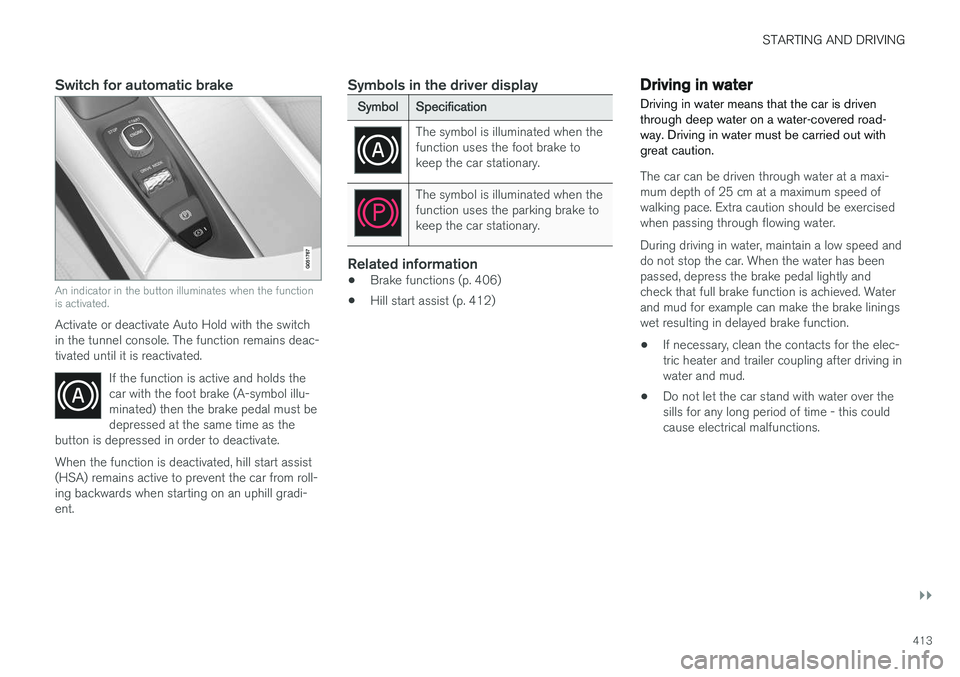
An indicator in the button illuminates when the function is activated.
Activate or deactivate Auto Hold with the switch in the tunnel console. The function remains deac-tivated until it is reactivated.If the function is active and holds thecar with the foot brake (A-symbol illu-minated) then the brake pedal must bedepressed at the same time as the
button is depressed in order to deactivate.
When the function is deactivated, hill start assist (HSA) remains active to prevent the car from roll-ing backwards when starting on an uphill gradi-ent.
Symbols in the driver display
Symbol Specification
The symbol is illuminated when the function uses the foot brake tokeep the car stationary.
The symbol is illuminated when the function uses the parking brake tokeep the car stationary.
Related information
•Brake functions (p. 406)
• Hill start assist (p. 412)
Driving in water Driving in water means that the car is driven through deep water on a water-covered road-way. Driving in water must be carried out withgreat caution.
The car can be driven through water at a maxi- mum depth of 25 cm at a maximum speed ofwalking pace. Extra caution should be exercisedwhen passing through flowing water. During driving in water, maintain a low speed and do not stop the car. When the water has beenpassed, depress the brake pedal lightly andcheck that full brake function is achieved. Waterand mud for example can make the brake liningswet resulting in delayed brake function.
• If necessary, clean the contacts for the elec-tric heater and trailer coupling after driving inwater and mud.
• Do not let the car stand with water over thesills for any long period of time - this couldcause electrical malfunctions.
Page 419 of 594
STARTING AND DRIVING
}}
* Option/accessory.417
•
Drive modes
* (p. 400)
• Foot brake (p. 406)
• All-wheel drive
* (p. 405)
• Electronic stability control (p. 273)
Opening/closing the fuel filler flap and refuelling
The fuel tank is fitted with a coverless fuel filler system.
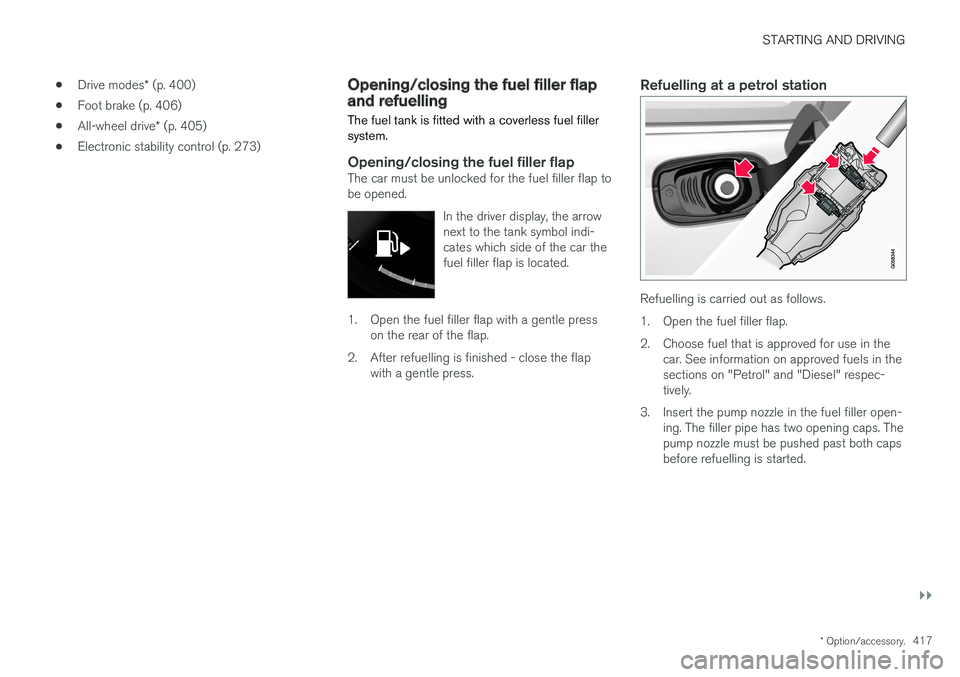
Opening/closing the fuel filler flapThe car must be unlocked for the fuel filler flap to be opened.
In the driver display, the arrownext to the tank symbol indi-cates which side of the car thefuel filler flap is located.
1. Open the fuel filler flap with a gentle presson the rear of the flap.
2. After refuelling is finished - close the flap with a gentle press.
Refuelling at a petrol station
Refuelling is carried out as follows.
1. Open the fuel filler flap.
2. Choose fuel that is approved for use in the car. See information on approved fuels in the sections on "Petrol" and "Diesel" respec-tively.
3. Insert the pump nozzle in the fuel filler open- ing. The filler pipe has two opening caps. Thepump nozzle must be pushed past both capsbefore refuelling is started.
Page 422 of 594
STARTING AND DRIVING
420
Diesel Diesel is a type of engine fuel that is intended for cars with a diesel engine.
Only use diesel fuel from well-known producers. Never use fuel of dubious quality. Diesel fuelmust fulfil the EN 590 or SS 155435 standard.Diesel engines are sensitive to contaminants inthe fuel, such as excessively high volumes of sul-phur and metals. At low temperatures (lower than 0 °C) a paraffin precipitate may form in the diesel fuel, which maylead to ignition problems. The fuel qualities thatare sold must be adapted for season and climatezone, but for extreme weather conditions, old fuelor moving between climate zones, paraffin precip-itate may occur. The risk of condensation in the fuel tank is reduced if the tank is kept well filled. When refuelling, check that the area around the fuel filler pipe is clean. Avoid spilling fuel onto thepaintwork. Wash off any spillage with detergentand water.
IMPORTANT
Diesel fuel must: •fulfil the EN 590 and/or SS 155435 standards
• have a sulphur content not exceeding10 mg/kg
• have a maximum of 7 vol % FAME 15
(B7).
IMPORTANT
Diesel type fuels that must not be used:
• Special additives
• Marine diesel fuel
• Heating oil
• FAME 16
and vegetable oil.
These fuels do not fulfil the requirements in accordance with Volvo recommendations andgenerate increased wear and engine damagethat is not covered by the Volvo warranty.
Related information
• Empty tank and diesel engine (p. 420)
• Diesel particulate filter (p. 421)
Empty tank and diesel engine
Once the engine has stopped due to fuel starva- tion, the fuel system needs a few moments tocarry out a check.
Before starting the engine after the fuel tank has
been filled with diesel - proceed as follows:
1. The remote control key must be inside the car.
2. Set the car in ignition position II - turn the
ignition dial to START without depressing
the brake pedal and hold the knob in the START position for approx. 4 seconds. Then
release the knob, which automatically returns to its starting position.
3. Wait approx. one minute.
4. To start the engine: Depress the brake pedal and turn the ignition dial to START again.
NOTE
Before filling with fuel in the event of fuel shortage:
• Stop the car on as flat/level ground aspossible - if the car is tilting there is a riskof air pockets in the fuel supply.
15
Fatty Acid Methyl Ester
16 Diesel fuel with maximum 7 vol % FAME (B7) is permitted.
Page 424 of 594
STARTING AND DRIVING
* Option/accessory.
422
Economical driving
Drive economically and eco-consciously by driv- ing smoothly, thinking ahead, and adjusting yourdriving style and speed to the prevailing condi-tions.
• For lower fuel consumption, activate ECO drive mode.
• Use the Eco Coast 17
freewheel function -
engine braking will cease and the car'skinetic energy can be used to freewheel forlonger distances.
• Drive in the highest gear 18
possible, adapted
to the current traffic situation and road -lower engine speeds result in lower fuel con-sumption. Use the gear shift indicator.
• Drive at a steady speed and keep a good dis-tance to other vehicles and objects to mini-mise braking.
• High speed results in increased fuel con-sumption - the wind resistance increaseswith speed.
• Do not run the engine to operating tempera-ture at idling speed, but rather drive with anormal load right after starting - a coldengine consumes more fuel than a warmone. •
Drive with the correct air pressure in thetyres and check this regularly - select ECOtyre pressure for best results.
• Choice of tyres can affect fuel consumption -seek advice on suitable tyres from a dealer.
• Remove unnecessary items from the car -the greater the load the higher the consump-tion.
• Use engine braking to slow down, when itcan take place without risk to other roadusers.
• A roof load and space box increase windresistance, leading to higher consumption -remove the load carriers when not in use.
• Avoid driving with open windows.
WARNING
Never switch off the engine while moving, such as downhill, this deactivates importantsystems such as the power steering andbrake servo.
Related information
•
Drive mode ECO (p. 402)
• Approved tyre pressures (p. 574)
• Fuel consumption and CO2 emissions (p. 572)
• Drive-E - cleaner driving pleasure (p. 25)
Towing bracket
*
The car can be equipped with a towing bracket that makes it possible to tow e.g. a trailer afterthe car.
There may be different towing bracket variants available for the car; contact a Volvo dealer formore information. For information on towing capacity and towball load, see the section "Towing capacity and tow-ball load".
IMPORTANT
When the engine is switched off, the constant battery voltage to the trailer connector can beswitched off automatically so as not to drainthe starter battery.
IMPORTANT
The towball needs regular cleaning and lubri- cation with grease in order to prevent wear.
17 See the section "Drive mode ECO".
18 Applies to driving with manual gear changing.
Page 428 of 594
STARTING AND DRIVING
426
Driving with a trailer
When driving with a trailer, there are a number of points that are important to think about regar-ding the towing bracket, the trailer and how theload is positioned in the trailer.
Payload depends on the car's kerb weight. The total of the weight of the passengers and allaccessories, e.g. towbar, reduces the car's pay-load by a corresponding weight. The car is supplied with the necessary equipment for towing a trailer.
• The car's towing bracket must be of anapproved type.
• Distribute the load on the trailer so that theweight on the towing bracket complies withthe specified maximum towball load. Towballload is calculated as part of the car's payload.
• Increase the tyre pressure to the recom-mended pressure for a full load. For moreinformation on tyre pressure, see the section"Approved tyre pressures".
• The engine is loaded more heavily than usualwhen driving with a trailer.
• Do not tow a heavy trailer when the car isbrand new. Wait until it has been driven atleast 1000 km.
• The brakes are loaded much more than usualon long and steep downhill slopes. Downshiftto a lower gear and adjust your speed. •
Follow the regulations in force for the permit-ted speeds and weights.
• Maintain a low speed when driving with atrailer up long, steep ascents.
• The maximum trailer weights given only applyto altitudes up to 1000 metres above sealevel. At higher altitudes, engine power andthus the car's climbing ability is decreaseddue to the reduced air density, and the maxi-mum trailer weight must therefore bereduced. The weight of the car and trailermust be decreased by 10 % for each addi-tional 1000 m (or part thereof).
• Avoid driving with a trailer on inclines of morethan 12%.
NOTE
Extreme weather conditions, driving with a trailer or driving at high altitudes in combina-tion with fuel quality are factors that consider-ably increase the car's fuel consumption.
Trailer connectorAn adapter is required if the car's towing bracket has a 13 pin connector and the trailer has a 7 pinconnector. Use an adapter approved by Volvo.Make sure the cable does not drag on theground.
IMPORTANT
When the engine is switched off, the constant battery voltage to the trailer connector can beswitched off automatically so as not to drainthe starter battery.
Trailer weightsInformation about Volvo's permitted trailer weights is available in the article "Towingcapacity and towball load".
WARNING
Follow the stated recommendations for trailer weights. Otherwise, the car and trailer may bedifficult to control in the event of suddenmovement and braking.
NOTE
The stated maximum permitted trailer weights are those permitted by Volvo. National vehicleregulations can further limit trailer weightsand speeds. Towbars can be certified forhigher towing weights than the car canactually tow.
Direction indicators and brake lights on the trailer
If one or more of the trailer's direction indicators or brake light bulbs is broken, the driver display
Page 429 of 594
STARTING AND DRIVING
* Option/accessory.427
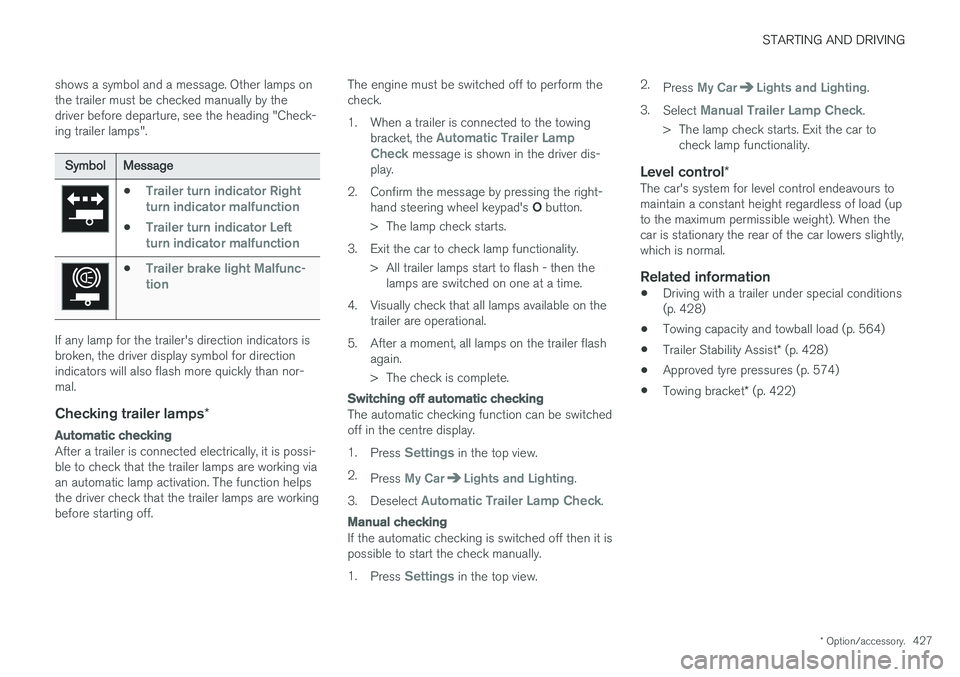
shows a symbol and a message. Other lamps on the trailer must be checked manually by thedriver before departure, see the heading "Check-ing trailer lamps".
Symbol
Message
•Trailer turn indicator Right
turn indicator malfunction
•Trailer turn indicator Left
turn indicator malfunction
•Trailer brake light Malfunc-
tion
If any lamp for the trailer's direction indicators is broken, the driver display symbol for directionindicators will also flash more quickly than nor-mal.
Checking trailer lamps *
Automatic checking
After a trailer is connected electrically, it is possi- ble to check that the trailer lamps are working viaan automatic lamp activation. The function helpsthe driver check that the trailer lamps are workingbefore starting off. The engine must be switched off to perform thecheck.
1. When a trailer is connected to the towing
bracket, the
Automatic Trailer Lamp
Check message is shown in the driver dis-
play.
2. Confirm the message by pressing the right- hand steering wheel keypad's O button.
> The lamp check starts.
3. Exit the car to check lamp functionality. > All trailer lamps start to flash - then thelamps are switched on one at a time.
4. Visually check that all lamps available on the trailer are operational.
5. After a moment, all lamps on the trailer flash again.
> The check is complete.
Switching off automatic checking
The automatic checking function can be switched off in the centre display. 1.Press
Settings in the top view.
2. Press
My CarLights and Lighting.
3. Deselect
Automatic Trailer Lamp Check.
Manual checking
If the automatic checking is switched off then it is possible to start the check manually. 1.Press
Settings in the top view. 2.
Press
My CarLights and Lighting.
3. Select
Manual Trailer Lamp Check.
> The lamp check starts. Exit the car to check lamp functionality.
Level control *The car's system for level control endeavours to maintain a constant height regardless of load (upto the maximum permissible weight). When thecar is stationary the rear of the car lowers slightly,which is normal.
Related information
•Driving with a trailer under special conditions(p. 428)
• Towing capacity and towball load (p. 564)
• Trailer Stability Assist
* (p. 428)
• Approved tyre pressures (p. 574)
• Towing bracket
* (p. 422)