brake VOLVO V90 2017 Manual PDF
[x] Cancel search | Manufacturer: VOLVO, Model Year: 2017, Model line: V90, Model: VOLVO V90 2017Pages: 594, PDF Size: 15.07 MB
Page 430 of 594
STARTING AND DRIVING
* Option/accessory.
428
Driving with a trailer under special conditions
When driving with a trailer in hilly terrain in a hot climate there may be a risk of overheating.
In the event of overheating, a warning symbol illu- minates in the driver display together with a mes-sage, see section "Overheating in the engine anddrive system". The following only applies to cars with automatic gearbox. The automatic gearbox selects the optimum gear related to load and engine speed.
Steep inclinesDo not lock the automatic gearbox in a highergear than the engine "can cope with" - it is notalways a good idea to drive at a high gear withlow engine speed.
Parking on a hill1. Depress the brake pedal fully.
2. Activate the parking brake.3. Select gear position P.
4. Release the brake pedal.Block the wheels with chocks when parking a car with hitched trailer on a hill.
Starting on a hill1. Depress the brake pedal fully. 2.
Select gear position D.
3. Releasing the parking brake.
4. Release the brake pedal and start driving off.
Related information
• Driving with a trailer (p. 426)
• Overheating in the engine and drive system (p. 414)
• Using the parking brake (p. 410)
Trailer Stability Assist
*
The function of the trailer stability assist Trailer Stability Assist (TSA) is to stabilise cars withattached trailers in situations where they begin
Page 431 of 594
STARTING AND DRIVING
429
snaking. The function is included in the stability system ESC19
.
Reasons for snakingThe snaking phenomenon can occur with any car/trailer combination. Snaking normally occursat high speeds. But, there is a risk of it occurringat lower speeds if the trailer is overloaded or theload is improperly distributed, e.g. too far back. In order for snaking to occur, there must be a triggering factor, e.g.: • Car with trailer subjected to a sudden and powerful side wind.
• Car with trailer drives on an uneven road sur-face or in a pothole.
• Sweeping steering wheel movements.
If snaking has started, it could be difficult or evenimpossible to suppress. This makes the car/trailer combination difficult to control and there isa risk that you could, for example, end up in thewrong lane or leave the carriageway.
Trailer Stability Assist functionThe trailer stability assist function continuallymonitors car movements, particularly lateralmovements. If snaking is detected, the frontwheels are individually braked. This serves to sta-bilise the car/trailer combination. This is oftenenough to help the driver regain control of thecar. If snaking is not eliminated the first time thattrailer stability assist comes into action, the car/trailer combination is braked with all wheels andengine power is reduced. Once snaking has beengradually suppressed and the car/trailer combi-nation is stable once again, the system stopsregulating and the driver once again has full con-trol of the car.
NOTE
The stability function is deactivated if the driver selects Sport mode by deactivating
ESC via the menu system in the centre dis-
play.
The trailer stability assist may fail to engage if the driver uses severe steering wheel movements totry to rectify the snaking because in such a situa-tion the system cannot determine whether it isthe trailer or the driver that is causing the snak-ing.
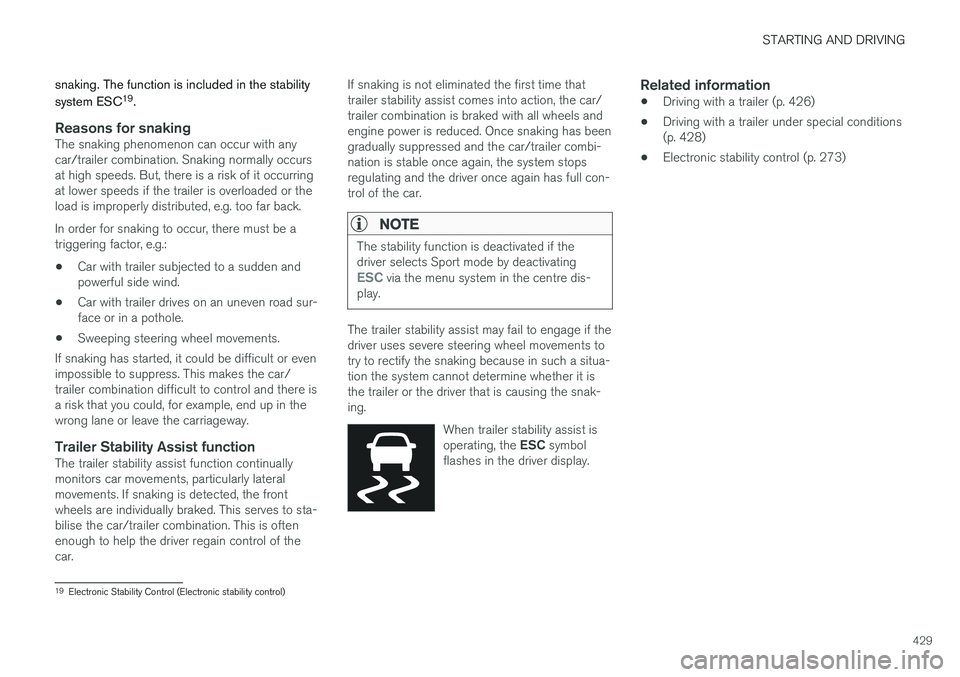
When trailer stability assist is operating, the ESC symbol
flashes in the driver display.
Related information
• Driving with a trailer (p. 426)
• Driving with a trailer under special conditions (p. 428)
• Electronic stability control (p. 273)
19
Electronic Stability Control (Electronic stability control)
Page 433 of 594
STARTING AND DRIVING
}}
431
The towing eye may be used to pull the car up onto a recovery vehicle with a flatbed platform.The car's position and ground clearance deter-mine whether it is possible. If the slope of the recovery vehicle's ramp is too steep, or if the ground clearance under the car isinadequate, then the car may be damaged if youtry to pull it up using the towing eye. If necessary, raise the car by using the recovery vehicle's lifting device. Do not use the towing eye.
WARNING
No one/nothing is allowed to remain behind the recovery vehicle while the car pulled uponto the flatbed platform.
IMPORTANT
The towing eye is only designed for towing on roads -
not for pulling the car unstuck or out
of a ditch. Call a recovery service for recovery assistance.
Related information
• Towing (p. 431)
• Recovering the car (p. 432)
Towing
During towing, one vehicle pulls another vehicle along behind it by means of a towline.
Find out the statutory maximum speed limit for towing before the towing begins.
Preparations and towing1. Activate the car's hazard warning flashers.
2. Secure the towline in the towing eye.
3. Deactivate the steering lock by unlocking the car.
NOTE
In ignition position II the steering lock is
deactivated if the car has been unlocked. See section “Ignition position” for more informa-tion.
4. Set the car in ignition position II by turning
the ignition dial to START and holding the
ignition dial in the START position for
approx. 4 seconds. Then release the knob, which automatically returns to its startingposition.
5. Move the gear selector to neutral position N
and release the parking brake.
> The towing vehicle can now start towing. 6. Keep the towline taut when the towing vehi-
cle reduces speed by holding your foot gen- tly pressed on the brake pedal - therebyavoiding unnecessary jerking.
7. Be prepared to brake to stop.
IMPORTANT
Note that the car must always be towed with the wheels rolling forward. • Do not tow cars with automatic transmis- sion at speeds higher than 80 km/h(50 mph) or for distances in excess of 80km.
WARNING
•Check that the steering lock is unlocked before towing.
• Ignition position
II must be active - in
ignition position I all airbags are deacti-
vated.
• Always keep the remote control key in thecar when it is being towed.
WARNING
The brake servo and power steering do not work when the engine is switched off - thebrake pedal needs to be depressedabout 5 times more heavily and the steering isconsiderably heavier than normal.
Page 497 of 594
WHEELS AND TYRES
}}
* Option/accessory.495
IMPORTANT
Risk of overheating. The compressor must not run for more than 10 minutes.
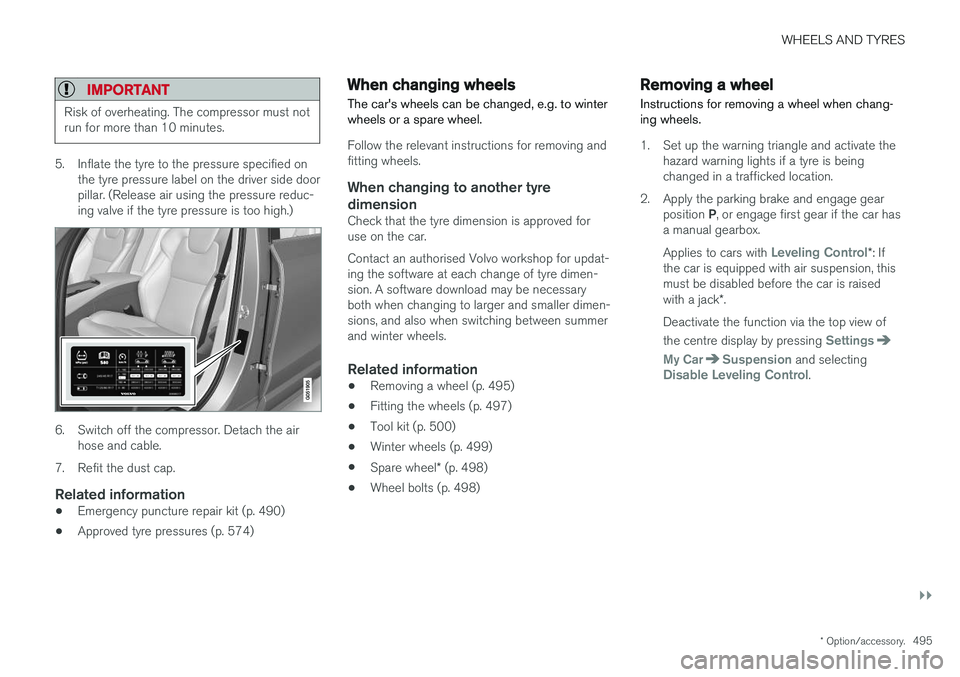
5. Inflate the tyre to the pressure specified on
the tyre pressure label on the driver side door pillar. (Release air using the pressure reduc-ing valve if the tyre pressure is too high.)
6. Switch off the compressor. Detach the airhose and cable.
7. Refit the dust cap.
Related information
• Emergency puncture repair kit (p. 490)
• Approved tyre pressures (p. 574)
When changing wheels
The car's wheels can be changed, e.g. to winter wheels or a spare wheel.
Follow the relevant instructions for removing and fitting wheels.
When changing to another tyre
dimension
Check that the tyre dimension is approved foruse on the car. Contact an authorised Volvo workshop for updat- ing the software at each change of tyre dimen-sion. A software download may be necessaryboth when changing to larger and smaller dimen-sions, and also when switching between summerand winter wheels.
Related information
• Removing a wheel (p. 495)
• Fitting the wheels (p. 497)
• Tool kit (p. 500)
• Winter wheels (p. 499)
• Spare wheel
* (p. 498)
• Wheel bolts (p. 498)
Removing a wheel
Instructions for removing a wheel when chang- ing wheels.
1. Set up the warning triangle and activate the hazard warning lights if a tyre is being changed in a trafficked location.
2. Apply the parking brake and engage gear position P, or engage first gear if the car has
a manual gearbox. Applies to cars with
Leveling Control* : If
the car is equipped with air suspension, this must be disabled before the car is raised with a jack *.
Deactivate the function via the top view of the centre display by pressing
Settings
My CarSuspension and selectingDisable Leveling Control.
Page 517 of 594
MAINTENANCE AND SERVICE
515
Bonnet completely closed.
WARNING
Never drive with an open bonnet! If there are any signs that the bonnet is not properly closed whilst driving, stop immedi-ately and close it.
Related information
•Engine compartment overview (p. 515)
• Door and seatbelt reminder (p. 62)
Engine compartment overview
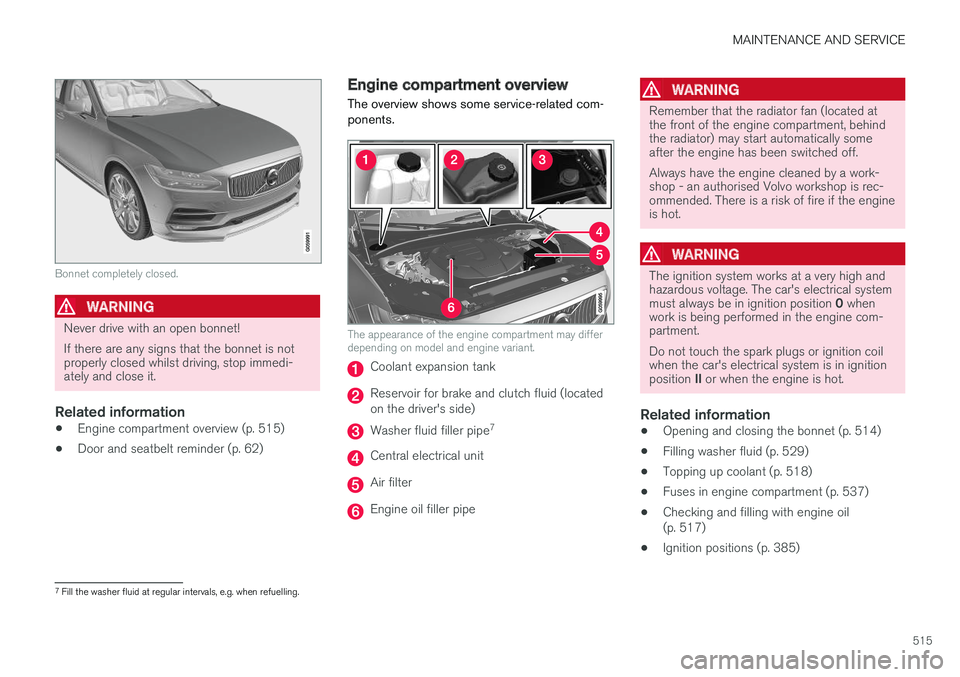
The overview shows some service-related com- ponents.
The appearance of the engine compartment may differ depending on model and engine variant.
Coolant expansion tank
Reservoir for brake and clutch fluid (located on the driver's side)
Washer fluid filler pipe 7
Central electrical unit
Air filter
Engine oil filler pipe
WARNING
Remember that the radiator fan (located at the front of the engine compartment, behindthe radiator) may start automatically someafter the engine has been switched off. Always have the engine cleaned by a work- shop - an authorised Volvo workshop is rec-ommended. There is a risk of fire if the engineis hot.
WARNING
The ignition system works at a very high and hazardous voltage. The car's electrical system must always be in ignition position
0 when
work is being performed in the engine com- partment. Do not touch the spark plugs or ignition coil when the car's electrical system is in ignition position II or when the engine is hot.
Related information
• Opening and closing the bonnet (p. 514)
• Filling washer fluid (p. 529)
• Topping up coolant (p. 518)
• Fuses in engine compartment (p. 537)
• Checking and filling with engine oil (p. 517)
• Ignition positions (p. 385)
7
Fill the washer fluid at regular intervals, e.g. when refuelling.
Page 524 of 594
||
MAINTENANCE AND SERVICE
522
Lamps, rear
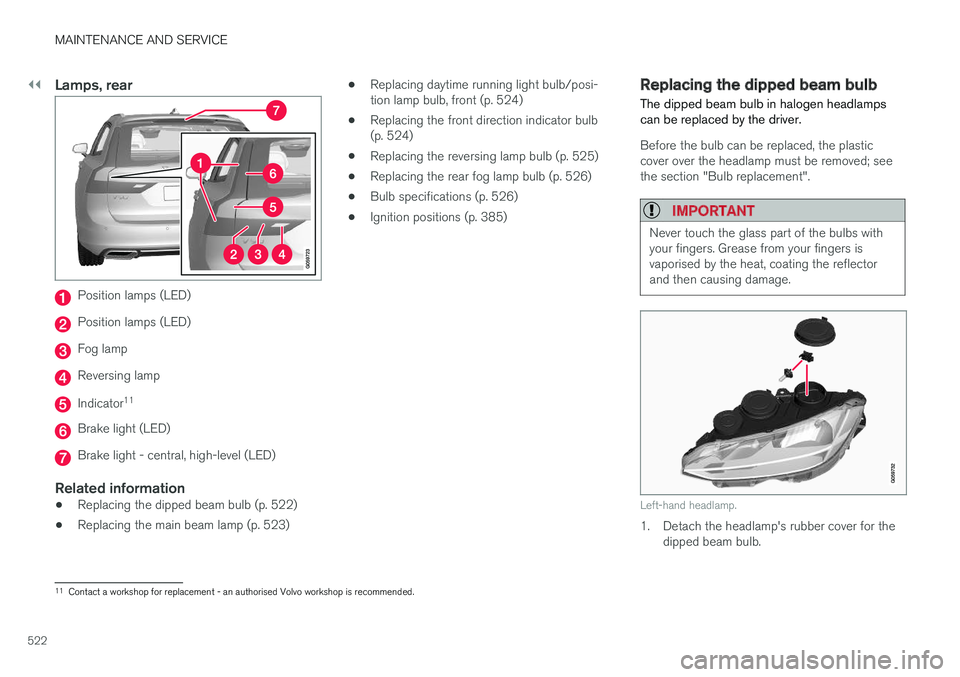
Position lamps (LED)
Position lamps (LED)
Fog lamp
Reversing lamp
Indicator11
Brake light (LED)
Brake light - central, high-level (LED)
Related information
•
Replacing the dipped beam bulb (p. 522)
• Replacing the main beam lamp (p. 523) •
Replacing daytime running light bulb/posi- tion lamp bulb, front (p. 524)
• Replacing the front direction indicator bulb(p. 524)
• Replacing the reversing lamp bulb (p. 525)
• Replacing the rear fog lamp bulb (p. 526)
• Bulb specifications (p. 526)
• Ignition positions (p. 385)
Replacing the dipped beam bulb
The dipped beam bulb in halogen headlamps can be replaced by the driver.
Before the bulb can be replaced, the plastic cover over the headlamp must be removed; seethe section "Bulb replacement".
IMPORTANT
Never touch the glass part of the bulbs with your fingers. Grease from your fingers isvaporised by the heat, coating the reflectorand then causing damage.
Left-hand headlamp.
1. Detach the headlamp's rubber cover for the dipped beam bulb.
11Contact a workshop for replacement - an authorised Volvo workshop is recommended.
Page 536 of 594
||
MAINTENANCE AND SERVICE
534
Size , L×W×H (mm) 150×90×130
Capacity (Ah) 10
AAccording to EN standard.
B Cold Cranking Amperes.
IMPORTANT
When replacing the starter battery or support battery, a battery of AGM 15
type must be fit-
ted.
NOTE
• The higher the current take-off in the car, the more the alternator must be workingand the batteries charging = Increasedfuel consumption.
• When the capacity of the starter batteryhas fallen below the lowest permissiblelevel then the Start/Stop function is dis-engaged.
Temporarily reduced Start/Stop function due to high current take-off means: •
The engine starts automatically 16
without the
driver depressing the clutch pedal (manualgearbox).
• The engine starts automatically without thedriver lifting his/her foot off the foot brakepedal (automatic gearbox).
The support battery normally requires no moreservice than the normal starter battery. A work-shop should be contacted in the event of ques-tions or problems - an authorised Volvo workshopis recommended.
IMPORTANT
If the following instruction is not observed then the Start/Stop function may temporarilycease to work after the connection of anexternal starter battery or battery charger:
• The negative battery terminal on the car's starter battery must
never be used for
connecting an external starter battery orbattery charger - only the car's negative
charging point may be used as the
grounding point.
NOTE
If the starter battery has been discharged so much that the car has no normal electricalfunctions and the engine is then jump-startedwith an external battery or a battery charger,the Start/Stop function will continue to beactivated. If the Start/Stop function thenauto-stops the engine shortly after, there is agreat risk that engine auto-start will fail dueto insufficient battery capacity, because thebattery has not had the opportunity torecharge. If the car has been jump-started, or if there is insufficient time to charge the battery with abattery charger, the recommendation is totemporarily deactivate the Start/Stop functionuntil the battery has been recharged by thecar. In an outside temperature of +15 °C, thebattery needs to be charged for at least1 hour by the car. In a lower outside tempera-ture, the charging time may increase to3-4 hours. The recommendation is to chargethe battery using an external battery charger.
Related information
• Starter battery (p. 530)
• Start/Stop (p. 396)
15
Absorbed Glass Mat.
16 Automatic starting can only take place if the gear lever is in neutral position.
Page 539 of 594
MAINTENANCE AND SERVICE
}}
537
Fuses in engine compartment
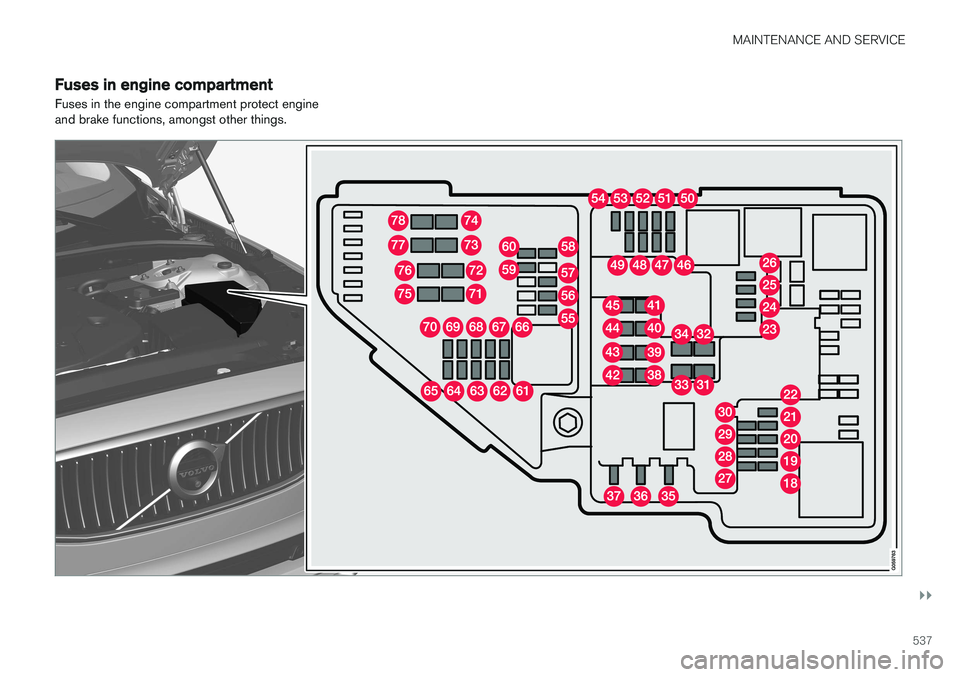
Fuses in the engine compartment protect engine and brake functions, amongst other things.
Page 541 of 594
MAINTENANCE AND SERVICE
}}
* Option/accessory.539
•
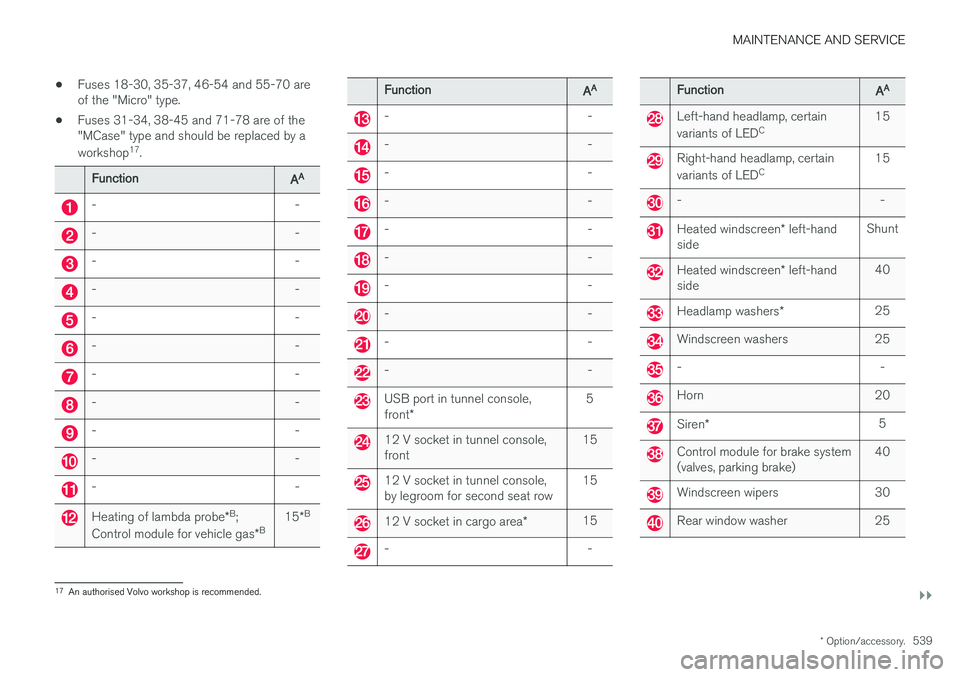
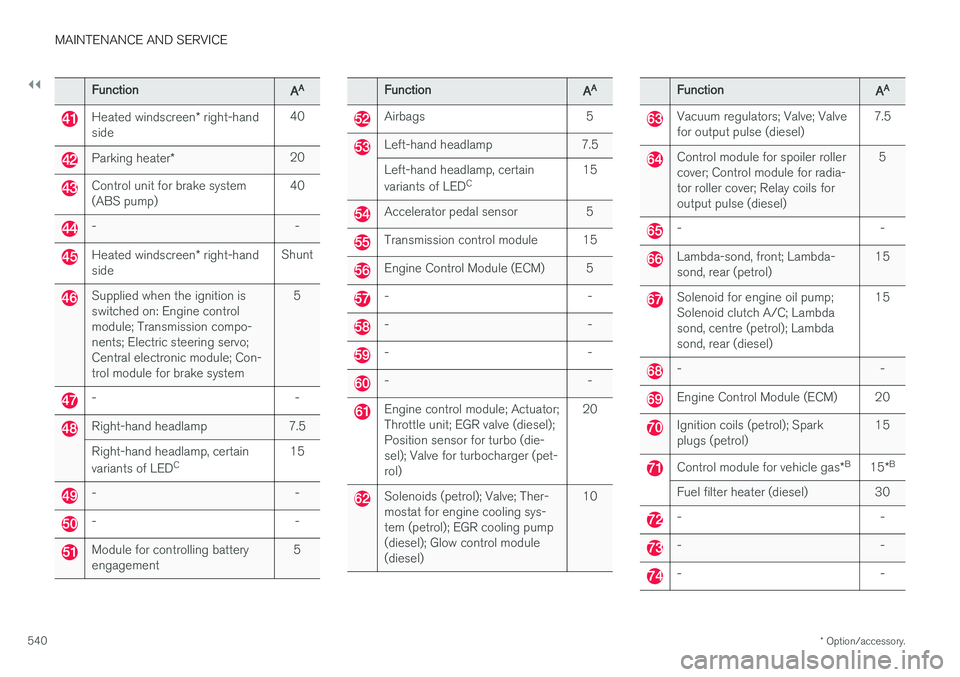
Fuses 18-30, 35-37, 46-54 and 55-70 are of the "Micro" type.
• Fuses 31-34, 38-45 and 71-78 are of the"MCase" type and should be replaced by a workshop 17
.
Function AA
- -
- -
- -
- -
- -
- -
- -
- -
- -
- -
- -
Heating of lambda probe
*B
;
Control module for vehicle gas *B 15
*B
Function
AA
- -
- -
- -
- -
- -
- -
- -
- -
- -
- -
USB port in tunnel console, front
* 5
12 V socket in tunnel console, front
15
12 V socket in tunnel console, by legroom for second seat row15
12 V socket in cargo area
*15
- -
Function
AA
Left-hand headlamp, certain variants of LED C 15
Right-hand headlamp, certain variants of LED
C 15
- -
Heated windscreen
* left-hand
side Shunt
Heated windscreen
* left-hand
side 40
Headlamp washers
*25
Windscreen washers 25
- -
Horn 20
Siren
* 5
Control module for brake system (valves, parking brake) 40
Windscreen wipers 30
Rear window washer 25
17
An authorised Volvo workshop is recommended.
Page 542 of 594
||
MAINTENANCE AND SERVICE
* Option/accessory.
540
Function
AA
Heated windscreen
* right-hand
side 40
Parking heater
* 20
Control unit for brake system (ABS pump) 40
- -
Heated windscreen
* right-hand
side Shunt
Supplied when the ignition is switched on: Engine controlmodule; Transmission compo-nents; Electric steering servo;Central electronic module; Con-trol module for brake system 5
- -
Right-hand headlamp 7.5 Right-hand headlamp, certain variants of LED
C 15
- -
- -
Module for controlling battery engagement 5
Function
AA
Airbags 5
Left-hand headlamp 7.5 Left-hand headlamp, certain variants of LED C 15
Accelerator pedal sensor 5
Transmission control module 15
Engine Control Module (ECM) 5
- -
- -
- -
- -
Engine control module; Actuator; Throttle unit; EGR valve (diesel);Position sensor for turbo (die-sel); Valve for turbocharger (pet-rol) 20
Solenoids (petrol); Valve; Ther- mostat for engine cooling sys-tem (petrol); EGR cooling pump(diesel); Glow control module(diesel)10
Function
AA
Vacuum regulators; Valve; Valve for output pulse (diesel) 7.5
Control module for spoiler roller cover; Control module for radia-tor roller cover; Relay coils foroutput pulse (diesel) 5
- -
Lambda-sond, front; Lambda- sond, rear (petrol)
15
Solenoid for engine oil pump; Solenoid clutch A/C; Lambdasond, centre (petrol); Lambdasond, rear (diesel)15
- -
Engine Control Module (ECM) 20
Ignition coils (petrol); Spark plugs (petrol)
15
Control module for vehicle gas
*B
15*B
Fuel filter heater (diesel) 30
- -
- -
- -