steering VOLVO XC60 2009 Owner´s Manual
[x] Cancel search | Manufacturer: VOLVO, Model Year: 2009, Model line: XC60, Model: VOLVO XC60 2009Pages: 297, PDF Size: 21.16 MB
Page 233 of 297
06 Maintenance and specifications
Fluids06
231
The brake fluid should always be between the
MIN and MAX marks on the inside of the res-
ervoir. Check, without removing the cap, that
there is sufficient fluid in the reservoir.
Fluid type: DOT 4+ boiling point >536 °F
(280 °C), P/N 9437433
Replace: The fluid should be replaced accord-
ing to the intervals specified in the Warranty
and Service Records Information booklet.
When driving under extremely hard conditions
(mountain driving, etc), it may be necessary to
replace the fluid more often. Consult a trained
and qualified Volvo service technician.
Always entrust brake fluid changing to a
trained and qualified Volvo service technician.
WARNING
If the fluid level is below the MIN mark in the
reservoir or if a brake-related message is
shown in the information display:
DO NOT
DRIVE. Have the car towed to a trained and
qualified Volvo service technician and have
the brake system inspected.
Filling1. Turn and open the cover.
2. Unscrew the reservoir cap and fill the fluid.
The level must be between the MIN and
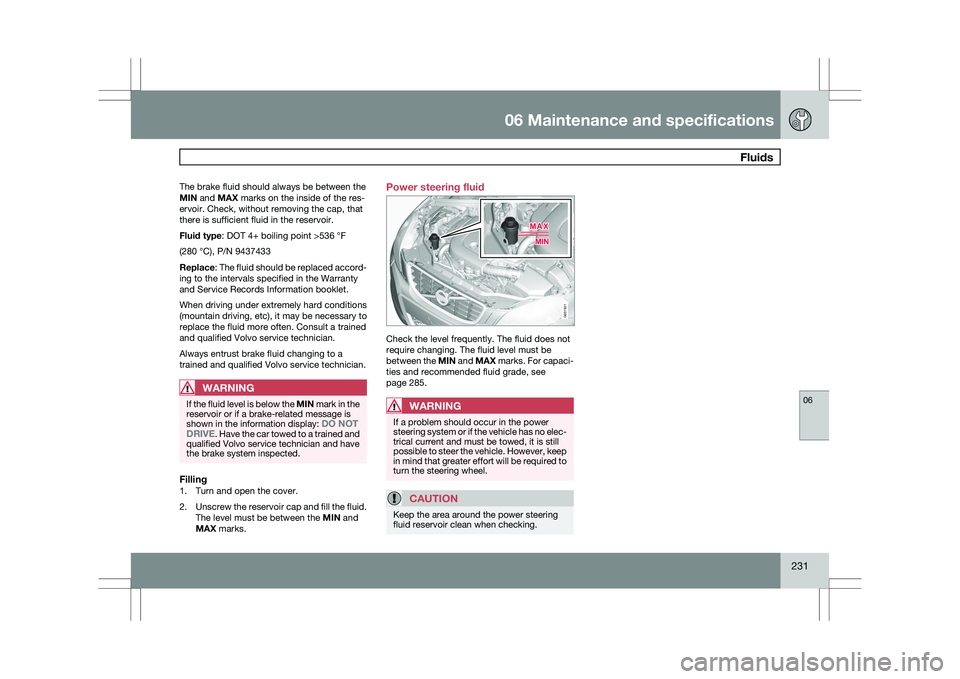
MAX marks. Power steering fluid
Check the level frequently. The fluid does not
require changing. The fluid level must be
between the MIN and MAX marks. For capaci-
ties and recommended fluid grade, see
page 285.
WARNING
If a problem should occur in the power
steering system or if the vehicle has no elec-
trical current and must be towed, it is still
possible to steer the vehicle. However, keep
in mind that greater effort will be required to
turn the steering wheel.
CAUTION
Keep the area around the power steering
fluid reservoir clean when checking. G031921
Page 242 of 297
06 Maintenance and specificationsWiper blades and washer fluid 06
240 Wiper blades
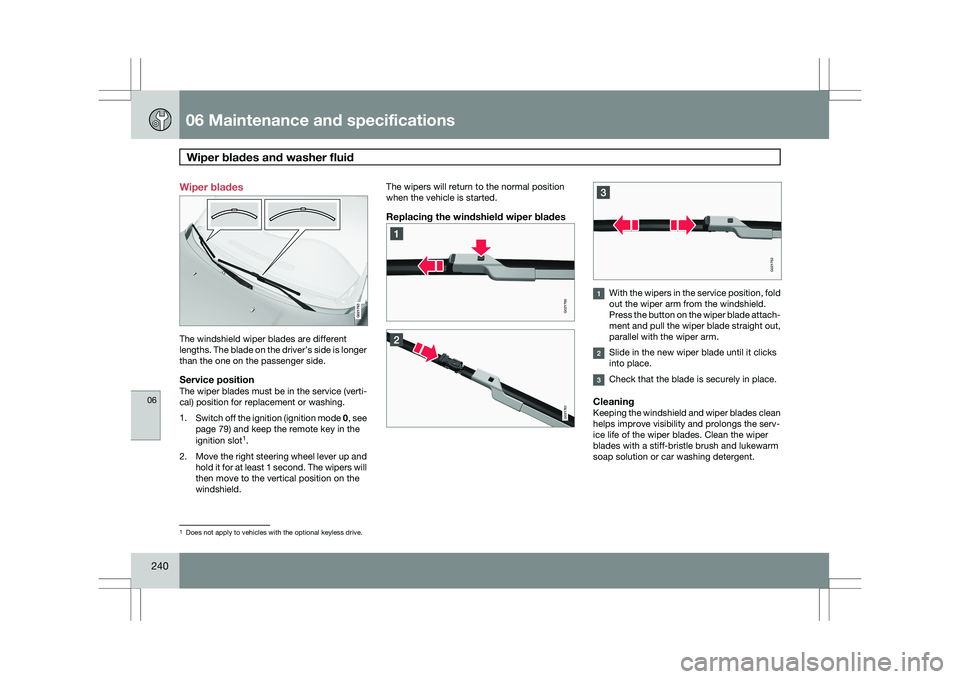
The windshield wiper blades are different
lengths. The blade on the driver’s side is longer
than the one on the passenger side.
Service positionThe wiper blades must be in the service (verti-
cal) position for replacement or washing.
1.
Switch off the ignition (ignition mode 0, see
page 79) and keep the remote key in the
ignition slot 1
.
2. Move the right steering wheel lever up and
hold it for at least 1 second. The wipers will
then move to the vertical position on the
windshield. The wipers will return to the normal position
when the vehicle is started.
Replacing the windshield wiper blades
With the wipers in the service position, fold
out the wiper arm from the windshield.
Press the button on the wiper blade attach-
ment and pull the wiper blade straight out,
parallel with the wiper arm.
Slide in the new wiper blade until it clicks
into place.
Check that the blade is securely in place.
CleaningKeeping the windshield and wiper blades clean
helps improve visibility and prolongs the serv-
ice life of the wiper blades. Clean the wiper
blades with a stiff-bristle brush and lukewarm
soap solution or car washing detergent.
1
Does not apply to vehicles with the optional keyless drive. G021763 G021760 G021761 G021762
Page 249 of 297
06 Maintenance and specifications
Fuses06
}}
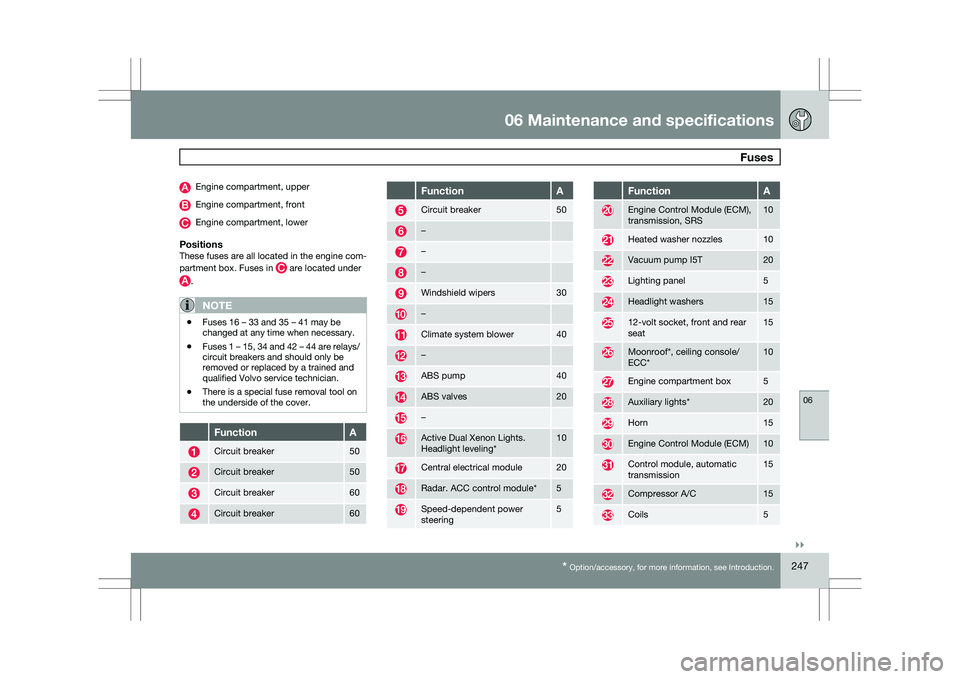
* Option/accessory, for more information, see Introduction. 247Engine compartment, upper
Engine compartment, front
Engine compartment, lower
PositionsThese fuses are all located in the engine com-
partment box. Fuses in
are located under
.
NOTE
\b
Fuses 16 – 33 and 35 – 41 may be
changed at any time when necessary.
\b Fuses 1 – 15, 34 and 42 – 44 are relays/
circuit breakers and should only be
removed or replaced by a trained and
qualified Volvo service technician.
\b There is a special fuse removal tool on
the underside of the cover. Function A
Circuit breaker 50
Circuit breaker 50
Circuit breaker 60
Circuit breaker 60 Function A
Circuit breaker 50
–
–
–
Windshield wipers 30
–
Climate system blower 40
–
ABS pump 40
ABS valves 20
–
Active Dual Xenon Lights.
Headlight leveling
* 10
Central electrical module 20
Radar. ACC control module* 5
Speed-dependent power
steering 5 Function A
Engine Control Module (ECM),
transmission, SRS 10
Heated washer nozzles 10
Vacuum pump I5T 20
Lighting panel 5
Headlight washers 15
12-volt socket, front and rear
seat 15
Moonroof*, ceiling console/
ECC* 10
Engine compartment box 5
Auxiliary lights* 20
Horn 15
Engine Control Module (ECM) 10
Control module, automatic
transmission 15
Compressor A/C 15
Coils 5
Page 251 of 297
06 Maintenance and specifications
Fuses06
}}
* Option/accessory, for more information, see Introduction. 249
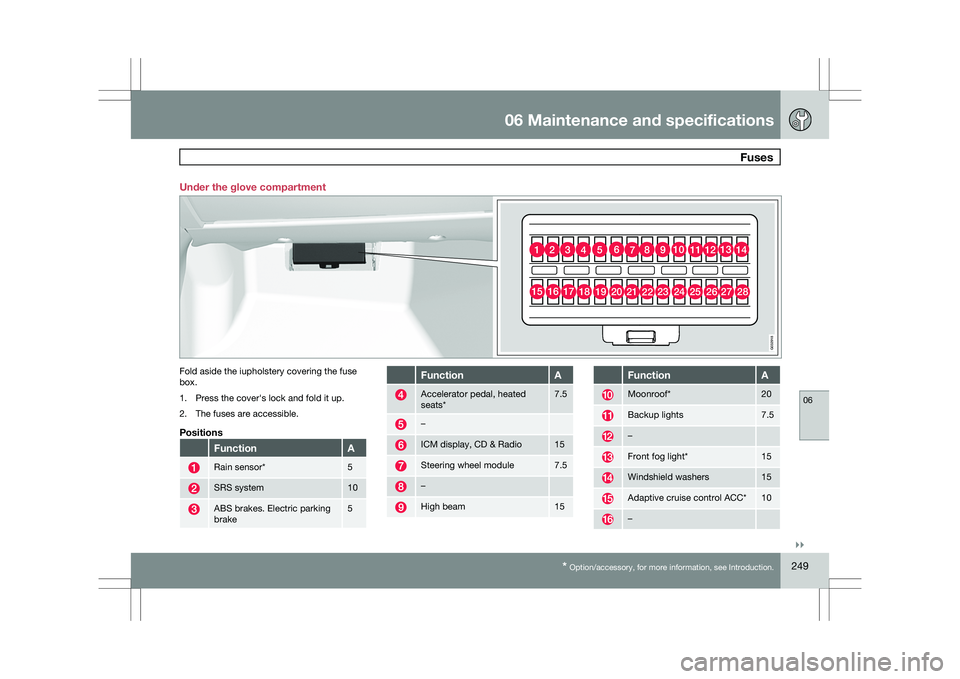
Under the glove compartment
Fold aside the iupholstery covering the fuse
box.
1. Press the cover\fs lock and fold it up.
2. The fuses are accessible.
Positions
Function A
Rain sensor* 5
SRS system 10
ABS brakes. Electric parking
brake 5 Function A
Accelerator pedal, heated
seats* 7.5
–
ICM display, CD & Radio 15
Steering wheel module 7.5
–
High beam 15 Function A
Moonroof* 20
Backup lights 7.5
–
Front fog light* 15
Windshield washers 15
Adaptive cruise control ACC* 10
– 1011121314123456789
2322212019181716152425262728
G032918
Page 252 of 297
06 Maintenance and specificationsFuses 06
250
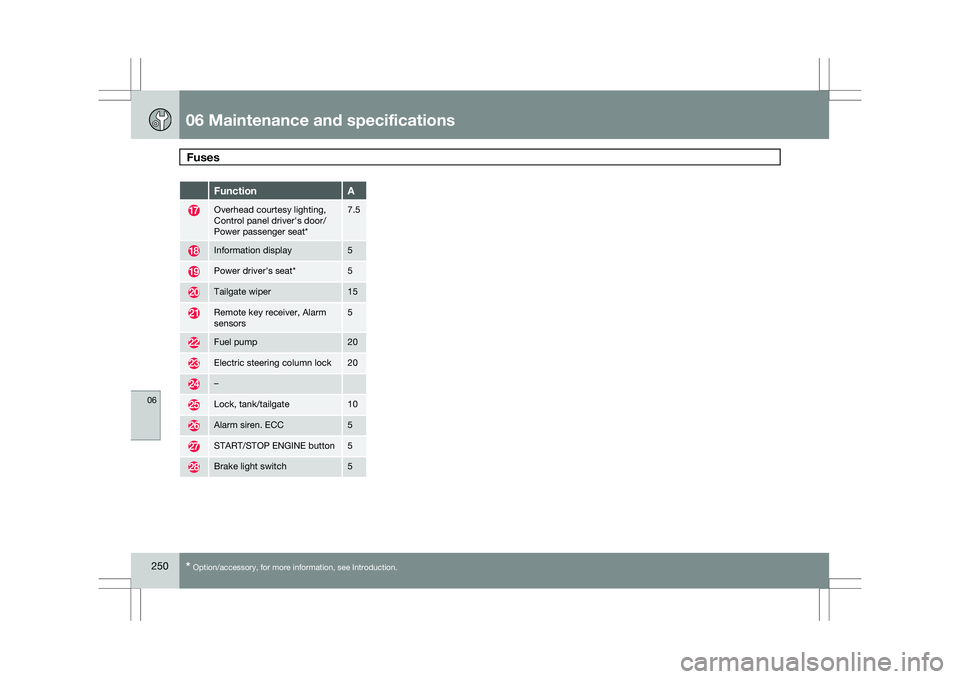
* Option/accessory, for more information, see Introduction. Function A
Overhead courtesy lighting,
Control panel driver\fs door/
Power passenger seat* 7.5
Information display 5
Power driver\fs seat* 5
Tailgate wiper 15
Remote key receiver, Alarm
sensors 5
Fuel pump 20
Electric steering column lock 20
–
Lock, tank/tailgate 10
Alarm siren. ECC 5
START/STOP ENGINE button 5
Brake light switch 5
Page 269 of 297
06 Maintenance and specifications
Wheels and tires06
}}
267
Accessing the tire sealing systemThe tire sealing system is stowed under the
floor of the cargo area. To access it:
1.
Fold up or remove any protective floor cov-
ering or carpet.
2. Open the floor hatch.
3. Remove the retaining screws.
4. Lift out the foam plastic block holding the jack and lug wrench.
5. Lift out the tire sealing system.
NOTE \b
The tire sealing system is only intended
to seal holes on the tire’s tread area, not
the sidewall.
\b Tires with large holes or tears cannot be
repaired with the tire sealing system.
WARNING \b
After using the tire sealing system, the
vehicle should not be driven farther than
approximately 120 miles (200 km).
\b Have the tire inspected by a trained and
qualified Volvo service technician as
soon as possible to determine if it can
be permanently repaired or must be
replaced.
\b The vehicle should not be driven faster
than 50 mph (80 km/h) while using a tire
that has been temporarily repaired with
the tire sealing system.
\b After using the tire sealing system, drive
carefully and avoid abrupt steering
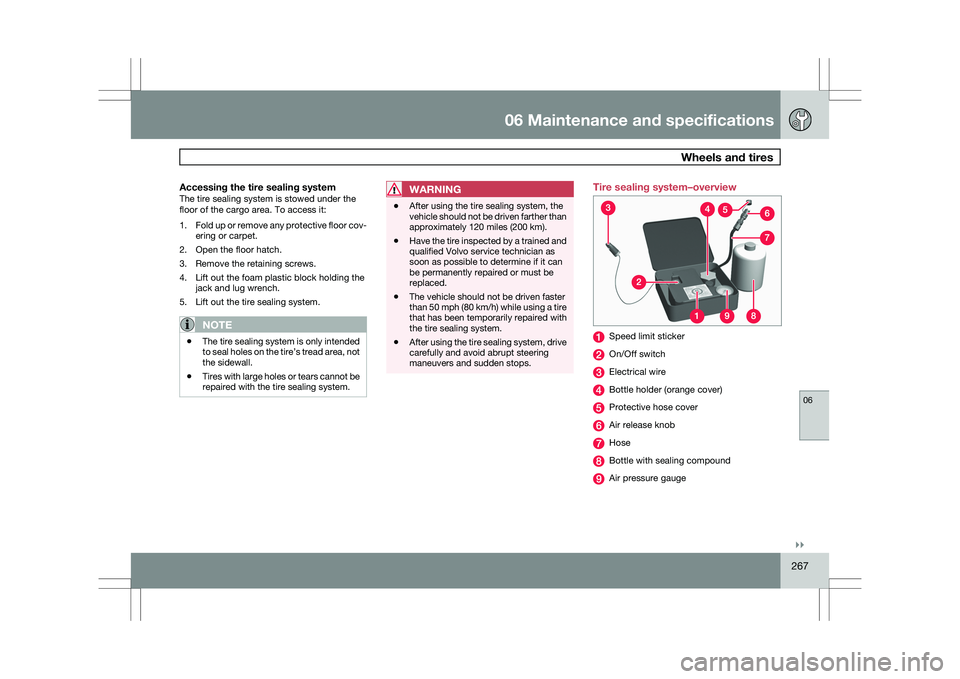
maneuvers and sudden stops. Tire sealing system–overview
Speed limit sticker
On/Off switch
Electrical wire
Bottle holder (orange cover)
Protective hose cover
Air release knob
Hose
Bottle with sealing compound
Air pressure gauge
Page 270 of 297
06 Maintenance and specificationsWheels and tires 06
268
WARNING Please keep the following points in mind
when using the tire sealing system:
\b
The sealing compound bottle (no. 8 in
the illustration) contains 1.2-Ethanol
and natural rubber-latex. These sub-
stances are harmful if swallowed.
\b The contents of this bottle may cause
allergic skin reactions or otherwise be
potentially harmful to the skin, the cen-
tral nervous system, and the eyes.
Precautions:
\b Keep out of reach of children.
\b Do not ingest the contents.
\b Avoid prolonged or repeated contact
with the skin.
\b Hands should be washed thoroughly
after handling.
First aid:
\b Skin: Wash affected areas of skin with
soap and water. Get medical attention
if symptoms occur.
\b Eyes: Flush with plenty of water for least
15 minutes, occasionally lifting the
upper and lower eyelids. Get medical
attention if symptoms occur. \b
Inhalation: Move the person to fresh air.
If irritation persists, get medical atten-
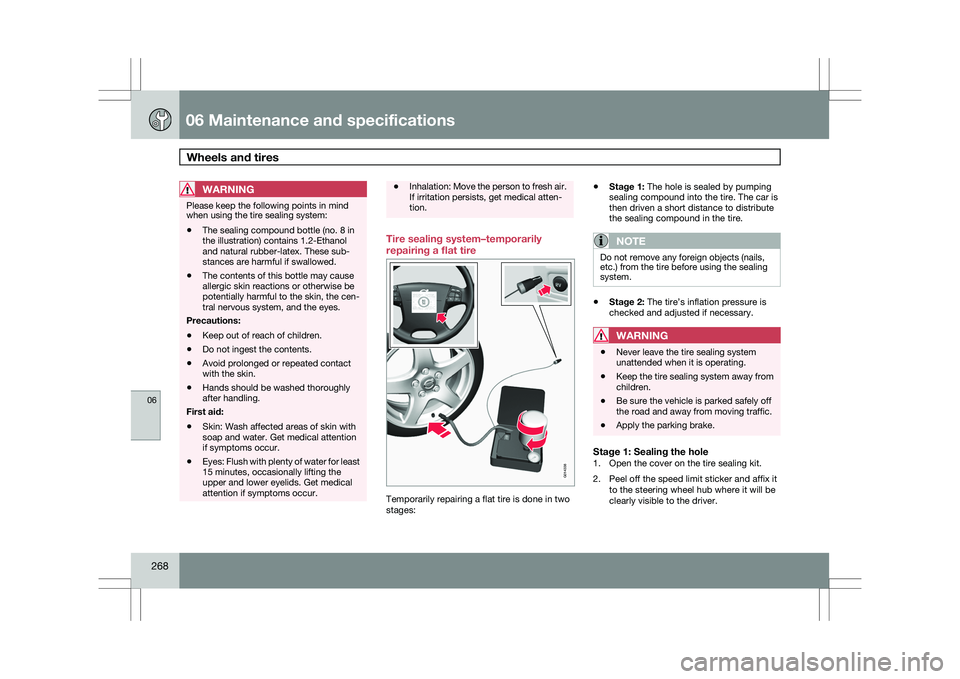
tion. Tire sealing system–temporarily
repairing a flat tire
Temporarily repairing a flat tire is done in two
stages:\b
Stage 1: The hole is sealed by pumping
sealing compound into the tire. The car is
then driven a short distance to distribute
the sealing compound in the tire.
NOTE Do not remove any foreign objects (nails,
etc.) from the tire before using the sealing
system.
\b
Stage 2: The tire’s inflation pressure is
checked and adjusted if necessary.
WARNING \b
Never leave the tire sealing system
unattended when it is operating.
\b Keep the tire sealing system away from
children.
\b Be sure the vehicle is parked safely off
the road and away from moving traffic.
\b Apply the parking brake.
Stage 1: Sealing the hole1. Open the cover on the tire sealing kit.
2. Peel off the speed limit sticker and affix it
to the steering wheel hub where it will be
clearly visible to the driver. G01433
8
Page 272 of 297
06 Maintenance and specificationsWheels and tires 06
270
CAUTION The compressor should not be used for
more than 10 minutes at a time to avoid
overheating.
WARNING
If the pressure remains below 22 psi
(1.8 bar) after approximately seven minutes,
turn off the compressor. In this case, the
hole is too large to be sealed and the vehicle
should not be driven.
11.
Switch off the compressor and disconnect
the electrical wire from the 12-volt
socket.
12. Unscrew the hose from the tire’s inflation valve and reinstall the valve cap.
13. Immediately drive the vehicle for approxi- mately 2 miles (3 km) at a maximum speed
of 50 mph (80 km/h) to distribute the seal-
ing compound in the tire.
NOTE \b
Safely stow the tire sealing system in a
convenient place as it will soon be used
again to check the tire’s inflation pres-
sure.
\b The empty bottle of sealing compound
cannot be removed from the bottle
holder. Consult a trained and qualified
Volvo service technician to have the
bottle removed and properly disposed
of.
WARNING If heavy vibrations, unsteady steering
behavior, or noises should occur while driv-
ing, reduce speed and park the vehicle in a
safe place. Recheck the tire for bumps,
cracks, or other visible damage, and
recheck its inflation pressure. If the pressure
is below 19 psi (1.3 bar), do not continue
driving. Have the vehicle towed to a trained
and qualified Volvo service technician.
Stage 2: Checking inflation pressure1. Connect the tire sealing system as descri-
bed in stage 1.
2. Refer to the inflation pressure tablesfor the
correct inflation pressure. If the tire needs
to be inflated, start the tire sealing system’s compressor. If necessary, release air from
the tire by turning the air release knob
counterclockwise.
CAUTION The compressor should not be used for
more than 10 minutes at a time to avoid
overheating.
WARNING
If you interrupt your trip for more than 1
hour, check the inflation pressure in the
damaged tire again before continuing.
Replacing the sealing compound
container
The sealing compound container must be
replaced if:
\b
the tire sealing system has been used to
repair a tire
\b the container’s expiration date has passed
(see the date on decal).
Page 287 of 297
06 Maintenance and specifications
Specifications06
}}
285
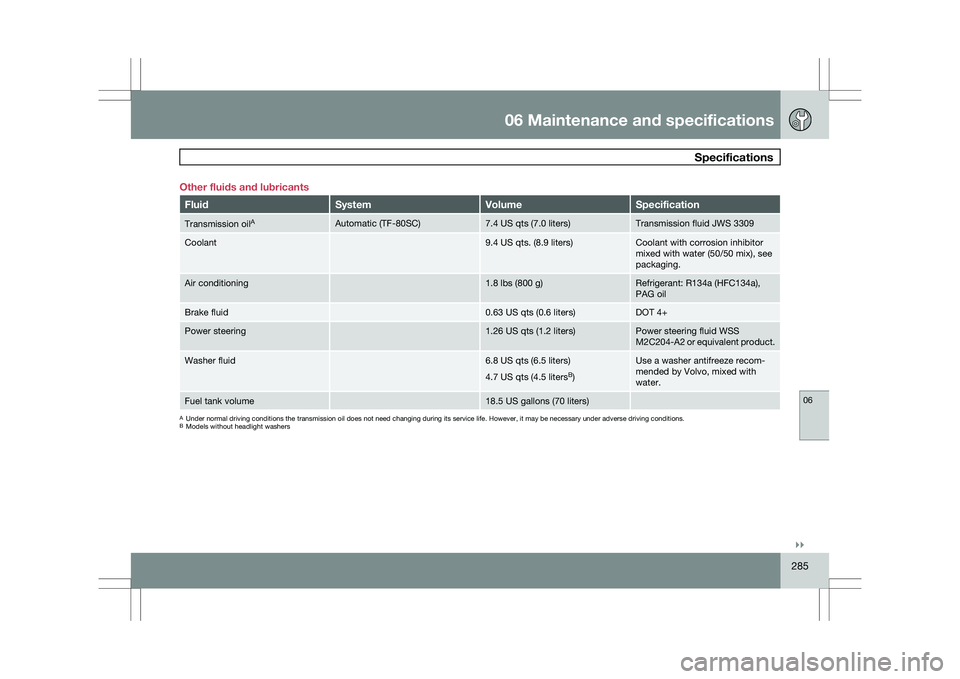
Other fluids and lubricants
Fluid System Volume Specification
Transmission oil
A Automatic (TF-80SC) 7.4 US qts (7.0 liters) Transmission fluid JWS 3309
Coolant 9.4 US qts. (8.9 liters) Coolant with corrosion inhibitor
mixed with water (50/50 mix), see
packaging.
Air conditioning 1.8 lbs (800 g) Refrigerant: R134a (HFC134a),
PAG oil
Brake fluid 0.63 US qts (0.6 liters) DOT 4+
Power steering 1.26 US qts (1.2 liters) Power steering fluid WSS
M2C204-A2 or equivalent product.
Washer fluid 6.8 US qts (6.5 liters)
4.7 US qts (4.5 liters
B
) Use a washer antifreeze recom-
mended by Volvo, mixed with
water.
Fuel tank volume 18.5 US gallons (70 liters)
A
Under normal driving conditions the transmission oil does not need chang\
ing during its service life. However, it may be necessary under adverse \
driving conditions.
B Models without headlight washers
Page 290 of 297
07 Index07
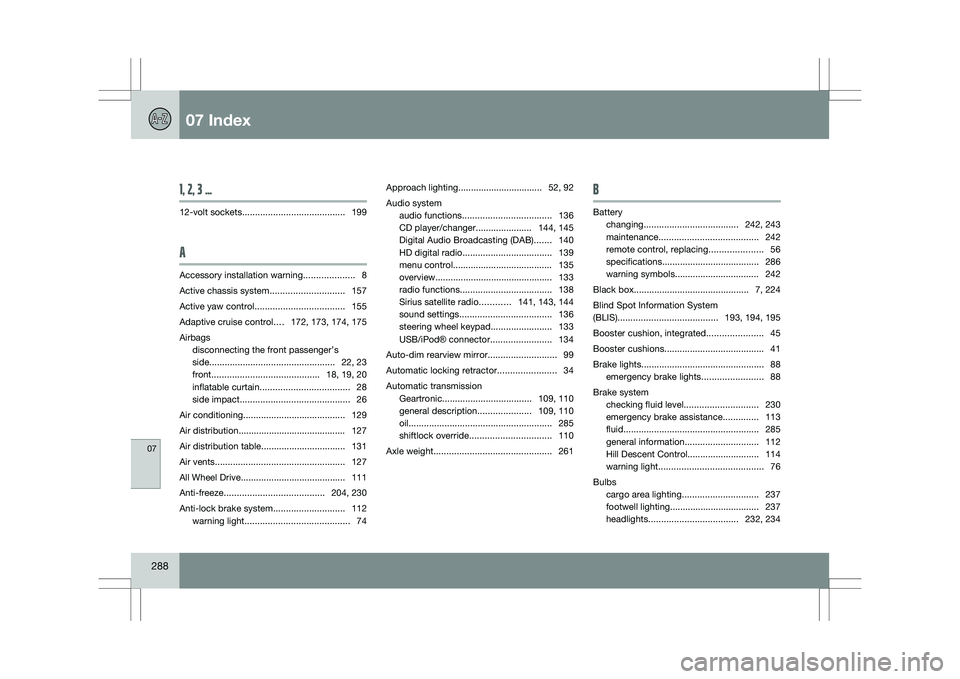
288 1, 2, 3 ...
12-volt sockets
........................................ 199
A Accessory installation warning
.................... 8
Active chassis system .............................157
Active yaw control ................................... 155
Adaptive cruise control ....172, 173, 174, 175
Airbags disconnecting the front passenger’s
side................................................. 22, 23
front.......................................... 18, 19, 20
inflatable curtain ................................... 28
side impact........................................... 26
Air conditioning ........................................ 129
Air distribution..........................................
127
Air distribution table................................. 131
Air vents................................................... 127
All Wheel Drive ......................................... 111
Anti-freeze ....................................... 204, 230
Anti-lock brake system ............................112
warning light ......................................... 74Approach lighting................................. 52, 92
Audio system
audio functions ................................... 136
CD player/changer
...................... 144, 145
Digital Audio Broadcasting (DAB) .......140
HD digital radio ................................... 139
menu control....................................... 135
overview.............................................. 133
radio functions .................................... 138
Sirius satellite radio ............141, 143, 144
sound settings .................................... 136
steering wheel keypad ........................133
USB/iPod® connector ........................134
Auto-dim rearview mirror ...........................99
Automatic locking retractor .......................34
Automatic transmission Geartronic ................................... 109, 110
general description .....................109, 110
oil ........................................................ 285
shiftlock override ................................ 110
Axle weight .............................................. 261B Battery
changing ..................................... 242, 243
maintenance ....................................... 242
remote control, replacing .....................56
specifications ...................................... 286
warning symbols.................................
242
Black box............................................. 7, 224
Blind Spot Information System
(BLIS)....................................... 193, 194, 195
Booster cushion, integrated ......................45
Booster cushions ....................................... 41
Brake lights ................................................ 88
emergency brake lights ........................88
Brake system checking fluid level ............................. 230
emergency brake assistance ..............113
fluid..................................................... 285
general information ............................. 112
Hill Descent Control ............................114
warning light ......................................... 76
Bulbs cargo area lighting .............................. 237
footwell lighting................................... 237
headlights ................................... 232, 234