brake VOLVO XC60 2009 Owner´s Manual
[x] Cancel search | Manufacturer: VOLVO, Model Year: 2009, Model line: XC60, Model: VOLVO XC60 2009Pages: 297, PDF Size: 21.16 MB
Page 239 of 297

06 Maintenance and specifications
Replacing bulbs06
}}
237Brake light
Backup light
Turn signal
Brake lights (LED)
NOTE
If an error message remains in the display
after a faulty bulb has been replaced, con-
tact an authorized Volvo workshop.
Brake lights and Taillights
The brake lights and taillights are replaced from
inside the cargo area.
NOTE Before starting to replace a bulb, see the
general information on page 232.
1. Open the panel.
2.
Remove the bulb holder by turning it coun-
terclockwise.
3. Remove the burned out bulb by pressing it
in and turning it counterclockwise.
4. Insert a new bulb, press it in and turn it clockwise.
5. Reinsert the bulb holder and turn it clock- wise.
License plate lighting 1. Remove the screws with a screwdriver.2. Carefully detach the entire bulb housing
and pull it out.
3. Replace the bulb.
4. Reinsert the entire bulb housing and screw
it into place.
Footwell lighting 1.
Insert a screwdriver at the short end of the
lens closest to the tunnel console (the cen-
ter of the vehicle) and turn gently so that
the lens comes loose. (Applies to both
lights).
2. Turn carefully until the lens comes loose.
3. Replace the bulb.
4. Press the lens back into place. G032485 G031940 G031941
Page 251 of 297
06 Maintenance and specifications
Fuses06
}}
* Option/accessory, for more information, see Introduction. 249
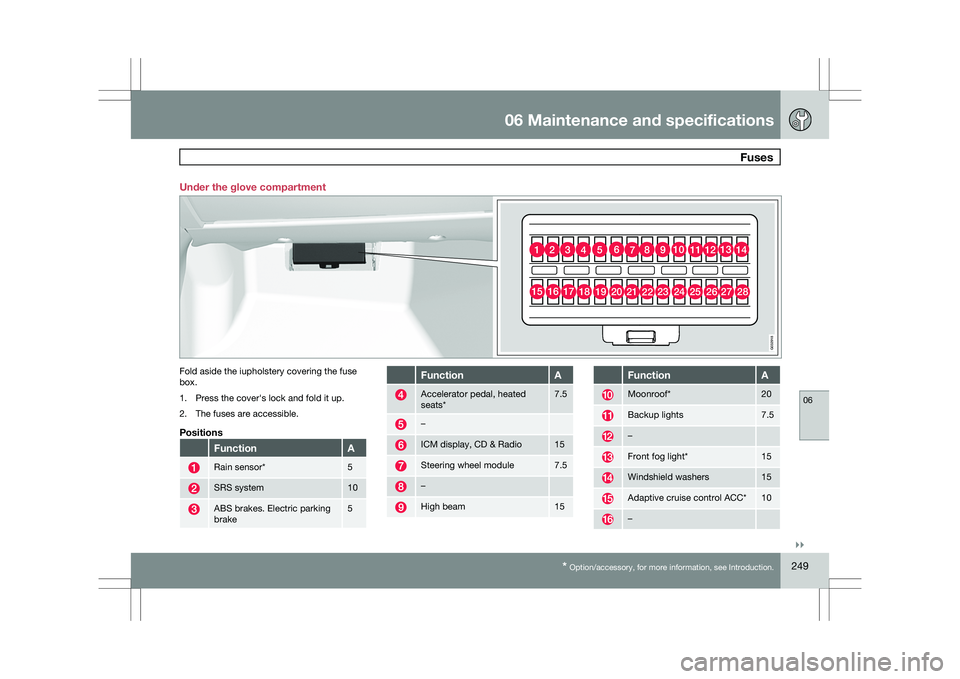
Under the glove compartment
Fold aside the iupholstery covering the fuse
box.
1. Press the cover\fs lock and fold it up.
2. The fuses are accessible.
Positions
Function A
Rain sensor* 5
SRS system 10
ABS brakes. Electric parking
brake 5 Function A
Accelerator pedal, heated
seats* 7.5
–
ICM display, CD & Radio 15
Steering wheel module 7.5
–
High beam 15 Function A
Moonroof* 20
Backup lights 7.5
–
Front fog light* 15
Windshield washers 15
Adaptive cruise control ACC* 10
– 1011121314123456789
2322212019181716152425262728
G032918
Page 252 of 297
06 Maintenance and specificationsFuses 06
250
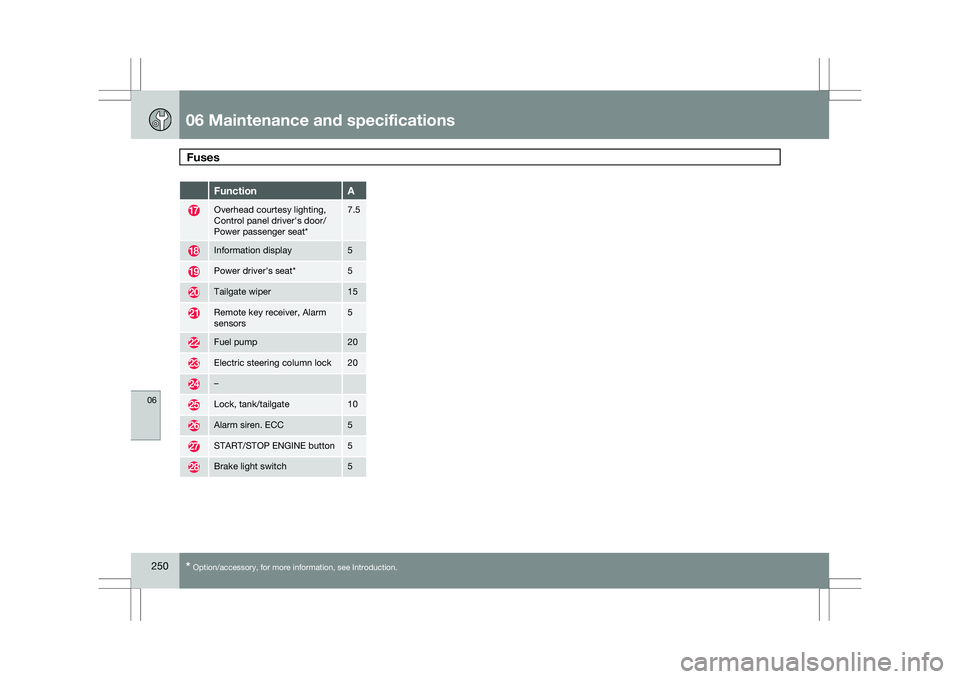
* Option/accessory, for more information, see Introduction. Function A
Overhead courtesy lighting,
Control panel driver\fs door/
Power passenger seat* 7.5
Information display 5
Power driver\fs seat* 5
Tailgate wiper 15
Remote key receiver, Alarm
sensors 5
Fuel pump 20
Electric steering column lock 20
–
Lock, tank/tailgate 10
Alarm siren. ECC 5
START/STOP ENGINE button 5
Brake light switch 5
Page 254 of 297
06 Maintenance and specificationsFuses 06
252
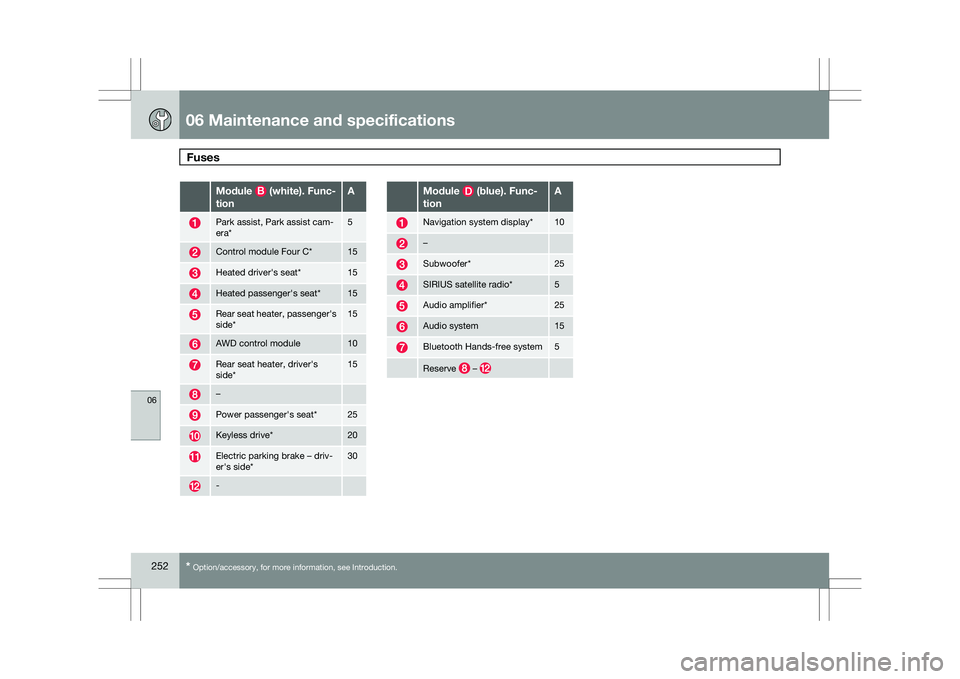
* Option/accessory, for more information, see Introduction. Module (white). Func-
tion A
Park assist, Park assist cam-
era* 5
Control module Four C* 15
Heated driver\fs seat* 15
Heated passenger\fs seat* 15
Rear seat heater, passenger\fs
side* 15
AWD control module 10
Rear seat heater, driver\fs
side* 15
–
Power passenger\fs seat* 25
Keyless drive* 20
Electric parking brake – driv-
er\fs side* 30
- Module (blue). Func-
tion A
Navigation system display* 10
–
Subwoofer* 25
SIRIUS satellite radio* 5
Audio amplifier* 25
Audio system 15
Bluetooth Hands-free system 5
Reserve –
Page 265 of 297
06 Maintenance and specifications
Wheels and tires06
}}
263
chains in some cases CANNOT be used.
Sufficient clearances between chains and
brakes, suspension and body components
must be maintained.
\b Some strap-on type chains will interfere
with brake components and therefore
CANNOT be used.
\b All Wheel Drive models: Snow chains
should only be installed on the front
wheels. Only chains adapted for AWD
models should be used.
Consult your Volvo retailer for additional snow
chain information.
CAUTION \b
Check local regulations regarding the
use of snow chains before installing.
\b Use single-sided snow chains only.
\b Always follow the chain manufacturer\fs
installation instructions carefully. Install
chains as tightly as possible and
retighten periodically.
\b Never exceed the chain manufacturer\fs
specified maximum speed limit. (Under
no circumstances should you exceed
31 mph (50 km/h).
\b Avoid bumps, holes or sharp turns
when driving with snow chains.
\b The handling of the vehicle can be
adversely affected when driving with
chains. Avoid fast or sharp turns as well
as locked wheel braking.
Snow tires, studded tires 2
Tires for winter use:
\b Owners who live in or regularly commute
through areas with sustained periods of
snow or icy driving conditions are strongly
advised to fit suitable winter tires to help
retain the highest degree of traction.
\b It is important to install winter tires on all
four wheels to help retain traction during cornering, braking, and accelerating. Fail-
ure to do so could reduce traction to an
unsafe level or adversely affect handling.
\b Do not mix tires of different design as this
could also negatively affect overall tire road
grip.
\b Winter tires wear more quickly on dry roads
in warm weather. They should be removed
when the winter driving season has ended.
\b Studded tires should be run-in
300 – 600 miles (500 – 1000 km) during
which the vehicle should be driven as
smoothly as possible to give the studs the
opportunity to seat properly in the tires.
The tires should have the same rotational
direction throughout their entire lifetime.
NOTE Please consult state or provincial regula-
tions restricting the use of studded winter
tires before installing such tires.
2
Where permitted
Page 267 of 297
06 Maintenance and specifications
Wheels and tires06
}}
265
After useThe foam block and spare wheel must be
replaced in the reverse order. Note the arrow
on the upper foam block. It should point for-
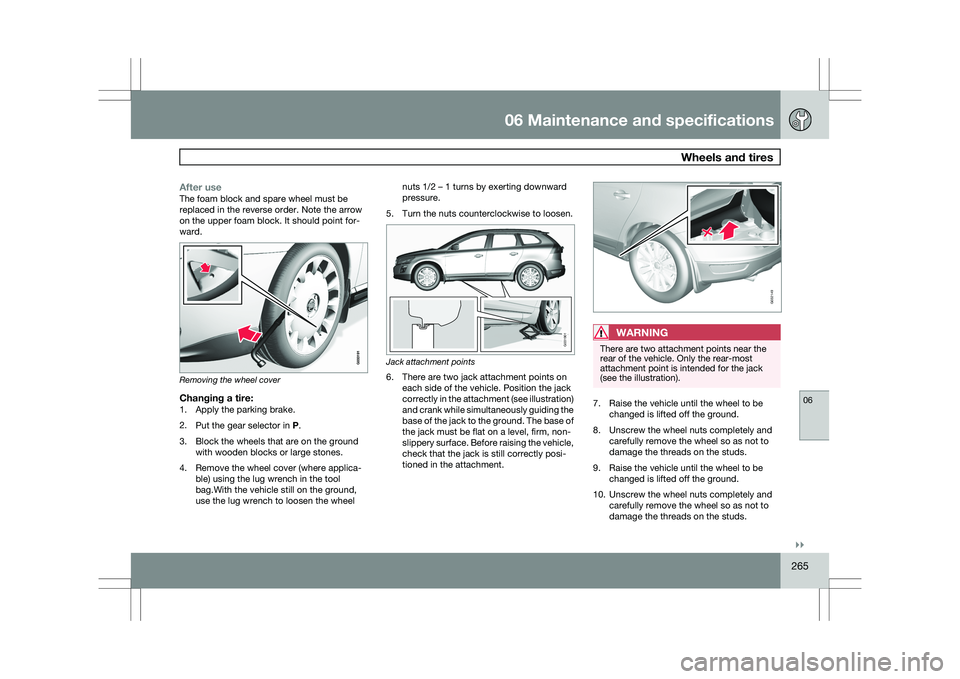
ward.Removing the wheel cover
Changing a tire:1. Apply the parking brake.
2.
Put the gear selector in P.
3. Block the wheels that are on the ground with wooden blocks or large stones.
4. Remove the wheel cover (where applica- ble) using the lug wrench in the tool
bag.With the vehicle still on the ground,
use the lug wrench to loosen the wheel nuts 1/2 – 1 turns by exerting downward
pressure.
5. Turn the nuts counterclockwise to loosen. Jack attachment points
6. There are two jack attachment points on
each side of the vehicle. Position the jack
correctly in the attachment (see illustration)
and crank while simultaneously guiding the
base of the jack to the ground. The base of
the jack must be flat on a level, firm, non-
slippery surface. Before raising the vehicle,
check that the jack is still correctly posi-
tioned in the attachment.
WARNING There are two attachment points near the
rear of the vehicle. Only the rear-most
attachment point is intended for the jack
(see the illustration).
7. Raise the vehicle until the wheel to be
changed is lifted off the ground.
8. Unscrew the wheel nuts completely and carefully remove the wheel so as not to
damage the threads on the studs.
9. Raise the vehicle until the wheel to be changed is lifted off the ground.
10. Unscrew the wheel nuts completely and carefully remove the wheel so as not to
damage the threads on the studs. G031901 G032149
Page 268 of 297
06 Maintenance and specificationsWheels and tires 06
266
* Option/accessory, for more information, see Introduction.
WARNING \b
The jack must correctly engage the jack
attachment.
\b Be sure the jack is on a firm, level, non-
slippery surface.
\b Never allow any part of your body to be
extended under a vehicle supported by
a jack.
\b Use the jack intended for the vehicle
when changing a tire. For any other job,
use stands to support the vehicle.
\b Apply the parking brake and put the
gear selector in the Park (
P) position.
\b Block the wheels standing on the
ground, use rigid wooden blocks or
large stones.
\b The jack should be kept well-greased
and clean, and should not be damaged.
\b No objects should be placed between
the base of jack and the ground, or
between the jack and the attachment
bar on the vehicle.
Re-installing the wheel1. Clean the contact surfaces on the wheel
and hub.
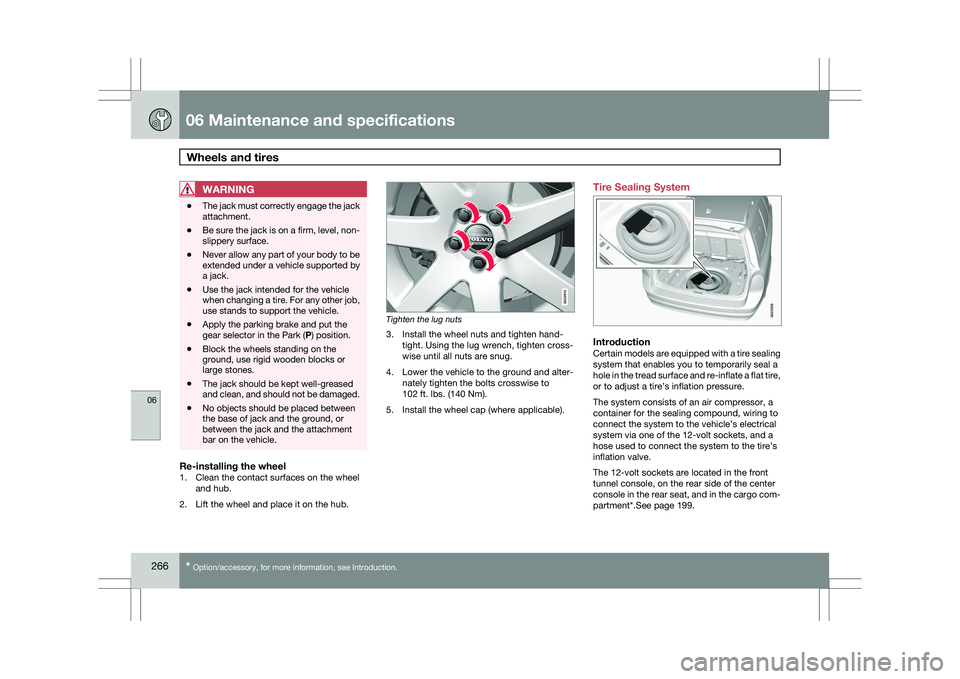
2. Lift the wheel and place it on the hub. Tighten the lug nuts
3. Install the wheel nuts and tighten hand-
tight. Using the lug wrench, tighten cross-
wise until all nuts are snug.
4. Lower the vehicle to the ground and alter- nately tighten the bolts crosswise to
102 ft. lbs. (140 Nm).
5. Install the wheel cap (where applicable). Tire Sealing System
IntroductionCertain models are equipped with a tire sealing
system that enables you to temporarily seal a
hole in the tread surface and re-inflate a flat tire,
or to adjust a tire’s inflation pressure.
The system consists of an air compressor, a
container for the sealing compound, wiring to
connect the system to the vehicle’s electrical
system via one of the 12-volt sockets, and a
hose used to connect the system to the tire’s
inflation valve.
The 12-volt sockets are located in the front
tunnel console, on the rear side of the center
console in the rear seat, and in the cargo com-
partment*.See page 199. G022916 G023309
Page 270 of 297
06 Maintenance and specificationsWheels and tires 06
268
WARNING Please keep the following points in mind
when using the tire sealing system:
\b
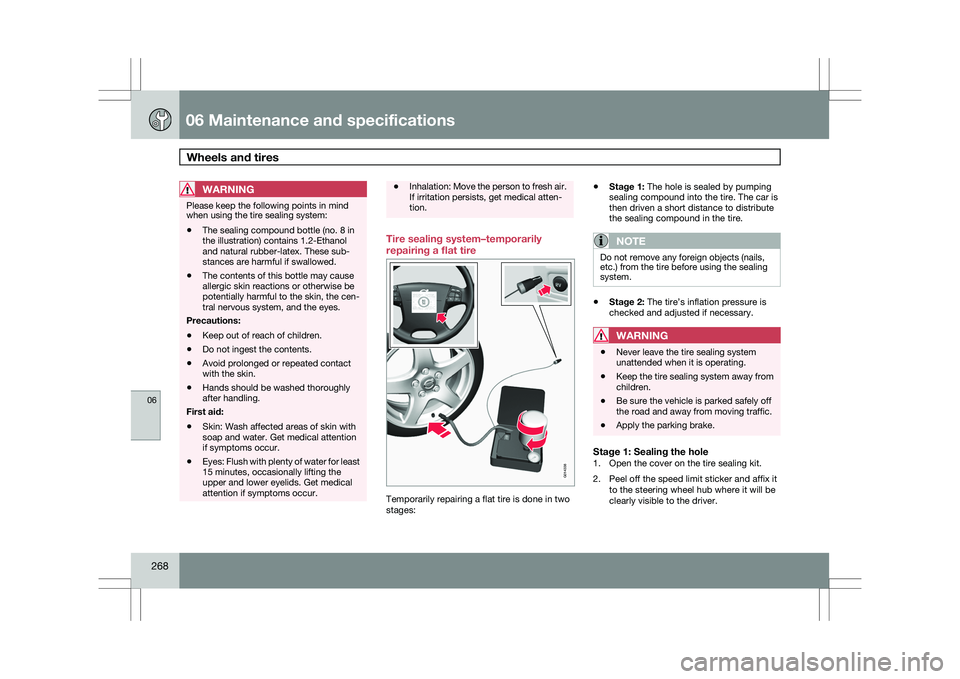
The sealing compound bottle (no. 8 in
the illustration) contains 1.2-Ethanol
and natural rubber-latex. These sub-
stances are harmful if swallowed.
\b The contents of this bottle may cause
allergic skin reactions or otherwise be
potentially harmful to the skin, the cen-
tral nervous system, and the eyes.
Precautions:
\b Keep out of reach of children.
\b Do not ingest the contents.
\b Avoid prolonged or repeated contact
with the skin.
\b Hands should be washed thoroughly
after handling.
First aid:
\b Skin: Wash affected areas of skin with
soap and water. Get medical attention
if symptoms occur.
\b Eyes: Flush with plenty of water for least
15 minutes, occasionally lifting the
upper and lower eyelids. Get medical
attention if symptoms occur. \b
Inhalation: Move the person to fresh air.
If irritation persists, get medical atten-
tion. Tire sealing system–temporarily
repairing a flat tire
Temporarily repairing a flat tire is done in two
stages:\b
Stage 1: The hole is sealed by pumping
sealing compound into the tire. The car is
then driven a short distance to distribute
the sealing compound in the tire.
NOTE Do not remove any foreign objects (nails,
etc.) from the tire before using the sealing
system.
\b
Stage 2: The tire’s inflation pressure is
checked and adjusted if necessary.
WARNING \b
Never leave the tire sealing system
unattended when it is operating.
\b Keep the tire sealing system away from
children.
\b Be sure the vehicle is parked safely off
the road and away from moving traffic.
\b Apply the parking brake.
Stage 1: Sealing the hole1. Open the cover on the tire sealing kit.
2. Peel off the speed limit sticker and affix it
to the steering wheel hub where it will be
clearly visible to the driver. G01433
8
Page 277 of 297
06 Maintenance and specifications
Vehicle care06
}}
275
fully. Solvents or stain removers should not be
used.
CAUTION
\b
Avoid waxing or polishing plastic or rub-
ber components
\b Polishing chromed strips can wear
away or damage the surface
\b Polishes containing abrasive sub-
stances should not be used
Automatic car wash
\b
We do NOT recommend washing your car
in an automatic wash during the first six
months (because the paint will not have
hardened sufficiently).
\b An automatic wash is a simple and quick
way to clean your car, but it is worth
remembering that it may not be as thor-
ough as when you yourself go over the car
with sponge and water. Keeping the under-
body clean is most important, especially in
the winter. Some automatic washers do
not have facilities for washing the under-
body.
CAUTION \b
Before driving into an automatic car
wash, turn off the optional rain sensor
to avoid damaging the windshield wip-
ers.
\b Make sure that side view mirrors, auxil-
iary lamps, etc, are secure, and that any
antenna(s) are retracted or removed.
Otherwise there is risk of the machine
dislodging them.
\b Chromed wheels: Clean chrome-
plated wheels using the same deter-
gents used for the body of the vehicle.
Aggressive wheel-cleaning agents can
permanently stain chrome-plated
wheels.
WARNING \b
When the vehicle is driven immediately
after being washed, apply the brakes,
including the parking brake, several
times in order to remove any moisture
from the brake linings.
\b Engine cleaning agents should not be
used when the engine is warm. This
constitutes a fire risk.
Exterior lightingCondensation may form temporarily on the
inside of the lenses of exterior lights such as headlights, fog lights, or taillights. This is nor-
mal and the lights are designed to withstand
moisture. Normally, condensation will dissi-
pate after the lights have been on for a short
time.
Polishing and waxing
\b
Normally, polishing is not required during
the first year after delivery, however, wax-
ing may be beneficial.
\b Before applying polish or wax the vehicle
must be washed and dried. Tar spots can
be removed with kerosene or tar remover.
Difficult spots may require a fine rubbing
compound.
\b After polishing use liquid or paste wax.
\b Several commercially available products
contain both polish and wax.
\b Waxing alone does not substitute for pol-
ishing a dull surface.
\b A wide range of polymer-based waxes can
be purchased today. These waxes are easy
to use and produce a long-lasting, high-
gloss finish that protects the bodywork
against oxidation, road dirt and fading.
\b Do not polish or wax your vehicle in direct
sunlight (the surface of the vehicle should
not be warmer than 113 °F (45 °C).
Page 284 of 297
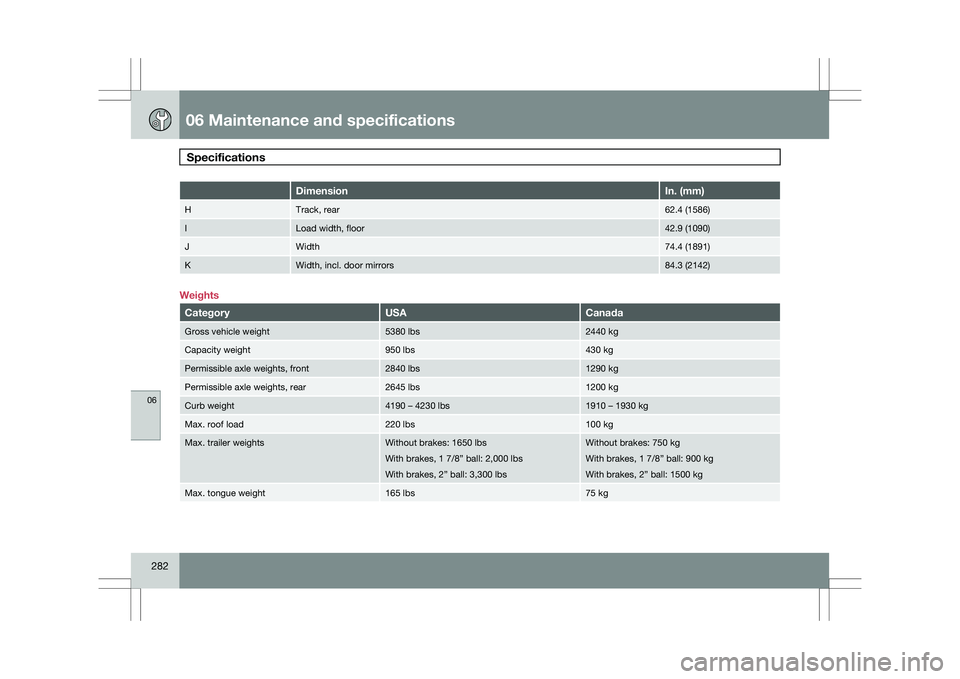
06 Maintenance and specificationsSpecifications 06
282 Dimension In. (mm)
H Track, rear 62.4 (1586)
I Load width, floor 42.9 (1090)
J Width 74.4 (1891)
K Width, incl. door mirrors 84.3 (2142)
Weights
Category USA Canada
Gross vehicle weight 5380 lbs 2440 kg
Capacity weight 950 lbs 430 kg
Permissible axle weights, front 2840 lbs 1290 kg
Permissible axle weights, rear 2645 lbs 1200 kg
Curb weight 4190 – 4230 lbs 1910 – 1930 kg
Max. roof load 220 lbs 100 kg
Max. trailer weights Without brakes: 1650 lbs
With brakes, 1 7/8” ball: 2,000 lbs
With brakes, 2” ball: 3,300 lbs Without brakes: 750 kg
With brakes, 1 7/8” ball: 900 kg
With brakes, 2” ball: 1500 kg
Max. tongue weight 165 lbs 75 kg