service VOLVO XC60 2009 Owner´s Manual
[x] Cancel search | Manufacturer: VOLVO, Model Year: 2009, Model line: XC60, Model: VOLVO XC60 2009Pages: 297, PDF Size: 21.16 MB
Page 275 of 297
06 Maintenance and specifications
Wheels and tires06
273
WARNINGIncorrect inflation pressure could lead to tire
failure, resulting in a loss of control of the
vehicle.
Changing wheels with TPMSPlease note the following when changing or
replacing the factory installed TPMS wheels/
tires on the vehicle:
\b
Only the factory-mounted wheels are
equipped with TPMS sensors in the valves.
\b If the vehicle is equipped with a temporary
spare tire, this tire does not have a TPMS
sensor.
\b If wheels without TPMS sensors are moun-
ted on the vehicle, TIRE PRESS SYST
SERVICE REQUIRED will be displayed
each time the vehicle is driven above
25 mph (40 km/h) for 10 minutes or more.
\b Once TPMS sensors are properly installed,
the warning message should not reappear.
If the message is still displayed, drive the
vehicle for several minutes at a speed of
20 mph (30 km/h) or faster to erase the
message.
\b Volvo recommends that TPMS sensors be
fitted on all wheels used on the vehicle.
Volvo does not recommend moving sen-
sors back and forth between sets of
wheels.
NOTE \b
If you change to tires with a different
recommended inflation pressure, the
TPMS system must be recalibrated to
these tires. This must be done by a
trained and qualified Volvo service tech-
nician.
\b If a tire is changed, or if the TPMS sen-
sor is moved to another wheel, the sen-
sor\fs seal, nut, and valve core should be
replaced.
\b When installing TPMS sensors, the
vehicle must be parked for at least
15 minutes with the ignition off. if the
vehicle is driven within 15 minutes, a
TPMS error message will be displayed.
CAUTION When inflating tires with TPMS valves, press
the pump\fs mouthpiece straight onto the
valve to help avoid bending or otherwise
damaging the valve.
Page 276 of 297
06 Maintenance and specificationsVehicle care 06
274 Washing the car
WARNING
Be sure that the compressor is not con-
nected to a 12-volt socket while replacing
the container.
The following points should be kept in mind
when washing and cleaning the car:
\b
The car should be washed at regular inter-
vals since dirt, dust, insects and tar spots
adhere to the paint and may cause dam-
age. To help prevent corrosion, it is partic-
ularly important to wash the car frequently
in the wintertime.
\b Avoid washing your car in direct sunlight.
Doing so may cause detergents and wax
to dry out and become abrasive. To avoid
scratching, use lukewarm water to soften
the dirt before you wash with a soft
sponge, and plenty of sudsy water.
\b Bird droppings: Remove from paintwork
as soon as possible. Otherwise the finish
may be permanently damaged.
\b A detergent can be used to facilitate the
softening of dirt and oil.
\b A water-soluble grease solvent may be
used in cases of sticky dirt. However, use
a wash place equipped with a drainage
separator. \b
Dry the car with a clean chamois and
remember to clean the drain holes in the
doors and rocker panels.
\b Tar spots can be removed with kerosene
or tar remover after the car has been
washed.
\b A stiff-bristle brush and lukewarm soapy
water can be used to clean the wiper
blades. Frequent cleaning of the wind-
shield and wiper blades improves visibility
considerably and also helps prolong the
service life of the wiper blades.
\b Wash off the dirt from the underside (wheel
housings, fenders, etc).
\b In areas of high industrial fallout, more fre-
quent washing is recommended.
\b After cleaning the engine, the spark plug
wells should be inspected for water and
blown dry if necessary.
NOTE When washing the car, remember to remove
dirt from the drain holes in the doors and
sills.
CAUTION \b
During high pressure washing, the
spray mouthpiece must never be closer
to the vehicle than 13" (30 cm). Do not
spray into the locks.
\b Dirt, snow, etc., on the headlights can
reduce lighting capacity considerably.
Clean the headlights regularly, for
example when refueling.
\b When washing or steam cleaning the
engine, avoid spraying water or steam
directly on the electrical components or
toward the rear side of the engine. Spe-
cial moonroof cautions:
\b Always close the moonroof and sun
shade before washing your vehicle.
\b Never use abrasive cleaning agents on
the moonroof.
\b Never use wax on the rubber seals
around the moonroof.
Exterior componentsVolvo recommends the use of special cleaning
products, available at your Volvo retailer, for
cleaning colored plastic, rubber, or ornamental
components such as chromed strips on the
exterior of your vehicle. The instructions for
using these products should be followed care-
Page 285 of 297
06 Maintenance and specifications
Specifications06
}}
283
Engine specifications
Specification/Model 3.0T
Engine designation B6304T2
Output (kW/rps) 210/93
Output (hp/rpm) 281/5600
Torque (Nm/rps) 400/25 – 80
Torque (ft. lbs./rpm) 295/1500 – 4800
No. of cylinders 6
Bore (in/mm) 3.23/82
Stroke (in/mm) 3.67/93.2
Displacement 2.95 liters (175 cu. in.)
Compression ratio 9.3:1
Engine oil
Engine oil must meet the minimum ILSAC
specification GF-4, API SL, or ACEA A1/B1.
Lower quality oils may not offer the same fuel
economy, engine performance, or engine pro-
tection.
Volvo recommends Castrol.
Depending on your driving habits, premium or
synthetic oils may provide superior fuel econ-
omy and engine protection. Consult your Volvo
retailer for recommendations on premium or
synthetic oils.
Oil additives must not be used.
Synthetic oil is not used when the oil is
changed at the normal maintenance services.
This oil is only used at customer request, at
additional charge. Please consult your Volvo
retailer.
Oil viscosityIncorrect viscosity oil can shorten engine life
under normal use. SAE 5W-30 will provide
good fuel economy and engine protection. See
the viscosity chart.
Page 286 of 297
06 Maintenance and specificationsSpecifications 06
284 Viscosity chart
Extreme engine operationSynthetic oils meeting SAE 0W-30 or 0W-40
and complying with oil quality requirements are
recommended for driving in areas of sustained
temperature extremes (hot or cold), when tow-
ing a trailer over long distances, and for pro-
longed driving in mountainous areas.
American Petroleum Institute (API)
symbol The API Service Symbol "donut" is divided into
three parts:
\b
The upper section describes the oil\fs per-
formance level.
\b The center identifies the oil\fs viscosity.
\b The lower section indicates whether the oil
has demonstrated energy-conserving
properties in a standard test in comparison
to a reference oil.
Oil volume Engine model Oil volume between MIN and
MAX Volume (incl. filter)
3.0T (6 cyl.) B6304T2 1.27 US qts (1.2 liters) 7.82 US qts (7.4 liters)
G023491
G022917
Page 287 of 297
06 Maintenance and specifications
Specifications06
}}
285
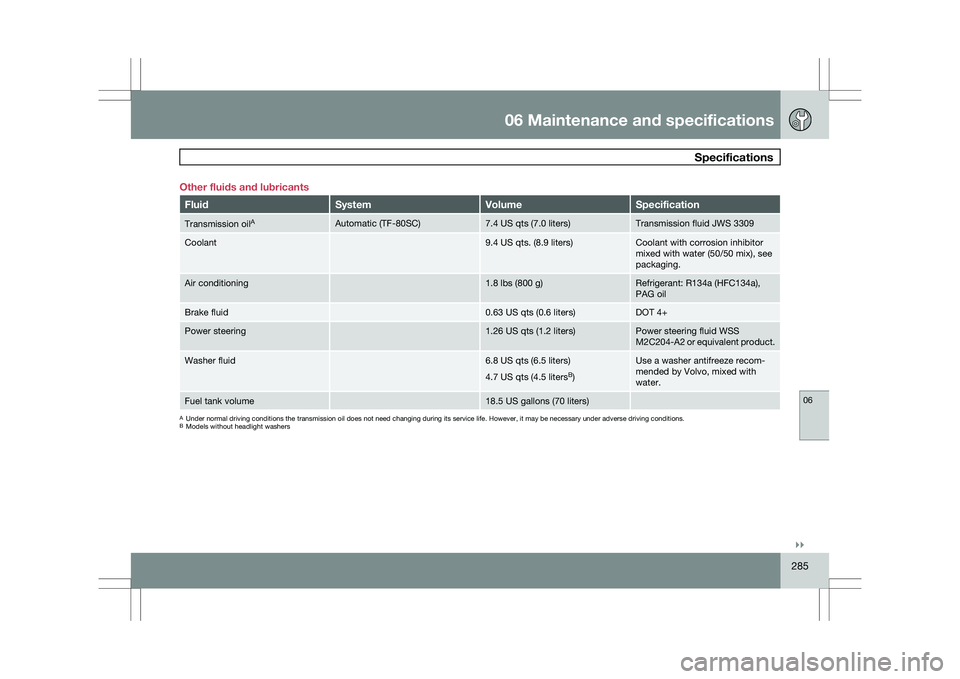
Other fluids and lubricants
Fluid System Volume Specification
Transmission oil
A Automatic (TF-80SC) 7.4 US qts (7.0 liters) Transmission fluid JWS 3309
Coolant 9.4 US qts. (8.9 liters) Coolant with corrosion inhibitor
mixed with water (50/50 mix), see
packaging.
Air conditioning 1.8 lbs (800 g) Refrigerant: R134a (HFC134a),
PAG oil
Brake fluid 0.63 US qts (0.6 liters) DOT 4+
Power steering 1.26 US qts (1.2 liters) Power steering fluid WSS
M2C204-A2 or equivalent product.
Washer fluid 6.8 US qts (6.5 liters)
4.7 US qts (4.5 liters
B
) Use a washer antifreeze recom-
mended by Volvo, mixed with
water.
Fuel tank volume 18.5 US gallons (70 liters)
A
Under normal driving conditions the transmission oil does not need chang\
ing during its service life. However, it may be necessary under adverse \
driving conditions.
B Models without headlight washers
Page 289 of 297
06 Maintenance and specifications
Volvo programs06
287
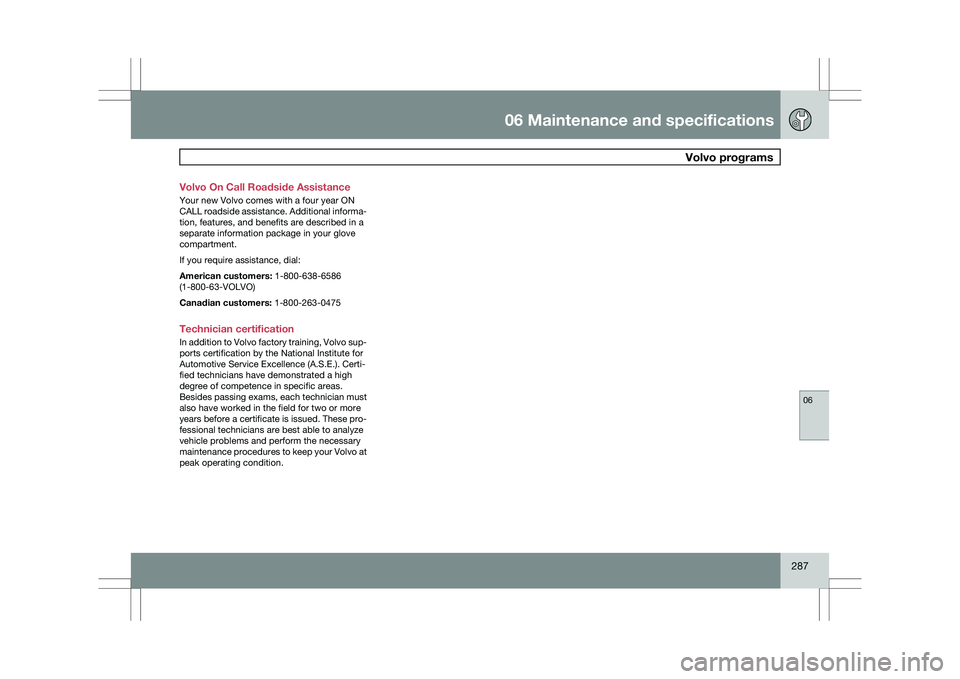
Volvo On Call Roadside Assistance
Your new Volvo comes with a four year ON
CALL roadside assistance. Additional informa-
tion, features, and benefits are described in a
separate information package in your glove
compartment.
If you require assistance, dial:
American customers: 1-800-638-6586
(1-800-63-VOLVO)
Canadian customers: 1-800-263-0475
Technician certification
In addition to Volvo factory training, Volvo sup-
ports certification by the National Institute for
Automotive Service Excellence (A.S.E.). Certi-
fied technicians have demonstrated a high
degree of competence in specific areas.
Besides passing exams, each technician must
also have worked in the field for two or more
years before a certificate is issued. These pro-
fessional technicians are best able to analyze
vehicle problems and perform the necessary
maintenance procedures to keep your Volvo at
peak operating condition.