372 VOLVO XC60 2017 Owner´s Manual
[x] Cancel search | Manufacturer: VOLVO, Model Year: 2017, Model line: XC60, Model: VOLVO XC60 2017Pages: 398, PDF Size: 9.17 MB
Page 10 of 398
8
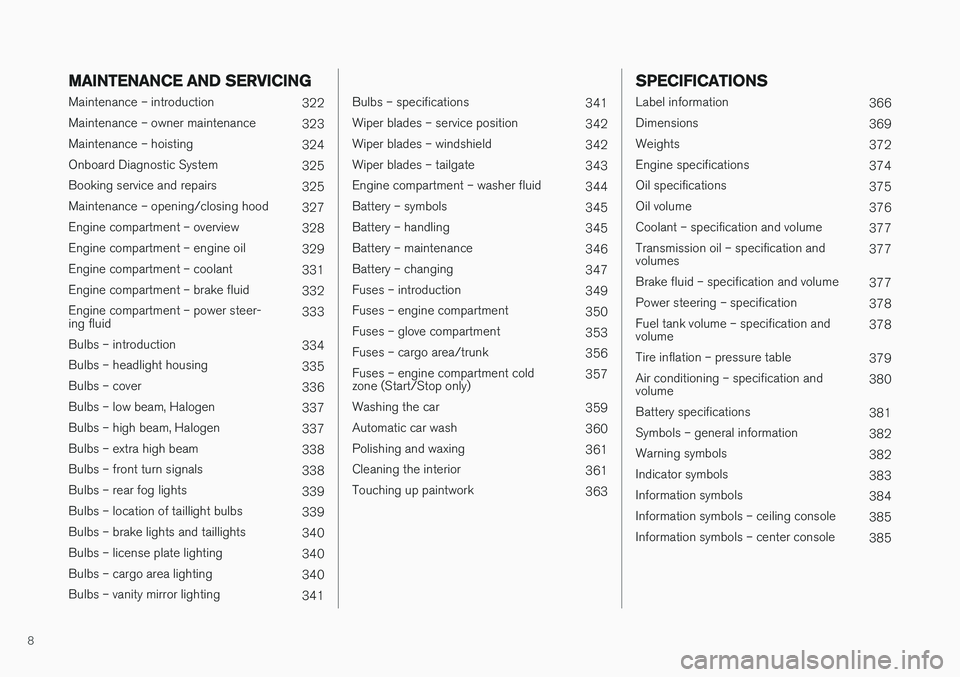
MAINTENANCE AND SERVICING
Maintenance – introduction322
Maintenance – owner maintenance 323
Maintenance – hoisting 324
Onboard Diagnostic System 325
Booking service and repairs 325
Maintenance – opening/closing hood 327
Engine compartment – overview 328
Engine compartment – engine oil 329
Engine compartment – coolant 331
Engine compartment – brake fluid 332
Engine compartment – power steer- ing fluid 333
Bulbs – introduction 334
Bulbs – headlight housing 335
Bulbs – cover 336
Bulbs – low beam, Halogen 337
Bulbs – high beam, Halogen 337
Bulbs – extra high beam 338
Bulbs – front turn signals 338
Bulbs – rear fog lights 339
Bulbs – location of taillight bulbs 339
Bulbs – brake lights and taillights 340
Bulbs – license plate lighting 340
Bulbs – cargo area lighting 340
Bulbs – vanity mirror lighting 341
Bulbs – specifications341
Wiper blades – service position 342
Wiper blades – windshield 342
Wiper blades – tailgate 343
Engine compartment – washer fluid 344
Battery – symbols 345
Battery – handling 345
Battery – maintenance 346
Battery – changing 347
Fuses – introduction 349
Fuses – engine compartment 350
Fuses – glove compartment 353
Fuses – cargo area/trunk 356
Fuses – engine compartment cold zone (Start/Stop only) 357
Washing the car 359
Automatic car wash 360
Polishing and waxing 361
Cleaning the interior 361
Touching up paintwork 363
SPECIFICATIONS
Label information366
Dimensions 369
Weights 372
Engine specifications 374
Oil specifications 375
Oil volume 376
Coolant – specification and volume 377
Transmission oil – specification and volumes 377
Brake fluid – specification and volume 377
Power steering – specification 378
Fuel tank volume – specification andvolume 378
Tire inflation – pressure table 379
Air conditioning – specification andvolume 380
Battery specifications 381
Symbols – general information 382
Warning symbols 382
Indicator symbols 383
Information symbols 384
Information symbols – ceiling console 385
Information symbols – center console 385
Page 31 of 398

SAFETY
29
Reporting safety defects
The following information will help you report any perceived safety-related defects in your vehicle.
Reporting safety defects in the U.S.
If you believe that your vehicle has a defect which could cause a crash orcould cause injury or death, you shouldimmediately inform the National High-way Traffic Safety Administration(NHTSA) in addition to notifying VolvoCars of North America, LLC. If NHTSAreceives similar complaints, it may openan investigation, and if it finds that asafety defect exists in a group of vehi-cles, it may order a recall and remedycampaign. However, NHTSA cannotbecome involved in individual problemsbetween you, your retailer, or VolvoCars of North America, LLC. To contactNHTSA, you may either call the AutoSafety Hotline toll-free at 1-888-327-4236(TTY: 1-800-424-9153) or write to: NHTSA, U.S. Department of Transpor-tation, Washington D.C. 20590. You can also obtain other informationabout motor vehicle safety from http://www.safercar.gov, where you can alsoenter your vehicle's VIN (Vehicle Identi-fication Number) to see if it has anyopen recalls. Volvo strongly recommends that if your vehicle is covered under a service cam-paign, safety or emission recall or simi-lar action, it should be completed assoon as possible. Please check withyour local retailer or Volvo Cars ofNorth America, LLC if your vehicle iscovered under these conditions. NHTSA can be reached at:Internet:http://www.nhtsa.govTelephone:1-888-DASH-2-DOT (1-888-327-4236).
Reporting safety defects in CanadaIf you believe your vehicle has a defect that could cause a crash or could cause injury or death, youshould immediately inform Transport Canada inaddition to notifying Volvo Cars of Canada Corp.
Transport Canada can be contacted at:
1-800-333-0510 Teletypewriter (TTY): 613 990-4500Fax: 1-819-994-3372Mailing Address: Transport Canada - Road Safety, 80 rue Noël, Gatineau, (Quebec) J8Z 0A1
Related information
•
Occupant safety (p. 28)
• Recall information (p. 28)
Page 281 of 398
STARTING AND DRIVING
}}
279
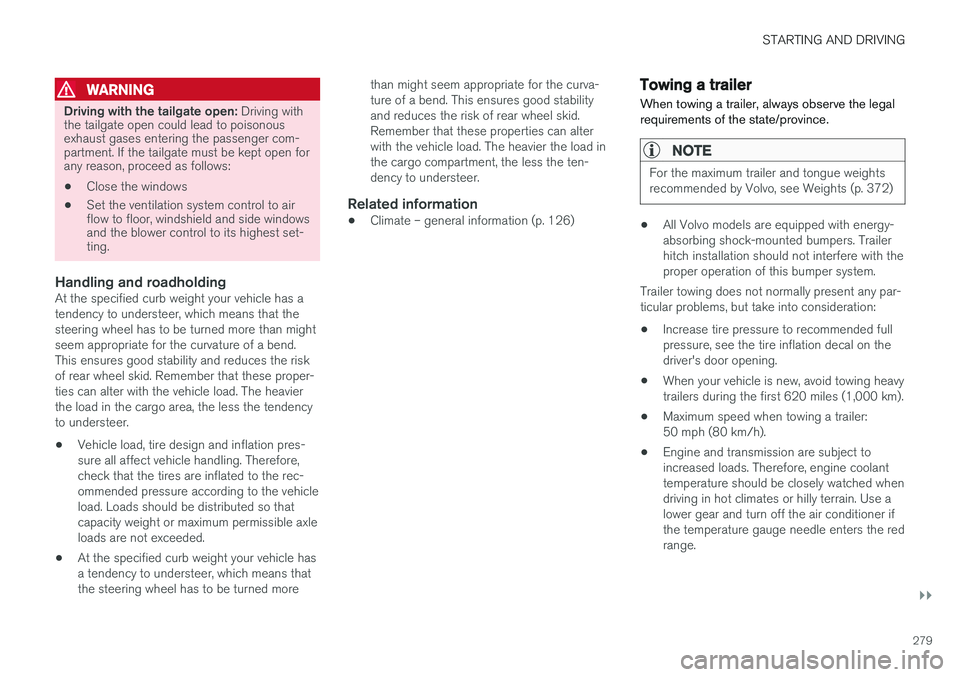
WARNING
Driving with the tailgate open: Driving with
the tailgate open could lead to poisonous exhaust gases entering the passenger com-partment. If the tailgate must be kept open forany reason, proceed as follows:
• Close the windows
• Set the ventilation system control to airflow to floor, windshield and side windowsand the blower control to its highest set-ting.
Handling and roadholdingAt the specified curb weight your vehicle has a tendency to understeer, which means that thesteering wheel has to be turned more than mightseem appropriate for the curvature of a bend.This ensures good stability and reduces the riskof rear wheel skid. Remember that these proper-ties can alter with the vehicle load. The heavierthe load in the cargo area, the less the tendencyto understeer.
• Vehicle load, tire design and inflation pres-sure all affect vehicle handling. Therefore,check that the tires are inflated to the rec-ommended pressure according to the vehicleload. Loads should be distributed so thatcapacity weight or maximum permissible axleloads are not exceeded.
• At the specified curb weight your vehicle hasa tendency to understeer, which means thatthe steering wheel has to be turned more than might seem appropriate for the curva-ture of a bend. This ensures good stabilityand reduces the risk of rear wheel skid.Remember that these properties can alterwith the vehicle load. The heavier the load inthe cargo compartment, the less the ten-dency to understeer.
Related information
•
Climate – general information (p. 126)
Towing a trailer When towing a trailer, always observe the legal requirements of the state/province.
NOTE
For the maximum trailer and tongue weights recommended by Volvo, see Weights (p. 372)
• All Volvo models are equipped with energy- absorbing shock-mounted bumpers. Trailerhitch installation should not interfere with theproper operation of this bumper system.
Trailer towing does not normally present any par-ticular problems, but take into consideration:
• Increase tire pressure to recommended fullpressure, see the tire inflation decal on thedriver's door opening.
• When your vehicle is new, avoid towing heavytrailers during the first 620 miles (1,000 km).
• Maximum speed when towing a trailer:50 mph (80 km/h).
• Engine and transmission are subject toincreased loads. Therefore, engine coolanttemperature should be closely watched whendriving in hot climates or hilly terrain. Use alower gear and turn off the air conditioner ifthe temperature gauge needle enters the redrange.
Page 302 of 398
WHEELS AND TIRES
300
NOTE
•The location of the various labels in your vehicle, see Label information (p. 366).
• A table listing important weight limits foryour vehicle, see Weights (p. 372).
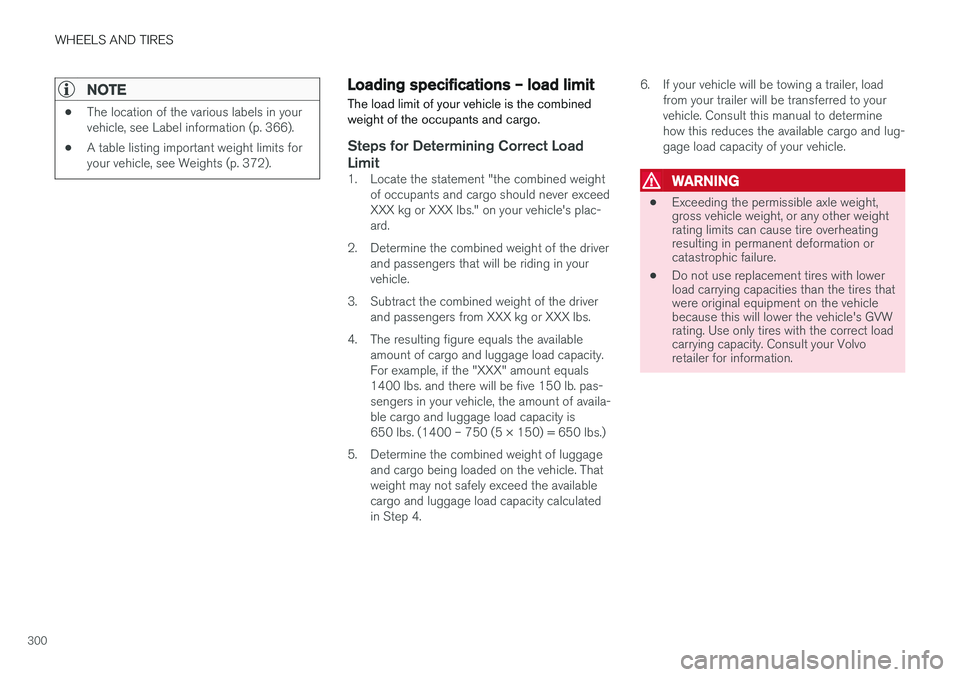
Loading specifications – load limit The load limit of your vehicle is the combined weight of the occupants and cargo.
Steps for Determining Correct Load
Limit
1. Locate the statement "the combined weight of occupants and cargo should never exceed XXX kg or XXX lbs." on your vehicle's plac-ard.
2. Determine the combined weight of the driver and passengers that will be riding in yourvehicle.
3. Subtract the combined weight of the driver and passengers from XXX kg or XXX lbs.
4. The resulting figure equals the available amount of cargo and luggage load capacity.For example, if the "XXX" amount equals1400 lbs. and there will be five 150 lb. pas-sengers in your vehicle, the amount of availa-ble cargo and luggage load capacity is650 lbs. (1400 – 750 (5 × 150) = 650 lbs.)
5. Determine the combined weight of luggage and cargo being loaded on the vehicle. Thatweight may not safely exceed the availablecargo and luggage load capacity calculatedin Step 4. 6. If your vehicle will be towing a trailer, load
from your trailer will be transferred to yourvehicle. Consult this manual to determinehow this reduces the available cargo and lug-gage load capacity of your vehicle.WARNING
• Exceeding the permissible axle weight, gross vehicle weight, or any other weightrating limits can cause tire overheatingresulting in permanent deformation orcatastrophic failure.
• Do not use replacement tires with lowerload carrying capacities than the tires thatwere original equipment on the vehiclebecause this will lower the vehicle's GVWrating. Use only tires with the correct loadcarrying capacity. Consult your Volvoretailer for information.
Page 370 of 398
||
SPECIFICATIONS
368
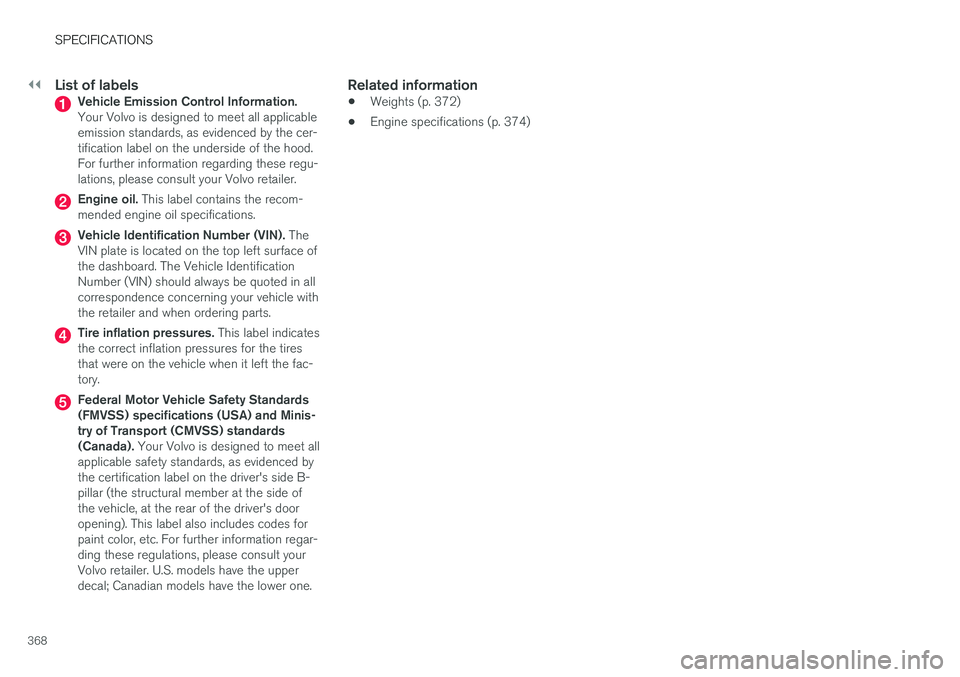
List of labelsVehicle Emission Control Information. Your Volvo is designed to meet all applicable emission standards, as evidenced by the cer-tification label on the underside of the hood.For further information regarding these regu-lations, please consult your Volvo retailer.
Engine oil. This label contains the recom-
mended engine oil specifications.
Vehicle Identification Number (VIN). The
VIN plate is located on the top left surface of the dashboard. The Vehicle IdentificationNumber (VIN) should always be quoted in allcorrespondence concerning your vehicle withthe retailer and when ordering parts.
Tire inflation pressures. This label indicates
the correct inflation pressures for the tires that were on the vehicle when it left the fac-tory.
Federal Motor Vehicle Safety Standards (FMVSS) specifications (USA) and Minis-try of Transport (CMVSS) standards(Canada). Your Volvo is designed to meet all
applicable safety standards, as evidenced bythe certification label on the driver's side B-pillar (the structural member at the side ofthe vehicle, at the rear of the driver's dooropening). This label also includes codes forpaint color, etc. For further information regar-ding these regulations, please consult yourVolvo retailer. U.S. models have the upperdecal; Canadian models have the lower one.
Related information
• Weights (p. 372)
• Engine specifications (p. 374)
Page 374 of 398
SPECIFICATIONS
372
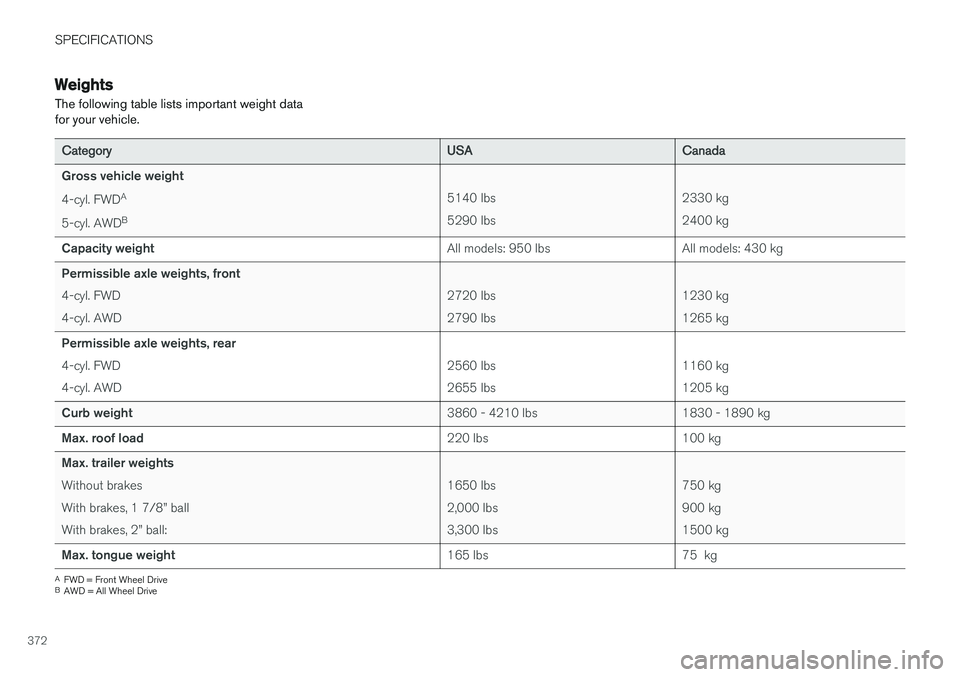
Weights The following table lists important weight data for your vehicle.
CategoryUSACanada
Gross vehicle weight 4-cyl. FWDA
5-cyl. AWD B
5140 lbs 5290 lbs2330 kg 2400 kg
Capacity weightAll models: 950 lbsAll models: 430 kg
Permissible axle weights, front 4-cyl. FWD 4-cyl. AWD
2720 lbs 2790 lbs1230 kg 1265 kg
Permissible axle weights, rear 4-cyl. FWD 4-cyl. AWD
2560 lbs 2655 lbs1160 kg 1205 kg
Curb weight3860 - 4210 lbs1830 - 1890 kg
Max. roof load220 lbs100 kg
Max. trailer weights Without brakes With brakes, 1 7/8” ballWith brakes, 2” ball:
1650 lbs 2,000 lbs3,300 lbs750 kg 900 kg1500 kg
Max. tongue weight165 lbs75 kg
A
FWD = Front Wheel Drive
B AWD = All Wheel Drive
Page 396 of 398

INDEX
394Vehicle loading 144, 145, 299, 300
roof loads 144
Vehicle maintenance 322 performed by the owner 323
Vehicle weights 372
Volvo and the environment 23
Volvo ID 22
Volvo maintenance 322
Volvo On Call Roadside Assistance 25
Volvo programs 25
Volvo Sensus 114
W
Warning flashers, hazard 96
Warning lights 69, 71, 75
Warning symbol 76
Warning system, collision 210, 212, 218
Warranties 322
Washer fluid 344Washers headlight 101
windshield 99
Water, driving through 271
Waxing 361
Weights 372
Wheels 288 changing 291
storing 289
Whiplash Protection System 43 Windows power 102
sun shade 102
Windshield heated 106, 133
rain sensor 100
washers 101
wipers/washers 99
Windshield washer fluid 344
Windshield wipers 342 service position 342
Wiper blades replacing 342
replacing tailgate wiper 343