wheel VOLVO XC60 TWIN ENGINE 2019 Owners Manual
[x] Cancel search | Manufacturer: VOLVO, Model Year: 2019, Model line: XC60 TWIN ENGINE, Model: VOLVO XC60 TWIN ENGINE 2019Pages: 695, PDF Size: 14.96 MB
Page 454 of 695
||
STARTING AND DRIVING
452
PURE
Uses the electric motor only, with the lowestpossible energy consumption and carbondioxide emissions.
This drive mode maximizes the use of the hybrid
battery. Ground clearance is lowered3 to reduceair resistance and certain climate system func-tions are reduced to provide the longest possibledriving distance using only electricity.
Pure mode is available when the hybrid battery issufficiently charged. Even in Pure mode, the com-bustion engine will start if the charge level in thebattery gets too low. The combustion engine willalso start
if the vehicle's speed goes above 125 km/h(78 mph)
if the driver requests more power than theelectric motor can provide
if factors such as cold weather affect thesystem or components.
This drive mode is optimized for maximum drivingdistance with electric propulsion and is primarilyintended for use in city driving. Pure helps pro-vide the lowest possible consumption even whenthe hybrid battery is fully discharged. ECO climateis activated to control the climate in the passen-ger compartment, and in slippery road conditionsslightly more wheel spin may be permitted beforeall-wheel drive is automatically activated.
ECO Climate
In Pure mode, ECO climate is automatically acti-vated in the passenger compartment to helpreduce energy consumption.
NOTE
When the Pure drive mode is activated, set-tings for certain climate system and electricityconsuming functions are reduced. Some ofthese settings can be reset manually, but fullfunctionality will only be restored by leavingPure mode or adapting the Individual drivemode to full climate system functionality.
If condensation forms on the windows, tap themax defroster button, which will function normally.
OFF ROAD
Maximizes the vehicle's ability to traverse dif-ficult terrain or poor roads.
In this mode, ground clearance3 is high, steeringis light, and all-wheel drive and Hill DescentControl are activated.
This drive mode is only available at low speeds,up to 40 km/h (25 mph). If this speed is excee-ded, Off road mode will be cancelled and AWDmode will be activated instead.
All-wheel drive requires both the combustion andelectric motor to be in continuous operation,which results in higher fuel consumption.
In Off road mode, a compass will be displayedbetween the speedometer and the tachometer inthe instrument panel. The permissible speedrange will be shown in the speedometer.
3For vehicles with pneumatic suspension.
Page 455 of 695
STARTING AND DRIVING
}}
453
This drive mode is optimized for maximum controlwhen driving at low speeds on very poor roads or
difficult terrain. It raises the chassis3, reducesdriveline throttle response, and locks the vehiclein all-wheel drive. The Hill Descent Control func-tion facilitates controlled driving on steep down-grades.
NOTE
This drive mode is not designed to be usedfor normal street driving.
NOTE
Due to the increased ground clearance, if theOFF ROAD mode was selected when theengine was switched off, the suspension willlower when the engine is restarted.
CAUTION
Do not use the OFF ROAD drive mode whentowing a trailer without an electrical connec-tion. This could result in damage to the pneu-matic suspension system's bellows.
AWD
Improves the vehicle's traction and handlingby increasing all-wheel drive.
This drive mode locks the vehicle in all-wheeldrive. An optimal distribution between front andrear axle torque helps provide the best possiblecontrol, stability and traction, e.g. on slipperyroads or when towing a heavy trailer or anothervehicle. The AWD drive mode is always availableregardless of the hybrid battery's charge status.
Both the combustion engine and the electricmotor are engaged to enable all-wheel drive,which results in higher fuel consumption.
In the other drive modes, the vehicle automati-cally adapts the need for all-wheel drive accord-ing to the road surface, and can activate the elec-tric motor or start the combustion engine as nee-ded.
POWER
Power mode is designed to provide sportierdriving characteristics and a faster accelera-tion response.
This drive mode maximizes the combined powerfrom the combustion engine and the electricmotor by providing power to both the front andrear wheels. Gear shifting will be faster and moredistinct and the transmission will prioritize gearswith a higher traction force. Steering response isfaster, suspension is stiffer and ground clearance
is lower3 to help reduce body roll when cornering.
Both the combustion engine and the electricmotor are engaged to enable all-wheel drive,which results in higher fuel consumption.
This drive mode is optimized for maximum per-formance and throttle response. It changes thethrottle response, gear shifting program andturbo boost system. Chassis settings and steer-ing and brake response are also optimized. ThePower drive mode is always available regardlessof the hybrid battery's charge status.
3For vehicles with pneumatic suspension.
Page 457 of 695
STARTING AND DRIVING
* Option/accessory.455
Related information
Changing drive mode (p. 455)
Economical driving (p. 463)
Energy distribution in hybrid mode using mapdata* (p. 456)
Hybrid gauge (p. 87)
General information about Twin Engine(p. 412)
Changing drive mode
Select the drive mode that is best suited to thecurrent driving conditions.
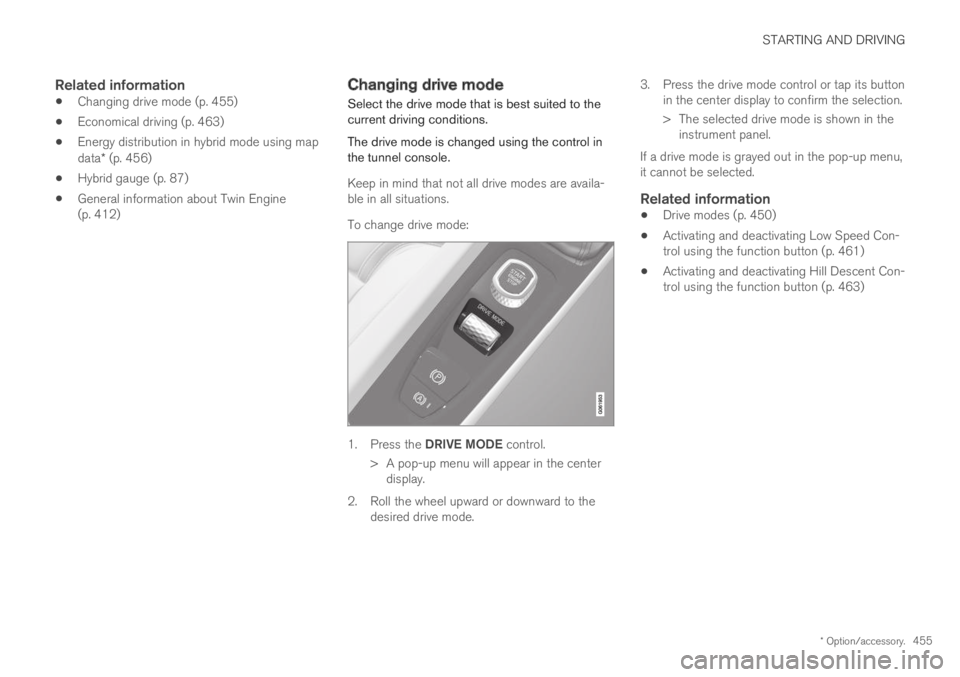
The drive mode is changed using the control inthe tunnel console.
Keep in mind that not all drive modes are availa-ble in all situations.
To change drive mode:
1.Press the DRIVE MODE control.
>A pop-up menu will appear in the centerdisplay.
2. Roll the wheel upward or downward to thedesired drive mode.
3. Press the drive mode control or tap its buttonin the center display to confirm the selection.
> The selected drive mode is shown in theinstrument panel.
If a drive mode is grayed out in the pop-up menu,it cannot be selected.
Related information
Drive modes (p. 450)
Activating and deactivating Low Speed Con-trol using the function button (p. 461)
Activating and deactivating Hill Descent Con-trol using the function button (p. 463)
Page 460 of 695
||
STARTING AND DRIVING
458
Symbols and messages in driver display
SymbolMessageMeaning
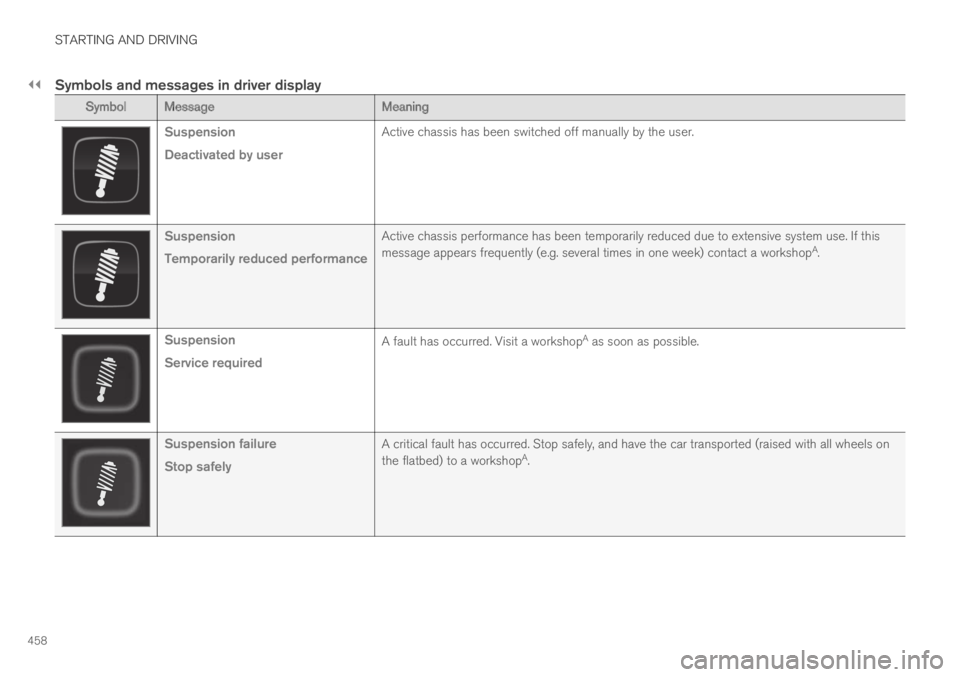
Suspension
Deactivated by user
Active chassis has been switched off manually by the user.
Suspension
Temporarily reduced performance
Active chassis performance has been temporarily reduced due to extensive system use. If this
message appears frequently (e.g. several times in one week) contact a workshopA.
Suspension
Service required
A fault has occurred. Visit a workshopA as soon as possible.
Suspension failure
Stop safely
A critical fault has occurred. Stop safely, and have the car transported (raised with all wheels on
the flatbed) to a workshopA.
Page 462 of 695
STARTING AND DRIVING
* Option/accessory.460
Leveling control settings*
Turn off leveling control before lifting the vehiclewith a jack to help avoid problems with thepneumatic suspension.
The vehicle can be lowered or raised to make iteasier to load or for passengers to get in andout.
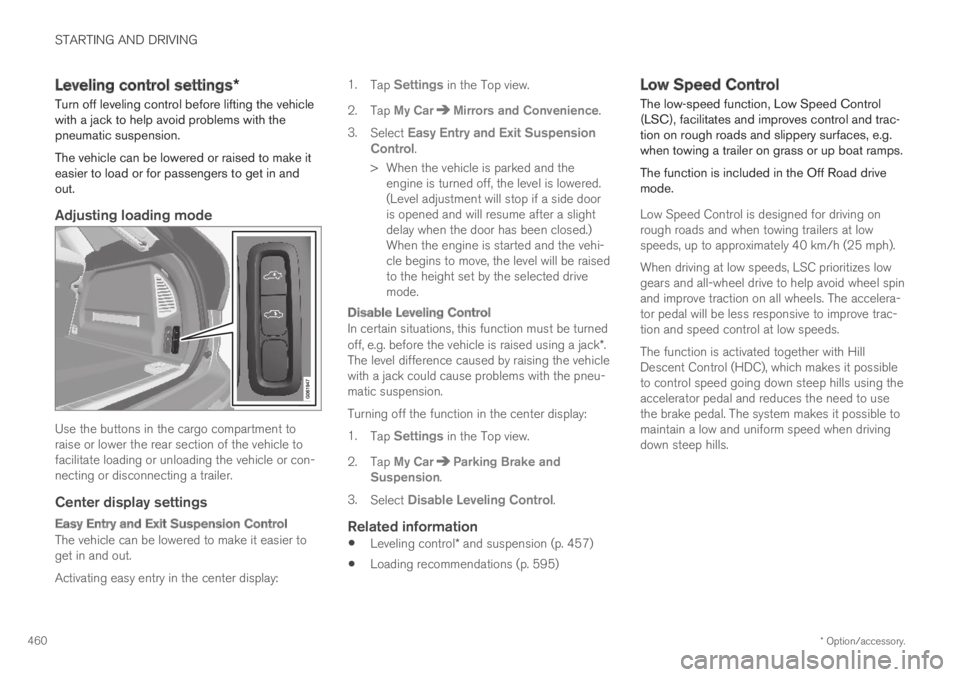
Adjusting loading mode
Use the buttons in the cargo compartment toraise or lower the rear section of the vehicle tofacilitate loading or unloading the vehicle or con-necting or disconnecting a trailer.
Center display settings
Easy Entry and Exit Suspension Control
The vehicle can be lowered to make it easier toget in and out.
Activating easy entry in the center display:
1.Tap Settings in the Top view.
2.Tap My CarMirrors and Convenience.
3.Select Easy Entry and Exit SuspensionControl.
>When the vehicle is parked and theengine is turned off, the level is lowered.(Level adjustment will stop if a side dooris opened and will resume after a slightdelay when the door has been closed.)When the engine is started and the vehi-cle begins to move, the level will be raisedto the height set by the selected drivemode.
Disable Leveling Control
In certain situations, this function must be turnedoff, e.g. before the vehicle is raised using a jack*.The level difference caused by raising the vehiclewith a jack could cause problems with the pneu-matic suspension.
Turning off the function in the center display:
1.Tap Settings in the Top view.
2.Tap My CarParking Brake andSuspension.
3.Select Disable Leveling Control.
Related information
Leveling control* and suspension (p. 457)
Loading recommendations (p. 595)
Low Speed Control
The low-speed function, Low Speed Control(LSC), facilitates and improves control and trac-tion on rough roads and slippery surfaces, e.g.when towing a trailer on grass or up boat ramps.
The function is included in the Off Road drivemode.
Low Speed Control is designed for driving onrough roads and when towing trailers at lowspeeds, up to approximately 40 km/h (25 mph).
When driving at low speeds, LSC prioritizes lowgears and all-wheel drive to help avoid wheel spinand improve traction on all wheels. The accelera-tor pedal will be less responsive to improve trac-tion and speed control at low speeds.
The function is activated together with HillDescent Control (HDC), which makes it possibleto control speed going down steep hills using theaccelerator pedal and reduces the need to usethe brake pedal. The system makes it possible tomaintain a low and uniform speed when drivingdown steep hills.
Page 463 of 695
STARTING AND DRIVING
461
NOTE
When LSC with HDC is activated in the OFFROAD drive mode, the feel of the acceleratorpedal and engine response will change.
NOTE
This drive mode is not designed to be usedfor normal street driving.
NOTE
The function is deactivated when driving athigh speeds and must be reactivated at lowerspeeds if so desired.
Related information
Activating and deactivating Low Speed Con-trol using the function button (p. 461)
Changing drive mode (p. 455)
Hill Descent Control (p. 462)
All Wheel Drive (AWD) (p. 448)
Activating and deactivating LowSpeed Control using the functionbutton
There is a function button for driving at lowspeeds with Hill Descent Control in the centerdisplay's Function view if the vehicle is notequipped with a drive mode control in the tunnelconsole.
Selecting Low Speed Control in the
center display's Function view
–Tap the Hill Descent Control button toactivate or deactivate the function.
> An indicator light in the button will illumi-nate when the function is activated.
When the engine is switched off, the function willbe automatically deactivated.
NOTE
The function is deactivated when driving athigh speeds and must be reactivated at lowerspeeds if so desired.
Related information
Low Speed Control (p. 460)
Changing drive mode (p. 455)
Page 464 of 695
STARTING AND DRIVING
462
Hill Descent Control
The function for assisting when driving downhill,Hill Descent Control (HDC), is a low-speedfunction with increased engine braking. Thefunction makes it possible to increase ordecrease the vehicle's speed on steep downhillgradients by only using the accelerator pedal,without applying the brakes.
The function is included in the Off Road drivemode.
HDC is designed for driving on rough roads atlow speeds and downhill gradients with slipperyor otherwise difficult road surfaces. The driverdoes not need to use the brake pedal but caninstead focus on steering.
WARNING
HDC is only intended to be a supplementarybraking aid and it does not function in all sit-uations.
The driver is always ultimately responsible foroperating the vehicle in a safe manner.
Function
Hill Descent Control allows the vehicle to moveforward or backward at very low speeds assistedby the brake system. The driver can increase thespeed by pressing the accelerator pedal. Whenthe accelerator pedal is released, the vehicle willreturn to very low speed regardless of how steep
the hill is and without the brakes needing to beapplied. The brake lights will illuminate when thefunction is activated.
The driver can brake to stop or slow the vehicleat any time by depressing the brake pedal.
HDC is activated along with Low Speed Control(LSC), which facilitates and improves traction andcontrol on rough and slippery surfaces. The sys-tem is intended to be used at low speeds, up toapproximately 40 km/h (25 mph).
To keep in mind when using HDC
If the function is switched off while driving ona steep downhill gradient, braking effect willbe gradually reduced.
HDC can be used in gear positions D and R,and in manual gears 1 or 2.
It is not possible to manually shift to thirdgear or higher when HDC is active.
NOTE
When LSC with HDC is activated in the OFFROAD drive mode, the feel of the acceleratorpedal and engine response will change.
NOTE
This drive mode is not designed to be usedfor normal street driving.
NOTE
The function is deactivated when driving athigh speeds and must be reactivated at lowerspeeds if so desired.
Related information
Activating and deactivating Hill Descent Con-trol using the function button (p. 463)
Changing drive mode (p. 455)
Low Speed Control (p. 460)
All Wheel Drive (AWD) (p. 448)
Page 466 of 695
||
STARTING AND DRIVING
* Option/accessory.464
Preconditioning
Whenever possible, precondition the vehiclebefore driving by connecting the chargingcable to an electrical outlet.
Avoid parking the vehicle somewhere wherethe interior will become too hot or too coldwhile the vehicle is parked. If possible, parkthe vehicle in a climate-controlled garage.
During a short drive after passenger com-partment preconditioning, turn off the pas-senger compartment fan or the air condition-ing in a hot climate.
If preconditioning is not possible when it iscold outside, use seat and steering wheelheating first. Avoid heating the entire pas-senger compartment to reduce the amountof current being taken from the hybrid bat-tery.
Driving
Choose the Pure drive mode to help mini-mize electric power consumption.
Maintain a steady speed and a generous fol-lowing distance to traffic ahead to minimizebraking. This drive mode has the lowestpower consumption.
Balance energy requirements using theaccelerator pedal. Use the indicator on theinstrument panel to see available electricpower and avoid starting the combustionengine unnecessarily. The electric motor is
more effective than the combustion engine,especially at low speeds.
When braking is necessary, brake gentlyusing the brake pedal. This will help rechargethe hybrid battery. A regenerative function isintegrated in the brake pedal and can beaugmented by the electric motor's brakingcapacity when the gear selector is in modeB.
Higher speeds increase energy consumption- air resistance increases with speed.
Activate the Hold function in the Functionview at high speeds when traveling fartherthan is possible using the hybrid battery'scapacity.
Whenever possible, avoid using the Chargefunction to charge the hybrid battery. Charg-ing the battery using the combustion engineincreases fuel consumption and carbon diox-ide emissions.
In a cold climate, reduce heating of the wind-shield/rear window, mirrors, seats and thesteering wheel.
Maintain the correct pressure in the tires andcheck pressure regularly.
The type of tires used could affect energyconsumption - consult a retailer for advice onsuitable tires.
Remove unnecessary items from the vehicle- the heavier the load, the higher the fuelconsumption.
Roof loads increase air resistance andincrease fuel consumption. Remove roofboxes, ski racks, etc. that are not in use.
Avoid driving with the windows open.
Do not keep the vehicle still on an upwardgradient by using the accelerator pedal. Usethe brakes instead.
Related information
Drive-E ‒ purer driving pleasure (p. 27)
Energy distribution in hybrid mode using mapdata* (p. 456)
Factors affecting electric motor range(p. 465)
Using the electric motor only (p. 465)
Hybrid gauge (p. 87)
Checking tire pressure (p. 563)
Page 471 of 695
STARTING AND DRIVING
469
Slippery driving conditions
For optimal traction and roadholding, Volvo rec-ommends using snow tires on all wheels when-ever there is a risk of snow or ice on the road.
NOTE
Certain countries require use of winter tiresby law. Not all countries permit the use ofstudded tires.
Practice driving on slippery surfaces under con-trolled conditions to learn how the vehicle reacts.
Related information
Snow tires (p. 577)
Snow chains (p. 577)
Braking on salted roads (p. 437)
Braking on wet roads (p. 437)
Filling washer fluid (p. 660)
Start battery (p. 625)
Replacing windshield wiper blades (p. 658)
Changing rear window wipers (p. 657)
Refilling coolant (p. 623)
Driving through standing water
Driving the vehicle through a deep pool of stand-ing water on a water-covered roadway is calledfording. This must be done with great caution.
To prevent damage to the vehicle when drivingthrough water (e.g. on flooded roads):
Do not drive in water higher than the floor ofthe vehicle. If possible, check the depth ofthe water at its deepest point before drivingthrough it. Be particularly careful when driv-ing through flowing water.
Always select the Off Road drive modebefore driving in water to ensure the gasolineengine is running.
Do not drive faster than walking speed.
Do not stop the vehicle in the water. Drivecarefully forward or back the vehicle out ofthe water.
Remember that waves created by passingvehicles could cause the water level to riseabove the vehicle's floor level.
Avoid driving through salt water to help avoidthe risk of corrosion.
CAUTION
Parts of the vehicle (e.g. engine, transmission,driveline, electrical components, etc.) can bedamaged if the vehicle is driven through waterhigher than its floor level. Damage to anycomponents caused by flooding, vapor lock orinsufficient oil is not covered under warranty.
If the engine stalls while the vehicle is inwater, do not attempt to restart it. Have thevehicle towed on the bed of a tow truck to aworkshop - an authorized Volvo workshop isrecommended.
CAUTION
Because it can be difficult to determine thewater depth, avoid driving through standing orrunning water.
When you have passed the water, press lightly onthe brake pedal and check that the brakes arefunctioning properly. Water, mud, slush, etc. canmake the brake linings slippery, resulting indelayed braking effect.
If the vehicle is equipped with a trailer couplingcontact, clean the contact after driving in water ormud.
Related information
Recovery (p. 485)
Low Speed Control (p. 460)
Page 480 of 695
||
STARTING AND DRIVING
* Option/accessory.478
12. Remove the jumper cables in the reverseorder ‒ first the black cables and then thered cables.
Make sure that none of the clamps of theblack jumper cables come into contact witheither vehicle's positive (+) jump start termi-nals or either of the red jumper cable's con-nected clamps.
WARNING
PROPOSITION 65 WARNING! Battery posts,terminals, and related accessories containlead and lead compounds, chemicals knownto the state of California to cause cancer andreproductive harm. Wash hands after han-dling.
WARNING
Batteries generate hydrogen gas, whichis flammable and explosive.
Do not connect the jumper cable to anypart of the fuel system or to any movingparts. Avoid touching hot manifolds.
Battery fluid contains sulfuric acid. Do notallow battery fluid to contact eyes, skin,fabrics or painted surfaces.
If contact occurs, flush the affected areaimmediately with water. Obtain medicalhelp immediately if eyes are affected.
Never expose the battery to open flameor electric spark. Do not smoke near thebattery. Failure to follow the instructionsfor jump starting can lead to injury.
NOTE
The vehicle cannot be started if the hybridbattery is discharged.
Related information
Starting the vehicle (p. 430)
Ignition modes (p. 433)
Adjusting the steering wheel (p. 198)
Selecting ignition mode (p. 434)
Detachable towbar*
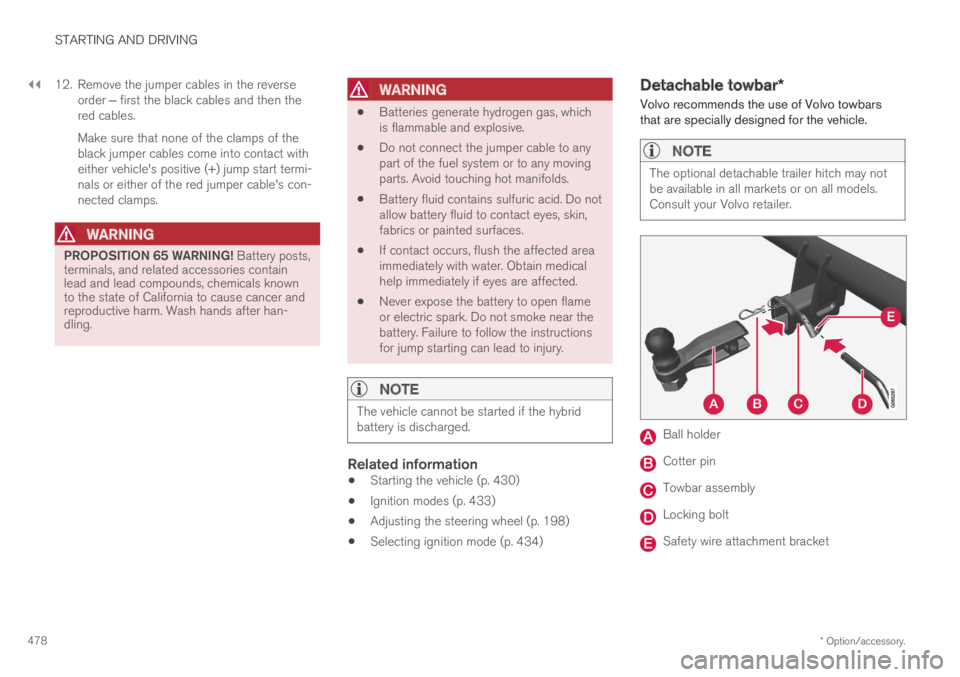
Volvo recommends the use of Volvo towbarsthat are specially designed for the vehicle.
NOTE
The optional detachable trailer hitch may notbe available in all markets or on all models.Consult your Volvo retailer.
Ball holder
Cotter pin
Towbar assembly
Locking bolt
Safety wire attachment bracket