instrument panel VOLVO XC60 TWIN ENGINE 2019 Repair Manual
[x] Cancel search | Manufacturer: VOLVO, Model Year: 2019, Model line: XC60 TWIN ENGINE, Model: VOLVO XC60 TWIN ENGINE 2019Pages: 695, PDF Size: 14.96 MB
Page 285 of 695
DRIVER SUPPORT
283
Activating/deactivating AutomaticSpeed Limiter
The Automatic Speed Limiter (ASL) is a supple-ment to the Speed Limiter (SL) and can be acti-vated/deactivated.
Activating ASL
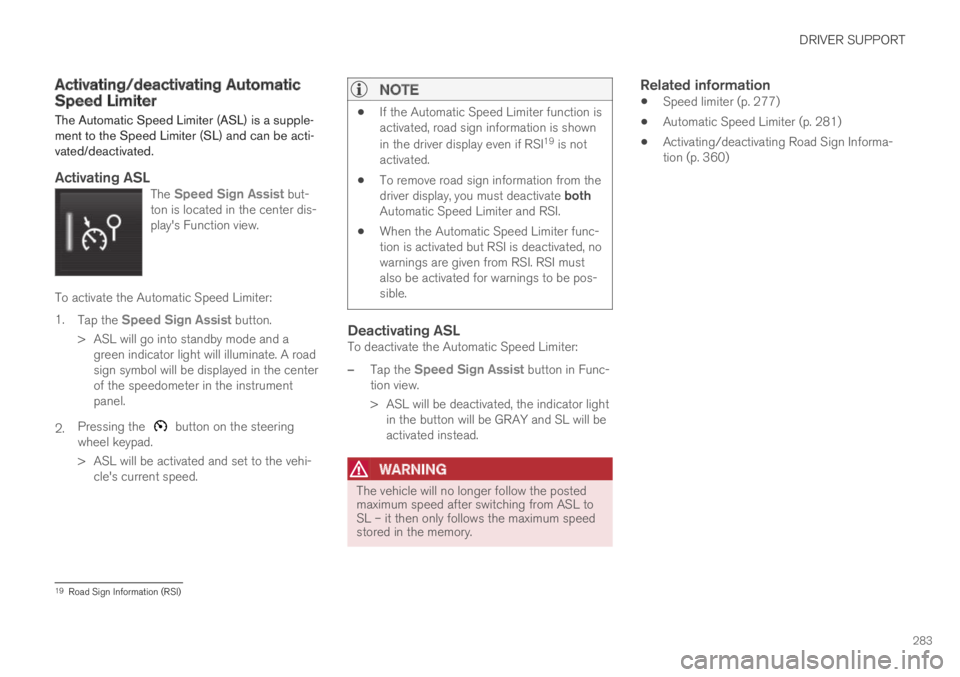
The Speed Sign Assist but-ton is located in the center dis-play's Function view.
To activate the Automatic Speed Limiter:
1.Tap the Speed Sign Assist button.
>ASL will go into standby mode and agreen indicator light will illuminate. A roadsign symbol will be displayed in the centerof the speedometer in the instrumentpanel.
2.Pressing the button on the steeringwheel keypad.
>ASL will be activated and set to the vehi-cle's current speed.
NOTE
If the Automatic Speed Limiter function isactivated, road sign information is shown
in the driver display even if RSI19 is notactivated.
To remove road sign information from thedriver display, you must deactivate bothAutomatic Speed Limiter and RSI.
When the Automatic Speed Limiter func-tion is activated but RSI is deactivated, nowarnings are given from RSI. RSI mustalso be activated for warnings to be pos-sible.
Deactivating ASL
To deactivate the Automatic Speed Limiter:
–Tap the Speed Sign Assist button in Func-tion view.
>ASL will be deactivated, the indicator lightin the button will be GRAY and SL will beactivated instead.
WARNING
The vehicle will no longer follow the postedmaximum speed after switching from ASL toSL – it then only follows the maximum speedstored in the memory.
Related information
Speed limiter (p. 277)
Automatic Speed Limiter (p. 281)
Activating/deactivating Road Sign Informa-tion (p. 360)
19Road Sign Information (RSI)
Page 291 of 695
DRIVER SUPPORT
289
Standby mode due to action by the driver
Cruise Control will be temporarily deactivated andput in standby mode if:
the brakes are applied
the gear selector is moved to N
the vehicle is driven faster than the setspeed for more than 1 minute
The driver must then control the vehicle's speed.
Temporarily increasing speed using the accelera-tor pedal, e.g. when passing another vehicle, willnot affect the setting. The vehicle will return tothe set speed when the accelerator pedal isreleased.
Automatic standby mode
Cruise Control will be temporarily deactivated andput in standby mode if:
the wheels lose traction
the engine speed (rpm) is too low/high
the temperature in the brake systembecomes too high
the vehicle's speed goes below 30 km/h(20 mph).
The driver must then control the vehicle's speed.
Related information
Cruise control (p. 285)
Reactivating Cruise Control fromstandby mode
Cruise Control (CC28) can be temporarily putinto standby mode and then reactivated.
Reactivating Cruise Control from
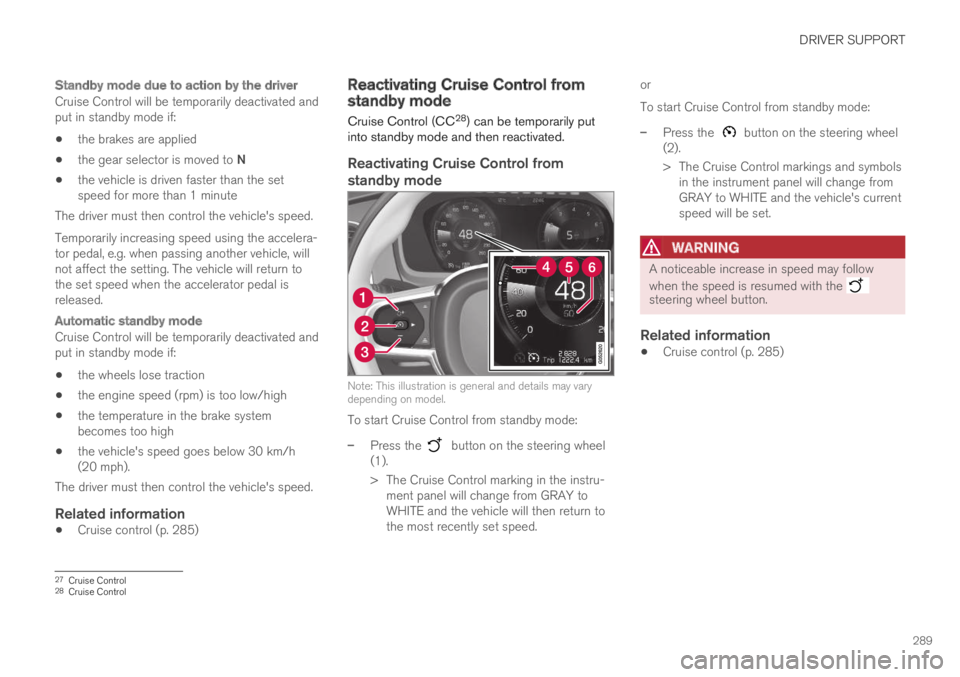
standby mode
Note: This illustration is general and details may varydepending on model.
To start Cruise Control from standby mode:
–Press the button on the steering wheel(1).
>The Cruise Control marking in the instru-ment panel will change from GRAY toWHITE and the vehicle will then return tothe most recently set speed.
or
To start Cruise Control from standby mode:
–Press the button on the steering wheel(2).
>The Cruise Control markings and symbolsin the instrument panel will change fromGRAY to WHITE and the vehicle's currentspeed will be set.
WARNING
A noticeable increase in speed may follow
when the speed is resumed with the steering wheel button.
Related information
Cruise control (p. 285)
27Cruise Control28Cruise Control
Page 292 of 695
DRIVER SUPPORT
* Option/accessory.290
Switching off Cruise Control
Cruise control (Cruise Control - CC) can beturned off.
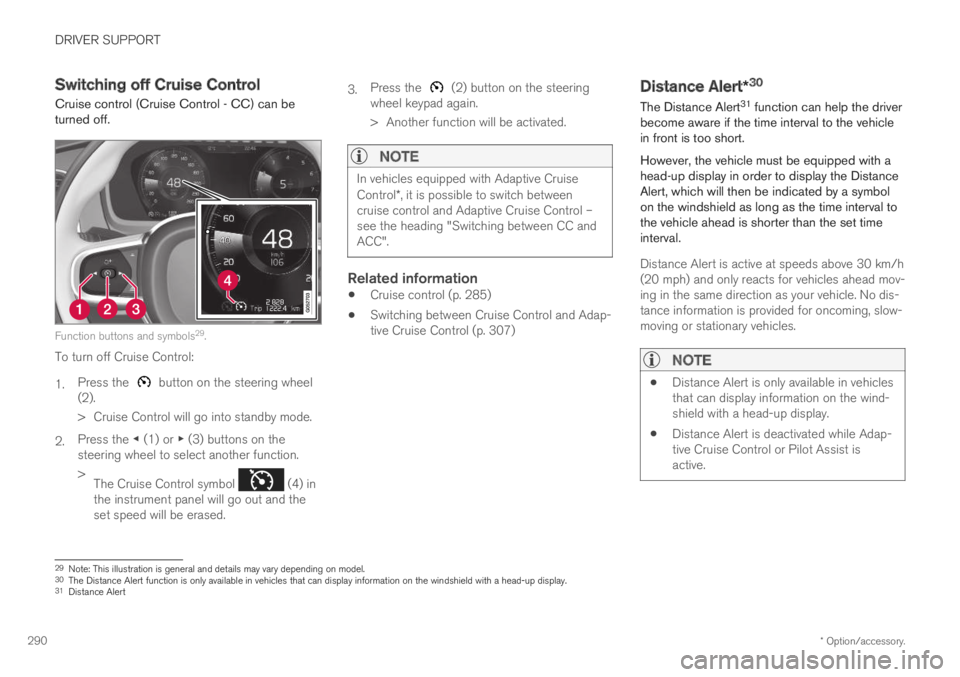
Function buttons and symbols29.
To turn off Cruise Control:
1.Press the button on the steering wheel(2).
>Cruise Control will go into standby mode.
2.Press the ◀ (1) or ▶ (3) buttons on thesteering wheel to select another function.
>The Cruise Control symbol (4) inthe instrument panel will go out and theset speed will be erased.
3.Press the (2) button on the steeringwheel keypad again.
>Another function will be activated.
NOTE
In vehicles equipped with Adaptive CruiseControl*, it is possible to switch betweencruise control and Adaptive Cruise Control –see the heading "Switching between CC andACC".
Related information
Cruise control (p. 285)
Switching between Cruise Control and Adap-tive Cruise Control (p. 307)
Distance Alert*30
The Distance Alert31 function can help the driverbecome aware if the time interval to the vehiclein front is too short.
However, the vehicle must be equipped with ahead-up display in order to display the DistanceAlert, which will then be indicated by a symbolon the windshield as long as the time interval tothe vehicle ahead is shorter than the set timeinterval.
Distance Alert is active at speeds above 30 km/h(20 mph) and only reacts for vehicles ahead mov-ing in the same direction as your vehicle. No dis-tance information is provided for oncoming, slow-moving or stationary vehicles.
NOTE
Distance Alert is only available in vehiclesthat can display information on the wind-shield with a head-up display.
Distance Alert is deactivated while Adap-tive Cruise Control or Pilot Assist isactive.
29Note: This illustration is general and details may vary depending on model.30The Distance Alert function is only available in vehicles that can display information on the windshield with a head-up display.31Distance Alert
Page 298 of 695
||
DRIVER SUPPORT
* Option/accessory.296
Reduces the time interval to the vehicleahead
Target vehicle indicator: ACC has detectedand is following a target vehicle using the settime interval
Symbol for time interval to the vehicle ahead
NOTE
In vehicles equipped with Adaptive CruiseControl*, it is possible to switch betweencruise control and Adaptive Cruise Control –see the heading "Switching between CC andACC".
Instrument panel
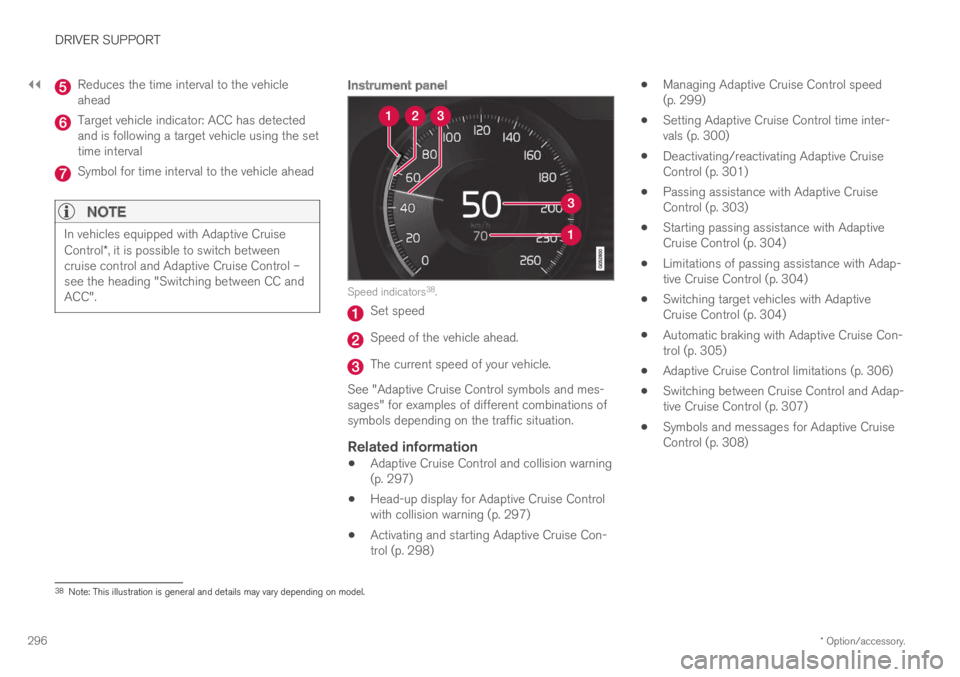
Speed indicators38.
Set speed
Speed of the vehicle ahead.
The current speed of your vehicle.
See "Adaptive Cruise Control symbols and mes-sages" for examples of different combinations ofsymbols depending on the traffic situation.
Related information
Adaptive Cruise Control and collision warning(p. 297)
Head-up display for Adaptive Cruise Controlwith collision warning (p. 297)
Activating and starting Adaptive Cruise Con-trol (p. 298)
Managing Adaptive Cruise Control speed(p. 299)
Setting Adaptive Cruise Control time inter-vals (p. 300)
Deactivating/reactivating Adaptive CruiseControl (p. 301)
Passing assistance with Adaptive CruiseControl (p. 303)
Starting passing assistance with AdaptiveCruise Control (p. 304)
Limitations of passing assistance with Adap-tive Cruise Control (p. 304)
Switching target vehicles with AdaptiveCruise Control (p. 304)
Automatic braking with Adaptive Cruise Con-trol (p. 305)
Adaptive Cruise Control limitations (p. 306)
Switching between Cruise Control and Adap-tive Cruise Control (p. 307)
Symbols and messages for Adaptive CruiseControl (p. 308)
38Note: This illustration is general and details may vary depending on model.
Page 302 of 695
||
DRIVER SUPPORT
* Option/accessory.300
Automatic transmission
Adaptive Cruise Control can follow another vehi-cle at speeds from a standstill up to 200 km/h(125 mph).
The lowest speed that can be set for AdaptiveCruise Control is 30 km/h (20 mph). When fol-lowing another vehicle, ACC can monitor thatvehicle's speed and slow your own vehicle downto a standstill, but it is not possible to set speedslower than 30 km/h (20 mph).
The highest possible speed that can be set is200 km/h (125 mph).
Related information
Adaptive Cruise Control* (p. 294)
Setting Adaptive Cruise Controltime intervals
Adaptive Cruise Control (ACC43) can be set tovarious time intervals to the vehicle ahead.
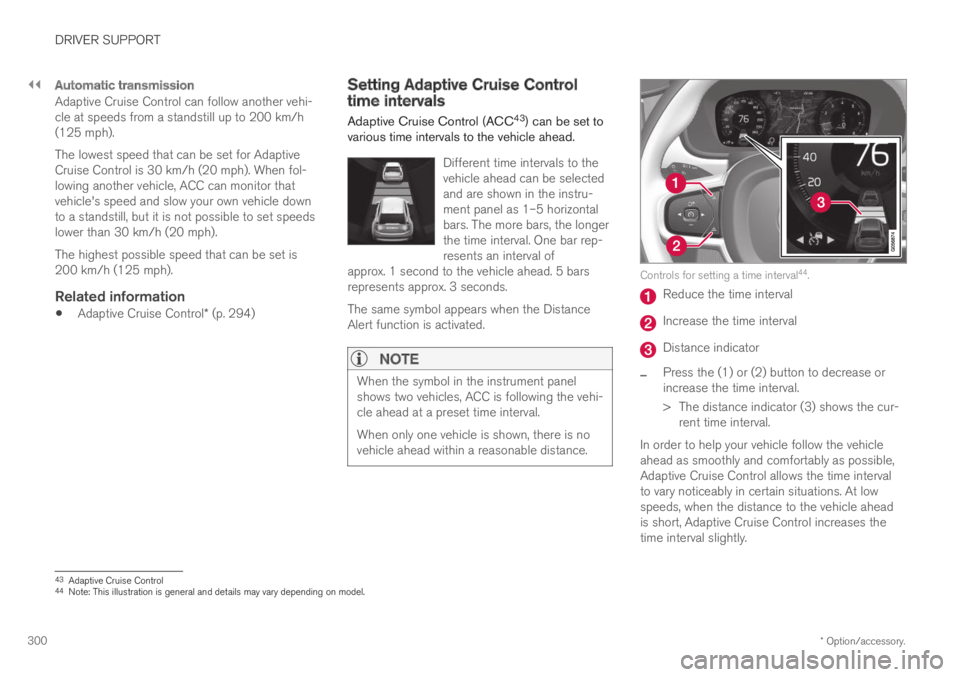
Different time intervals to thevehicle ahead can be selectedand are shown in the instru-ment panel as 1–5 horizontalbars. The more bars, the longerthe time interval. One bar rep-resents an interval ofapprox. 1 second to the vehicle ahead. 5 barsrepresents approx. 3 seconds.
The same symbol appears when the DistanceAlert function is activated.
NOTE
When the symbol in the instrument panelshows two vehicles, ACC is following the vehi-cle ahead at a preset time interval.
When only one vehicle is shown, there is novehicle ahead within a reasonable distance.
Controls for setting a time interval44.
Reduce the time interval
Increase the time interval
Distance indicator
–Press the (1) or (2) button to decrease orincrease the time interval.
>The distance indicator (3) shows the cur-rent time interval.
In order to help your vehicle follow the vehicleahead as smoothly and comfortably as possible,Adaptive Cruise Control allows the time intervalto vary noticeably in certain situations. At lowspeeds, when the distance to the vehicle aheadis short, Adaptive Cruise Control increases thetime interval slightly.
43Adaptive Cruise Control44Note: This illustration is general and details may vary depending on model.
Page 304 of 695
||
DRIVER SUPPORT
302
To temporarily deactivate Adaptive Cruise Controland put it in standby mode:
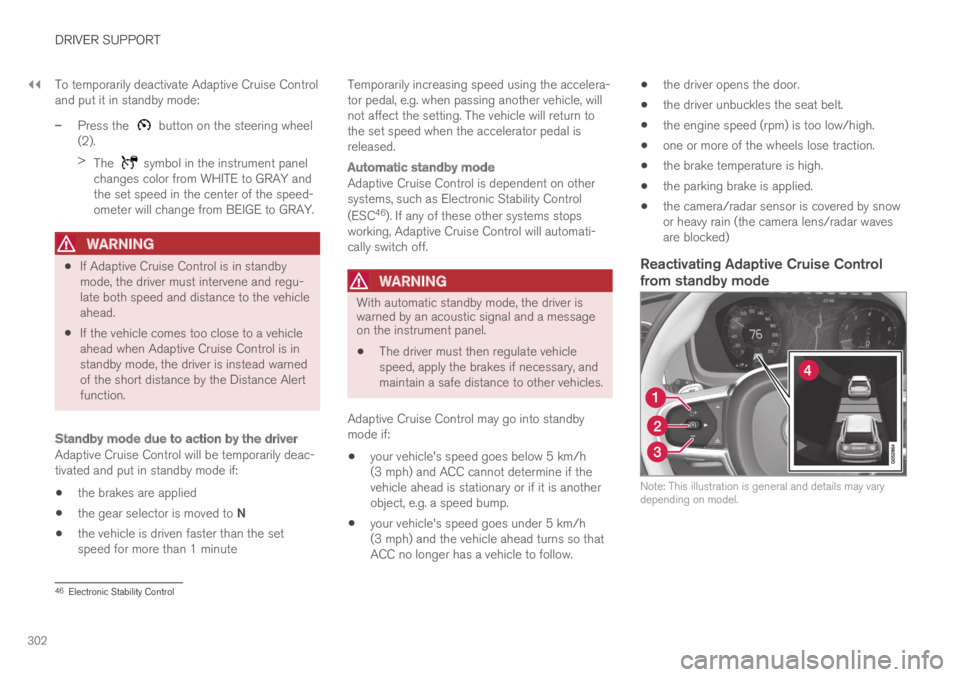
–Press the button on the steering wheel(2).
>The symbol in the instrument panelchanges color from WHITE to GRAY andthe set speed in the center of the speed-ometer will change from BEIGE to GRAY.
WARNING
If Adaptive Cruise Control is in standbymode, the driver must intervene and regu-late both speed and distance to the vehicleahead.
If the vehicle comes too close to a vehicleahead when Adaptive Cruise Control is instandby mode, the driver is instead warnedof the short distance by the Distance Alertfunction.
Standby mode due to action by the driver
Adaptive Cruise Control will be temporarily deac-tivated and put in standby mode if:
the brakes are applied
the gear selector is moved to N
the vehicle is driven faster than the setspeed for more than 1 minute
Temporarily increasing speed using the accelera-tor pedal, e.g. when passing another vehicle, willnot affect the setting. The vehicle will return tothe set speed when the accelerator pedal isreleased.
Automatic standby mode
Adaptive Cruise Control is dependent on othersystems, such as Electronic Stability Control
(ESC46). If any of these other systems stopsworking, Adaptive Cruise Control will automati-cally switch off.
WARNING
With automatic standby mode, the driver iswarned by an acoustic signal and a messageon the instrument panel.
The driver must then regulate vehiclespeed, apply the brakes if necessary, andmaintain a safe distance to other vehicles.
Adaptive Cruise Control may go into standbymode if:
your vehicle's speed goes below 5 km/h(3 mph) and ACC cannot determine if thevehicle ahead is stationary or if it is anotherobject, e.g. a speed bump.
your vehicle's speed goes under 5 km/h(3 mph) and the vehicle ahead turns so thatACC no longer has a vehicle to follow.
the driver opens the door.
the driver unbuckles the seat belt.
the engine speed (rpm) is too low/high.
one or more of the wheels lose traction.
the brake temperature is high.
the parking brake is applied.
the camera/radar sensor is covered by snowor heavy rain (the camera lens/radar wavesare blocked)
Reactivating Adaptive Cruise Control
from standby mode
Note: This illustration is general and details may varydepending on model.
46Electronic Stability Control
Page 309 of 695
DRIVER SUPPORT
* Option/accessory.307
Switching between Cruise Controland Adaptive Cruise Control
In vehicles equipped with Adaptive Cruise Con-trol (ACC), the driver can switch between CruiseControl (CC) and ACC.
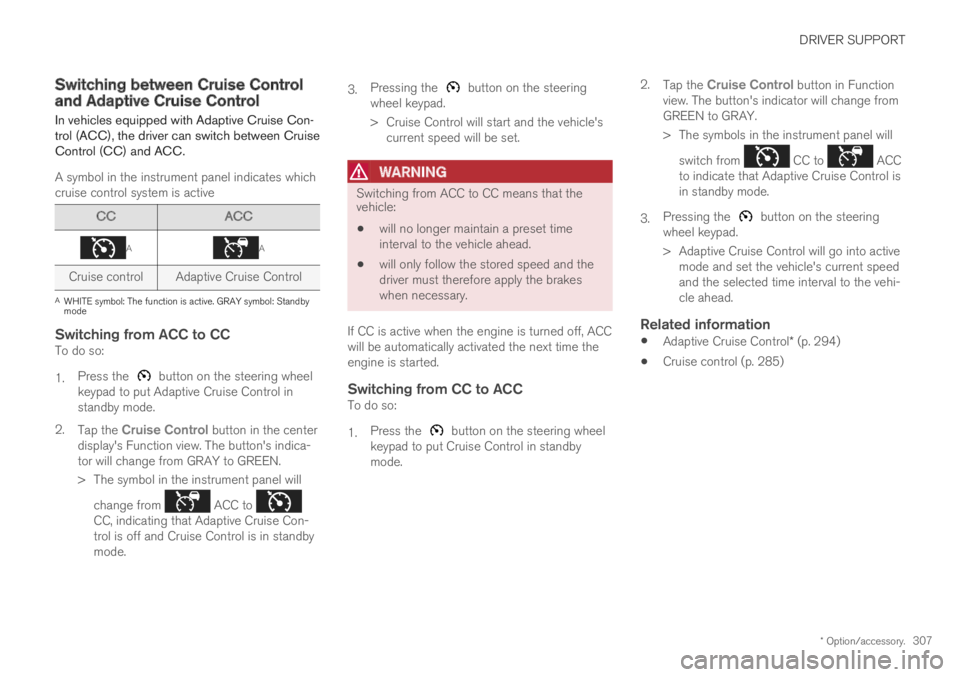
A symbol in the instrument panel indicates whichcruise control system is active
CCACC
AA
Cruise controlAdaptive Cruise Control
AWHITE symbol: The function is active. GRAY symbol: Standbymode
Switching from ACC to CC
To do so:
1.Press the button on the steering wheelkeypad to put Adaptive Cruise Control instandby mode.
2.Tap the Cruise Control button in the centerdisplay's Function view. The button's indica-tor will change from GRAY to GREEN.
>The symbol in the instrument panel will
change from ACC to CC, indicating that Adaptive Cruise Con-trol is off and Cruise Control is in standbymode.
3.Pressing the button on the steeringwheel keypad.
>Cruise Control will start and the vehicle'scurrent speed will be set.
WARNING
Switching from ACC to CC means that thevehicle:
will no longer maintain a preset timeinterval to the vehicle ahead.
will only follow the stored speed and thedriver must therefore apply the brakeswhen necessary.
If CC is active when the engine is turned off, ACCwill be automatically activated the next time theengine is started.
Switching from CC to ACC
To do so:
1.Press the button on the steering wheelkeypad to put Cruise Control in standbymode.
2.Tap the Cruise Control button in Functionview. The button's indicator will change fromGREEN to GRAY.
>The symbols in the instrument panel will
switch from CC to ACCto indicate that Adaptive Cruise Control isin standby mode.
3.Pressing the button on the steeringwheel keypad.
>Adaptive Cruise Control will go into activemode and set the vehicle's current speedand the selected time interval to the vehi-cle ahead.
Related information
Adaptive Cruise Control* (p. 294)
Cruise control (p. 285)
Page 310 of 695
DRIVER SUPPORT
* Option/accessory.308
Symbols and messages forAdaptive Cruise Control
A number of symbols and messages relating to
Adaptive Cruise Control (ACC53) may be dis-played in the instrument panel and/or the head-up display*.
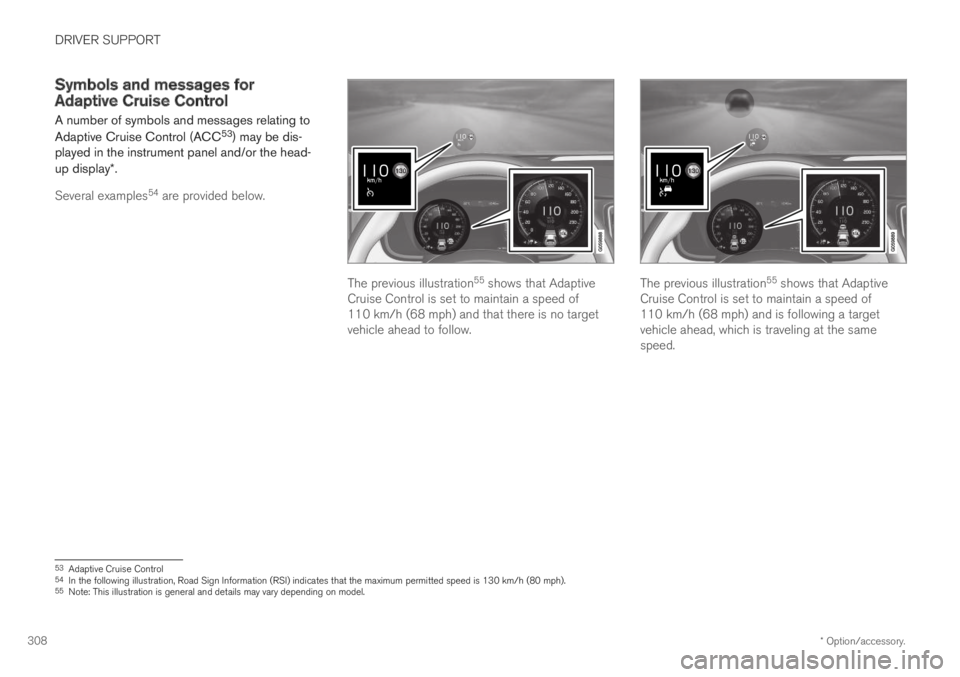
Several examples54 are provided below.
The previous illustration55 shows that AdaptiveCruise Control is set to maintain a speed of110 km/h (68 mph) and that there is no targetvehicle ahead to follow.
The previous illustration55 shows that AdaptiveCruise Control is set to maintain a speed of110 km/h (68 mph) and is following a targetvehicle ahead, which is traveling at the samespeed.
53Adaptive Cruise Control54In the following illustration, Road Sign Information (RSI) indicates that the maximum permitted speed is 130 km/h (80 mph).55Note: This illustration is general and details may vary depending on model.
Page 315 of 695
DRIVER SUPPORT
}}
* Option/accessory.313
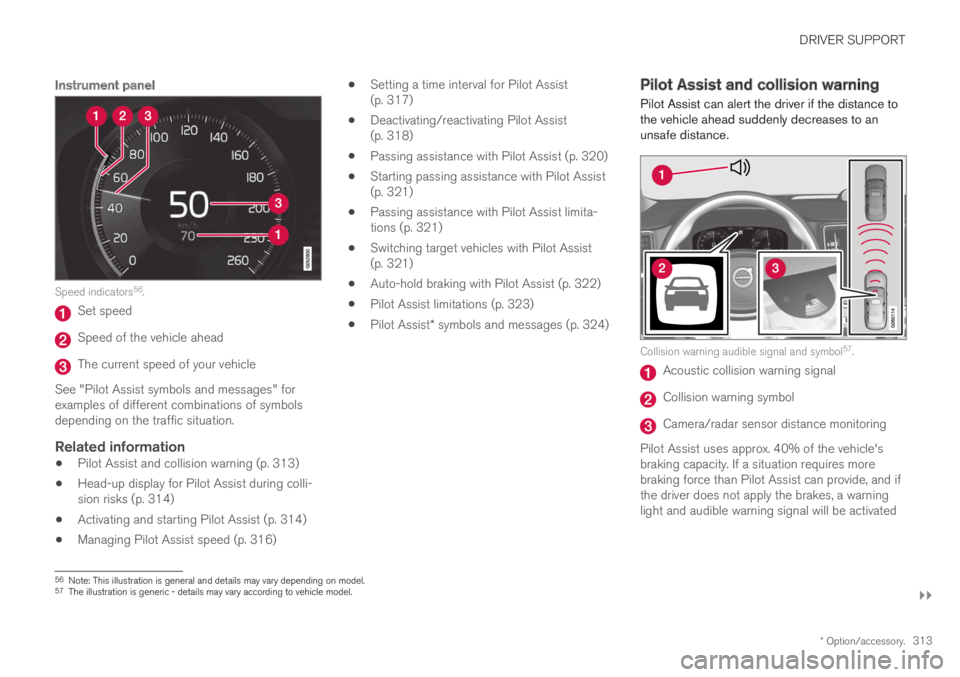
Instrument panel
Speed indicators56.
Set speed
Speed of the vehicle ahead
The current speed of your vehicle
See "Pilot Assist symbols and messages" forexamples of different combinations of symbolsdepending on the traffic situation.
Related information
Pilot Assist and collision warning (p. 313)
Head-up display for Pilot Assist during colli-sion risks (p. 314)
Activating and starting Pilot Assist (p. 314)
Managing Pilot Assist speed (p. 316)
Setting a time interval for Pilot Assist(p. 317)
Deactivating/reactivating Pilot Assist(p. 318)
Passing assistance with Pilot Assist (p. 320)
Starting passing assistance with Pilot Assist(p. 321)
Passing assistance with Pilot Assist limita-tions (p. 321)
Switching target vehicles with Pilot Assist(p. 321)
Auto-hold braking with Pilot Assist (p. 322)
Pilot Assist limitations (p. 323)
Pilot Assist* symbols and messages (p. 324)
Pilot Assist and collision warning
Pilot Assist can alert the driver if the distance tothe vehicle ahead suddenly decreases to anunsafe distance.
Collision warning audible signal and symbol57.
Acoustic collision warning signal
Collision warning symbol
Camera/radar sensor distance monitoring
Pilot Assist uses approx. 40% of the vehicle'sbraking capacity. If a situation requires morebraking force than Pilot Assist can provide, and ifthe driver does not apply the brakes, a warninglight and audible warning signal will be activated
56Note: This illustration is general and details may vary depending on model.57The illustration is generic - details may vary according to vehicle model.
Page 319 of 695
DRIVER SUPPORT
}}
* Option/accessory.317
Setting a time interval for PilotAssist
Pilot Assist can be set to different time intervals.
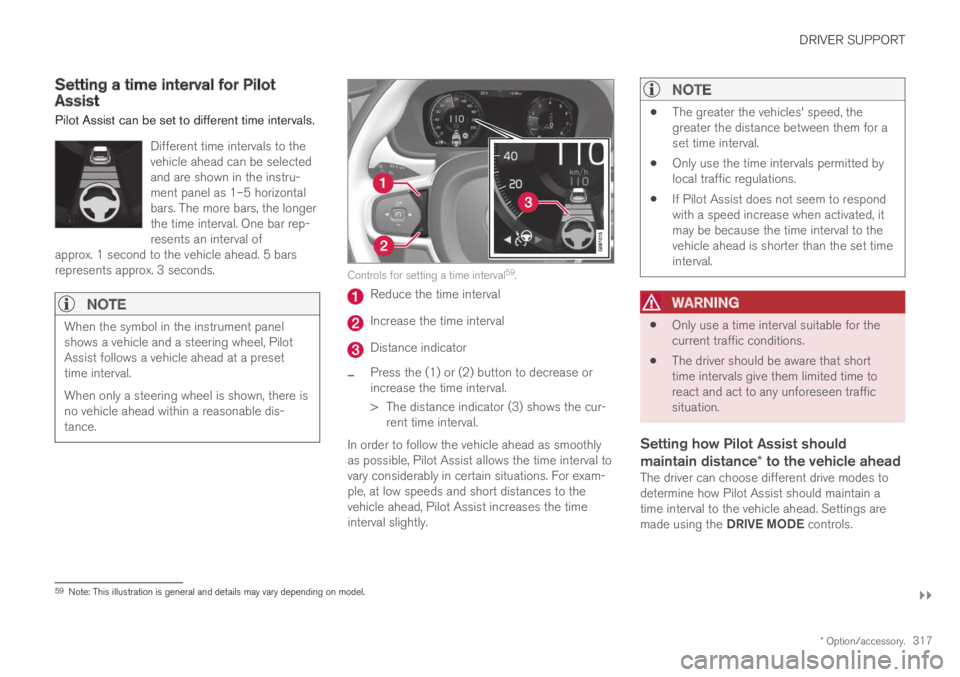
Different time intervals to thevehicle ahead can be selectedand are shown in the instru-ment panel as 1–5 horizontalbars. The more bars, the longerthe time interval. One bar rep-resents an interval ofapprox. 1 second to the vehicle ahead. 5 barsrepresents approx. 3 seconds.
NOTE
When the symbol in the instrument panelshows a vehicle and a steering wheel, PilotAssist follows a vehicle ahead at a presettime interval.
When only a steering wheel is shown, there isno vehicle ahead within a reasonable dis-tance.
Controls for setting a time interval59.
Reduce the time interval
Increase the time interval
Distance indicator
–Press the (1) or (2) button to decrease orincrease the time interval.
>The distance indicator (3) shows the cur-rent time interval.
In order to follow the vehicle ahead as smoothlyas possible, Pilot Assist allows the time interval tovary considerably in certain situations. For exam-ple, at low speeds and short distances to thevehicle ahead, Pilot Assist increases the timeinterval slightly.
NOTE
The greater the vehicles' speed, thegreater the distance between them for aset time interval.
Only use the time intervals permitted bylocal traffic regulations.
If Pilot Assist does not seem to respondwith a speed increase when activated, itmay be because the time interval to thevehicle ahead is shorter than the set timeinterval.
WARNING
Only use a time interval suitable for thecurrent traffic conditions.
The driver should be aware that shorttime intervals give them limited time toreact and act to any unforeseen trafficsituation.
Setting how Pilot Assist should
maintain distance * to the vehicle ahead
The driver can choose different drive modes todetermine how Pilot Assist should maintain atime interval to the vehicle ahead. Settings aremade using the DRIVE MODE controls.
59Note: This illustration is general and details may vary depending on model.