light VOLVO XC70 2003 Repair Manual
[x] Cancel search | Manufacturer: VOLVO, Model Year: 2003, Model line: XC70, Model: VOLVO XC70 2003Pages: 257, PDF Size: 5.33 MB
Page 139 of 257

2003 VOLVO XC70
pattern, load-, speed-, traction-, temperature-, and treadwear rating. N\
ever drive on mixed tires, except
for brief periods when the temporary spare tire is in use.
Always use properly inflated tires of correct dimensions. Tire size and \
inflation pressures are shown on
the tire pressure label located inside the fuel filler door.
Tire Rotation
Volvo recommends rotating the tires every 7,500 miles (12,000 km). Tir\
es should be rotated front-to-
back/back-to-front only. Tires must maintain the same direction of rotat\
ion throughout their lifetime, and
should never be rotated from one side of the vehicle to the other.
Temporary Spare
The temporary spare tire is for temporary, low-speed, short-distance use\
only. Replace it with a full-
sized tire as soon as possible, in accordance with "Tire Rotation" above\
. Do not drive on the temporary
spare at speeds above 50 m.p.h. (80km/h) or for distances greater than\
50 miles (80 km).
Never install snow chains on a temporary spare.
pg. 95 Driving economy
Economical driving conserves natural resources
Better driving economy may be obtained by thinking ahead, avoiding rapid\
starts and stops and
adjusting the speed of your vehicle to immediate traffic conditions. Obs\
erve the following rules:
l Bring the engine to normal operating temperature as soon as possible by \
driving with a light foot on
the accelerator pedal for the first few minutes of operation. A cold eng\
ine uses more fuel and is subject
to increased wear.
l Whenever possible, avoid using the car for driving short distances. This\
does not allow the engine to
reach normal operating temperature.
l Drive carefully and avoid rapid acceleration and hard braking.
l Do not exceed posted speed limits.
l Avoid carrying unnecessary items (extra load) in the car.
l Maintain correct tire pressure. Check tire pressure regularly (when tir\
es are cold).
l Remove snow tires when threat of snow or ice has ended.
l Note that roof racks, ski racks, etc., increase air resistance and also \
fuel consumption.
l Avoid using automatic transmission kickdown feature unless necessary.
l Avoid using the air conditioning when it is not required. When engaged, \
the conditioner's compressor
places an additional load on the engine. However, at higher driving spee\
ds, fuel consumption will be
file:///K|/ownersdocs/2003/2003_XC70/03xc70_06a.htm (16 of 22)12/30/20\
06 4:18:00 PM
Page 143 of 257

The attachment brackets for the load carriers are located under the roof\
molding.
1 Make sure that th")
2003 VOLVO XC70
Load carrier attachment points
Attaching load carriers (models without rails)
The attachment brackets for the load carriers are located under the roof\
molding.
1 Make sure that the load carriers are placed in the right direction. Se\
e the mark on the decal under the
cover.
2 Press the guide lugs into the holes (1).
3 Carefully lower the opposite side of the load carrier to the roof.
4 Loosen the tightening wheel slightly. Slide the hook on the load carri\
er attachment into the attachment
bracket under the roof molding.
5 Turn the tightening wheel to secure the load carrier in the attachment\
bracket.
6 Repeat this procedure for the other load carrier attachments.
7 Check that the hooks on all four load carrier attachments are securely\
tightened in the respective
attachment brackets on the roof of the car.
8 Press down the covers.
Check periodically that the load carriers and load are properly secured.\
Reducing wind noise and improving fuel economy
To maximize fuel efficiency and minimize wind noise, Volvo recommends th\
at load carriers be removed
when not in use.
pg. 98 Load carriers (models with rails)
file:///K|/ownersdocs/2003/2003_XC70/03xc70_06a.htm (20 of 22)12/30/20\
06 4:18:00 PM
Page 147 of 257

2003 VOLVO XC70
Rear towing eyelet
Precautions when the car is in tow
l The steering wheel must be unlocked. Turn the ignition key to position I\
or II.
l The gear selector must be in position N.
l Maximum speed: 50 mph (80 km/h)
l Maximum distance with front wheels on ground: 50 miles (80 km).
l While the car is being towed, try to keep the tow rope taut at all times\
.
l Cars with an automatic transmission should only be towed in forward dire\
ction.
CAUTION:
l Please check with state and local authorities before attempting this typ\
e of towing, as vehicles being
towed are subject to regulations regarding maximum towing speed, length \
and type of towing device,
lighting, etc.
l If the car's battery is dead, do not attempt to start the vehicle by pus\
hing or pulling it as this will
damage the three-way catalytic converter(s). The engine must be jump s\
tarted using an auxiliary battery
(see
page 103).
l If the car is being towed on a flat bed truck, the towing eyelets must n\
ot be used to secure the car on
the flat bed. Consult the tow truck operator.
WARNING!
l Remember that the power brakes and power steering will not function when\
engine is not running.
The braking and steering systems will function but the brake pedal press\
ure required is 3 - 4 times
above normal and greater steering effort must be exerted.
l The towing eyelets must not be used for pulling another vehicle out of a\
ditch or for any similar
purpose involving severe strain.
l Do not use the towing eyelets to pull the car up onto a flat bed tow tru\
ck.
pg. 100 Vehicle towing information
file:///K|/ownersdocs/2003/2003_XC70/03xc70_06b.htm (2 of 10)12/30/200\
6 4:18:00 PM
Page 150 of 257

2003 VOLVO XC70
WARNING!
l Bumper-attached trailer hitches must not be used on Volvo's, nor should \
safety chains be attached
to the bumper.
l Trailer hitches attaching to the vehicle rear axle must not be used.
l Never connect a trailer's hydraulic brake system directly to the vehicle\
brake system, nor a trailer's
lighting system directly to the vehicle lighting system. Consult your ne\
arest authorized Volvo retailer
for correct installation.
l When towing a trailer, the trailer's safety wire must be correctly faste\
ned to the hole or hook
provided in the trailer hitch on the car. The safety wire should never b\
e fastened to or wound around
the drawbar ball.
NOTE:
l When parking the car with a trailer on a hill, apply the parking brake before putting the gear selector
in (P)ark. When starting on a hill, put the gear selector in (D)rive\
before releasing the parking brake.
l If you use the manual (Geartronic) shift positions while towing a trai\
ler, make sure the gear you select
does not put too much strain on the engine (using too high a gear).
l The drawbar assembly/trailer hitch may be certified for trailers that ar\
e heavier than the car is
designed to tow. Please adhere to Volvo's recommended trailer weights.
* When driving for prolonged periods at temperatures above 86° F (30\
° C), the maximum recommended
weight is 2000 lbs (900 kg).
pg. 102 Detachable trailer hitch (accessory) - installing/removing
A - ball holder, B - locking bolt, C - cotter pin, D - hitch assembly
Installing the ball holder
file:///K|/ownersdocs/2003/2003_XC70/03xc70_06b.htm (5 of 10)12/30/200\
6 4:18:00 PM
Page 153 of 257

2003 VOLVO XC70
Cold weather precautions
If you wish to check your car before the approach of cold weather, the f\
ollowing advice is worth noting:
l Make sure that the engine coolant contains 50 percent antifreeze. Any ot\
her mixture will reduce
freeze protection. This gives protection against freezing down to -31°\
F (-35°C). See section "Coolant".
The use of "recycled" antifreeze is not approved by Volvo. Different typ\
es of antifreeze must not
be mixed.
l Volvo recommends using only genuine Volvo antifreeze in your car's radia\
tor. Your local Volvo
retailer stocks plenty of Volvo engine coolant to protect your car durin\
g cold weather.
l Try to keep the fuel tank well filled - this prevents the formation of condensation in the tank. \
In
addition, in extremely cold weather conditions it is worthwhile to add f\
uel line de-icer before refueling.
l The viscosity of the engine oil is important. Oil with low viscosity (thinner oil) improves cold-
weather starting as well as decreasing fuel consumption while the engine\
is warming up. For winter use,
5W-30 oil, particularly the synthetic type *, is recommended. Be sure to\
use good quality oil but do not
use this cold-weather oil for hard driving or in warm weather. See section "Engine oil" for more
information.
l The load placed on the battery is greater during the winter since the windshield wipers, lighting, etc\
.
are used more often. Moreover, the capacity of the battery decreases as \
the temperature drops. In very
cold weather, a poorly charged battery can freeze and be damaged. It is \
therefore advisable to check the
state of charge more frequently and spray an anti-rust oil on the batter\
y posts.
l Volvo recommends the use of snow tires on all four wheels for winter dri\
ving - see section "Wheels
and tires".
l To prevent the washer fluid reservoir from freezing, add washer solvents\
containing antifreeze (see
page 130 for the location of the washer fluid reservoir). This is important sin\
ce dirt is often splashed on
the windshield during winter driving, requiring the frequent use of the \
washers and wipers. The Volvo
Washer Solvent should be diluted as follows:
Down to 14° F (-10° C): 1 part washer solvent and 4 parts water \
Down to 5° F (-15° C): 1 part washer solvent and 3 parts water
Down to 0° F (-18° C): 1 part washer solvent and 2 parts water
Down to -18° F (-28° C): 1 part washer solvent and 1 part water \
l Use Volvo Teflon Lock Spray in the locks.
NOTE: Avoid the use of de-icing sprays as they can cause damage to the locks.
W Winter/Wet driving mode - enhanced vehicle traction
l Mode W will only function if the gear selector is in the (D)rive posit\
ion.
l Press the button at the base of the gear selector to engage/disengage th\
is driving mode (see
illustration).
l An LED in the button will light up to indicate that W is engaged and this will also be displayed in the
instrument panel (see
page 27).
l This mode may be selected for starting/moving off on slippery roads.
file:///K|/ownersdocs/2003/2003_XC70/03xc70_06b.htm (8 of 10)12/30/200\
6 4:18:00 PM
Page 154 of 257

2003 VOLVO XC70
pg. 105 Long distance trips
Before a long distance trip
It is always worthwhile to have your car checked at a Volvo retailer bef\
ore driving long distances. Your
retailer will also be able to supply you with bulbs, fuses, spark plugs \
and wiper blades for your use in the
event that problems occur.
As a minimum, the following items should be checked before any long trip\
:
l Check that engine runs smoothly and that fuel consumption is normal.
l Check for fuel, oil, and fluid leakage.
l Check condition of accessory drive belts.
l Check transmission oil level*.
l Check state of the battery's charge.
l Examine tires carefully (the spare tire as well), and replace those th\
at are worn. Check tire pressures.
l The brakes, front wheel alignment, and steering gear should be checked b\
y your Volvo retailer only.
l Check all lights, including high beams.
l Reflective warning triangles are legal requirement in some countries.
l Have a word with your Volvo retailer if you intend to drive in countries\
where it may be difficult to
obtain the correct fuel.
l Consider your destination. If you will be driving through an area where \
snow or ice are likely to
occur, consider snow tires.
* To prevent injury from contact with hot surfaces, do not inspect your \
car's transmission fluid yourself.
Have your car's transmission fluid level inspected by a qualified Volvo \
service technician.
pg. 106 Three-way catalytic converters
file:///K|/ownersdocs/2003/2003_XC70/03xc70_06b.htm (9 of 10)12/30/200\
6 4:18:00 PM
Page 157 of 257
 and
preferably from the same manufacturer, on all four wheels. Do not use bi\
a")
2003 VOLVO XC70
four wheels. When replacing tires, be sure that the new tires are the same dimensio\
ns, type (radial) and
preferably from the same manufacturer, on all four wheels. Do not use bi\
as ply tires. Otherwise there is a
risk of altering the car's roadholding and handling characteristics.
NOTE: When storing wheel/tire assemblies (e.g. snow tires and wheels), eith\
er stand the assemblies
upright, or suspend them off the ground. Laying wheel/tire assemblies on\
their sides for prolonged
periods can cause wheel and/or tire damage.
Wear indicator
The tires have wear indicator strips running across or parallel to the t\
read. When approx. 1/16" (1.6 mm)
is left on the tread, these strips become visible and indicate that the \
tire should be replaced.
Tires with less than 1/16" (1.6 mm) tread have very poor grip in rain \
or snow.
To improve tire economy:
l Maintain correct tire pressure. See the tire pressure label on the insid\
e of the fuel filler door.
l Drive smoothly: avoid fast starts, hard braking and tire screeching.
l Tire wear increases with speed.
l Correct front wheel alignment is very important.
l Unbalanced wheels impair tire economy and driving comfort.
l Volvo does not recommend rotating the tires. However, if tires are rotat\
ed, they must be kept on the
same side of the car so that they revolve in the same direction as befor\
e rotation.
l Hitting curbs or potholes can damage the tires and/or wheels permanently\
.
Flat spots
All tires become warm during use. After cooling, when the vehicle is par\
ked, the tires have a tendency to
distort slightly, forming flat spots. These flat spots can cause vibrati\
ons similar to the vibrations caused
by unbalanced wheels. They do, however, disappear when the tire warms up\
. The degree to which flat
spots form depends on the type of cord used in the tire. Remember that, \
in cold weather, it takes longer
for the tire to warm up and consequently longer for the flat spot to dis\
appear.
CAUTION: The car must not be driven with wheels of different dimensions/specific\
ations or with a
spare tire other than the one that came with the car. The use of differe\
nt size wheels can seriously
damage your car's transmission or driveline.
pg. 109 Wheels and tires
file:///K|/ownersdocs/2003/2003_XC70/03xc70_07.htm (2 of 10)12/30/2006\
4:18:01 PM
Page 169 of 257
2003 VOLVO XC70
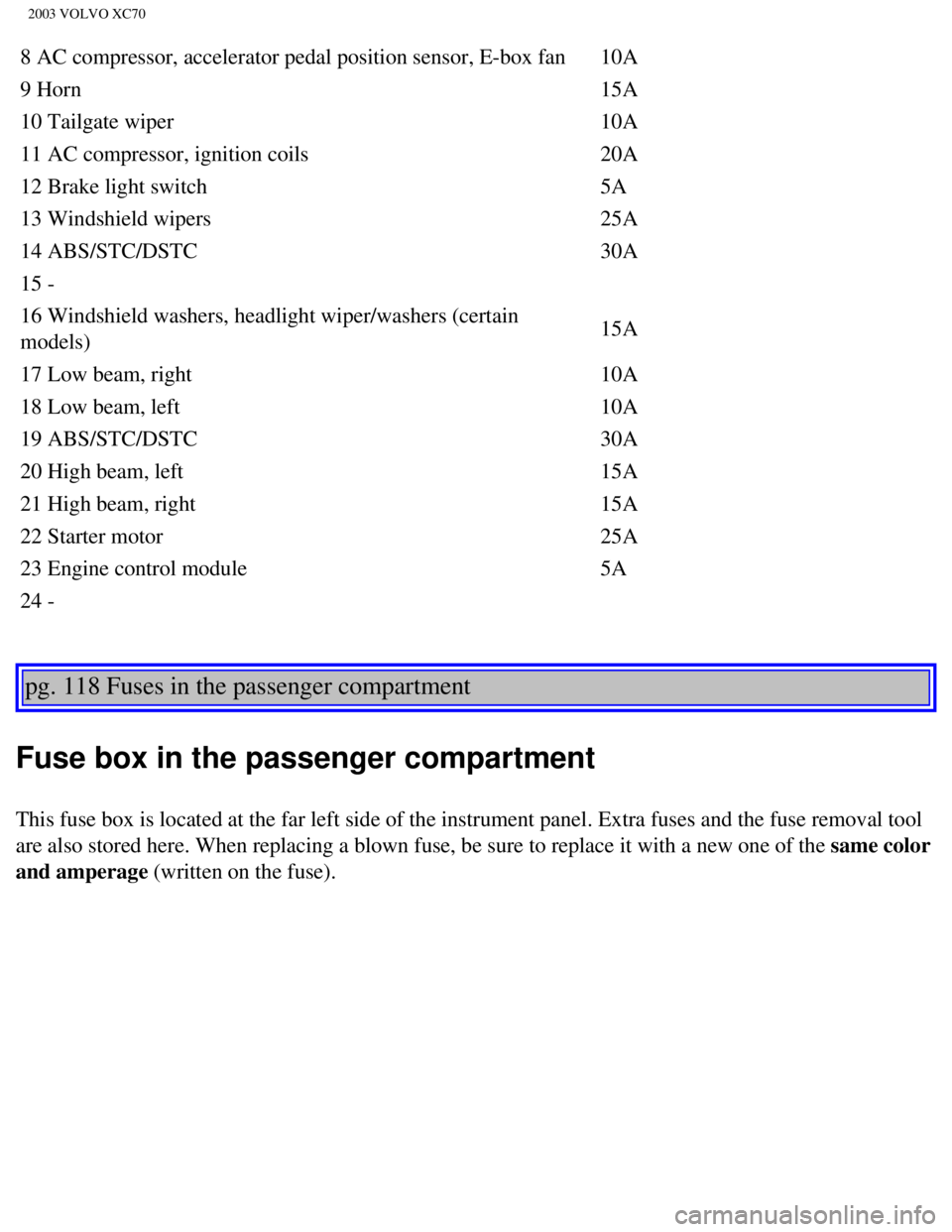
8 AC compressor, accelerator pedal position sensor, E-box fan 10A
9 Horn 15A
10 Tailgate wiper 10A
11 AC compressor, ignition coils 20A
12 Brake light switch 5A
13 Windshield wipers 25A
14 ABS/STC/DSTC 30A
15 -
16 Windshield washers, headlight wiper/washers (certain
models) 15A
17 Low beam, right 10A
18 Low beam, left 10A
19 ABS/STC/DSTC 30A
20 High beam, left 15A
21 High beam, right 15A
22 Starter motor 25A
23 Engine control module 5A
24 -
pg. 118 Fuses in the passenger compartment
Fuse box in the passenger compartment
This fuse box is located at the far left side of the instrument panel. E\
xtra fuses and the fuse removal tool
are also stored here. When replacing a blown fuse, be sure to replace it\
with a new one of the same color
and amperage (written on the fuse).
file:///K|/ownersdocs/2003/2003_XC70/03xc70_08a.htm (4 of 21)12/30/200\
6 4:18:03 PM
Page 170 of 257
2003 VOLVO XC70
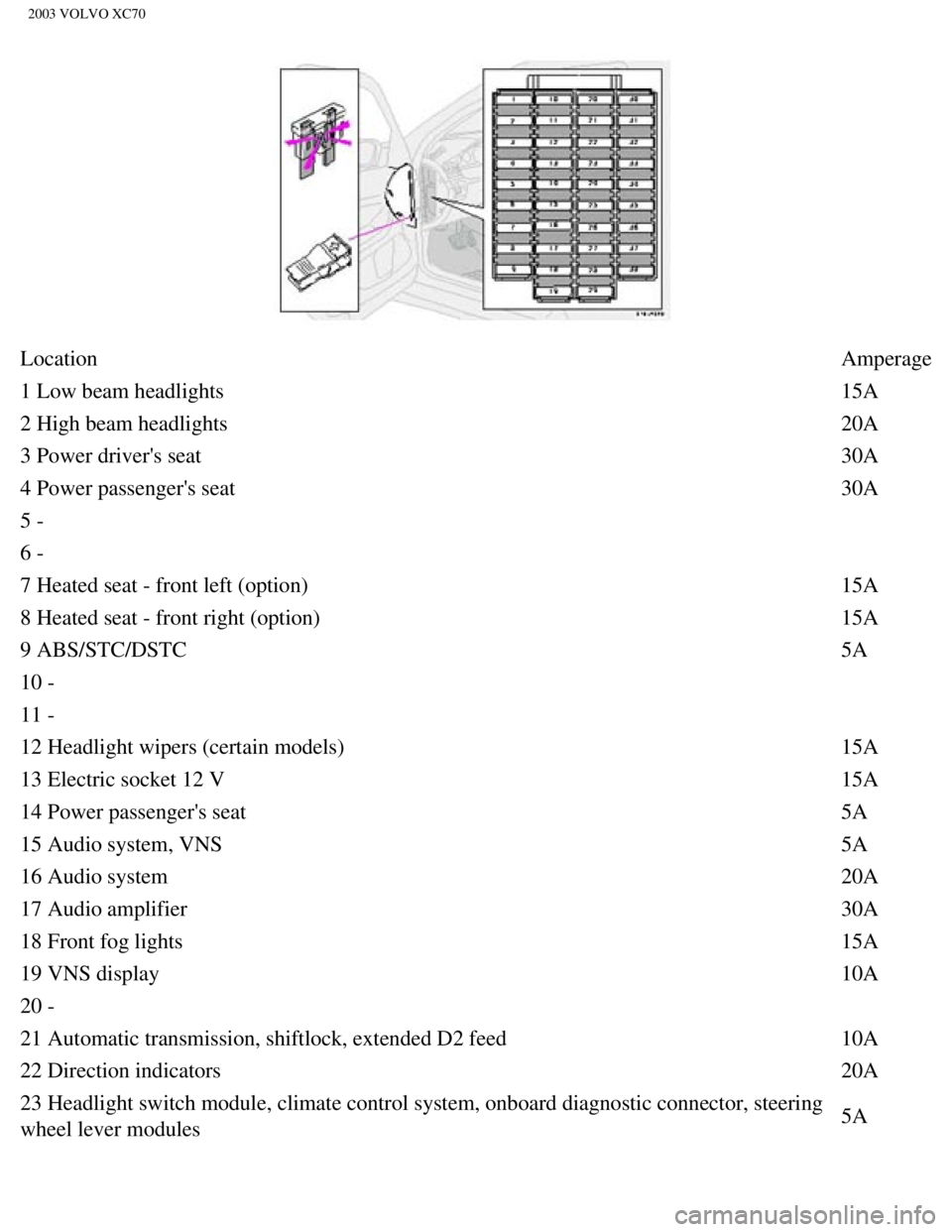
Location Amperage
1 Low beam headlights 15A
2 High beam headlights 20A
3 Power driver's seat 30A
4 Power passenger's seat 30A
5 -
6 -
7 Heated seat - front left (option) 15A
8 Heated seat - front right (option) 15A
9 ABS/STC/DSTC 5A
10 -
11 -
12 Headlight wipers (certain models) 15A
13 Electric socket 12 V 15A
14 Power passenger's seat 5A
15 Audio system, VNS 5A
16 Audio system 20A
17 Audio amplifier 30A
18 Front fog lights 15A
19 VNS display 10A
20 -
21 Automatic transmission, shiftlock, extended D2 feed 10A
22 Direction indicators 20A
23 Headlight switch module, climate control system, onboard diagnostic c\
onnector, steering
wheel lever modules 5A
file:///K|/ownersdocs/2003/2003_XC70/03xc70_08a.htm (5 of 21)12/30/200\
6 4:18:03 PM
Page 171 of 257

2003 VOLVO XC70
24 Relay for extended D1 feed: climate control system, power driver's se\
at, driver's info 10A
25 Ignition switch, relay starter motor, SRS, engine control module 10A
26 Climate control system blower 30A
27 -
28 Electronic module - courtesy lighting 10A
29 -
30 Left front/rear parking lights 7.5A
31 Right front/rear parking lights, license plate lights 7.5A
32 Central electrical module, vanity mirror lighting, power steering, gl\
ove compartment
light, interior courtesy lighting 10A
33 Fuel pump 15A
34 Power sun roof 15A
35 Central locking system, power windows - left door mirror 25A
36 Central locking system, power windows - right door mirror 25A
37 Rear power windows, power child safety 30A
38 Alarm siren 5A
* Please be aware that if this fuse is not intact, or if it is removed, \
the alarm will sound.
pg. 119 Fuses in the cargo area
Fuses in the cargo area
The fuses in the cargo area are located on the trim on the left-hand sid\
e. When replacing a blown fuse,
be sure to replace it with a new one of the same color and amperage (wr\
itten on the fuse).
file:///K|/ownersdocs/2003/2003_XC70/03xc70_08a.htm (6 of 21)12/30/200\
6 4:18:03 PM