weight VOLVO XC90 2006 User Guide
[x] Cancel search | Manufacturer: VOLVO, Model Year: 2006, Model line: XC90, Model: VOLVO XC90 2006Pages: 256, PDF Size: 6.87 MB
Page 30 of 256

2006 VOLVO XC90
Some restraint systems for children are designed to be secured in the ve\
hicle by lap belts or the lap
portion of a lap-shoulder belt. Such child restraint systems can help pr\
otect children in cars in the event
of an accident only if they are used properly. However, children could b\
e endangered in a crash if the
child restraints are not properly secured in the vehicle. Failure to fol\
low the installation instructions for
your child restraint can result in your child striking the vehicle's int\
erior in a sudden stop.
Holding a child in your arms is NOT a suitable substitute for a child re\
straint system. In an accident, a
child held in a person's arms can be crushed between the vehicle's inter\
ior and an unrestrained person.
The child could also be injured by striking the interior, or by being ej\
ected from the vehicle during a
sudden maneuver or impact. The same can also happen if the infant or chi\
ld rides unrestrained on the
seat. Other occupants should also be properly restrained to help reduce \
the chance of injuring or
increasing the injury of a child.
All states and provinces have legislation governing how and where childr\
en should be carried in a car.
Find out the regulations existing in your state or province. Recent acci\
dent statistics have shown that
children are safer in rear seating positions than front seating position\
s when properly restrained. A child
restraint system can help protect a child in a vehicle. Here's what to l\
ook for when selecting a child
restraint system:
l It should have a label certifying that it meets applicable Federal Motor\
Vehicle Safety Standards
(FMVSS 213) - or in Canada, CMVSS 213.
l Make sure the child restraint system is approved for the child's height,\
weight and development - the
label required by the standard or regulation, or instructions for infant\
restraints, typically provide this
information.
l In using any child restraint system, we urge you to carefully look over \
the instructions that are
provided with the restraint. Be sure you understand them and can use the\
device properly and safely in
this vehicle. A misused child restraint system can result in increased i\
njuries for both the infant or child
and other occupants in the vehicle.
When a child has outgrown the child safety seat, you should use the rear\
seat with the standard seat belt
fastened. The best way to help protect the child here is to place the ch\
ild on a cushion so that the seat
belt is properly located on the hips (see the illustration on
page 18). Legislation in your state or province
may mandate the use of a child seat or cushion in combination with the s\
eat belt, depending on the
child's age and/or size. Please check local regulations.
A specially designed and tested booster cushion (not available in Canad\
a) can be obtained from your
Volvo retailer for children weighing 33 - 80 lb. (15 - 36 kg) and 38-5\
4 inches (97 - 137 cm) in height.
file:///K|/ownersdocs/2006/2006_XC90/06xc90_01b.htm (6 of 11)12/30/200\
6 5:32:37 PM
Page 95 of 256

2006 VOLVO XC90
pg. 71 Interior
Securing cargo
Securing cargo
As a safety precaution, all cargo in your vehicle should be securely anc\
hored to keep it from being thrown forward in the
event of sudden braking, etc. The vehicle is equipped with eyelets in th\
e cargo space to which straps or other cargo
restraints can be attached.
WARNING!
The eyelets are not to be used as passenger restraints or as anchorages \
for child
restraints.
Consult your Volvo retailer about suitable accessories for this purpose.\
Remember that an object weighing 44 lbs (20 kg) produces a force of 2,\
200 lbs (1,000 kg) in a head-on collision at 30
mph (50 km/h)!
Keep the following in mind when loading the vehicle:
l The load carrying capacity of your vehicle is determined by factors such\
as the number of passengers, the amount of
cargo, the weight of any accessories that may be installed, etc. See the\
section "Vehicle loading" in the chapter "Wheel and
tires" for more detailed information.
l Load the cargo against the backrest.
l Load heavy cargo as low as possible.
l If no one is sitting in the outboard rear seat(s), reinforce the backr\
est by fastening the seat belts.
l Never load cargo above the backrest without a cargo net.
WARNING!
When the rear backrest(s) are folded down, the vehicle should not be l\
oaded to a level higher than 2 in. (5 cm) below the
upper edge of the rear side windows. Objects placed higher than this lev\
el could impede the function of the Inflatable
Curtain.
pg. 72 Interior
file:///K|/ownersdocs/2006/2006_XC90/06xc90_04b.htm (5 of 9)12/30/2006\
5:32:42 PM
Page 121 of 256

2006 VOLVO XC90
l Remove snow tires when threat of snow or ice has ended.
l Note that roof racks, ski racks, etc, increase air resistance and also f\
uel consumption.
l At highway driving speeds, fuel consumption will be lower with the air c\
onditioning on and the
windows closed than with the air conditioning off and the windows open. \
l Using the onboard trip computer's fuel consumption modes can help you le\
arn how to drive more
economically.
Other factors that decrease gas mileage are:
l Dirty air cleaner
l Dirty engine oil and clogged oil filter
l Dragging brakes
l Incorrect front end alignment
Some of the above mentioned items and others are checked at the standard\
Maintenance intervals.
Weight distribution affects handling
At the specified curb weight your vehicle has a tendency to understeer, \
which means that the steering
wheel has to be turned more than might seem appropriate for the curvatur\
e of a bend. This ensures good
stability and reduces the risk of rear wheel skid. Remember that these p\
roperties can alter with the
vehicle load. The heavier the load in the cargo area, the less the tende\
ncy to understeer.
WARNING!
Driving with the tailgate open: Driving with the tailgate open could lead to poisonous exhaust gases
entering the passenger compartment. If the tailgate must be kept open fo\
r any reason, proceed as
follows
- Close the windows
- Set the ventilation system control to air flow to floor, windshield an\
d side windows and blower
control to its highest setting.
CAUTION
Drive slowly and carefully if going through standing water (i.e. floode\
d roadways, etc.). Damage to
the engine could result if excess water is drawn in through the air inta\
ke system. Never drive the
vehicle in water deeper than 18 inches (48 cm).
pg. 92 Starting and driving
General information (contd)
Handling, roadholding
file:///K|/ownersdocs/2006/2006_XC90/06xc90_06a.htm (9 of 14)12/30/200\
6 5:32:45 PM
Page 122 of 256

2006 VOLVO XC90
Vehicle load, tire design and inflation pressure all affect vehicle hand\
ling. Therefore, check that the tires
are inflated to the recommended pressure according to the vehicle load. \
See "Tire pressure" section.
Loads should be distributed so that capacity weight or maximum permissib\
le axle loads are not exceeded.
Driving on rough/unpaved surfaces
The Volvo XC90 is designed primarily for onroad driving, and it has exce\
llent handling characteristics
on very rough or unpaved roads.
When driving on poorly maintained or unpaved roads, please keep the foll\
owing in mind:
l Reduce speed on rough surfaces to minimize possible damage to the vehicl\
e's underbody.
l When driving on soft surfaces such as dry sand or snow, try to avoid sto\
pping if at all possible.
WARNING!
Avoid driving diagonally across steep inclines as this could increase th\
e risk of a roll-over. Try to
drive straight up or down the slope.
If the road is very steep, avoid turning the vehicle around to help avoi\
d the risk of rolling over. Back
the vehicle up or down the incline instead.
NOTE: Avoid driving on steep inclines if the fuel tank is nearly empty. If the\
flow of fuel to the engine
is interrupted due to the vehicle's angle of inclination, this could res\
ult in damage to the three-way
catalytic converter. We recommend keeping the fuel tank at least half fu\
ll when driving on steep inclines.
Driving through water
l The vehicle should not be driven through water that is deeper than 18 in\
ches (48 cm). Driving through
deeper water could result in damage to transmission components or the di\
fferential, or to the engine if
excess water is drawn in through the air intake system.
l Drive slowly and avoid stopping when driving through water.
l After having driven through water, apply the brakes lightly several time\
s to remove water, mud, etc
from the brake discs.
l Never allow the vehicle to stand in water above the door sills. This cou\
ld result in damage to the
electrical system.
Conserving electrical current
Keep the following in mind to help minimize battery drain:
l When the engine is not running, avoid turning the ignition key to positi\
on II (see page 90). Many
electrical systems (the audio system, the optional infotainment/navigat\
ion systems, power windows, etc)
will function with the ignition key in position I. This position reduces\
drain on the battery.
l Please keep in mind that using systems, accessories, etc that consume a \
great deal of current when the
engine is not running could result in the battery being completely drain\
ed.
file:///K|/ownersdocs/2006/2006_XC90/06xc90_06a.htm (10 of 14)12/30/20\
06 5:32:45 PM
Page 137 of 256

2006 VOLVO XC90
WARNING!
- Do not connect the jumper cable to any part of the fuel system or to a\
ny moving parts. Avoid
touching hot manifolds.
Never expose the battery to open flame or electric spark.
- Do not smoke near the battery.
- Batteries generate hydrogen gas, which is flammable and explosive.
- Battery fluid contains sulphuric acid. Do not allow battery fluid to c\
ontact eyes, skin, fabrics or
painted surfaces. If contact occurs, flush the affected area immediately\
with water. Obtain medical
help immediately if eyes are affected.
- Failure to follow the instructions for jump starting can lead to perso\
nal injury.
pg. 104 Starting and driving
Towing a trailer
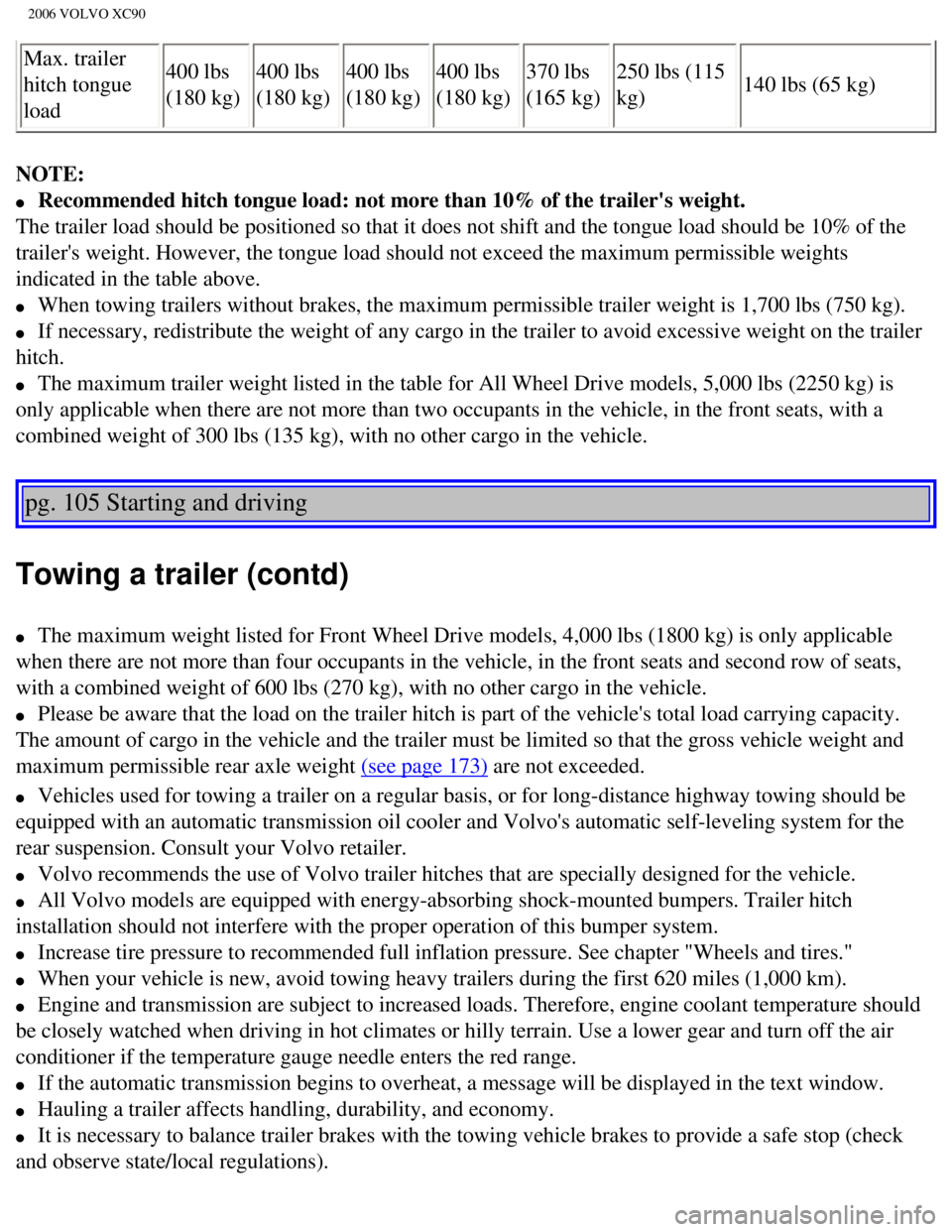
The maximum weights recommended by Volvo for trailers with brakes are sh\
own in the table below.
No. of
occupants 1
2 3 4 5 6 7
Seating
position Front
seat Front
seat 2nd row
of seats2nd row
of seats2nd row
of seatsOptional 3rd
row of seats Optional 3rd row of
seats
All Wheel
Drive 5,000
lbs
(2250
kg)5,000
lbs
(2250
kg)4,500
lbs
(2050
kg)3,700
lbs
(1700
kg)2,900
lbs
(1350
kg)
1,800 lbs
(800 kg)
Trailer towing not
recommended
Max. trailer
hitch tongue
load 500 lbs
(225 kg)
500 lbs
(225 kg)450 lbs
(205 kg)370 lbs
(170 kg)290 lbs
(135 kg)180 lbs (80
kg)
-
Front Wheel
Drive 4,000
lbs
(1800
kg)4,000
lbs
(1800
kg)4,000
lbs
(1800
kg)4,000
lbs
(1800
kg)3,700
lbs
(1650
kg)
2,500 lbs
(1150 kg)
1,400 lbs (650 kg)
file:///K|/ownersdocs/2006/2006_XC90/06xc90_06b.htm (11 of 18)12/30/20\
06 5:32:46 PM
Page 138 of 256
2006 VOLVO XC90
Max. trailer
hitch tongue
load400 lbs
(180 kg)
400 lbs
(180 kg)400 lbs
(180 kg)400 lbs
(180 kg)370 lbs
(165 kg)250 lbs (115
kg)
140 lbs (65 kg)
NOTE:
l Recommended hitch tongue load: not more than 10% of the trailer's weight\
.
The trailer load should be positioned so that it does not shift and the \
tongue load should be 10% of the
trailer's weight. However, the tongue load should not exceed the maximum\
permissible weights
indicated in the table above.
l When towing trailers without brakes, the maximum permissible trailer wei\
ght is 1,700 lbs (750 kg).
l If necessary, redistribute the weight of any cargo in the trailer to avo\
id excessive weight on the trailer
hitch.
l The maximum trailer weight listed in the table for All Wheel Drive model\
s, 5,000 lbs (2250 kg) is
only applicable when there are not more than two occupants in the vehicl\
e, in the front seats, with a
combined weight of 300 lbs (135 kg), with no other cargo in the vehicl\
e.
pg. 105 Starting and driving
Towing a trailer (contd)
l The maximum weight listed for Front Wheel Drive models, 4,000 lbs (1800\
kg) is only applicable
when there are not more than four occupants in the vehicle, in the front\
seats and second row of seats,
with a combined weight of 600 lbs (270 kg), with no other cargo in the\
vehicle.
l Please be aware that the load on the trailer hitch is part of the vehicl\
e's total load carrying capacity.
The amount of cargo in the vehicle and the trailer must be limited so th\
at the gross vehicle weight and
maximum permissible rear axle weight
(see page 173) are not exceeded.
l Vehicles used for towing a trailer on a regular basis, or for long-dista\
nce highway towing should be
equipped with an automatic transmission oil cooler and Volvo's automatic\
self-leveling system for the
rear suspension. Consult your Volvo retailer.
l Volvo recommends the use of Volvo trailer hitches that are specially des\
igned for the vehicle.
l All Volvo models are equipped with energy-absorbing shock-mounted bumper\
s. Trailer hitch
installation should not interfere with the proper operation of this bump\
er system.
l Increase tire pressure to recommended full inflation pressure. See chapt\
er "Wheels and tires."
l When your vehicle is new, avoid towing heavy trailers during the first 6\
20 miles (1,000 km).
l Engine and transmission are subject to increased loads. Therefore, engin\
e coolant temperature should
be closely watched when driving in hot climates or hilly terrain. Use a \
lower gear and turn off the air
conditioner if the temperature gauge needle enters the red range.
l If the automatic transmission begins to overheat, a message will be disp\
layed in the text window.
l Hauling a trailer affects handling, durability, and economy.
l It is necessary to balance trailer brakes with the towing vehicle brakes\
to provide a safe stop (check
and observe state/local regulations).
file:///K|/ownersdocs/2006/2006_XC90/06xc90_06b.htm (12 of 18)12/30/20\
06 5:32:46 PM
Page 142 of 256
\
, including the weight of the
load carriers and any other load carrying equipment (ski boxes, bicycl")
2006 VOLVO XC90
WARNING!
Loads carried on the vehicle's roof should not exceed 220 lbs (100 kg)\
, including the weight of the
load carriers and any other load carrying equipment (ski boxes, bicycle\
racks, etc.). Excessive loads
on the roof can adversely affect the handling and roadholding characteri\
stics of the vehicle.
Load carrier cover
The vehicle's ignition key or the stud on the edge of the supplied torqu\
e wrench can be used to undo or
tighten the cover. Turn a quarter turn (90 degrees). See illustration.\
pg. 108 Starting and driving
Cold weather precautions
If you wish to check your vehicle before the approach of cold weather, t\
he following advice is worth
noting:
l Make sure that the engine coolant contains 50 percent antifreeze. Any ot\
her mixture will reduce
freeze protection. This gives protection against freezing down to -31°\
F (-35°C). See section "Coolant".
The use of "recycled" antifreeze is not approved by Volvo. Different typ\
es of antifreeze must not
be mixed.
l Volvo recommends using only genuine Volvo antifreeze in your vehicle's r\
adiator. Your Volvo
retailer stocks plenty of Volvo engine coolant to help protect your vehi\
cle during cold weather.
l Try to keep the fuel tank well filled - this prevents the formation of condensation in the tank. \
In
addition, in extremely cold weather conditions it is worthwhile to add f\
uel line de-icer before refueling.
l The viscosity of the engine oil is important. Oil with low viscosity (thinner oil) improves cold-
weather starting as well as decreasing fuel consumption while the engine\
is warming up. For winter use,
5W-30 oil, particularly the synthetic type*, is recommended. Be sure to \
use good quality oil but do not
use cold-weather oil for hard driving or in warm weather. See section "E\
ngine oil" for more information.
l The load placed on the battery is greater during the winter since the windshield wipers, lighting, etc\
.
file:///K|/ownersdocs/2006/2006_XC90/06xc90_06b.htm (16 of 18)12/30/20\
06 5:32:46 PM
Page 158 of 256

61 (420)
a. These weights include the weight of all occupants of the car plus car\
go.
Optional tire pressure. These inflation pressures may")
2006 VOLVO XC90
Temporary spare tire
T155/85R18 61 (420)
61 (420)
a. These weights include the weight of all occupants of the car plus car\
go.
Optional tire pressure. These inflation pressures may only be used when \
the vehicle is not fully loaded. Optional cold tire pressure that may only be used for vehicle loads up t\
o 495 lbs (225 kg).
Tire size Front, psi (kPa) Rear, psi (kPa)
XC90
225/70R16
235/65R17
235/60R18
255/50R19 32 (220)
32 (220)
Temporary spare tire
T155/85R18 61 (420)
61 (420)
NOTE: The optional tire pressure shown in the table above may not be used on \
XC90s equipped with
the Tire Pressure Monitoring System (option as available). Vehicles wi\
th this system must use the
standard tire pressure listed in the table in the left column (39 psi/2\
70 kPa).
pg. 117 Wheels and tires
Tire Pressure Monitoring System (TPMS) - option on certain U.S. models\
only
The tire pressure monitoring system uses sensors mounted in the tire val\
ves to check inflation pressure
levels. When the vehicle is moving at a speed of 20 mph (30 km/h) or f\
aster, these sensors transmit
inflation pressure data to a receiver located in the vehicle.
USA - FCC ID: MRXTG315AM04
This device complies with part 15 of the FCC rules. Operation is subject\
to the following conditions: (1)
This device may not cause harmful interference, and (2) this device mu\
st accept any interference
received, including interference that may cause undesired operation.
file:///K|/ownersdocs/2006/2006_XC90/06xc90_08.htm (7 of 22)12/30/2006\
5:32:49 PM
Page 162 of 256
: This begins with the let\
ters \"DOT\" and indicates that the
tire meets all federal standards. The next two numbers or letters are th\
e")
2006 VOLVO XC90
8. U.S. DOT Tire Identification Number (TIN): This begins with the let\
ters "DOT" and indicates that the
tire meets all federal standards. The next two numbers or letters are th\
e plant code where it was
manufactured, the next two are the tire size code and the last four numb\
ers represent the week and year
the tire was built. For example, the numbers 317 mean the 31st week of 1\
997. After 2000 the numbers
go to four digits. For example, 2501 means the 25th week of 2001. The nu\
mbers in between are
marketing codes used at the manufacturer's discretion. This information \
helps a tire manufacturer
identify a tire for safety recall purposes.
9. Tire Ply Composition and Material Used: Indicates the number of plies\
indicates or the number of
layers of rubber-coated fabric in the tire tread and sidewall. Tire manu\
facturers also must indicate the
ply materials in the tire and the sidewall, which include steel, nylon, \
polyester, and others.
10. Maximum Load: Indicates the maximum load in pounds and kilograms tha\
t can be carried by the
tire. Refer to the vehicle's tire information placard or the safety cert\
ification label, located on the B-Pillar
or the driver's door or on the inside of the fuel filler door on Canadia\
n models, for the correct tire
pressure for your vehicle.
11. Treadwear, Traction, and Temperature grades: See
page 122 for more information.
12. Maximum permissible inflation pressure: the greatest amount of air p\
ressure that should ever be put
in the tire. This limit is set by the tire manufacturer.
pg. 120 Wheels and tires
Glossary of tire terminology
The tire suppliers may have additional markings, notes or warnings such \
as standard load, radial
tubeless, etc.
Glossary of tire terminology
l Tire information placard: A placard showing the OE (Original Equipment) tire sizes, recommende\
d
inflation pressure, and the maximum weight the vehicle can carry.
l Tire Identification Number (TIN): A number on the sidewall of each tire providing information
about the tire brand and manufacturing plant, tire size and date of manu\
facturer.
l Inflation pressure: A measure of the amount of air in a tire.
l Standard load: A class of P-metric or Metric tires designed to carry a maximum load a\
t 35 psi [37
psi (2.5 bar) for Metric tires]. Increasing the inflation pressure bey\
ond this pressure will not increase the
tires load carrying capability.
l Extra load: A class of P-metric or Metric tires designed to carry a heavier maximu\
m load at 41 psi
[43 psi (2.9 bar) for Metric tires]. Increasing the inflation pressure\
beyond this pressure will not increase
the tires load carrying capability.
l kPa: Kilopascal, a metric unit of air pressure.
file:///K|/ownersdocs/2006/2006_XC90/06xc90_08.htm (11 of 22)12/30/200\
6 5:32:49 PM
Page 163 of 256

2006 VOLVO XC90
l PSI: Pounds per square inch, a standard unit of air pressure.
l B-pillar: The structural member at the side of the vehicle behind the front door\
.
l Bead area of the tire: Area of the tire next to the rim.
l Sidewall of the tire: Area between the bead area and the tread.
l Tread area of the tire: Area of the perimeter of the tire that contacts the road when mounted \
on the
vehicle.
l Rim: The metal support (wheel) for a tire or a tire and tube assembly upo\
n which the tire beads are
seated.
l Maximum load rating: a figure indicating the maximum load in pounds and kilograms that can \
be
carried by the tire. This rating is established by the tire manufacturer\
.
l Maximum permissible inflation pressure: the greatest amount of air pressure that should ever be
put in the tire. This limit is set by the tire manufacturer.
l Recommended tire inflation pressure: inflation pressure, established by Volvo, which is based on
the type of tires that are mounted on a vehicle at the factory. This inf\
lation pressure is affected by the
number of occupants in the car, the amount of cargo, and the speed at wh\
ich the vehicle will be driven
for a prolonged period. This information can be found on the tire inflat\
ion placard(s) located on the
driver's side B-pillar or on the inside of the fuel filler door on Canad\
ian models, and in the tire inflation
table in this chapter.
l Cold tires: The tires are considered to be cold when they have the same temperatur\
e as the
surrounding (ambient) air. This temperature is normally reached after \
the car has been parked for at least
3 hours.
pg. 121 Wheels and tires
Vehicle loading
Properly loading your vehicle will provide maximum return of vehicle des\
ign performance. Before
loading your vehicle, familiarize yourself with the following terms for \
determining your vehicle's weight
ratings, with or without a trailer, from the vehicle's Federal/Canadian \
Motor Vehicle Safety Standards
(FMVSS/CMVSS) label, and the vehicle's tire information placard:
Curb weight
The weight of the vehicle including a full tank of fuel and all standard\
equipment. It does not include
passengers, cargo, or optional equipment.
Capacity weight
All weight added to the curb weight, including cargo and optional equipm\
ent. When towing, trailer hitch
tongue load is also part of cargo weight.
NOTE: For trailer towing information, please refer to the section "Towin\
g a trailer" on
page 104.
Permissible axle weight
file:///K|/ownersdocs/2006/2006_XC90/06xc90_08.htm (12 of 22)12/30/200\
6 5:32:49 PM