wheel VOLVO XC90 2006 User Guide
[x] Cancel search | Manufacturer: VOLVO, Model Year: 2006, Model line: XC90, Model: VOLVO XC90 2006Pages: 256, PDF Size: 6.87 MB
Page 51 of 256
2006 VOLVO XC90
Continuous high beams
l Turn the ignition key to position II.
l With the light switch (1) in position , (see page 29) pull the turn signal lever toward the
steering wheel (position 4) to toggle between high and low beams (thi\
s also applies on models equipped
with the optional Bi-Xenon headlights).
High beam flash
l Turn the ignition key to position II.
l Pull the turn signal lever to position 3. The high beams will remain on \
until the lever is released.
Home safe lighting
When you leave your car at night, you can make use of the home safe ligh\
ting function to illuminate the
area in front of the car.
l Remove the key from the ignition switch.
l Pull the direction indicator lever as far as possible towards the steeri\
ng wheel (to position 4) and
release it.
l Exit the car and lock the doors.
The headlights and parking lights will illuminate and remain on for 30
1, 60 or 90 seconds. The time
interval can be changed by an authorized Volvo retailer.
1. Factory setting
pg. 33 Instruments and controls
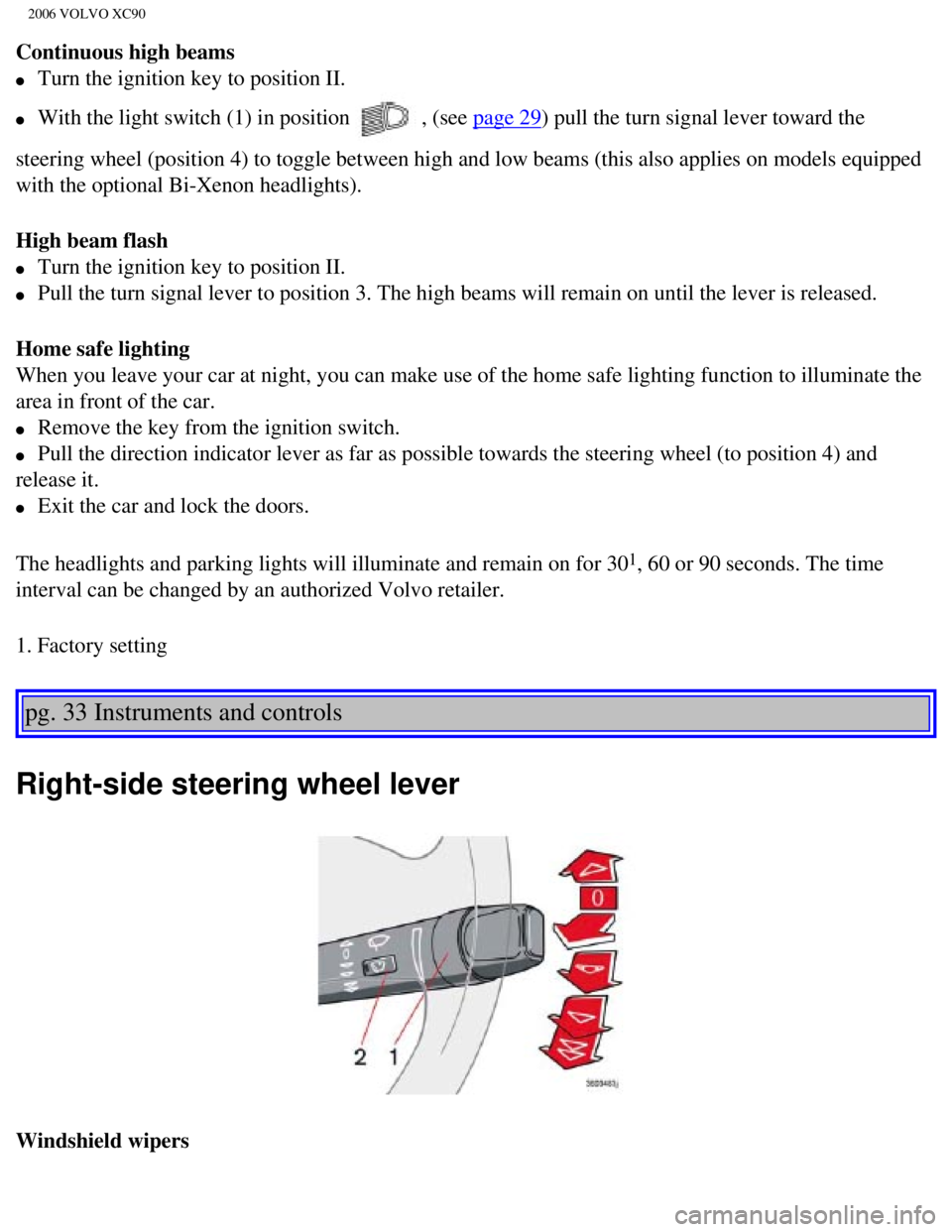
Right-side steering wheel lever
Windshield wipers
file:///K|/ownersdocs/2006/2006_XC90/06xc90_02a.htm (16 of 18)12/30/20\
06 5:32:38 PM
Page 59 of 256
.
Braking
l Cruise control is automatically disengaged when the brake pedal is depre\
ssed.")
2006 VOLVO XC90
NOTE: Cruise control will not function at speeds below approximately 20 mph (\
30 km/h).
Braking
l Cruise control is automatically disengaged when the brake pedal is depre\
ssed. The currently set speed
is stored in memory.
l Pressing resume will return the vehicle to the previously set speed.
Acceleration
Momentary acceleration, such as when passing another vehicle, does not a\
ffect cruise control operation.
The vehicle will automatically return to the previously set speed when y\
ou release the accelerator pedal.
Disengaging cruise control
To disengage cruise control, press the CRUISE button. CRUISE or CRUISE-O\
N will no longer be
displayed in the information window in the instrument panel.
NOTE: Cruise control is automatically disengaged if:
l the engine is switched off
l the gear selector is placed in (N)eutral
l the wheels start to spin or lock
l if an increase in speed is maintained for more than one minute
l if the vehicle's speed falls below approximately 20 mph (30 km/h).
Temporarily disengaging cruise control
l Press 0 to temporarily disengage cruise control. CRUISE will be displaye\
d in the information window
in the instrument panel.
l Press the brake pedal.
pg. 39 Instruments and controls
Press "resume"
to return to the previously set speed.
WARNING!
The Cruise control should not be used in heavy traffic or when driving o\
n wet or slippery roads, or
when driving on unpaved or uneven road surfaces. Cruise control may not \
maintain set speed on steep
downgrades.
pg. 40 Instruments and controls
file:///K|/ownersdocs/2006/2006_XC90/06xc90_02b.htm (6 of 17)12/30/200\
6 5:32:40 PM
Page 61 of 256

2006 VOLVO XC90
12-volt socket in the cargo compartment
If the ignition is switched off and a device drawing more than 0.1A is c\
onnected to a socket, a battery
warning will be displayed in the text window.
l The covers should be kept on when the auxiliary sockets are not in use. \
l Maximum current from the sockets is 15A.
Ashtrays/cigarette lighter
The auxiliary sockets can also be used for cigarette lighters.
Ashtrays and lighters are available as accessories. Please contact your \
Volvo retailer.
pg. 41 Instruments and controls
Parking brake, Opening/closing the hood
Parking brake
l To apply the parking brake, press the pedal (C). The brake is applied \
to the rear wheels. The indicator
light in the instrument panel will light up to indicate that the parking\
brake is applied.
file:///K|/ownersdocs/2006/2006_XC90/06xc90_02b.htm (8 of 17)12/30/200\
6 5:32:40 PM
Page 62 of 256

2006 VOLVO XC90
NOTE: There is also an audible signal that will sound if the car is driven wi\
th the parking brake
engaged.
l Release the parking brake pulling out the lower edge of the release hand\
le (A).
l If you inadvertently pull the plastic cover (B), it can be pressed bac\
k into place.
Opening the hood
WARNING!
Always use the parking brake when parking. On hills, also turn the front\
wheels toward the curb.The
indicator light in the instrument panel will light up even if the parkin\
g brake is applied only slightly.
Be sure to press down on the pedal sufficiently.
Opening/closing the hood
1. Pull the lever (1) located under the left side of the dashboard to \
release the hood lock.
2. Lift the hood slightly.
3. Press up the release control (2) located under the front edge of th\
e hood and lift.
To close the hood, place your hand on it and press down until the hood l\
ocks in the closed position.
WARNING!
l Do not grasp the ribs in the grille when closing the hood. If your finge\
rs protrude through the
grille, they could be injured on components in the engine compartment as\
the grille closes. We
recommend pressing down on the hood to close it.
l Check that the hood locks properly when closed!
pg. 42 Instruments and controls
file:///K|/ownersdocs/2006/2006_XC90/06xc90_02b.htm (9 of 17)12/30/200\
6 5:32:40 PM
Page 95 of 256

2006 VOLVO XC90
pg. 71 Interior
Securing cargo
Securing cargo
As a safety precaution, all cargo in your vehicle should be securely anc\
hored to keep it from being thrown forward in the
event of sudden braking, etc. The vehicle is equipped with eyelets in th\
e cargo space to which straps or other cargo
restraints can be attached.
WARNING!
The eyelets are not to be used as passenger restraints or as anchorages \
for child
restraints.
Consult your Volvo retailer about suitable accessories for this purpose.\
Remember that an object weighing 44 lbs (20 kg) produces a force of 2,\
200 lbs (1,000 kg) in a head-on collision at 30
mph (50 km/h)!
Keep the following in mind when loading the vehicle:
l The load carrying capacity of your vehicle is determined by factors such\
as the number of passengers, the amount of
cargo, the weight of any accessories that may be installed, etc. See the\
section "Vehicle loading" in the chapter "Wheel and
tires" for more detailed information.
l Load the cargo against the backrest.
l Load heavy cargo as low as possible.
l If no one is sitting in the outboard rear seat(s), reinforce the backr\
est by fastening the seat belts.
l Never load cargo above the backrest without a cargo net.
WARNING!
When the rear backrest(s) are folded down, the vehicle should not be l\
oaded to a level higher than 2 in. (5 cm) below the
upper edge of the rear side windows. Objects placed higher than this lev\
el could impede the function of the Inflatable
Curtain.
pg. 72 Interior
file:///K|/ownersdocs/2006/2006_XC90/06xc90_04b.htm (5 of 9)12/30/2006\
5:32:42 PM
Page 113 of 256
2006 VOLVO XC90
2 0 0 6
VOLVO XC90
Starting and driving
pg. 85 Starting and driving
Refueling86
Starting the vehicle89
General information91
Automatic transmission with Geartronic93
All Wheel Drive95
Brake system96
Dynamic Stability Traction Control (DSTC)98
Park assist100
Towing 101
Jump starting 103
Towing a trailer 104
Detachable trailer hitch - installing/
removing 106
Load carriers 107
Cold weather precautions 108
Before a long distance trip109
file:///K|/ownersdocs/2006/2006_XC90/06xc90_06a.htm (1 of 14)12/30/200\
6 5:32:44 PM
Page 117 of 256

2006 VOLVO XC90
engine with an adequate supply of fuel. Therefore, it is advisable to re\
fuel as soon as possible when the
needle nears the red zone, or when the fuel warning light comes on.
WARNING!
Never carry a cell phone that is switched on while refueling your vehicle. If the phone rings, this may
cause a spark that could ignite gasoline fumes, resulting in fire and in\
jury.
CAUTION
- Do not refuel with the engine running *. Turn the ignition off or to p\
osition I. If the ignition is on,
an incorrect reading could occur in the fuel gauge
- After refueling, close the fuel filler cap by turning it clockwise unt\
il it clicks into place*.
- Allow for fuel expansion by not overfilling the tank. Overfilling coul\
d also cause damage to the
emission control systems.
- Avoid spilling gasoline during refueling. In addition to causing damag\
e to the environment,
gasolines containing alcohol can cause damage to painted surfaces, which\
may not be covered under
the New Vehicle Limited Warranty.
- Do not use gasolines containing methanol (methyl alcohol, wood alcoho\
l). This practice can result
in vehicle performance deterioration and can damage critical parts in th\
e fuel system. Such damage
may not be covered under the New Vehicle Limited Warranty.
* If the fuel filler cap is not closed tightly or if the engine is runni\
ng when the vehicle is refueled, the
Check Engine Light (malfunction indicator lamp) may indicate a fault. \
However, your vehicle's
performance will not be affected. Use only Volvo original or approved fu\
el filler caps.
pg. 89 Starting and driving
Starting the engine
1. Fasten the seat belt.
WARNING!
Before starting, check that the seat, steering wheel and mirrors are adj\
usted properly. Make sure the
brake pedal can be depressed completely. Adjust the seat if necessary. S\
ee
pages 58, 60.
2. Apply the parking brake if not already set. The gear selector is lock\
ed in the (P)ark position
(Shiftlock).
Manual transmission: the clutch must be fully depressed.
file:///K|/ownersdocs/2006/2006_XC90/06xc90_06a.htm (5 of 14)12/30/200\
6 5:32:45 PM
Page 120 of 256

This function makes it possible to start the vehicle without holding the\
key in the start position (position
III) until the engine starts. Turn the key to")
2006 VOLVO XC90
Autostart (V8 AWD only)
This function makes it possible to start the vehicle without holding the\
key in the start position (position
III) until the engine starts. Turn the key to position III and release \
it. The starter motor will then operate
automatically (for up to ten seconds) until the engine starts.
Steering wheel lock
The steering wheel lock might be under tension when the vehicle is parke\
d.
Turn the steering wheel slightly to free the ignition key.
In order to help reduce vehicle theft, make sure the steering wheel lock\
is engaged before leaving
the vehicle.
WARNING!
Never switch off the ignition (turn the ignition key to position 0) or\
remove the key from the ignition
switch while the vehicle is in motion. This could cause the steering whe\
el to lock, which would make
the vehicle impossible to steer.
* The gear selector must be in the (P)ark position (automatic transmission).
** Please be aware that leaving the key in this position will increase b\
attery drain.
pg. 91 Starting and driving
General information
Economical driving conserves natural resources
Better driving economy may be obtained by thinking ahead, avoiding rapid\
starts and stops and
adjusting the speed of your vehicle to immediate traffic conditions. Obs\
erve the following rules:
l Bring the engine to normal operating temperature as soon as possible by \
driving with a light foot on
the accelerator pedal for the first few minutes of operation. A cold eng\
ine uses more fuel and is subject
to increased wear.
l Whenever possible, avoid using the vehicle for driving short distances. \
This does not allow the engine
to reach normal operating temperature.
l Drive carefully and avoid rapid acceleration and hard braking.
l Use the transmission's (D)rive position as often as possible and avoid using "kickdown" to help
improve fuel economy.
l Do not exceed posted speed limits.
l Avoid carrying unnecessary items (extra load) in the vehicle.
l Maintain correct tire pressure. Check tire pressure regularly (when tir\
es are cold).
file:///K|/ownersdocs/2006/2006_XC90/06xc90_06a.htm (8 of 14)12/30/200\
6 5:32:45 PM
Page 121 of 256

2006 VOLVO XC90
l Remove snow tires when threat of snow or ice has ended.
l Note that roof racks, ski racks, etc, increase air resistance and also f\
uel consumption.
l At highway driving speeds, fuel consumption will be lower with the air c\
onditioning on and the
windows closed than with the air conditioning off and the windows open. \
l Using the onboard trip computer's fuel consumption modes can help you le\
arn how to drive more
economically.
Other factors that decrease gas mileage are:
l Dirty air cleaner
l Dirty engine oil and clogged oil filter
l Dragging brakes
l Incorrect front end alignment
Some of the above mentioned items and others are checked at the standard\
Maintenance intervals.
Weight distribution affects handling
At the specified curb weight your vehicle has a tendency to understeer, \
which means that the steering
wheel has to be turned more than might seem appropriate for the curvatur\
e of a bend. This ensures good
stability and reduces the risk of rear wheel skid. Remember that these p\
roperties can alter with the
vehicle load. The heavier the load in the cargo area, the less the tende\
ncy to understeer.
WARNING!
Driving with the tailgate open: Driving with the tailgate open could lead to poisonous exhaust gases
entering the passenger compartment. If the tailgate must be kept open fo\
r any reason, proceed as
follows
- Close the windows
- Set the ventilation system control to air flow to floor, windshield an\
d side windows and blower
control to its highest setting.
CAUTION
Drive slowly and carefully if going through standing water (i.e. floode\
d roadways, etc.). Damage to
the engine could result if excess water is drawn in through the air inta\
ke system. Never drive the
vehicle in water deeper than 18 inches (48 cm).
pg. 92 Starting and driving
General information (contd)
Handling, roadholding
file:///K|/ownersdocs/2006/2006_XC90/06xc90_06a.htm (9 of 14)12/30/200\
6 5:32:45 PM
Page 126 of 256
 - general information
Your Volvo can be equipped with permanent All Wheel Drive (option), wh\
ich means that power")
2006 VOLVO XC90
pg. 95 Starting and driving
All Wheel Drive
All Wheel Drive (AWD) - general information
Your Volvo can be equipped with permanent All Wheel Drive (option), wh\
ich means that power is
distributed automatically between the front and rear wheels. Under norma\
l driving conditions, most of
the engine's power is directed to the front wheels. However, if there is\
any tendency for the front wheels
to spin, an electronically controlled coupling distributes power to the \
wheels that have the best traction.
Tire dimensions
Volvo recommends that you always drive on tires of the same brand, size,\
construction (radial), tread
pattern, load-, speed-, traction-, temperature-, and treadwear rating. N\
ever drive on mixed tires, except
for brief periods when the temporary spare tire is in use.
Always use properly inflated tires of correct dimensions. Tire size and \
inflation pressures are shown on
the tire inflation pressure placards, located on the driver's side B-pil\
lar (the structural member at the side
of the vehicle, at the rear of the driver's door opening), or on the in\
side of the fuel filler door on
Canadian models.
Temporary Spare
The temporary spare tire is for temporary, lowspeed, short-distance use \
only. Replace it with a full-sized
tire as soon as possible. Do not drive on the temporary spare at speeds \
above 50 m.p.h. (80km/h) or for
distances greater than 50 miles (80 km).
Never install snow chains on a temporary spare.
Contents | Top of Page
file:///K|/ownersdocs/2006/2006_XC90/06xc90_06a.htm (14 of 14)12/30/20\
06 5:32:45 PM