ECO mode VOLVO XC90 2009 Owner´s Manual
[x] Cancel search | Manufacturer: VOLVO, Model Year: 2009, Model line: XC90, Model: VOLVO XC90 2009Pages: 282, PDF Size: 8.76 MB
Page 157 of 282
06 Starting and driving
Cold weather precautions
06
157
If you wish to check your vehicle before the
approach of cold weather, the following advice
is worth noting:•
Make sure that the engine coolant contains
50 percent antifreeze. Any other mixture
will reduce freeze protection. This gives
protection against freezing down to –31 °F
(–35 °C). See section "Coolant".
•
The use of "recycled" antifreeze is not
approved by Volvo. Different types of
antifreeze must not be mixed.
•
Volvo recommends using only genuine
Volvo antifreeze in your vehicle's radiator.
Your Volvo retailer stocks plenty of Volvo
engine coolant to protect your vehicle dur-
ing cold weather.
•
Try to keep the fuel tank well filled – this
prevents the formation of condensation in
the tank. In addition, in extremely cold
weather conditions it is worthwhile to add
fuel line de-icer before refueling.
•
The viscosity of the engine oil is important.
Oil with low viscosity (thinner oil) improves
cold-weather starting as well as decreas-
ing fuel consumption while the engine is
warming up. For winter use, 5W-30 oil, par-
ticularly the synthetic type
1, is recom-
mended. Be sure to use good quality oil but
do not use cold-weather oil for hard drivingor in warm weather. See section "Engine
oil" for more information.
•
The load placed on the battery is greater
during the winter since the windshield wip-
ers, lighting, etc. are used more often.
Moreover, the capacity of the battery
decreases as the temperature drops. In
very cold weather, a poorly charged bat-
tery can freeze and be damaged. It is there-
fore advisable to check the state of charge
more frequently and spray an antirust oil on
the battery posts.
•
Volvo recommends the use of snow tires
on all four wheels for winter driving – see
section "Wheels and tires."
•
To prevent the washer fluid reservoir
from freezing, add washer solvents con-
taining antifreeze (see page 211 for the
location of the washer fluid reservoir). This
is important since dirt is often splashed on
the windshield during winter driving,
requiring the frequent use of the washers
and wipers. Volvo Washer Solvent should
be diluted as follows:
•
Down to 14 ° F (–10 ° C): 1 part washer
solvent and 4 parts water
•
Down to 5 ° F (–15 ° C): 1 part washer sol-
vent and 3 parts water
•
Down to 0 ° F (–18 ° C):1 part washer sol-
vent and 2 parts water
•
Down to –18 ° F (–28 ° C): 1 part washer
solvent and 1 part water
•
Use Volvo Teflon Lock Spray in the locks.NOTE
Avoid the use of de-icing sprays as they can
cause damage to the locks.W – Winter/Wet driving mode – enhanced
vehicle traction•
Mode W will only function if the gear selec-
tor is in the (D)rive position.
•
Press the button at the base of the gear
selector to engage/disengage this driving
mode.
•
An LED in the button will light up to indicate
that W is engaged and this will also be dis-
played in the instrument panel (see
page 54).
•
This mode may be selected for starting/
moving off on slippery roads.
1Synthetic oil is not used when the oil is changed at the normal maintenance service intervals except at owner request and at additional charge. Please consult your Volvo retailer.
Page 166 of 282
07 Wheels and tiresGeneral information
07166
Your vehicle is equipped with tires according
to the vehicle's tire information placard on the
B-pillar (the structural member at the side of
the vehicle, at the rear of the driver's door
opening), or on the inside of the fuel filler door
on Canadian models.
CAUTION
Some Volvo models are equipped with an
Ultra High Performance tire and wheel com-
bination designed to provide maximum dry
pavement performance with consideration
for hydroplaning resistance. As such, they
may be more susceptible to road hazard
damage and, depending on driving condi-
tions, may achieve a tread life of less than
20,000 miles (30,000 km). Even if this vehi-
cle is equipped with Volvo’s advanced AWD
or DSTC system, these tires are not
designed for winter driving, and should be
replaced with winter tires when weather
conditions dictate.The tires have good road holding characteris-
tics and offer good handling on dry and wet
surfaces. It should be noted however that the
tires have been developed to give these fea-
tures on snow/ice-free surfaces.
Certain models are equipped with "all-season"
tires, which provide a somewhat higher degree
of road holding on slippery surfaces than tires
without the "all-season" rating. However, foroptimum road holding on icy or snow-covered
roads, we recommend suitable winter tires on
all four wheels.
When replacing tires, be sure that the new tires
are the same size designation, type (radial) and
preferably from the same manufacturer, on all
four wheels. Otherwise there is a risk of altering
the vehicle's roadholding and handling charac-
teristics.
Storing wheels and tiresWhen storing complete wheels (tires mounted
on rims), they should be suspended off the
floor or placed on their sides on the floor.
Tires not mounted on rims should be stored on
their sides or standing upright, but should not
be suspended.
CAUTION
Tires should preferably be stored in a cool,
dry, dark place, and should never be stored
in close proximity to solvents, gasoline, oils,
etc.
Tread wear indicator
G020323
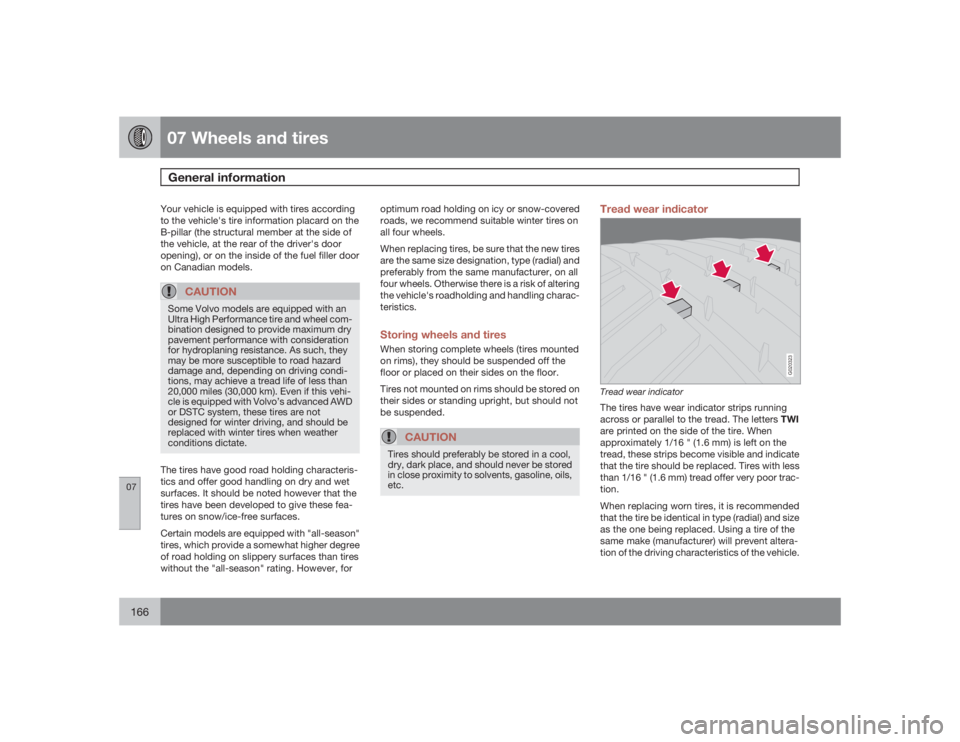
Tread wear indicatorThe tires have wear indicator strips running
across or parallel to the tread. The letters TWI
are printed on the side of the tire. When
approximately 1/16 " (1.6 mm) is left on the
tread, these strips become visible and indicate
that the tire should be replaced. Tires with less
than 1/16 " (1.6 mm) tread offer very poor trac-
tion.
When replacing worn tires, it is recommended
that the tire be identical in type (radial) and size
as the one being replaced. Using a tire of the
same make (manufacturer) will prevent altera-
tion of the driving characteristics of the vehicle.
Page 168 of 282

07 Wheels and tiresTire inflation
07168
G032513
Tire inflation placards on U.S. modelsCheck tire inflation pressure regularly.
Tables listing the recommended inflation pres-
sure for your vehicle can be found on pages
170 and 171. A tire inflation pressure placard
is also located on the driver's side B-pillar (the
structural member at the side of the vehicle, at
the rear of the driver's door opening). This plac-
ard indicates the designation of the factory-
mounted tires on your vehicle, as well as load
limits and inflation pressure.
G032520
Tire inflation placard on Canadian models
NOTE
The placards shown indicate inflation pres-
sure for the tires installed on the vehicle at
the factory only.•
Use a tire gauge to check the tire inflation
pressure, including the spare, at least once
a month and before long trips. You are
strongly urged to buy a reliable tire pres-
sure gauge, as automatic service station
gauges may be inaccurate.
•
Use the recommended cold inflation pres-
sure for optimum tire performance and
wear.
•
Under-inflation or over-inflation may cause
uneven treadwear patterns.WARNING
•
Under-inflation is the most common
cause of tire failure and may result in
severe tire cracking, tread separation,
or "blow-out," with unexpected loss of
vehicle control and increased risk of
injury.
•
Under-inflated tires reduce the load car-
rying capacity of your vehicle.
When weather temperature changes occur, tire
inflation pressures also change. A 10-degree
temperature drop causes a corresponding
drop of 1 psi (7 kPa) in inflation pressure. Check
your tire pressures frequently and adjust them
to the proper pressure, which can be found on
the vehicle's tire information placard or certifi-
cation label.Checking tire pressureA certain amount of air seepage from the tires
occurs naturally and tire pressure fluctuates
with seasonal changes in temperature. Always
check tire pressure regularly.Cold tiresInflation pressure should be checked when the
tires are cold.
Page 170 of 282
07 Wheels and tiresTire inflation pressure tables – U.S. models
07170
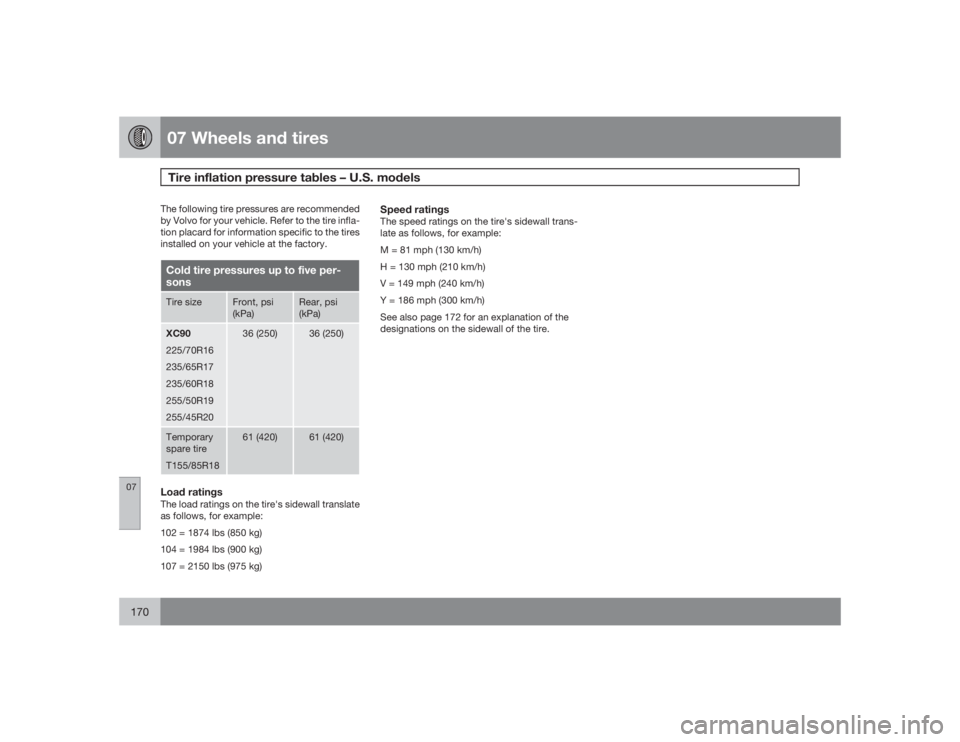
The following tire pressures are recommended
by Volvo for your vehicle. Refer to the tire infla-
tion placard for information specific to the tires
installed on your vehicle at the factory.Cold tire pressures up to five per-
sonsTire size
Front, psi
(kPa)
Rear, psi
(kPa)
XC90
225/70R16
235/65R17
235/60R18
255/50R19
255/45R20
36 (250)
36 (250)
Temporary
spare tire
T155/85R18
61 (420)
61 (420)
Load ratingsThe load ratings on the tire's sidewall translate
as follows, for example:
102 = 1874 lbs (850 kg)
104 = 1984 lbs (900 kg)
107 = 2150 lbs (975 kg)
Speed ratingsThe speed ratings on the tire's sidewall trans-
late as follows, for example:
M = 81 mph (130 km/h)
H = 130 mph (210 km/h)
V = 149 mph (240 km/h)
Y = 186 mph (300 km/h)
See also page 172 for an explanation of the
designations on the sidewall of the tire.
Page 171 of 282
07 Wheels and tires
Tire inflation pressure tables – Canadian models
07
171
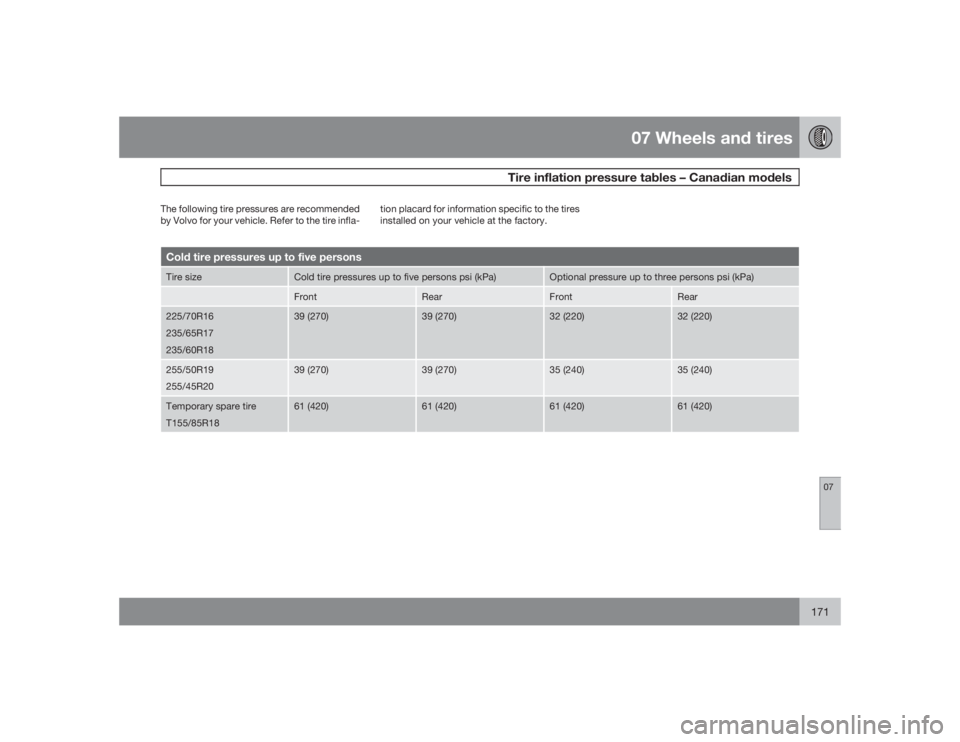
The following tire pressures are recommended
by Volvo for your vehicle. Refer to the tire infla-tion placard for information specific to the tires
installed on your vehicle at the factory.Cold tire pressures up to five personsTire size
Cold tire pressures up to five persons psi (kPa)
Optional pressure up to three persons psi (kPa)
Front
Rear
Front
Rear
225/70R16
235/65R17
235/60R18
39 (270)
39 (270)
32 (220)
32 (220)
255/50R19
255/45R20
39 (270)
39 (270)
35 (240)
35 (240)
Temporary spare tire
T155/85R18
61 (420)
61 (420)
61 (420)
61 (420)
Page 174 of 282
07 Wheels and tiresGlossary of tire terminology
07174
•
Tire information placard: A placard
showing the OE (Original Equipment) tire
sizes, recommended inflation pressure,
and the maximum weight the vehicle can
carry.
•
Tire Identification Number (TIN): A num-
ber on the sidewall of each tire providing
information about the tire brand and man-
ufacturing plant, tire size and date of man-
ufacturer.
•
Inflation pressure: A measure of the
amount of air in a tire.
•
Standard load: A class of P-metric or Met-
ric tires designed to carry a maximum load
at 35 psi [37 psi (2.5 bar) for Metric tires].
Increasing the inflation pressure beyond
this pressure will not increase the tires load
carrying capability.
•
Extra load: A class of P-metric or Metric
tires designed to carry a heavier maximum
load at 41 psi [43 psi (2.9 bar) for Metric
tires]. Increasing the inflation pressure
beyond this pressure will not increase the
tires load carrying capability.
•
kPa: Kilopascal, a metric unit of air pres-
sure.
•
PSI: Pounds per square inch, a standard
unit of air pressure.
•
B-pillar: The structural member at the side
of the vehicle behind the front door.
•
Bead area of the tire: Area of the tire next
to the rim.
•
Sidewall of the tire: Area between the
bead area and the tread.
•
Tread area of the tire: Area of the perim-
eter of the tire that contacts the road when
mounted on the vehicle.
•
Rim: The metal support (wheel) for a tire or
a tire and tube assembly upon which the
tire beads are seated.
•
Maximum load rating: a figure indicating
the maximum load in pounds and kilo-
grams that can be carried by the tire. This
rating is established by the tire manufac-
turer.
•
Maximum permissible inflation pres-
sure: the greatest amount of air pressure
that should ever be put in the tire. This limit
is set by the tire manufacturer.
•
Recommended tire inflation pressure:
inflation pressure, established by Volvo,
which is based on the type of tires that are
mounted on a vehicle at the factory. This
inflation pressure is affected by the number
of occupants in the vehicle, the amount of
cargo, and the speed at which the vehicle
will be driven for a prolonged period. This
information can be found on the tire infla-
tion placard(s) located on the driver's side
B-pillar or on the inside of the fuel filler dooron Canadian models, and in the tire infla-
tion table in this chapter.
•
Cold tires: The tires are considered to be
cold when they have the same temperature
as the surrounding (ambient) air. This tem-
perature is normally reached after the vehi-
cle has been parked for at least 3 hours.
Page 180 of 282
07 Wheels and tiresChanging wheels
07180
G030879
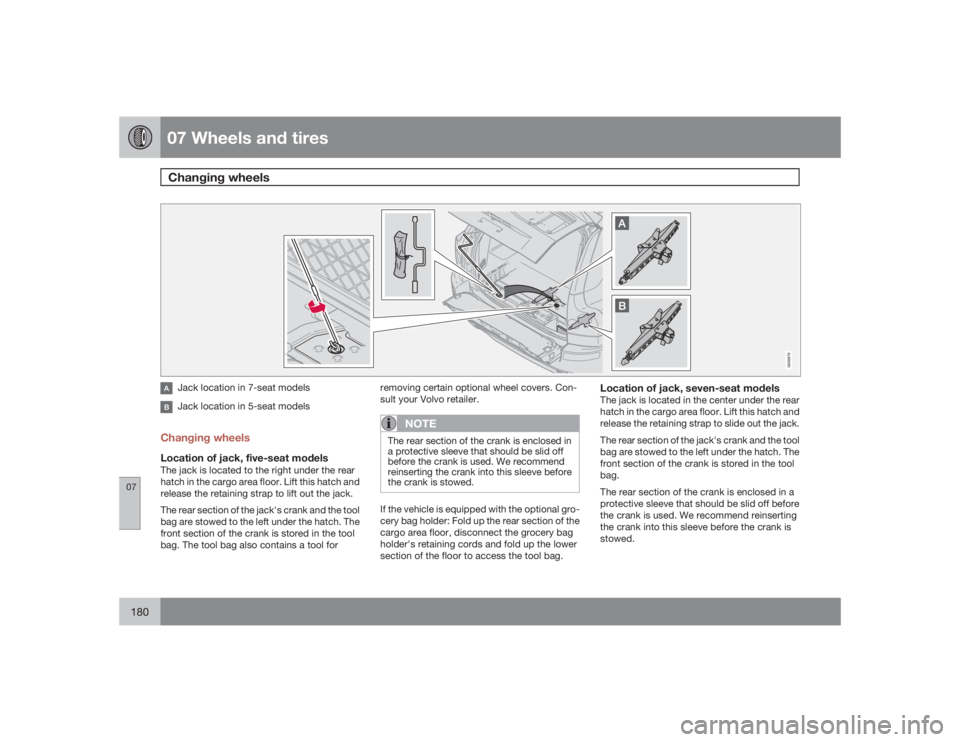
Jack location in 7-seat modelsJack location in 5-seat models
Changing wheelsLocation of jack, five-seat modelsThe jack is located to the right under the rear
hatch in the cargo area floor. Lift this hatch and
release the retaining strap to lift out the jack.
The rear section of the jack's crank and the tool
bag are stowed to the left under the hatch. The
front section of the crank is stored in the tool
bag. The tool bag also contains a tool forremoving certain optional wheel covers. Con-
sult your Volvo retailer.
NOTE
The rear section of the crank is enclosed in
a protective sleeve that should be slid off
before the crank is used. We recommend
reinserting the crank into this sleeve before
the crank is stowed.If the vehicle is equipped with the optional gro-
cery bag holder: Fold up the rear section of the
cargo area floor, disconnect the grocery bag
holder's retaining cords and fold up the lower
section of the floor to access the tool bag.
Location of jack, seven-seat modelsThe jack is located in the center under the rear
hatch in the cargo area floor. Lift this hatch and
release the retaining strap to slide out the jack.
The rear section of the jack's crank and the tool
bag are stowed to the left under the hatch. The
front section of the crank is stored in the tool
bag.
The rear section of the crank is enclosed in a
protective sleeve that should be slid off before
the crank is used. We recommend reinserting
the crank into this sleeve before the crank is
stowed.
Page 190 of 282
07 Wheels and tiresTire Pressure Monitoring System (TPMS) – U.S. models only
07190
The tire pressure monitoring system uses sen-
sors mounted in the tire valves to check infla-
tion pressure levels. When the vehicle is
moving at a speed of approximately 20 mph
(30 km/h) or faster, these sensors transmit
inflation pressure data to a receiver located in
the vehicle.USA – FCC ID: MRXG403MA4
A
This device complies with part 15 of the FCC
rules. Operation is subject to the following
conditions: (1) This device may not cause
harmful interference, and (2) this device
must accept any interference received,
including interference that may cause unde-
sired operation.
When low inflation pressure is detected,
TPMS will light up the tire pressure warning
light (also referred to as a telltale) in the
instrument panel (see page 57), and will dis-
play a message in the text window. The
wording of this message is determined by
the degree of inflation pressure loss.AOn certain models, the FCC code is MRXTG315AM04
NOTE
If a fault occurs in TPMS, the tire pressure
warning light will flash for approximately
1 minute and
TIRE PRESS SYST
SERVICE REQUIRED
will be displayed.
Each tire, including the spare (if provided),
should be checked monthly when cold and
inflated to the inflation pressure recommended
by the vehicle manufacturer on the vehicle
placard or tire inflation pressure label. (If your
vehicle has tires of a different size than the size
indicated on the vehicle placard or tire inflation
pressure label, you should determine the
proper tire inflation pressure for those tires.)
As an added safety feature, your vehicle has
been equipped with a tire pressure monitoring
system (TPMS) that illuminates a low tire pres-
sure telltale when one or more of your tires is
significantly under-inflated. Accordingly, when
the low tire pressure telltale illuminates, you
should stop and check your tires as soon as
possible, and inflate them to the proper pres-
sure. Driving on a significantly under-inflated
tire causes the tire to overheat and can lead to
tire failure. Under-inflation also reduces fuel
efficiency and tire tread life, and may affect the
vehicle's handling and stopping ability.
Please note that the TPMS is not a substitute
for proper tire maintenance, and it is the driv-er's responsibility to maintain correct tire pres-
sure, even if under-inflation has not reached
the level to trigger illumination of the TPMS low
tire pressure telltale.
Your vehicle has also been equipped with a
TPMS malfunction indicator to indicate when
the system is not operating properly. The
TPMS malfunction indicator is combined with
the low tire pressure telltale. When the system
detects a malfunction, the telltale will flash for
approximately one minute and then remain
continuously illuminated. This sequence will
continue upon subsequent vehicle start-ups as
long as the malfunction exists. When the mal-
function indicator is illuminated, the system
may not be able to detect or signal low tire
pressure as intended. TPMS malfunctions may
occur for a variety of reasons, including the
installation of replacement or alternate tires or
wheels on the vehicle that prevent the TPMS
from functioning properly. Always check the
TPMS malfunction telltale after replacing one
or more tires or wheels on your vehicle to
ensure that the replacement or alternate tires
and wheels allow the TPMS to continue to
function properly.
Page 191 of 282
07 Wheels and tires
Tire Pressure Monitoring System (TPMS) – U.S. models only
07
191
NOTE
TPMS indicates low tire pressure but does
not replace normal tire maintenance. For
information on correct tire pressure, please
refer to the tables on pages 170 and 171, or
consult your Volvo retailer.Erasing warning messagesWhen a low tire pressure warning message has
been displayed, and the tire pressure warning
light has come on:•
Use a tire pressure gauge to check the
inflation pressure of all four tires.
•
Re-inflate the tire(s) to the correct pressure
(consult the tire pressure placard or the
table see page 170).
•
Drive the vehicle for several minutes at a
speed of 20 mph (30 km/h) or faster.
This will erase the warning text and the warning
light will go out.WARNING
Incorrect inflation pressure could lead to tire
failure, resulting in a loss of control of the
vehicle.
Changing wheels with TPMSPlease note the following when changing or
replacing the factory installed TPMS wheels/
tires on the vehicle:•
Only the factory-mounted wheels are
equipped with TPMS sensors in the valves.
•
If the vehicle is equipped with a temporary
spare tire, this tire does not have a TPMS
sensor.
•
If wheels without TPMS sensors are moun-
ted on the vehicle,
TIRE PRESS SYST
SERVICE REQUIRED
will be displayed
each time the vehicle is driven above
25 mph (40 km/h) for 10 minutes or more.
•
Once TPMS sensors are properly installed,
the warning message should not reappear.
•
Volvo recommends that TPMS sensors be
fitted on all wheels used on the vehicle.
Volvo does not recommend moving sen-
sors back and forth between sets of
wheels.NOTE
If a tire is changed or if the TPMS sensor is
moved to another wheel, the sensor’s seal,
nut and valve core should be replaced.
CAUTION
When inflating tires with TPMS valves, press
the pump's mouthpiece straight onto the
valve to help avoid bending or otherwise
damaging the valve.
Page 209 of 282
09 Maintenance and servicing
Engine oil
09``209
NOTE
Volvo uses different systems to indicate a
low oil level or pressure. Some models have
an oil pressure sensor, in which case a
warning symbol (see page 56) is used to
indicate low oil pressure. Other models have
an oil level sensor, in which case the driver
is alerted by the warning symbol in the cen-
ter of the instrument panel and a text in the
information display. Some models use both
systems. Contact a trained and qualified
Volvo service technician for more informa-
tion.Changing engine oil and oil filterSee page 208 for oil specifications and page
268 for oil volumes. Refer to the Warranty and
Service Records Information booklet for infor-
mation on the oil change intervals.
NOTE
Volvo does not recommend the use of oil
additives.
Synthetic oil is not used when the oil is
changed at the normal maintenance inter-
vals except at owner request and at addi-
tional charge. Please consult a trained and
qualified Volvo service technician.
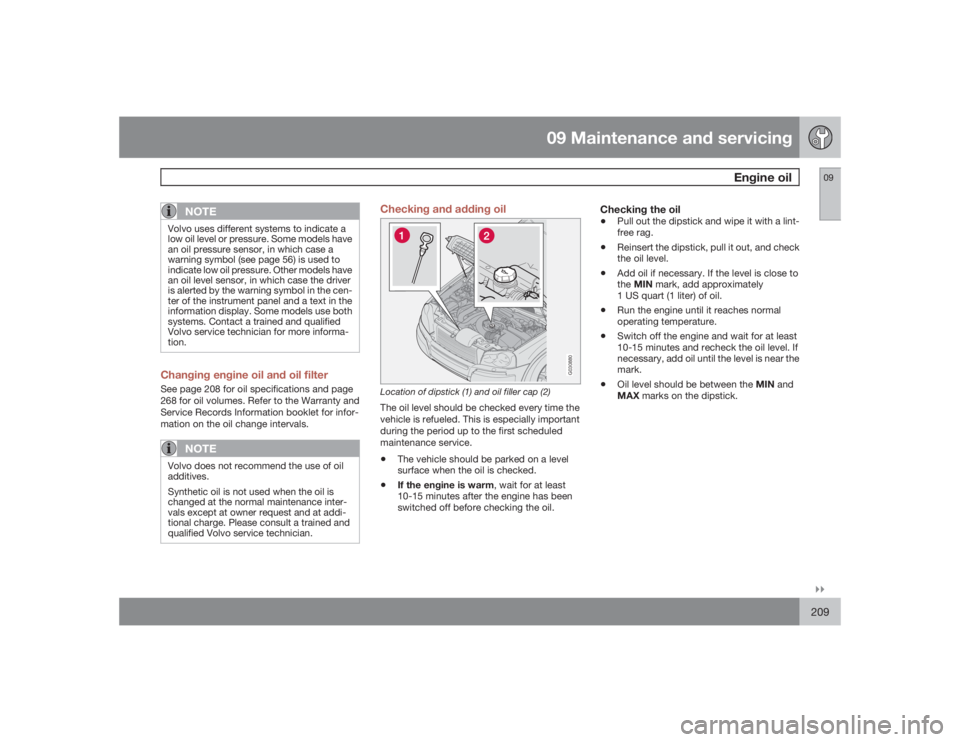
Checking and adding oil
G030880
Location of dipstick (1) and oil filler cap (2)The oil level should be checked every time the
vehicle is refueled. This is especially important
during the period up to the first scheduled
maintenance service.•
The vehicle should be parked on a level
surface when the oil is checked.
•
If the engine is warm, wait for at least
10-15 minutes after the engine has been
switched off before checking the oil.
Checking the oil•
Pull out the dipstick and wipe it with a lint-
free rag.
•
Reinsert the dipstick, pull it out, and check
the oil level.
•
Add oil if necessary. If the level is close to
theMIN mark, add approximately
1 US quart (1 liter) of oil.
•
Run the engine until it reaches normal
operating temperature.
•
Switch off the engine and wait for at least
10-15 minutes and recheck the oil level. If
necessary, add oil until the level is near the
mark.
•
Oil level should be between the MIN and
MAX marks on the dipstick.