belt VOLVO XC90 2014 Owner´s Manual
[x] Cancel search | Manufacturer: VOLVO, Model Year: 2014, Model line: XC90, Model: VOLVO XC90 2014Pages: 308, PDF Size: 13.31 MB
Page 3 of 308
WELCOME TO THE WORLD-WIDE FAMILY OF VOLVO OWNERS.
We trust that you will enjoy many years of safe driving in your Volvo, an automobile designedwith your safety and comfort in mind. We encour-age you to familiarize yourself with the equipmentdescriptions and operating instructions in thismanual. We also urge you and your passengers to wear seat belts at all times in this (or any other) vehicle.And, of course, please do not operate a vehicle ifyou may be affected by alcohol, medication orany impairment that could hinder your ability todrive. Your Volvo is designed to meet all applicable fed- eral safety and emission standards. If you haveany questions regarding your vehicle, please con-tact your Volvo retailer or see the section "Con-tacting Volvo" in this manual's "Introduction"chapter for information on getting in touch withVolvo in the United States and Canada.
Page 4 of 308
Contents
2* Option/accessory, for more information, see Introduction.
00
00 Introduction
Important information................................. 8
Environment.............................................. 13
Important warnings................................... 14
01
01 Safety
Occupant safety........................................ 18
Reporting safety defects........................... 19
Seat belts.................................................. 20
Supplemental Restraint System............... 23
Front airbags............................................. 24
Occupant Weight Sensor.......................... 28
Side impact protection airbags................. 32
Inflatable Curtain....................................... 34
Whiplash Protection System..................... 36
Child safety............................................... 38
Child restraint systems............................. 41
Infant seats............................................... 43
Convertible seats...................................... 45
Booster cushions...................................... 48
ISOFIX/LATCH lower anchors.................. 49
Top tether anchors.................................... 51
Integrated booster cushion....................... 52
02
02 Instruments and controls
Instrument overview.................................. 56
Instrument panel....................................... 58
Information display................................... 62
Center console buttons............................ 64
Steering wheel adjustment....................... 66
Lighting panel........................................... 67
Manually unlocking the fuel filler door...... 70
Left-side steering wheel lever................... 71
Right-side steering wheel lever................. 72
Hazard warning flashers........................... 75
Trip computer........................................... 76
Cruise control............................................ 78
12-volt sockets......................................... 80
Hood/tailgate............................................ 81
Power windows......................................... 82
Mirrors....................................................... 84
Power moonroof....................................... 87 HomeLink ®
Wireless Control System*...... 89
Page 12 of 308
Introduction
Important information
10
Bullet listsBullets are used to differentiate a number of components/functions/points of informationthat can be listed in random order. For example:• Coolant
• Engine oil
Continued
}
}This symbol can be found at the lower
right corner of an odd-numbered (right-hand) page to indicate that the current topic is con-tinued on the following page.
Options and accessoriesOptional or accessory equipment describedin this manual is indicated by an asterisk. Optional or accessory equipment may not be available in all countries or markets. Pleasenote that some vehicles may be equipped dif-ferently, depending on special legal require-ments. Contact your Volvo retailer for additional information.
NOTE
• All information, illustrations and speci- fications contained in this manual arebased on the latest product informa-tion available at the time of publica-tion.
• Volvo reserves the right to make modelchanges at any time, or to changespecifications or design without noticeand without incurring obligation.
• Do not export your Volvo to anothercountry before investigating that coun-try's applicable safety and emissioncontrol requirements. In some cases itmay be difficult or impossible to com-ply with these requirements. Modifica-tions to the emission control system(s)may render your Volvo not certifiablefor legal operation in the U.S., Canadaand other countries.
WARNING
If your vehicle is involved in an accident, unseen damage may affect its drivabilityand safety.
WARNING
CALIFORNIA proposition 65 Engine exhaust, some of its constituents, and certain vehicle components contain oremit chemicals known to the state of Cali-fornia to cause cancer, and birth defectsor other reproductive harm. In addition,certain fluids contained in vehicles andcertain products of component wear con-tain or emit chemicals known to the Stateof California to cause cancer, and birthdefects or other reproductive harm.
WARNING
Certain components of this vehicle such as air bag modules, seat belt pretensioners,adaptive steering columns, and button cellbatteries may contain Perchlorate material.Special handling may apply for service orvehicle end of life disposal. See www.dtsc.ca.gov/hazardouswaste/ perchlorate.
Page 18 of 308
16
Occupant safety...................................................................................... 18
Reporting safety defects......................................................................... 19Seat belts................................................................................................ 20
Supplemental Restraint System.............................................................. 23Front airbags........................................................................................... 24
Occupant Weight Sensor........................................................................ 28
Side impact protection airbags............................................................... 32Inflatable Curtain..................................................................................... 34
Whiplash Protection System................................................................... 36Child safety............................................................................................. 38
Child restraint systems........................................................................... 41Infant seats.............................................................................................. 43Convertible seats.................................................................................... 45
Booster cushions....................................................................................48
ISOFIX/LATCH lower anchors................................................................. 49
Top tether anchors..................................................................................51
Integrated booster cushion..................................................................... 52
Page 20 of 308
01 Safety
Occupant safety 01
18
Volvo's concern for safety
Safety is the Volvo cornerstone. Our concern dates back to 1927 when the first Volvo rolledoff the production line. Three-point seat belts(a Volvo invention), safety cages, and energy-absorbing impact zones were designed intoVolvo vehicles long before it was fashionableor required by government regulation. We willnot compromise our commitment to safety.We continue to seek out new safety featuresand to refine those already in our vehicles.You can help. We would appreciate hearingyour suggestions about improving automobilesafety. We also want to know if you ever havea safety concern with your vehicle. Call us inthe U.S. at: 800-458-1552 or in Canada at:800-663-8255.
Occupant safety reminders
How safely you drive doesn't depend on how old you are but rather on:• How well you see.
• Your ability to concentrate.
• How quickly you make decisions under stress to avoid an accident.
The tips listed below are suggestions to help you cope with the ever changing traffic envi-ronment. •
Never drink and drive.
• If you are taking any medication, consult your physician about its potential effectson your driving abilities.
• Take a driver-retraining course.
• Have your eyes checked regularly.
• Keep your windshield and headlightsclean.
• Replace wiper blades when they start toleave streaks.
• Take into account the traffic, road, andweather conditions, particularly withregard to stopping distance.
• Never send text messages while driving.
• Refrain from using or minimize the use ofa cell phone while driving.Recall information
Information regarding recalls or other service campaigns is available on our website atwww.volvocars.com/us/. Select the tabYOUR VOLVO and the heading RECALLINFORMATION will be displayed at the lowerleft side of the screen. Enter your VehicleIdentification Number for your vehicle (foundat the base of the windshield). If your vehiclehas any open Recalls, they will be displayedon this page.
Volvo customers in CanadaFor any questions regarding open recalls foryour vehicle, please contact your authorizedVolvo retailer. If your retailer is unable toanswer your questions, please contact VolvoCustomer Relations at 905 695-9626, Mon-day through Friday, 8:30 A.M. to 5:00 P.M.EST or by e-mail at [email protected] may also write us at: Volvo Cars of CanadaNational Customer Service9130 Leslie Street, Suite 101Richmond Hill, Ontario L4B 0B9
Page 22 of 308
01 Safety
Seat belts 01
20
Using seat belts
G020104
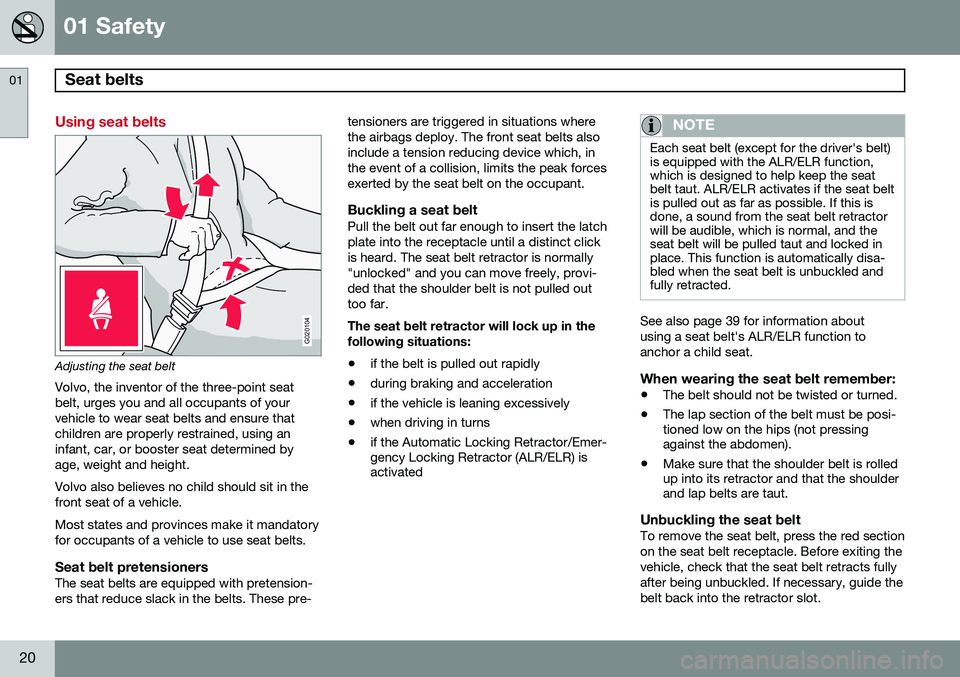
Adjusting the seat beltVolvo, the inventor of the three-point seat belt, urges you and all occupants of yourvehicle to wear seat belts and ensure thatchildren are properly restrained, using aninfant, car, or booster seat determined byage, weight and height. Volvo also believes no child should sit in the front seat of a vehicle. Most states and provinces make it mandatory for occupants of a vehicle to use seat belts.
Seat belt pretensionersThe seat belts are equipped with pretension-ers that reduce slack in the belts. These pre- tensioners are triggered in situations wherethe airbags deploy. The front seat belts alsoinclude a tension reducing device which, inthe event of a collision, limits the peak forcesexerted by the seat belt on the occupant.
Buckling a seat beltPull the belt out far enough to insert the latchplate into the receptacle until a distinct clickis heard. The seat belt retractor is normally"unlocked" and you can move freely, provi-ded that the shoulder belt is not pulled outtoo far. The seat belt retractor will lock up in the following situations:
• if the belt is pulled out rapidly
• during braking and acceleration
• if the vehicle is leaning excessively
• when driving in turns
• if the Automatic Locking Retractor/Emer- gency Locking Retractor (ALR/ELR) isactivated
NOTE
Each seat belt (except for the driver's belt) is equipped with the ALR/ELR function,which is designed to help keep the seatbelt taut. ALR/ELR activates if the seat beltis pulled out as far as possible. If this isdone, a sound from the seat belt retractorwill be audible, which is normal, and theseat belt will be pulled taut and locked inplace. This function is automatically disa-bled when the seat belt is unbuckled andfully retracted.
See also page 39 for information about using a seat belt's ALR/ELR function toanchor a child seat.
When wearing the seat belt remember:
• The belt should not be twisted or turned.
• The lap section of the belt must be posi- tioned low on the hips (not pressingagainst the abdomen).
• Make sure that the shoulder belt is rolledup into its retractor and that the shoulderand lap belts are taut.
Unbuckling the seat beltTo remove the seat belt, press the red section on the seat belt receptacle. Before exiting thevehicle, check that the seat belt retracts fullyafter being unbuckled. If necessary, guide thebelt back into the retractor slot.
Page 23 of 308
01 Safety
Seat belts01
21
Seat belt reminderThe seat belt reminder consists of an audible signal, an indicator light above the rearviewmirror, and a symbol in the instrument panelthat alert the driver and front seat passengerif their seat belts are not fastened.WARNING
•Never use a seat belt for more than one occupant.
• Never wear the shoulder portion of thebelt under the arm, behind the back orotherwise out of position. Such usecould cause injury in the event of anaccident.
• Seat belts lose much of their strengthwhen exposed to violent stretchingand should be replaced after any colli-sion, even if they appear to be undam-aged.
• Never repair the belt yourself; have thiswork done by an authorized Volvoservice technician only.
• Any device used to induce slack intothe shoulder belt portion of the three-point belt system will have a detrimen-tal effect on the amount of protectionavailable to you in the event of a colli-sion.
• The seat back should not be tilted toofar back. The shoulder belt must betaut in order to function properly.
• Do not use child safety seats or childbooster cushions/backrests in thefront passenger's seat. We also rec-ommend that children who have out-grown these devices sit in the rear
seat with the seat belt properly fas- tened.
Seat belt use during pregnancy
G020105
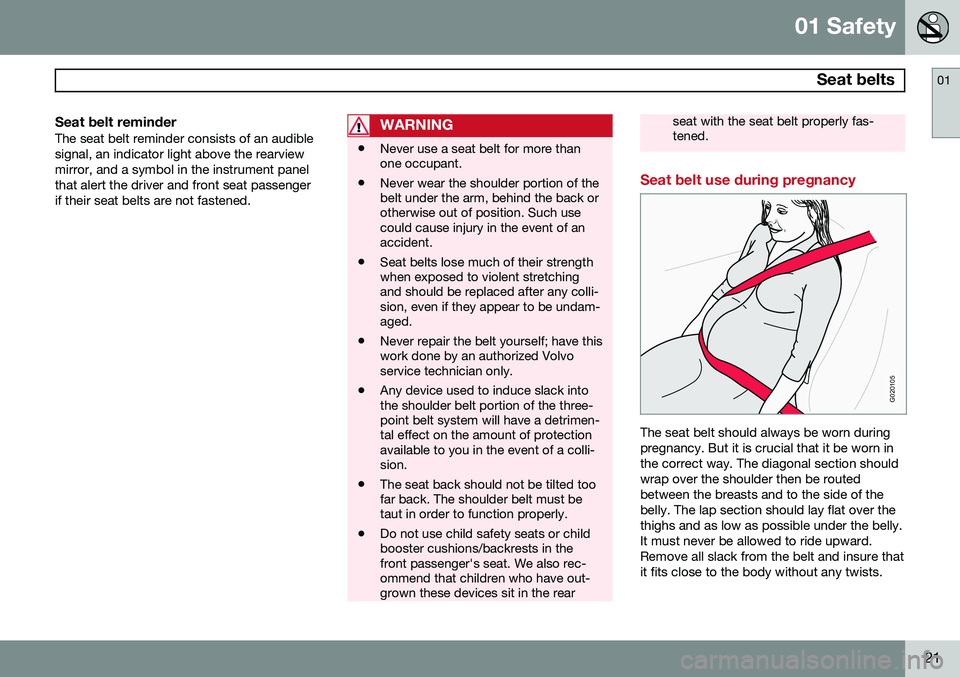
The seat belt should always be worn during pregnancy. But it is crucial that it be worn inthe correct way. The diagonal section shouldwrap over the shoulder then be routedbetween the breasts and to the side of thebelly. The lap section should lay flat over thethighs and as low as possible under the belly.It must never be allowed to ride upward.Remove all slack from the belt and insure thatit fits close to the body without any twists.
Page 24 of 308
01 Safety
Seat belts 01
22
As a pregnancy progresses, pregnant drivers should adjust their seats and steering wheelsuch that they can easily maintain control ofthe vehicle as they drive (which means theymust be able to easily operate the foot pedalsand steering wheel). Within this context, theyshould strive to position the seat with as largea distance as possible between their bellyand the steering wheel.
Child seatsPlease see page 39 for information onsecuring child seats with the seat belts.
Seat belt maintenanceCheck periodically that the seat belts are ingood condition. Use water and a mild deter-gent for cleaning. Check seat belt mechanismfunction as follows: attach the seat belt andpull rapidly on the strap.
Page 25 of 308
01 Safety
Supplemental Restraint System01
23
Supplemental Restraint System (SRS)
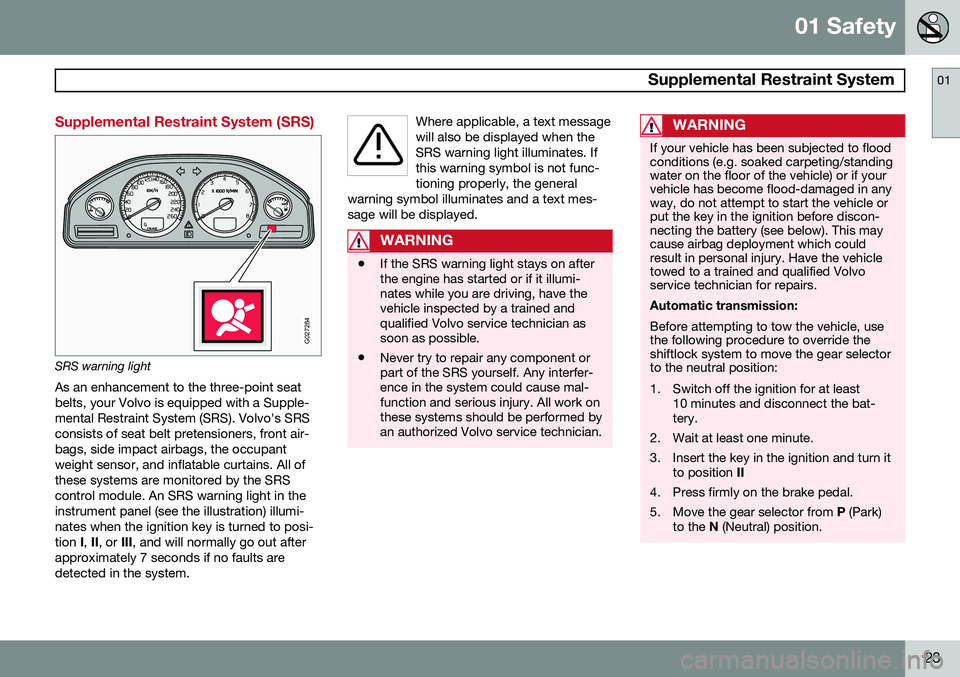
G027284
SRS warning lightAs an enhancement to the three-point seat belts, your Volvo is equipped with a Supple-mental Restraint System (SRS). Volvo's SRSconsists of seat belt pretensioners, front air-bags, side impact airbags, the occupantweight sensor, and inflatable curtains. All ofthese systems are monitored by the SRScontrol module. An SRS warning light in theinstrument panel (see the illustration) illumi-nates when the ignition key is turned to posi-tion I, II , or III, and will normally go out after
approximately 7 seconds if no faults aredetected in the system. Where applicable, a text messagewill also be displayed when theSRS warning light illuminates. Ifthis warning symbol is not func-tioning properly, the general
warning symbol illuminates and a text mes-sage will be displayed.
WARNING
• If the SRS warning light stays on after the engine has started or if it illumi-nates while you are driving, have thevehicle inspected by a trained andqualified Volvo service technician assoon as possible.
• Never try to repair any component orpart of the SRS yourself. Any interfer-ence in the system could cause mal-function and serious injury. All work onthese systems should be performed byan authorized Volvo service technician.
WARNING
If your vehicle has been subjected to flood conditions (e.g. soaked carpeting/standingwater on the floor of the vehicle) or if yourvehicle has become flood-damaged in anyway, do not attempt to start the vehicle orput the key in the ignition before discon-necting the battery (see below). This maycause airbag deployment which couldresult in personal injury. Have the vehicletowed to a trained and qualified Volvoservice technician for repairs. Automatic transmission: Before attempting to tow the vehicle, use the following procedure to override theshiftlock system to move the gear selectorto the neutral position:
1. Switch off the ignition for at least
10 minutes and disconnect the bat- tery.
2. Wait at least one minute.
3. Insert the key in the ignition and turn it to position II
4. Press firmly on the brake pedal.
5. Move the gear selector from P (Park)
to the N (Neutral) position.
Page 26 of 308
01 Safety
Front airbags 01
24
The front airbag system
G020111
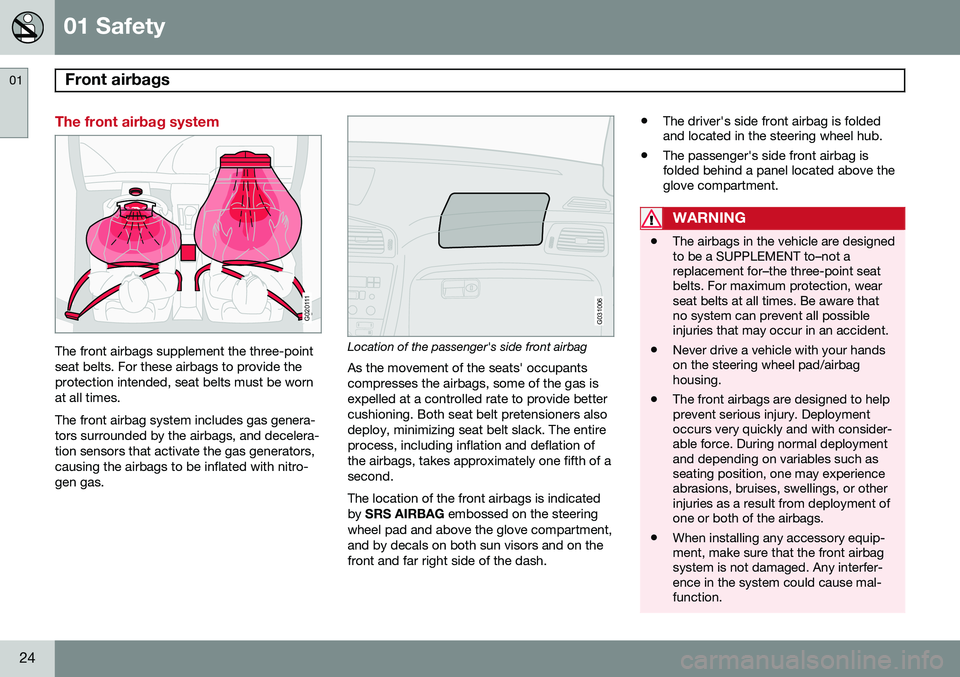
The front airbags supplement the three-point seat belts. For these airbags to provide theprotection intended, seat belts must be wornat all times. The front airbag system includes gas genera- tors surrounded by the airbags, and decelera-tion sensors that activate the gas generators,causing the airbags to be inflated with nitro-gen gas.
G031006
Location of the passenger's side front airbagAs the movement of the seats' occupants compresses the airbags, some of the gas isexpelled at a controlled rate to provide bettercushioning. Both seat belt pretensioners alsodeploy, minimizing seat belt slack. The entireprocess, including inflation and deflation ofthe airbags, takes approximately one fifth of asecond. The location of the front airbags is indicated by SRS AIRBAG embossed on the steering
wheel pad and above the glove compartment,and by decals on both sun visors and on thefront and far right side of the dash. •
The driver's side front airbag is folded and located in the steering wheel hub.
• The passenger's side front airbag isfolded behind a panel located above theglove compartment.
WARNING
• The airbags in the vehicle are designed to be a SUPPLEMENT to–not areplacement for–the three-point seatbelts. For maximum protection, wearseat belts at all times. Be aware thatno system can prevent all possibleinjuries that may occur in an accident.
• Never drive a vehicle with your handson the steering wheel pad/airbaghousing.
• The front airbags are designed to helpprevent serious injury. Deploymentoccurs very quickly and with consider-able force. During normal deploymentand depending on variables such asseating position, one may experienceabrasions, bruises, swellings, or otherinjuries as a result from deployment ofone or both of the airbags.
• When installing any accessory equip-ment, make sure that the front airbagsystem is not damaged. Any interfer-ence in the system could cause mal-function.