lock VOLVO XC90 2014 Owner´s Manual
[x] Cancel search | Manufacturer: VOLVO, Model Year: 2014, Model line: XC90, Model: VOLVO XC90 2014Pages: 308, PDF Size: 13.31 MB
Page 157 of 308
06 Starting and driving
Brake system
06
155
WARNING
•Use the jack intended for the vehicle when changing a tire. For any otherjob, use stands to support the vehicle.
• The jack should be kept well-greasedand clean, and should not be dam-aged.
• Be sure the jack is on a firm, level,non-slippery surface.
• No objects should be placed betweenthe base of jack and the ground, orbetween the jack and the attachmentbar on the vehicle.
• The jack must correctly engage thejack attachment.
• Never allow any part of your body tobe extended under a vehicle suppor-ted by a jack.
Power brakes function only when the engine is running
The power brakes utilize vacuum pressure which is only created when the engine is run-ning. Never let the vehicle roll to a stop withthe engine switched off. If the power brakes are not working, consid- erably higher pressure will be required on thebrake pedal to compensate for the lack ofpower assistance. This can happen for exam- ple when towing your vehicle or if the engineis switched off when the vehicle is rolling. Thebrake pedal feels harder than usual.
Water on brake discs and brake pads
affects braking
Driving in rain and slush or passing throughan automatic car wash can cause water tocollect on the brake discs and pads. This willcause a delay in braking effect when thepedal is depressed. To avoid such a delaywhen the brakes are needed, depress thepedal occasionally when driving through rain,slush etc. This will remove the water from thebrakes. Check that brake application feelsnormal. This should also be done after wash-ing or starting in very damp or cold weather.
Severe strain on the brake systemThe brakes will be subject to severe strainwhen driving in mountains or hilly areas, orwhen towing a trailer. Vehicle speed is usuallyslower, which means that the cooling of thebrakes is less efficient than when driving onlevel roads. To reduce the strain on thebrakes, shift into a lower gear and let theengine help with the braking. Do not forgetthat, if you are towing a trailer, the brakes willbe subjected to a greater than normal load.
Anti-lock brakes (ABS)If the ABS warning lamp lights up there is a
malfunction in the ABS system (the standardbraking system will however function) and thevehicle should be driven cautiously to atrained and qualified Volvo service technicianfor inspection. The Anti-lock Braking System(ABS) helps to improve vehicle control (stop-ping and steering) during severe braking con-ditions by limiting brake lockup. When thesystem "senses" impending lockup, brakingpressure is automatically modulated in orderto help prevent lockup, which could lead to askid. The system performs a self-diagnostic test when the engine is started and when thevehicle first reaches a speed of approxi- mately 12 mph (20 km/h). The brake pedal
will pulsate several times and a sound may be audible from the ABS control module. This isnormal. To obtain optimal effect from the ABS sys- tem, constant pressure should be kept on thebrake pedal. Do not pump the brake pedal. The switching of the ABS modulator will be audible and the brake pedal will pulsate dur-ing braking. Please be aware that ABS doesnot increase the absolute braking potential ofthe vehicle. While control will be enhanced,ABS will not shorten stopping distances onslippery surfaces.
Page 164 of 308
06 Starting and driving
Towing
06
162
G027042
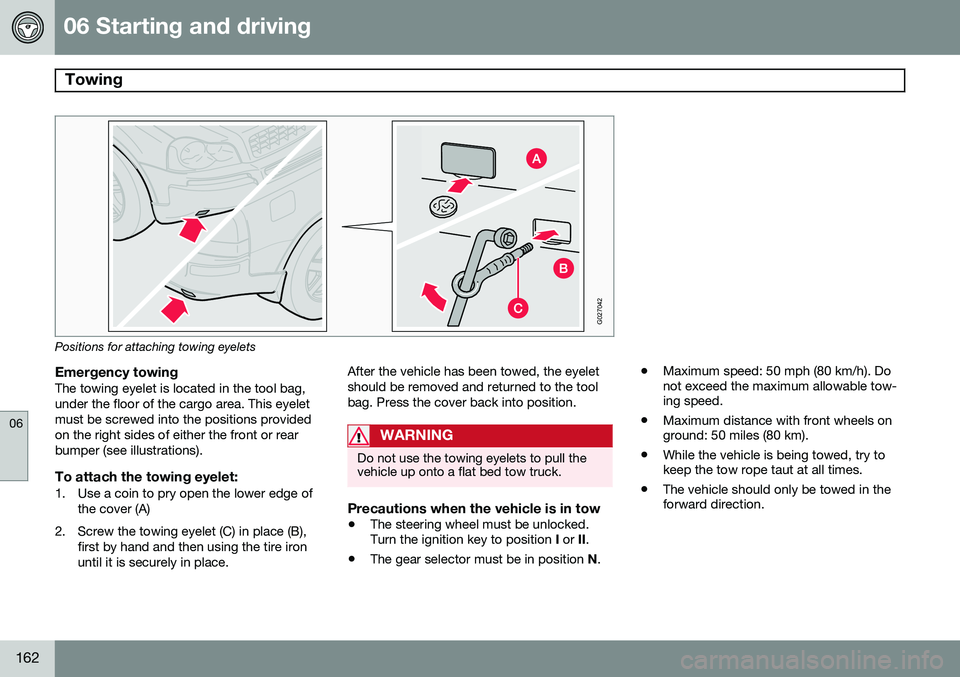
Positions for attaching towing eyelets
Emergency towingThe towing eyelet is located in the tool bag, under the floor of the cargo area. This eyeletmust be screwed into the positions providedon the right sides of either the front or rearbumper (see illustrations).
To attach the towing eyelet:1. Use a coin to pry open the lower edge ofthe cover (A)
2. Screw the towing eyelet (C) in place (B), first by hand and then using the tire ironuntil it is securely in place. After the vehicle has been towed, the eyeletshould be removed and returned to the toolbag. Press the cover back into position.
WARNING
Do not use the towing eyelets to pull the vehicle up onto a flat bed tow truck.
Precautions when the vehicle is in tow
•
The steering wheel must be unlocked. Turn the ignition key to position
I or II.
• The gear selector must be in position
N. •
Maximum speed: 50 mph (80 km/h). Donot exceed the maximum allowable tow-ing speed.
• Maximum distance with front wheels onground: 50 miles (80 km).
• While the vehicle is being towed, try tokeep the tow rope taut at all times.
• The vehicle should only be towed in theforward direction.
Page 169 of 308
06 Starting and driving
Detachable trailer hitch
06
167
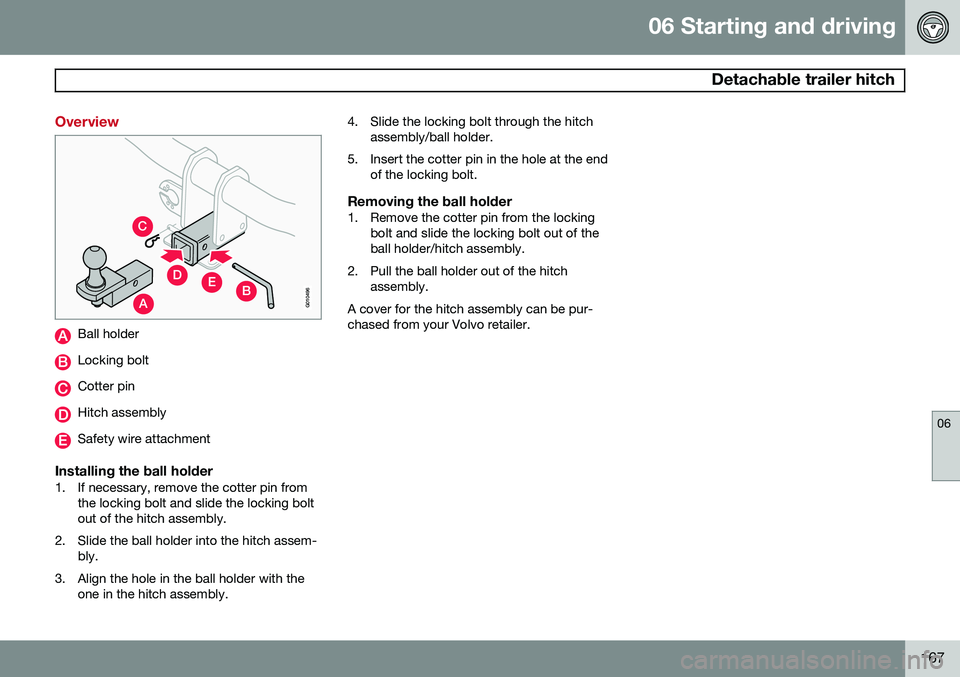
Overview
A
C
EDBG010496
Ball holder
Locking bolt
Cotter pin
Hitch assembly
Safety wire attachment
Installing the ball holder1. If necessary, remove the cotter pin fromthe locking bolt and slide the locking bolt out of the hitch assembly.
2. Slide the ball holder into the hitch assem- bly.
3. Align the hole in the ball holder with the one in the hitch assembly. 4. Slide the locking bolt through the hitch
assembly/ball holder.
5. Insert the cotter pin in the hole at the end of the locking bolt.
Removing the ball holder1. Remove the cotter pin from the lockingbolt and slide the locking bolt out of theball holder/hitch assembly.
2. Pull the ball holder out of the hitch assembly.
A cover for the hitch assembly can be pur-chased from your Volvo retailer.
Page 171 of 308
06 Starting and driving
Cold weather precautions
06
169
If you wish to check your vehicle before the approach of cold weather, the followingadvice is worth noting:
• Make sure that the engine coolant con- tains 50 percent antifreeze. Any othermixture will reduce freeze protection. Thisgives protection against freezing down to–31 °F (–35 °C). See section "Coolant".
• The use of "recycled" antifreeze is notapproved by Volvo. Different types ofantifreeze must not be mixed.
• Volvo recommends using only genuineVolvo antifreeze in your vehicle's radiator.Your Volvo retailer stocks plenty of Volvoengine coolant to protect your vehicleduring cold weather.
• Try to keep the
fuel tank well filled – this
prevents the formation of condensation inthe tank. In addition, in extremely coldweather conditions it is worthwhile to addfuel line de-icer before refueling.
• The viscosity of the engine oil is impor-tant. Oil with low viscosity (thinner oil)improves cold-weather starting as well asdecreasing fuel consumption while theengine is warming up. Full synthetic0W-30 oil is recommended for driving inareas with sustained low temperatures.
• The load placed on the
battery is greater
during the winter since the windshieldwipers, lighting, etc. are used more often. Moreover, the capacity of the batterydecreases as the temperature drops. Invery cold weather, a poorly charged bat-tery can freeze and be damaged. It istherefore advisable to check the state ofcharge more frequently and spray an anti-rust oil on the battery posts.
• Volvo recommends the use of
snow tires
on all four wheels for winter driving – seesection "Wheels and tires."
• To prevent the
washer fluid reservoir
from freezing, add washer solvents con-taining antifreeze (see page 224 for thelocation of the washer fluid reservoir).This is important since dirt is oftensplashed on the windshield during winterdriving, requiring the frequent use of thewashers and wipers. Volvo Washer Sol-vent should be diluted as follows:
• Down to 14 ° F (–10 ° C):
1 part washer
solvent and 4 parts water
• Down to 5 ° F (–15 ° C):
1 part washer
solvent and 3 parts water
• Down to 0 ° F (–18 ° C):
1 part washer
solvent and 2 parts water
• Down to –18 ° F (–28 ° C):
1 part washer
solvent and 1 part water
• Use Volvo Teflon Lock Spray in the locks.
NOTE
Avoid the use of de-icing sprays as they can cause damage to the locks.
W – Winter/Wet driving mode – enhanced vehicle traction
•Mode W will only function if the gear selector is in the (
D)rive position.
• Press the button at the base of the gearselector to engage/disengage this drivingmode.
• An LED in the button will light up to indi-cate that W is engaged and this will alsobe displayed in the instrument panel (seepage 58).
• This mode may be selected for starting/moving off on slippery roads.
Page 175 of 308
06 Starting and driving
Blind Spot Information System*
06
}}
* Option/accessory, for more information, see Introduction.173
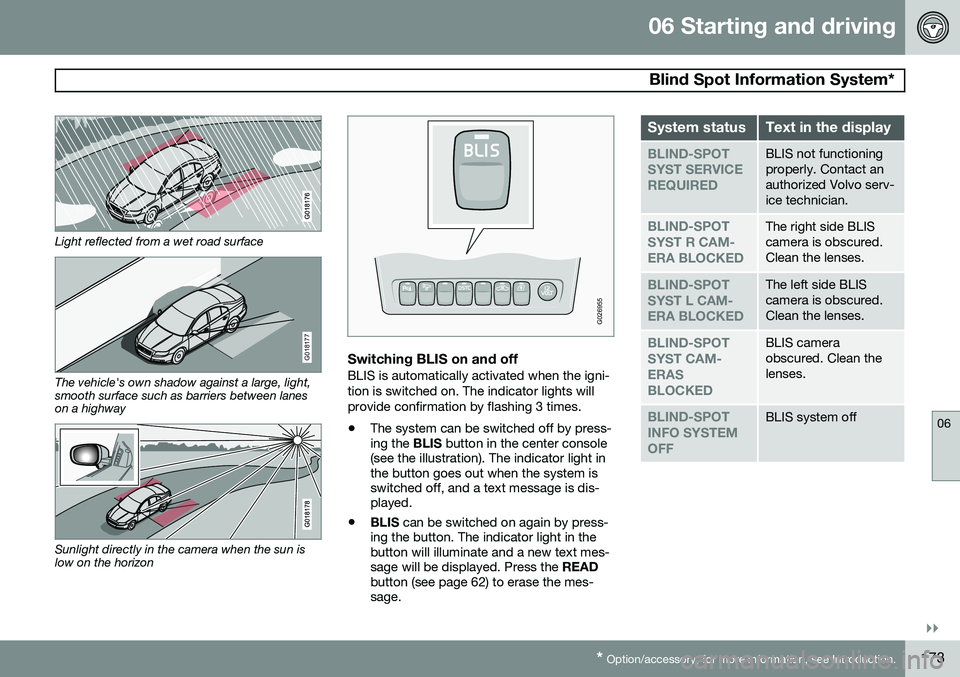
Light reflected from a wet road surface
G018177
The vehicle's own shadow against a large, light, smooth surface such as barriers between laneson a highway
Sunlight directly in the camera when the sun is low on the horizon
G026955
Switching BLIS on and offBLIS is automatically activated when the igni- tion is switched on. The indicator lights willprovide confirmation by flashing 3 times.
• The system can be switched off by press- ing the
BLIS button in the center console
(see the illustration). The indicator light inthe button goes out when the system isswitched off, and a text message is dis-played.
• BLIS
can be switched on again by press-
ing the button. The indicator light in thebutton will illuminate and a new text mes-sage will be displayed. Press the READ
button (see page 62) to erase the mes-sage.
System statusText in the display
BLIND-SPOT SYST SERVICEREQUIREDBLIS not functioning properly. Contact anauthorized Volvo serv-ice technician.
BLIND-SPOT SYST R CAM-ERA BLOCKEDThe right side BLIS camera is obscured.Clean the lenses.
BLIND-SPOT SYST L CAM-ERA BLOCKEDThe left side BLIS camera is obscured.Clean the lenses.
BLIND-SPOT SYST CAM-ERASBLOCKEDBLIS camera obscured. Clean thelenses.
BLIND-SPOT INFO SYSTEMOFFBLIS system off
Page 192 of 308
07 Wheels and tires
Snow chains, snow tires, studded tires
07
190
Snow chains
Snow chains can be used on your Volvo with the following restrictions:• Snow chains should be installed on front wheels only. Use only Volvo approvedsnow chains.
• If accessory, aftermarket or "custom"tires and wheels are installed and are of asize different than the original tires andwheels, chains in some cases CANNOTbe used. Sufficient clearances betweenchains and brakes, suspension and bodycomponents must be maintained.
• Some strap-on type chains will interferewith brake components and thereforeCANNOT be used.
• All Wheel Drive models: Snow chainsshould only be installed on the frontwheels.
• Certain size tires may not allow theassembly of snow chains/traction devi-ces.
Consult your Volvo retailer for additional snow chain information.CAUTION
• Check local regulations regarding the use of snow chains before installing.
• Always follow the chain manufactur-er's installation instructions carefully.Install chains as tightly as possible andretighten periodically.
• Never exceed the chain manufactur-er's specified maximum speed limit.(Under no circumstances should youexceed 31 mph (50 km/h)).
• Avoid bumps, holes or sharp turnswhen driving with snow chains.
• The handling of the vehicle can beadversely affected when driving withchains. Avoid fast or sharp turns aswell as locked wheel braking.
Snow tires, studded tires 1
Tires for winter use:
•
Owners who live in or regularly commute through areas with sustained periods ofsnow or icy driving conditions arestrongly advised to fit suitable winter tires to help retain the highest degree of trac-tion.
• It is important to install winter tires on allfour wheels to help retain traction duringcornering, braking, and accelerating. Fail-ure to do so could reduce traction to anunsafe level or adversely affect handling.
• Do not mix tires of different design as thiscould also negatively affect overall tireroad grip.
• Winter tires wear more quickly on dryroads in warm weather. They should beremoved when the winter driving seasonhas ended.
• Studded tires should be run-in300-600 miles (500-1000 km) duringwhich the vehicle should be driven assmoothly as possible to give the studsthe opportunity to seat properly in thetires. The tires should have the samerotational direction throughout their entirelifetime.NOTE
Please consult state or provincial regula- tions restricting the use of studded wintertires before installing such tires.
1
Where permitted
Page 198 of 308
07 Wheels and tires
Tire Sealing System
07
196
system’s compressor. If necessary, release air from the tire by turning the airrelease knob counterclockwise.
CAUTION
The compressor should not be used for more than 10 minutes at a time to avoidoverheating.
WARNING
If you interrupt your trip for more than 1 hour, check the inflation pressure in thedamaged tire again before continuing.
Replacing the sealing compound container
The sealing compound container must be replaced if:• the tire sealing system has been used to repair a tire
• the container’s expiration date haspassed (see the date on decal).
NOTE
• After use, the sealing compound bot- tle, the hose, and certain other systemcomponents must be replaced. Pleaseconsult your Volvo retailer for replace-ment parts.
• If the sealing compound bottle’s expi-ration date has passed, please take itto a Volvo retailer or a recycling stationthat can properly dispose of harmfulsubstances.
Inflating tires
The tire sealing system can be used to inflate the tires. To do so:
1. Park the car in a safe place.
2. The compressor should be switched off.
Ensure that the on/off switch is in position 0 (the 0 side of the switch should be
pressed down).
3. Take out the electrical wire and hose.
4. Remove the valve cap from the tire’s inflation valve and screw the hose con- nector onto the valve as tightly as possi-ble by hand.
5. Connect the electrical wire to the nearest 12-volt socket in the vehicle. 6. Start the vehicle’s engine.
WARNING
•
The vehicle’s engine should be running when the tire sealing system is used toavoid battery drain. Therefore, be surethe vehicle is parked in a well ventilatedplace, or outdoors, before using thesystem. The parking brake should besecurely applied and the gear selectorshould be in the
P (park) position.
• Children should never be left unatten-ded in the vehicle when the engine isrunning.
7. Check the tire’s inflation pressure on the
gauge. Switch off the compressor briefly to get a clear reading from the pressuregauge.
8. Refer to the tire inflation tables for the correct inflation pressure. If the tire needsto be inflated, start the tire sealing sys-tem’s compressor (press the on/offswitch to position I). If necessary, releaseair from the tire by turning the air releaseknob counterclockwise.
Page 200 of 308
07 Wheels and tires
Changing wheels
07
198
G030879
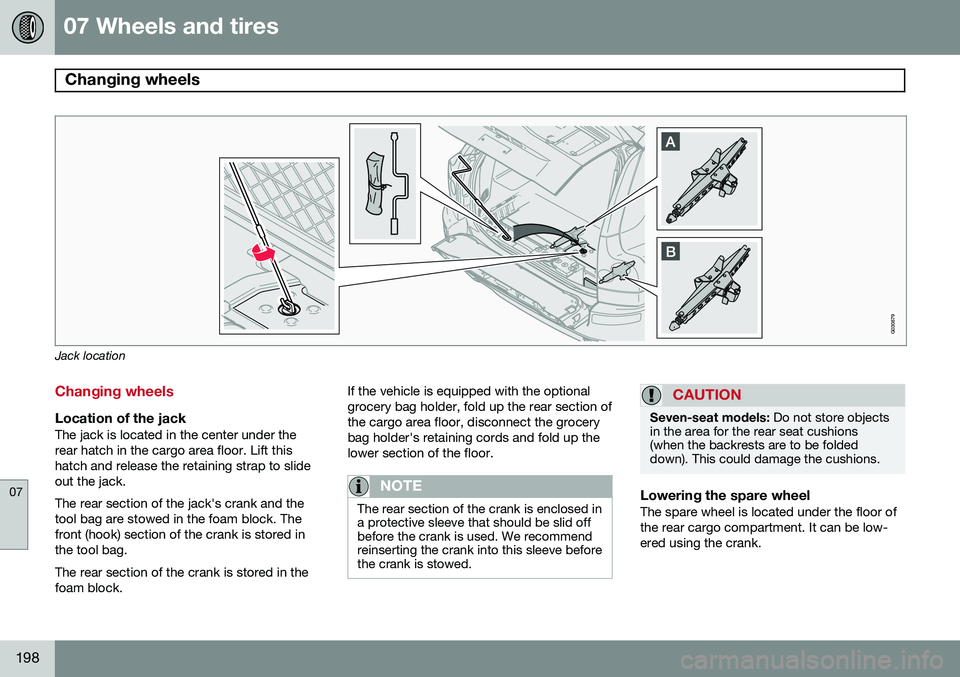
Jack location
Changing wheels
Location of the jackThe jack is located in the center under the rear hatch in the cargo area floor. Lift thishatch and release the retaining strap to slideout the jack. The rear section of the jack's crank and the tool bag are stowed in the foam block. Thefront (hook) section of the crank is stored inthe tool bag. The rear section of the crank is stored in the foam block.If the vehicle is equipped with the optionalgrocery bag holder, fold up the rear section ofthe cargo area floor, disconnect the grocerybag holder's retaining cords and fold up thelower section of the floor.
NOTE
The rear section of the crank is enclosed in a protective sleeve that should be slid offbefore the crank is used. We recommendreinserting the crank into this sleeve beforethe crank is stowed.
CAUTION
Seven-seat models:
Do not store objects
in the area for the rear seat cushions (when the backrests are to be foldeddown). This could damage the cushions.
Lowering the spare wheelThe spare wheel is located under the floor of the rear cargo compartment. It can be low-ered using the crank.
Page 201 of 308
07 Wheels and tires
Changing wheels
07
199
WARNING
When raising or lowering the spare wheel, please keep in mind that components inthe exhaust system may be very hot.
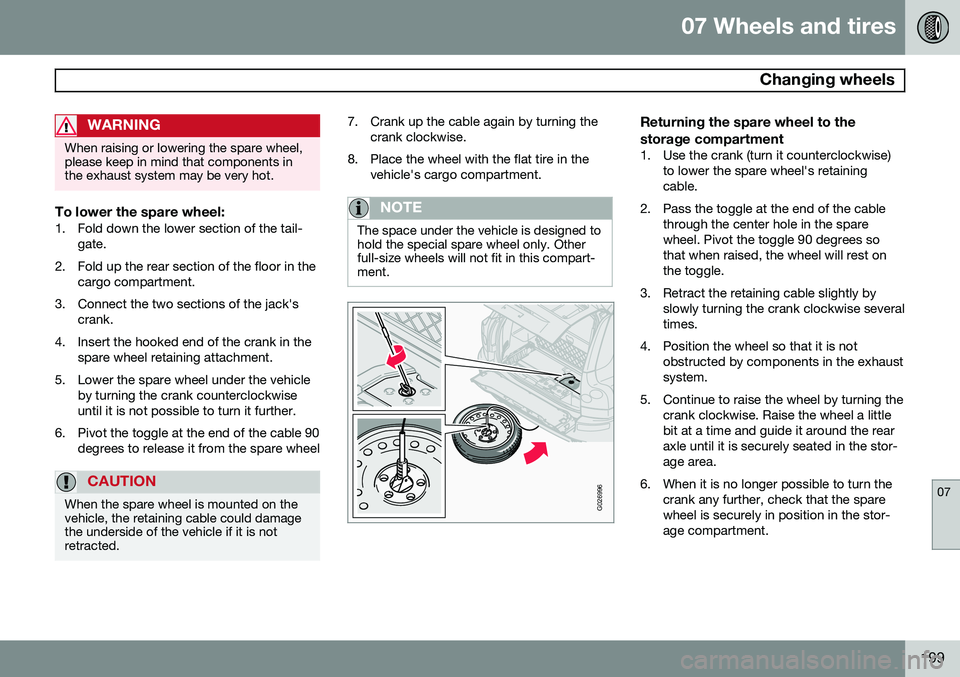
To lower the spare wheel:1. Fold down the lower section of the tail-gate.
2. Fold up the rear section of the floor in the cargo compartment.
3. Connect the two sections of the jack's crank.
4. Insert the hooked end of the crank in the spare wheel retaining attachment.
5. Lower the spare wheel under the vehicle by turning the crank counterclockwise until it is not possible to turn it further.
6. Pivot the toggle at the end of the cable 90 degrees to release it from the spare wheel
CAUTION
When the spare wheel is mounted on the vehicle, the retaining cable could damagethe underside of the vehicle if it is notretracted.
7. Crank up the cable again by turning thecrank clockwise.
8. Place the wheel with the flat tire in the vehicle's cargo compartment.
NOTE
The space under the vehicle is designed to hold the special spare wheel only. Otherfull-size wheels will not fit in this compart-ment.
G026996
Returning the spare wheel to the storage compartment
1. Use the crank (turn it counterclockwise) to lower the spare wheel's retaining cable.
2. Pass the toggle at the end of the cable through the center hole in the sparewheel. Pivot the toggle 90 degrees sothat when raised, the wheel will rest onthe toggle.
3. Retract the retaining cable slightly by slowly turning the crank clockwise severaltimes.
4. Position the wheel so that it is not obstructed by components in the exhaustsystem.
5. Continue to raise the wheel by turning the crank clockwise. Raise the wheel a littlebit at a time and guide it around the rearaxle until it is securely seated in the stor-age area.
6. When it is no longer possible to turn the crank any further, check that the sparewheel is securely in position in the stor-age compartment.
Page 202 of 308
07 Wheels and tires
Changing wheels
07
200
G026997
Jack attachment points
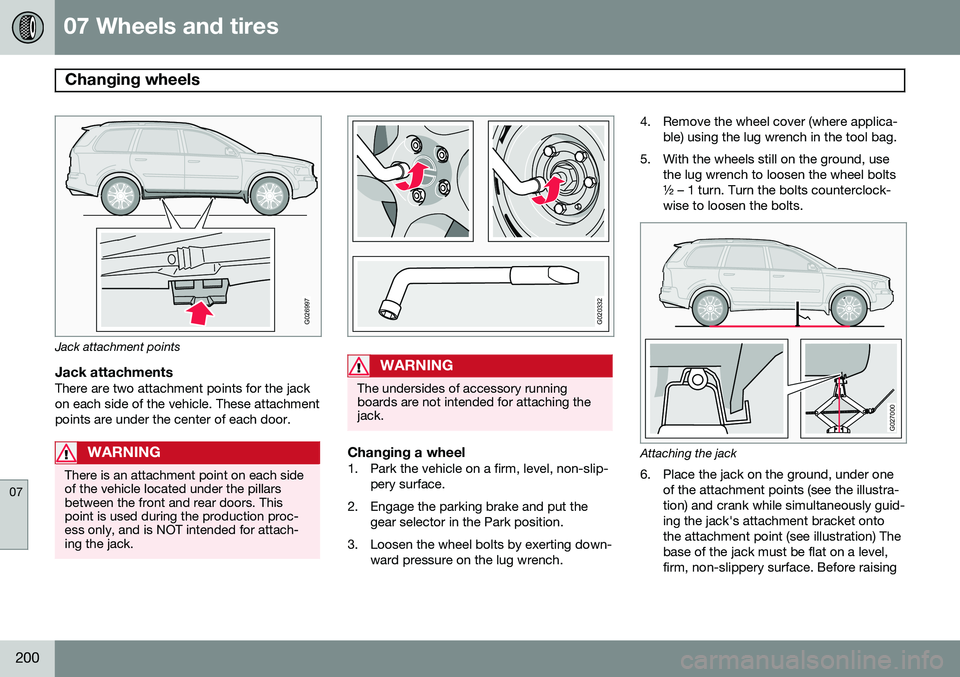
Jack attachmentsThere are two attachment points for the jack on each side of the vehicle. These attachmentpoints are under the center of each door.
WARNING
There is an attachment point on each side of the vehicle located under the pillarsbetween the front and rear doors. Thispoint is used during the production proc-ess only, and is NOT intended for attach-ing the jack.
G020332
WARNING
The undersides of accessory running boards are not intended for attaching thejack.
Changing a wheel1. Park the vehicle on a firm, level, non-slip-pery surface.
2. Engage the parking brake and put the gear selector in the Park position.
3. Loosen the wheel bolts by exerting down- ward pressure on the lug wrench. 4. Remove the wheel cover (where applica-
ble) using the lug wrench in the tool bag.
5. With the wheels still on the ground, use the lug wrench to loosen the wheel bolts ½ – 1 turn. Turn the bolts counterclock-wise to loosen the bolts.
G027000
Attaching the jack
6. Place the jack on the ground, under oneof the attachment points (see the illustra- tion) and crank while simultaneously guid-ing the jack's attachment bracket ontothe attachment point (see illustration) Thebase of the jack must be flat on a level,firm, non-slippery surface. Before raising